30 Apr 2006

GE buzz on Web

From Today Online
Weekend • April 29, 2006

WHO says Singaporeans are apolitical? The buzz on the Internet about the Singapore election should dispel all such talk.

According to a report by Nexlabs, an information management company which scanned election related postings on the Internet, there have been about 1,200 reports on GE 2006 published on blogs since January.

Since the Election Writ was issued the week before, the volume of postings about the election has also gone up. The week before the Writ was issued, about 280 related postings were tracked on blogs over six days; after the Writ was issued, over 400 postings were tracked in the six days that followed.

The most prolific of all the blogs is www.singabloodypore.blogspot.com, which, as of Thursday, had posted 232 articles since the beginning of this year.

The issue of an open society was the most widely discussed election theme on blogs, making up almost 18 per cent of all articles and postings about GE 2006. This differed from issues news websites focused on — defamation suits and the National Kidney Foundation scandal. The most commonly discussed Group Representation Constituency (GRC) on blogs is Sembawang GRC , while the most oft-mentioned Single Member Constituencies were the two Opposition-held wards of Potong Pasir and Hougang. — LIN YANQIN


Call to Action - Letter to the Editor

Someone has generously provided a well written letter. You might want to consider attaching your name to it and sending it to CNA.

Dear Editor,

I have just been to your website and am disappointed that your media is taking the liberal opportunity of presenting pro-PAP news features at the expense of the opposition, which doesn't do much to reduce the very widespread perception that your media company is a propaganda tool of the ruling party.

A quick glance of your homepage shows about 12 stories dedicated to the PAP's promotional campaigning while stories of the Opposition parties number a paltry few. Your "jumping" on the PAP bandwagon on defining the Opposition parties along the James Gomez minority form fiasco and the pending defamation lawsuits involving the SDP have not gone unnoticed.

Singapore Inc. has acquired a notorious reputation overseas in terms of its repressive political and social environment, having become bedfellows with some of the most oppressive regimes in the world including Burma, Saudi Arabia and China. Perhaps it may be a good strategic policy for your media to move away from your affinity with the establishment and move towards establishing yourself as a credible, independent media that peoples of the world can come to admire.

I am a member of your target audience group (the PMEBs) and I know that many of us having travelled widely and being educated, sophisticated world citizens are no fools in discerning and recognising the blatant bias in the reporting in your media.

-----------------------------------

MediaCorp News Hotline 68 2222 68

Channelnewsasia.com
Give us your feedback on our content.
Contact: newseditor@channelnewsasia.com

Rally at Ubi field


More outstanding work from Yawning Bread...

This is a part of a screenshot of 'Today' newspaper, 28 April 2006. It informed the public that there would be 2 election rallies in the evening for Aljunied Group Representation Constituency (GRC).
The People's Action Party would be holding theirs at a comfortable sports stadium about 700 metres from Serangoon metro station, walking along paved roads. The stadium would have seats.

The Workers' Party was allocated a rough field in a mixed industrial and residential area, about 1.2 km from Eunos metro station, with no easy walking approach. The Pan-Island Expressway lies midway between the station and the field. Only one bus service goes there.

I chose Ubi field. I only had an hour or so, as I had a ticket for the Film Festival's 'Angry Monk' at 21.15h. But I should be able to grab some photos, I told myself.

Then it started to rain.


Singapore Election 2006: Party Political Broadcast


Part 1: WP and SDA


Part 2: SDA


Part 3: PAP


Broadcast details: Political parties fielding six or more candidates in this election are eligible for party political broadcast. Airtime is in proportion to the number of the candidates fielded. This is the first of two programs, the speakers respresenting their parties are:

Mr Lee Hsien Loong, from the People's Action Party;
Mr Chiam See Tong from the Singapore Democratic Alliance;
Ms Sylvia Lim from the Workers' Party;
Ms Chee Siok Chin from the Singapore Democratic Party.

The party fielding the smallest number of candidates will appear first, the party fielding the largest number, last.


S'pore Election: Parties Speak To S'poreans Via Political Broadcasts

By Jackson Sawatan

SINGAPORE, April 30 (Bernama) -- The four contesting parties in the Singapore general election spoke to Singaporeans last night via political broadcasts aired over television and radio.

The alloted time for each party to make their political broadcasts in four languages -- English, Chinese, Malay and Tamil -- was based on the number of seats contested.

The People's Action Party (PAP), which is contesting all 84 seats, was given 12 minutes while the Workers' Party and Singapore Democratic Alliance (SDA), each with 20 candidates, were given 4.5 minutes each.

The Singapore Democratic Party (SDP), with seven candidates, was given 2.5 minutes.

In his broadcast message, Prime Minister Lee Hsien Loong said that the PAP had fulfilled its 2001 promise to create more jobs for Singaporeans.

"You gave the PAP a strong mandate. We delivered on our promise. Last year, we created 113,000 jobs -- the highest number in 10 years," he said.

He also spoke of making Singapore a land of opportunity, saying that he would put in all his energy to make it a reality.

"But I cannot do it alone. I need a strong team of ministers and MPs to help me. I need honest, capable and committed men and women who feel passionately about Singapore and can draw on the ideas and energies of all Singaporeans to create our future," he said.

He promised that the PAP would educate all Singaporeans to be the best that they could be, involve the people in building the country and help lower-income households and to have more affordable health care services.

He said that the PAP candidates were the best team for Singapore.

Workers' Party chairman Sylvia Lim criticised what she claimed as the selective implementation of upgrading projects for constituencies.

"Why we came forth? Amongst many other issues is one that clearly threatens to split the fabric of our nation. This is the use of taxpayers' money to selectively upgrade constituencies that vote for the PAP," she said.

Calling that strategy a threat to the voters, Lim said that the PAP used public funds to entrench and promote the party through public-funded grassroots organisations. "Is this a First World government?" she asked.

SDA chairman Chiam See Tong urged the voters to deny the PAP -- which has already won 37 seats in seven Group Representation Constituencies (GRC) -- a clean sweep.

"We need a multi-party system in Singapore to ensure that democracy survives... A vibrant and cosmopolitan Singapore needs creativity of the mind and innovation. All these can only flourish in an atmosphere of freedom and an environment where there is no fear -- the people's mind can be most creative and most productive," he said.

SDP made comparison of the salaries the ministers earn and the thousands of Singaporeans it said were not able to pay their utility bills or afford to buy their own flats or rent homes.

"The PAP ministers are paid S$100,000 a month -- the highest in the world," SDP member Chee Siok Chin said. The next and final political broadcasts is on Thursday.

-- BERNAMA


Call to Action

The comment below was submitted by an anonymous reader and I thought it deserved your attention.

Please call mediacorp as [a] member of the public to say how disgusting we find the misrepresentation of the non-PAP parties during their coverage of the election.

If everyone [of] us calls, they will change. Trust me. Many of the reporters WANT to report the TRUTH! However, they are stopped by their bosses.

We are Professionals & thinking people, [we] must do our part by giving them pressure from all sides. [If] enough pressure and professional support [is raised], the reporters will have call in figures to back their desire to want to report the TRUTH.

Many reporters are on our side, many policemen are on our side, they are Singaporeans too. We can support them by calling in & writing in.

Let's give them tons of calls and emails to press for TRUTH. We can make a difference. Each call can make a difference.

MediaCorp News Hotline 68 2222 68

Feedback
Channelnewsasia.com
Give us your feedback on our content.
Contact: newseditor@channelnewsasia.com

What are you waiting for.....pick up the phone and call, logon and email. Give them support to report the TRUTH and nothing but the TRUTH.

Some reporters said they hate the censor and want to resign, they need our support, they need our encourgement, they need to hear from us to know that they are not fighting alone against their bosses.

By Anonymous,


SDA candidate Steve Chia says govt not transparent on NKF, reserves

Singapore Democratic Alliance's (SDA) Steve Chia, who is contesting Chua Chu Kang, has accused the PAP government of not being transparent.

He was referring to what had happened at the NKF.

"If TT Durai did not sue SPH (Singapore Press Holdings), let me ask you, will our PAP ministers still be praising the NKF, Mr TT Durai and urging people to continue donating to the old NKF? If TT Durai did not sue SPH, would they, our world class ministers, know all the wrongdoings in NKF?” challenged Steve Chia, SDA candidate for Chua Chua Kang.

"Our world class ministers are led blindly by a charity organisation. It is an honest mistake and the ministers say we were all conned by them and apologised. Is that all? When the government makes mistakes, they apologise. Don't you think more should be done?" asked Mr Chia

Meanwhile, speaking at an SDA rally at Tampines Stadium on Saturday evening, the party's candidate for the single seat of Yio Chu Kang Mr Yip Yew Weng said the SDA is not out to form the next government.

They goal is to check on the government formed by the PAP.

"In this election, we are not aiming to form the next government. Our 20 candidates are not enough to form the government so that's not an issue. What we aim to do is keep an eye on the PAP to ensure they govern Singapore well. Let the PAP form the government, let them distribute the money. But nobody is perfect and the NKF is a case in point. We must not let such an incident take place again," said Yip Yew Weng, SDA candidate for Yio Chu Kang.

- CNA /ls


SDA's Chiam See Tong rebuts NCMP suggestion

By Rita Zahara, Channel NewsAsia

SINGAPORE : The chairman of Singapore Democratic Alliance Chiam See Tong has rebutted National Development Minister Mah Bow Tan's suggestion that he should be voted into Parliament as a Non-Constituency MP.

Mr Chiam, who has served as MP for Potong Pasir for the past 22 years, said he would not be able to help the residents and meet their needs if he is relegated to just keep a check on the PAP in Parliament.

Mr Mah had criticised Mr Chiam's two-in-one formula, in which the SDA leader urged residents to vote opposition candidates into Parliament so they would get the services of both the opposition MPs as well as the aspiring PAP candidates, who would work extra hard to win them over.

Turning the tables against him, Mr Mah had said residents in Potong Pasir will still benefit from the services of two representatives if they vote for Mr Sitoh Yih Pin, as Mr Chiam can come in as a Non-Constituency MP.

Mr Chiam said: "One very basic thing he does not know is that a Non-Constituency MP has got no constituency to look after. How can I help the constituency ... if I am selected as a NCMP? I don't think he knows what he is talking about." - CNA/de

SINGAPORE: HAMSTRUNG OPPOSITION HAS NO CHANCE IN ELECTIONS

(English IPS News Via Thomson Dialog NewsEdge)by Marwaan Macan-Markar

BANGKOK, Apr. 28, 2006 (IPS/GIN) -- The three opposition parties fielding candidates in Singapore's May 6 legislative election have little chance of winning against the People's Action Party (PAP), which has ruled with an iron grip since 1959.

The PAP's return to power in Southeast Asia's richest country is a foregone conclusion. But opposition groups like the Workers' Party, the Singapore Democratic Party (SDP) and the Singapore Democratic Alliance (SDA) fielded enough candidates to force a contest in more than half the seats in the 84-member legislature. The PAP was sole contestant in 37 other seats.

The government of Prime Minister Lee Hsien Loong is attempting to silence opposition voices and prevent customary pre-election debates by preventing opposition parties from campaigning.

In that way, Singapore and its supposed democracy is no different in spirit and intention to what is on display in Laos. Opposition voices in Laos have been denied a space to argue their case in the April 30 elections for the country's 119-member national assembly, being held a year ahead of schedule.

"The people of Laos have no right to present their independent and opposition party's ideas," Wangyee Vang, secretary general of the U.S.-based Laos National Federation for Peace, Democracy and Prosperity, said on the group's Web site soon after the Communist Party of Laos, which has run the country since 1975, announced plans for the April poll.

In February 2002, during the last elections for the Laotian national assembly, all but one of the 166 candidates were from the ruling party.

The Paris-based Reporters Without Borders (or RSF) ranked both Singapore and Laos among the bottom 20 of 167 countries reviewed in its 2005 survey on the right to free expression, a cornerstone of any democracy. While Singapore came 140th, Laos was the 155th. The ranking was similar the year before.

"Despite being far advanced in the use of new technologies, Singapore is still in the Middle Ages when you look at the way it deals with freedom of expression in cyberspace," Philippe Latour, RSF's Southeast Asia representative, told IPS. "For the current electoral campaign bloggers and Web site managers do not have the right to back a particular candidate's program. It (Singapore) is no better than Laos or Vietnam in this regard."

The plight of the opposition SDP and its leader, Chee Soon Juan, is a case in point. The Singaporean government has banned Chee's views criticizing the PAP from being broadcast on the SDP's Web site and has cracked down on the SDP for the opinions expressed in its party newspaper, The New Democrat. In addition, police repeatedly harass Chee.

Singapore's founding father, former prime minister Lee Kuan Yew, and his successor, former premier Goh Chok Tong, pursued a strategy favored by the country's ruling elite to silence dissent -- bankrupting the dissenter through legal suits. Chee became the target early this year with a defamation case filed against him by Lee and Goh demanding $500,000 in damages.

The government also has banned Chee, a neuropsychologist educated in Singapore and the United States, from speaking in public ahead of the election. The ban also holds true for groups who try to read in public any speeches written by Chee.

The PAP currently controls 82 of the 84 seats in the Singapore legislature.

"This is a new policy. It is part of the effort to control freedom of expression because the PAP is worried about criticism and the questions the public will raise, particularly the young voters," Sinapan Samydorai, president of Think Center, a Singapore-based non-governmental group, told IPS in a telephone interview. "The opposition cannot use blogs, the Internet, podcasts, the entire electronic media during the election period."

Lee Hsien Loong, the leader of the PAP, inherited the post without an electoral contest in August 2004 when Goh stepped down. Lee is the son of the country's founding father, who transformed Singapore from a developing country to a developed one by ensuring that the PAP dominated the government with able support from the supine judiciary and media.

"The political system here is as fair as you can find in any country in terms of your being able to stand up, to have a view, to organize, to mobilize and participate, and not need a lot of money or lot of power to get moving," Lee was quoted by The Straits Times, a government-controlled daily, this week. "You just need good people and passion, and you can win."

He will have to do more than that to convince the Alliance for Reform and Democracy in Asia, an organization of democracy activists, which has given Singapore a failing grade in its 2005 Asia Democracy Index (ADI).

"Singapore ranks second from the bottom, just one place higher than Myanmar (Burma)," states the index, which studied the climate for civil rights, elections, governance, media, rule of law and public participation in 16 Asian countries. These included Japan, Bangladesh, the Philippines, Thailand, South Korea, Cambodia, Pakistan and Malaysia.


"This may surprise many who are not familiar with the island-state's politics," it adds. "Yet, the results of the ADI dispels the myth and shows Singapore for what it really is, a highly repressive society."


29 Apr 2006

Workers Party Rally Videos


Chiam See Tong (SDA)

Gopal Krisnan

Arrival of Sylvia Lim

Eric Tan

Low Thia Khiang introduces Aljunied GRC WP candidates

James Gomez


To save these videos visit


These videos were first spotted on Singapore Election Watch


SDP chairman flip-flops over ousting Chee

I really got to add that this seems to be the ONLY press the SDP is getting during the current elections. Dr Chee needs to get those podcasts out now and circumvent the PAP controlled mass media, whether it is illegal or not is rapidly becoming unimportant. The international press is listening and this is all they hear...

SINGAPORE: SDP chairman flip-flops over ousting Chee
Chairman accuses media of discrediting the Singapore Democratic Party

Straits Time
Friday, April 28, 2006


By Chua Chin Hon

At 11 a.m. yesterday, Singapore Democratic Party (SDP) chairman Ling How Doong was going on about how he was 'angry and disappointed' with the way Dr Chee Soon Juan ran the party and got members dragged into a lawsuit.

He even told reporters that he and fellow SDP leader Wong Hong Toy had wanted to oust Dr Chee a few weeks ago but failed to marshal support.

'You didn't read that report when we told the Chinese press we said we intended to remove him?' Mr Ling asked shortly after arriving at Fajar Secondary School, the nomination centre for the single-seat Bukit Panjang ward.

But several hours later, in the afternoon, he did an about-face. In a joint statement with Dr Chee, the two SDP leaders said media reports on how Mr Ling wanted Dr Chee sacked 'is completely untrue' and accused the media of discrediting the SDP even before the hustings began.

'The SDP stands united in this election amd is determined to speak up for the people,' the statement read.

It was a far cry from what Mr Ling told reporters when he turned up with supporters to file his papers in the morning.

He noted press reports in which Dr Chee was decribed as running a 'one-man show', adding: 'I can't agree more.'

Mr Ling also said that he disagreed with Dr Chee on 'a lot of things', including the party newsletter, which he had no hand in.

Asked whether he would quit the SDP or switch political parties if he was so unhappy, he said: 'I've been standing for elections since 1984, and I've no reason to pack up because someone made a boo-boo.'

Over at Hotel Asia where the SDP was having a press conference, its first for this General Election, Mr Ling was conspicuously absent.

When asked about Mr Ling's comments on wanting to oust him, Dr Chee said: 'I don't want to be entertaining all these reports.'

Pressed further, he said he had called Mr Ling but the SDP veteran could not speak as he was driving. 'But those with him said there was no such thing. Let me sort this out and then we'll take it when it comes.'

Asked why Mr Ling was not present, Dr Chee said that the press conference was intended for the introduction of the Sembawang slate only.

As for the assertion that he ran a 'one-man show', he replied: 'The people sitting here, many of them are in the CEC. If the whole situation rests on the fact that this is a one-man show, I don't see how we can get these things done.'

He told reporters that during the nine-day campaigning period, the SDP will focus on issues like the National Kidney Foundation (NKF) scandal, income disparity and rising cost of living.

These issues had 'tremendous significance' for ordinary Singaporeans, he said, but offered no concrete solutions when asked how his party would go about lowering the cost of living.

As for the lawsuit filed by Prime Minister Lee Hsien Loong and Minister Mentor Lee Kuan Yew, he said it had affected the party's campaign logistics as the printer was afraid to print his posters.

Asked if it would also affect how voters viewed the SDP team, he said: 'A lawsuit is a lawsuit. This campaign is separate from that.'

But would the SDP be able to convince Sembawang voters to separate the two? He replied: 'We tell the voters that it is important for you to concentrate on what is going to happen right now and the PAP is trying to distract you.'

Additional reporting by Ben Nadarajan, Aaron Low and Azrin Asmani


Lee Defends Policy, Calling Singapore Politics `A Rough Game'

2021 Signatures of Singaporeans disagree MM Lee

To: The Secretary-General of the People's Action Party
We are concerned about the linking of public housing upgrading and estate renewal programmes to electoral support for the PAP in a constituency.

The prioritisation of upgrading programmes should be based on sound criteria and be kept a separate issue from the general election.

These are the reasons:

1) In selecting a precinct for upgrading, the age and condition of the estate and the flats should be foremost considerations. As national agencies, the HDB and the MND have the responsibility to improve the living environment of all Singaporeans.

2) Residents in the opposition wards are fellow citizens and they contribute to this country just like you and me. It is against national cohesion and irresponsible for the government to alienate them by denying them of upgrading programmes and public amenities in their constituencies. The people of Singapore certainly have not entrusted the PAP government to misuse public funds to advance its self-interests.

3) It is important not to turn our parliamentary elections into local council contests. The government should be elected based on their policies and plans for Singapore - not municipal issues. To intimidate voters with withholding upgrading programmes seems to suggest that the ruling party is trying to avoid serious debates on national policies.

The elected government of the day should work for and together with all Singaporeans transcending political factions. The provision of upgrading programmes and public amenities must not be dominated by narrow party self-interests.

We, the undersigned, request that the vote in a general election not be linked to upgrading programmes.

Sincerely,

The Undersigned

Click here to Sign the Petition


View Current Signatures

Lee Defends Policy, Calling Singapore Politics `A Rough Game'
April 29 (Bloomberg) -- Lee Kuan Yew, modern Singapore's founder, defended a government policy that prioritizes housing renovations for its own supporters, saying that reversing the practice may loosen the ruling party's four-decade hold on power.

``Where it is upgrading and it is by constituency, surely it is the principle of government to do the upgrading first in the constituencies that supported them,'' Lee, who holds the post of minister mentor, said late yesterday. If districts held by the opposition were renovated first, ``why should our constituents vote for us the next time around?''

Singapore's People's Action Party has changed the island from a trading backwater to the region's second-richest nation per capita after Japan. The party, which has been in power since before the country won independence in 1965, is seeking to extend its rule in an election May 6. Still, opposition groups this week mustered enough candidates to challenge the government in the polls for the first time since 1988.

Lee, answering questions after dinner at the Foreign Correspondents Association in Singapore, said improving democracy and fostering a free press weren't priorities for the city-state's 4.3 million voters.

``If you watch what happens in the election, nobody talks about freedom of the press, more democracy etc.,'' Lee said. ``They are talking about the cost of living, cost of transport, cost of electricity, power, and wages not catching up. That's what the daily grind of life is about. We're going to win this election because we've got the answers.''

Policies

The government currently holds 82 of the 84 directly elected parliamentary seats. The People's Action Party, led by Lee's son, Prime Minister Lee Hsien Loong, was uncontested in 37 of the seats on nomination day on April 27.

The housing-renovation policy has been questioned at least twice in public this week. At a debate at the National University of Singapore on April 26, Arhshath Kaleni, a 17-year- old student, told lawmaker Indranee Rajah that any work should be completed based on the need of the buildings, not on how the constituents voted.

The policy penalizes people for exercising their choice, Kaleni said. The government ``should represent the collective population without this bias,'' he said. About 80 percent of Singapore's population lives in such housing.

Critics of Singapore's political system include Human Rights Watch and billionaire George Soros, who have argued that the government places unnecessary curbs on civil rights and lawsuits against political opponents have harmed freedom of speech.

Developing

Lee said yesterday that Singapore's society will develop ``at our own pace and in our way.''

Asked whether an unrestricted media would help, Lee said ``if I believed that a free press would create a more self- reliant and creative opposition, I would seriously consider that.''

He said the challenges for Singapore include narrowing the gap between the rich and the poor, and remaining competitive in the shadow of India and China, the world's two largest populations. Lee said he, not foreign countries or their media, knows best how to meet those challenges.

``There are very few things that I do not know about Singapore politics,'' said Lee. ``I know what would work here.''

Lee said he was unwilling to participate in a televised debate with Singapore's opposition parties, which include the Workers' Party and the Singapore Democratic Party. To do so would give them pre-election publicity that they're unable to generate on their own, he said.

``We are happy to meet anybody, after the votes have been cast,'' he said.

Singapore Democratic Party leader Chee Soon Juan said April 26 that ``fear'' of repercussions was hampering the development of a political opposition. Lee yesterday said the opposition is able to win seats in parliament, though will need to field higher quality candidates.

``I want a world-class opposition, not this riff-raff,'' he said. ``You've got to be rough. This is a rough game.''

Chee is being sued for defamation by Prime Minister Lee and Lee Kuan Yew for statements made in his party's newspaper earlier this month.

Yesterday the elder Lee said Chee, who can't stand for this year's election because he is bankrupt, has been ``discredited'' and was unlikely to return to the political arena. Chee lost a defamation suit filed during a 2001 election and was ordered to pay S$500,000 ($315,000) in damages to the elder Lee and former Prime Minister Goh Chok Tong.

``Having got rid of what I would call gutter politics,'' Singapore has the opportunity ``to start off on a new basis,'' Lee said.


To contact the reporter on this story:
Angus Whitley in Singapore at awhitley1@bloomberg.net


The (In)significance of Elections in Singapore?


Who cares, and how the elections provide political legitimacy for the PAP, thats it...


28 Apr 2006

Nomination Day in Photos by Yawning Bread

Below is a very brief excerpt from Yawning Breads photo essay on nomination day. Nice to get an alternative take, rather than the CNA we love the PAP coverage.


More supporters of the Workers' Party. Some of their colleagues didn't want to be in the picture.

When I approached them, they immediately asked me if I was from the mainstream media. Only when they were convinced of my denials did they agree to pose. I wondered why.

After the shot, they enquired which website it would be on. I soon realised that none of them had ever heard of Yawning Bread. Out of curiosity, I asked if they knew of other sites like Singapore Ink, Singabloodypore, Mr Wang, etc. Zilch. None of them recognised any of those names.

Somewhere in there may be an indicator of how the party is not yet able to exploit new media.

But these folks have the courage to wear the opposition's colours and show up at the Nomination Centre, even if they'd be outnumbered 50:1 by the PAP. Think about that.


Can we nominate Yawning Bread for the Pulitzer Prize?

Opposition party ordered to withdraw podcast from website

Reporters Without Borders today accused the Singaporean government of placing increasing curbs on online free expression after the electoral authorities ordered the opposition Singapore Democratic Party (SDP) to withdraw a podcast from its website on Wednesday, 10 days before parliamentary elections.

“A new form of protest on the Internet and in blogs is emerging in Singapore,” the press freedom organisation said. “Internet users aware of the latest technologies are daring to say things online which one has never been able to read in the local newspapers. Podcasts are the only way to hear the speeches of opposition leaders, who have few opportunities to speak publicly. We support the Internet users and bloggers fighting for free expression in Singapore.”

The speech by SDP leader Chee Soon Juan can still be downloaded from the party’s site at http://www.sgdemocrat.org/radioSDP/GE2006_PC1.mp3, while a transcript is available at this blog : http://www.singabloodypore.blogspot.com/. In it, Chee accuses Prime Minister Lee Hsien Loong and the government of sabotaging his election campaign and trying to undermine his party by denying it the means to communicate with its supporters.

Chee says he is constantly being followed, watched and threatened by the police and has not been allowed to make any public speeches. The SDP lawyer claims that the podcast ban is unconstitutional, even during an election campaign.

At the start of this month, Reporters Without Borders condemned the new Internet regulations that have just been adopted by the government. They force websites that openly espouse a political position to register with the Media Development Authority. During an election campaign, even registered sites must now refrain from posting any political comments. The government says this is necessary in order to have a “responsible” election campaign.

As the traditional media are unfailing in their support for the People’s Action Party, which has ruled the city-state since independence in 1959, the Internet offers the only space where a real democratic debate could be held.


Mr Lee or PM Lee?

quzy of quiescente queste has raised an extremely important point by stating
Correct me if I'm wrong, but since Parliament has been dissolved on 21 April, shouldn't all Cabinet apppointments be expired as well? Yet CNA has been consistently using appointment titles like MM Lee, PM Lee and SM Goh.

It's notable that election officers at the nomination centres correctly used Mr, Ms, and Dr when announcing candidate names.


This matter should be clarified by the election officers, but then again I feel that as they are not independent this seems unlikely to happen. What it does indicate is the open bias in favour of the PAP of Channel News Asia. Just look at the opening paragraphs and headline of the latest article on Mr Lee Hsien Loong.

PM Lee begins campaigning at Ang Mo Kio GRC
By Asha Popatlal, Channel NewsAsia

SINGAPORE : With 47 seats being contested in the upcoming General Election, political candidates were out busy canvassing for votes from the constituents a day after Nomination Day.

Among them was Prime Minister Lee Hsien Loong, who last faced a contest 18 years ago.

There were a few surprised faces but mostly smiles when the early morning crowd in Ang Mo Kio encountered the Prime Minister during his morning walkabout.

One of his first stops was the MRT station where he greeted people queuing for a copy of their "TODAY" newspaper and others rushing to work.

Mr Lee has been with the Teck Ghee ward since he joined politics but this is the first time he is facing a contest since 1988.

And he is not making light of this challenge.

PM Lee said: "I'm taking it quite seriously otherwise I would not be here."


Is it PM Lee or Mr Lee since Parliament has been dissolved?


27 Apr 2006

Local media waging a campaign against SDP

According to Singapore Elections Watch this reply has been issued by Dr Chee and Ling How Doong. If this rebuttal is true and was issued by the Singapore Democrats it raises some serious questions about the 'journalist' and Channel News Asia. Just who is spreading untruths, lies during the election? Who is deviating from an engagement in political debates in a factual and objective manner?

Local media waging a campaign against SDP
The reports about Mr Ling How Doong saying that Dr Chee Soon Juan should be sacked as Secretary-General of the SDP is completely untrue. The SDP stands united in this election and is determined to speak up for the people.

It looks like the media is running a campaign aimed at unfairly discrediting the SDP before the hustings can even begin. Such reportage of the SDP is not surprising. The media has consistently tried to present the worst image of the SDP because the Party has called for reform of the political system in Singapore.

The SDP’s message to voters at the Sembawang GRC and Bukit Panjang SMC is resonating and the anger of the voters at the PAP will have a significant impact on the results in these wards.

Ling How Doong
Chairman

Chee Soon Juan
Secretary-General
posted by Singapore Election


The offending article is posted below...

By Sharon Tong, Channel NewsAsia

SINGAPORE : The Singapore Democratic Party Chairman Ling How Doong says the party's Secretary-General Chee Soon Juan may be sacked from its Central Executive Committee.

Mr Ling was talking to the media shortly after arriving at Fajar Secondary School on Thursday morning to file his nomination paper to contest Bukit Panjang in the General Election.

Speaking at a separate media conference, Dr Chee denied he could be ousted from the party.

He said he had not heard a word from Mr Ling.

Dr Chee claimed he had not heard the report that he might be sacked from the Central Executive Committee.

He claimed he had called Mr Ling and was told that the chairman had denied the matter.

Mr Ling was not present at the news conference, while the rest of the team vying for Sembawang GRC was there.

Dr Chee and other members of the CEC currently face defamation suits brought on them by Prime Minister Lee Hsien Loong and Minister Mentor Lee Kuan Yew over their comments on the government's handling of the National Kidney Foundation issue.

These remarks were published in the SDP's newsletter.

The PAP leaders had sent letters of demand last Friday to all 12 members of the SDP's CEC that they were to apologise and pay damages or be sued.

But only four of them have apologised.

Dr Chee and a few other CEC members have said they will be fighting the defamation suits.

They also continued to sell the newsletter over the weekend.

The two PAP leaders are now seeking aggravated damages. - CNA /ct


Video Blogging the Elections?

Viewing an election rally, take your camera, film it, upload and email me the address of the site.

Check out these sites over the next week for updates and new rally dates and places

Election Meeting Sites.

Election Meetings Updates.

Workers Party.
Rally for 28th April 2006
WP will be holding its first rally for this elections at the open field by Ubi Road 3, Ubi Ave 1 and Ubi Ave2. Time: 7.00pm to 10.00pm

Singapore Democratic Alliance.
SDA Rally Venue
Date: 28 April 2006
Venue: Potong Pasir Ave 1 Open Field infront of Blk 147

Singapore Democrats


And re-posted here for your convenience...

Included here are two of the more popular sites to upload video to. Signing up is easy and most require you to download some software.


Your work deserves to be seen.You've made a great video. Now who will watch it?

Whether you produce hundreds of titles a year or just a few, you can give your videos the recognition and visibility they deserve by promoting them on Google - for free. Signing up for the Google Video Upload Program will connect your work with users who are most likely to want to view them.

Sign up and upload...
We're accepting digital video files of any length and size. Simply sign up for an account and upload your videos using our Video Uploader (please be sure you own the rights to the works you upload), and, pending our approval process and the launch of this new service, we'll include your video in Google Video, where users will be able to search, preview, purchase and play it. Find out more here.


What is YouTube?


YouTube is a way to get your videos to the people who matter to you.
With YouTube you can:
Upload, tag and share your videos worldwide
Browse thousands of original videos uploaded by community members
Find, join and create video groups to connect with people with similar interests
Customize your experience with playlists and subscriptions
Integrate YouTube with your website using video embeds or APIs


Some other sites that accept videos include:
break.com
IFILM
photobucket


PAP's Election results

1955: won 3 of 25 elected seats, % NA.(PAP began in opposition with Lee Kuan Yew as opposition leader. The Labour Front won 13 seats and was the governing party.)

1959: won 43 of 51 seats, with 53% of the vote (since 1959, voting in Singapore has been compulsory).

1963: won 37 of 51 seats, with 47% of the vote (opposition votes were spilt between the Barisan Sosialis Party and the United People's Party).

1968: won all of the seats, with 84% of the vote.

1972: won all of the seats, with 69% of the vote.

1976: won all of the seats, with 72% of the vote.

1980: won all of the seats, with 77% of the vote.

1984: won all except 2 seats, with 65% of the vote.

1988: won 80 of 81 seats, with 63% of the vote.

1991: won 36 of 40 contested seats, with 61% of the vote.

1997: won 34 of 36 contested seats, with 65% of the vote.

2001: won 25 of 27 contested seats, with 75% of the vote.


The number to watch in the coming election is the percentage of the vote, a dip in the percentage of votes for the PAP would be interpreted as Singaporeans giving LHL and the PAP a bloody nose.

Workers Party Coming On Strong


For the first time in two decades the Singapore election isn't simply a one horse race with Singapore's opposition parties on Thursday declaring their intention to contest more than half of the seats in Singapore's May 6.

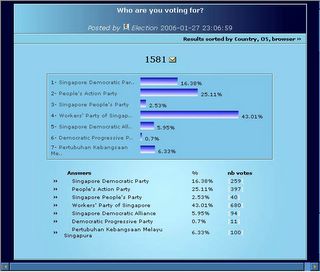
Not the most objective of polls above, even though it has received 1581 votes, not all from Singaporeans and not taken from a random sample. It does seem to be indicating that the Workers Party are at least in front of the Social Democratic Party.

And with the PAP shifting the number of seats they hope to win downwards, in order to be able to claim a success for their party, the PAP seem to be aware of the competition.

What you don't see on TV

From Singapore Election Watch


FILIPINA MAID IN SINGAPORE ESCAPES DEATH PENALTY

SINGAPORE (AFP), APRIL 26, 2006 (STAR) A Filipina maid facing trial over the death of a compatriot whose body was chopped up and left inside a bag will escape a possible death sentence after prosecutors reduced the murder charge against her, the woman’s lawyer said yesterday.

Guen Aguilar could now be jailed for life if convicted after a trial to begin on May 15, the lawyer Shashi Nathan said.

"Originally she faced a murder charge," Nathan told reporters after a preliminary inquiry at High Court.

"The present charge is one for culpable homicide not amounting to murder. There is a possibility of a life sentence."

Nathan said he did not know why the charge had been altered but it was a huge relief for his client and he would work to convince the court that she should be sentenced to much less than life if convicted.

"Certainly the first thing we need to do is to tell the court that a life sentence would not be fair in this case and we have to show the court through our own arguments and submissions that a sentence below 10 years would be appropriate."

The accused listened to proceedings through an interpreter.

Aguilar, 29, was arrested hours after the severed head and limbs of Jane La Puebla, 26, were found inside a sports bag near a subway station at the Orchard Road shopping district on Sept. 9.

La Puebla’s torso was later found at a nature park.

Nathan first said last October that he would not rule out seeking an amendment to the murder charge against Aguilar after his conversations with her gave the defence team a clearer picture of what may have transpired
.

Singapore's opposition to contest more than half of parliament seats+

(Japan Economic Newswire Via Thomson Dialog NewsEdge)SINGAPORE, April 27_(Kyodo) _ Singapore's opposition parties on Thursday declared their intention to contest more than half of the seats in Singapore's May 6 parliamentary election for the first time in nearly two decades, challenging Prime Minister Lee Hsien Loong's bid for a strong leadership mandate.

The opposition parties filed nomination papers to contest 47 of the 84 seats in Parliament, marking the first time since 1988 that the ruling People's Action Party has not been automatically returned to power on nomination day.

"We don't have a majority who have been returned unopposed, so we are fighting this election to decide who will form the next government of Singapore," Lee told reporters.

The PAP is expected to win the election on polling day as it has done at every election since the country's independence in 1965.

Most people in the wealthy city-state see the PAP as the backbone of Singapore's economic success and prefer political and economic stability rather than change.

The opposition parties have made it their clarion call for Singaporeans to vote more opposition members into parliament to check the ruling party's overbearing power. They will contest all nine single-seat wards and half of the 14 multi-seat wards, including Lee's constituency.

Lee, who is facing his first electoral battle since taking over from Goh Chok Tong in a planned leadership succession in 2004, is seeking a clear mandate for his leadership.

Noting that the Workers' Party challenging his constituency has got the largest number of candidates among the opposition parties, he said, "We are taking them seriously...we are eager to fight them."

Most other top party leaders, including Lee's 82-year old father, elder statesman Lee Kuan Yew, and Goh, who has been a senior minister in the Cabinet since he stepped down from the premiership, will retain their parliamentary seats as they are uncontested.

The move to contest more seats reflects a newfound confidence among the larger opposition parties, which have recently managed to attract more young, successful professionals to join their ranks despite being hampered by government-imposed restrictions on public speeches by opposition politicians and Internet debates.

One positive factor that has helped the opposition this time is the government's unprecedented move to release changes in electoral boundaries about a month earlier instead of at the last minute, thus giving the opposition more time to prepare. It also tinkered much less with the boundaries.

The ruling party won a landslide victory in the previous election in 2001, when it was under Goh, sweeping 75 percent of valid votes and all but two of the 84 parliamentary seats.

PAP leaders have said they would be happy to win at least 65 percent of the vote in this election and to wrestle back the two opposition-held seats.

"This election is really about PM Lee Hsien Loong and his new team and whether the electorate will go for the 'staying together, moving ahead' slogan," said Antonio Rappa, assistant professor of political science at the state-run National University of Singapore.

"If he can get at least 68 percent, it would be a super strong signal from the electorate that they are very confident of his leadership ability in the future. This would mean an increased likelihood of him continuing beyond the next three to four elections," he said.

Diane Mauzy, a political science lecturer at Canada's University of British Columbia, who has researched and written on Singapore politics, said "The PAP would be delighted with 70 percent or more of the votes. Sixty-five percent they could live with, but were it down to 60 percent, I think the PAP would be shaken."

The ruling party and the opposition camp will hold intense campaign rallies over nine days until polling day. Lee has chosen to take advantage of the current economic upswing by calling for an early election even though the five-year term of Parliament was not due to expire until the middle of next year.

The two main opposition groups -- the Workers' Party and the Singapore Democratic Alliance, which groups four parties -- hope to defend their respective seats and also wrench one or two more seats from the PAP in the hope of carving a larger presence in Parliament.

Singapore Democratic Party, a small party that is unrelated to the SDA, has been threatened with a libel suit from top ruling party leaders in the last few days for certain allegedly defamatory remarks in the party's newsletter on a scandal involving Singapore's largest charitable organization that has shocked the nation.

The National Kidney Foundation scandal, involving the abuse of charity money, is one of the issues that the opposition hopes to raise, along with perennial bread-and-butter concerns such as the high cost of living, subsidies for medical care and jobs for displaced older workers.


Singapore's authoritarian rulers tangled in web

By Shawn W Crispin

BANGKOK - Democratic elections in Singapore have always brought out the worst in the People's Action Party (PAP), which has ruled the island republic in authoritarian fashion since 1959.

The PAP has repeatedly threatened to cut public housing funds to constituencies that vote for opposition candidates. In populist fashion, this year the party handed out cash payments to low- and middle-income voters just weeks before announcing the May 6 elections.

Historically those PAP tactics have had the desired effect: landslide election victories. The PAP swept 82 of the possible 84 seats in the country's unicameral legislature in 2001, and the ruling party is widely expected to score another resounding electoral win next week.

Yet a new government ban on electioneering and political discussion over the Internet during the current 10-day election season shows that the PAP may be falling out of step with a new generation of Singaporean voters, who increasingly say they favor more democracy and less government intervention in their daily lives.

Muted political chatter

The Internet is changing the nature of political expression in Singapore in new and profound ways.

Online political chatter has surged during the periods leading up to national elections, and the run-up to this year's polls saw unprecedented Internet traffic. At the same time, the PAP has an established record of unplugging online commentators deemed critical of the government.

Consider Sintercom, an online news provider that broke new ground with its 1997 election coverage that often trumped the PAP-controlled mainstream media by posting maps, past election results and snippets from various political parties' manifestos on the Internet.

In the run-up to 2001 polls, the PAP-led government inexplicably amended the Parliamentary Elections Act, limiting political parties' election "advertising" over the Internet and banning non-political entities from election-related reporting and discussion. Sintercom's owner closed down the site in protest, voiding Singapore's only credible outlet for balanced election news coverage.

Chat rooms partially filled the information gap, with voters engaging in online forums to discuss and debate the rules and processes of the elections that have historically worked to the PAP's advantage. The new special legislation on politically oriented electronic communications, however, in effect outlaws all forms of citizen journalism related to this year's election.

New rules limit political discussions online during the 10-day campaign season, including politically oriented podcasting, vodcasting, blogging and even posting photos of opposition rallies on public websites. The opposition had earlier planned to stream its rallies live over the Internet using podcasting technologies.

In recent years opposition parties have used the Internet to bypass the country's state-influenced media, including The Straits Times daily English-language newspaper, which reports unswervingly in favor of the PAP, to appeal to voters. Until last year, commentators needed to receive licenses from the government to conduct any type of public political discussions; that ban is still in place if foreign commentators are scheduled to participate in public forums.

New media have opened the political space for opposition parties to promote their alternative economic policies and raise their profile as a "more transparent, more accountable" political option among the younger, more technology-savvy generation of voters, they contend.

Tan Tarn How, a media researcher at Singapore's Institute of Policy Studies, said the country has hit the "global blogging big league", citing statistics gleaned from Technorati.com, an independent blogger search engine. Technorati.com recently showed that the names of three Singaporean bloggers ranked among the world's top 10 most used search words.

Prior to the PAP's controversial new Internet ban on political discussions during elections, new blog entries with the words "Singapore election" ranged between 12 and 30 per day, with more than 100 new politically oriented entries uploaded on some days in March, Tan noted. More than 67% of Singapore's 4.4 million population is connected to the Internet, the third-highest percentage in Asia behind only Japan and Hong Kong, according to statistics provided by Internetworldstats.com.

Significantly, the new ban on new media highlights a glaring contradiction in the PAP's policy rhetoric and its on-the-ground actions. Recent policy initiatives have aimed, at least conceptually, to promote more creativity in Singapore's still severely repressed society.

However, that drive has not yet translated into more political and social freedoms. The PAP-led government is now in the process of forcing bloggers to register their online identities, stripping online writers of their anonymity and exposing them to possible defamation prosecution for writing considered objectionable by the government. Last year, two bloggers were charged under the Sedition Act related to their online postings.

Behind the times

Singapore's election system has since the 1980s been structured and regulated in ways that inhibit small opposition parties from fielding candidates, including the cumbersome requirement that parties must assemble an ethnically balanced six-member committee to contest a single parliamentary seat. At next week's polls, opposition parties will likely contest fewer than half of parliament's 84 seats. Yet the new Internet ban hints that the PAP is feeling more vulnerable than most political analysts realize.

Opposition political hopefuls such as James Gomez, a first-time candidate with the opposition Workers Party and a self-styled Internet political activist replete with his own blog and online news website, are actively wooing the new generation of voters that the PAP's heavy-handed policies increasingly alienate.

Gomez contends that the PAP banned posting photos of opposition rallies on the Internet precisely because small opposition parties are attracting tens of thousands of supporters on the hustings, whereas the PAP can barely muster hundreds of supporters at their campaign stops.

"The PAP has a history of trying to control all political content, and now they are trying to extend that control to new media as well," Gomez told Asia Times Online. "It shows just how bankrupt for new ideas they have become," he added, referring to the Internet ban and the PAP's newly promulgated party manifesto.

The PAP has struggled to land upon a cogent policy response to Southeast Asia's diminished role in the global economy and China's concomitant economic rise, both of which have taken a heavy toll on Singapore's export-geared economy. The PAP strategically called snap elections during a cyclical business upswing, but Singapore-based economists say the competitiveness problems that deepened the country's recent recession remain largely unaddressed.

Moreover, the PAP's attempts to force creativity into Singaporean society after years of trying to restrain it has, at best, met with mixed results. The recent decision to open a mega-casino resort complex is just one example of an elderly leadership's grasping for quick economic fixes rather than undertaking long-overdue political reforms, opposition candidates contend.

As the PAP tries to forge a racier national profile, albeit in old-fashioned nanny-state style, it continues to ignore the necessity of free expression to invigorate the population and spawn the new class of technology-savvy entrepreneurs who would propel the economy up the value-added ladder.

When Singapore's new generation of entrepreneurs try to test their creative gears, however, the PAP-led government often cracks down on their activities. Consider, for instance, the case of Martyn See Tong Ming, an independent filmmaker.

See last year produced and distributed over the Internet Singapore Rebel, a short documentary film on the life of Chee Soon Juan, secretary general of the opposition Singapore Democratic Party, who last year lost a three-year legal battle against PAP founder Lee Kwan Yew and former prime minister Goh Chok Tong. The film, which aired at various international film festivals, featured instances of opposition-led civil disobedience to the PAP's restrictions on free speech, including an uncut 10-minute segment of Singaporean police arresting Chee for speaking in public without a permit in front of the presidential palace in 2002.

Police claimed in August that See may have violated the draconian Films Act, which in 1998 was expanded to punish with a fine of S$100,000 (about US$63,000) and two years in prison anyone who produces or distributes so-called "party political films". See has not been formally charged, but similarly to the PAP's harassment tactics of other government critics, he was most recently called in for police questioning last month.

"By questioning me three different times, they are trying to discourage other filmmakers from doing the same thing," See told ATol. "By making me surrender my tapes and cameras, it was a subtle warning to me not to produce similar films in the future."

See's latest documentary, nonetheless, is about a former communist detainee who was jailed without trial in Singapore for more than 17 years because of his political views.

Selective openness

For all the PAP's grandstanding about forging a more open society, even oblique political criticism still warrants severe reprisals. Singapore's first family has a long history of filing crippling criminal defamation suits against feisty journalists and opposition politicians, including most recently a libel suit threat against the Singapore Democratic Party related to its allegations of a government cover-up of corruption at the National Kidney Foundation.

The local news media are renowned for their world-class self-censorship. Big foreign news agencies, which for years through their reporting had challenged then-prime minister Lee Kwan Yew's less-than-democratic credentials, have in recent years also been cowed by the threat of litigation and now regularly report glowingly on his economic accomplishments.

Meanwhile, the PAP's litigious founder has worked behind the scenes to pave the political way for his eldest son, Lee Hsien Loong, to take over the premiership in 2004 without democratic challenge. The son's wife, Ho Ching, was later appointed as executive director of the government's highly secretive, multibillion-dollar international investment arm, Temasek.

The younger Lee is obviously between a rock and a hard place. His PAP advisers are cognizant of the economic importance of more openness, but at the same time fret about the potential repercussions if the PAP loosens its political grip too fast. Judging by the proliferating number of Singapore-based blogs, however, a new, Internet-savvy generation of voters has already reached a critical mass and is less satisfied to wander aimlessly around the mall while the PAP unilaterally handles the rest of Singapore's business.

For the first time in years, Singapore has a group of better-organized, forward-looking alternative candidates to the PAP that, among other things, are trying to leverage rather than restrain the democratizing force of the Internet for political change.

It's a given: the PAP may win next week's polls in a landslide. But by unplugging the Internet for shortsighted, self-serving political purposes, at the same time the ruling party is also likely planting the seeds of its future demise.

Shawn W Crispin is Asia Times Online's Southeast Asia editor


Singapore Tries to Squelch Political Blogs, Podcasts

Simply published here for my own records. Nice to get a mention on MediaShift.

And here is a working link to the podcast from DrChee... If for some reason you are unable to access the mp3 file, leave a comment and I will rectify the problem as soon as possible, or I can email it to you directly.

by Mark Glaser, 12:28PM
Permanent Link to This Post

While many Americans have been focused lately on online censorship in China, few have noticed a similar practice in other countries such as Singapore. That island state is a parliamentary republic in theory, but has really been run by one dominant party in its history of independence since 1965 (see a Singapore historical timeline here ).

The mainstream media is strictly controlled by the government, and one political party — the People’s Action Party (PAP) — has had complete control of all centers of government. The country infamously practices caning of citizens who break certain laws, and executes drug smugglers. (Amnesty International reports Singapore has the highest execution rate per capita in the world.) And recently, its Minister of Communication and Arts, Balaji Sadasiva, announced that blogs and podcasts would be shut down if they ran overt political content in the runup to the May 6 election.

Immediately, the move was denounced by the free expression rights group Reporters Without Borders. “Once again the Singapore authorities are showing their determination to prevent the holding of a genuinely democratic debate on the Internet,” the group said in a statement. And the Internet crackdown was aimed squarely at two new media platforms — blogs and podcasts — that have been embraced by opposition parties such as the Singapore Democratic Party (SDP) to get around censorship in other media.

The Singaporean government has won over residents with a powerful economic engine that rivals Western European powers. And in recent years Singapore has relaxed its ban on chewing gum — in order to win a free trade agreement with the U.S — and it has allowed the showing of the movie “Brokeback Mountain” despite laws against homosexuality. So just how serious is this new regulation, and will political speech by bloggers and podcasters be chilled now that elections have been set for May 6?

One Singaporean blogger, Soci, who writes for the very political group blog, Singabloodypore , was defiant in a comment on a related story
on ZDNet:

This blog — Singabloodypore — is not registered with the Singaporean government, has never been asked to register, and if invited to register would NOT register. I Soci also intend to post material of an “explicitly political nature” during the elections and will gladly show videocasting and podcasting of election rallies, speeches etc. of opposition candidates.

And indeed they have been showcasing just that on the group blog. But in many cases, these bloggers and the dozens of others that write about Singapore are anonymous or operate from outside the country. Chris Myrick, who pens the Asia Pundit blog , lived in Singapore until February 2005. He was unsure how much the new regulation would chill speech online.

“Most Singapore bloggers stay pretty much within limits - there are only a small handful of political blogs and even those will stay away from certain issues (nepotism) or the authors will remain anonymous,” Myrick told me via email. “I have no doubt that the Singapore government would prosecute an individual for breaking the ban. It tends to be the methodology of the state to make an example of people (i.e., the three bloggers who were last year sentenced for sedition ).”

Government explains the crackdown
I queried Singapore’s Ministry of Communication and the Arts (MICA) to get more insight into the new rules for blogs and podcasts and they directed me to a detailed Q&A between government minister Lee Boon Yang and the Straits Times. Here’s one telling exchange:

Q. Why is streaming of explicit political content through podcasts or videocasts not allowed but posting of party manifestos and texts of rally speeches allowed for political parties? What is the worry?

Podcasts and videocasts…have a greater impact because of the nature of the medium. They have the greater power to influence. Hence, we do not allow podcasts and videocasts for election advertising, just as we do not allow party political films and videos. The Internet has its own unique characteristics which require special attention. The Internet is ubiquitous, fast and anonymous. Once a false story or rumour is started on the Internet, it is almost impossible to put it right. Despite its usefulness, the Internet is chaotic and disorganised, with many half-truths and untruths masquerading as facts…

To help bring some order to this chaotic environment, we have made it a requirement for political parties and individuals who use websites to propagate or promote political issues to register with the Media Development Authority (MDA). This promotes accountability and also ensures personal responsibility for comments made on the Internet.

Soci at Singabloodypore was quick to read between the lines of this Q&A , analyzing the underlying meaning of each passage. Soci’s take on the comment above from the minister: “The Internet is a threat to our domination of the national mind set.”

While the minister makes a strong case about the way misinformation spreads online, there are more transparent ways of countering that than blocking off speech completely. For instance, the government could make its own case online, or try to open up a debate with oppositional views.


Alex Au, who blogs about gay rights in Singapore at Yawning Bread , told me that freedom of speech in Singapore exists to a certain point.

“The freedom available to Singaporeans is quite wide,” Au told me via email. “However, there is a climate of fear that the government can clamp down anytime. There have actually been very few instances of arbitrary clamping down, but the fear persists, and thus a lot of people in Singapore, including bloggers, self-censor to some extent. With the passage of time, there is increasing confidence that freedom of speech on the Internet is pretty wide. The more years that pass without incident, the more confidence people gain.”

Au says that in the sedition cases last year, the language used online by the three people who were prosecuted was “extremely gross, full of expletives and deliberately provocative,” rather than an intelligent discussion. So Au feels that the government was drawing the line between measured discussion of issues and inflammatory speech.

In the recent crackdown of blogs and podcasts, Au thinks the government’s ban is very narrow in covering blogs that “persistently promote a political line” — leaving broad political discussions alone. I asked him if he thought the government might act against bloggers in the next couple weeks.

“No I don’t,” he said. “I think the government may want to create the impression that they will clamp down, in order to get people to tremble in their socks and self-censor anything critical that they may have to say about the government. But the government probably knows that the Internet is not (yet) a mass medium that can move large numbers of voters, so to really take action would be overkill. In any case, the junior minister did say in Parliament that politics can be discussed, just that unless one is identified as a political party, one shouldn’t go around promoting any particular party or candidate.”

As Singapore is a trade partner to the West, how the Western media portrays the Singaporean government is important to them. So that means that bloggers and journalists who bring attention to the recent crackdown could help the PAP reconsider taking action.

“Bringing the world’s attention to authoritarian instincts of this government, making them a little of a pariah on account of their policies, embarrasses them greatly,” Au said.

If you want to read more about the upcoming Singaporean elections, you’ll want to check out these sites:

AsiaOne election coverage

Official Singapore Government Site on Elections

Singapore Election Watch

Singabloodypore

Chemical Generation Singapore

What do you think? Is the Singaporean government going too far in threatening bloggers and podcasters? Is there something that we as outsiders can do to support the bloggers and podcasters who are worried about being arrested or blocked from speaking their minds?


Singapore Democratic Party to Contest Lees' Legal Action

April 26 (Bloomberg) -- The opposition Singapore Democratic Party, contesting elections May 6, said it will fight legal action being considered by Prime Minister Lee Hsien Loong and his father Lee Kuan Yew, founder of modern Singapore.

Secretary-General Chee Soon Juan and other officials had until 10 a.m. yesterday to apologize for statements made in the party newspaper and pay damages to the Lees. Lawyers were hired to contest any action, the party said in a statement.

``We won't apologize,'' Chee said in a phone interview on April 24, a stand the party reaffirmed today. ``It's in their court, and they will be issuing the writ after that and we will respond to it.''

The prime minister and his father last week demanded an apology from Chee and the other 11 members of the Singapore Democratic Party's central executive committee for statements made in The New Democrat newspaper. The spat has overshadowed campaigning for the city-state's upcoming elections.

The Lees said they would sue unless a public apology was forthcoming, according to the Straits Times newspaper, which cited their lawyer, Senior Counsel Davinder Singh. Singh couldn't be reached today in his office.

Three of the Singapore Democratic Party's executive committee have apologized so far. Kwan Yue Keng, Abdul Rasheed Abdul Kuthus and Lai Kin Kheong published statements in the Straits Times saying they ``unreservedly'' withdrew the allegations and apologized to both the prime minister and his father.

Damages


The three also agreed to pay an undisclosed amount in damages to Lee Hsien Loong, who became prime minister 20 months ago, and Lee Kuan Yew, prime minister from 1959 to 1990.

Legal action may also be taken against the printer of the political newspaper, Chee said in a statement on the party Web site.

Both Lees are members of the People's Action Party, which has ruled Singapore since independence about four decades ago. The party has 82 of 84 elected seats in Parliament and is expected to secure a landslide win in May elections, though opposition groups have been trying to increase their popular support.

``The opposition is hoping to put a tougher challenge this time around,'' said Bruce Gale, a Singapore-based independent political consultant covering Southeast Asia since 1988.

Chee faced a defamation suit during a 2001 election. He was ordered to pay S$500,000 ($315,000) in damages for defaming the elder Lee and former prime minister Goh Chok Tong, Agence France- Presse reported last year.

Reputation


Previous lawsuits by leaders of the ruling People's Action Party have been criticized by human rights groups, the European Union and billionaire George Soros, who called for Singapore's government to allow more freedom of expression during a visit in January. He said then that Singapore, ranked 140th out of 167 countries in a 2005 press freedom ranking by Reporters Without Borders, doesn't qualify as an ``open society.''

The prime minister and his father have both made recent statements saying they need to defend their reputations.

``If we do not act and the lies and defamation are repeated throughout and in election rallies and spread around, I think the government's reputation goes down and its standing must go down,'' Singapore's Sunday Times quoted Lee Hsien Loong as saying. ``It must lose its moral authority to govern because these statements have been made and you have not reacted and that means there must be some truth in it.''

`Extremely Limited'

Singapore also has restrictions on unauthorized public assembly and earlier this month limited the use of the Internet in the election campaign.

``Freedom of expression is extremely limited. Freedom of assembly is extremely limited,'' said Brad Adams, Asia director for Human Rights Watch. ``What's missing from the government's position is an end-date for all of this. It was always implicitly the argument that Singapore could grow into a developed society where people could be trusted.''

Singapore barred the use of so-called podcasting, or the distribution of audio files over the Internet, in political broadcasts. The ban during the election period also extends to the distribution of online video messages, as well as blogging, or posting political opinions on Web sites, the government said.

``People will have their diverse opinion and some will want to share their opinion. But people should not take refuge behind the anonymity of the Internet to manipulate public opinion,'' Balaji Sadasivan, senior minister of state for information, said in Parliament on April 3. ``It is better and more responsible to engage in political debates in a factual and objective manner.''


To contact the reporter on this story:
Linus Chua in Singapore at lchua@bloomberg.net.


26 Apr 2006

On the Thai elections

Thaksin Shinawatra generates some sympathy fawning from some normally critical local bloggers. It's not easy to see why: he was on the verge of a long historical project to turn the kingdom into a benevolently authoritarian one-party state, replacing unproductive party politics with pragmatic, technocratic business sense, and instituting some control over the nation's independent media. What's there to hate in people who sincerely want to imitate your country?

So newspapers here were the only ones caught out of the loop. Local reporters were fawning and predicting 2006 will be Thailand's 1966, that the decision of the oppposition parties to boycott the election undo them and propel Thaksin's ascension to legal and legitimate one-party rule. That's a national blind spot for you, but surely they should've rmembered that when history actually repeats itself, the second time is always a farce?

What they did not count on (the national blind spot!) was the constitution of Thailand, which was written to prevent precisely these travesties from occuring. In constituencies with a walkover, the unopposed candidate is not confirmed unless 20% of the voters turn up to vote for him anyway. Voters are also given the choice to cast a "no vote", essentially a vote for "none of the above" that in sufficient numbers will invalidate the winner of the election. These are safeguards that prevent the country from sliding into a one-party state with a fake opposition.

Today, Thai King Bhumibol Adulyadej gives the best sign that Singapore should be the one emulating Thailand instead. Speaking out at the "complete mess" that Thaksin's snap elections caused, the monarch commented strongly: "The current election is undemocratic. Where there is only one candidate it is not considered a democracy."

King Bhumibol Adulyadej, the true senior statesman of Asia.

25 Apr 2006

Videocasts on GE to be available on Channel NewsAsia website

So the media has a legal hold on videocasting during elections while video bloggers are prevented from doing so. As a blogger, I take offence at such blatant discrimination perpetuated by the state... All this talk about opening up is complete b***... Bloggers should just defy the ban on electoral reporting/podcasting/videocasting...

SINGAPORE : Videocasts of the General Election, shot using 3G mobile phones, will be available on the Channel NewsAsia website everyday starting from Nomination Day.

These clips will be produced by bloggers representing both the pre- and post-independence generations.

"Whenever you see Workers' Party or PAP or SDP, the news is pretty objective. You have to state the views and you can't editorialise anything. But here (with videocasting), you can put a little bit of your own personal comments on the issues being argued," said logger and Channel NewsAsia's producer Au Yong May Lin.

"I'm trying to capture a different angle of the elections, something that is more colourful, something noisier and funnier," said blogger and Channel NewsAsia's art director Farid Johari.

What viewers will also be seeing is news as it happens on the ground, as the bloggers will be uploading their clips on the Channel NewsAsia website instantaneously.

Chee's Podcast Text

Chee's podcast text
25 Apr 06

The Singapore Democrats have been ordered to remove our podcasts, including the address Dr Chee Soon Juan gave regarding the persecuting of the SDP and its leaders. Below is the text of the speech.

My fellow Singaporeans,

This is Chee Soon Juan The elections are upon us again and the Singapore Democrats are busy preparing for the polls on May 6.

But unlike previous campaigns, this one is a little different in that even before the hustings begin, the PAP is up to its favourite tactic of suing its opponents for defamation. It is certainly whipping up anti-SDP sentiments through the mass media that it controls.

But that’s not all. The PAP is hell-bent on crippling the SDP’s election campaign.

First, it bans podcasting knowing full well that we had set up our podcast last year specifically so that we can better reach out to voters in this election.

Two, MM Lee Kuan Yew and his son, Prime Minister Lee Hsien Loong have sued our Party for defamation.

Three, the PAP has even gone after the SDP’s printer, Mr David Sum, who is now so fearful he dares not print our election material.

Four, everywhere that we go for our walkabouts, undercover police agents are on hand to harass us and issue us warnings.

Five, the PAP is so desperate that it has even changed the rules to bar both Mr J B Jeyaretnam and I from speaking at the election rallies. It goes to the extent to rule that no one can read my speeches out for me at the rallies.

Let me ask you one simple question: Does this sound like a Government that is confident of the popular support that it claims to have or does this sound more like an insecure regime determined to prevent the SDP from telling voters its views and competing with the PAP for votes?

Mr Lee Kuan Yew says that Singapore should have a First World Government and opposition. I couldn’t agree more. But I’d like to remind him that First World Governments don’t sue their political opponents or their printers, they don’t have police officers tailing the opposition wherever they go out to meet voters, or prevent them from speaking at election rallies, or ban podcasting.

What First World Governments do is to have public debates with their opponents uncensored and unedited so that voters can watch and make up their own minds. To this end, I would like to invite Mr Lee Kuan Yew and/or Mr Lee Hsien Loong to demonstrate the PAP’s First World-ness by engaging my colleagues and I in public debate during one of our rallies – telecast live.

This would be a wonderful opportunity for the PAP to show how much of a First World government it is and if what Mr Lee Kuan Yew says about the SDP being a ‘hooligan’ party is true or not. The SDP is confident of letting the people of Singapore be the judge. What about the PAP?

The truth of the matter is that Singaporeans must not let the PAP dictate what kind of an opposition Singapore should have. The state-controlled media will portray the SDP as a party not worthy of the people’s support. That’s not surprising because the Singapore Democrats are openly calling for reform of our political system and for the Government to truly serve the people and not vice versa. The PAP is terrified of this message and wants to shut the party down.

An opposition must speak clearly and loudly when the people are being bullied, when ministers are paying themselves millions of dollars in salaries while the people continue to take cuts in their wages and CPF.

An opposition must spell out its alternative ideas clearly as we have done in our newspaper and various books and reports.

An opposition must not be intimidated by the ruling party no matter how tough the going gets.

Because ultimately an opposition exists to keep democracy alive by speaking up for the people.

Clearly, the Government is going all out to crush the Singapore Democrats. It wants to shut the SDP down. We’re not surprised by this because that’s what undemocratic regimes do to parties that call for reform – reform so that power can be rightly returned to the citizens.

Everything I’ve done, I’ve done it with our nation at heart. You may not agree with everything I say or do. But you cannot accuse me of not speaking up for the people. I love my country as much as anyone else in Singapore. But loving my country and being loyal to it doesn’t mean I have to bow down to the PAP and look the other way when injustice occurs.

We, the members of the SDP, will continue to speak up and we will tell the PAP when it is wrong no matter how much we are persecuted. We will not kow-tow to bullying and to arrogance.

We will continue to speak up and to fight for you. Why? Because Singapore belongs to us Singaporeans, not the PAP. Whatever happens in this election, the SDP will always remain true to our beliefs, our people and, most important, our nation.

Thank you and may God bless all of you and your loved ones.

SDP told to remove podcasts from website

By S Ramesh, Channel NewsAsia

SINGAPORE : The Returning Officer for the General Election has ordered the Singapore Democratic Party to take down audio files and podcasts from its website.

The Elections Department says the podcast contravenes the Parliamentary Elections (Election Advertising) Regulations.

It says those found guilty are liable for a fine of up to S$1,000 or imprisonment of up to 12 months, or both.

Dr Chee, the SDP's Secretary-General, had recorded a podcast message and posted it on the party's website two days ago.

The Returning Officer has also issued a notice to all political parties with websites to remind them to conspicuously display particulars of any election advertising on their websites, in accordance to the rules spelt out.

Political parties have also been reminded to only publish election advertising on the Internet which conforms to the positive list set out in the regulations. - CNA /ct


The Democrats will not bow to the Lees


Chee podcast: Show Singaporeans you're really First World, debate SDP
23 Apr 06

________________

The Democrats will not bow to the Lees
24 Apr 06


The Singapore Democratic Party will not apologise to Mr Lee Kuan Yew and Mr Lee Hsien Loong. The Party will engage Mr M Ravi to act for it and we have instructed him to launch a vigorous defence.

The following have also signaled their determination to defend the legal action: Ling How Doong, Francis Yong, Chee Soon Juan, Wong Hong Toy, Abdul Rasheed, Christopher Neo, Chee Siok Chin, Gerald Sng, Mohd Isa, and Lawrence Lai.

The Party has made a decision that it will not stop individual defendants from apologising to the plaintiffs as this is a matter concerning the individual and his/her family members.

Regarding the election campaign, the Party will continue to ask Ministers Khaw Boon Wan and Lim Hng Kiang to answer our questions:

One, why did the Ministers endorse the NKF and tell Singaporeans that the organization was “in full compliance with the regulations” despite the repeated warnings given by volunteers, members of the public and MPs about NKF’s operations?

Two, why did the Minister for Health reinstate NKF’s IPC status even though the NCSS had rejected it just weeks earlier?

We are still awaiting the Ministers’ explanations.

CHEE SOON JUAN
Secretary-General
Singapore Democratic Party


Where's the defamation?

Below is the article from The New Democrat which Father Lee Kuan Yew and Son Lee Hsien Loong are saying is defamatory. Read and see how ridiculous they are.

The Government's Role in the NKF

In all the hand-wringing and breast-beating by the Government over the NKF issue, Singaporeans must not lose sight of one thing: Such a scandal is inevitable given the kind of secretive and non-accountable system bred by the PAP.

The Government now tries to exone-rate itself by playing the innocent and gullible party duped by greedy NKF officials.

It forgets that in April 2004, Minister Khaw Boon Wan had, in reaction to public unease about the NKF, sought to appease Singaporeans by telling them that the Ministry of Finance "would have reacted many years ago" if there was any breach of rules by the NKF.

Mr Khaw categorically endorsed the NKF's dealings and called on the charity to "continue" to remain "transparent" in its operations.

At the same time the Second Minister for Finance, Mr Lim Hng Kiang, said that the NKF had "quite a sound record" because it spends "more than 80 percent of its funds on its beneficiaries" whom we now know are not kidney patients.

Clearly, alarm bells were raised. People could see that something was wrong and they had expressed their unhappiness over the years.

And yet, the Government which had the power to do something, chose not to. Not only did it choose not to rein in NKF but it also continued to praise the charity and encouraged people to donate to it. With assurances from not one but two Ministers, the charity went on its merry way.

The question that is on everyone's lips is: If Mr TT Durai had not taken the legal suit, would the Government have bothered to look into the NKF records? NKF would in all likelihood have continued to operate with the Government's blessings.

The NKF fiasco is not about bad practices. It is not even about negligence on the Government's part.

It is about greed and power.

It is about the idea that the political elite must be paid top dollar, no matter how obscene those amounts are and regardless of who suffers as a result of it.

It is about a system engineered over the decades by the PAP that ensures that it and only it has access to public information and by fiat decides what is allowed and what is not.

It is about what a "democratic society, based on justice and equality" should not be.

Singaporeans must note that the NKF is not an aberration of the PAP system. It is, instead, a product of it.

To ensure that there is transparency and that Singaporeans are kept informed of matters directly affecting them and their future, the Government must:

One, disclose the breakdown of the cost of building HDB flats and the profits HDB makes.

Two, reveal where and how GIC uses our savings.

Three, disclose the salaries of the top executives of Temasek Holdings and other GLCs.

Four, declare the assets and incomes of its Ministers.

Five, reform the election system to ensure that it is free and fair.

It goes without saying that someone must be held accountable over the whole sordid NKF affair. However, real accountability starts much higher up.


Why Sudddenly EveryBody Talking About FIrst World

Minister Mentor Lee Kuan Yew has rebutted criticism by Workers' Party chief Low Thia Khiang that the PAP is not a First World government.

Mr Lee said that if the PAP did not have the capabilities of a First World government, Singapore would not have risen up to the First World standards as measured by the World Bank, the World Economic Forum (WEF), the International Institute for Management Development (IMD) and the Transparency International.

The Minister Mentor's rebuttal was issued in a statement by his Press Secretary on Tuesday.

The opposition chief made his comment on Monday, after the Minister Mentor said over the weekend that Singapore would not have a First World parliament without First World opposition candidates.

In Tuesday's statement, Mr Lee reiterated that the PAP would respond at the level the opposition chooses to fight for votes.

When dealing with opposition like the Workers' Party when it was headed by Mr J B Jeyaretnam - whom Mr Lee said "played by the standards of the street fighters" - he stressed that the PAP must respond in kind.

The Minister Mentor added that the Workers' Party under Mr Low Thia Khiang must take this opportunity of having got rid of Mr Jeyaretnam to begin the process of getting the Workers' Party to First World standards. - CNA/ir


I am not sure whats wrong with me, but one thing i know about first world politics, is that politicians do not tell each other "You are not first world." Elections were held in UK quite recently. Guess what they talked about, among other things? Education and Healthcare.

The Worker's Party Manifesto is a concerted effort to talk about real issues.

Why are we not talking about them?

I know, I know - because even politics in Singapore is not first world!

SDP Stands Firm


Another defamation suit is underway. Why does not the PAP understand that such underhand tactics on the opposition leaders are stellar examples of how the promise of an open and inclusive society is all a sham. This time the PAP has gone a step further and indiscriminately wants to sue all the SDP leaders, even including one that jumped ship to another party some time ago. Where is the sense in that? Who is the real hooligan?

24 Apr 2006

Took Leng How (m) aged 22, Malaysian citizen

Received from AMNESTY INTERNATIONAL Canada

Urgent Action

PUBLIC
AI Index: ASA 36/004/2006

UA 94/06
Death Penalty
19 April 2006

SINGAPORE

Took Leng How (m) aged 22, Malaysian citizen

Malaysian citizen Took Leng How, who was sentenced to death in August 2005, has had his final appeal rejected by the Court of Appeal. The President still has the power to grant clemency. Took Leng How's lawyers are currently preparing a clemency appeal: for maximum impact they have asked that all UA Network appeals should arrive by 11 May, before they submit the appeal to the President.

Took Leng How was sentenced to death for the October 2004 murder of an eight-year-old girl, Huang Na. In Singapore a murder conviction carries a mandatory death sentence.

A panel of three Court of Appeal judges rejected his appeal by two votes to one, in late January. The judge who voted against execution, Kan Ting Chiu, wrote in his dissenting opinion that there was "reasonable doubt whether the appellant caused the deceased's death by smothering her mouth and nose, or whether she died as a result of a fit." He concluded that Took Leng How "should be convicted for an offence of voluntarily causing hurt".

Took Leng How's family have reportedly gathered more than 30,000 signatures on a petition for clemency.

BACKGROUND INFORMATION

There is usually little public debate in Singapore about the death penalty, partly as a result of tight government controls on the press and civil society organisations. However, activists in the country claim the debate on the death penalty in 2005 was possibly the most prominent in four decades, after national and international campaigning for clemency for two men facing execution for drug-related offences, Shanmugam s/o Murugesu and Van Tuong Nguyen. (See UA 104/05, ASA 36/001/2005, 29 April 2005 and UA 279/05, ASA 36/003/2005, 24 October 2005, and follow-ups).

In his report to the United Nations Commission on Human Rights on 24 March 2006, the Special Rapporteur on extrajudicial, summary or arbitrary executions, Philip Alston, observed:

"Measures taken by the Government of Singapore suggest an attempt to suppress public debate about the death penalty in the country. For example, in April 2005, the Government denied a permit to an Amnesty International official to speak at a conference on the death penalty organized by political opposition leaders and human rights activists... If public opinion really is an important consideration for a country, then it would seem that the Government should facilitate access to the relevant information so as to make this opinion as informed as possible".

The UN Special Rapporteur has previously argued that the mandatory nature of the death sentence is a violation of international legal standards.

Singapore, with a population of just over four million, is believed to have the highest per capita execution rate in the world. More than 420 people have been executed since 1991, the majority for drug trafficking. The government has consistently maintained that the death penalty is not a human rights issue.

Amnesty International opposes the death penalty in all cases as a violation of the most fundamental of human rights: the right to life. It is the ultimate cruel, inhuman and degrading punishment and there is no escaping the risk of error, which can lead to the execution of an innocent person.


RECOMMENDED ACTION: Use your own words to send appeals quickly

- urging the President to grant clemency to Took Leng How and commute his death sentence;
- urging the authorities to impose a moratorium on executions, with a view to complete abolition, in line with the April 2005 UN Commission on Human Rights (UNCHR) resolution on the question of the death penalty;
- noting that the UNCHR has urged states which still maintain the death penalty not to impose it as a mandatory sentence;
- calling on the authorities to be transparent by making full statistics on death sentences and the background of those on death row regularly available to the public.


APPEALS TO:

His Excellency S R Nathan
Office of the President
Istana, Orchard Road
Singapore 0922
Fax:011 65 6735 3135
Email: s_r_nathan@istana.gov.sg
Salutation:Your Excellency


COPIES TO:

His Excellency Mr Vanu Gopala MENON
High Commissioner for Singapore
c/o Permanent Mission to the U.N.
231 East 51st Street
New York, NY 10022, USA
Fax:(212) 826-2964

Lee Hsien Loong
Office of the Prime Minister
Istana Annexe, Orchard Road
Singapore 0923
Fax:011 65 6732 4627
Email:lee_hsien_loong@pmo.gov.sg

Professor S. Jayakumar
Ministry of Law
100 High Street
The Treasury 08-02
Singapore 179434
Fax:011 65 6332 8842


23 Apr 2006

Singapore opposition leader says will not apologise

Why should he retract a statement which is true? The PAP should be apologising to the people of Singapore.

Sun Apr 23, 2006

SINGAPORE (Reuters) - The leader of a Singapore opposition party, threatened with a defamation suit by the city-state's ruling politicians for accusations of corruption days ahead of a poll, said on Sunday he would not apologise.

Lawyers for Prime Minister Lee Hsien Loong and his father, Lee Kuan Yew, have sent letters to leaders of the Singapore Democratic Party (SDP), complaining about articles in the party's newsletter.

The action comes before the May 6 general election in a replay of a legal drama ahead of the last poll in 2001, won overwhelmingly by the People's Action Party (PAP) that has dominated parliament since independence from Malaysia in 1965.

Chee Soon Juan, secretary-general of the SDP, and members of his party's central executive committee must apologise and pay an unspecified amount in damages, a lawyer representing the Lees told the Strait Times newspaper on Saturday.

"I personally will not be apologising. You can't be apologising every time someone threatens you," Chee told Reuters.

"I was only doing what the opposition should be doing: questioning government policies and wanting more transparency and accountability. Only here in Singapore are these actions frowned upon and draw defamation lawsuits," he said.

Lawyers said should the case go to court, the SDP ran the risk of being shut down if the party or its executive committee was not able to pay the damages.

An acerbic critic of the Singapore government, Chee has had several skirmishes with the ruling PAP. He was slapped with a defamation suit in 2001 for accusations against Lee, founder of the city state, and then Prime Minister Goh Chok Tong.

Chee was declared bankrupt in February for failing to make libel payments of S$500,000. Last month, he was jailed for eight days for questioning the independence of Singapore's judiciary.

Does the Defence of Qualified Privilege Work in Singapore?

4. Qualified Privilege

In most common law democracies qualified privilege protects criticism of government political debate from libel actions. The degree of protection provided to political expression varies.

In the United States following the decisions of the U.S. Supreme Court in New York Time v. Sullivan[14] and Garrison v. Lousiana[15], a political plaintiff can only establish liability for such statements if theplaintiff can prove that the words complained of were untrue and the defendant either knew the words were false or was reckless as to their falsity.[16]

Therefore in the United States, a government official or public figure cannot succeed in a defamation suit based on a statement regarding an issue of public interest even though that statement damages the plaintiff’s reputation unless malice can be proven. Even if the defendant’s assertion is proven to be untrue and defamatory the plaintiff, to succeed, has to prove that the defendant knew the impugned statement was untrue or showed reckless disregard.[17]

In New Zealand and Australia courts have recognised a more limited defence of qualified privilege in defamation arising from political discussions. England has recognised a more general qualified privilege for discussions of matters of public concern. [18]

Australian courts have extended the defence of qualified privilege to “disseminating and receiving information, opinions and arguments concerning government and political matters that affect the people of Australia” provided that the publication is ‘reasonable’.

The New Zealand Court in Lange v. Atkinson[19], found that the public has an interest in information about the government and concluded that a defence of qualified privilege is available for words published to the public. Justice Elias of the New Zealand Supreme Court has explained that it is an essential to the democratic political process that issues can be put forward for political debate without the risk of defamation suits. Elias J. held:

“Comment on the official conduct and suitability for office of those exercising the powers of government is essential to the proper operation of a representative democracy. Political discussion in a democracy will inevitably on occasion entail the making of statements that are likely to injure the reputation of others. Qualified privilege in my view attaches to statements made to the general public about matters of government. It is necessary for the public to be informed about these matters for a representative government to function.”[20]

The New Zealand Law Commission issued a preliminary paper criticising the decision and recommending that the defence of qualified privilege for discussion of political matters published to the general public should be available to a defendant only if the publication of the defamatory material was reasonable, i.e. if the defendant had reasonable grounds for believing the defamatory words were true and gave the plaintiff a chance to respond.[21]

The Latimer House Guidelines for the Commonwealth while affirming that freedom is expression is the foundation upon which other freedoms depend, specifically rejects the American approach and recommends that defamation law “continue to strike an appropriate balance between the protection of reputation and freedom of expression.”[22] The Guidelines explicitly provide for restrictions that are required to “respect other social interest which are of pressing and substantial significance”.

Clearly the pressing and substantial need is to protect the citizen’s right to participate in political debate during elections and not the protection of reputation.

Singapore’s Constitution provides for a freedom of expression subject to restrictions, including the restriction of defamation:

Article 14

(1)Subject to clauses (2) and (3)

(a)every citizen of Singapore has the right to freedom of speech and expression;

(2)Parliament may by law impose

(a)on the rights conferred by clause (1)(a), such restrictions as it considers necessary or expedient in the interest of the security of Singapore or any part thereof, friendly relations with other countries, public order or morality and restrictions designed to protect the privileges of Parliament or to provide against contempt of court, defamation or incitement to any offence:

The Defamation Act of Singapore, Section 14 is clearly designed to severely restrict the freedom of to discuss ‘questions in issue’ in an election (by or on behalf of a candidate) by precluding qualified privilege as a defence. Singapore’s Defamation Act is designed to preclude candidates from using this defense.

* 14.A defamatory statement published by or on behalf of a candidate in any election of the President or other elected or partially elected body shall not be deemed to be published on a privileged occasion on the grounds that it is material to a question in issue in the election, whether or not the person by whom it is published qualified to vote at the election.

Given the definition of defamatory words as ones that “tend to lower the plaintiff in the estimation of right thinking members of society generally”[23] this section seeks to remove the protection of qualified privilege from the political discussion and debate upon which an election depends. Candidates or those campaigning for them engage in political expression at the risk of defamation suits against them.

There is no question that this restriction goes beyond a restriction that is appropriate in a democratic society. Section 14 of the Defamation Act is also inconsistent with the Declaration of Commonwealth Principles, 1971 (The Singapore Declaration) which affirms citizens’ “inalienable right to participate by means of free and democratic political processes in framing the society in which they live.”[24]


Lawyers Rights Watch Canada (LRWC) seems to be suggesting that Singapore's right to criticize public figures seems to be one of the most restrictive in the Commonwealth especially compared to the First world countries.

Lee Kuan Yew said that "First World country must have First World government and opposition." Perhaps a First World country should also have First World laws.

Thais To Rally in San Francisco to Stop the Thaksin Regime


Thais To Rally in San Francisco to Stop the Thaksin Regime

Next Saturday, April 22th at 12pm

Exhausted by Thaksin's shameless corruption, obstruction of justice, deception, and dishonesty?

Take control of our own destiny and be part of a sustained international movement to uproot the Thaksin Regime!

Send signals to the international community that Thaksin's puppet government must leave now!

And let Temasek, a.k.a the Singaporean government, know that their takeover of Shin Corp. is not a smart investment after all.

Meet at noon on April 22th at 595 Market Street, San Francisco, one block from the Montgomery BART exit

Feel free to be creative with your banners and placards!

This blitz rally should take approx. 10 minutes. We would gather, take photos, give interviews to reporters, and part. The purpose is to wield people's power through international media and not to disrupt San Francisco pedestrians! So, you can even hop from the rally to the soccer game!

posted by Singapore Imperialism

22 Apr 2006

Singapore opposition party faces threat of legal action


"There is no policy too sensitive to question, and no subject so taboo that you cannot even mention it."

- DPM Lee Hsien Loong, Straits Times, 17 Jan 2000

Picture and quote from Singapore Election Watch

'Corrupt' is a very strong term, maybe the opposition should simply use a different term, nepotism, authoritarianism, dictatorship, benevolent dictatorship, despotic, oppressive, totalitarian, one party state... just a few of the choices. Which one will get your vote?


Apr 22, 2006, 5:30 GMT


Singapore - Leaders of an opposition party faced the threat of legal action on Saturday for newsletter articles alleging that Prime Minister Lee Hsien Loong was perpetuating a corrupt political system set up by Minister Mentor Lee Kuan Yew, Singapore's founding father.

The alleged defamation was contained in three English and Chinese articles in the latest issue of the Singapore Democratic Party's (SDP's) newsletter, The New Democrat, according to letters of demand served on members of the party's 12-member central committee, including party leader Chee Soon Juan.

Chee, bankrupted by a defamation suit stemming from the last general election, and the others were given until Tuesday to apologize and pay unspecified damages to the Lees. The prime minister is secretary general of the ruling People's Action Party (PAP).

The apologies would have to be published in The Straits Times and the Chinese-language Liahe Zaobao on April 27, Nomination Day, ahead of the May 6 general election, the first since Lee Hsien Loong came into power in August 2004.

The opposition leaders will face legal action unless they apologize, Senior Counsel Davinder Singh, representing the prime minister and Singapore's founding father, told The Straits Times Friday night after the letters of demand were delivered.

'The party expected this,' said opposition supporter Yap Keng Ho, a 44-year-old executive. 'We are not intimidated.'

The SDP has not disclosed the number of candidates it plans to run, but political observers noted the impact could deal a blow to the goal of the opposition parties to field 47 candidates and prevent the PAP from being automatically returned to power on Nomination Day. The walkovers stretch back to 1988.

The PAP, which has ruled the city-state since independence from Malaysia in 1965, is hoping to defeat the only two opposition members in the 84-seat parliament.

Critics such as Amnesty International maintain the spate of defamation suits brought by Singapore's leaders against opposition members in the past were aimed at crippling the cash-strapped parties.

Leaders contend the suits are necessary to protect their reputations.

Heads of two other opposition parties said they were not surprised by the development and would continue with their campaigns.

Workers' Party Chief Low Thia Khiang said Singaporeans must decide if they want to give the PAP a 'blank cheque' or if they want an opposition to check and balance a PAP government.

Low, 49, who is defending his seat for the fourth time, referred to the WP slogan, 'You Have A Choice.'

The three articles suggested that the prime minister condoned corruption at the Housing Board, Central Providend Fund Board responsible for pensions and the Government of Singapore Investment Corporation.

They also alleged that the PAP leaders covered up problems at the National Kidney Foundation (NKF), Singapore's largest charity.

The scandal came to light in court testimony last July over pay and perks for its former chief and raised questions about NKF's transparency and accountability.

Saying the NKF was run in an autocratic manner with power concentrated in the hands of Durai, the article asked, 'Is not power in Singapore concentrated around one party, if not one individual?'

The lawyer's letters said the articles implied and alleged that the prime minister and his government knew about the NKF's wrongdoings but corruptly concealed and covered up the facts to avoid criticism.

The PAP was also accused of monopolizing power 'and making sure that no one has the power to challenge that hold.'

The articles and pictures were 'published maliciously and constitute a grave libel,' The Straits Times quoted Singh as saying. They were calculated to gain political mileage and undermine the character and integrity of the two leaders, he added.

The scenario was viewed as a replay of the legal drama that took place in the run-up to the 2001 polls.

Chee was slapped with a suit after falsely accusing then Prime Minister Goh Chok Tong of lending money to former Indonesian President Suharto.

Chee later apologized publicly. He was declared bankrupt after failing to pay 500,000 Singapore dollars (314,000 US) in libel damages. Bankrupt individuals are barred from running for election.

Under Singapore's carefully orchestrated system of political succession, Lee Hsien Loong, then deputy prime miniter, was named premier after Goh, now senior minister, stepped down from the top post.

Goh had inherited the premiership in 1990 from Lee Kuan Yew, father of Lee Hsien Loong.


© 2006 dpa - Deutsche Presse-Agentur

Asian Dialogues Series: General Election Singapore


Asian Dialogues Series: General Election of Singapore
Asia247
15 min 36 sec - Apr 21, 2006


WP and the SDP

Workers' Party Candidates Unveiled Officially

"The MIW is going to harp on the quality of the opposition candidates again and the academic and employment background of people from the WP etc would be scrutinised. That is a fair personal attack in a GE but academic and employment history alone do not measure how a person can be a good political leader. Once an opposition party member possesses a subjective minimum standard in terms of education and work experience, we as voters should look our for other criteria to assess whether he or she can perform well as an MP in parliament. Academic and work history is not the be all and end all. For example, what makes a good political leader is someone who can inspire, communicate, and reach out to all Singaporeans. People and oratorical skills to me is what might be lacking in the current MPs and only very few of them inspire through their speeches."

More

Another GE Defamation Lawsuit Threat

As all of us know, politics can be about timing and this demand to the SDP to apologise is questionable in terms of how the MIW can benefit from it. If anything, it is bad timing with the GE here and it reminds political observers and voters that defamation lawsuits are still in vogue with the MIW. It just shows that the MIW are just not creative enough to come up with new tricks to tackle the opposition, and by extension, maybe the MIW might not have new ideas on making Singapore "stay ahead" in the next few years.

More

21 Apr 2006

Asian Dialogues: James versus Isaac on Singapore


Talking Point: Foreign Talent

Almost Anonymous Blogging


Anonymous said...
even emailing you the rally speeches will get ourselves into danger in S'pore.

the govet have an EYE in the email content too, and might scan the email content and sue us for sending you rally speeches etc.


Hi Anon, click on the image above and read the instructions, all you have to do is email me the website address that is hosting the video or podcast. If you are worried then better not. Or simply go to a cybercafe... Oh hold on, I just remembered, you have to give your IC so they can register you before they allow you access, or is that in China?

Best option, is to follow the instructions carefully on the powerpoint above.


Nigerian faces execution in Singapore over drug trafficking

April 21, 2006,

By AND Nigeria

A Nigerian, Amara Tochi Iwuchukwu, is among the 20,000 people currently on death row, according to Amnesty International. Iwuchukwu currently faces execution in Singapore for allegedly trafficking in heroin. In the annual global death penalty report for this year published on its website yesterday, the human rights organisation revealed that about 20,000 people are currently on death row awaiting executions

In the annual global death penalty report for this year published on its website yesterday, the human rights organisation revealed that about 20,000 people are currently on death row awaiting executions worldwide.

The report, entitled: 'The Death Penalty Worldwide: Developments in 2005", also showed that at least 2,148 people were executed last year - the vast majority in China (1,770), Iran (94), Saudi Arabia (86) and the United States (60).

These four countries alone, according to Amnesty International, accounted for 94 per cent of executions recorded during last year.

In the preceding year (2004), about 3,797 executions were carried out, indicating a substantial drop in recorded executions last year as well as a fall in the number of countries carrying out executions (22 down from 25), the report said.

The number of countries carrying out executions, it added, has halved in the past 20 years and has dropped for the fourth consecutive year.

The report, however, cautioned that these figures were minimum figures only because countries like China, among others, have refused to publish full official statistics on executions while Vietnam has also made death penalty information a "state secret".

But a Chinese legal expert has estimated that China actually executes about 8,000 people annually, while a Chinese state official said in 2004 that "nearly 10,000" people are executed in China each year.

A person in China, the report noted, could be sentenced to death for 68 different crimes, including non-violent ones like tax fraud, embezzlement and drug offences.

According to Amnesty International, United Kingdom Director, Kate Allen: "It is an affront to human rights that in 2006, 20,000 prisoners are currently on death row waiting to be taken out and killed by their governments.

"The death penalty is cruel and unnecessary, does not deter crime and often comes after torture, false "confessions" and deeply unfair trials.


By Francis Obinor for Guardian Newspaper


Asia247 Pick of the Week


This week, we have the rare opportunity to talk to Executive Director of the Alliance for Reform and Democracy in Asia (ARDA), Ms Chee Siok Chin, to tell us about the democractic space and political opression in Singapore. Since, podcasting during the upcoming general election will be banned, we hope the voices of the suppressed could be heard via Asia247.


Get the podcast here.

Free Expression in Asian Cyberspace


This is the blog of the Free Expression in Asian Cyberspace: A Conference of Asian Bloggers, Podcasters and Online Media, a three-day meeting of Asian bloggers, podcasters, and independent online news providers sponsored by the Southeast Asian Press Alliance (SEAPA), in cooperaton with the Philippine Center for Investigative Journalism (PCIJ), will be held at The Asian Institute of Management Conference Center (ACCEED) in Makati from April 19-21, 2006.


20 Apr 2006

Uploading Video During Sg Election 2006

Viewing an election rally, take your camera, film it, upload and email me the address of the site.

Included here are two of the more popular sites to upload video to. Signing up is easy and most require you to download some software.

Your work deserves to be seen.You've made a great video. Now who will watch it?

Whether you produce hundreds of titles a year or just a few, you can give your videos the recognition and visibility they deserve by promoting them on Google - for free. Signing up for the Google Video Upload Program will connect your work with users who are most likely to want to view them.

Sign up and upload...
We're accepting digital video files of any length and size. Simply sign up for an account and upload your videos using our Video Uploader (please be sure you own the rights to the works you upload), and, pending our approval process and the launch of this new service, we'll include your video in Google Video, where users will be able to search, preview, purchase and play it. Find out more here.


What is YouTube?


YouTube is a way to get your videos to the people who matter to you.
With YouTube you can:
Upload, tag and share your videos worldwide
Browse thousands of original videos uploaded by community members
Find, join and create video groups to connect with people with similar interests
Customize your experience with playlists and subscriptions
Integrate YouTube with your website using video embeds or APIs


Some other sites that accept videos include:
break.com
IFILM
photobucket

Singapore calls parliamentary election for May 6

Thu Apr 20, 2006 2:46 PM IST

SINGAPORE (Reuters) - Singapore's government dissolved parliament on Thursday and called an election for May 6, a poll that will be the first real test of Prime Minister Lee Hsien Loong's leadership.

Lee, eldest son of founding prime minister Lee Kuan Yew, was appointed to the post in August 2004. He had been deputy prime minister since 1990.

"The President, on the advice of the Prime Minister, has dissolved Parliament," the government said. In a separate statement, it set May 6 as polling day.

The ruling People's Action Party (PAP), which has dominated parliament since independence in 1965, had been widely expected to go to the polls before a June 2007 deadline to take advantage of a strong economy.

Analysts have no doubt that the PAP, which has ruled with an overwhelming majority since independence from Malaysia in 1965, will win by a large margin.

But it might face a tougher contest than in previous polls, with Singapore's tiny opposition parties vowing to field candidates for more than half the seats in parliament.

Sylvia Lim, chairwoman of Singapore's oldest opposition party, The Workers' Party, said her team looked forward to the contest: "We've been preparing for the elections for some time so we're glad the wait is finally over."

The last three polls in 2001, 1997 and 1991 were walkovers after the opposition put up candidates for fewer than half the seats. In 2001, only 29 of 84 seats were contested, but analysts expect more than 42 will be contested this time.

Of the 84 elected members of the current parliament, 82 are from the PAP, one from the Worker's Party and one from the Singapore Democratic Alliance.

Analysts say the Singapore opposition is too weak to be a viable alternative to the government. But in every election, the opposition parties capture a significant number of protest votes in the constituencies that they do contest.

A key question is whether Lee can match former Prime Minister Goh Chok Tong's 2001 result, when he won 75 percent of the votes cast.

Lee, 54, has played down that comparison, saying the 2001 poll came just after the Sept. 11 attacks on the United States, when people were worried about growing Islamic radicalism.

"Since he came into power, Lee has been saying that he wants to build an open and inclusive society. The government has translated that into various policies. During this election, we shall see how well that resonates on the ground, and if people welcome Lee's new policies," said Gillian Koh, a research fellow at the Institute of Policy Studies, a think-tank in Singapore.

Analysts expect the PAP to benefit from the strength of the Singapore economy. Gross domestic product is set to grow as much as 6 percent in 2006, jobs growth is the fastest in nearly five years, and consumer confidence is riding high.

Even so, the wealthy city-state of 4.4 million people still has about 250,000 citizens earning less than S$1,000 ($625) a month.

In recent months, the government unveiled measures to help low-wage workers hit by competition from China and India. Several PAP-led town councils have announced plans to upgrade state-built housing blocks, at a cost of several hundred million dollars.


© Reuters 2006. All Rights Reserved.

browncast: jedi elections special

A real treat for Star Wars fans.

I haven't laughed so much in a long time. Hilarious!

browncast: jedi elections special

A long time ago, in a galaxy far far away... a young republic was having their elections, and the ruling party decided to have a dialogue with the disenfranchised youth.

A fanfic parody by mr brown and Mr Miyagi.

This audio podcast does not contain "explicit political content" because that is prohibited during the election period under the Singapore's Election Advertising Regulations. We are just inspired by the recent election events, like the dialogue MM Lee Kuan Yew had with 10 young people on TV (read opinions here and here, read a CNA report here, and watch video here). Yes, I know, we have overly active imaginations and way too much free time. Results of our misspent youth, I'm sure.


Audio file for the mrbrown show 20 April 2006: jedi elections special
(MP3, Filesize: 4.1mb, Time: 00:08:07)


Democracy, liberalism and values

From Yawning Bread, whose writing needs no introduction...

-------------------------------

I get well-written mail, and I enjoy the intellectual challenges that readers throw at me. I've also been humbled by mistakes they have pointed out.

Earlier this week, I received an email which I think cries out for a public answer, rather than a private response. So it is.

The reader wrote:


... you seem to have made some basic assumptions which I can find no grounding for.

1) Singapore's system does not have the necessary checks and balances to ensure proper governance.

The assumption then is that a step towards truer democracy would solve this issue. In theory, perhaps. But in reality, a look at Taiwan, Thailand, Indonesia & even the U.S. will reveal that the corrupt will always be corrupt; if your reliance is on systems then there's always a way around it. Is S'pore's answer of blind faith in people of integrity the solution then? Surely not, but maybe there are no perfect answers.

2) You mention that we should value "freedom of expression" over supposed "Asian values" but i'm not sure where the basis of this argument lies. Is freedom of expression a higher value because it's constitutional? or because it's a Western value? or simply because it's something you value more?

I don't think that ministers simply use their own "conservative" values to decide on policies. Rather, they attempt to approximate a representation of what the people as a whole want. You and I might not be "conservative", but my uncles and aunts are, and probably much of the uneducated older generations. I don't think it's a religious reason that promiscuity is deemed unacceptable but rather the secular, pragmatic reason - that people don't like it. Is that right? I don't know, but in life too many supposed "values" are really a matter of personal preference. You would like to go about your activities and some pple would like to go about in self-denial that you are; is that not their right?


* * * * *

In response to the first question,
Actually, I seldom talk about "more democracy". Partly, it is because the word "democracy" has been so abused that it is no longer clear what people mean by it, but partly too, I wonder if political participation requires a certain minimum of being informed, rational and liberal. If large swathes of a population are neither informed, rational nor liberal, what would "democracy" represent? Mob rule?

Instead, although I think I don't quite say it in so many words, I am more concerned about liberalism, because this is one of the necessary conditions for democracy. A society can be prosperous and dynamic with liberalism alone, without democracy. Hong Kong under the British was one such example.

By liberalism, I mean the way we structure state and society in order to accommodate as many variations in opinion, culture and preferences as possible, no doubt within limits of security and civil peace. I am driven by the idea that as much liberty as possible should repose with the individual. The community and the state should take as little away from him as is absolutely necessary to function.

I argue repeatedly that Singapore is too statist and too communitarian, politically, socially and in some ways, economically too. We too often prioritise the demands of the state and community over the autonomy of individuals.

The state gets to control the mass media, at the expense of the individual's freedom of speech. Majoritarian ideas stifle artistic expression, unusual career choices and innovation generally, not to mention imposing "mother tongue" demands on tens of thousands of school children that is at variance with their home language. For a generation, many bright students have been denied university education on account of this conformist requirement. Needless to say, majoritarian ideas about morality trump the gay and lesbian persons' freedom to live his life as he wishes and his access to equal treatment in law, employment and social recognition.

Even with respect to the economy, liberalism, which is most consistent with laissez-faire markets, falls short in Singapore. Here, the state is extensively involved in the economy. For example, too much of our economy is bound up with government-linked businesses, with the result that the government mindset -- paper qualifications being supreme, scholars being highly valued and fast-tracked -- permeates through much of economic life. The elitist attitudes and unquestioning culture that this mindset brings tends to be inimical to competition and innovation.

Another example would be in the way our public transport system is basically a government-blessed duopoly. Entry barriers are set so high that potential new entrants to the bus industry are deterred.

Liberalism is founded on ideals of human rights, separation of powers, the free market and a general notion of limited government.

All governments have expansionist tendencies, wanting to control more and more areas of a country's social and economic life. In so doing, they steadily reduce the choices, intellectual, social and economic, that are available to citizens.

Censorship reduces intellectual space. State intervention in the economy beyond areas which are natural monopolies reduces livelihood and consumer options. Demands of social conformity strangle creativity and personal actualisation.

Liberalism has to be actively defended against encroachment by the state and illiberal social movements through adherence to a Bill of Rights, by a free press, an independent judiciary, and even, as is developing in Europe, the institution of ombudsmen, whose job is to scrutinise administrative actions by the government for fairness and respect for people's rights.

In addition, there should be robust civic institutions independent of the government, to speak up on various issues. For example, we might ask, where are the citizen's watchdogs over public transport, housing, education, healthcare or judicial behaviour? Where are the independent labour unions? Why must law and government policy be so suspicious and restrictive of independent organisations?

Not least, the multiplicity of voices should also be represented at the political level, so that it's harder to pass bad law in the first place.

This is what I mean by checks and balances. I feel that in Singapore, the instinct of the executive to widen its scope of control is not sufficiently balanced by due regard for defending the liberty of the individual.

I have always believed that liberalism and civic institutions come first before democracy. Democracy without the freedom to express views, and organise to promote beliefs, without justice and the rule of law, is meaningless.

As for corruption, why are we only bringing up examples of Thailand and Indonesia? Democracy is not a cause of corruption, which some people imply when they posit the choice between Singapore's (authoritarian) status quo and "more democracy", e.g. Philippines. Consider New Zealand, Finland, Ireland, Israel. These are small countries, but they are liberal democracies with vibrant civic organisations and alternating parties in government. Yet there is very little corruption. Why can't we be like them?

One should argue that it is independent civic organisations that can act as watchdogs against corruption in government. A free media that is not deterred from investigative journalism, a sure-footed judiciary that examines government legislation and decisions with a sceptical eye, and independent ombudsmen in various areas that review administrative actions, all help to keep corruption in check. Even if a government turns dirty, independent bodies are there to hold them to account.

We are at greater risk for not having these checks and balances. I don't mean to knock the integrity of the present People's Action Party (PAP) leaders, but I point out again and again how we don't have a second line of defence. When the first line -– the PAP's integrity -– fails, we have nothing left to stop a complete rout.

* * * * *


In response to the second question:

I do not consider liberalism as a "Western value" that stands opposed to "Asian values". Like most political observers, I see the effort to sell "Asian values" as a ploy to mask authoritarianism.

The tension is between liberalism on one hand and statism/ communitarianism on the other. Very often communitarianism relies on the state for its coercive power, at the same time, it has little objection to an interventionist state, thus the relationship between the two can be symbiotic.

Communitarianism is not without its good points. The general principle is for the individual to submit to the norms of the community, in return for the community's care and protection afforded to him.

This can be quite highly recommended in societies that are rooted (immobile), culturally homogenous, not particularly fast-moving technologically, perhaps agrarian.

With little mobility, the individual has little choice but be part of the community; it is better then that the community accepts and extends its support to him. With cultural homogeneity, and relative technological stability, the individual's ideas and his options do not deviate too far from the mean anyway, so he doesn't have to give up much in order to conform.

One of the possible good things about communitarianism is a tendency to impose a burden of care on those who are better off. Philanthropy and mutual obligation helps to bridge economic divides.

The problem is that, for Singapore, the conditions for communitarianism are not there. Ours is a society of mobility and diversity. That diversity is heightened by a constant import of cultural and intellectual ideas, and rapid technological change, continuously opening previously unimagined economic horizons. Life options are numerous. People want to try new things and go off in different directions. Limiting their choices, holding them back, simply makes them unhappy. And then they leave, to our country's loss.

Worse, what communitarianism we have is not really a natural result of identity and community spirit, but is kept alive as a tool for statist authoritarianism and its attempt to monopolise "truth". The very attempt to re-label it as "Asian values" betrays the fact of its political capture.

Both liberalism and communitarianism have good track records as ways for organising society. But different societies call for different solutions.

* * * * *

Let me now come to values. I acknowledge that the government may, at times, be merely trying to approximate a community's values when they formulate policies. But sometimes, they themselves admit that their own personal values colour their decisions. In an interview with the Straits Times, Minister of State Ho Peng Kee admitted as much. See Is homophobia essential to our 'national interests'?

Our cabinet ministers are drawn from a very unrepresentative segment of our population, mostly because they are selected by induction. None of them are self-made politicians. There is a tendency for the incumbents to induct others of the same mould and outlook.

To see what I mean, just look at the new candidates that the PAP has introduced to the public for the coming general election. There are 17 men among them. All of the men are married. There is no bachelor, not even a divorcee among them. Why not? Bachelors and divorcees are not at all uncommon in Singapore, even among professionals and corporate leaders.

It won't surprise anyone of us if ministers tend to echo each other's values in cabinet discussions, creating the illusion that in the community at large there is a similar unanimity.

Even allowing that they may bend over backwards to try to reflect a community's views when they make their decisions, I still have three caveats:

Firstly, how they read public opinion can easily be coloured by their own personal views. Where are the objective surveys, for example, of public opinion? In the few cases where there are, how are the questions phrased? In the absence of impartial data, it is entirely human to believe that one's opinion has more support among others than may prove to be the case.

Secondly, policies can be formulated narrowly or widely. A certain value may be common, but it doesn't mean that other values must be proscribed; they can also be allowed and given fair space to co-exist. Now if you say that Value A demands that Value B be proscribed and the former is more popular, then you are back to a philosophical question of whether we wish to be a liberal or a conformist society. Without overriding threat to society itself, a liberal society cannot allow one value to banish another value, so no matter how popular Value A is, it cannot be used to justify the suppression of Value B. Yet in many areas, our government does this, censorship and bans being their chief tools. Have they no choice but to be illiberal?

Thirdly and most important of all, I have elsewhere argued that it is false to argue to that government policy merely reflects public opinion, when the government, through censorship and bans, go out of its way to shape public opinion. Example: So Singaporeans are in the main homophobic, and therefore the government must maintain homophobic policies, they say. But how can Singaporeans be anything other than homophobic if gay-positive news and opinion are censored out, if government ministers themselves keep on making homophobic remarks, and the education ministry has programs to drum into people that homosexuality is sick, immoral and illegal?

* * * * *

As the reader who wrote to me says, there may be no perfect answers. And I certainly don't claim to have any. But what I am concerned about is how, through their domination of the media, the Singapore government has got too many people thinking that only they know the best answers.

But for goodness sake, where in history is there an example where a government has all the best answers? If Singaporeans believe that we are some kind of ahistorical exception, we must be the world's greatest fools.

© Yawning Bread


19 Apr 2006

Internet seen as venue for free expression in Asia

First posted 12:42pm (Mla time) April 19, 2006
By Erwin Lemuel Oliva
INQ7.net, Agence France-Presse


(UPDATE) IN SOME Asian countries where freedom of expression remains curtailed, the Internet has provided a venue to freely express views, a Filipino investigative journalist said during a forum in Manila.

"In our day and age, cyberspace remains the most promising outlet for the exercise of the most elemental of all our rights: the right to free expression. At little cost and with much more freedom than is possible in the real world, the Net provides a space for one of the most profound expressions of our humanity: the need to speak out. Those of us who have lived through repressive regimes in Asia know what it is like to be forced into silence. My own story is similar to that of many of yours," said Sheila Coronel, executive director of the Philippine Center for Investigative Journalism during a keynote speech at the Southeast Asian Press Alliance-hosted forum on free expression in Asian cyberspace.

However, Asian governments will still try to crack down on new media, and advances in technology may actually help them monitor the messages being sent on the Internet, delegates at a Free Expression Asian Cyberspace conference warned.

Addressing journalists, webmasters, bloggers and other proponents of free expression in Asia, Coronel said in countries where freedom of expression is curtailed, the Internet has provided a haven or a "safe space" where people continue to "plant the seeds of a democratic discourse."

In Vietnam, Chi Dang, founder of new underground group Free Journalists Association in Vietnam, said that the Internet has changed public discourse in the country despite strong government controls.

Dang said that Vietnam has at least two million Internet users.

"Owners of websites [in Vietnam] have to submit their content to government," Dang said.

Steven Gan, editor at the Malaysiakini.com, said that the Internet in Malaysia is now the only democratic space left in their country.

He said that while the Malaysian government has promised not to censor the Internet, there have been instances where government has reprimanded citizens and journalists for expressing views against it. Gan, for instance, noted that Malaysiakini's office was raided by the police in January 2003. Police, however, found no reason to charge Malaysiakini.com.

In Burma, laws such as the 1996 Computer Science Development Law requires all network-ready computers, including facsimile machines. to be registered with the Ministry of Communications, Posts and Telegraph, according to Sein Win of mizzima.com in Burma. Failure to register will land a company or a person in jail, Win added.

However, he pointed out innovations like Skype, a free voice over Internet protocol service, are now allowing the Burmese citizens to communicate and exchange information though strict Internet access controls and content regulation imposed by the military government remain, particularly on matters pertaining to politics and the military rule.

Win said that the cost of broadband in Burma is around 1,300 dollars a month, while average monthly household income is only about 42 dollars, he said. Citizens are also going to Internet cafes in Mandalay or Rangoon to access the web.

Ying Chan, a professor of journalism and communications at the University of Hong Kong said that generally, advances in information technology forced societies to open up. But the case of China showed that high technology could also be used to stifle dissent.

"There's no automatic conclusion that techonology will lead to a more open society," she warned.

PCIJ's Coronel has indeed painted a picture of an Asian cyberspace still under the close watch of the "Big Brother."

"In Burma, clandestine pamphlets against a brutal and repressive junta are passed on from hand to hand despite the threat of torture and prison. In China, those posting on blogs and websites critical of the all-powerful Communist Party risk jail and interrogation just to get the word out to the world. In Singapore and Malaysia, bloggers and webmasters plod on despite the imminent possibility of being charged with criminal defamation and violation of the onerous Internal Security Act. In Nepal, journalists have been arrested for reporting that an absolute monarchy is plunging their country into absolute anarchy," she said.

"In many other countries across Asia, even in countries like the Philippines, Indonesia and Thailand where there are constitutional guarantees of free speech, journalists and citizens use old and new media to speak truth to power no matter the consequences. If tyranny and oppression are part of the human condition, then so is speaking out. And thanks to technology, this is so much easier now. No need for banana leaves. No need even to stain our fingers with printer's ink. With proxy servers and anonymizing software, it is now possible to reach a global audience without being traced," she added.

Despite these restrictions, cyberspace has provided journalists, bloggers and proponents of freedom of expression in Asia a means to freely discuss issues that subsequently creates interactive communities of citizens.

In the Philippines, Coronel said that the PCIJ made a big leap from being a traditional news organization into a media organization that took advantage the Internet.

A year ago, PCIJ started blogging. The group's timing was good since six weeks later, the news organization found itself in the middle of biggest scandal to hit the presidency of Gloria Macapagal-Arroyo.

"The blog allowed us to update not just everyday, but several times a day. It also enabled us to post important material – notably a three-hour recording of the wiretapped conversations of an election official. Those conversations included 11 phone calls made by the president, during which she discussed election fraud with the official," Coronel said.

Last year, the PCIJ saw one million downloads of the Garcillano wiretapped recordings and the mobile-phone ring tones that unidentified composers fashioned from snippets of the phone conversations of the former election officer with the president.

"The Net has also gifted us with immediacy. We could report on events real time at almost no cost. No need for satellite dishes and expensive newsgathering facilities. Several times, including the release of the wiretapped conversations, we beat mainstream journalists to the draw. Thanks to the political crisis, the PCIJ blog exceeded our wildest expectations. In a span of a year, we amassed 2.5 million regular visitors, 12 million pageviews, 38 million hits and two terabytes of data transfer. We are now the top media and political blog in the Philippines," the PCIJ executive said.

PCIJ's success with blogging came with a price. It has been sued for libel and issued a temporary restraining order by a trial court judge. The Philippine Department of Justice has also threatened PCIJ for some of its posts, including the wiretapped recording, saying that the group could be liable for "inciting to sedition."

With a report from Agence France-Presse


Suffering Singapore's slings, arrows

By Michael Backman

April 19, 2006

DOES Singapore have a sound legal system or is Singapore just another autocracy with a leadership that subverts the law to preserve its own power?

Should its court orders relating to commercial and other matters be enforced in countries that do have excellent legal systems? These are matters over which a Canadian court has been asked to rule in a case that is hugely embarrassing to Singapore's Government, particularly in an election year.

Singapore does well in Transparency International's annual survey of perceptions of corruption, but it needs to be remembered perceptions are surveyed, not reality. Sure, it's unlikely you will ever be asked for a bribe or a kickback in Singapore, but should corruption be so narrowly defined?

Canadian oil and gas company EnerNorth Industries set up a joint venture with Singapore's Oakwell Engineering in 1997 to finance, build and operate two mobile power plants in the Indian state of Andhra Pradesh.

The Indian Government, at various levels, was obstructionist, and by 2002 it was clear to EnerNorth that plans for the power plants would not be realised. EnerNorth did not secure the agreed financing and so Oakwell sued it in a Singapore court in 2003, obtaining a favourable $US5.4 million judgement. EnerNorth appealed unsuccessfully.

EnerNorth has few or no assets in Singapore, so Oakwell next applied to Ontario's Superior Court of Justice in Canada for the Singapore judgement to be enforced there, so it could pursue EnerNorth's Canadian assets. The Canadian court ruled that the Singapore judgement should be enforced. EnerNorth appealed, which was heard last week.

What was the basis for EnerNorth's appeal? In 2003, Canada's Supreme Court said Canadian courts can only recognise a foreign judgement if the legal system that produced the judgement meets Canada's constitutional standards. And so EnerNorth's lawyers, in their written submission, argued that Singapore's legal system is not on a par with Canada's and so the Singapore decision against their client should not be enforceable in Canada.

The submission says the Singapore judgement "was granted by a corrupt legal system before biased judges in a jurisdiction that operates outside the law".

It presents evidence that it says reveals "Singapore is ruled by a small oligarchy who controls all facets of the Singapore state, including the judiciary, which is utterly politicised. The judiciary bends over backwards to support the Government's and ruling elite's interests."

Dr Ross Worthington, an expert on governance who has written extensively about Singapore, and is employed by the World Bank, said in an affidavit on behalf of EnerNorth that "all aspects of the governance of Singapore, including the judiciary, are carefully manipulated and ultimately controlled by a core executive of individuals who use their powers to maintain their own power and further their own political, economic, social and familial interests".

EnerNorth's submission also cites the regular use of defamation actions by senior Government figures to bankrupt opposition politicians, thereby disqualifying them from sitting in Parliament. Mentioned is the case of J. B. Jeyaretnam, when as Singapore's only opposition member of Parliament, was sued for defamation by a Government minister and ultimately bankrupted. Today he can often be seen selling copies of a self-published book near the underground train station exit, close to Raffles City Shopping Centre, a broken, lonely figure past whom many Singaporeans rush for fear of being seen near him.

EnerNorth's submission also cites the Societies Act, which requires that organisations of more than 10 people must have a Government-appointed representative, and no public meeting can proceed unless the police first issue a permit that specifies the duration of the meeting, the names of the speakers, their topics and the length of time they will speak.

Also cited is the state of Singapore's media — all outlets of which are owned either directly or indirectly by Government-linked companies — as is the change to the constitution so that Singaporeans who remain outside the country for 10 or more years can be stripped of their citizenship. It is a move that takes aim at Government critics who have gone into self-imposed exile.

Judicial independence is questioned: it is pointed out, for instance, that up to half the Supreme Court judges at any time are under contract and do not have security of tenure, including the chief justice. They are appointed by the executive and beholden to it.

A further EnerNorth contention is that Oakwell is part of the Koh Brothers Group, which is heavily reliant on Singapore Government contracts. EnerNorth also says that at the time of the first judgement, directors in the group included a former member of the Government's Inland Revenue Authority, a senior parliamentary secretary, a senior minister of state and ambassador, and a former president of the Government-affiliated National Trade Unions Congress.

And then there is the matter of the first presiding judge. Before his appointment to the bench, he practised at the law firm Lee & Lee, the firm founded by former prime minister Lee Kuan Yew and later run by his wife. It was this same judge, who on J. B. Jeyaretnam's appeal from a lower court, increased the fine that he was required to pay that led to his expulsion from Parliament.

So does Singapore have a fair and independent judiciary on a par with Canada's or, for that matter, Australia's? Should its decisions against Canadian or Australian companies be enforced in their home countries?

This is particularly pertinent given the huge and highly intrusive role that Singapore's Government plays in business matters in Singapore, and if judges are biased in favour of the Government as EnerNorth contends. The Canadian appeals judge has reserved his decision. But you don't have to. The full submissions of Oakwell and EnerNorth are available at www.enernorth.com/litigation.html.

How the legal system operates in Singapore makes for extraordinary reading.

michaelbackman@yahoo.com

www.michaelbackman.com


Politics and Timing

"Yet another recent local example of how timing in politics is vital. The timing of the Durai hearing is almost perfect and unlikey to be coincidental. The election is in early May according to the heavy hints floating around and the burning of Durai at the stake is only happening now, although the NKF saga erupted about 9 months ago."

More

18 Apr 2006

KeepVid

During the elections, there may be videocasts and podcasts of rallies on several websites. You may not wish to watch an entire hour's worth of streaming video at your workstation.

Today, I introduce to you KeepVid, a program that allows you to safe the entire video on the harddisk of your computer, so you can watch any videocast anytime, without an internet connection. You can, for example, download the google video of the recent MM Lee forum to your hdd and burn it to CDs for distribution: the possibilities are endless.

KeepVid supports Google Video, Youtube, putfile, Ifilm, and other websites with streaming video.

Censors say Zahari's 17 Years rated PG, but film fest cancelled screening

A new development has suddenly clouded yesterday's cancellation of the scheduled screening of Zahari's 17 Years as a non-finalist short film entry at the Singapore International Film Festival.

According to a local journalist, the censors confirmed today that Zahari's 17 Years was passed with a PG rating last week. Yet, when I spoke to a festival staff yesterday, he said the screening was cancelled as the censors has yet to authorise the screening.

Somebody bungled. You go figure.

to coninue reading...


Ignore bloggers at your peril, say researchers

· Online pundits 'influence businesses and opinion'
· Companies are falling foul of negative net buzz


Bobbie Johnson, technology correspondent
Tuesday April 18, 2006
The Guardian


Bloggers and internet pundits are exerting a "disproportionately large influence" on society, according to a report by a technology research company. Its study suggests that although "active" web users make up only a small proportion of Europe's online population, they are increasingly dominating public conversations and creating business trends.

More than half of the internet users on the continent are passive and do not contribute to the web at all, while a further 23% only respond when prompted. But the remainder who do engage with the net - through messageboards, websites and blogs - are helping change the national conversation, say researchers.

"We're seeing this growing," said Julian Smith, an online advertising analyst with Jupiter Research and author of the report. "The strongest part of their influence is on the media: if something online suddenly becomes a story in the local press, then it matters."

Although unprompted contributors are generally younger and more vocal than the wider online population, they are increasingly important as opinion formers and trend-setters. Mr Smith says businesses, media organisations and advertisers reading blogs should be wary of making assumptions about their wider significance, but that their muscle cannot be ignored.

"They're not representative of the larger audience, but what they're saying does matter," he said. "It's a good straw poll - a snapshot of the verbal conversations going on that we can't measure."

"That's exactly right," said Glenn Reynolds, author of An Army of Davids, which explores the explosion in web punditry. "Bloggers and blog-readers are 'influentials' - the minority that pays attention to events outside of political and news cycles. They also tend on average to be better off, better educated and, more importantly, employed."

There are now more than 35m blogs around the world, according to search engine Technorati. While most bloggers only write for small audiences, they can sometimes achieve wider fame or become the focus of consumer campaigns.

Companies like McDonald's, lock manufacturer Kryptonite and computer firm Dell have all fallen foul of internet buzz in recent years. Because search engines like Google can allow grassroots campaigns to become highly visible, industry insiders agree decisions can be shaped by a small number of activists.

"It's always been the case that vocal minorities are listened to by media organisations, brands, advertisers and marketers - normally because they're thought to represent a wider swath of opinion," said Tom Coates, a technologist with Yahoo! and prominent blogger.

"TV and radio programmes are censored or pulled on the green-inked letters of a few hundred people, products removed from shelves because of less than 100 complaints.

"On that basis, these figures start to sound like a pretty large number of people, and probably a much more representative sample than perhaps before."

Mr Reynolds admits the idea of small groups being able to pressurise wider decisions is nothing new, but those who ignore online buzz do so at their peril: "You can bury your head in the sand, but very quickly you'll look like a very old-fashioned company."


SDA ELECTION AGENDA 2006

Dear fellow Singaporeans,

Mr. Chiam See Tong
Chairman of SDA


The Singapore Democratic Alliance (SDA) is an alliance of 4 political parties, represented in Parliament by Mr Chiam See Tong, MP for Potong Pasir, and NCMP Mr Steve Chia. It was founded in 14th July 2001 with the belief that Singaporeans want a more united and effective political party to compete with the governing PAP.

The SDA aims to win at least 4 SMCs and 2 GRCs in this election – bringing a total of 15 MPs into Parliament. Only with at least such a number can we hope to establish a viable shadow Cabinet – to shadow the workings of the various ministries, and propose viable alternative policies for Singaporeans’ consideration to challenge for the running of the government.

Till then, the immediate and primary role of the SDA is to send more of its alliance members into Parliament – to act as an effective check and balance; to bring greater transparency and accountability in Government processes; and to reduce the over-whelming majority of the PAP in Parliament. On that basis, we detail below the SDA beliefs and aims.


1. The SDA believes that:

a. There must be competition in politics.


This competition for the people's support will bring about a better and more progressive society. We must not give the PAP Government too much power without checks and balances being established. There must be greater transparency and accountability of Government policies, decisions and expenses at the national level. Otherwise, accidents like NKF will repeat itself at the national level.

b. Power corrupts, and absolute power corrupts absolutely.

The nature of corruption can be financial, complacency, cronyism, intolerance, or simply taking the public's support for granted. The government constantly preaches the importance of “good corporate governance”, the need for “checks and balances,” “transparency and accountability” and “level playing field” in the corporate and charity sectors. Yet, it is not willing to devolve power to promote the long-overdue and much-needed “checks and balances, transparency and accountability” to promote good political governance in our society. Why the double-standard protection when they legislate competition onto every other business sectors, except in their own domain?

c. There is too much power in the hands of the PAP Government.

This is unhealthy for the long term growth and progress of a democratic, knowledge-based society. And the SDA intends to change this by acting as an effective check to balance this power of the Government.

2. It is the aim and vision of SDA to:

a. Help establish a strong, credible, and viable people-oriented alternative political institution to compete with the PAP -- for the people’s mandate,

b. Create a vibrant prosperous economy through a open transparent system of governance, and

c. Work towards the democratic growth and development of Singapore into a dynamic multi-cultural and caring society.


We need your understanding and support of these objectives. As we try to build a strong foundation for the political alternatives with quality people, we hope you can be open-minded and support us in this General Election.

Help us build political competition, so that your concerns are better served. Thank you,

From the Singapore Democratic Alliance (SDA)


No manifesto, but Chiam shows his hand


By Loh Chee Kong, TODAY

SINGAPORE : Singapore Democratic Alliance (SDA) chairman Chiam See Tong is taking a realistic approach to the coming General Election and has decided not to come up with a party manifesto.

His reasoning? Manifestos sketch out plans of governance and there was no point in talking of taking over a government at a time when there are only two Opposition MPs in Parliament.

"From what I know of a manifesto, it consists of the programmes a party would carry out if it came into power. In that sense, what we, as the SDA, have is not a manifesto. We call it the election agenda. We don't want to call it a manifesto because in any event, our party will have only a limited number of candidates," Mr Chiam told Today. The SDA has posted its agenda on its website.

Instead, SDA will focus on local issues in the wards it is contesting and will make the lack of opposition an issue in itself.

"We want to tell the electorate what we believe in and what the country should have. For example, there must be competition in politics," said Mr Chiam.

Mr Chiam also indicated that the Opposition grouping that he headed was willing to start the long grind to build up its support base.

"One big mistake the Opposition parties made in the past was that while we built up a strong momentum during the elections, we did not take the trouble to follow through with it after the election was over. This time, we should not make the same mistake," he said. - TODAY


Singapore opposition party leader warned by police

While MM Lee gets 50 minutes mass exposure in the run up to the election on the PAP controlled media...

Apr 17, 2006, 2:27 GMT

Singapore - An opposition party leader was being investigated by police for speaking without a licence ahead of Singapore's upcoming general election, officials said Monday.

Chee Soon Juan, secretary-general of the Singapore Democratic Party (SDP), and his aide, Yap Keng Ho, set up tables, displayed party banners and took turns addressing residents through a microphone during the weekend.

Disqualified in 2002 from taking part in the election when he was fined 3,000 Singapore dollars (1,851 US dollars), Chee was talking to residents Sunday about other party members who are likely candidates.

Anyone fined 2,000 Singapore dollars (1,234 US) or jailed for one year is barred from running in an election for five years.

The SDP and other opposition parties are aiming to increase their number of seats in parliament from the current two out of 84, while the ruling People's Action Party (PAP) is aiming for a clean sweep.

The PAP, which has ruled Singapore since independence in 1965, has never lost more than four seats.

Plainclothes police officers advised Chee and Yap to stop their activities because they did not have a licence to speak in public.

The two continued speaking while several uniformed officers turned up. About 30 minutes later, Chee told the listeners he had to leave.

Police said they were investigating the incident for a possible breach under the Public Entertainments and Meetings Act. Chee was also warned Saturday and on four other occasions since November, police said.

The penalty for speaking in public without a licence carries a maximum fine of 10,000 Singapore dollars (6,172 US dollars).

Every election since 1991 has been a walkover on nomination day for the PAP, with the cash-strapped and fragmented opposition fielding too few candidates. This time, the opposition is serious about going for more seats.

The opposition claims they have been additionally muzzled by the government's ban on political podcasts of videocasts containing content such as election rallies or views on the polls during the campaign period.

Senior Minister Goh Chok Tong has been given the job of campaigning on behalf of the PAP candidates in the two opposition- held wards.

Chiam See Tong, the 71-year-old head of the Singapore Democratic Alliance, has been in parliament since 1984 and Low Thia Khiang for more than 15 years.

The election is likely to take place in the first two weeks of May, with Prime Minister Lee Hsien Loong seeking a huge mandate for his own rule.

Lee, the 54-year-old son of founding father Lee Kuan Yew, became premier when Goh stepped down in August 2004.


© 2006 dpa - Deutsche Presse-Agentur


16 Apr 2006

Great moments in television history


On 12 April 2006, Channel News Asia Singapore telecast a dialogue between Papalee and several Singaporeans born after 1970. You don't have to watch the entire thing, because you can fast forward to about the 12m30s mark of the video to view this interesting exchange:

(previously: a journalist fields a question on whether any invasion of privacy and violation of the secrecy of the vote had been committed since (allegedly) the PAP does know the percentage of people, down to the apartment block or polling district, who voted one way or another)

MM Lee: But you won't know who comprises the 60%, right?

Ken Kwek, 26 - Journalist; Never voted: You don't need to know that to strike fear, though.

MM Lee: Oh, come off it! (laughter) You mean to tell me you have, you're one of the 40% who voted against the PAP and something happens to you?

Ken Kwek: I mean, I've never voted for that matter, but I mean - we talk to hundreds of voters in the course of our work, and it's either "no comment" or "if I vote against the PAP, I may..."

MM Lee: No, no. Let's get down. What are the hundreds of voters? You name the hundreds of voters, a few of them. Tell me.

Ken Kwek: Well, I mean I can't name them by name...

MM Lee: No, no. You tell me you've spoken to and tell you they're afraid.

Ken Kwek: A few weeks ago, the Straits Times did a report, we polled a hundred voters...

MM Lee: No, no, no, no. Never mind the Straits Times poll. You made a statement just now, that "I spoke to a hundred respondents, and they were all afraid." I say, you name them. Tell me who.

Ken Kwek had the guts to start this, but he did not have the gumption to go all the way. After being badgered by Lee Kuan Yew, he remained silent for the remaining 40 minutes of the forum.

Foreign media should watch this video clip and take down notes here. When the Minister Mentor goes to a foreign talk show, he answers difficult questions through spinning. This video shows how he answers difficult questions from his own citizens and subjects.

Since Ken Kwek did have a point to make, let me perhaps construct what he should've said to the Minister Mentor, had he the guts to finish what he started:

Mr Minister, what will you do with this list of names of people who believe there is a climate of fear in Singapore? Can we trust you not to run investigations on who these people are, who they have studied with, who taught them?

Sir, many Singaporeans of my age do not want to live in a country where people get their names on a list because they espouse a view that you cannot accept, a view that you insist is factually wrong.

You may have started life as a cross-examiner. I have started life as a journalist, and one of the basic rules of the profession, one that is legally protected, is the right to confidentiality of journalists and their interviewees. You may ask for the list of names, but you have no right to ask for them. You, sir, do not have the right to know.

My editor at the Straits Times would have that right, to check my findings. You do not. You may even cross-examine me in court. Our judges, whose legal standards and rulings are in lockstep with judicial matters elsewhere, will answer to you the same way: you do not have the right to ask me for that list of names. Perhaps you could test this out legally. I welcome you to cross-examine me, not in a television studio, but in open court, in the full attention of the world media.

Mr Minister, why are you so insistent on proving that there cannot exist a hundred people in Singapore who believe there is a climate of fear? They are but a hundred. They are insignificant, compared to the popular support your party has had.

We at the Straits Times polled a hundred people. On the conservative side, say we have 10 people out of the 100 who believe there is some fear, and 40 who gave no comment. We shan't bother with the 40. What is the probability that out of this sample, the actual number of people in the entire population of Singapore who believe there is fear, is less than 100? The Prime Minister, your son, is a mathematician. He can tell you the odds, and he can certainly tell you that it's silly to swipe at this claim just because I didn't personally interview all the 100 respondents. Your own department of statistics operates on the same principle as well, and I don't see you swiping at them.

Why are you so insistent, then, that there cannot exist even 100 people in Singapore who believe the electorate is cowed by your party?

15 Apr 2006

PM Lee releases PAP's election manifesto with slogan "Staying Together, Moving Ahead"

SINGAPORE : "Staying Together, Moving Ahead" - that's the election slogan of Singapore's governing People's Action Party (PAP) for the coming polls.

Announcing this in the party's manifesto on Saturday, PAP Secretary General and Prime Minister Lee Hsien Loong left no doubt the nation's unity remains a top priority as Singapore forges ahead.

He called on the people to vote for the party that delivers and the team they can trust to realise the vision of a better life for all.

In his message in the manifesto, Mr Lee says when he became Prime Minister in 2004, he had promised to make Singapore a land of opportunity where everyone belongs.

But there are major challenges even as opportunities are opening up in the world.

He is concerned about less-skilled Singaporeans whose jobs and wages are under pressure - and also for older Singaporeans living on their own, and taking care of their own medical and daily expenses.

The Prime Minister says he was also troubled that a terrorist attack will sow suspicion and discord among Singaporeans.

He urged Singaporeans to respond boldly and creatively to opportunities and challenges.

He feels the young must be imbued with the same can-do, never-say-die Singapore spirit that has brought the nation where it is today.

So, while he is confident Singapore will move ahead, he says the people must also stay together.

This means even as each person strives for himself, all must care for one another.

As Prime Minister, Mr Lee says he will devote all his energy to this effort but he cannot succeed alone.

He needs the full support of the people and a strong team of Ministers and MPs to help him.

Hence his call to Singaporeans to give him and his team the strong mandate to:

* create opportunities for Singaporeans;
* give the young the best start;
* encourage every citizen to play a role;
* do more for lower income Singaporeans;
* help older Singaporeans to lead full and active lives; and
* provide affordable healthcare for all.

Updated: MM Lee's blunt talk on Opposition, GE


Link

The election campaigning is in full flow. The PAP wheel out their big guns to undermine the opposition. If I could ask one question to Lee, it would be -

"When will opposition politicians/parties be given one full hour of mass media exposure in the run up to the 10th general elections?"

Wednesday • April 12, 2006

Lee Ching Wern
chingwern@newstoday.com.sg


A SINGAPORE completely devoid of opposition — is this really what Minister Mentor Lee Kuan Yew (picture) wants?

Why did the People's Action Party (PAP) have to sue political opponents like J B Jeyaratnam to the point of bankruptcy? Is Mr Lee pulling the strings in the Government led by Prime Minister Lee Hsien Loong?

As Singapore gears up for its 10th General Election since independence, the Minister Mentor answers these candid questions in a television forum Why My Vote Matters — A Dialogue with the Minister Mentor.

The forum, which will telecast on Channel NewsAsia at 8pm tonight, sees Mr Lee sitting down with a group of young Singaporeans — all under 30 years of age — and addressing their questions on Singapore politics and the election. The group, which included seven journalists, two students and a professional, questioned Mr Lee on whether the political playing field in Singapore was level. One even asked whether the PAP was "power crazy". Mr Lee was asked if a complete elimination of the Opposition would be good for Singapore.

Mr Lee said if he were an Opposition leader — like Mr Chiam See Tong or Mr Low Thia Kiang — he would first seek to win a single seat. He would then eye a Group Representative Constituency (GRC).

"I will find four or five equally capable people, and I will choose a GRC and say, look, you compare them, you compare us," he told the panellists.

"And with the ground in Singapore as it is, wanting an opposition ... all of you want an opposition right? You are young, you want to vote, and you want to see a fight in Parliament. You want to see the heat and dust of clash in the arena. If they are any good you will vote for them," he said.

The path he sketched out roughly mirrored his own journey. From winning a single seat in the 1955 election, Mr Lee expanded his base and built up his following went on to become the country's Prime Minister.

Challenging the two Opposition Members of Parliament to do what he did, he said: "I suggested to Low Thia Kiang and Chiam in a straightforward way … Chiam has been there 20 years, Low Thia Kiang has been there 15 years. He has had all the exposure in Parliament ... (so) take on a GRC. But watch whether he will do it or not."

The hour-long programme will be shown tonight at 8pm and 11.30pm on Channel NewsAsia.


New media, same rules

Clear as mud. But isn't that intentional.

Just keep blogging until you receive a knock on the door for breaking a law that isn't clearly demarcated. The usual 'out of bounds' new speak. Orwell and Kafka couldn't write this stuff, you wouldn't have believed them.

New media, same New Speak from Asia One

In an e-mail interview with Sue-ann Chia, Minister for Information, Communications and the Arts Lee Boon Yang gives an insight into the thinking [this sentence ends here but I think the missing words are "of a total institution."]

April 15, 2006
The Straits Times


One argument the Government has made is that politics is a serious business and should not descend into entertainment. How so?

We encourage the free flow of information and exchange of views within our political system. However, for political debates and discourse to be constructive and taken seriously, people have to take responsibility for what they say and should not remain anonymous. Facts must be ascertainable and arguments examined.

Voters can then consider the issues calmly and rationally with a view to the impact on their future, and not get carried away by emotions in the heat of the moment. This is the basis on which we run elections and politics in Singapore, and this is how we have crafted our rules.

For example, there is full freedom to write or publish anything you like and to voice your beliefs and convictions at election rallies, subject to defamation, sedition and other laws of the land. But political campaigning should not be turned into info-tainment, where the line between fact and fiction gets blurred, and people get worked up emotionally without understanding the substantive issues. This is why we do not allow music and entertainment at election rallies, unlike the practice in other countries.

For the same reason, we have not allowed party political films and videos. The impact of watching a video is very different from reading something in cold print. Political videos may be presented as objective documentaries, but are in fact slanted propaganda to draw attention and score political points.

For example, the film Fahrenheit 9/11 was released as a documentary but its selective use of images and out-of-context quotations were designed to shock the audience and make President Bush look bad. Such videos cannot be easily countered with rational written arguments. They evoke visceral emotions and are not conducive to a calm and dispassionate treatment of politics.

[Politics does not belong to the people but the state.]

Why is streaming of explicit political content through podcasts or videocasts not allowed but posting of party manifesto and texts of rally speeches allowed for political parties? What is the worry?

The Internet is a new medium, but the key issues are the same, and so we apply the same principles to address them. This is why we allow texts, party manifestos, candidates' write-ups and photos to be posted on the Internet in the same way that they are allowed in the print media.

Podcasts and videocasts, on the other hand, have a greater impact because of the nature of the medium. They have the greater power to influence. Hence, we do not allow podcasts and videocasts for election advertising, just as we do not allow party political films and videos.

The Internet has its own unique characteristics which require special attention. The Internet is ubiquitous, fast and anonymous. Once a false story or rumour is started on the Internet, it is almost impossible to put it right. Despite its usefulness, the Internet is chaotic and disorganised, with many half-truths and untruths masquerading as facts.

This is not theoretical; it has already occurred. Shortly after we announced Zaqy Mohamad [WHO? WHAT?] in the line-up of new PAP candidates, there were netters who said that he was a nephew of Speaker of Parliament Abdullah Tarmugi, and this spread quickly on the Internet.

In fact, this is completely untrue, but how do we now rebut it on the Internet, and get all the blogs, bulletin boards and chatrooms to put out corrections to set this right? In this case, it is not an important issue, but if it involves emotive issues of race, language or religion, then it can easily destabilise our society. So we must be very careful and set rules so that individuals take responsibility for their actions.

To help bring some order to this chaotic environment, we have made it a requirement for political parties and individuals who use websites to propagate or promote political issues to register with the Media Development Authority (MDA). This promotes accountability and also ensures personal responsibility for comments made on the Internet.

Other countries are also grappling with similar issues. In the last US presidential elections, for example, there were vitriolic Internet campaigns against the two candidates, John Kerry and George Bush. One group tried to discredit Kerry's war record, while another accused Bush of dodging the Vietnam War draft. But those who propagated the personal attacks through their websites were never asked to account for what they said.

By registering political sites, we can avoid a similar situation from happening in Singapore. In this way, we uphold the seriousness and integrity of our electoral process.

[The internet is a threat to our domination of the national mind set.]

Can we really have effective controls over the Internet?

I agree that the controls are not water-tight. The virtual nature of the Internet and its global scale make regulation difficult. But rules do have some effect. They set a certain standard and help maintain order and accountability in the way political issues are discussed over the Internet. There will always be grey areas but these rules will help define unacceptable practices.

["NO"]

Will there be new laws to keep up with changing technologies? What would these changes be?

Our position is dynamic as technology is advancing rapidly. We now have broadband and 3G, and people are connected everywhere they go. As the situation evolves, we will have to update our position accordingly. We are constantly reviewing our rules, and by the next election, I am sure we will have them updated to deal with a different environment.

But we will move cautiously, and learn from the experience of other countries. As we feel our way forward, we will continue to take steps to enhance the quality of political debate and preserve the choice that Singaporeans have when it comes to elections.

[We don't know what we are doing but we need to control political debate.]

The opposition parties have slammed the latest announcement disallowing podcasting and videocasting. They said that it is meant to limit the audience for their rallies and hence hamstring their chances of reaching out to more voters. What's your response?

In fact, the restrictions on political films and videos pose more disadvantages for the PAP than for the opposition. If the PAP were to make a political video, it has the resources to do a first-class production. But we decided against this, as it could demean the spirit of political debate and undermine the longer-term interest of Singapore.

I am also surprised that the opposition parties feel that their plans have been disrupted. This is not a ban that came out of the blue. All these parties had to do was to check the positive list to see what is allowed and what is not allowed. The regulations have been available since the last General Election in 2001. The opposition parties are free to approach MDA or Mica for clarification, but have not done so.

(Note: The 'positive list' states what types of election advertising are allowed for political parties, candidates and election agents.)

[We know that. Why do you think we are doing this, we have controlled other media. What makes you think we will not try to control this media in order to ensure that Singaporeans hear one voice, one discourse.]

What if the blogger is anonymous or hosts his blog overseas? How do you get the blogger to register? How will registration be enforced given the proliferation of blogs? Who will monitor or police the blogs?

Underlying some of these questions is the issue of what happens when someone tries to influence the political process by attempting to host websites anonymously or from overseas locations. This is a possibility that cannot be dismissed. MDA has oversight on these matters.

Where necessary, it will work in tandem with Mica and other relevant agencies. But we have always adopted a light touch for the Internet. So I will not lose much sleep over these scenarios. Internet users will just have to be more careful about putting their faith in the content of overseas websites. Singaporeans must also exercise judgment and avoid being taken in by those with an axe to grind or who are out to promote a hidden agenda.

[National Media and Newspapers are good because we control them. Leave this island or listen to non-Singaporeans at your peril, they are evil, all evil... You have to believe us.]

Can political parties mass e-mail/SMS to people? Are they, in these mass e-mails/SMS, allowed to advertise themselves and put out their party manifesto or send out their rally speeches? Can political parties and individuals send mass e-mail/SMS with pictures or videos of election rallies?

Political parties are allowed to send e-mails during the election period. This is on the positive list, but subject to certain restrictions. For example, they should clearly provide information that would enable a recipient to unsubscribe from the party's mailing list. In addition, parties are not allowed to solicit for donations through e-mail or to request the recipient to forward the e-mail to others.

As for individual SMSes and e-mails, we consider these as private communication and they will remain the private domain of individuals. I agree that some people may hide behind this facade of private communication and use e-mails, or a chain-mail system to conduct election advertising. But they should bear in mind that other laws also apply to e-mail communication. These include libel. One should not hastily dash off e-mails in the heat of the moment and live to regret a rash act later. So think first, and then write knowing fully the consequences of such comments.

[Be careful regarding your personal sms's, emails etc. We are watching.]

Can foreign based newspapers, especially online news sites, put up podcasts/videocasts of an explicit political nature on their websites? Can local newspapers and other mainstream media put up podcasts/vodcasts of election rallies?

The Parliamentary Elections Act makes specific exemptions which allow the publication of any news relating to an election in a newspaper in any medium or in a radio or television broadcast. If they choose to, they will be allowed to carry such materials in the form of videocasts and audiocasts on their websites.

Foreign news organisations will, of course, be allowed to report on the election. But there is a big difference between reporting on local affairs and interfering in them. We do not permit foreign news organisations operating in Singapore to participate or interfere in domestic politics. Singapore politics is for Singaporeans only. Should we find that a foreign newspaper or broadcaster has been inaccurate in its reporting or presented unfounded reports, we expect to be accorded the right of reply. I think this is a fair and reasonable thing to ask for. We are simply asking for journalistic integrity.

If a newspaper, for example, has published an unjustified comment, the very least that it should do is to let us present our side of the story and facts for their readers to be the judge.

If they are not prepared to give us this right of reply, then the Newspaper Printing and Publishing Act and the Broadcasting Act set out the sanctions which we can impose on the foreign media including restrictions to their circulation.

We welcome foreign media to Singapore. I hope that they understand our position on this matter and we can continue our amicable and mutually beneficial relationship.

[We will sue overseas publishers if they do not stick to the offical discourse. We have sued in the past and WILL sue in the future.]

sueann@sph.com.sg

SEEKING ORDER

'I agree that the controls are not water-tight. The virtual nature of the Internet and its global scale make regulation difficult. But rules do have some effect. They set a certain standard and help maintain order and accountability in the way political issues are discussed over the Internet.'
DR LEE BOON YANG


[We have zero control over the internet but want you to think we do.]


LKY breaks MOE rule to enrol Lee Hsien Yang's son in Singapore American school

This is rather annoying as I have had conversations with Singaporeans in the past who have made frequent requests to opt out of the system only to be constantly rejected. One rule for Singaporeans and another for the Lee family?

Someone should approach MM Lee and politely request that he, with the deepest respect, keep away from the press.

From Singapore Window.

Channel News Asia
April 11, 2006
By Asha Popatlal,


MINISTER Mentor Lee Kuan Yew hopes Singaporeans can emulate the American spirit of self-help where citizens get together to do what's needed instead of looking to the government for assistance.
He made this call at the Singapore American School's 50th anniversary celebrations.

The school first opened its doors in 1956 in a colonial house with just over a hundred students.

Since then it has grown from strength to strength, and is now the largest international school in the world, with 3450 students.

In many ways, its growth and success has mirrored that of Singapore, the country it's located in.

US Ambassador to Singapore, Patricia Herbold, said: "What stands out most to me is the fact that neither Singapore American School nor Singapore rested on its laurels. They consistently looked to the future and planned for tomorrow. Both have been blessed with exceptional leaders who have grasped opportunities that have resulted in continuous growth and adaptation."

But there is one difference.

And that's the American trait of self-help.

The school itself was set up by a group of American businessmen and their spouses, not the American embassy.

And it's this characteristic that MM Lee hopes Singaporeans can emulate.

He said: "As Singapore companies go abroad and have to expand, Singapore expatriates have to set up their own international schools. But unlike Americans who get together and set up their own international schools, Singaporeans write to their government and say 'please set up such schools for us'."

For Mr Lee, the help extended by the Singapore American School was also personal as it has touched the life of his grandson.

Addressing the Singapore American School (SAS), MM Lee said: "I also had a grandson who could not fit into our schools. He had an IQ of 140, so he is not a stupid boy. But he was having trouble. His brother was scoring and he was not because he was dyslexic and he had to learn two languages - English and Chinese.

"So, the Education Ministry allowed him to opt out of the system. We did not have the specialist teachers to cater for people like him. He joined the SAS and at your school, your teachers helped him cope with his dyslexia and in the process restored his self esteem and confidence, and he's done well. Your staff support the American community and they have brought benefits to Singaporeans. Thank you." - CNA/ir


Following comments received from Robert Ho...


RH: Most rules are draconian and ill-conceived by LKY and this one rule by his Ministry of Education had to be broken purely for the sake of his grandson.

Prior to his grandson, allegedly with the IQ of 140, probably tested with tests designed for Americans as most are, so a well-read and well-schooled boy from our system has far superior advantage compared to the lazy Americans and other whites who spend all their time playing and dancing to MTV, etc, the MOE refused all requests for Singaporean parents to let their children study in the American School. Then, when this grandson, from SingTel's Lee Hsien Yang, if I remember correctly, found that he could not fit and compete effectively in Singapore's tought educational system, he wanted to opt out and the MOE Rule was broken for him to attend SAS.

Proves that when you are related to LKY, no rules can apply to you. After Lee Hsien Yang's son was allowed to attend SAS, other Singaporean parents were tokenly allowed in as well. Also, why SAS? Why not other good local dyslectic schools? Reason, LKY wanted yet another opportunity to prostitute to the Americans. He has such faith in the American system and wanted to his grandson to be the tool for him to burnish his prostituting relations with the Americans.

He succeeded so well that now, as this article proves, he got a chance to speak at the SAS and meet Herbold. His grandson was thus just another tool for his prostitution to the Americans. Note: There are many local dyslexia schools in Singapore but LKY wanted his grandson to be a tool for his American prostitution.

An Unlevel Playing Field in Singapore Politics

"MM Lee was insistent that there can never be a level playing field in politics. So, all is fair in love and war, and in the books of MM Lee, politics too. He thinks he is right to question why a ruling party should give their challengers a break. His rationale was that politically battling uphill was his baptism of fire when he entered politics as an opposition and if he can do it, others can and should too. I find this sort of reasoning somewhat questionable. Along a similar but naturally not identical vein, just because I was bullied in primary school years ago, that does not mean that bullying in primary schools now is acceptable and that there is no need to address the bullying problem. MIW Inc and its steadfast focus on market-domination is rather like Microsoft, like some have mentioned before."

More

14 Apr 2006

Singapore's 'fear factor' fails to silence dissident

Simon Tisdall
Friday April 14, 2006
The Guardian


Chee Soon Juan is Singapore's best-known dissident. In his decade-long struggle with the People's Action party (PAP), which has ruled the former British colony since independence in 1965, he has been jailed four times, fined, dismissed from his job as a university lecturer, sued by the country's "minister mentor" Lee Kuan Yew, bankrupted and barred from running in elections.

Mr Chee, leader of the tiny opposition Singapore Democratic party, says the spectacular economic progress for which Singapore is famous is no longer enough. He wants a more open, inclusive and democratic political system in the city state. He is backed by human rights groups.

Mr Chee was briefly jailed again last month for contempt of court after he accused the judiciary of pro-government bias. "This is only the beginning, we're going to carry on fighting," he vowed on his release. Standing outside the rusty barbed wire fences of Queenstown remand prison on a Friday morning with his wife and children at his side, he added: "We are going to do whatever we can to bring democracy to Singapore."

Veteran opposition leader JB Jeyaretnam, formerly of the Workers party, said reform was long overdue. "The whole system is a shambles. The government is a law unto itself in many cases ... From the beginning, parliament has been kept as a sort of rubber stamp for the PAP. I call this a castrated society."

But opposition parties, which hold two of parliament's 84 elected seats, face an all but impossible task in polls expected by the end of June. Government critics cite budget giveaways, cowed media, PAP threats to withhold state funding from opposition constituencies, mandatory voting, and what some Singaporeans call the "fear factor" as evidence that the system is stacked against them.

"People are frightened to get involved as candidates or even to help the opposition. There is a very real fear of what the PAP can do," Mr Jeyaretnam said. Repercussions ranged from dismissing people from their jobs to throwing them in jail. Like Mr Chee, he was bankrupted after defamation suits brought by the prime minister, Lee Hsien Loong, Lee Kuan Yew's son, among others.

Officials make no apology for Singapore's top-down way of doing things. Mr Chee and others were free to oppose policies provided they followed the rules, second solicitor-general Lee Seiu Kin said after the contempt hearing. "If he [Chee] deliberately and flagrantly breaks the law, whether by uttering extremely defamatory words or flouting the criminal law - or in this case, making grave accusations against not just a judge but the entire judiciary - then he must know the law must be enforced," he said.

All the same, Singapore's leaders acknowledge times are changing. Its "economic miracle" is under threat as competition mounts from larger neighbours, as well as the region's emerging superpowers. They admit if the PAP cannot guarantee sustained prosperity, pressure for political reform may increase.

As China's wealth and power grows, Singapore (whose 4.2 million people are 75% ethnic Chinese) is beginning to resemble a pilot for a far bigger project. Officials say the government is intent on opening up the political system. But, like China, they insist it must balance demands for greater freedom against the "existential" need to maintain security and economic growth. And Singapore was not going to have one-size-fits-all western values foisted upon it - whatever people like Mr Chee might say.

"I hope we are improving by our standards. Whether we are improving by your standards or American standards is a different question," said the foreign minister, George Yeo. "Our responsibility is to Singaporeans, and what we do here should meet their approval. There are no universal prescriptions."


Iwuchukwu Amara Tochi and Okele Nelson Malachy

Received via email from Amnesty International.

Death Penalty

13th April 2006
SINGAPORE

Iwuchukwu Amara Tochi (m) aged 19, Nigerian citizen

Okele Nelson Malachy (m) aged 33, reportedly from South
Africa

Iwuchukwu Amara Tochi and Okele Nelson Malachy lost their appeal against a mandatory death sentence at the Court of Appeal on 16 March. Their only hope for clemency lies with the President.

Both men were arrested at Changi Airport on 27 November 2004, accused of transporting 727.02 grams of heroin into Singapore. They were convicted under the Misuse of Drugs Act, which carries a mandatory death sentence for anyone found guilty of trafficking in more than 15 grams of heroin.

Iwuchukwu Amara Tochi was the first to be arrested following a search of his luggage. He later identified Okele Nelson Malachy, who reportedly does not have proof of current citizenship, as being involved during a subsequent police investigation.

BACKGROUND INFORMATION
There is usually little public debate in Singapore about the death penalty, partly as a result of tight government controls on the press and civil society organisations. In his report to the United Nations Commission on Human Rights on 24 March 2006, the Special Rapporteur on extrajudicial, summary or arbitrary executions, Philip Alston, remarked:

“Measures taken by the Government of Singapore suggest an attempt to suppress public debate about the death penalty in the country. For example, in April 2005, the Government denied a permit to an Amnesty International official to speak at a conference on the death penalty organized by political opposition leaders and human rights activists... If public opinion really is an important consideration for a country, then it would seem that the Government should facilitate access to the relevant information so as to make this opinion as informed as possible”.

The UN Special Rapporteur has previously called for the death penalty to be eliminated for drug-related offences and has argued that the mandatory nature of death sentence is a violation of international legal standards. However, following a national and international campaigning to appeal for clemency in the cases of Shanmugam s/o Murugesu and Van Tuong Nguyen, who were both sentenced for drug-related offences, activists in Singapore claim the debate in 2005 had been the most prominent in possibly four decades (See UA 104/05, ASA 36/001/2005, 29 April 2005 and UA 279/05, ASA 36/003/2005, 24 October 2005).

Singapore, with a population of just over four million, is believed to have the highest per capita execution rate in the world. More than 420 people have been executed since 1991, the majority for drug trafficking. The Misuse of Drugs Act provides for a mandatory death sentence for at least 20 different offences and contains a series of presumptions which shift the burden of proof from the prosecution to the defence. The Singapore government has consistently maintained that the death penalty is not a human rights issue.

Amnesty International opposes the death penalty in all cases as a violation of one of the most fundamental of human rights: the right to life. It is the ultimate cruel, inhuman and degrading punishment and there is no escaping the risk of error, which can lead to the execution of an innocent person.

RECOMMENDED ACTION: Please send appeals to arrive as quickly as possible, in English or your own language:

- urging the Singapore Cabinet to recommend that the President grant clemency in the case of Iwuchukwu Amara Tochi and Okele Nelson Malachy and commute their death sentences;

- urging the authorities to impose a moratorium on executions, with a view to complete abolition, in line with the April 2005 UN Commission on Human Rights (UNCHR) resolution on the question of the death penalty;

- noting that the UNCHR has urged states which still maintain the death penalty not to impose it as a mandatory sentence, or for crimes without lethal or extremely grave consequences;

- calling on the authorities to be transparent by making full statistics related to death sentences and the background of those on death row regularly available to the public.

APPEALS TO:

The President
His Excellency S R Nathan
Office of the President
Istana, Orchard Road
Singapore 0922
Fax:+65 6735 3135
Email:s_r_nathan@istana.gov.sg

Salutation: Your Excellency

COPIES TO:
Prime Minister
Lee Hsien Loong
Office of the Prime Minister
Istana Annexe, Orchard Road
Singapore 0923
Fax: +65 6732 4627
Email:lee_hsien_loong@pmo.gov.sg


Minister of Law
Professor S. Jayakumar
Ministry of Law
100 High Street
The Treasury 08-02
Singapore 179434
Fax: +65 6332 8842


High Commissioner to Canada
His Excellency Vanu Gopala Menon
Permanent Representative of the Republic of Singapore to the United Nations
231 E. 51st Street
New York, NY 10022
USA
Fax:+1 212 826 2964

PLEASE SEND APPEALS IMMEDIATELY.


12 Apr 2006

MM Lee's blunt talk on Opposition, GE

The election campaigning is in full flow. The PAP wheel out their big guns to undermine the opposition. If I could ask one question to Lee, it would be -

"When will opposition politicians/parties be given one full hour of mass media exposure in the run up to the 10th general elections?"

Wednesday • April 12, 2006

Lee Ching Wern
chingwern@newstoday.com.sg


A SINGAPORE completely devoid of opposition — is this really what Minister Mentor Lee Kuan Yew (picture) wants?

Why did the People's Action Party (PAP) have to sue political opponents like J B Jeyaratnam to the point of bankruptcy? Is Mr Lee pulling the strings in the Government led by Prime Minister Lee Hsien Loong?

As Singapore gears up for its 10th General Election since independence, the Minister Mentor answers these candid questions in a television forum Why My Vote Matters — A Dialogue with the Minister Mentor.

The forum, which will telecast on Channel NewsAsia at 8pm tonight, sees Mr Lee sitting down with a group of young Singaporeans — all under 30 years of age — and addressing their questions on Singapore politics and the election. The group, which included seven journalists, two students and a professional, questioned Mr Lee on whether the political playing field in Singapore was level. One even asked whether the PAP was "power crazy". Mr Lee was asked if a complete elimination of the Opposition would be good for Singapore.

Mr Lee said if he were an Opposition leader — like Mr Chiam See Tong or Mr Low Thia Kiang — he would first seek to win a single seat. He would then eye a Group Representative Constituency (GRC).

"I will find four or five equally capable people, and I will choose a GRC and say, look, you compare them, you compare us," he told the panellists.

"And with the ground in Singapore as it is, wanting an opposition ... all of you want an opposition right? You are young, you want to vote, and you want to see a fight in Parliament. You want to see the heat and dust of clash in the arena. If they are any good you will vote for them," he said.

The path he sketched out roughly mirrored his own journey. From winning a single seat in the 1955 election, Mr Lee expanded his base and built up his following went on to become the country's Prime Minister.

Challenging the two Opposition Members of Parliament to do what he did, he said: "I suggested to Low Thia Kiang and Chiam in a straightforward way … Chiam has been there 20 years, Low Thia Kiang has been there 15 years. He has had all the exposure in Parliament ... (so) take on a GRC. But watch whether he will do it or not."

The hour-long programme will be shown tonight at 8pm and 11.30pm on Channel NewsAsia.

11 Apr 2006

JBJ's fight to annul bankruptcy

Elections are closing in. Very little time left for JBJ to qualify to take part. If you care about Singapore's future (not JBJ's) it is now or never.

If you care about what JBJ is saying for the future of Singapore and wish to help, you can catch him at the following places:-

Monday, 10-04-2006
11.30 a.m. to 1.30 p.m. - Outside ICA (Lavender MRT)
5 p.m. to 7.30 p.m. - Raffles City (opposite Starbucks)

Tuesday
11.30 a.m. to 1.30 p.m - Outside ICA
5 p.m. to 7.30 p.m. - Centrepoint – Orchard Road

Wednesday
11.30 a.m. to 1.30 p.m - Telok Ayer Hawker Centre
5 p.m. to 7.30 p.m. - Far East Plaza – Scotts Road

Thursday
11.30 a.m. to 1.30 p.m. - Raffles City (opposite Starbucks)

Act now and show the PAP that you can beat them in their their determination to keep JBJ out.


History major interviews prostitutes in Singapore as part of senior thesis project

This petition is made out of our belief that as members of a civilised society we have a responsibility to treat every person, regardless of age, social or economic status, ethnicity, nationality or religion, with respect, dignity and common humanity, and ensure the protection of the most vulnerable against those who seek to exploit and degrade them for personal gratification. We demand that positive action be taken immediately by Singaporeans and Singapore residents to help stop the commercial sexual exploitation of children overseas...


and at home!

Dan Thalkar
Posted: 4/10/06
Few Syracuse University seniors travel to the other side of the world to work on their theses as Joleen Zanuzoski did when she spent her spring break interviewing prostitutes in Singapore.

The interviews were part of the research Zanuzoski, a history and political science major, was conducting for a senior research thesis project.

She first became interested in prostitution after watching the HBO movie "Born into Brothels," about prostitution in India, and last semester while studying abroad in Hong Kong, she was able to begin researching in earnest, she said.

"Singapore was recommended to me; a professor in Hong Kong said it'd be a great place to go," Zanuzoski said.

Zanuzoski said she then began interviewing prostitutes in Singapore two weeks at a time while studying abroad and was both shocked and fascinated by some of the stories she heard. The memory of one in particular stuck with her.

After paying a taxi driver to translate for her, Zanuzoski had him ask how old the prostitute was.

"(After I asked), she laughed and didn't answer the question," Zanuzoski said. "It turns out she was 10 and had started two years ago. She started when she was 8. That's when I saw this project was huge."

This story is just another example of the contradictions inherent to Singapore, she said.

"It's a huge contradiction of a country," Zanuzoski said. "Porn's illegal. Chewing gum is illegal. They can (beat people with canes) legally. Brothels are completely legal."

It was at these high-class brothels that Zanuzoski spent most of her time during spring break, after receiving contacts from Gerrie Lim, the author of a book on the high-class sex trade in Singapore, and funding from the SU history department.

After writing to the authors of different books on prostitution in Singapore, "she heard from the author of one of the principal books, and he said if she came back he'd introduce her to his contacts," said Margaret Thompson, an associate professor of history and Zanuzoski's adviser.

Thompson said she is amazed at the initiative Zanuzoski showed, considering the thesis is not a requirement for graduation.

"She's been incredibly creative," she said. "Some people research in a lab, in a library or in sex bars in Singapore."

Zanuzoski was able to return with the help of the Wortman and Elman scholarships, which the SU history department offers for undergraduate research, Thompson said.

It was then that Zanuzoski discovered just how organized the sex trade in Singapore is.

Prostitution in Singapore is not only legal, Zanuzoski said, it is world-renowned. She recalled one madame, the woman who runs a brothel, who listed some of the different foreigners who visit her house.

"All of her clients are American, Australian and European businessmen," she said. "Multi-billion-dollar businessmen like a person from ExxonMobil. They're all married for the most part, but they have weird fetishes and they want to keep it secret."

While these businessmen come to Singapore seeking the services of prostitutes, many women come there in search of the quick money available in prostitution. The high-class sex workers can make as much as $450,000 a year, Zanuzoski said. In addition, Singapore is known for having one of the most worker-friendly environments, she said.

"(The prostitutes) come to Singapore because they know it's the safest place to do this," Zanuzoski said. "It's kind of this huge facade. It's very well done. They completely think this is a lucrative profession. It's been taught to be acceptable to them. They say American girls have sex with their employers for personal gain - they're doing this for personal gain. They're rationalizing it."

While Zanuzoski was in Singapore interviewing prostitutes and exploring the red light districts, her sisters in the sorority Delta Delta Delta laughed at her e-mails and worried about her, said Allison Rothman, a junior political science major.

"I'd be in hysterics when I read her e-mails," Rothman said. "They were so funny."

But when she really considered what Zanuzoski was researching, Rothman saw the more serious aspect of it.

"I thought about how uncomfortable I'd be," Rothman said. "It's frightening, I think."

While Zanuzoski said she felt uncomfortable most of the time and frightened more than a few times, since she was repeatedly asked whether she was a CIA agent, she said that it was all worth it.

"Undergraduate experience is such an incredible opportunity; I wish I would've done it earlier," Zanuzoski said.

Zanuzoski said her paper, while more than 100 pages right now, is nowhere near done, but she hopes to do more with it than just receive an A.

Zanuzoski would like to publish her work and, after meeting with a publisher who seemed supportive, she thinks it will happen.

"I think it'll work out," Zanuzoski said. "I have a lot more to do."

What she has already done, however, is inspiring to those who know her.

"It's incredible," Rothman said, adding that she is now taking similar subjects very seriously. "I watched a Lifetime movie on human trafficking and am really interested in that now."
© Copyright 2006 The Daily Orange


Shocked yet into taking action?

Sign the petition "Action by Singaporeans and Singapore Residents to help stop the commercial sexual exploitation of children overseas" and at home!

The Serene Backbenchers

From YawningBread.

The three opposition MPs spoke an average of 435 times in the last 4 years. The average for the 11 PAP backbenchers was 131 times.

The clichéd question that comes to mind is, "Who gives you more bang for the buck?"

The most likely rejoinder from the PAP is, "Yes, but it's all scattershot." Perhaps that's true. But it's for voters to judge.

to read in full.


10 Apr 2006

Singapore dissident rejects bitterness in favor of truth

AP , SINGAPORE
Monday, Apr 10, 2006 Page 4


Said Zahari, a former leftist activist, sits in front of his library at his home in Kuala Lumpur on March 25.
PHOTO: AP


In the twilight of his life, a former leftist activist who was arrested in 1963 on suspicion of plotting violent acts and detained without trial for 17 years says he bears no ill will toward Singapore.

"I don't have this sense of vengeance or feel bitter about what happened to me. Singapore is my country, I love it," said Said Zahari, an ailing 78-year-old who lives in Malaysia. "I only wish that it will become a more open society."

Said also wants young Singaporeans to get another perspective on the often tumultuous events that shaped the road to independence in 1965 and Singapore's first decades of nationhood under the ruling People's Action Party.

The party, gearing up for parliamentary elections soon, still dominates. Former prime minister Lee Kuan Yew (李光耀), the man who led the party at the time of Said's arrest, remains a powerful force in politics. He transformed Singapore into a regional center for finance and manufacturing while maintaining a tight grip on society and politics.

Said has written a memoir about life as a political prisoner. A Malaysian publisher will launch the English-language version of the book in Malaysia next month.

Said wants his book to be distributed in Singapore, and a previous political memoir by him is available in at least one Singaporean bookstore and the national library. In a statement, A.R. Madeei, assistant director of publications at the state Media Development Authority, said Said's book, like all imported publications, would be "subject to the laws of the land."

Such laws include prohibitions on publications deemed objectionable on moral, racial or religious grounds or detrimental to Singapore's national interests.

"The book deals mostly with our lives in prison, those political detainees arrested together with me, and others following that," Said said in a telephone interview from Malaysia.

He said some detainees were beaten and deprived of sleep for days, and that he and other inmates held a three-month hunger strike.

"I wanted the younger generation of Singapore to know the other side of history," he said.

Singapore's longest-serving political prisoner, Chia Thye Poh, was jailed without trial for 23 years from 1966 for alleged communist activities. International rights groups often protested the detention.

Britain gave self-government to Singapore in 1959. In the early 1960s, authorities arrested left-wing politicians, trade unionists and Chinese students involved in strikes and rallies, accusing them of being violent subversives planning a communist state.

Said was detained on Feb. 2, 1963, hours after he was appointed president of a left-wing party.

Singapore, which was planning a merger with what later became Malaysia, said the swoop was aimed at individuals threatening to use violence to sabotage the proposed amalgamation. The detainees were jailed under a colonial-era law allowing detention without trial.

Said, who denied the accusations, was held for years, sometimes in solitary confinement, after the merger failed in 1965 and Singapore became independent.

He also missed the birth of his youngest daughter and when his wife had breast cancer.

"Those were the days when I felt so horrible to see things happening outside, things happening to my wife that I couldn't do anything about," said Said, his voice low and gravelly.

Said was released in 1979, at age 51. A stroke in 1992 left him reliant on a walking stick and prompted his move to Malaysia, where his children had relocated.

There, he began his memoirs. The Long Nightmare: My 17 Years in Lee Kuan Yew's Prison, is the second installment of a planned trilogy he is writing in the book-lined study of his home in Subang Jaya near Kuala Lumpur.
This story has been viewed 166 times.

Neighbourly Assistance

An offer of assistance from Shagadelica.

There are many things we can concur as good neighbours. Like why that crooked half-bridge should be dismantled. Like why folks should not be sued ’til they’re bankrupt for their reasoned political views.

And that people should have free access to information, more so during elections in a tightly controlled environment where the mass media behave like sheep.

We’re not governed by the MDA. We don’t know Balaji from Bal Puri. But we think people have a right to know. There are many of us who would be more than happy to host your content on our sites.

So SDP, Workers Party and the rest:- Send us your stuff, and let’s podcast like never before!

The article in full.


A New Contributor

After the following exchange, Gilbert Koh suggested that we offer Chemgen access to posting here on Singabloodypore. The invitation has been accepted and so by way of introduction I have included an extract of Chemgen's latest posting on Chemical Generation.

Some issues concerning the Thai election were that of whether all voters were "informed" and "rational", and if numbers per se mattered in the end. PAD's view would probably be a 'no' and a 'no'. With our own elections arriving in Singapore soon, are voters ready to make informed responsible decisions? Would they vote for the sake of voting opposition? Would they vote for the incumbents out of habit, assuming that there is a contest in their GRC or SMC? Voters without an understanding of what the various parties stand for in theory and more important perhaps, in reality, can be easily swayed by the elites on all sides. In a democracy and especially during an election, ignorance is not bliss, as far as the management of the state goes. What will be the lessons on Singapore's illiberal democracy when the GE is over?

to read in full.


For Timber Trade, Many Routes Lead Through Singapore

For Timber Trade, Many Routes Lead Through Singapore
Illegal Indonesian Exports Are Concern

By Ellen Nakashima
Washington Post Foreign Service

Sunday, April 9, 2006; A20


SINGAPORE -- A Singapore timber trader boasted that the cargo he had sent to India was a hardwood known as merbau, prized for its use in elegant flooring and door and window frames. The species has been so heavily logged in Southeast Asia that conservationists consider it threatened. But the trader stressed in a recent telephone interview that the logs he ordered were from Papua New Guinea, where log exports are legal.

Environmentalists who investigated the 2005 deal, however, said the timber was probably smuggled out of neighboring Indonesia, where all log exports are banned. And a Papua New Guinea customs official who looked at the documents accompanying the shipment concluded they were forged.

Like many cases in the murky world of timber trade, the deal involved businessmen in different countries sending money and wood across many borders. Sometimes, illicit wood ends up as furniture and flooring in the homes of unsuspecting Americans. And the transaction lines often run through Singapore, which has become a vital physical and financial hub in the Asian timber trafficking trade, according to environmentalists.

In just two months last year, the Indonesian navy seized 314 containers of timber and pulp in the waters between Sumatra and Singapore, which lie on opposite sides of the 40-mile-wide Malacca Strait. The boats and barges were headed to Singapore, Indonesian police said. They carried false documents listing the cargo as wood moldings, when they were actually carrying sawed timber, which Indonesia has banned for export, officials said.

An Indonesian government crackdown on illegal logging last year resulted in more than 1,200 arrests, but many of the major alleged criminals remain at large, including more than 10 individuals in Singapore, Indonesian national police said.

"They feel secure there," said Anton Bachrul Alam, the national police spokesman, noting that the two countries do not have an extradition treaty.

The Singapore government stresses that it does not condone illegal activity. People who break Singaporean laws will be prosecuted, officials said.

Illegal wood, even without forged documents, often makes it out of Indonesia and into or through Singapore and other ports, despite Indonesia's ban on sawed timber and log exports. And even if the timber is logged illegally, there is nothing illegal about importing it into another country unless that country bans the imports.

Twenty-four hours a day, seven days a week, cranes at the ports here lift hulking containers onto waiting ships, waterborne couriers moving 60,000 containers a day -- making Singapore the world's maritime transshipment capital.

Immigration and customs authorities conduct rigorous checks for drugs, weapons and other contraband entering and leaving Singapore. But "transshipment goods do not enter the commerce of Singapore, as it does not cross the customs line," Trade Ministry officials noted. "Any timber, if it indeed passed through Singapore, merely switched ships here."

In the first 10 months of 2005, U.S. ports received about 3,840 tons of Indonesian sawed timber that had been transshipped through Singapore, up from 2,600 tons the year before, according to U.S. customs data analyzed by the Environmental Investigation Agency, a nonprofit organization with offices in Washington and London. The agency obtained the data from a subscription database maintained by the commercial Port Import Export Reporting Service.

U.S. officials said they felt the more pressing issue was helping Indonesia fight illegal logging. Last week in Washington, trade officials from both countries announced that they would work toward an agreement to combat illegal logging in Indonesian forests.

According to Singapore Trade Ministry data, in 2005, about 126,300 cubic meters of sawed timber, the equivalent of forest area the size of Arlington County, was imported into Singapore from Indonesia.

Singapore officials said they could not be expected to enforce other countries' laws.

"If there is evidence of smuggling offenses into Singapore and that Singapore laws have been breached, our authorities will do what is within their legal powers," the Trade Ministry said in an e-mail reply to questions from The Washington Post.

"The most robust solution to smuggling is to deal with the problems at source," the ministry said. "Destination ports could perhaps play a part, as the shipments would have to pass through customs checks to reach their buyers. At transshipment ports, most shipments merely stay a few hours. It is not possible or even feasible to check each and every shipment."

In February 2005, the Environmental Investigation Agency issued a report exposing a massive smuggling trade in which up to 300,000 cubic meters of merbau logs a month -- worth more than $600 million retail -- were being illegally cut in Indonesia's Papua province and shipped to China and India. Often, Singaporean traders were involved in the deals, the environmental group alleged.

Some of those logs were shipped by Wajilam Exports Pte., according to the environmental group. Wajilam's director, Tarun Mehta, insisted in a telephone interview that the shipments were legal and came from Papua New Guinea.

In two transactions, Wajilam and another Singaporean firm shipped 21,626 cubic meters of logs to India via Davao, in the southern Philippines, the Environmental Investigation Agency reported.

The logs went by barge to Davao, where, according to documents and interviews with Philippine officials, they were hoisted onto ships bound for Hong Kong and India. The accompanying documents listed the logs' origin as Papua New Guinea.

But Waliya Abilo, Papua New Guinea customs' director of investigations, who examined the papers at the agency's request, concluded that the documents had been forged. He said the way the forms were filled out did not match those usually issued by his customs office.

Asked whether the logs were actually from Indonesia and the documents forged, Mehta replied: "I wouldn't know absolutely anything about that. I was just the exporter, [with the] beginning point from Davao, that's all."

Last year, the Indonesian government's Financial Transaction Reports and Analysis Center, which tracks money laundering, filed a report with police about suspected timber smuggling involving more than 50 transactions from a Singapore bank account to two bank accounts in Indonesia. The transactions totaled $10 million over two years, investigators said.

Those accounts fed a series of other accounts in Indonesia belonging to local military, police and Forestry Ministry officials and timber company representatives in several Indonesian provinces with serious illegal logging problems, the investigators said.

The money-laundering unit has not yet asked Singapore about the account, held in the name of a Malaysian timber company, because the case is still being investigated, said Yunus Husein, head of the Indonesian Financial Transaction Reports and Analysis Center.

Singapore officials said Singapore was "fully committed" to the international effort against money laundering. "If there is evidence to show that proceeds of crime have been laundered in Singapore, we will not hesitate to investigate the matter and take appropriate enforcement action," said Stanley Norbert, a police spokesman, in an e-mail reply on behalf of the police and the Monetary Authority of Singapore, the nation's financial regulator.

But based on inquiries in previous money-laundering cases, Husein said, he is not optimistic that Singapore would respond. "I think because Singapore wants to keep its status as the region's financial center," he said, "they keep secret information about bank accounts."

Norbert acknowledged that Singapore aims to preserve "the integrity" of its financial sector. But, he said in his e-mail, "banking confidentiality is never absolute." He said that in Singapore, bank account information may be provided as part of a police investigation.

In Singapore, officials said they conduct stringent checks for an endangered hardwood species called ramin, a blond wood noted for its fine grain that grows primarily in Indonesia. Singapore reported imports of sawed ramin from Malaysia, but not Indonesia, in 2004 and 2005. But a wood-products manufacturer in the booming Guangzhou area of southern China told an Environmental Investigation Agency investigator in November that Indonesian ramin, most of it smuggled, often finds its way into the market through Singapore.

"Singapore is the place to be if you want to look for ramin," the manufacturer said.

Singaporean officials asked for proof. "Singapore authorities stand ready to take action," trade officials said in their e-mail, "should reliable and detailed information that illegal trade in ramin is taking place through Singapore be made available to us."


© 2006 The Washington Post Company

9 Apr 2006

Ao Li: What I meant when I said ‘Singaporeans are stupid’

Taiwanese politician and intellectual Ao Li made waves among Singaporean circles by claiming that Singaporeans are stupid in a press interview last year. He has since made a recent clarification in his own talk show. Here is my translation of what Ao Li said, based on the original transcript posted on the PhoenixTV website. Accuracy not guaranteed. Corrections welcomed.


I received a letter from a Singaporean viewer. Here is the envelope, [it] comes from Singapore. The letter itself says, Mr. Li, frankly speaking, we are a group of Singaporeans who respect you very much; several months ago, we wrote a letter to you, asking for an explanation of your comment that "Singaporeans are more stupid", and your rationale for saying so.


When I had said Singaporeans are stupid, this is what I had meant: I said, Taiwanese are not the most ill-intentioned, Taiwanese are the most inept, people from Hong Kong are relatively more ill-intentioned, mainland Chinese are inscrutable, and Singaporeans are the ones who are more stupid. I said Singaporeans are stupid. I meant to say it in an oversimplified manner, to describe a general phenomenon: this kind of statement is made in a very crass fashion, I never said my words were not oversimplified. When reporters interview you, you will naturally make a general point, but if we want to read too much into it and split hairs, then of course you'd think that this is too strong a statement, and have this kind of furore. But I must say, if we make such a big deal about this kind of talk, getting all straight-laced or overly serious, that is somewhat of an overkill.


People only hear me say "Singaporeans are relatively stupid", they don't realize, when I said Hong Kongers are ill-intentioned, the converse is to say that Singaporeans are not ill-intentioned, just more stupid. Why resent being called stupid without knowing why you are [allegedly] stupid? I need to tell everyone about this person in this photograph, who is he? This is Lee Kuan Yew, a person I respect very much; why do I respect him? I tell you, many people dislike him, they say he was too strict or too nitpicky, he cajoled his critics into silence; for example, people say he likes to wage legal battles. I repect him for all these reasons. He was essential in the making of independent Singapore; under such gruelling conditions, he managed to work his way up step by step, and eventually put Singapore on the map: this is a remarkable achievement, so I respect Lee Kuan Yew very much.


When people see the young Lee Kuan Yew, as he was in this campaign photo, what am I raising as a discussion point? My point is, how many of you knew how Lee Kuan Yew was raised? Who was his great-grandfather?When his great-grandfather was sixteen, he had nothing, just like a commoner, who journeyed to Singapore and raised a family from scratch; after he had some success, he sponsored for himself an officialdom from the Ming government, named the Office of the Seven Character Virtues (七品官) (Ed: literal translation), and after a second generation, a third generation, and then the fourth generation was Lee Kuan Yew's; the ancestors of today's Singaporeans, like Lee Kuan Yew's great-grandfather, from places like Fujian (福建), were desperately poor, and came to places like Singapore and made their livings here; this kind of industriousness and assidiousness are worthy of our respect. But one thing I must remind everyone, their level of culture was not high, because they didn't even have enough to eat; they couldn't live in rural Fujian and elsewhere. That is why, as I had just said, their industrious and assiduous nature is good, but their cultural literacy was poor, because they were a very poor people, and this batch of people were the ancestors of modern-day Singaporeans, and also the ancestors of modern-day Taiwanese; when we look from a historical perspective, we view them with repect and empathy. But we must acknowledge that these people did not have solid cultural foundations.


When Lee Kuan Yew burst onto the scene, he had had a good education; to have become a world-renown figure from such complex circumstances is the pride of Singaporeans everywhere, isn't it? Yes, but there is a minor point: this success, albeit mostly from the leadership of the illustrious Lee Kuan Yew, is still a collaborative result, you understand? If you ask me to name a few exceptional Singaporeans, besides Lee Kuan Yew's son and a few senior government officials, I can only name one other person I know, and that is that adorable girl Stephanie Sun (孙燕姿). If you ask me, to name yet another, I cheerfully admit my ignorance. What does this prove? It proves that labors of Singaporeans, their successes, are collective and not very many. Not to say there aren't any, it would be because Ao Li doesn't know of them, but who knows how many more talented individuals are there. This gives me an impression that Singaporeans are stupid. This is not a pejorative accusation, but rather that while Singapore under Lee Kuan Yew's leadership has her successes, it also has had other consequences. Philosophers tell us that the ancient Chinese pursued a legalistic government, as espoused by intellectuals like Guan Zhong, but ancient China did not succesfully implement a legalistic ideology, or better to say that there was not long-term success, no reasonable success, yet this principle, this legalistic principle, under the governance of Lee Kuan Yew, has borne fruit in the soil of Singapore. Lee Kuan Yew and Singapore have materialized this philosophy of ancient China perfectly in the real world. But it has its flaws, namely that the country is governed too strictly and too tightly, everywhere there are signs telling you what fines you are liable for. Everyone has become dominated by a collectivist mindset, and very few truly individual, individualistic, exceptional individuals have emerged. An important reason, which everyone should consider, when I say that the seeds that born today's generations] were bad, I do not meant it in a derogatory manner. How could seeds be bad? [Recall that] three generations before Mr. Lee Kuan Yew, there was a single remarkable, destitute, culturally illiterate sixteen-year-old indivual, who came to Singapore.


Among the poor of Taiwan four centuries ago, was the great-grandfather of the famous scholar Ming-Min Peng; his great-grandfather had only the underpants he was wearing when he came to Taiwan from Fujian. He was that destitute, and was of course uncultured too. These kinds of ancestry can't possibly compare with countries like England with a culture accumulated over countless generations, so when Lee Kuan Yew wanted to establish English-style democratic institutions in Singapore, the populace was frankly not up to par. So I think in Lee Kuan Yew's heart, he had some intuition that his people and his citizens were not altogether up to scratch. But his legalistic foundations, built from that oppressive civic philosophy of ancient China, are responsible for the sudden appearance of Singapore on the world scene in her own right, in a way that I of course do not fully know. But this form of government and this herd mentality have fused together too well, and so we feel the absence of spontaniety. This is what I mean when I say Singaporeans are relatively stupid: 'stupid' is that kind of go-through-the-motions reflex, that lack of deviation [from the social norm]. Of course, the advantage is the lack of exceptional deviants; but the disadvantage is the lack of exceptional talents. Such is the situation. I never meant ill will; why should I? But I tell you, being an intellectual and a historian, I see this problem with crystal clarity. That is why I have the confidence to speak up.


E.D.: More thoughts and specific translation comments on my blog.

technorati tags: , , , , ,

7 Apr 2006

SingTel chief denies bluffing

By Vanda Carson
07-04-2006
From: The Australian

THE head of Singapore Telecommunications and brother of the island state's Prime Minister has denied misleading Australian Prime Minister John Howard over the future of Optus's troubled pay-TV arm.

Lee Hsien Yang, the chief executive of SingTel - parent company of Optus - yesterday rejected claims that he had acted improperly in giving regulators and Mr Howard the impression that Optus would be forced to abandon pay-TV if a deal to share pay-TV programming with rival broadcaster Foxtel was not approved.
Under cross-examination for a second day in the Federal Court, Mr Lee conceded that in a teleconference with Mr Howard and Optus chief Chris Anderson in 2002, he had failed to mention that alternatives to closure of the pay-TV service were being investigated.

Mr Lee agreed with suggestions that he had told then-Australian Competition & Consumer Commission chairman Allan Fels that Optus would also exit telephony and other services as a consequence of having to close down its pay-TV business.

Kerry Stokes's Seven Network is suing Optus, telco rival Telstra and other media companies in a $1.1 billion damages suit over the closure of Seven's pay-TV sports content provider C7.

Seven has alleged that Optus was only bluffing about closing the pay-TV business, in order to pressure the regulator to approve a content-sharing deal with Foxtel.

It alleges that the ACCC was not fully informed before approving the deal in March 2002 and that had the watchdog known the full details it would have found the deal to be anti-competitive.

Seven alleges that the content-sharing agreement ended price competition between Optus and Foxtel's pay-TV service and aided Foxtel's pursuit of a monopoly business. Seven alleges Foxtel's monopoly forced C7 out of business.

C7 ceased operating in May 2002, shortly after Optus severed all supply arrangements with the Seven subsidiary.

Mr Lee denied the plan to close the business was a pretence, arguing he was concerned about the survival of the Optus pay-TV arm because it was losing money.

He said he recalled Mr Anderson telling both Mr Howard and the ACCC that he (Mr Anderson) "would have to recommend to his shareholders and the SingTel board that we close down the business" if the content-sharing deal was knocked back.

Counsel for Seven, John Karkar QC, asked Mr Lee: "You did not tell the Prime Minister, did you, at that meeting that in fact the board of Singtel had resolved" to continue negotiations involving a merger with rival Austar?.

"No, we didn't," Mr Lee replied.

Documents tendered to the court showed Optus considered three options for its pay-TV operation in 2002, including "managing it for cash", which Mr Lee said would result in its eventual closure, a merger with Austar, or doing a deal with Foxtel.

Mr Lee agreed that he understood that Telstra and Foxtel would profit from the content-sharing agreement because it reduced competition.

He also denied that Optus's decision to reject a deal with C7 "flies in the face of business common sense".


Any difference between the Death Penalty in US and Singapore?


Film Review: Deadline
Screened on 5 April, 2006, The Substation, 8 pm by the Singapore Anti-Death Penalty Committee (SAPDC)

After 3 inmates on death row are discovered to be innocent in Illinois, Governor George Ryan, troubled by the findings, decided to set up special clemency hearings for those sentenced to capital punishment. By the end of the hearings, 3 days before he left his office, the elected representative made the difficult decision of pardoning four men and granted blanket clemency to the remaining 167 on death row, virtually unheard of in the country.

It is that period that Deadline has captured unabashedly: interviews with inmates in death row, anti-death penalty activists, academics, and journalists as well as historical footage on the death penalty in the country. It balances precariously among opinions, facts and emotions from different camps not shying away from the sentiments of the victims of the families who insist on the death penalty and those whose son or husband sentenced to death; during the hearing.

Deadline reveals multiple perspectives and doubts on the death penalty including the accuracy and fairness of the policing system and the judiciary when it comes to such controversial cases. Many a times, there is intense pressure on the police to find the murderer and as such, resulting in torture on the suspect during interrogation. Those on death row also happen to be the poor or coloured as one activist puts it bluntly.

What has that got to with with the situation in Singapore ? One might ask.

Plenty I would argue.

In US, only those who committed homicide are sentenced to death. In Singapore, the majority on death row are those sentenced for possessing drugs. Singapore's situation, I would argue, is more disturbing.

This huge difference reveals what the society or at least the government feels strongly against. Are we a society that believes possessing illegal drugs a greater evil than murdering someone? To the extent, we believe the state has the right to kill them? Another disturbing fact revolves around the mandatory death penalty for possession of drugs simply meant the judges do not have any discretion even if mitigating factors are involved.

Many more arguments can and has been made on abolishing the death penalty which is available on the internet (and even within this blog) from the moral, human rights and even economic perspectives.

For those who have seen the film and undecided on the death penalty, the question, they might ask is, “ what has this film got to do with the situation in Singapore” given most of us have always assumed that we are run by an efficient police and judiciary system. Yet, I could not help but suspect this as the most difficult thing to prove.

Instead of asking if there exists differences between the death penalty in Singapore and US (or any other parts of the world), what we should really be aware of are the similarities, what it does in and to society; and most importantly, why it should be abolished.

6 Apr 2006

Singabloodypore is yet another tool used by SDP

From Chemical Generation.

More on SDP lobbying in the internet, one of the bloggers in Singabloodypore could even be a SDP member lurking there. According to a comment in this post, Charles Tan in Singabloodypore might be Charles Tan, President of the Young Democrats in SDP. He didn't deny it and that could mean that he is indeed a SDP man inside Singabloodypore, or maybe he just didn't bother to confirm or refute the claim. Charles' past Singabloodypore posts could suggest that he is a SDP member. Nevertheless, it is all speculation but I also think that Charles Tan the blogger is Charles Tan the SDP member, and that Singabloodypore is yet another tool used by SDP to creatively spread SDP's political position.


According to Chemical Generation Singabloodypore is simply a tool for the Singapore Democratic Party. As far as I am aware Charles Tan IS the same Charles Tan who is President of the Young Democrats in SDP. But then again he/she could be a member of the Workers Party.

But who are the other contributors?
Who We Are

  • Clyde

  • Xenoboysg

  • Gilbert Koh

  • Akikonomu

  • Pleinelune

  • singaporeclassics

  • Eng Chuan

  • Charles

  • Soci

  • Mister K

  • Locky2K

  • Elia Diodati

  • Pantalaimon


  • CSJ rejects police warning

    From the Singapore Democratic Party
    06 Apr 06

    6 April 2006

    Abdul Kahlik Bin Abdul Latiff, DSP
    Head Investigation 'A'
    Central Police Division
    Fax: 65573326

    Dear Sir,

    I refer to your two letters (see below) both dated 30 March 2006 in which you say that you decided to issue me a warning instead of prosecuting me in court over the following matters: One, the protest outside the CPF Building on 11 August 2005 and, two, possession of a VCD of my arrest outside the Istana in 2002 which you seized during my book launch on 9 July 2005.

    I write to inform you that I do not accept your warning. If you think that you have a case against me, please prefer a charge. Otherwise, it behooves you to admit that you have overstepped your authority and undertake to refrain from doing so again in the future.

    Instead of warning me to “refrain from such conduct,” you would do well to remember that your job is to deal with crime and not to be used as a tool of the PAP to harass and persecute citizens who exercise our right to freedom of speech and assembly.

    As to the VCD that you seized, you are welcome to keep it. Please, however, show it to your colleagues and assist me in my continuing effort to raise awareness of the importance and need for democracy in Singapore. Our police officers are Singaporeans too and would want to see Singapore become a democracy as well.

    Sincerely,

    CHEE SOON JUAN
    Secretary-General
    Singapore Democratic Party

    ----------------------------------------

    LETTER 1

    Central Police Division
    391 New Bridge Road #03-112
    Cantonment Complex Blk A
    Singapore 088762
    Date: 30 March 2006

    To: Dr Chee Soon Juan

    Dear Sir

    Police Report Dated 11 August 2005
    Miscellaneous Offence (Public Order and Nuisance)
    (Assemblies and Processions) Rules

    We refer to the above case.

    Our investigations into the case have been completed. After careful consideration of the circumstances of the case and in consultation with the Attorney-General’s Chambers, the Police have decided that a warning be issued instead of prosecution in court.

    You are hereby warned to refrain from such conduct or other criminal conduct. If you commit any offence in future, the same leniency may not be shown to you.

    Yours faithfully
    Abdul Khalik Bin Abdul Latiff, DSP
    Head Investigation ‘A’
    Central Police Division

    ----------------------------------------

    LETTER 2

    Central Police Division
    391 New Bridge Road #03-112
    Cantonment Complex Blk A
    Singapore 088762
    Date: 30 March 2006

    To: Dr Chee Soon Juan

    Dear Sir

    Police Report Dated 9 July 2005
    Films Act

    Please refer to the above case.

    After careful consideration of the facts and circumstances of the case and in consultation with the Attorney-General’s Chambers, the Police have decided not to take further action against you.

    All investigations and enquiries into the matter will cease and the case will be closed.

    Pertaining to the VCD that was seized, we have decided to return to you. Please contact the investigation officer, ASP William Goh, at DID: 65573324, FAX: 65573326, for return of the said VCD by 29 June 2006.

    Yours faithfully
    Abdul Khalik Bin Abdul Latiff, DSP
    Head Investigation ‘A’
    Central Police Division


    Singapore attacked over blog gag

    From the BBC Technology Section.

    The Singapore government has been condemned for gagging political discussion on the web in the run up to the country's parliamentary elections.

    The government has extended censorship laws to ban podcasts and videocasts that carry political content.

    Websites and blogs are already under strict control and must be registered with the government.

    Media watchdog Reporters without Borders said the ban would prevent democratic debate on the net.

    The ban was outlined by Communications and Arts minister, Balaji Sadasivan of the People's Action Party in a parliamentary speech.

    It is enforced under a 2001 law that seeks to prevent overt advertising by political parties.

    New technology

    It will come as a blow to the main opposition party, the Singapore Democratic Party (SDP).

    It has used both podcasts and videocasts in an attempt to get round traditional media censorship laws in their campaign.

    The party said on their website that the latest announcement was aimed "squarely at the SDP's efforts to harness the new technology to advance its platform in the upcoming general elections".

    For its part, Reporters without Borders said: "Once again the Singapore authorities are showing their determination to prevent the holding of a genuinely democratic debate on the internet."

    No date has yet been announced for the election.

    Outside of election periods, bloggers and website managers have to register with the Media Development Authority (MDA) if they want to write about party politics.

    However during elections even registered users are prohibited from open political discussion.

    The government said that anyone breaking the ban faces legal action.

    The announcement is an extension of the Singapore's government strict censorship policy that applies to all media.

    Recently the government relaxed some of its laws in an attempt to market the country as a hub for arts and culture.

    The film, Brokeback Mountain, passed film censors this year, in spite of the country's stringent laws against homosexuality.


    SINGAPORE: Opposition parties slam podcast ban rule

    "Political parties and bloggers fear that government's regulations against podcasting and blogs during elections will have a chilling effect on free speech" As far as I am concerned it had a chilling effect when it was first mentioned by now free speech in Singapore is frozen and rapidly approaching absolute zero.

    One solution would be to send the material anonymously here, using proxy servers and an anonymous email.

    Straits Times from AsiaMedia
    Wednesday, April 5, 2006

    By Sue-ann Chia, Aaron Low and Serene Luo

    Three political parties poised to launch their campaigns online are scrapping their plans after rules on Internet electioneering were made clear on Monday.

    But the parties slammed the Government's decision to ban podcasting and videocasting during elections as an attempt to curb alternative voices.

    Bloggers, on the other hand, had a mixed reaction to the news that they can comment on politics but with certain caveats thrown in.

    Internet experts and lawyers said the Government's position on these new Internet tools is to be expected, as it wants to confine political debate here to the mainstream media as long as it can and uphold a serious tone for Singapore politics.

    Many also expressed concern that it will curtail space and opportunities for political discourse.

    They were reacting to Senior Minister of State for Information, Communications and the Arts Balaji Sadasivan, who clarified Internet rules on election advertising in Parliament on Monday.

    He commented specifically on blogs, as well as podcasts and videocasts, or vodcasts, which are online audio and video clips that can be downloaded into a multimedia player to be listened to or viewed later.

    He said such streaming of "explicit political content" by political parties or individuals is banned under election advertising rules set in 2001.

    Bloggers can discuss politics but have to register their site if they "persistently propagate, promote or circulate political issues relating to Singapore."

    Once they are required to register, they will have to remove from their site any material deemed by the law to be election advertising during the campaign period.

    This period is from the time the writ of election is issued until the close of the last polling station on Polling Day.

    The Singapore Democratic Party (SDP), the first political party to use podcasts on its website since last August, said the latest move "deals a crushing blow to the SDP's strategy."

    "The party will consult IT experts to see what can be done to salvage its plans," said SDP chief Chee Soon Juan in a statement.

    Workers' Party (WP) chairman Sylvia Lim also said the party now has to scrap plans for podcasting to promote the party during the polls.

    "It is limiting but we will work within the law. This just shows the PAP does not trust Singaporeans to make informed choices," she said.

    Mr Tan Tarn How of the Institute of Policy Studies said: "Such rules should not be there in the first place. In a democracy, you want the people and political parties to have access to as many tools as possible for a free flow of information."

    Commentators also noted that the ban on podcasting and videocasting means rally speeches and events cannot be put online and hence will have limited reach.

    Those interviewed said the rules on blogs remain vague, despite the clarification.

    For instance, how will the line between discussion and "persistent propagation" of a political message be drawn?

    Litigation lawyer Adrian Tan said "political content" includes anything that espouses a political platform, or promotes or denigrates a political party.

    "The minister's clarification is aimed at getting people who want to discuss political matters to come out and declare themselves to be players," he said.

    It may also be aimed at clearing up the ambiguity about political personalities, such as Dr Chee and WP's James Gomez, who have their own personal blogs.

    "Previously, it was unclear if they would escape regulation. But now it seems they can't escape it," he said.

    Academic Mark Cenite, who teaches media law at Nanyang Technological University, said: "This has a chilling effect as people may steer clear of discussing politics, as they fear running foul of the law."

    Bloggers -- like WP council member Goh Meng Seng, who has a personal blog -- said they will adopt a wait-and-see attitude. "If they tell me to, I may or may not register. In fact, it goes against my principle as every individual should have a right to express his own views," said Mr Goh.

    However, teacher Victor Yang, 31, who blogs on politics here, said: "It's a step forward.

    "There is a generation that is trying to work towards more leeway and fewer restrictions, and by coming out to say this, the Government is acknowledging that the electorate is changing."

    FAQs on using the Internet during elections

    Singapore began regulating the Internet in 1996 with policymakers promising to do so with a "light touch."

    Rules on Internet campaigning during elections were introduced before the 2001 General Election. Changes to the Parliamentary Elections Act that year allowed political parties to campaign online, but limits were set.

    The Government issued a "positive list" of what they can do.

    What is allowed: photographs and biographies of candidates, party histories and manifestos and moderated chats and discussion forums.

    Non-party political sites cannot campaign for any party. The reason: to ensure a level playing field, and that political parties do not make use of non-party political sites to bypass the rules.

    The Government said then the rules are needed to ensure political campaigning is done responsibly and with seriousness.

    On Monday, Senior Minister of State Balaji Sadasivan clarified that podcasting and videocasting cannot be used to spread political content during elections. Bloggers can discuss politics, but will be required to register their site if they consistently espouse a political line.

    Here is a list of commonly asked questions The Straits Times posed to lawyers on the Internet and elections:

    Can individuals put up podcasts or videocasts of political rallies on their blog or website?

    No. [We'll see]

    What about pictures of political rallies?

    Not allowed either. [Want to bet?]

    Can bloggers talk about political parties and their candidates?

    Yes, but they must avoid consistently supporting or criticising political parties and their candidates. Dr Balaji said bloggers can give their own personal views about a candidate or political party. But if they use their blog to promote political ideals in a consistent fashion or show support for one political party, they are considered to be party political and must register.[How about consistently attacking one particular party?]

    Can bloggers link their site to political parties' websites?

    Yes. [Thanks]

    Can individuals send out SMS or e-mail containing political content during the campaign period?

    Yes, but they need to obey the laws of land, including libel laws. Mass SMS and e-mail by individuals may run foul of the law.

    Can political parties send out SMS or e-mail?

    Yes. But they must indicate who is sending the messages and on whose behalf. Such messages must not include a "chain-letter" appeal, asking recipients to send them on. They must also stop sending to people who ask them to.

    Date Posted: 4/5/2006


    PAP Sycophant

    PAP...

    Mixed reactions to ban on political podcasts and blogs
    By May Wong, Channel NewsAsia

    Outside blogging, some believe they might be better off just sticking to coffee-shop talk instead of using the Internet to express their political views.


    Is this news or the opinion of a sycophant?


    Government steps up online censorship in run-up to elections

    Reporters Without Borders has condemned rules gagging free expression online, in the same way as for traditional media, in the run-up to parliamentary elections in Singapore.

    Singapore Information, Communications and Arts minister, Balaji Sadasivan, repeated on 3 April 2006, the strict rules in force since 2001 on Internet use in electoral periods. The Singapore government has already warned Internet users who are likely to discsuss politics online that they are at risk of legal action. No official date has been announced for the elections but they are due to be held in the next few months.

    "Once again the Singapore authorities are showing their determination to prevent the holding of a genuinely democratic debate on the Internet,” the press freedom organisation said.

    During a parliamentary debate on 3 April 2006, Balaji Sadasivan repeated and enlarged on the very restrictive measures applying to Internet use during election campaigns. Bloggers and website managers do not have the right to back a particular candidate’s programme.

    Outside of elections periods, bloggers have to register with the Media Development Authority (MDA) if they want to openly and regularly defend a political line. But during election periods, the fact of being registered does not allow them to express opinons on political issues. Website managers are subjected to the same rules.

    These restrictions will now also apply to new Internet technology. The minister specified that use during the campaign of podcasting and videocasting, two new devices for putting audio or video online, will be banned if they carry political content. During the last election campaign, in November 2001, the main opposition party, the Singapore Democratic Party, made use of podcasting.

    Sinapan Samydorai, chairman of the freedom of expression organisation Think Centre, who has been forced to register his website, said that there has been no improvement since the last elections in 2001, during which official party websites were the only authorised source of political news and information.

    Another Singaporean blogger, known under the pseudonym of Alex, highlighted the confusion that has been caused by the minister’s remarks about the exact limits of Internet-users rights to express themselves politically in his country. “The minister’s statements raise more new questions than it provides clarification”, he told Reporters Without Borders.

    Boing Boing: Singapore bans podcasting during elections

    Boing Boing: Singapore bans podcasting during elections
    Tomorrow.sg says,
    The government here in Singapore is banning all podcasting and videocasting during the upcoming elections. They are also requiring bloggers who want to speak up during the election to register themselves with the local broadcasting authority. Furthermore, once they are registered, they are required to take down their posts if the government deems it unsuitable.


    Link

    posted by Xeni Jardin at 10:23:03 AM permalink | blogs' comments


    Blogging during elections 2

    Blogging during elections 2 which is a continuation of Blogging During Elections written in Jan 2006, by none other than Yawning Bread.

    After two months simmering away in the blogosphere and making the occasional appearance in the mainstream press, the government finally addressed the question of political blogging.

    It has clarified the situation somewhat, but on a closer analysis, not quite enough.

    The clarification came on 3 April 2006, when Balaji Sadasivan responded to a parliamentary question by Low Thia Kiang, (Workers' Party, Hougang). This is the part of the reply pertaining to political blogging:

    Private or individual bloggers can discuss politics. However, if they persistently propagate, promote or circulate political issues relating to Singapore, they are required to register with the MDA. During the election period, these registered persons will not be permitted to provide material online that constitutes election advertising.

    -- MITA website ('MITA News') accessed 4 April 2006

    For the text of Minister of State Balaji's reply, see Parliament questions about internet regulation

    The MDA is the Media Development Authority, whose job is really that of censoring people rather than developing anything.

    As you can see, after saying "bloggers can discuss politics" -- nobody ever said they couldn't outside of the election period -- the Minister of State for Information, Communication and the Arts qualified his comments almost immediately.

    The first qualification was that if a website persistently propagates, promotes or circulates political issues, it has to be registered. As a sentence, this is very badly constructed. One never propagates, promotes or circulates "issues", but certain points of view. Because the sentence is badly constructed, its meaning is unclear.

    It sounds as if a site that discusses political issues, even in an opinionated way, is not within the ambit of the sentence, but one is left unsure [1]. The MDA's website uses a slightly longer expression: "propagation, promotion or discussion of political or religious issues", yet Balaji dropped the word "discussion" from his Parliamentary statement.

    This is confusing. Perhaps he means to be more liberal-minded now, but unless the MDA's own regulations are changed, which version are we to rely on?

    Secondly, even if a site persistently propagates, promotes or circulates political issues -- whatever that means -- it still can do so, provided it is registered.

    So what's the point of registration, you might ask? I don't think I can give you any answer that makes sense. See the section below 'Why register?'

    to continue reading...


    Related Links:
    Singapore Ink also outlines certain issues with anonymity and responsibility.
    And Mr Wang is in full flow.
    Mr Wang is also conducting a Mini Project. Be careful though it was launched on April Fools Day.
    Singapore Angle also manages to take a break from a ridiculously hectic schedule to discuss the matter.
    Mr Miyagi explains to the uninitiated exactly what a podcast is and isn't for Today readers.

    5 Apr 2006

    Singapore has transparent elections system: DPM Wong Kan Seng

    Singapore has transparent elections system: DPM Wong Kan Seng [LOL]
    By S Ramesh, Channel NewsAsia

    The PAP are so transparent that there is no need to look? The PAP are so clean they don't need to wash? They are so open that they are closed? The PAP are so full of ... rhetoric that there is no substance to anything they are saying.

    International election monitors usually monitor elections in developing democracies. Singapore is not a 'developing democracy' but an authoritarian state. Yes Singapore has developed economically but when individuals engage with politics it is viewed as a criminal offence [bloggers have recently been reminded of this] unless conducted by government sanctioned groups. Therefore international election monitors are not welcomed by the People's Action Party, because they WILL/MIGHT/COULD declare the election invalid and cause an international outrage.

    Best not take that risk!

    SINGAPORE : Deputy Prime Minister Wong Kan Seng said Singapore does not need election monitors to observe the nation's voting process.

    Some opposition parties had been lobbying for them on their websites.

    The People's Action Party's (PAP) First Assistant Secretary-General said the country has a transparent elections system.

    And he urged opposition parties to exercise this same transparency by introducing their new candidates to Singaporeans.

    The PAP had so far introduced 15 new candidates and Mr Wong said opposition parties should not wait till Parliament is dissolved before doing the same.

    "What we want the voters to know is, who are the people before them who will contest the election. They know the new candidates we are introducing but we see no signs of any of the opposition MPs other than the few individuals going on house visits," said DPM Wong.

    "Apart from that, what do Singaporeans or the voters in those constituencies know of the opposition candidates? Very little. It's not just those voters in the constituencies but also Singaporeans in general, so that they can assess whether the political party concerned is bringing in people of quality and character," added Mr Wong.

    Mr Wong also spoke about the fight for Potong Pasir and Hougang, both single seat constituencies currently held by the opposition.

    He said some people had interpreted the Prime Mnnister asking Senior Minister Goh to help in the two wards as a sign that the PAP wanted to secure a clean sweep in the upcoming General Election.

    Mr Wong explained: "It just means that we fight seriously in every constituency because we owe it to the PAP supporters who are in every constituency. We will not put up a token fight and deliberately lose to the opposition."

    As to calls by some opposition parties for election monitors, Mr Wong said voters, candidates and their election agents could see for themselves what is happening at polling stations and that it has been the same transparent system all these years. [and the reason Singapore is a one party state?]

    Meanwhile, [blah, blah, blah ...]


    The Danger of Discourse

    An excellant article by Trowa Evans of The Police State

    It's not a matter of "dangerous discourse", as Senior Minister of State Balaji Sadasivan says, but a matter of danger that discourse itself should ever show itself in the political climate, where ruling elites may have to escape from academic rhetoric and fancy language, but have to contend with serious debate.

    An authentic discussion on serious issues of the day is not a laboratory experiment; that is, there are no such things as a controlled environment, or the removal of certain factors nor would we even expect a higher imposing authority figure dictating how the rules should follow. But that's how intimidating dialogues and debates are supposed to be for us. That is, we shouldn't be engaging with the voices of the many, rather it is much easier to follow the 'rules of discourse' dictated by the few.

    Politically-conscious citizens, actually normal decent human beings who want to participate in society without eternally wearing the lens of any one ruling group, will need to be persistent in seeking, questioning, debating, answering and challenging fundamental assumptions that arises in social issues. Only a figure who has either distaste of democratic participation or wish to create conditions of minimal opposition to his/her power would chase after those who "persistently propagate, promote or circulate political issues". The end goals are quite obvious: rhetoric about promoting active citizenry and facilitating open dialogue is quite meaningless if people are not allowed to take part in the social, economic and political realms of their own society.

    Furthermore, it is particularly striking that this issue arises at a crucial period where their power is at risk, even if only marginally. Given the arbitrary nature of what constitutes out-of-bounds dialogue, not to mention the many issues that Singaporeans need to educate themselves about, such as trade agreements, labor conditions and human rights, it would come as no doubt that these political issues are bound to apply pressure, which is extremely unneccessary, for the governing class to surrender their power to. To be worried about the spreading of propaganda on the internet is correct, but it is not propaganda about racial and religious extrememism, or Marxist conspiracies or class discrimination. For those things, you can either choose to apply grossly extreme legal coercion such as Sedition Acts or choose to call them entertaining, such as when pop blogger XiaXue justifies outright racial discrimination. Rather, the type of "propaganda" that warrants serious regulation are those that are critical about the fundamental premises behind corporate or governmental policies, values and ideologies.

    Remember, the few individual blogs, such as those outlined in the article, such as Singabloodypore or YawningBread or Talkingcock, pose only minimal danger to the powers that be. There is some critical analysis, some newsworthy articles and good writings, but these blogs can't "propagate, promote or circulate political issues" as strongly nor widely as grassroots organizations. But those who could stir up public support, that could undermine the credibility of those they criticize, are quickly subjugated to the bureaucratic and sanitizing effects of "registing at the MDA", police monitoring such as Martyr See and other surveillance mechanisms.

    I fully agree with the Senior Minister's response that "it is better and more responsible to engage in political debates in a factual and objective manner". Indeed, nothing would please me more than to see active debates held by citizen panels, discussing about facts that are not concealed by the subservient obedient media and objective enough that it is not one-sided Q&A monologue.


    4 Apr 2006

    Parliament Sitting on 3 April 2006

    "DO NOT PANIC".

    With special thanks to Thrasymachus.

    This is an official release regarding the Bloggers and the law issue during the elections. When the entire questions and answers session is released I will post the relevant sections here.

    QUESTION NO. *407 FOR ORAL ANSWER

    Mdm Ho Geok Choo: To ask the Minister for Information, Communications and the Arts (a) whether his Ministry has taken any action against bloggers who deliberately post lewd photographs of themselves or others, with or without their consent, on their blogs; and (b) how many people have been charged for such offences.

    Response from the Senior Minister of State for Information, Communications and the Arts Dr Balaji Sadasivan:

    I share the Member’s concern about bloggers posting lewd photographs of themselves or others on their blogs. We recognise that blogs are a means of private communication used by individuals as well as groups. However, bloggers must realise that the materials they post in their personal blogs can be seen in the public domain. Posting of content such as lewd photographs of themselves or others, would be offensive to many other Internet users. Bloggers could also run foul of the law. While some bloggers may do it deliberately, some others, especially young Singaporeans, may not be aware of the adverse consequences of their action. That is why we have emphasised the importance of developing public education programmes and industry self-regulation to work hand in hand with legal enforcement, so as to keep our online environment safe for all users.

    2 To date, there has been no police report complaining about lewd pictures posted by Singaporeans or of lewd pictures being hosted on blogs in Singapore . When the Police receive public information on such cases, they will investigate and assess each case. Where offences have been committed, they will investigate them thoroughly. If an offender is apprehended, he or she may be prosecuted. The Media Development Authority will assist the Police with these investigations.

    3 The Government recognises that legal enforcement alone is not enough, given the nature of the Internet where bloggers could be anonymous. It is crucial for us to address the issue by building up awareness and responsibility in using the Internet among our young users. In this regard, education plays an important role whereby parents, schools and the community work together through various programmes to help promote safe practices online . The MDA has also funded public education efforts on Internet.

    4 Furthermore, the Government has been working actively with the industry and the local Internet Service Providers (ISPs) to promote greater industry self- regulation. This is to encourage the industry to provide a safe Internet environment for subscribers, especially families with young children . A positive result is that ISPs now offer Family Access Networks (FANs) that filter out undesirable websites to their subscribers.

    QUESTION NO. *424 FOR ORAL ANSWER

    Mr Low Thia Khiang: To ask the Minister for Information, Communications and the Arts whether the Government intends to change the laws and regulations concerning the use of Internet and new technologies such as podcasts for campaigning during the General Election and, if so, what will be the main changes and when will such changes be made public.

    Response from the Senior Minister of State for Information, Communications and the Arts Dr Balaji Sadasivan:

    Currently, there are several pieces of legislation and guidelines which cover Internet campaigning issues or which touch on such matters. These include the Parliamentary Elections Act (PEA) and the Election Advertising Regulations under the PEA, and the Class Licence Scheme and the Internet Code of Practice administered by the Media Development Authority (MDA).

    2. Political pa