30 Nov 2006

World Movement for Democracy condemns imprisonment of democrats in Singapore

World Movement for Democracy (WMD)
30 Nov 06
http://www.wmd.org

The World Movement for Democracy condemns the jail sentence of WMD participant in Singapore, Dr. Chee Soon Juan, Chairman of the Alliance of Reform and Democracy in Asia (ARDA) and Secretary-General of the Singapore Democratic Party (SDP) and his colleagues.

On November 23, 2006, the Subordinate Court of Singapore sentenced Dr. Chee to a five-week imprisonment for the "crime" of speaking in public without a valid permit. Two of his colleagues from SDP, Mr. Gandhi Ambalam and Mr. Yap Keng Ho, were sentenced to shorter terms for speaking to passing citizens as they were selling the party newspaper on the street on April 22, 2006.

The World Movement is also concerned about Dr. Chee's health condition. According to ARDA, Dr. Chee's health has considerably deteriorated. Although Dr. Chee is not on a hunger strike, the prison authorities interpret his failure to eat as such, and will punish him by depriving him of family visits and "yard-time."

Dr. Chee will also have to attend a trial on December 21 for attempting to leave Singapore without a permit (to attend the World Movement's Fourth Assembly in Istanbul), as well as another pre-trial on January 4 for a suit brought against his family. These actions and charges give the appearance of orchestrated efforts to restrain Dr. Chee and his SDP colleagues in their efforts to advance democracy in Singapore.

Friends from the Singapore Democratic Party have also made numerous requests to the prison authorities to see Mr. Yap Keng Ho, who is now reportedly on a hunger strike, but the prison authorities have yet to let anyone see him. His condition is unknown. Mr. Gandhi Ambalam has a heart ailment, and his family has not received news on how he is doing since their first visit to him.


To view a video message from Dr. Chee Soon Juan, go to: http://www.youtube.com/watch?v=ZnLqpYupQfg
For statements by WMD participating organizations, go to:
Alliance for Reform and Democracy in Asia (ARDA):
http://www.asiademocracy.org/content_view.php?section_id=1&content_id=724

World Forum for Democratization in Asia (WFDA):
http://www.wfda.net/news_detail.htm?id=255

For information about Dr. Chee's health condition, go to: http://www.singaporedemocrat.org/articleOct25trial33.html

For a previous statement from the WMD Steering Committee (October 17, 2006), go to: http://www.wmd.org/democracyalerts/oct1706.html


29 Nov 2006

Dr Chee Soon Juan's health deteriorates in prison

For immediate release
Urgent: Dr Chee Soon Juan's health deteriorates in prison
28 Nov 06


Dr Chee Soon Juan was visited by his sister Ms Chee Siok Chin this afternoon at the Queenstown Remand Prison. They met to discuss their lawsuit brought on by Mr Lee Kuan Yew and his son, Mr Lee Hsien Loong.

During the brief half an hour meeting, Dr Chee revealed that he had not eaten since the morning of Monday 27 November. This was because every time he ate what was served to him, he would feel nauseous and dizzy and then throw up. Normal sounds such as the jangling of the guard's keys and even the sound of his cell mate urinating are amplified causing him massive headaches. He has not been able to sleep and has been taking valium to help him rest. Dr Chee has also lost a considerable amount of weight.

A close friend of ex-remisier Mr Boon Suan Ban who was committed to Institute of Mental Health (IMH) last year, had revealed that the latter was given medication for schizophrenia even though he did not suffer from that ailment. Mr Boon had taken legal action against the close friend of Mr Lee Kuan Yew and former Chief Justice, Mr Yong Pung How. It was only when he proceeded with the case that he was then committed to the IMH.

There were speculations that the late Mr Lim Chin Siong, the leader of the now-defunct political party, Barisan Socialis who was imprisoned by the ruling People's Action Party (PAP) in 1963, was given drugs during his confinement. The once spirited Mr Lim came close to taking his own life whilst in prison.

In an open letter to Mr Lee Kuan Yew, Singapore's former president, the late Mr Devan Nair who had a fall out with the former, said that he came under "heavy sedation from 125 mgs of valium daily" for 10 days, administered by the medical staff, enough medication to "dope an elephant".

The above cases give real cause for concern and suspicion for the enormous discomfort that Dr Chee is presently experiencing.

Dr Chee Soon Juan, Mr Gandhi Ambalam and Mr Yap Keng Ho were sentenced to prison for making a speech in public without a permit. The three men have not seen each other since they were taken into prison.

Friends from the Singapore Democratic Party have made numerous requests to the prison authorities to see Mr Yap Keng Ho. We understand that Mr Yap is on a hunger strike and we have made urgent requests to see him to ascertain his condition. The prison authorities have been cold and callous about this and have been dragging their feet on the matter.

Mr Gandhi Ambalam has a heart ailment and his family has not received news on how he is doing since the first visit to him.

Dr Chee also revealed that the Attorney General's Chambers are proceeding with the other seven charges on him and Mr Yap for the same offence that both men are now serving sentence for. Their pre-trial conference comes up on 4 January 2007.

Dr Chee and Ms Chee are to attend another pre-trial conference on the assessment of damages in the suit brought on by the Lees in the mid January 2007.

These are in addition to another trial of Dr Chee for attempting to leave Singapore without a permit. Dr Chee has to attend court on 21 December 2006, almost immediately after he is released from serving the current jail term. It seems likely that he has to serve another sentence soon after his release from the current one.

These three men are prisoners of conscience. Their incarceration is politically motivated by the ruling party, if not the Singapore Government. They have not committed any crime. They are victims of a dictatorial regime that is desperate to cling on to power.

Family and friends are extremely concerned that the authorities are trying to psychologically destabilize the men and play mind games on them to discourage them from furthering their act of civil disobedience against repressive laws in Singapore.

Although Dr Chee is not on a hunger strike, the prison authorities interpret his abstinence from taking the food they give him as such act, and will punish him by depriving him of family visits and "yard-time". The family will request to the prison authorities to allow him food brought from home.

The actions taken against Dr Chee, Mr Gandhi and Mr Yap by the Singapore Government are deplorable.

We call on our fellow Singaporeans to express their support by writing to the authorities to show their concern for the three.

To our friends in the international community, we ask that you write to the Singapore Government to visit Dr Chee, Mr Gandhi and Mr Yap to ensure that their physical and psychological conditions do not worsen during their imprisonment.


For further information and update, please see:


http:www.singaporedemocrat.org


27 Nov 2006

Dismantling the Bloggers vs. Journalists Debate

Blogging and mainstream journalism - can they complement each other? It's an interesting situation which technology has thrown up.

"There are therefore, multiple forms of journalisms for Singapore that are untapped, and a “one size fits all” approach may not address the needs of the Post-65ers."

By Mykel Sim

Friday, 24 November, 2006

“[If] you read something in the Straits Times or on CNA, you must know that it’s real, it’s quite different from reading this say on Talkingcock.com.”

Prime Minister Lee Hsien Loong, (National Day Rally Speech, 20 August 2006).


“Where blogging falls down is in its very origin from amateurs. As I
have said elsewhere, because bloggers are non-professionals, they are
likely to stumble into the pitfalls of writing. That is, bloggers are
likely to get into trouble because of the lack of training.”

Ang Peng Hwa, Dean of the School of Communication and Information,
Nanyang Technological University, (The Straits Times, 22 August 2006).


Since the completion of my undergraduate thesis on local contentious blogs in April 2006, many events have swept through the media-scape of Singapore and were not captured in my academic exercise. For instance, in the General Elections of 2006, where the field reporting of election rallies using videos and pictures, including the iconic shot of the massive turnout at a Worker’s Party rally (by Alex Au of Yawning Bread), as well as individual citizens providing their own analysis of the polling results, truly marked the beginning of the blog’s ascendancy into citizen journalism.

These events in the blogosphere stirred up the excitement of many media studies enthusiasts (including myself) as the threshold of the liberalization of political communication in Singapore and have sparked debates about the medium’s future role in society. Interestingly, the government has also been quick in reminding us of the negativities involved in engaging in unbridled free speech on blogs in the post-election period; Char’s brush in with the police regarding his Jesus cartoons in June 2006, and the recent “mrbrown affair” at the local paper Today, which clarified the government’s distinction between journalists and bloggers, are just two incidents that complicate Singapore’s growing history on the use of the Internet as an arbiter in local state-society relations.


Internet’s role in local politics in a state of perpetual flux

It comes as no surprise then that the government’s unclear position regarding the Internet’s role in local politics has left the democratic role of the blog in a state of perpetual flux. Who can use the blog, for what purposes, and with what restrictions or support, are all questions individual citizens, companies, political parties and civil societies in Singapore are trying to answer at the moment.

Indeed, there are often no clear answers to these broad questions and the various groups in society have divergent and often conflicting interests in a technology, and will struggle to control its implementation in accordance with their attendant interests. For the government of Singapore, they have not placed clear legal guidelines that could potentially help citizens navigate this difficult e-terrain, but have instead put into place a discourse on “responsible blogging” which is in tandem with its current communitarian project of “Asian Values”. Underlying the views espoused by Prime Minister Lee and Associate Professor Ang above is thus a general conception of bloggers as a category that is starkly different and perhaps inferior from our mainstream journalists, as well as a need to manage blog content and educate bloggers to write sensitively and responsibly to protect national interests.

The themes underlying their position are issues concerning the professionalism, respectability and responsibility of the supposedly polar opposites of mainstream and alternative media. Predictably, bloggers stand at the losing end of this battle they do not wish to be part of, with the government’s communitarian discourse and the professional ethos of “objectivity” winning the debate for mainstream journalism in Singapore as the more trustworthy reporter of news.

Even within the local blogosphere itself, politically inclined blogs that are insufficiently “professionalized” have become stigmatized as unworthy flag bearers of the citizen journalism, as an informal and satirical style is perceivably lacking in the rigorousness and intellectual depth needed to examine complex social and political issues.


Blogs as alternative media?

But to accept the state’s discourse would be essentially denying the possibility of conceiving local blogs as a form of alternative media that can exist amicably alongside mainstream press, without the antagonism exaggerated by a “bloggers versus journalists” dichotomy. Can we not problematize the relationship between the two then? Jay Rosen, the chair of Journalism Studies at New York University, would probably agree with me on this. In a media conference held in 2005 in Cambridge, Massachusetts, Rosen declared that the “bloggers versus journalists” debate has outlived its usefulness and should be dismantled. His argument is simple:

“The question now isn't whether blogs can be journalism. They can be, sometimes. It isn't whether bloggers ‘are’ journalists. They apparently are, sometimes. We have to ask different questions now because events have moved the story forward. […] That's why we're conferencing: to find the deeper pattern, of which blogging and journalism are a part.”


Rethink the role of the media

Rather, we should start by asking how both forms of journalism can be appropriated under one diverse media system in Singapore, with mainstream journalism serving a distinct sector of society, and alternative media like blogs catering to other sectors of society. It is time to rethink the role of the media in contemporary democracies. As James Curran, Professor of Communications at Goldsmiths College would suggest, Singapore can start by understanding the strengths of different journalisms in the local media system so that each of them can be employed to serve niche segments of society they are identified as suitable for:

“Perhaps the first step […] is to break free from the assumption that the media are a single institution with a common democratic purpose. Instead, different media should be viewed as having different functions within the democratic system, calling for different kinds of structure and styles of journalism.”

Where mainstream media is still relevant in, such as hard news reporting, bloggers should be less prominent there. But in exercising the media’s ombudsman role as a check on the centers of power in society and as a platform for subaltern groups, citizen journalism and social commentary, bloggers have shown that their non-institutional and particularistic character can help them comment on issues ranging from faulty Dell laptop batteries to opposition party rallies, more effectively than journalists; views which the mainstream media have problems publishing because of various institutional pressures particular to their social and political context, as well as the impetus to maintain a moderate viewpoint to capture a large readership.

This is precisely why I personally find it ironic that the premise of “professionalism” has taken up such a large space within local debates on blogs, without taking into account how the deprofessionalized, decapitalized and deinstitutionalized character of blogs account for much of the its popularity in the first place.

It is afterall the blog’s promise to allow for instant web publishing without the requisite professional values of news objectivity, substantial startup capital, and an institutional presence (all of which are endemic to the professional news media), which provides many of these politically inclined blogs we see today the space needed to pursue their journalistic ends. To deny bloggers this advantage inherent within the medium would be to effectively dilute any potential benefits the blog may offer towards the creation of a more democratic media system in Singapore.

There are therefore, multiple forms of journalisms for Singapore that are untapped, and a “one size fits all” approach as with our current system, may not adequately address the needs of the bulk of the Post-65 generation who embody rather different conceptions of democracy from the nation’s founding fathers.

Further Reading/References:

Yee, Yeong Chong (2005) Virtually Democratic: Weblog Journalism and the Public Sphere in Singapore. Academic Exercise. Singapore: Department of Sociology, National University of Singapore.

Curran, James (2000). “Rethinking Media and Democracy”, in Mass Media and Society, (eds.) J. Curran & M. Gurevich. London: Arnold Publishers, 120-154.
Jay Rosen article, “Bloggers vs. Journalists is Over”


Netizens add to credibility gap

Insight: Down South
By SEAH CHIANG NEE

IN the real world, the economy is humming strongly, more jobs are being created than at anytime in the last 10 years, the stock market is near record high and so are high-end properties.

The Singapore dollar has strengthened to around S$1.55 to the US dollar on speculation that economic growth would quicken, thus encouraging investors to put more funds in the city-state.

The sanguine mood is reflected on the streets. With the school holidays on, the crowds are out in force. At night, it is virtually impossible to get a cab in the city centre without prior booking.

Restaurants and shopping malls are full, and people are spending ahead of a hike in Goods and Services Tax from 5% to 7% next April.

Year-end festivals are a month away but a fairyland of lights already covers the kilometres stretching from Orchard Road and Bras Basah Road to Marina Bay.

While the mood is upbeat, the Internet world, however, is painting a very different picture. Here, the talk is of continued weakness, rising unemployment and people committing suicide.

Forums are still full of tales of retrenched managers driving taxis, and 70-year-old “uncles” cleaning tables when they should be enjoying their sunset years. They also feature pictures of homeless families sleeping in housing estate lobbies.

To the cynics, the government has lost its economic way, unable to steer Singapore to a better future. “They’re so desperate they need casinos to get out of the rut”, is a frequent comment.

Ironically, this is happening as the city is flourishing with growth expected to reach 7.5% to 8% this year and new jobs created – 132,000 in the first nine months – being at a 10-year high.

So who is right? Are we in a time of boom or doldrums? Why is there such a large disparity between the real world and the blogosphere?

To market analysts, the question is not whether there is a boom. It is: Can the boom be maintained?

A Citigroup analysis recently asked if it is sustainable or heading for a bust like that in the 1990s when the economy fell into a recession. By keeping labour plentiful and wages low, it said Singapore should continue to perform strongly.

Other reports predicted a 6% annual growth for the next 10 years. There is a caveat, though: the wage gap between rich and poor will continue to widen.

The Internet community, which considers itself an alternative information source, carried few, if any, of the good news.

Even the most serious bloggers are indulging in predictions of doom-and-gloom with young people talking of migrating or seeking jobs elsewhere.

It is a problem for Singaporeans who believe that the mainstream media are too controlled to give them a balanced, objective coverage and who turn to the Internet to seek it.

“If they think the newspapers are too pro-government, reporting only the good and avoiding the bad news, the Internet isn’t any help either,” commented a surfer.

“That’s because it is providing the exact opposite; that the government can do no right, magnifying the negative and ignoring the good news (like the current economic boom).”

So why is there a credibility gap? There are several reasons.

Firstly, the growing influence of a liberal-minded Internet, which often paints the sufferings of a minority as a city-wide phenomenon.

Secondly, Singaporeans, by nature, find it easier to believe the bad news more easily than good news.

Thirdly, the society has become more divided. Unlike their parents who tended to believe whatever the government told them, today’s youths are more cynical.

The Internet is still in transformation, not as mature as civil societies. The easy availability and anonymity are giving people a cover to say anything they want without being held responsible.

In 20 years of growth, the web hasn’t really built a better-informed Singapore as was once hoped.

Those who argue for an anti-government Internet as a means to counter a pro-government media are themselves contributing to its lack of credibility.

This poses a problem for the government if the Net continues to spread negativism as it tries to rally its citizens and dispels pessimism.

How serious is it? A recent government survey on the influence of the Internet on the young surprised me.

Published by the Media Development Authority of Singapore (MDA), the survey showed half of all teens between 15 and 19 are on the Internet, blogging or podcasting.

It meant about 120,000 of these teens take part in web activities. Among those aged 20 to 24, some 46% are participants, and the figure dropped to 18% for those between 39 and 49.

Not all youths take part in political, let alone anti-government, discussions. The majority, I suspect, are just passive readers indulging in teenage chat-rooms or simply posting diaries of their personal activities.

But the extent of their participation surprised me, though. I had thought it amounted to no more than 10%.

Which brings me to a serious point: if the youths are so active and the Net is anti-government (a government backbencher said she was shocked to find they made up 80% of postings) it is a worrying trend.

A rising number of youngsters have stopped reading the traditional media, or what the government says, and have cocooned themselves into a sub-culture group that just talks to each other.

By ignoring this group, or, worse, treating them as enemies instead of engaging them, the government may be in danger of losing these young citizens by default.

Until a clear policy surfaces, it doesn’t augur well for Singapore.


Seah Chiang Nee is a veteran journalist and editor of the information website littlespeck.com


25 Nov 2006

Dr Chee Soon Juan's video message


25 Nov 06

Dr Chee Soon Juan, currently serving a 5 weeks jail term for speaking in public without a permit, recorded the following video message before his imprisonment on 23 November 2006.


Jailed In Singapore for This...

Yap Keng Ho 10 days prison in place of $2,000


Gandhi Ambalam 3 weeks in prison in place of $3,000


Chee Soon Juan 5 weeks in prison in place of $5,000


24 Nov 2006

Exclusive images of FRANCE 24


Exclusive images of FRANCE 24
Uploaded by stephany24

Some of the more eagle eyed of you may have noticed the adding of a new image in the upper right hand corner. It refers to the launch of a new online news broadcasting organisation that hopes to be more inclusive than the terrestrial media publishers that tend to focus solely on the medium of television to get the news out. The video showcases their initiative.

A FRENCH EYE ON WORLD NEWS Gleamed from a pdf file from FRANCE 24.
FRANCE 24 is the first French international news channel to broadcast on a 24/7 basis. In December 2006, it offers a French perspective on world events.

FRANCE 24 is characterized by respect for diversity and attention to political and cultural differences and identities. It offers an in-depth analysis of current events, aiming to uncover what lies beneath the surface and reveal what the public is not used to seeing, knowing or understanding. It also gives special attention to culture and lifestyle.

FRANCE 24 is deploying a decisive and bold multilingual strategy. Its programs are broadcast on two channels, one in French, one in English, with Arabic scheduled for 2007. Spanish will follow. Free and unencrypted, the network broadcasts via the various platforms of the digital universe : satellite, cable, ADSL, Internet... It places Internet at the heart of its strategy with a trilingual site as of its launch.

FRANCE 24 is targeting an audience of opinion leaders. Initially, it is broadcast in Europe, the Middle East, Africa and the cities of New York and Washington D.C.Its coverage will ultimately extend worldwide.

FRANCE 24 brings a fresh new look at international developments, with a view to ensuring greater pluralism in a multi-faceted world where information plays a decisive role. To this end, it has been endowed with the necessary resources - both financial and human -to guarantee its editorial independence and enable it to offer new and original reporting.


Diary of the night vigil

John Tan
23 Nov 06


The verdict was a foregone conclusion. Milling outside the court room, some people shook their heads in disbelief at the harshness of the sentences for such a "small crime". Others expressed relief that the maximum sentence was not invoked. The curial question, however, is why anyone should be prosecuted at all for speaking in public in a democratic society.

Dr. Chee Soon Juan is being imprisoned for five weeks for speaking publicly at Yishun during the last Singapore general election. His colleague, Mr. Gandhi Ambalam, is being jailed for three weeks and his supporter, Mr. Yap Keng Ho for 10 days.

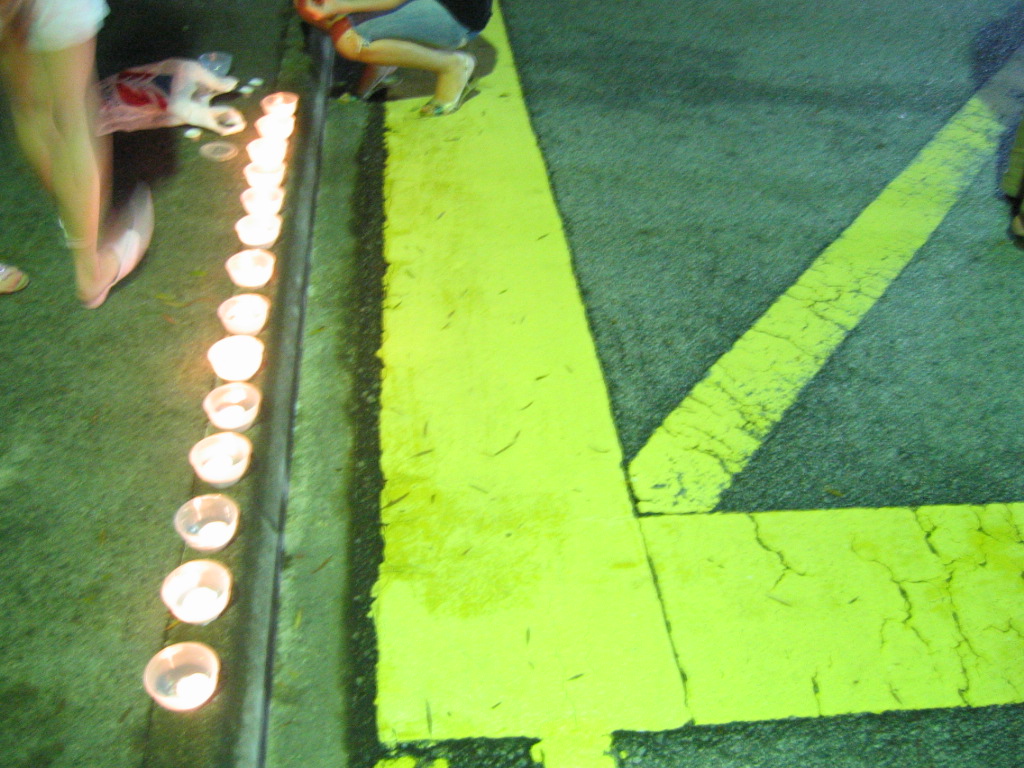
At 7pm, outside the Queenstown Remand Prison, a dozen of supporters gathered to keep vigil for the three men. It was our expression of solidarity with those who have been persecuted for exercising their rights to free speech. As darkness fell, the entrance to the cold, foreboding fortress was illuminated with the flickers of candles. Dr. Chee’s wife and three lovely children arrived and joined the group. Carrying a candle each, signifying the light we need in these dark hours of our nation, we accompanied the three prisoners of conscience till midnight.

A new supporter, Mr. Leong, was visibly touched by the gathering. He expressed admiration for our show of solidarity with our prisoner friends and was glad he came to share the moment with us.

The vigil-keepers found solace in each other. The mood was sombre, yet hopeful. We even joked about belting out a few familiar tunes in the hopes that our three friends will hear us. After all, it is hope that sustains us and keeps us going along the road towards genuine democracy for Singapore.

We intend to keep the light burning for the next seven days as a symbol of our hope for a free and democratic society. If you have similar hope and aspiration for your nation, we invite you to join us outside the Queenstown Remand Prison daily between 7 and 12pm.

Keep vigil with the 3 prisoners of conscience


WFDA statement on CSJ's imprisonment in Singapore

World Forum for Democracy in Asia
23 Nov 06

The World Forum for Democratization in Asia (WFDA) strongly condemns the jail sentence passed on one of our Steering Committee members, Dr. Chee Soon Juan, Chairman of the Alliance of Reform and Democracy in Asia (ARDA). The Subordinate Court of Singapore today sentenced him to five weeks in prison for the "crime"of speaking in public without a valid permit; his term began today. Two of his colleagues from the Singapore Democratic Party (SDP), Mr. Gandhi Ambalam and Mr. Yap Keng Ho, were also sentenced to shorter terms. The "offense"for which they were convicted was an instance of speaking to passing citizens as they were selling the party newspaper on the street on 22 April of this year.

This is yet another step in the ongoing judicial persecution of Dr. Chee and the members of the SDP. Dr. Chee has already been bankrupted and deprived of his civil rights, including the right to travel, as a result of a libel suit by Singapore's strongman Lee Kuan Yew and then Prime Minister Goh Chok Tong. Similarly, a critical article in the party's newspaper in the run-up to the general elections in May 2006 has resulted in a further libel suit against the whole party leadership, including ARDA's Secretary General and one of its staff members, who are likely to be rendered bankrupt at a separate hearing tomorrow (24 November). Dr. Chee also faces a further trial in December on charges of attempting to leave the country to attend the World Movement for Democracy Fourth Assembly earlier this year.

These actions have not taken place in a vacuum. In recent weeks, amendments to the Penal Code have been drafted to further restrict and criminalize many forms of speech, including internet content, drawing complaints from several international media organizations. In September, the Far Eastern Economic Review was banned, and accredited civil society representatives from many countries were refused entry for the IMF/World Bank meetings.

We call on the judiciary of Singapore to live up to its proper mission to uphold the rule of law by protecting the basic human rights of all Singaporean citizens, including the right to free speech and participation in public affairs. In particular, it should immediately cease this politically motivated persecution of Dr. Chee, overturn his prison sentence, and restore all his civil rights, including the right to stand for office and the unfettered right to international travel.

We further call on the international community, especially democracies in Asia and beyond, to place issues of human rights firmly on the agenda in their relations with Singapore. The government of Singapore must be made to understand that such repressive tactics are not compatible with Singapore's image as an advanced society. This process should begin at the upcoming 12th ASEAN Summit -- with its theme "One Caring and Sharing Community"– and the 2nd East Asian Summit, as well as in all relevant meetings with ASEAN dialogue partners.


Keep vigil with the prisoners of conscience


From the Singapore Democrats website

Supporters will keep vigil with the three democracy advocates, Mr Gandhi Ambalam, Dr Chee Soon Juan and Mr Yap Keng Ho, who have been jailed for speaking without a permit.

We will be present outside the Queenstown Remand Prison overnight from 23 Nov (Thursday) to 30 Nov (Thursday) from 7 pm to 12 am midnight.

Please come and join us if you want to show your support for the 3 prisoners of conscience, and the cause of freedom of speech and democracy in Singapore.

Bring along your family and friends.

UncleYap - Hunger Strike


I aclaim my right to hunger-strike even in prison under Article 12 and Article15 of Republic of Singapore Constitution, that my fasting in political faith equals to my religion, to be treated equal with fasting by Muslim or Hindu faiths.

23 Nov 2006

Blogger - UncleYap Begins Hunger-Strike

UncleYap Already Began Hunger-Strike
======================================
Commence at midnight right now, I begin my hunger-strike against corrupted Lee Kuan Yew famiLEE LEEgime. This strike will last until I announce otherwise. My plans had been anounced on my blog months ago, basically unchanged.

The strike is not just against politically motivated 17 charges against 3 of us for speeches, it is a general protest against a big series of corrupted oppressions and cheatings in General Election 2006.

* Nation Vote Buying via Progress Package distributing total of S$2.6 billion to voters just 5 days before polling day.
* Series of stinking defamation suits against Singapore Democratic Party & The New Democrats publication.
* Police Harrassments against Singapore Democratic Party election campaign and The New Democrats' sale.
* Corrupt Practises Investigation Bureau refused to probe nationwide Vote Buying, upon my report.
* Arresting of Workers' Party's candidate Mr. James Gormes.
* Election Department refusing to accept cash deposit, in collusion to fabricate excuese to dismiss Election Judge's hearing of Vote Buying & Election Corruption.
* 17 charges against Singapore Democratic Party election campaign accusing us of Speech Without License.
* Pressing Stinking Bankruptcy Suits against Singapore Democratic Party, & Chee Siok Chin.
* Cowardly bankrupting Dr Chee Soon Juan jsut before election aiming to prevent his campaigning during election.
* Cowardly baned Internet Blogs and Podcasting During Election.
* Cowardly trying to prevent police evidence video of election campaign from being accessed by public.

All the aboves are just to for covering up corrupted crimes and scandals of Lee Kuan Yew famiLEE LEEgime, which had been exposed by Singapore Democratic Party; The New Democrats; the 3 walk-about and meet-the-people preambulators of Singapore Democratic Party including myself; and recorded within the police video recording which is now an evidence in court. Crimes and scandals such as:

* Nation Vote Buying via Progress Package distributing total of S$2.6 billion to voters just 5 days before polling day.
* National Kidney Foundation Scandals
* Investing tax payer's money in Myanmar in close connection with drug criminal syndicate of Lo Shing Han family
* Collusion with Thailand's corrupted Thaksin family
* Profiteering via world's highest ministerial salaries
* Maintaining a famiLEE feudal LEEgime which father's political power is succeeded by son in violation of Republic Constitution

My strike is to bring awareness and make political statement, and remind Singaporeans to fight against corrupt famiLEE LEEgime, to punish corrupted criminal particularly from the famiLEE. To remove shameful corrupt practises. To retain national pride and integrity for our children and future citizens. I will call off my hunger-strike at moment deem fit by myself.

Most of my hunger-strike is expected to take place within Queens Town Remand Prison.

Activists may gather and stage civil actions outside prison during our imprisonment such as candle lighting. Supporters are encorage to attend the court sentencing on 23.Nov.2006 at court 18 of Subordinate Court.

As SDP's web had been hacked today, Internet activist are asked to mirror and download then re-post the site, and remind internet community to observe alternate blogs such as:


http://cheesoonjuan.blogspot.com/
http://uncleyap-news.blogspot.com/
http://forums.delphiforums.com/sammyboymod/messages


Singapore jails opposition leader Chee Soon Juan over public speaking

From SDP site
Koh Gui Qing
Reuters
23 Nov 06

A Singapore court jailed an opposition leader for five weeks on Thursday over his failure to pay a fine for speaking in public without a permit.

Chee Soon Juan, one of Singapore's most vocal opposition politicians and leader of the tiny Singapore Democratic Party, committed the speaking offence on April 22, two weeks before the country's general election.

The court initially fined him S$5,000 and because he refused to pay, he and two of his supporters were jailed.

"Every hour, every day, every month that I spend in jail only strengthens my resolve to fight," the 44-year-old Chee told the court before the verdict was read.

Chee hugged his wife and three young children before police led him away.

A vocal campaigner for human rights and free speech, Chee was jailed for eight days in March for questioning the independence of Singapore's judiciary. He was jailed for five weeks in 2002, and 12 days and one week in 1999 for speaking in public without permit.

Chee grabbed world headlines in September, when he and a small group of supporters spent four days in a public park as Singapore police blocked them from holding a protest march during the IMF-World Bank annual meeting in Singapore.

SDP supporters Yap Keng Ho and Gandhi Ambalam were fined S$2,000 and S$3,000 respectively. As they also refused to pay, they will be jailed for 10 days and three weeks respectively.

Singapore has been criticised by human rights groups such as Amnesty International for its tight controls on political expression, and the use of defamation lawsuits by Singapore's leaders to silence and bankrupt opposition politicians.

The city-state has been ruled by the People's Action Party (PAP) since independence in 1965. Its Public Entertainments and Meetings Act (PEMA) prohibits public speaking unless speakers have been licenced by the government.

"The PEMA has been used by the PAP to prosecute and deter legitimate political activity," Chee told the court.

Chee -- declared bankrupt in February after failing to make libel payments of S$500,000 ($322,000) to former Prime Ministers Lee Kuan Yew and Goh Chok Tong -- said he had "absolutely no remorse" for his actions, and vowed to continue fighting for democracy in the city-state.

The SDP did not win any parliament seats in the May election, but won 23 percent of the votes in the wards that it contested.

Chee and his sister, Chee Siok Chin -- also a senior member of the SDP -- are also facing a defamation lawsuit launched by Prime Minister Lee Hsien Loong and his father Lee Kuan Yew over an article in the SDP's newsletter.

Chee Siok Chin told Reuters that a group of SDP supporters will hold vigils outside the Queenstown Remand Prison to protest against the imprisonment.

An acerbic critic of the Singapore government, Chee has had several run-ins with the PAP. In 1993, months after he ran in a by-election for the SDP, Chee was sacked from his job as a lecturer at the National University of Singapore, which accused him of improperly using S$226 (US$137) for postage.

When Chee said the evidence was fabricated, he was sued for defamation by his former department head -- a PAP member of parliament -- and ordered to pay $200,000 plus court costs.

Dr Chee Soon Juan's statement:Trial a mockery of justice

For more information and update, please go to:

http://www.singaporedemocrat.org

And how is this reported in the PAP controlled state media Channel News Asia. Note the headline and then read the article. The accused all 'decided' of their own volition to go to jail.

Chee Soon Juan fined $5,000 for speaking in public without a licence
By Noor Mohd Aziz, Channel NewsAsia Posted: 23 November 2006 2142 hrs

Singapore Democratic Party's Secretary-General Chee Soon Juan was on Thursday ordered to pay a fine of $5,000, or face five weeks in jail, for speaking in public without a licence on April 22.

Two other party members were also fined.

Gandhi Ambalam had to pay $3,000 or 3 weeks in jail while Yap Keng Ho was sentenced to a $2,000 fine or 10 days in prison.

According to family members, all three refused to pay their fines and decided to serve their jail terms.

Seven other charges against Dr Chee and Yap for speaking in public without a licence, will come up for mention at a later date.

Under the Constitution, anyone fined $2,000 or jailed for one year, or both, is barred from standing for elections for five years. - CNA/ch


22 Nov 2006

Mixing welfare and elitism in Singapore

By Alex Au

SINGAPORE - Is Prime Minister Lee Hsien Loong moving to soften the island state's time-tested capitalist credentials with state welfare policies for the poor?

Growing economic inequality has put Lee to the political test, one that is challenging his economic lieutenants to devise ways to redistribute national wealth consistent with Singapore's strong laissez-faire capitalist tradition. The formula they've arrived at, however, seems likely to widen rather than bridge the divide.

In mid-November, Lee announced government plans to raise the goods and service tax (GST) from 5% to 7%. The tax hike is designed to generate about S$1.5 billion (US$960 million) annually, funds that will be earmarked to develop a more generous social safety net. "It's essential for us to tilt the balance [of spending] in favor of lower-income Singaporeans because globalization is going to strain our social compact," Lee said upon announcing the policy.

It was an unusually candid admission for the leader of the ruling People's Action Party (PAP), the political machine that Lee's father, former premier and current Mentor Minister Lee Kuan Yew, founded and that has ruled Singapore uninterrupted since the country's founding in 1959. Strict adherence to neo-liberal economic prescriptions and policy promotion of an export-oriented economy contributed to Singapore's emergence as one of Asia's richest countries in the 1980s and 1990s.

Now, it appears those same policies are disproportionately lifting the top tier of society while leaving a growing number of lower-wage earners in the economic lurch. That trend arguably began with the 1997-98 Asian financial crisis when, government statistics show, the wages of lower-skilled workers fell by about one-third.

Despite economic recovery, the income gap has continued to widen as Singapore's past advantage in manufacturing industries has been eroded by China and other lower-cost countries in the region. Over the past five years, about 20% of Singapore's households have suffered from declining incomes. And that's arguably starting to take a toll on the PAP's popularity.

Political reaction

Prime Minister Lee's pronouncements and policies are clearly a reaction to those shifting perceptions. Details of the various proposed new welfare schemes - known provisionally as "offset packages" - will be announced in February along with the state budget. Indications are that existing modest schemes to subsidize elderly health care, housing and education will be topped up and many new welfare schemes introduced.

Lee has said that the so-called "workfare bonus" - an unprecedented cash payout to low-wage earners introduced as a one-off measure just weeks before last May's general election - would be employed to redistribute government budget surpluses back to taxpayers.

The PAP in the run-up to the polls doled out S$150 million of bonuses to about 330,000 low-wage earners, representing about 9% of Singapore's population of citizens and permanent residents. That payout anticipated but didn't blunt opposition parties' class-oriented attacks against the PAP-dominated government, claiming it systematically neglected the island state's many low-wage earners.

The PAP won those polls handily, capturing 82 of 84 parliamentary seats - though the weak opposition has since the 1980s claimed that the election system is structured and regulated in ways that inhibit small parties from fielding candidates, including the requirement that parties must assemble an ethnically balanced six-member committee to contest some electoral constituencies.

Yet the prickly income-inequality issue was quickly resurrected one month after the elections when a blogger writing under the pseudonym Mr Brown pointedly asked why official data that showed that 20% of national households were suffering from declining incomes were released after rather than before the general polls.

For his pains, Mr Brown's regular column in the government-owned Today newspaper was brusquely terminated - fueling outrage in Internet chat rooms about the government's heavy-handedness and apparent lack of transparency. Meanwhile, the PAP-led government proposed this month to tighten laws that govern the Internet as part of an overhaul of the national penal code.

The proposed amendments would hold Internet users liable for statements the government deemed to "cause public mischief" or "wound racial feelings". If passed, the legislation would appear to institutionalize the ban on posting inflammatory political content the government enforced temporarily in the run-up to this year's polls and would give it broad new powers to curtail freedom of expression.

It's unclear whether public debates over the Internet about the GST rise would be considered "mischievous" under the proposed new rules. Some commentators have already dared to note that raising the consumption tax is by definition regressive and will hit poor households harder than rich ones as they are forced to spend a greater proportion of their income on tax-inflated necessities.

The Singapore Chinese Chamber of Commerce, a grouping of about 4,000 mostly small businesses, likewise took the chance to express its "great concern and disappointment" about the tax hike. That's because the policy has the dual purpose of also covering the expected shortfall in tax revenues that will occur when the government cuts corporate-tax rates from their current level of 20%. It has not yet been announced when the new lower tax rate will take effect, but Singapore is under growing competitive pressure to reduce its tax rates to remain attractive to foreign investors.

To justify his government's corporate-tax cut, Lee recently said in parliament that developing Baltic nations such as Latvia and Lithuania levy a flat 15% tax on corporations. More to the competitive point, Hong Kong's top personal income-tax rate is currently 16%, a full 4 percentage points lower than Singapore's rate.

"Such a reduction would only benefit profitable companies and not the significant majority of small and medium-sized enterprises which have to contend with high business overheads and a dwindling bottom line," the Singapore Chinese Chamber of Commerce said in a statement.

The unspoken subtext is that raising the GST while cutting corporate taxes will in effect shift the tax burden from big companies to ordinary citizens, particularly lower-income Singaporeans, some commentators say.

While the details of the promised new welfare schemes are still pending, the PAP-led government is headed into an uncharted and difficult interventionist direction.

On the surface, Lee's government appears to have shaken its historical aversion to welfare schemes and taken on board providing long-term state assistance to a large cross section of the population. Singapore currently does not impose minimum wages, nor are there state-backed pension plans as in many Western countries. In nanny-state fashion, each Singaporean is currently compelled by law to set aside a certain proportion of his or her income for retirement purposes.

The government insists it will fashion the new assistance schemes in a way that avoids institutionalizing the economic lethargy and dependence inherent in Western welfare systems. Lee recently told parliament: "I would like to caution members that we should proceed with care ... it is a real slippery slope. And many, many social-welfare schemes which have ended up in serious trouble have started off with good intentions."

Notwithstanding those words, the scale of the proposed changes suggests a fundamental philosophical shift for the PAP. That's largely because the growing chorus of complaints about the widening income gap has grown politically too loud to ignore.

Entrenched elitism

The issue is also significantly tied to growing public perceptions about elitism among PAP members of parliament (MPs) and their family members - a perceived social arrogance and economic selfishness that increasingly sticks in the craw of many Singaporeans, particularly among low-wage earners.

Sin Boon Ann, a PAP MP, recently highlighted the danger of class conflict in a speech to parliament. "The perception exists that Singapore is a society bifurcated between the elites and the commoners, the scholars and the normal streams, the gifted and the ordinary, the [public housing] dwellers and the private property owner, the rich and the poor," the parliamentarian said. It is necessary to "break down the institution of snobbery within our society", he said.

He spoke amid a surge in cyber-criticism aimed at PAP MP Wee Siew Kim. In a now-famous exchange in Singapore's vibrant blogosphere, Derek Wee (no relation to the parliamentarian) wrote in his blog on October 12 about his economic insecurities as he approached middle age. He opined that Singapore's liberal immigration policies were putting his job at risk, and he urged the government to be more understanding of ordinary citizens' plight.

An 18-year-old girl in her own blog replied and disparaged Derek Wee's concerns, saying, "If you're not good enough, life will kick you in the balls ... There's no point in lambasting the government for making our society one that is, I quote, 'far too survival-of-fittest'.

"If uncertainty of success offends you so much, you will certainly be poor and miserable," the young blogger added. She went on to refer to Derek Wee as "one of many wretched, under-motivated, over-assuming leeches in our country", and rounded off her attack by telling him to "get out of my elite uncaring face".

It was quickly discovered that the girl, Wee Shu Min, was the daughter of a less-known PAP MP, demonstrating to many Internet users that Singapore's highly touted meritocracy was being undermined by an intolerant elitism at the top. Her name, "Wee Shu Min", rocketed to the top of keyword searches in Singapore as measured by Technorati.com.

Her father, Wee Siew Kim, later unapologetically waded into the controversy. "I think if you cut through the insensitivity of the language, her basic point is reasonable," he told the government-controlled Straits Times newspaper, adding: "Some people cannot take the brutal truth and that sort of language, so she ought to learn from it."

It is against this ferment that Lee's government is now emphasizing the need for long-term social support for the poor, and at the same time moving to curtail political debate over the Internet. Yet Lee's tax reforms and welfare promises are unlikely to bridge quickly the divide between his government and its low-income constituents. It's an issue that promises to dominate Singapore's popular discourse and give Lee political headaches for years to come.

Alex Au is an independent social and political commentator and freelance writer based in Singapore. He often speaks at public forums on politics, culture and gay issues.


Myanmar: Life under sanctions

Published on Al Jazzera,
Tuesday, November 21, 2006
By Veronica Pedrosa in Yangon, Myanmar

===

On the bustling streets of Yangon, there is little on the surface to differentiate it from other South-east Asian cities.

The buses are overloaded, hawkers at street stalls yell out to attract buyers. In the music shops you can buy Myanmar rap, while hip hop-style graffiti is daubed on pedestrian crossings.

But this is urban life under a military government and things are not what they seem.

Residents go about their daily business in spite of US sanctions aimed at forcing the hand of the military government, and in spite of the extraordinary control that government exercises in every facet of their lives.

In the main streets it seems as if there is brisk trade at the stalls, but take a walk down the back streets, you can see how sanctions have forced people to be resourceful.

Repair shops are a common sight in a country where goods need to last longer.

The government says the economy is growing at 12 per cent a year - faster than China - but there is little evidence to bear that out.

In a country used to isolation, sanctions have only hardened the military's position against the US...

To read more...

21 Nov 2006

Singapore Human Rights Lawyer M Ravi Assaulted in HongKong


First spotted on SammyBoy Forum and further follow up reports are available on Uncle Yap. Apparently M. Ravi is now safely back in Singapore. Hopefully the Singaporean or Hong Kong police can identify the attackers as soon as possible and press charges.
Time now is 1855Hr. Saturday 18.Nov.2006
I just received call from HongKong ChakLapKok Airport that Singaporean Human Rights Lawyer M Ravi had been assulted by 3 Chinese Singaporeans at the airport. The assiliants are recognizable as about 40 years age, name of one person is known.

M Ravi is injured with bruises, and he had been given threats to have Lee Kuan Yew government finishing him of when he returned to Singapore.

According to Ravi, his attackers are racist against Indians, and that also being the basis of the attack.

Another Chinese Singaporean traveling with Ravi had not been assulted. The assult just happened 15 mins ago.

Police at HongKong airport had been reported to, and I will report to Singaporean Police and Changi Airport. Updates will follow.

M Ravi was acting in my defence against charges under Public Entertainment & Meeting Act, on the 3rd day of my trial he got suspended from bar by The Court of Appeal. My trial began on 25.Oct.06.


Hong Kong's migrant workforce exposes wealth gap

HONG KONG, China (Reuters) -- Take a stroll through Hong Kong's downtown Victoria Park on any given Sunday and one can witness a unique social ritual as the city's one million domestic helpers revel in their weekly day off.

Sitting around in garrulous groups; Indonesian and Filipino maids can be seen chatting loudly, picnicking on home-cooked dishes, singing and dancing -- often to the accompaniment of musical instruments.

It's a boisterous, jubilant scene, beyond the dreams of maids around Asia including those in Singapore, who get just one rest day off a month -- if they're lucky.

But life for Hong Kong's migrant workforce is anything but easy. Working hours can be extremely long, and many lack any privacy in the city's cramped flats. Sometimes space is so scarce, maids have to sleep on makeshift beds on kitchen floors.

There also exists in places like Bethune House -- a shelter for migrant helpers -- a seamier world of maids suffering financial exploitation, underpayment, physical abuse and worse.

Tanuj Rai, a gentle, soft-spoken 24-year-old Nepali woman who's been living in Bethune House for the past nine months was abused and blackmailed by her employer.

"I was raped many times. I had no friends," she said.

Tanuj and others in the shelter, have been seeking redress for crimes committed against them, but the slow legal proceedings have left them jobless, poor and in a kind of legal limbo.

"The women are discouraged to lodge complaints because that would mean several months of no wages, so many just go back," said Edwina Antonio-Santoyo, who runs the shelter.

"Only these women are courageous enough to file complaints against their employers," she added.

By Asian standards, maids in Hong Kong are relatively well paid and are protected by labor laws.

But a notable number face widespread financial exploitation by employers and employment agencies, who flout minimum-wage laws with sophisticated under-the-table deals.

Social Workers say many maids work in situations of near "debt-bondage", forced to pay crippling placement fees of up to eight times their monthly salaries. But the Hong Kong government has shirked responsibility for the problem, saying the maids first incurred these debts in their home countries.

"The problem with the Indonesian workers is that they're very innocent, they never have knowledge of law in Hong Kong so they accept what the agency will offer," said Eni Lestari of the Asian Migrant Workers Co-ordinating body.

Wealth and abuse
The migration of workers from poor countries to more affluent ones is illustrative of Asia's gaping wealth gap, with affluent Singapore, like Hong Kong, able to employ maids en masse.

But Singapore, which has around 150,000 helpers, has gained a notoriety for headline-grabbing abuses against its migrant workforce, exacerbated in part, by government inaction.

Dewi Ratih for instance, a 24-year-old Indonesian from Central Java, was beaten repeatedly with a bamboo pole by her employer, who also burned her arms with a clothes iron.

"I was there for only a few weeks... If I had stayed there longer, I might have died," said Dewi, displaying unhealed welts on her arms.

Groups like Human Rights Watch say abuses against maids like Dewi are widespread in Singapore, a situation at odds with the city state's reputation as a wealthy, racially diverse and progressive society.

"They do have the power to enforce many laws and become a model for other countries, but they've remained one of the worst case scenarios," said Nisha Varia, a researcher with Human Rights Watch and author of a detailed report on the issue.

While Singapore's laws offer better protections than do neighboring countries like Malaysia, maids still face long working hours, pitiful wages and conditions amounting to "forced labor," as well as sexual and verbal harassment, she said.

So far, Singapore's government has been reluctant to grant maids full legal rights. Earlier this year, it made headlines by rejecting calls to give maids a statutory day off every month, arguing this would "inconvenience households."

"I think it's a surprise that the Singapore government isn't taking the necessary steps to change the situation... The changes they've made have been so superficial and none have addressed the root causes of the problem," said Varia.

Gradual empowerment
Back in Hong Kong, there is perhaps an important lesson to be learned -- that progress, while difficult, is possible.

When the first Filipino maids arrived in the late 1970s, they had scant rights. It was only through sustained activism that they become more empowered, winning landmark protections like a minimum wage.

Nowadays, Church groups and increasingly sophisticated support networks are confident enough to fight the government in court and organize mass street protests.

"Nothing was given to us. We had to fight for everything," said Antonio-Santoyo of Bethune house, "It's the painstaking organizing work of the Filipinos who started forming organizations in the mid-'80s."

Copyright 2006 Reuters. All rights reserved.This material may not be published, broadcast, rewritten, or redistributed.


20 Nov 2006

Canadian professors write CSJ protest letter

Sourced at Singapore Democratic Party site.

19 Nov 06
October 20, 2006

The Honourable Peter Gordon MacKay
Minister of Foreign Affairs
House of Commons
Ottawa, ON
K1A 0A6

Dear Minister MacKay,

Re: Dr. Chee Soon Juan

We are writing on behalf of more than 55,000 academic staff at over 100 universities and colleges across Canada to express our concern about the continued persecution of Singapore scholar and democratic opposition leader Dr. Chee Soon Juan.

Singapore's government claims to be encouraging a more participatory, inclusive society, but in practice continues to use an array of laws to restrict freedom of expression. The result is a pervasive climate of fear in the country, and Dr. Chee is one of the few people in Singapore still willing to press for fundamental rights.

Dr. Chee is an academic and activist who has tirelessly promoted freedom of expression, transparency and democracy within Singapore and throughout the Asia Pacific region.

He is recognized internationally as a human rights defender and has received the Defender of Democracy Award by the respected organization Parliamentarians for Global Action. He is the author of several books, journal articles, editorials and essays, and has traveled around the world to speak out for democracy.

While in Canada in 2003, Dr. Chee met with government and several academics to discuss his struggle. Dr. Chee has been held in contempt for attempting to raise the same concerns about the independence of the Singapore judiciary that have been repeatedly raised by international observers including Amnesty International, Lawyers Rights Watch Canada, the International Commission of Jurists, Human Rights First (formerly Lawyers Committee for Human Rights) and the United States Department of State. Government officials have publicly branded Dr. Chee a "liar", "cheat" and "fraud" in apparent attempts to discredit and silence him.

He has been imprisoned several times, and repeatedly prosecuted, all for non-violently exercising his fundamental human right of free expression. An accomplished neuro-psychologist, Dr. Chee has lost his university post, and his academic career has been destroyed.

He was bankrupted earlier this year, unable to pay 500,000 Singapore dollars (500,000 Canadian dollars) in damages to Senior Minister Goh Chok Tong and Minister Mentor Lee Kuan Yew for allegedly defaming them during the 2001 election campaign. His bankruptcy means he is now barred from contesting elections and holding a parliamentary seat.

We were encouraged to learn that Canada demonstrated its concern by sending a representative of the Canadian High Commission in Singapore to attend Dr. Chee's trial in March this year.

The Singapore government, however, continues to try to silence Dr. Chee. Earlier this month, he was charged with trying to leave the country without asking permission, and if convicted, could be fined thousands of dollars and jailed for up to two years.

We believe that in the face of continued persecution of Dr. Chee by the Singapore government, Canada and the international community need to do more.

We urge you to take further steps and, where possible, work with other governments to impress upon the government of Singapore that its public statements about working towards a more inclusive participatory society must hold true.

It is vital that the Singapore government desist its abuse of civil or criminal proceedings against Dr. Chee and other dissenting voices in Singapore, and lift its restrictions on peaceful exercise of free expression and other fundamental rights in Singapore.

Sincerely,

Greg Allain James L. Turk
President Executive Director
Canadian Association of University Teachers


cc. His Excellency Vanu Gopala Menon, Permanent Representative of Singapore to
the United Nations and High Commissioner to Canada

The Singapore Sink

Apparently, it does not matter if Singapore sinks.

Today's Straits Times, Science section, 18 November 2006, an article entitled 'S'pore will practically disappear' is a shocking title.

I am not sure if it was meant to be sensational but it certainly caught my attention. Based on an interview with Sir David Attenborough, he was quoted as saying, "Singapore will practically disappear".

This disappearance, according to the article, would be caused by global warming. The aforementioned phenomenon is caused by rising temperatures due to burning of fossil fuels which leads to an increase of carbon emmisions in the atmosphere. One of the disastrous consequences of global warming is the rise of the sea level which will sink Singapore, as we contain low- lying coastal areas.

Page 44 of the Straits Times contains two articles with global environmental themes, "Global Warming 'also affects small nations' " and "24 hours of freak weather Down Under".

The former contains keypoints of a speech delivered by Dr Yaacob, Singapore's Environment and Water Resources Minister at the UN Climate Change Conference in Nairobi. In his speech, Dr Yaacob talked about how the Singapore government supports the United Nations Framework Convention on Climate Change (UNFCCC) and is a signatory to the Kyoto Protocol (earlier this April). He also revealed the process on how we switch from carbon- intensive oil fired power plants to clean new low- carbon intensive, natural- gas- fired systems and erecting environmentally sustainable buildings.

Sure the Singapore government is appearing to be doing its best when it comes to reducing global warming within our frontiers. Whether they could have done more is another topic for discussion.

The very apparent problem is that we are not sending out stronger signals to our trading counterparts that global warming is a serious and important issue.

When George Bush was in town on Thursday, the Singapore government did not talk about global warming with him.

America and Australia, of whom we have close business relations, are two remaining developed countries that have yet to sign the Kyoto protocol. We also have close business relationships with China and India which are heavy and growing contributors to global warming.

We can argue that the Singapore government has been diplomatically wise to avoid discussing global warming issues with these trading partners. The perverted logic is this, "We are a small nation and hence, we should not ruffle the feathers of these influential countries."

Yet, this is not a justified assumption given the direct consequence is the sinking of Singapore.

We must put it on the talks as an agenda item with other governments as global warming affects the world. More importantly, it can and will destroy us, perhaps much faster, as we are much smaller physically and hence, probably the first to sink, if a major natural catastrophe occurs.

If Singapore does not exist, how can we even talk about trade or economic well- being?

According to the other article, "24 hours of freak weather Down Under", Australia is seeing insane weather conditions. Sydney experienced its coldest November day since 1905 with temperatures dropping to as low as 8 degrees centigrade. Parts of Victoria and Tasmania are also seeing snow. Yet, it is supposed to be summer now. The irony was that firefighters were struggling against blazes in the Blue Mountains when the temperature was hovering around zero. These are just a few examples of how crazy the weather has become in Australia, whom I need to remind you, is not that far from us.

However, Dr Yaacob, in his speech reiterates that "any climate change regime must take into account the principle of common but differentiated responsiblities" and that "developing countries had a right to energy for development".

If countries with major trading powers are allowed to get away with it, and risk the survival of Singapore literally, our government must have the temerity to stick their necks out and raise global warming as a discussion topic with these countries with whom we have close trade relations with.

18 Nov 2006

Protest At Bush NUS Visit

A blog post by Gabriel Seah, a student at the National University of Singapore where President Bush spoke on Thursday. The post contains 2 video clips, one of the protester brandishing a black umbrella at the police.


Bush at NUS


Bush's extremely long motorcade, and the heckling. At first I thought NUS Campus Security brought up the rear, but it turns out they were police cars. No wonder the former shares the latter's colours. Actually you can't hear the heckling. I'm quite sure I took a video of it ("Boo!", "Go home!", "We don't want you here!"), but maybe something went wrong (d'oh!) or it just can't be heard due to technical problems. You can see the umbrella being waved at the motorcade though. Also this video would've been longer, but Gayle called me while I was shooting it. Grr.


Umbrella girl shows her umbrella to the police cameras, to applause from the onlookers.


to view all text plus pictures of the protest click here.

Today To Toe The Line

Spotted this on Singapore Elections and the source is allegedly Sammyboy's Forum. Read the following, but the 'truth' of it is open to debate...

Hello all. This fell onto my lap.

Days after the shocking staff reshuffle in Today, the "resignation" of Mano Sabnani was used as a warning to others in Today to toe the line. On Nov 12, P N Balji and some senior editors were told by Mediacorp Deputy CEO Shaun Seow that Today should tone down its alternative streak at least for the moment until the coast is clear.

During the half hour meeting in the morning, Shaun reiterated that Mediacorp had top-down and bottom-up pressure to remove Mano, who was a lousy people manager. The final straw was Mano's handling of the Mr Brown affair and his anxious decision to terminate Lee Kin Mun's popular weekly column. Mano had over-reacted and misread the government's anger after his experience in the Val Chua incident. As a result of Mano's action, the public became incensed with what they saw was the strong interfering hand of the government in removing their favourite columinist from Today.

The topic then changed to editorial hooks. While no names were mentioned, Shaun said that the angles by certain Today editors during the 2006 General Election were touchy and it should not become a habit. Shaun tried to reason with his increasingly uncomfortable audience that his hands were tied and everybody better play ball or they might suffer an even worse fate than Mano. Mano had at least an ex-gratia payment upon his departure.

Shaun reminded them that the political masters have them sighted and keeping their heads down was sensible.

After the meeting, everyone trooped out with dark looks and a worried Balji, Today's returned founding editor, was frustrated that he had to deal with more morale problems, although Today was already turning profitable.

By afternoon, whispers soon began circulating about their spineless leadership who dare not stand up and insist on editorial independence. Derrick Paulo is one reporter who feels that he might be the next sacrificial lamb. Balji is just the seat warmer for Walter Fernandez, the new number two in Today. Walter is eager to please but is trying not to attract too much attention to himself in Today's management mess. He is bidding his time and letting Balji take the heat.

So, don't expect Today to be like what it was.


The NMP Farce

It is beneficial to have plurality of voices in debates. Yet, the current NMP system is not viable for two very basic reasons. It is unconstitutional and anti- democratic.

Unconstitutional as our statutes does not provide for certain people, which may be considered as outspoken members or elites, to have a voice in parliamentary debates.

Anti- democratic for the NMP is chosen by the government and not elected. Though NMPs do not have any voting rights in parliament, their outspoken position means they can alter or effect the course of parliamentary debates. Moreover, the procedure for choosing these NMPs are neither transparent nor accountable.

They are chosen by the government for their prominent positions in their sectors, and sometimes thought by the government to be representative voices of these sectors. However, even within these smaller communities, it does not always follow that the voices may be unified and that the selected individual is representative of those voices.

The current list of Singaporeans being bandied around for the NMP posts may be outspoken and respected individuals in their fields but it cannot be thus guaranteed that they should have a voice in the parliament.

There is also the problem of which sectors or groups should have a privileged voice in parliamentary debates. Why are gay representatives not included? Foreign workers? Single parents? Where is the litmus test on who should be chosen?

It has also often been argued that the NMP system is PAP's way of co-opting opposing voices, or to be seen as accepting of pluralistic views.

There is no doubt that we cannot continue to endorse the NMP system. It makes a mockery of what democracy is.

PAP - chosen individuals asked to become NMPs should flatly decline the offer and publicly denounce the selection process. By rejecting the NMP nomination and openly stating their reasons for not doing so, they are destroying the perpetuating myth that Singapore is a functioning democracy.

===

The above short commentary is in response to a news article on TODAY, published on Friday November 17, entitled, "Wanted: Less conventional NMPs; SINGAPORE: As the month-long race to put up names for Nominated Members of Parliament (NMPs) for the 11th Parliament kicks in, names are already being bandied about."

17 Nov 2006

CNN Sg vs. Media


16 Nov 2006

Singapore and Thailand face showdown over Temasek

Bangkok contends Shin deal broke law
By Wayne Arnold
International Herald Tribune

They have been careful to appear cordial, but in the polite language of Asian diplomacy, a stubborn standoff has emerged between Thailand and Singapore over how to handle Singapore's purchase of the deposed Prime Minister Thaksin Shinawatra's telecommunications assets, and a legal confrontation between them is looming.

The troubles between the two Southeast Asian neighbors began in January, when Singapore's investment arm, Temasek Holdings, purchased a controlling stake in Thailand's dominant phone company, Shin, for $1.9 billion. That stoked public protests in Thailand over foreign ownership of a national champion and the Thaksin family's tax- free windfall - adding to charges of alleged corruption that culminated in the September coup.

With Thaksin in exile, both governments have stressed that their relations are on track. Yet the two are now at loggerheads over Shin.

The new, military-appointed Thai government, determined to document the corruption used to justify the coup, is preparing a criminal case against Temasek and its Thai partners over the purchase. It also has signaled that it would like Temasek to voluntarily reduce its stake in order to avoid having to force an important foreign investor to divest.

Such a face-saving solution is anathema to Singapore, however, which denies breaking any laws.

"The two find themselves in a difficult situation," said Karen Ang, an analyst who follows Shin for Citigroup in Bangkok.

The stakes are high. Shin's falling share price since January has already added up to paper losses at Temasek of almost $680 million. That could rise if a court ruling against Temasek puts it in the position of a forced seller.

Analysts say Temasek failed to grasp just how political taking control of Shin would be. While cutting its losses now might take the diplomatic sting out of an awkward situation, it presents another problem.

"Selling at a loss would be admitting that, yes, we indulged in a transaction that wasn't very transparent and was legally wrong," said Vikas Kawatra, head of institutional sales at Kim Eng Securities in Bangkok.

The new Thai government, for its part, cannot very well drop an inquiry that has become the centerpiece of investigations into alleged corruption during Thaksin's rule.

"They're very, very worried about him making a comeback," said Bob Broadfoot, Managing Director at the Political & Economic Risk Consultancy in Hong Kong. "There's no way in the world they can take Shin out of this political equation."

But in challenging the legality of the Shin deal, Thailand's reputation among foreign investors - a major source of capital for development - may suffer.

Building up Shin made Thaksin a billionaire. He transferred ownership to his eldest son and daughter when he became prime minister in 2001. But he was fending off allegations that he used his office to benefit the company when Temasek stepped in. After the purchase, Temasek and its partners were obliged to make a general offer and ended up with a 96 percent stake, as well as control of Thailand's largest cellular operator, a TV station and a satellite company.

What incensed Thai protesters was that the Singapore government had not only gained control of critical national assets but that it had seemingly helped Thaksin's family cash out tax-free.

Temasek has denied that it knew the deal would be tax-free.

Temasek's chief executive, Ho Ching, has been largely silent, but her husband, Prime Minister Lee Hsien Loong of Singapore, rose to Temasek's defense in early October, saying the Shin deal did not violate Thai laws.

Singapore's influential founding prime minister, Lee Kuan Yew, who is the current prime minister's father and holds a senior position in his cabinet, added his voice.

"It can withstand any investigation," he said of the deal. "Nobody doubts that, nobody within the system doubts that."

After meeting with Lee, the prime minister, in China in late October, Thailand's new prime minister, Surayud Chulanont, said the issue would not upset diplomatic relations. But he also said the government would not intervene in efforts to prosecute Temasek and its partners.

Analysts note that Surayud skipped Singapore during his first tour of Southeast Asia as prime minister, a snub shared only by tiny Brunei and the diplomatic outcast Myanmar.

Singapore bought control of Shin through a complicated holding structure, which lawyers and analysts say has been used for years to avoid falling afoul of Thai limits on foreign ownership. Among the most prominent examples are the German logistics company DHL and the French supermarket operator Carrefour.

Pick at the Shin deal, they warn, and a host of other foreign investments could unravel.

The Thai government has promised eventually to amend the foreign investment law to clear up any confusion over holding companies. In the meantime, regional media have reported talks between the Thai government and Temasek, with the Thai government offering a "road map" for a settlement that calls for Temasek to reduce its combined stake in Shin below the 49 percent legal limit for foreign ownership of a telecommunications company.

Temasek has said only that it plans to sell about 11 percent of Shin to comply with Thai stock market rules. Those stipulate that a listed company must have at least 15 percent of its shares "free floating." Companies that end up not conforming to the limit, through a merger or general offer, are given a year to rectify the situation.

The criminal allegations against Temasek and its partners are separate, and center on accusations that one or more of the minority shareholders in the Shin deal was an illegal "nominee," or proxy, for Temasek, enabling it to skirt the foreign ownership limit.

It is unclear, however, when any criminal case over Shin would go to trial. The Thai Ministry of Commerce handed the case to prosecutors in early October, and Thai critics accuse prosecutors of foot-dragging to buy time for an amicable settlement.

Temasek's efforts to blunt public criticism have not appeared very effective. Last month it said it would set up an office in Bangkok headed by a former Singapore air force chief and a private secretary to Thailand's crown prince, Tongnoi Tongyai, who resigned the day before from the board of a rival cellphone operator.

A week later, Temasek withdrew Tongnoi's appointment and the crown prince issued a rare statement criticizing Tongnoi for abusing his position, denouncing him as cunning and immoral.

"It really shows a lack of understanding of the full political dynamics," Broadfoot said of Temasek's decision to hire Tongnoi.

But analysts say time is on Temasek's side; with few potential buyers willing to step into the political hornet's nest, Shin's share price has been rising on hopes that Temasek will eventually sell. With no court date in sight, analysts say Temasek may be able to hold out for the situation to improve.

"If I were Temasek," said Kawatra at Kim Eng, "I wouldn't do anything either."


Lee family's role in the Shin Corp deal
Published Wednesday, October 18, 2006 by Singapore Election

Thanong Khanthong
The Nation
17 Oct 06

Lee Kuan Yew, the patriarch of Singapore, is believed to have played an important role in convincing his son, Prime Minister Lee Hsien Loong and daughter-in-law, Madame Ho Ching, that Thaksin was a sure bet because of his strong grip on power, according to a well-informed financial source.

Thaksin was a recipient of Lee senior's leadership award. And he was seen as the kind of person Singaporeans could do a deal with.

When Ho Ching, who is chief executive of Temasek, decided to buy into Shin Corp last year, she did not insist on Temasek's financial adviser, in this case Goldman Sachs, conducting a due diligence investigation into the Thai company, then owned by the Shinawatra family.

Due diligence is normal procedure for a prudent investor, often going beyond a company's solvency and assets and probing civil and criminal litigation matters, conflicts of interest, insider trading and press and public records that identify problems with a target company.

Temasek was assured that, with Thaksin in power, all legal obligations and any problems arising from buying into Shin would be taken care of. The takeover was struck on a personal basis.


to continue reading...

15 Nov 2006

Say NO! to GST Hike


SINGAPORE: The Goods and Services Tax will be increased to 7 percent, up from 5 percent presently.

This was announced by Prime Minister Lee Hsien Loong in Parliament on Monday but when exactly will be decided later.

Speaking in Malay, Mandarin and English, Mr Lee explained that the hike is necessary to finance the enhanced social safety nets, needed to help the lower income group, and he emphasised that the offset package will more than counter the rise in GST.

While Singapore's current model to tackle the widening income gap is sound, Mr Lee said the government will take on 2 approaches to deal with the new environment - to strengthen the safety nets and tilt the balance in favour of the lower-income groups who do not benefit from the fruits of economic growth.

To do this, government spending will have to go up. The government now spends some 15 percent of its GDP - one of the lowest in the world.

"This is inevitable over the next 5 to 10 years - infrastructure investments will cost money - R&D is to cost $5b over the next 5 years; as medical technology improves, people age and more will go to hospital to get more treatment so spending is bound to go up. As we tilt the playing field across the board, the lower income will be getting another boost not just once in awhile. Therefore its better to start building resources now so that when we spend more," said Mr Lee.

To finance this, indirect taxes or the Goods & Services Tax will have to go up.


To sign the Petition

FEER fails in attempt to move defamation case out of Singapore


By S Ramesh, Channel NewsAsia Posted: 15 November 2006 1902 hrs

SINGAPORE: The Far Eastern Economic Review (FEER) has failed in its attempt to argue that the Singapore Courts do not have the jurisdiction to hear defamation suits filed against it by Singapore's Prime Minister Lee Hsien Loong and Minister Mentor Lee Kuan Yew.

Both leaders are suing the magazine for defamation over an article published in its July/August 2006 issue.

The hearing was held before an assistant registrar of the High Court and in Chambers.

FEER also argued that the papers, which were tendered in court by the lawyers for the Prime Minister and Minister Mentor, were not in order.

This claim was also dismissed by the High Court.

It is understood that the lawyers for the magazine are appealing against the assistant registrar's rulings.

Meanwhile, FEER has been ordered to pay costs of S$24,000 for Wednesday's hearing.

Both the Prime Minister and Minister Mentor are being defended by Senior Counsel Davinder Singh. - CNA/so


SINGAPORE THREATENS TIGHTER CONTROL OVER INTERNET AND FREE EXPRESSION

From IFEXInternational freedon of Expression eXchange

Singapore, a city-state where high levels of economic development contrast with some of the world's strictest controls on free expression and assembly, plans to tighten laws governing the Internet and public gatherings. The Southeast Asian Press Alliance (SEAPA) and Reporters Without Borders (Reporters sans frontières, RSF) have expressed concern about the proposed amendments, which are part of a penal code review.

As increasing numbers of Singaporeans turn to the Internet for alternative viewpoints not found in state-controlled media, the government has proposed expanding certain sections of the penal code to cover offences committed via electronic media. Under the suggested amendments, bloggers and other Internet users could face prison sentences or fines for defamation, making "statements that cause public mischief" and "wounding" of racial or religious feelings. Documents, including film and sound recordings, sent over the Internet could also be subject to criminal prosecution, reports the "Financial Times".

The amendments, which include a provision making it an offence for anyone outside the country to abet an offence committed within the country, would allow the authorities to prosecute Internet users living abroad. RSF believes the government is "sending a message to the many Singaporeans living abroad, especially students, reminding them of the need to censor themselves when writing about their country."

The proposed penal code amendments come on the heels of several recent cases involving bloggers, notes RSF. For example, in April 2005, Jiahao Chen, who was studying in the United States, was forced to close down his website after being accused of defamation for criticising a government-administered system of university grants.

More recently, on 6 November 2006, a judge ordered Yap Keng Ho, a member of the opposition Singapore Democratic Party, to remove from his blog a video of himself speaking in public during general elections earlier this year. The blogger, and two other defendants, have been charged with speaking in public without a permit.

Also of concern to SEAPA and RSF is a proposed amendment to strengthen limits on "unlawful assembly." Outdoor gatherings of more than four people already require a police permit. The amendments would give the government more power to act against public gatherings as it would no longer have to prove in court an intention to cause a disturbance.

Singapore's limits on free speech and assembly attracted international attention during the annual meeting of the International Monetary Fund and World Bank in September. The authorities banned outdoor protests and barred some accredited representatives of non-governmental organisations from entering the country.

The proposals will come before parliament at the beginning of 2007. RSF recently ranked Singapore 146th out of 167 countries in its 2006 Worldwide Press Freedom Index.


Visit these links:
- SEAPA
- RSF
- Freedom House 2006 "Freedom of the Press" report
- Singapore Ministry of Home Affairs, Proposed Penal Code Amendments
- Yap Keng Ho's blog
- "Financial Times"


Protest in Singapore Against Bush Visit?

George Bush is coming to Singapore on Thursday. No points for guessing what is going to happen when he is here. The Singapore government will impose high level security to protect one of the world’s biggest terrorist. The other aim of security will be to prevent activists from publicly protesting against his war on terrorism policies. Not that Singaporeans will protest. Moreover, the freedom to assembly is criminalized.

But, just for argument’s sake, even if we are allowed to protest, how many of us will feel strongly enough to protest against Bush’s administration Middle East policies when he lands in Singapore?

Sure, we may complain against increasing oil prices due to the Iraqi invasion. Some will shrug their shoulders as they feel there is nothing that can be done to challenge US hegemony. Moreover, US Middle East policies are too far from home for us to care.

Nevertheless, just a skip away, Bush’s scheduled visit with Indonesian President Susilo Bambang Yudhoyono in Bogor on the way back from the Asia-Pacific Economic Cooperation summit in Vietnam has met with protests.

Activists have demanded the Indonesian government to cancel a visit by US President George W Bush. According to the Deutsche Presse-Agentur, in Bogor, just south of Jakarta, various Muslim youth organizations have staged a rally opposing the visit. Housewives and children from the Muslim- based Prosperous Justice Party have also joined the protest calling the US president 'poison-mouthed' and a 'cold-blooded killer.' In the Central Java capital of Semarang, Muslim student protestors burned US flags and an effigy of Bush to expressed their objection to the planned visit. Other protests have also happened within the nation including the East Java capital of Surabaya.

One can argue that the protesters were mainly indignant Muslims against the administration’s military invasion in Iraq.

Yet, that is avoiding the issue.

When Bush and his government is allowed to carry out a large scale war that murders innocents; arbitrarily detain people suspected of terrorism and torturing them, he is violating international laws. As decent human beings, we have the obligation to denounce these acts.

The much- awaited repercussion on the Bush administration is just starting. US-based Centre for Constitutional Rights (CCR) has tried to persuade German prosecutors to open a war crimes investigation against outgoing US Defence Secretary, Donald Rumsfeld.

14 Nov 2006

Two Unrelated Matters - GST Increase and Corporate Tax Decrease

Associated Press

Singapore's goods and services tax will be increased by 2 percentage points 7 percent to finance social programs and help people with low incomes, local media cited the prime minister as saying Monday.

Lee Hsien Loong told Parliament that the GST will be raised from 5 percent to 7 percent, ChannelNewsAsia reported.

The details of the tax changes will be announced in the budget in February.

Lee said the GST report would come with a package weighted in favor of lower income Singaporeans.

"When we implement the GST increase, it's not a GST increase, it's a package which will fully offset the impact of GST for these groups and begin to strengthen the safety nets and tilt the balance in favor of the lower income Singaporeans," said Lee, according to radio station 938Live.

Lee also said income tax rates could be lowered in future, 938Live reported.

The radio station also reported that Lee said Singapore's constitution will be changed to allow the government to tap capital gains on state reserves.


And according to the government controlled media - a completely un-related matter which has absolutely nothing to do with the article above...

Singapore to cut corporate tax rate - media
14 November 2006

SINGAPORE: Singapore is prepared to cut its corporate tax rate to remain competitive in the global race for investments, Prime Minister Lee Hsien Loong was quoted by local media as saying.


Mr Lee said Singapore might have to adjust its current 20 per cent corporate tax rate if Hong Kong moved to lower its own 17.5 per cent rate, the Straits Times reported.

Mr Lee made the comments in parliament on Monday, where he also revealed plans to raise the Goods and Services Tax (GST) to 7 per cent from the current 5 per cent.

The Hong Kong government has proposed a GST to broaden its tax base, and says reductions in income or profits tax, or even both, would accompany any introduction of such a tax. But it is facing mounting public opposition to its plan.

"Hong Kong is competition for us," he said. "If they do a GST, they may decide to bring their corporate tax down. We may have to follow them down."


Say 'NO' to the GST Hike. Sign the Petition.

Internet threatened by proposed new rules, while blogger prosecuted over video of himself talking

Reporters Without Borders / Internet Freedom desk

SINGAPORE

Internet threatened by proposed new rules, while blogger prosecuted over video of himself speaking in public

Reporters Without Borders voiced concern today about proposed criminal code amendments designed to encourage online self-censorship and to enable the authorities to prosecute bloggers living abroad. The organisation also condemned the imminent prosecution of opposition member Yap Keng Ho for posting a video of one of his public addresses online.

"These new measures aim to impose the same rules on Internet users as journalists," the press freedom organisation said. "This is not good news for those aware of the lack of media independence in Singapore. The government's response to the development of the Singaporean blogosphere is repression, as the blogosphere has introduced an unprecedented degree of diversity of views in the city state."

Reporters Without Borders added: "The government is also sending a message to the many Singaporeans living abroad, especially students, reminding them of the need to censor themselves when writing about their country."

The amendments affecting the Internet are part of a major, government-proposed overhaul of the criminal code that will come before parliament at the beginning of 2007. According to the South-East Asian Press Alliance (SEAPA), the new rules aim above all to control online content. Bloggers who post content that is libellous or disrupts "religious harmony" could get heavy fines or prison sentences.

The proposed criminal code amendments come after several cases involving bloggers. For example, Jiahao Chen, a student finishing his studies in the United States, was forced in April 2005 to close down his site after being accused of defamation for criticising a system of university grants administered by a governmental agency, A*STAR (see http://www.rsf.org/article.php3?id_article=13486).

The SEAPA said the proposed rule changes would affect Internet users posting information online from abroad, which would seem to be a direct response to the problem caused by Jiahao.

Meanwhile, Yap Keng Ho of the opposition Singapore Democratic Party (SDP) has been accused of posting a video of himself speaking in public on his blog (http://uncleyap-news.blogspot.com). After questioning him on 6 November, a judge ordered him to remove all the documents relating to his public address. His blog is still accessible and the video is still online, but he is to be tried shortly.

No meeting of more than four people can take place in Singapore without police permission. According to the SEAPA, one of the criminal code amendments proposed by the government would restrict the "right of assembly" even more.


11 Nov 2006

Bloggers decry whinging civil servants, call for ophthalmological, audiological examinations

[Author's note: After reading this article, I felt compelled to satirize it, to illustrate how neatly the roles of the Government and the governed can be reversed with little damage to the syntactic, and even semantic, structure of the article.]

[Editor's note: Cross-posted on e pur si muove.]

BLOGOSPHERE: Instead of harping on what Singaporeans can do to bridge the Great Affective Divide, the spotlight in the Topicless Community in recent posts fell on civil servants. And there were some clichés used, too.

"Obsessed with OB markers" and "having selective hearing" were among the sadder - and harsher - labels mentioned. Blogger Alex Au on his blog Yawning Bread started the ball rolling when he wrote "Almost everyone with a political view has critical opinions about the state of politics here, but they have very low expectations that they will be heard should they speak up. Nothing will change, many say, with a tone of either resignation or disgust. It's like shouting across a ravine to the government on the other side and getting no response. Not even an echo comes back [... Ministers] their ears for the feedback that they want to hear, but instead get none. Not even an echo comes back.

(It's not that [some people are silent], but what they say in response is seldom what the government wants to hear. Since the government's ear filters out what their brains don't want to hear, they end up hearing nothing at all.)"

Blogger Xenoboy noted that top civil servants have become increasingly1 reliant on an efficient system that confounds issues on the municipal and national level. The Government has until very recently completely ignored the ramifications of technological improvements such as blogs, having previously dismissed them pejoratively as "idle Internet chatter"; even as recently as two weeks ago, MP Wee Siew Kim demonstrated a lack of understanding of how the blogosphere works by describing his daughter's blog as "private" whose "privacy ha[d] been violated". Wrote Xenoboy, "Despite the attempt at Babel by WSM and her father, the common language of Singaporeans shone through clearly, refusing to be confounded, to be confused."

While not advocating that the citzenry be taken out of the "equation", this blogger hopes to see that the "responsibility to make the2 society work rests not only on the Singaporeans dutifully attending to their daily lives", but also on "the collective interlocking bureaucracy of the Singapore government". For example, the Government should reflect on what they, and not the citizens, had done to strengthen resilience within their own policies, without continually pointing fingers at the common citizen, accusing them of political apathy, without thinking about how systematically they have disenfranchised the voice of the body politic by their selective hearing and selective eyesight.

Blogger AcidFlask called on the Government to be more gracious and compassionate and said the Government is fast becoming a myopic, deaf bureaucracy immune to criticism. While Singaporeans can set the tone, he urged the Government to schedule itself for ophthalmological and audiological examinations.

Even some Members of Parliament appear to agree with the general sentiment espoused by bloggers. A recent TODAY article quoted MP for Marine Parade GRC Lim Biow Chuan as saying ' "What makes a country great? It is not just the laws … the efficiency or the beautiful buildings but the people that make it great" '. Another TODAY article reported that Pasir Ris-Punggol GRC MP Michael Palmer has received some ' "hard-hitting" comments on Singapore. One blogger he quoted felt the Government "doesn't really listen to us anyway" and gave "patronising replies" on online forums [...] "I believe the P-65 generation are … willing to speak up and be engaged… Are we ready to hear them?"

MP Baey Yam Keng also spoke in Parliament, voicing his opinion that3:
[The] New media’s impact on the young, to say the least, has been massive.

Compared to traditional media, new media is much less structured; it is more informal and also more difficult to control. It is a virtual world with its own parameters, rules and regulations [...] It is a force to be reckoned with and most people in the developed world cannot envision a future without it. We are beginning to see its social, political and economic powers.

The differences between new media and traditional media call for different treatments from the authorities. We can allow different platforms for responsible and less responsible expression of views[...] The government should not and cannot hold itself responsible for what the people see or read. Otherwise, Singaporeans risk losing the ability to think, evaluate and judge for themselves. The Mr Brown incident illustrates too clearly how new and old media could have engaged each other better. Having driven negative comments or untrue information about the government underground, into the labyrinth of virtual space, the government loses an opportunity to engage the propagators and dispel the erroneous statements.

As I read comments in the newspapers and compare them with those in blogs and online forums, I sometimes wonder if they are from two different populations talking about two different countries. I do not think that the reality is mostly positive like in the traditional media or like what the new media is portraying, mostly negative and critical[...]

We have to accept that it will be very difficult, in fact, impossible to monitor and rebut all negative online comments against the government. We should also consider relaxing regulations on traditional media to allow people to vent grouses and frustrations, without always demanding for constructive suggestions. Singaporeans can then engage openly in meaningful, level-headed discussions without fear of prosecution. Erroneous assumptions, wrong ideas, narrow mindsets, prejudices and biases, loyalties, tolerance and wisdom can all be brought to the light of day and seen clearly for what they are. I believe in the Singaporean’s ability to discern wisely. Even if we may not be able to do so accurately, that is our judgment and that judgment should be given the opportunity to be sharpened. "
Blogger Molly Meek urged the Government and Singaporeans to live in an environment where "people can run their own race"; she commented on how the Government appears to be living in a different country from most Singaporeans and lamented on how her personal experiences didn't matter as much as official statistics.

This blogger concurs. Using the example of the non-infantile blogosphere, the mutual discussion of national issues through cross-referenced postings, trackbacks and aggregators encourages lively debate and provides a framework that allows a consensus opinion to emerge, which may facilitate the Government's ability to see and hear what public opinions are like. Likewise, should the Government be in the position to require corrective surgery from any potential diagnosis of myopia and/or deafness, the Government should make a speedy post-operative recovery, in the hope that such possible corrective surgery would make "the transition to being able to see and hear Singaporeans much more clearly much better" for the Government.

Footnotes
1. Pedants may note the incorrect non-use of an adverb in the original article.
2. sic.
3. CNA has a digital video recording of MP Baey's speech here.

10 Nov 2006

Singapore to tighten curbs on free speech

I don't know if I am just having a bad day - but it just got worse...

John Burton
Financial Times
10 Nov 06


Singapore is proposing to tighten laws governing the internet and public gatherings as part of an overhaul of the city-state's penal code.

The changes would give the government broader statutory authority to prosecute offenders and to punish them with higher fines, in spite of promises by Lee Hsien Loong, the prime minister, to promote an "open society".

Singapore has some of the world's toughest restrictions on free speech and assembly. The issue received international attention during the recent International Monetary Fund/World Bank annual meeting. Singapore banned outdoor protests and some accredited representatives of non-governmental organisations were barred from entering.

Reporters Without Borders recently ranked Singapore 146th out of 167 countries surveyed for press freedom.

Outdoor gatherings of five or more persons and speaking in public without a police licence are already forbidden.

The proposed amendments, which will be submitted to parliament after a month-long period of public consultation, would give the government more power to act against public gatherings by no longer having to prove in court that they intended to cause a disturbance.

Singapore has laws that could be used against public protesters "but the definition of an offence will be wider now", said Amolat Singh, a Singapore lawyer.

"If five or more persons gather in preparation to commit a crime, such as a gang robbery, it will constitute an unlawful assembly. We need to be able to take action even before they commit robbery," the government said.

Internet users could face punishment for defamation and making "statements that cause public mischief" or for "the wounding of racial feelings". Documents, including film or sound recordings, sent over the internet could be subject to criminal prosecution.

The internet has rapidly become an alternative to Singapore's state-controlled media. A survey released on Thursday by the government's Media Development Authority said 65 per cent of Singaporeans between 15 and 49 were at least moderate internet users, and a third of people in the same age group produced internet content, such as blogs.

The government said the new laws would help to combat crime, such as credit card fraud, and punish those who disturb racial and religious harmony.

The government remained unapologetic about its tough controls over the traditional media and the internet.


Further interpretations from South East Asian Press Alliance...


[...]
In particular, there is the expansion of certain sections to cover offences committed via the Internet and other electronic media, namely: section 298, which makes it an offence to deliberately "wound the religious feelings" of anyone, through words or other acts; section 499, which touches on defamation, and section 505, which covers "statements conducing to public mischief".

In addition, section 298 may be expanded to include the "wounding of racial feelings". The ministry said this will "provide another option to the Sedition Act, to charge such offenders in future cases", referring to the September 2005 case of two men charged under the Sedition Act for posting racist comments on the Internet. One was eventually imprisoned for one month while the other was imprisoned for a day and fined a maximum S$5,000 (approx. US$). The maximum prison sentence is three years, but repeat offenders can be imprisoned up to five years.
[...]
Another amendment that may affect Internet users is a new provision to make it an offence for anyone who, while outside the country, abets an offence committed in the country.


And its as if Singapore has regressed back into the 1960's version of its self. That Judge really knows how to keep his or her eye on the ball.

9 Nov 2006

Singapore Blogosphere: No Topic Community?

A little article sparked by Elia Diodati which contains a wonderful image from Matthew W. Hurst (Data Mining)of the blogosphere. Now as I attended the www2006 workshop this little Community Without a topic has been at the back of my mind for sometime now not just as a blogger but also someone researching the blogosphere. The only general topic if there is one is "ME" or "Us".


From Discovery of Blog Communities based on Mutual Awareness
Community with no obvious central topic: The community in Figure 14 is one of the communities that we were not able to discover cohesive topics from the top keywords. However, from the metrics of conductance and interest coefficient we can see that members in the community almost exclusively interact with other members in this same community and seldom communicate with non-members.

A closer look at the “No topic” Community (Figure 14): The members of this community are real online friends—most of them are 20-30 year-old youngsters living in Singapore and Malaysia— they are aware of each other and frequently interact with each other but the topics of their talks are not restricted to a specific area. This is a closed community of bloggers from othercountries, which could be a reason for extremely low (0) conductance.
by Yu-Ru Lin, Hari Sundaram, Yun Chi, Jun Tatemura, Belle Tseng.
Arts Media and Engineering Program
Arizona State University
NEC Laboratories America
Cupertino, CA 95014

Media Release: Defendants boycott trial

From Singapore Democratic Party
8 Nov 06

We, the Defendants, wish to make the following statement:

Under Article 12 of Republic of Singapore Constitution, citizens are entitled to a fair trial and equal treatment under the law. In this trial you, Judge Eddy Tham, have ruled on dozens of occasions that our questions to Prosecution witnesses irrelevant. This has prevented us from adducing evidence to establish our defence on two fronts:

One, that the police have acted at the behest of the PAP to victimize us for our election activity on 22 April 2006. By preventing us from cross-examining the police witnesses on this matter, we are unable to show that we have been discriminated against and victimized by the PAP.

Two, that the police have no intention to grant a permit on any occasion for outdoors political speeches. Thus we cannot be accused of not having a permit. By disallowing our questions to elicit information from the police about this matter, the Judge has effectively undermined our defence and passed a guilty verdict.

These and other decisions and actions by Judge Eddy Tham clearly show that we are not receiving a fair trial. We have no reason to expect that an appeal will make any difference.

In the circumstances, we are left with no choice but to boycott the rest of the trial. We will therefore not participate in the remainder of the proceedings and will remain silent to protest our treatment in this Court.

Signed,
Gandhi Ambalam
Chee Soon Juan
Yap Keng Ho

8 November 2006

This statement was read out by Mr Gandhi Ambalam in court today.


Goh Meng Seng 吴明盛 Resigns

My Resignation from Workers' Party

I did not expect to write this so soon as I wanted to wait until the present parliamentary sitting is over before I make any public statement on my resignation which I think is not news worthy at all, but may be a distraction to Sylvia Lim's maiden speech in parliament.

Anyway, for some reasons, the ST reporter got to know about it sooner than I desire. I granted the interview with the view that it is better to make it clear right from the start rather than allowing the reporter to write with all sorts of speculations in mind.

The following are just some facts that I need to clarify:

1) I resigned from Workers' Party on the day when the misinformation of I threatening to sue an internet forummer was reported in Today. This is due to my private assessment on the damage done to WP's public image despite the fact that I have clarified the facts on the matter to the Today's reporter. I guess Today will never make any reports on misinformation about any PAP MPs or ministers with their clarifications put side by side. Well, this is life in Singapore.

to continue reading


Singapore may relax strict sex laws, but for heterosexuals only

[Cartoons from My Sketchbook.]

The Associated Press Published: November 9, 2006

SINGAPORE: Singapore plans to decriminalize oral and anal sex for adult heterosexuals under legislation unveiled Thursday, but the government said sex between homosexuals will remain banned.

The government posted proposed amendments to the city-state's Penal Code — the result of a three-year review — on a Web site, and Singaporeans have a month to offer feedback. The Ministry of Home Affairs will consider the input before presenting the proposals to Parliament early next year.

The amendments that have generated the most water-cooler buzz in strait-laced Singapore are those that would legalize oral and anal sex between consenting heterosexuals over age 16 — and the retention of the law against acts between homosexuals.

That drew immediate criticism from People Like Us, a gay rights group.

"If the government aims for an open, inclusive society, it should be doing all it can to overturn prejudice and discrimination, rather than give people reason to remain close-minded through retaining (the ban) for symbolic purposes," the group said in a statement.

The Home Affairs Ministry said it wants to modernize the laws "to be in line with social mores and emerging societal trends" — but that doesn't include homosexuality.

"Singapore remains, by and large, a conservative society. Many do not tolerate homosexuality," said a note published with the amendments.

However, it said it would continue its policy of not proactively prosecuting private homosexual acts.

"Gross indecency" between two men can lead to two years in jail, but it's rarely punished. Singapore has a thriving gay community.

Other proposed amendments would ban necrophilia, toughen penalties for sex with minors under 14, and introduce penalties for men who rape their wives.

The amendments would also expand the Sedition Act to cover "the wounding of racial feelings," and would toughen credit card fraud laws.

A change in the "unlawful assembly" law would broaden its focus to groups "whose common object is to commit any offense, and not just those relating to public tranquility."

Outdoor gatherings of more than four people now require a police permit — a law seen by critics as an attempt to curb political dialogue.

Such laws were highlighted in September, when protesters were confined to an indoor lobby during annual International Monetary Fund and World Bank meetings held in Singapore.


Proposal Number 9 Seems to have been drafted with the recent case of the 'Zombie Jesus' cartoons and is based on the notion that it is an offence to 'offend' someone's religion.

Consultation Paper
ON THE PROPOSED PENAL CODE AMENDMENTS


9. Arising from the case of the racist bloggers who were charged under the Sedition Act, we propose amending the Penal Code to provide another option to the Sedition Act, to charge such offenders in future cases. Hence, MHA recommends expanding the scope of s.298 on “Uttering words, etc with deliberate intent to wound the religious feelings of any person” to cover the wounding of racial feelings as well. For future such cases, where appropriate, prosecution can have the option to proceed under the Penal Code or the Sedition Act.

10. Currently, s.377 criminalises all forms of carnal intercourse against the order of nature, other than vaginal intercourse, between a man, woman, or an animal, regardless of whether consent was obtained or if the act was performed in a public or private place. We intend to repeal s.377, re-scoping it such that anal and oral sex, if done in private between a consenting adult heterosexual couple aged 16 years old and above, would no longer be criminalised. As part of the rescoping, the archaic term “carnal intercourse against the order of nature” will be removed. The offence of bestiality, currently covered under s.377, will be expanded to cover the scenario where a person was compelled by another person to perform bestiality without his consent.

11. As for sexual offences, “incest” (ss.376A1376B1376C) will be expanded to
i) cover other sexual acts involving penetration, in addition to sexual intercourse;
H) cover penetrative sexual acts between a grandmother and her grandson and Hi) provide that a boy under 16 cannot be prosecuted for incest (as currently provided for females under 16 yrs old), as they are not mature enough to make an informed decision.

12. For the provision on “rape”, its scope would be amended to cover persons who have undergone a sex reassignment procedure, and to define sexual intercourse to include acts involving a surgically constructed penis or vagina that is integrated into the body of a person.

13. Currently, a husband cannot be prosecuted for raping his wife. Marital immunity therefore exists for a man who engages in non-consensual sexual intercourse with his wife 13 years of age and above. Given the changed status of women and the evolving nature of the marital relationship, it is proposed that such marital immunity be withdrawn, if:
(a) the wife was at the time of the offence living separately from him under a judgment of judicial separation or an interim judgment of divorce not made final;
(b) at the time of the offence, there was in force an injunction restraining him from having sexual intercourse with his wife; or
(c) at the time of the offence, there was in force a protection order under s.65 or an expedited order under s.66 of the Women’s Charter (Cap. 353) made against him pursuant to an application by his wife.

14. Tougher penalties will also be introduced for outraging the modesty of a minor under 14 years of age under s.354. The age restriction under existing s.293, which makes it an offence for a person to sell, hire, distribute, exhibit or circulate any obscene object to any person under 20 years of age, will be increased to 21 years of age, in line with the Restricted 21(R21) classification for films.


To submit your feedback.

Waa Waa Waa!


A Form Letter To My Past Self; Or, an Experiment in Introspective Ellipsis

Author's note: please feel free to fill in your own words in the spaces provided. Think of it as a cloze passage assignment, if you like.

Dear Past Self,

Last year you ___________ that the Singapore blogosphere was "full of infantile sub intelligentsia nonsense." It took you so long to realize ___________, and in fact, you had tarred yourself with your own po-mo free-floating paintbrush; it was only just a few months ago you introspectively arrived at this ___________ introspection.

I'm confused, not just because I'm feeling ________, but because the mainstream _________ appear to have has very suddenly changed their tune about you and your kind. Once you were reviled as being little more than ________ online diaries; today the press __________ you, revels in your existence; even the stodgy Straits Times exhorts your ________ by writing "Tell it like it is - on your blog".

Can it be, that the Singapore blogosphere is full of __________ online diaries, full of egotistical ________ consumerist whinefests when slipshod service gets the collective goats of __________ Singaporeans? I thought the whole _________ point was to not be infantile; am I supposed to start _________ about my substandard ____________ from the ________ store on _________ Road? What am I going to do about my gripes, my fears, my trials, my tribulations, my _________, my ____________, my __________?

Should I do as I'm told, and remain infantile; or should I not, and try to live up to some other ineffable, _________, standard?

I'm _____________ and I have to hide in my crib now. Let me know when I'm more ____________ of my correct Status in Society.

Yours sincerely,

Your Future Self

These mata Videos Are MURDER WEAPONS?

From News Release by UncleYap
These mata Videos Are MURDER WEAPONS?
I promised the judge who would be sending me to jail that I would state on this blog that I am posting evidence video here to seek witness to assist my own defence. :-) So witnesses of Chong Pang Village, if these video reminded your memory of SDP's GE2006 activites on SATURDAY 22.April.2006 at Chong Pang Market, pse come forward to testify in court. :-)

The famiLEE LEEgime had so far wanted tried their best to prevent the world from seeing the contents of these videos, which highlighted a collection of the worst scandals of famiLEE LEEgime, including NKF; Vote-Buying; Drug-Money Investment; Money Laundry; Thaksin; Minister Salaries etc.

famiLEE LEEgime is doing so, by deny all our applications of public speech license except for election rallies, they sent matas to film us, and harrassed us many dozens of times when we go meet the people and exposed their scandals by speech and by selling SDP The New Democrats publishing these scandals. They sued SDP, also trying to prevent this publications from spreading. They took us to court for speeches also for the same reason. Then in this trial, they changed their mind about using these videos as evidence, trying very hard not to give us a copy of these videos, and then try to threaten me to remove them from my blog here. All that, are consistant series of actions trying to prevent scandals from spreading out by us.


In the court hearing the government prosecutor compared this video using the example of a MURDER WEAPON, to argue that is why it can not be duplicated to be given to defense for fair preparation of trial.

I told DPP Lee in court that, yes indeed, these videos will kill famiLEE LEEgime likea MURDER WEAPON :-)

Video from evidence P10 - tape 1
Video from evidence P11 - tape 2

Video filmed by Scene Of Crime Officer Goh Wee Siong of Ang Mo Kio mata division on 22.Apr.2006 when his rank was CPL then. Few month after filming this his rank had been promoted to SGT.

Who Is Wee Shu Min?

From CBS News, Blogophile By Melissa McNamara

One of the most talked about people in the blogosphere, Wee Shu Min, is likely largely unknown by many Americans. Just who is Wee Shu Min and why is she one of the most searched name on Technorati?

Wee Shu Min is the 18-year-old undergraduate daughter of a Singapore MP and a college student. She recently posted a snarky entry on her blog — and, classist, according to some — in response to fellow blogger Derek Wee's fears about Singapore's struggling labor market.

Derek Wee, 35, is a Singaporean who works for a multinational corporation, had written in his blog that he was concerned about competition from foreign talent and the lack of job opportunities for older workers here. He urged the government to understand Singaporeans' plight. Wee Shu Min called Wee one of her country's "wretched, undermotivated, overassuming leeches." "If uncertainty of success offends you so much, you will certainly be poor and miserable," she added.

Wee Shu Min's blog has since been taken down, but many bloggers have reposted her entry and are angry at what they say is her disregard for others.

"…There is a strata of society in Singapore that is oblivious to the plight of others," Shang Jun writes at The World Through My Eyes.

"People like Wee Shu Min should really take a good look in the mirror. Try waiting on tables and giving private tuition to raise funds to pay for your own tertiary education," Stressed Teacher blogs. "Try taking a loan from the bank to fund your university tuition fees. Many of us stand on our own two feet. We did not receive any freebies from the State, even though we are from a significantly lower-income group than the elites."

While some bloggers denounce what Wee Shu Min wrote, they also don't think she's being treated fairly. "(Derek Week) may be whining (or may not be), but the underlying issues are real. Anyway, I don't think she deserves to have her photos dugged up and splashed across the Web," a blogger at The-Double-O-Project writes.

Ixora05 agrees. "I begin to understand somewhat how Wee Shu Min feels. Something written in a moment of silliness, rashness, recklessness, stupidity, carelessness, impetuousness, can come back to haunt you and bite you in the butt very severely," Ixora writes on LiveJournal.

And some defend Wee Shu Min's remarks because she is young and her views are not fully developed. "She's 18, she's young, she has everything going for her, being scholar at a top jc (junior college) in singapore etc. full of ideals, opinionated, energetic, outspoken, not yet tried and tested in the world, hence hasn't faced any failure of any sort in the real world," déjà vu writes at Love. Angel. Music. Baby.

Meanwhile, as bloggers continue to debate Wee Shu Min's words, Derek Wee says that his mission was accomplished. "Some may be wondering how I feel about the whole episode. Well, my objective was to create an AWARENESS of the plight of people in their 40s," Wee wrote on his blog. "Looking at the numbers who have visited my blog & the 'accidental' limelight as a result of a 'visit from the elite,' I should be happy some level of awareness has been achieved indeed."


By Melissa McNamara
©MMVI, CBS Broadcasting Inc. All Rights Reserved.


8 Nov 2006

TARD Networks Singapore Beat Up


Provided by corporatecharlie

"I was trying to speak up against the authoritarian regime directorate when i got mauled by the grunts from the tactically armed response detail... just because i was speaking in the park without a permit" :( -MR ChaN-

Recovered from a Crime Scene and edited for TARD TV


An echoless ravine

From Yawning Bread of course.

There's a certain ironic symmetry in the way the Singapore government faces off against the Singapore people.

Almost everyone with a political view has critical opinions about the state of politics here, but they have very low expectations that they will be heard should they speak up. Nothing will change, many say, with a tone of either resignation or disgust. It's like shouting across a ravine to the government on the other side and getting no response. Not even an echo comes back.

Meanwhile, minister after minister does the round of schools, polytechnics and universities, trying to encourage young Singaporeans to speak up. Political apathy will be fatal for our future, they say. They then cock their ears for the feedback that they want to hear, but instead get none. Not even an echo comes back.

(It's not that students are silent at these forums, but what they say in response is seldom what the government wants to hear. Since the government's ear filters out what their brains don't want to hear, they end up hearing nothing at all.)

In August 2001, a forum was organised to discuss the NUS Political Association Survey which had polled a random sample of 2000 NUS students [1] on issues such as political participation, awareness, attitudes and expectations. Of the more than 600 respondents, 77% had noted that they were not interested in political participation now and 88% had felt there were barriers that prevented them from entering politics, including the fear of authorities. One had remarked that 'Politics in Singapore is a taboo topic', while 48% had felt that it was boring a topic to discuss. Forty-five percent had seen it as being for the elite only.

The discussion panel included the Acting Minister for the Environment Lim Swee Say and he faced a barrage of questions. One student asked, 'How can the Government encourage students to participate in politics when it comes down hard on the opposition?' (the Straits Times, 23 August 2001; Lianhe Zaobao, 23 Aug 2001; Today, 22 August 2001)


The above passage (I have not corrected the occasional typographical error) comes from a paper by Huang Jianli, published in Inter-Asia Cultural Studies, Volume 7, Number 3, 2006. It is titled Positioning the student political activism of Singapore: articulation, contestation and omission.


7 Nov 2006

24 hours against Internet censorship launched, list of the 13 Internet enemies in 2006 published

24 hours against Internet censorship launched, list of the 13 Internet enemies in 2006 published


Click here to combat online censorship now.
The list of 13 Internet enemies

Three countries - Nepal, Maldives and Libya - have been removed from the annual list of Internet enemies, which Reporters Without Borders publishes today. But many bloggers were harassed and imprisoned this year in Egypt, so it has been added to the roll of shame reserved for countries that systematically violate online free expression.

Countries in alphabetical order :

- Belarus

The government has a monopoly of telecommunications and does not hesitate to block access to opposition websites if it feels the need, especially at election time. Independent online publications are also often hacked. In March 2006, for example, several websites critical of President Alexandre Lukashenko mysteriously disappeared from the Internet for several days.


- Burma

The Burmese government’s Internet policies are even more repressive than those of its Chinese and Vietnamese neighbours. The military junta clearly filters opposition websites. It keeps a very close eye on Internet cafes, in which the computers automatically execute screen captures every five minutes, in order to monitor user activity. The authorities targeted Internet telephony and chat services in June, blocking Google’s Gtalk, for example. The aim was two-fold: to defend the profitable long-distance telecommunications market, which is controlled by state companies, as well as to stop cyber-dissidents from using a means of communication that is hard to monitor.


- China

China unquestionably continues to be the world’s most advanced country in Internet filtering. The authorities carefully monitor technological progress to ensure that no new window of free expression opens up, After initially targeting websites and chat forums, they nowadays concentrate on blogs and video exchange sites. China now has nearly 17 million bloggers. This is an enormous number, but very few of them dare to tackle sensitive issues, still less criticise government policy. Firstly, because China’s blog tools all include filters that block “subversive” word strings. Secondly, because the companies operating these services, both Chinese and foreign, are pressured by the authorities to control content. They employ armies of moderators to clean up the content produced by the bloggers. Finally, in a country in which 52 people are currently in prison for expressing themselves too freely online, self-censorship is obviously in full force. Just five years ago, many people thought Chinese society and politics would be revolutionised by the Internet, a supposedly uncontrollable medium. Now, with China enjoying increasing geopolitical influence, people are wondering the opposite, whether perhaps China’s Internet model, based on censorship and surveillance, may one day be imposed on the rest of the world.


- Cuba

With less than 2 per cent of its population online, Cuba is one of the most backward Internet countries. An investigation carried out by Reporters Without Borders in October revealed that the Cuban government uses several levers to ensure that this medium is not used in a “counter-revolutionary” way. Firstly, it has more or less banned private Internet connections. To surf the Internet or check their e-mail, Cubans have to go to public access points such as Internet cafes, universities and “youth computer clubs” where their activity is more easily monitored. Secondly, the computers in all the Internet cafes and leading hotels contain software installed by the Cuban police that triggers an alert message whenever “subversive” key-words are spotted. The regime also ensures that there is no Internet access for dissidents and independent journalists, for whom communicating with people abroad is an ordeal. Finally, the government also relies on self-censorship. You can get 20 years in prison for writing “counter-revolutionary” articles for foreign websites. You can even get five years just for connecting to the Internet illegally. Few Internet users dare to run the risk of defying the regime’s censorship.

- Egypt

Aside from a few sites linked to the Muslim Brotherhood’s religious movements, Egypt does little online filtering. But President Hosni Mubarak, who has been in power since 1981, displays an extremely disturbing authoritarianism as regards the Internet. Three bloggers were arrested in June 2006 and were held for two to three months for calling for democratic reforms. Others have been harassed, such as Coptic blogger Hela Hemi Botros, who was forced to close down her blog in August under pressure from the police. Finally, a Council of State administrative court recently ruled that the authorities could block, suspend of close down any website likely to pose a threat to “national security.” This could open the way to extensive online censorship.

- Iran

Repression of bloggers seems to have declined in 2006. Whereas around 20 were imprisoned in 2005, only Arash Sigarchi is in jail at the moment. But Internet filtering has stepped up and Iran today boasts of filtering 10 million “immoral” websites. Pornographic sites, political sites and those dealing with religion are usually the ones most targeted. But since the summer of 2006, the censors have concentrated on online publications dealing with women’s rights. The authorities also recently decided to ban broadband connections. This could be explained by a concern not to overload the very poor-quality Iranian network, but it could also be motivated by a desire to prevent the downloading of Western cultural products such as films and songs.


- North Korea

Like last year, North Korea continues to be the world’s worst Internet black hole. Only a few officials are able to access the web, using connections rented from China. The country’s domain name - .nk - has still not been launched and the few websites created by the North Korean government are hosted on servers in Japan or South Korea. It is hard to believe this is simply the result of economic difficulties in a country which today is capable of manufacturing nuclear warheads. The North Korean journalists who have found refuge in South Korea are very active on the Internet, especially on the www.dailynk.com website.

- Saudi Arabia

Saudi Arabia does not hide its online censorship. Unlike China, where website blocking is disguised as technical problems, Saudi Arabia’s filters clearly tell Internet users that certain websites are banned. Censorship concentrates on pornographic content, but it also targets opposition websites, Israeli publications, or sites dealing with homosexuality. Blogs also pose a problem to the Saudi censors. Last year they tried to completely block access to the country’s biggest blog tool, blogger.com. But they backed off a few days later and now they just block the blogs that are deemed unacceptable. In June of this year, for example, the intimate diary of “Saudi Eve,” a young woman who dared to talk about her love life and criticise government censorship, was added to the blacklist.

- Syria

Syria is the Middle East’s biggest prison for cyber-dissidents, with three people currently detained for criticising the authorities online. They are systematically tortured and subjected to inhumane conditions. The government bans access to Arabic-language opposition sites and sites dealing with Syria’s Kurdish minority.

- Tunisia

In 2005, Tunisia had the honour of hosting the World Summit on the Information Society (WSIS), a big UN event about the Internet’s future. Yet President Zine el Abidine Ben Ali’s Internet policies are among the most repressive in the world. All the Internet cafes are state-controlled. They filter web content and are under close police surveillance. It is, for example, impossible to access the Reporters Without Borders website from inside Tunisia. The security services also constantly harass independent bloggers and opposition website editors to ensure that self-censorship prevails. One cyber-dissident, Mohammed Abbou, has been imprisoned since March 2005 for criticising the president in an online newsletter.


- Turkmenistan

With less than 1 per cent of the population online, this is one of the world’s least connected countries. President Separmurad Nyazov is a central Asian Kim Jong-Il, wielding total control over the media. Not only is the Turkmen Internet censored, it is also forbidden territory for the vast majority of the population.

- Uzbekistan

Official censorship seems to have become even tougher since the bloody crackdown on the pro-democracy protests in Andidjan in May 2005. The iron-fisted government led by President Islam Karimov blocks access to most independent websites dealing with Uzbekistan, which are usually hosted on servers in Russia, and to NGO websites that criticise its human rights violations.

- Vietnam

The Vietnamese government is negotiating its admission to the World Trade Organisation and is in the uncomfortable position of being squeezed by the international community. Unlike neighbouring China, it is unable to completely ignore the demands of foreign diplomats. It therefore seems to be tending to soften its control over news and information, and hesitates to crack down on dissidents. Several cyber-dissidents, the most famous of whom was Pham Hong Son, were released in 2005 and 2006. This relative forbearance seems to have breathed new life into Vietnam’s pro-democracy movement, which is making admirable use of the Internet to organise and circulate independently-sourced news domestically. A group calling itself “8406" even launched an online petition in the summer of 2006, signed by hundreds of people using their real names, calling on the government to begin political reforms. This use of the Internet by young democrats alarms the authorities, who are still often ready to use force to silence these cyber-dissidents. Ten people have been arrested this year for what they said on the Internet. Four of them are still detained.

Countries removed from the list

- Libya

Reporters Without Borders confirmed, during a fact-finding visit, that the Internet is no longer censored in Libya. Furthermore, no cyber-dissident has been detained since Abdel Razak Al Mansuri’s release in March 2006. Reporters Without Borders nonetheless still regards President Muammar Gaddafi as a press freedom predator.


- Maldives

No cyber-dissident has been imprisoned in the Maldives since Fathimath Nisreen, Mohamed Zaki and Ahmad Didi were released between May 2005 and February 2006. President Maumoon Abdul Gayoom is still viewed by Reporters Without Borders as a press freedom predator but his policies towards the Internet no longer justify keeping his country on the list of Internet enemies.

- Nepal

Reporters Without Borders has observed a marked improvement in freedom of expression since King Gyanendra backed down and democratic rule was restored in May 2006. The Internet is no longer censored and no harassment or arbitrary detention of any blogger has been reported.


6 Nov 2006

Nonparticipation as Self-Censorship: Publicly-Observable Political Activity in a Polarized Opinion Climate

by Andrew F. Hayes, Dietram Scheufele and Mike Huge.
In a polarized opinion climate, people may refrain from participating in publicly-observable political activities that make them vulnerable to scrutiny and criticism by others who hold different opinions and perspectives. We took a dispositional approach to testing this claim by determining whether people who differ in their willingness to censor their own opinion expression are less likely to engage in public political activities. In a poll of residents of the United States, respondents were administered the Willingness to Self-Censor Scale (Hayes, Glynn, & Shanahan, 2005) as well as a series of questions about their recent political activity. Even after controlling for interest in politics, political ideology, ideological extremity, political efficacy, attention to political news, dispositional shyness, frequency of political discussion, and demographics, we found that dispositional self-censors reported having engaged in relatively fewer public political activities over the prior two years compared to those less willing to censor their own opinion expression. These results are consistent with our interpretation of political participation as a social process that is governed in part by the social psychological implications of participation to the person. At a larger theoretical level, our findings connect the literature on opinion perceptions and opinion expression with research on political participation.

KEYWORDS: Political Participation, Disagreement, Self-Censorship, Public Opinion, Opinion Expression


[...]
In closing, our data support our claim that nonparticipation in public political activities amounts to a form of self-censorship, where some but certainly not all people consider the climate of opinion and the social ramifications of participation prior to action. Our data are consistent with our argument that self-censors may want to participate but worry so much so about the social consequences of expressing opinions that others might find disagreeable or offensive that they choose nonparticipation as the safer course.


4 Nov 2006

‘‘Tonight Another Man Will Die’’

Althought this research was conducted in the US and therefore is not applicable to the Singaporean context it does raise a particular issue that no country can claim to be 100% free of - the power of racism and its possible link to penological policy.

"Tonight Another Man Will Die":Crime, Violence, and the Master Tropes of Contemporary Arguments about the Death Penalty

Stephen John Hartnett & Daniel Mark Larson

Communication and Critical/Cultural Studies
Vol. 3, No. 4, December 2006, pp. 263-287


Merging our work as grassroots activists and scholars, we map the master tropes of contemporary arguments both for and against the death penalty. This rhetorical work is preceded by analyses of who uses the death penalty and why, noting especially the overlap between lynching and capital punishment; the status of exonerations, moratoriums, and contested scientific evidence; and recent court cases affecting executions. In addition to providing this informational overview of, and rhetorical road map to, debates about executions, we argue that each master trope suggests useful political strategies for advocating against the death penalty.

Keywords: Capital Punishment; Crime; Violence; Abolition; Prison-Industrial-Complex

As the clock approached midnight on 4 May 1999, the state of California executed Manny Babbitt. This was a controversial execution because when Babbit committed the crime for which he was sentenced to die, he suffered from Post-Traumatic Stress Disorder, one of the debilitating results of his medal-winning tour of duty in Vietnam. While Babbit waited to die that night, and while thousands of protesters gathered outside the walls of San Quentin prison to bear witness, Babbit’s fellow death row prisoner, Joseph Hart, wrote this poem:

Tonight another man will die
Another tear will fall
As you kill my friend.
What a horrible state
To kill to show
That killing is wrong.
I’m tired of losing my friends, and wonder
How many more will die?


Spurred by Hart’s burning question and the memory of standing outside San Quentin prison that and other evenings, I (SJH) have spent the past seven years traveling around the nation giving lectures and poetry readings, participating on panels, and hosting community conversations about the prisonindustrial complex and the death penalty. These travels have taken me through the heartland (Illinois, Indiana, and Michigan), the Northeastern seaboard (Massachusetts, New York, New Jersey, and Pennsylvania), the Deep South (Georgia, Florida, Louisiana, Texas), the Middle South (Missouri and Tennessee), and the far West (California and Washington). My range of experiences is therefore limited, reaching but fifteen of our fifty states, meaning it is a stretch to claim that my journeys have taught lessons that are representative of the nation as a whole. Nonetheless, these ventures have given me a first-hand sense of how many of my neighbors argue about crime, violence, and the death penalty. By coupling my notes from these travels with Daniel Larson’s research on the subject, we have come to believe that contemporary debates about the death penalty break down into three master tropes, each including a prodeath penalty and abolitionist angle. These master tropes are: (1) The Rhetorics of Closure vs. Reconciliation, which amount to dueling philosophies of time;(2) The Rhetorics of Horrible Acts, which amount to dueling versions of causality ; and (3) The Rhetorics of Systemic Error, which amount to dueling theories of process . Mapping contemporary arguments about the death penalty in this way should give readers the ability to make sense of what may appear to be a string of contradictions, a jumbled mess of non-sequiturs, or a swirling web of anger. Our hope is that understanding these ubiquitous tropes and their persuasive powers will enable activists and scholars to wade through the barrage of public arguments about crime and violence to produce stronger, more effective arguments about the death penalty. We accordingly end our analysis of each master trope by suggesting how it points to practical political strategies for abolitionists.

Before proceeding,we offer the caveat that death penalty argumentation historically has relied on two additional tropes that we will not address here in detail. First, eighteenth- and nineteenth-century opponents of the death penalty argued that executions sullied the progressive spirit of the Enlightenment, which they argued was building a New World of public reason, moderate jurisprudence, expanded education, and social progress. As Cesare Beccaria argued in his 1764 On Crimes and 264 S. J. Hartnett & D. M. Larson Punishment, the ‘‘present enlightened century’’ calls for a rejection of executions, which are but ‘‘entrenched and legitimized examples of cold-blooded atrocity.’’ Such thinking dominated abolitionist arguments up until the US Civil War, after which talk about the Enlightenment in general, let alone the Enlightenment as a reason to abolish executions, lapsed into obscurity.
[...]

Thinking about the power of racism to shape penological policy therefore makes obvious and even chilling historical sense. Consider The Contradictions of American Capital Punishment, where Franklin Zimring chronicles ‘‘a striking parallel between the practice of capital punishment at the end of the twentieth century and the practice of lynching a century earlier.’’ Zimring notes that 88 percent of the 4,743 lynchings that took place in the US between 1882 and 1968 occurred in the South, whereas 7 percent were in the Midwest, 5 percent were in the West, and .03 percent were in the Northeast. These regional lynching numbers map closely onto execution figures from 1977 to 2000, when 81 percent of US executions occurred in the South, whereas 10 percent were in the Midwest, 8 percent were in the West, and .05 percent were in the Northeast. Zimring argues that the South’s commitment first to extralegal lynchings and then to legal executions stems from a cultural tradition of vigilante justice: ‘‘the citizen who has positive feelings about vigilante values will identify more closely with the punishment process, [and] will think of punishment as a community activity rather than the conduct of a governmental entity separate from community processes.’’ While he leaves the more damning aspects of this theory unstated, we would argue that the tight relationship between lynchings and the death penalty points directly back to slavery. For what are Southern ‘‘vigilante values’’ if not the expression of white supremacy? Indeed, Peter Ehrenhaus and A. Susan Owen have studied the history of vigilante justice and the theatrical aspects of lynchings, concluding that ‘‘public ritual lynching was a performative affirmation of fundamentalist Christian faith in a white supremacist national community.


Article available in full...

Singapore Government Takes Away Another Life.

There can be so much arguments on the death penalty but a story like this shows how senseless state sanctioned murder is.

Filtered through the lens of journalism - the report wants us to believe that Took exhibits a sense of calm. Truth or Illusion? Nobody knows except the man himself.

The media will like us to believe that this was how it ended. It will however not report what happened at the actual execution - how cruel, cold, brutal and barbaric it is. If people can see for themselves what the death penalty is, many among us will denounce the death penalty.

The media has no access to the actual execution; and hence, is paid and forced to write an article which the state wants us to believe. This article surfaces to tell us the tragedy of murder - an eye for an eye. It is a cautionary tale spun to make us believe that Singapore believes in justice.

Yet, it will never tell us the truth...

===

A picture of calm
Murderer Took did not look like a man about to die in the days before his hanging
Weekend • November 4, 2006

Ansley Ng
ansley@mediacorp.com.sg

IN THE last few photographs of him taken when he was alive, child killer Took Leng How did not look like a man who had only a few days to live.

Took, 24, who was hanged at dawn at Changi Prison on Friday, had asked for pictures of himself to be taken before his execution for the murder of eight-year-old Huang Na. The former vegetable packer was sentenced to death for killing the Chinese national in October 2004.

The Court of Appeal upheld the decision in January this year. Last week, President S R Nathan rejected Took's plea for a pardon.

In more than two dozen photographs taken in prison on Monday, Took — wearing a black suit that his mother had bought him specially for the photo session — was all smiles.

Flashing his trademark grin and thrusting his chest towards the camera, his exuberance suggested that he wanted to leave his family with only good memories.

On Friday, after he was embalmed and dressed in the same suit he wore for the photo shoot, Took's body was taken to a funeral parlour in Sin Ming Drive.

A handful of family members — including his parents and Chinese Indonesian wife Yuli — turned up to chant Buddhist prayers.

Took's mother Loo Swee Heow and father Took Long Lai showed no emotion throughout most of the proceedings.

Speaking calmly to the media, Mr Took said his son's last words were for them to take care of his wife and three-year-old son, Soon Wang.

But when the undertaker told his family to take one last look at his body before closing the coffin — leaving only his face visible — Madam Loo broke down and thumped her fists on a pillar, wailing: "Give me back my son!"

Took's father refused to enter the parlour to have a final look at his son.

Mdm Yuli, clutching a letter that Took had written to her hours before his execution, broke down in tears after reading it.

Took, addressing his wife as "Mak" (mother in Malay), apologised for creating the "situation they are in".

Mdm Yuli could stay with his family as long as she liked, he wrote, or she could return to her hometown in Medan.

He thanked his wife for the love notes she had written him over the months he was in custody.

"People can die, but love doesn't," Took wrote in neat handwriting, then drawing a heart. "My love for you will never die."

Copyright MediaCorp Press Ltd. All rights reserved.

3 Nov 2006

HELP TO COMBAT ONLINE CENSORSHIP


Reporters Without Borders / Internet Freedom desk

INTERNATIONAL

REPORTERS WITHOUT BORDERS ORGANISES 24-HOUR ONLINE DEMO AGAINST INTERNET CENSORSHIP

HELP TO COMBAT ONLINE CENSORSHIP BY TAKING PART


Everyone is invited to connect to the Reporters Without Borders website (www.rsf.org) between 11 a.m. on 7 November and 11 a.m. on 8 November.

More than 60 cyber-dissidents around the world are currently in prison for expressing themselves online. Something that is fairly simple for anyone to do in most countries is nonetheless banned in 13 of them. You can go to prison for posting your views on a blog or website in China, Tunisia or Egypt, for example. In order to combat this kind of censorship and to make as many people as possible aware of the situation, Reporters Without Borders is for the first time launching a major protest: 24 hours against online censorship.

The general public, Internet users, bloggers, journalists, students - everyone is invited to register their opposition to censorship with a simple click.

How to take part in the 24-hour online demo against censorship:

The Reporters Without Borders website will be given over to this protest from 11 a.m. on 7 November until 11 a.m. on 8 November.

l CYBER-DEMO against "Internet black holes"
Go to www.rsf.org during this 24-hour period, find the list of 13 countries that are Internet enemies and click on an inter-active map of the world to help make the Internet black holes disappear. Each click will help to change the map's appearance. The aim is to re-establish the Internet in the countries where it is censored, to rebuild it before the 24 hours are over. Every vote will be counted. Every click will help Reporters Without Borders to speak with more force when it condemns the behaviour of those regimes that censor what should an arena for free expression.

l Record a message for the founder of Yahoo!
By going to the special webpages, Internet users from all over the world will have the chance to record a message for Yahoo!'s founder from their personal computers. Reporters Without Borders will make sure the messages get to him.
Why Yahoo? Because this was the first company to censor its own search engine to curry favour with the Chinese authorities. And because it has been collaborating for years with the Chinese police, which arrests and convicts dissident and freelance journalists. Shi Tao, for example, was sentenced to 10 years in prison on the basis of information supplied by Yahoo!, which hosted his e-mail account. Other international corporations have acted in a similarly culpable manner and have been criticised by Reporters Without Borders (see the www.internet.rsf.org).

l Create your blog on rsfblog
Reporters Without Borders is launching its own blog platform. By choosing to create your blog on www.rsfblog.org, you will help our organisation to support the Internet users who defy the bans on free expression. Each week, the "The Blog View of the World" publishes the opinions of bloggers all over the world on an important development.

l www.rsf.org in Arabic
The Reporters Without Borders website, which is visited by 200,000 people a month, already has French, English and Spanish-language versions. On 7 November, the organisation will launch an Arabic-language version of the site. Every day, the site will have the latest press freedom news in Arabic.

The agency Saatchi & Saatchi has created an Internet ad calling on the entire Internet community to take part in the 24-hour campaign. All media, websites and blogs that want to support this large-scale protest are invited to get in touch with Cédric Gervet at +33 1 4483-8474.


Download our online adds at : http://www.rsf.org/self_en.php3

2 Nov 2006

Mano Resigns From Today - The Real Picture?

From Sammyboy's Coffee Shop Talk
Hello everyone

I registered this nickname a little more than a week ago after I heard that there were parties inside Mediacorp who were making a move to sack Mano Sabnani as Today's chief editor. Little did I know how ugly it would become.

On the surface, the corporate communications machine of Mediacorp will present everything as very nice and orderly. What you read here will be a reasonably accurate account related to me of what actually happened and not what you will read in Today, Channel News Asia, Straits Times or Business Times.

I had waited until I got a clear picture from my contact before I post this, therefore there was bit of a delay.

Mano is not a bad person. He may be dull and unexciting, even a coward before the civil servants who oversee him, but he was treated as pariah by his peers.

On Oct 31, Today had a senior editors' meeting which Shaun Seow presided. Mano lost his editorial independence not during the recent Mr Brown affair, but some years earlier, during the Val Chua affair. For those of you not familiar with the matter, just do a Google search on Val Chua, Mano Sabnani and you will find a lot of material on the Net. Since the Val Chua affair, Mano had to report to Shaun within the Mediacorp stable. All reports involving cabinet ministers must be vetted by Shaun and his team at Mediacorp HQ, not at Today.

There are no real editors at Today, they are all a bunch of word processors. They send good reporters like Derrick Paulo and Ansley Ng to cover political happenings, then censor and rewrite everything to suit their political masters.

In fact, Derrick Paulo mounted a campaign within the Today office to protest the newspaper's suspension of Mr Brown. He got many of his colleagues to wear brown on a day when Shaun was to give a talk to the staff there. What he did not know was that had severely undermined Mano, who was already being pushed out by the other senior people in Mediacorp. They saw how weak Mano was in front of Derrick and took full advantage of the situation.

Shaun is a former president scholar and his entire career is scripted to perfection. As long as he serves his political masters, his career will be smooth. Even the conviction of Zahara Latif for maid abuse within the Seow household did little more than embarrass him. Goh Chok Tong wrote a letter to support Zahara during her mitigation hearing.

During the Oct 31 meeting, Mano was not able to speak because his ex-gratia payment was held back unless he played ball. Shaun humiliated Mano by paying lip service to his contribution and saying how the newspaper will move ahead without him. Most of the editors were too afraid for their jobs and kept generally quiet as they watched Mano run to the ground and abused. This coming from Shaun, was no surprise, for like Zahara, he is an abuser. Shaun is many years younger than Mano and behaved like an arrogant brat wielding too much power for his own good.

Worse was to come. After a polite round of applause for Mano's three years in the newspaper, they proceeded to the newsroom where Mano's resignation was announced to all the staff. All of Today's staff gathered outside Mano's room. Shaun announced the changes and talked about new directions, while Mano sat inside his room (glass walls) in full view to all the staff, with his face buried in his hands in front of his computer screen.

Somebody in the crowd interrupted Shaun when he felt that Shaun had gone too far. He asked for the real reason why Mano was leaving. Shaun then said that there are many confidential things that cannot be publicised.

Slowly there was a pair of hands clapping, then more and more. They wanted Mano to come out and address them. Mano came out, and keeping in mind that his payment has been withheld, said he had nothing to say. They wouldn't let him go and kept clapping. Mano had no choice but to respond. So he said to the staff that they should not worry about him and move on. His voice was shaking, then he went back into his room a sad and broken man, humiliated and traumatised.

Led by Shaun and director Philip Koh, Today brought back PN Balji, who was the founding editor of the paper. Balji is a much more colourful character than Mano but is of questionable character. Balji is closely tied to TT Durai, the disgraced head of the former National Kidney Foundation. The auditor's report into the NKF fraud and deception showed that Balji was one of the parties who flew first class with Durai. Together with Durai and his gang, they abused the charity's funds, but while Durai is now in the docks, Balji has gotten away scot free because he knows how to butter up his political masters.

More worrying for many of the Today staff is that a new guy named Walter Fernandez was brought in from Channel News Asia where he was a faithful lap dog of Shaun Seow to oversee Today's day-to-day operations. Walter is a scholar and another spineless idiot who is where he is only because he knows how and whose balls to carry.

I will update further when I hear of more developments.


MediaCorp Press Release in 2003
P N Balji will relinquish his position as CEO of MediaCorp Press Ltd and Editor-In-Chief of TODAY when his 3-year contract expires on 19 July 2003. Mr. Balji, who is 55 years old, has agreed to stay on as Executive Advisor.

He will be succeeded by Mr. Mano Sabnani, who comes to the job with impressive credentials


Channel News Asia October 2006
Mr P N Balji has rejoined the group as Editorial Director to help raise journalistic standards across the group.

He will also directly supervise the TODAY newspaper after the resignation of Mr Mano Sabnani.


Related Links:
TODAY's Editor-in-Chief Resigns

1 Nov 2006

America pressurising Vietnamese government to repeal laws on illegal detention. But...

This is encouraging news for the development of human rights in the South East Asia region.

If the Vietnam government repeals its detention without trial laws and sticks to it in practice, activists will have less fear of unfair imprisonment. That said, the government may resort to other repressive tactics including unjust trials or other forms of intimidation.

Moreover, the government has still to account for numerous religious and political prisoners remaining in prisons.

According to Human Rights Watch, they include internet users such as Pham Hong Son, Nguyen Vu Binh, Truong Quoc Tuan, Truong Quoc Huy and Lisa Pham, who have been imprisoned for alleged national security crimes.

Religious figures such as buddhist monks from the banned Unified Buddhist Church of Vietnam, including its Supreme Patriarch, Thich Huyen Quang, and second-ranking leader, Thich Quang Do, have also been imprisoned in their monasteries under police surveillance.

According to the same NGO, the Vietnamese government continues to restrict the freedoms of expression, association, assembly, and religion. Arbitrary arrest, torture, and unfair trials have continued to dog the situation in the country.

Hence, the repeal of this policy, while seen as a step towards the right direction, should be carefully monitored by human rights NGO. There remains much more human rights work to be done in Vietnam.

It is also interesting to note that the American government has had such an influence and has exerted pressure on the Vietnamese government.

While the AFP article mentioned that Bush administration made the removal of the law their top priority in its human rights dialogue with the Vietnam government early this year, and hence, perhaps translated into pressure, we wonder if similar American governmental pressures can be used against neighbouring Asian dictatorial governments with similar detention law?

The irony is of course not lost, given that the American government is guilty of detention without trials in its war against terror. It includes those imprisoned and tortured at Guantánamo Bay, Abu Ghraib prison and secret CIA prisons in Europe, as well as their use of illegal rendition.

===

Vietnam to abolish detention without trial ahead of Bush visit: official
Tuesday • October 31, 2006

Vietnam has decided to abolish the practice of detention without trial, ahead of US President George W. Bush's visit to the communist state in November, a US official told AFP.

"We received word that the government of Vietnam has made a political decision to repeal or abolish this administrative decree," Michael Orona, the State Department's deputy director of the bureau of democracy, human rights and labor, said in an interview.

He was referring to the so-called "administrative detention decree 31/CP," which Hanoi has used to hold many dissidents, and democracy and rights activists.

Washington had made the removal of the decade-old decree a top priority in its human rights dialogue with Vietnam that was resumed in February 2006.

Orona said Hanoi's decision was conveyed to US Assistant Secretary of State Barry Lowenkron through Vietnam's ministry of justice during Lowenkron's visit to Hanoi a fortnight ago as part of the human rights dialogue.

Vietnam has however not made any formal announcement on the removal of the measure, which allows local officials and police to detain any person up to two years without trial in the name of protecting national security.

Asked what would be the implications of the Vietnamese decision, Orona said, "This would mean that the government cannot use this decree to detain an individual any longer and that they would have to actually provide a rule of law access and due process."

With the decree's removal, "whoever is detained will have to know what they are being detained for and be given an opportunity to go to court and to meet with a lawyer -- rights which were not granted before," said Orona, who accompanied Lowenkron on the Hanoi trip.

Hanoi was expected to make concessions on the human rights front ahead of Congress's expected approval of a bill normalizing trade relations with Vietnam, granting full market access rights not subject to annual review.

The approval of the Permanent Normal Trade Relations (PNTR) bill is expected to precede Bush's visit to Hanoi for the Asia-Pacific Economic Cooperation (APEC) summit on November 18-19, during which he would hold talks with Vietnamese President Nguyen Minh Triet and Prime Minister Nguyen Tan Dung.

The World Trade Organization (WTO) is expected to approve Vietnam as its 150th member next month.

A raft of Vietnamese laws have been amended to bring them into line with WTO rules and Hanoi has completed bilateral talks on similar legal amendments with all WTO members who had requested them, including the United States, with whom it signed a market access agreement in late May.

Orona expressed gratitude to the US Congress and human rights groups for continuing to highlight human rights concerns in Vietnam and "make an effort to better the human rights environment" there.

He pointed out that since the resumption eight months ago of the human rights dialogue with Hanoi, three "prisoners of concern" have been released by the Vietnamese authorities.

They included Internet dissident Nguyen Khac Toan, a freelance writer judged to have emailed details about farmers' demonstrations to Vietnamese groups overseas and found guilty of espionage, and pro-democracy activist Pham Hong Son, a trained medical doctor, also for alleged espionage.)

"There are two remaining political prisoners or prisoners of concern -- Nguyen Vu Binh and Phan Van Ban -- and we are continuing to press for their release," Orona said.

Lowenkron had also pressed Hanoi to end the monitoring of Internet sites and allow for freedom of the press, he said.

"We have made benchmarks and we have seen them meet what we set out. As long as we see progress, we'll continue the human rights dialogue," he said. — AFP

COURT DECIDES TO SKIP HEARINGS WHEN CONSIDERING CHING CHEONG'S APPEAL

Reporters Without Borders/Reporters sans frontières
Press release

31 October 2006
CHINA
COURT DECIDES TO SKIP HEARINGS WHEN CONSIDERING CHING CHEONG'S APPEAL


Reporters Without Borders today said it was outraged by a Chinese court's decision not to hold any hearings when it considers Hong Kong-based journalist Ching Cheong's appeal against the five-year prison sentence and heavy fine he was given in August for alleged spying.

"What do the judicial authorities have to fear when they deny an honest journalist the right to be defended," the press freedom organisation said. "Regardless of the crude distortion and imprecision of the lower court's verdict, politically-influenced judges are getting ready to uphold an unfair conviction without even troubling to hold a single hearing."

Reporters Without Borders added: "We call on Prime Minister Wen Jiabao, who said he had confidence in the courts' handling of this case, to ensure that public hearings are held and that the defence is able to present its arguments."

It was Ching's lawyers who reported that the Beijing appeal court has decided to consider the appeal without hearings. Ching's wife, Mary Lau, said that she was "disappointed" by the court's decision. "They have deprived us of the possibility of demonstrating that the Taiwanese foundation Ching Cheong was working with is not a spy agency," she told Reporters Without Borders.

Ching's lawyers say the appeal process should take place in November. It could be limited to an announcement confirming the sentence. Chinese law allows an appeal court to act without convening any hearing if it thinks the evidence presented by the prosecution at the trial was sufficient.

The appeal was filed on 8 September. Ching, who is the correspondent of the Singapore-based Straits Times daily, has always insisted on his innocence. His health has reportedly deteriorated considerably since his arrest in April last year.


Chee 'suspicious' - He's Not the Only One

From Todayonline Tuesday, October 31, 2006. Not that I would want anyone to read into anything regarding the poster placing this news story next to the one below.

What is going on?

Tuesday • October 31, 2006

Chee 'suspicious'
Leong Wee Keat

TAKING offence to an apparent U-turn with a piece of evidence, Opposition figure Chee Soon Juan and two others accused the prosecution yesterday of being arrogant, deceptive and employing under-handed tactics.

Chee — together with Singapore Democratic Party colleague Ghandi Ambalam and party supporter Yap Keng Ho — faces a charge of speaking to the public without a licence on April 22.

Deputy Public Prosecutor Lee Lit Cheng had applied to District Judge Eddy Tham for a police video recording made on that date to be admitted as evidence. The defence and prosecution had agreed in a pre-trial conference in August to admit the video as evidence but the prosecution wrote to Chee's lawyers a month later to drop it. This raised the ire of the three accused.

In light of a prosecution witness being in court on the first two days of the hearing last week, Chee said he was suspicious of the prosecution. "(They) did not come into court with their hands clean," he charged.

In earlier proceedings, Yap's application for a criminal motion to abort the trial was rejected by the High Court. Yap had said in his affidavit that he had "lost confidence and hope towards a fair trial" after he claimed that neither District Judge Tham nor DPP Lee did about certain "irregularities" that took place during the trial.

Chee and Ghandi are expected to file similar motions before the High Court.


TODAY's Editor-in-Chief Resigns

This terse NASDAQ bulletin was seen on Singapore Surf:

Singapore Today Editor-In-Chief Resigns - Sources

SINGAPORE -(Dow Jones)- Today newspaper chief executive and editor-in-chief Mano Sabnani has resigned and will leave the newspaper in the next month, people familar with the situation said Tuesday.

State broadcaster MediaCorp., which is the majority owner of the daily freesheet, wouldn't confirm Sabnani's resignation.

"When there are major changes in our management line-up, we will issue a media statement accordingly," a MediaCorp spokeswoman said in an email.

Sabnani referred questions to MediaCorp's corporate communications department.

Launched in November 2000, Today has built a daily readership of 550,000 with independent commentary that has occasionally tested the limits of the Singapore government's tolerance for media criticism.

In July the paper dropped one of its columnists, popular local blogger Mr Brown, after the government stridently attacked an article he wrote that poked fun at a spate of price increases in the wake of May's general elections.

Singapore Press Holdings Ltd. (T39.SG), which publishes the city-state's biggest circulation English daily The Straits Times, owns 40% of the MediaCorp unit that publishes Today.

-By Kevin Lim & Stephen Wright, Dow Jones Newswires;

65 6415 4156; kevin.lim@dowjones.com;

65 6415 4151; stephen.wright@dowjones.com