31 Jul 2006

North Korea's Foreign Minister makes official visit to Singapore


Foreign minister of totalitarian state visits authoritarian state. Trying to bring North Korea in from the cold or hoping to get in on a few economic deals? Something tells me it will have more to do with economics.

The totalitarian state also stands accused of systematic human rights abuses. Reports of torture, public executions, slave labour, and forced abortions and infanticides in prison camps have emerged. A US-based rights group has estimated that there are up to 200,000 political prisoners in North Korea [NOT Singapore of course]. BBC


North Korea's Foreign Minister makes official visit to Singapore
SINGAPORE : North Korea's Foreign Minister Paek Nam Sun, will make an official visit to Singapore from 31 July to 3 August at the invitation of Foreign Minister George Yeo.

A Singapore Foreign Ministry statement says this will be the first official visit by Mr Paek in his capacity as Foreign Minister.

While in Singapore, Mr Paek will call on President S R Nathan, Prime Minister Lee Hsien Loong, Senior Minister Goh Chok Tong, and Foreign Minister George Yeo.

The delegation will also visit the National University of Singapore and JTC Corporation. - CNA/ms


Sexier to say "no" to sex, Singapore Malay youth told

It may result in an open debate but the opening salvo and obvious direction that the campaign intends to go in is clear.

"This shows that our community has matured and is now ready to discuss this issue in the open and do something about it collectively." Just don't mention safe sex and condoms. The advice reads like a christian campaign you might find in America. Surely young people should be given information about contraception and how to protect themselves from sexually transmitted diseases. Abstinence supporters are up front about their crusade being morality-based -- and unpopular.

There is of course more than one approach to this 'social problem'. But the approach in Singapore will be abstinence aimed directly at the Malay community. Preaching abstinence as the birth rate declines, stigmatising children born to unwed mothers rather than treating all children equally. Blantantly placing the blame of teenage abortion on a group that make up a minor proportion of the over all population while two thirds of all teenage abortions are from other ethnic groups. With over half of teenagers infected with sexually transmitted diseases not Malay.

So 'Just Say No to Sex', but when you are older and 'married' we want you at it like rabbits in order to overcome the continuing birth rate decline of certain ethnic groups. But by then you might be so terrified and uneducated about sex and sexuality that you have no idea about what to do and how to do it.

Surely a better policy would be to promote 'abstinence' with younger children but with teenagers who may already be sexually active promote safe-sex. To assume that teenagers and young people are a single group that can be approached with one singular campaign denies the activities and attitudes of different cohorts in the target community. I also feel that the headlines focusing on Malays is counter-productive and may add further stigma to the group. Was it absolutely necessary to focus on 14% of the population.

Singapore (ANTARA News) - "It's sexier to say No!"

Singapore's ethnic Malay teenagers will be given that message in a campaign to curb a disproportionate number of teenage mothers and sexually transmitted diseases, press reports said Monday.

About one third of all teenage abortions in 2004 occurred in the Malay community, The Straits Times quoted Minister of Muslim Affairs Yaacob Ibrahim as saying at the launch of the campaign.

Malays make up about 14 percent of the city-state's resident population.

Almost half of all teenagers infected with sexually transmitted diseases were Malay, and more than half of the 417 teens who gave birth in 2004 were Malay, The Straits Times said.

Yaacob was quoted as saying the data is "worrying".

The month-long abstinence campaign will involve posters, the Internet, radio talk shows and community volunteers, newspapers reported.

"This shows that our community has matured and is now ready to discuss this issue in the open and do something about it collectively," The Straits Times quoted Yaacob as saying.

Most resident Singaporeans are ethnic Chinese but there is also a substantial Indian minority as well as Malays. (*)


COPYRIGHT © 2006 ANTARA


30 Jul 2006

Singapore - Trust and Risk in the Workplace

If you have a few minutes to spare why not take part in an online survey and help an academic out...

If you are 18 years or over and currently live and work (full time/part time or casually) in Australia, the Netherlands, Singapore, the UK, or USA, you are invited to fill out this survey. Only people who use a computer and/or laptop at work are invited to complete this survey.

A number of surveys have been run on internet usage, yet researchers still know little about how individuals use their work computers. The purpose of this study is to ascertain how individuals in different countries use their work computers and/or laptop computers. It also asks how they protect their work computers and/or laptops from security risks.

The current study is being run by Dr. Monica Whitty at Queen's University Belfast. If you have any questions about this research you should call Dr. Monica Whitty on 028 9097 5654, (+44 28 9097 5654 outside the UK) or email: m.whitty@qub.ac.uk

Participation in this study is on a volunteer basis. Any information or personal details gathered in the course of the study are confidential. No individual will be identified in any publication of the results. Your responses will be completely anonymous. This survey should take approximately 10 minutes to complete. Submission of the survey is considered consent to participate in the study.

A summary of the results will be published from about November 2006 - December 2006 on the psychology website at Queen's University Belfast.


If you want to take part click on the button below, and thanks in advance.

http://tinyurl.com/m2rml


Chees' case against the Lees: Part II

From Singapore Democratic Party
30 Jul 06


Dr Chee Soon Juan and Ms Chee Siok Chin filed their affidavits for the summary judgement hearing on 3 Aug 06. The affidavit which presents the case against the Lees will be posted on this website in separate instalments. Part B is presented below:

B. The meaning of the words in Article

1. Essentially the Article makes the argument that the NKF scandal “is about greed and power.” This greed and power of T T Durai and the other officials in the NKF is borne out of a political culture bred by the PAP.

On greed

2. The Government insists that its ministers be paid millions of dollars in salaries in order to attract and retain talent in its ranks. Without this kind of pay, the Government insists, many of the individuals now serving as ministers will quit public service and join the private sector, thus depriving Singapore of talent and capability. Former prime minister Goh Chok Tong said that if “you pay peanuts, you get monkeys” to justify their salaries. Also, the Government says that it is important for the ministers to be paid their current salaries so that they will not be tempted by corruption.

3. On the first point about retaining talent through high pay, the Government forgets that it is not a corporation where profit-making and the increment of shareholders’ values are the prime objectives. Public-service and working for the common, greater good of society are the overriding objectives of public servants in government (especially ministers and lawmakers). To be in positions of power and using that power to enrich themselves financially is to indulge in the politics of greed.

4. The Defendants are not saying that ministers should not be paid their worth but when the rationale is that their salaries should be pegged at those at the top levels of the private sector, monetary gain (instead of public-oriented, public-minded type of service) becomes the main motivating factor. And when money becomes the main motivating factor, greed surfaces. Our nation’s ministers must have the wherewithal to want to be leaders of the country and that includes have the vision and passion to lead. True political leaders don’t need to be enticed and retained by unseemly large amounts of money.

5. As for the reason that high salaries are a deterrent against corruption, a nation’s leaders must be of such character that they should be able to resist wrongdoing without being enticed by money. Ministers who are enticed by money do not make good leaders for the country.

6. An extension of this type of thinking can be found in the NKF when it was revealed that T T Durai was paid $600,00 a year. This caused a public uproar. Mrs Goh Chok Tong uncannily also used the same word that her former prime minister husband did when talking about salaries – that paying TT Durai $600,000 is “peanuts.”

7. The public outrage caused Mr Goh Chok Tong to apologise on his wife’s behalf. The public was angry because NKF was not a profit-making entity but a charitable organization set up to help those with severe medical problems. More importantly it relies on the goodwill donations from the people. To draw salaries as much as top earners in private business corporations was seen as greed and unacceptable.

8. Similarly, the Government of Singapore is not a profit-generating body and is not meant to be one. It derives its “wealth” through taxes, fees, levies, forced savings and acquisitions on the people. To pay ministers salaries comparable to business executives is also seen by many to be motivated by greed and is unacceptable.

9. It is this idea from the Government that people of “talent” must be paid salaries of private business executives, regardless of the fact that they serve in non-business capacities that allowed the thinking in the NKF that its executives must also be paid market rate. Mrs Goh’s “peanuts” comment testifies to this type of thinking.

10. This was not an opinion formed exclusively by the Defendants. The Yawning Bread website also wrote:

“Durai's high salary and perks.

There were audible gasps in the courtroom when, in July, Durai revealed that his annual salary and bonuses amounted to $600,000 a year. Did he forget that he was running a charity? people asked.

Did he forget that the money for NKF came from the pockets of ordinary citizens, almost all of whom earned less than he did?

To compound matters, Mrs Goh Chok Tong, the wife of the former Prime Minister, and then-patron of the NKF, remarked to the press that Durai’s $600,000 pay was "peanuts" for someone who ran a multi-million charity with a few hundred million in reserves.

She would later publicly express regrets for those words, but the damage had been done. The public would see the PAP elite as completely out of touch with the average Singaporean's feelings.

The additional revelations from KPMG's report on 19 December 2005 only makes things worse. The report documented how Durai was given backdated salary increments, paid extra for "overtime" work, and how he was given extra days' leave, only to convert those days into cash.

He also charged an average of $32,952 a month to his corporate credit card in 2004.

Singaporeans have never stopped grumbling about high salaries for ministers and senior civil servants. A case like this only keeps the grumbling alive.

Mrs Goh's now-withdrawn remarks also reveal the tendency to measure the appropriateness of salary levels as a ratio to how much money is in the kitty, while the common man may think in terms of what is morally right for the job.

The government has always argued that however big the topline figure is, total ministers' salaries are just a small percentage of the government budget, and that given the heavy responsibility to run an economy of billions, high salaries are justified. That's the ratio justification. Mrs Goh's remark basically runs along the same vein.

Few have bought that kind of argument, and now the depravity of it all as seen from the NKF saga, have once more turned people against it.”

11. Another similarity between the salaries of ministers and that of NKF officials is that they are not made readily available. When asked by Nominated Member of Parliament Braema Mathi during a Parliamentary sitting on 19 April 2004 to reveal T T Durai’s salary, Second Minister for Finance Lim Hng Kiang replied: “…this is a decision by NKF whether to disclose the salaries of the CEOs. Here, I have some sympathy for their dilemma. If they do not disclose, then there will be critics who say they are not transparent. If they disclose, there will also be critics who will say that whatever they pay are too high.” In a similar way, ministerial salaries are not made public as a matter of course. This is especially troubling when the levels are, by far, the highest in the world.

On Power

12. Greed cannot exist without power. It is power that enables those in top positions to indulge in greed by paying themselves astronomical sums of money. More importantly, power also enables the powerful to silence their critics through punitive action as well as to manipulate systems and people so that they can retain their positions. In other words, the greed can only be fed if the individuals indulging in greed remain in positions of power.

13. When volunteers criticised T T Durai’s practices at NKF, they were sued by Durai and were silenced even though they were clearly justified in their criticisms. Because they could not afford to fight the suit due to limited financial means, they had to agree to pay Durai and settle the matter out of court. This has the added advantage of ensuring that other critics also keep their views to themselves.

14. Again, this notion was not exclusively held by the Defendants. The Yawning Bread website wrote:

“The use of defamation suits

The moment Durai's and NKF's suit against Singapore Press Holdings (SPH) and journalist Susan Long collapsed on 12 July 2005, the point was not lost on Singaporeans. Here was proof, if they ever needed it, that defamation suits can be used for dishonourable purposes.

The Straits Times' article was not the first time allegations of impropriety at NKF had been aired. In August 1997 and December 1998, two volunteers at the NKF had also been sued for loose talk about misuse of funds at the charity. One of them, Archie Ong, made a casual comment to Alwyn Lim, another volunteer at NKF, that the NKF management squandered money meant for patients. He also said that Durai "jets about here and there in first class".

Alwyn Lim reported this comment to Durai and the next thing Archie Ong knew, he was faced with a lawsuit. Lacking the means to prove his allegations, he settled out of court. He had to pay a "five-figure sum" in damages and legal costs.

Later, Alwyn Lim would be a board director and head the Finance Committee at NKF, flying first class alongside Durai.

In May 1999, the same thing happened again. This time, Tan Kiat Noi had to pay $50,000 in damages and legal costs for sending an email to 48 persons on 5 April 1999. Acording to news agency DPA, in her email, she alleged that the NKF did not help the poor and needy and paid its staff unrealistically high bonuses. She also urged members of the public not to donate money to it.

DPA news agency quoted Matilda Chua, speaking for the NKF, as saying, "NKF employees were paid an average bonus of 1.4 months last year [i.e. 1998] and were not given a 13th month bonus."

Chua herself received a bonus in 1998 equivalent to 14 months' salary.

But things were different with the 2005 case. Probably because SPH could afford high-powered lawyers, they could contest their suit where the volunteers and Tan Kiat Noi had not felt confident doing the same earlier. SPH's high-powered lawyers could demand from NKF the information they needed. What this information showed was not only that the Straits Times' article was well-founded, but also that the volunteers and Tan had been right all along.

The Singapore public now feels it was extremely perverse that the law had been used to shield wrong-doers from the "little guy". Only in the rare case of the NKF taking on a "big guy" – the Straits Times – was justice obtained.

As everyone knows, People's Action Party (PAP) ministers have regularly taken their political opponents to court for defamation, always against the "little guy". The Straits Times is unlikely to pick up this thread, but that's not to say it won't be a question asked around in coffeeshop talk: what's the difference between Durai's defamation suits and the PAP's?

Will the public recall the NKF scandal the next time the PAP sues someone for defamation? And then, if the court finds for the PAP, will respect for the judicial system go down the same chute?”

15. In the PAP’s case, the officials have the power to amend the rules and laws governing elections so that they are returned to power. These undemocratic measures help the PAP to retain power and it is this power that enables them to indulge in greed and to silence their opponents. Freedom House reported in its annual report in 2005:

“Citizens of Singapore cannot change their government democratically. Singapore's 1959 constitution created a parliamentary system of government and allowed for the right of citizens to change their government peacefully. Periodic elections are held on the basis of universal suffrage, and voting is compulsory. In practice, however, the ruling PAP dominates the government and the political process, and uses a variety of indirect methods to handicap opposition parties. The head of government is not chosen through elections; the prime minister, like the cabinet, is appointed by the president…Though general elections are free from irregularities and vote rigging, the PAP's manipulation of the political system means that they cannot be termed fair. Opposition parties are constrained by the ban on political films and televised programs; the curtailing of expressions of political opinion by the threat of libel or slander suits; strict regulations and limitations on associations, including political associations; and the PAP's influence of the media and in the courts, among other things. The net result is that there is no effective opposition.”


Chees' case against the Lees: Part I

From Singapore Democratic Party

30 Jul 06

Dr Chee Soon Juan and Ms Chee Siok Chin filed their affidavits for the summary judgement hearing on 3 Aug 06. The affidavit which presents the case against the Lees will be posted on this website in separate instalments. Part A is presented below:

A. Test of what is defamatory

1. In the Halsbury Laws of Singapore, the test of whether a statement is defamatory or not, the Courts must consider:

a. What meaning the words would convey to the ordinary person.

b. Whether the reasonable person would be likely to understand them in a defamatory sense.

c. The views of the community as a whole, and not just that of a limited class.

2. It is therefore important to show that the ordinary, reasonable person in the community had formed the same views following the scandal of the National Kidney Foundation (“NKF”). This is because if such persons had formed similar views, the words in The New Democrat article “The Govt’s role in the NKF scandal” (“the Article”) would not be deemed defamatory. The following sentence in the Article formed the main thesis: “It is impossible not to notice the striking resemblance between how the NKF operated and how the PAP runs Singapore.”

3. In December 2005, four months before the Article was published Yawning Bread, a website published by Alex Au, posted an article entitled “The political parallels to the NKF scandal” in which the author also compared the resemblance between how the NKF operated (under NKF CEO TT Durai) and the way Singapore was run by the Government:

“I can see five aspects of the NKF scandal that parallels features of Singapore's political system, and now that the systemic failings of the NKF are being brought to public attention in such an ignominious fashion, they may cause longer-term complications for the ruling party. They are:

- The use of defamation suit
- Durai's high salary and perks
- Incompetence in government
- Oversight of executives
- Dollars and cents as the criterion of success”

4. The community at large also compared the operation of the NKF with the running of Singapore. The Straits Times (6 Jan 2006) published reporter Li Xueying’s statement:

“Some people have drawn parallels between the NKF and the Government, namely the use and justification of high salaries to draw talents, the use of libel suits to silence critics and the political patronage.”

5. Discussions commenting on the similarity of the operations of the Government and the NKF in the Internet was rife:

Publish the salaries of PAP ministers for all to see
http://omekanahuria.blogspot.com/2005/07/publish-salaries-of-pap-ministers-for.html

T T Durai, Defamation Lawsuits, And The PAP Government
http://www.myapplemenu.com/singapore/2005/12/22/

Be Open on HDB Flat Pricing --- Open Letter to PM Lee
http://forums.hardwarezone.com/showthread.php?t=1235459

NKF Saga III: Transparency & Accountability?
http://singaporealternatives.blogspot.com/2005/07/nkf-saga-iii-transparency.html

Where’s the defamation?
http://singabloodypore.blogspot.com/2006/04/wheres-defamation.html

The Similarities Between Durai's NKF & the PAP
http://www.talkingcock.com/html/viewtopic.php?forum=6&topic=1439

Singapore's Greedy Ministers Compared With Other World Leaders
http://groups.yahoo.com/group/Sg_Review/message/1826

NKF Scam Places Spotlight On Rediculous Minister Salaries
http://groups.yahoo.com/group/Sg_Review/message/1811

Understanding Legitmized Corruption - The NKF Scam
http://groups.yahoo.com/group/Sg_Review/message/1808

The Board Behind The NKF Scam
http://groups.yahoo.com/group/Sg_Review/message/1802

NKF=PAP=CPF
http://search.blogger.com/?as_q=NKF&ie=UTF-8&ui=blg&bl_url=xenoboysg.blogspot.com&x=61&y=4


Gun in the Mouth


From Channel X

29 Jul 2006

singabloodypore.wordpress.com


An alternative site is under consideration. I have begun preparing it but I still have a few concerns. The prompt to move is that this site on blogger seems to have outgrown my programming abilities and looks really untidy and hard to navigate which a few readers and contributors have mentioned.

As I have no intention of paying for a registered domain at the minute because this site already takes up too much of my time and money for zero and I mean zero financial return.

I considered moving the site to civiblog but the bandwidth allowance is very little. In fact most months, after only a few days, the site is no longer available. So moving the site there is out of the question.

I am now experimenting with a move to wordpress, in order to test the usability I will continue to cross post all contributors work until we make the decision to shift. Major problems that I have already encountered include but are not limited to embedding youtube and google as well as entering html and java enabled links to sidebars etc.

On the plus side it looks much cleaner and feels a lot easier to navigate with the added pages.

Let me know what you think...


Lebanon: the world's choice


Lebanon: the world's choice from Open Democracy of course in response to a commentator asking for the topic to be brought up in an unrelated thread.
Paul Rogers
28 - 7 - 2006


The first two weeks of August will be decisive in determining whether the Lebanon war escalates further or can be contained.


The failure of the emergency Rome summit on the middle east on 26 July to call for an immediate ceasefire in Lebanon has been taken by the Ehud Olmert government in Israel to be a green light for intensified military operations.

Israel is calling up three divisions of reservists – initially around 15,000 troops, leading eventually to 30,000 – for what is likely to be a protracted operation in southern Lebanon. This, however, may not take the form of an all-out invasion and occupation, not least because memories of the Israeli Defence Forces (IDF) retreat from the region in the early 1980s are still a strong deterrent to that option.

Instead, the more likely development is devastating air operations to clear localities, allowing IDF troops to operate afterwards with less risk to themselves. Olmert's close ally, the justice minister Haim Ramon, stated on Israeli army radio on 27 July that the Israeli government had given sufficient opportunity for civilians to leave southern Lebanon, and Israel could therefore assume that "…all those in south Lebanon are terrorists who are related in some way to Hizbollah".


to continue reading...


Information for Civil Society Organizations

2006 Annual Meetings

Information for Civil Society Organizations (CSOs)


As of: June 28, 2006

UPDATED !!!!

The Annual Meetings of Boards of Governors of the International Monetary Fund (IMF) and the World Bank Group (WB) have customarily been held in Washington, DC for two consecutive years and in another member country in the third year. In 2006, the Annual Meetings and related events will be held in Singapore between September 13-20.

All CSO representatives who wish to participate in the 2006 Annual Meetings will need to obtain formal accreditation. The accreditation system is fully web-based. It opened on June 2 and will close on August 4, 2006. If you are planning to attend the Annual Meetings, please apply for accreditation as early as possible. Please note that no applications will be accepted past the deadline.

As in previous years, the Civil Society Teams at the Bank and IMF will organize a Civil Society Forum for accredited CSOs during the 2006 Annual Meetings.

We would like to encourage representatives from established CSOs that focus on development issues and other issues relevant to the work of the World Bank and the IMF, and have a track record in these areas, to apply for accreditation.

Please note that at the present time the World Bank and the IMF do not have any funding to enable CSO participation in the Annual Meetings. Accredited CSOs are responsible for obtaining a visa, if necessary, to enter Singapore.

If you have any questions about the Annual Meetings and/or the accreditation Information on visa requirementsprocess, please contact us at: civilsociety@worldbank.org.

28 Jul 2006

Singapore to ban outdoor protests at IMF meeting

(Updated 05:15 p.m.)

2006/7/28
SINGAPORE (AP)

Singapore will not allow outdoor demonstrations during the upcoming annual meeting of the IMF and World Bank, but will set up an indoor venue for registered civil groups, the police chief of staff announced Friday.

Soh Wai Wah told a news conference that outdoor protests during the Sept. 11-20 meetings would compromise security, could be exploited by terrorists, and disrupt the day-to-day activities of the area, making things "unpleasant" for residents.

"In the current security climate, the priority is to ensure the safety and security of our residents, visitors and delegates to the meetings," Soh said.

But in recognition of the IMF/WB's tradition of "constructive engagement" with accredited civil society organizations, Singapore will set up a private area in the lobby of the conference venue for these groups to gather and engage with delegates.

"The police recognize the importance of the participation of civil security organizations in the event. We have made maximum effort to facilitate their involvement, within the framework of our laws," Soh said. "However, we are unable to waive the current rules which prohibit outdoor demonstrations and processions, so as not to compromise security."

Under national law, permits are required for any outdoor gathering of more than four people, Singaporean or foreigner, amounting to an effective ban on protests and demonstrations. Singaporeans can freely hold indoor meetings without a permit as long as the topic does not deal with race or religion. Foreign groups or foreign speakers must apply for a permit.

Soh said the civil groups must be accredited by the World Bank to gain access to the indoor venue.

The police official said Singapore was mobilizing its entire police force and its police national service to provide 24-hour security for the meetings, which are expected to gather 16,000 delegates and visitors. Security measures would include aerial monitoring of the venue and screening of visitors to the country.

"If any laws will be broken, the police will not hesitate to take firm and fair action to prosecute or to arrest any individuals. The action that we take will be proportionate to the actions of any lawbreakers," Soh said.

Home Affairs Minister Wong Kan Seng said earlier this year that Singapore could use severe punishments _ such as caning _ against protesters who commit violent acts such as vandalism, arson or causing harm during the IMF meetings.


Singapore, Unused to Protests, Girds for World Bank Meetings

July 28 (Bloomberg) -- Singapore police last week clashed with about 30 Molotov cocktail-wielding demonstrators, dispersing the crowd with a water cannon and a charge by baton-wielding officers clad in body armor.

U.K.-based ``security experts'' and local police officers played the role of rioters in the battle, a dress rehearsal for International Monetary Fund and World Bank meetings here in September which are expected to attract protests from anti- globalization and other groups.

The meetings, to be attended by European Central Bank President Jean-Claude Trichet and more than 16,000 other officials, will be a key test for Singapore police, who are scheduled to announce their public order policy today. After race riots in the 1960s, the government imposed curbs on public assembly, and large-scale protests are almost unknown in the city-state.

``The Singapore government has activated very considerable resources to deal with this event,'' said Steven Vickers, chief executive of Hong Kong-based International Risk Ltd. Groups ranging from South Korean farmers to Taiwan rice growers are expected to protest at the meetings, Vickers said.

At the World Trade Organization meeting in Hong Kong in December, police used tear gas and batons in clashes with demonstrators and arrested more than 1,000 people. At the 2000 IMF meetings in Prague, 600 people were hurt when protesters pulled cobblestones from the streets and flung them at police.

``Our level of force will be proportionate to the level of violence,'' Soh Wai Wah, chief-of-staff at the Singapore Police Force, said after the mock battle on July 19.

Showcase

For Singapore, the Sept. 12-20 meetings are an opportunity to showcase itself as a financial center and base for doing business in Asia.

The city is ranked second, after Hong Kong, in terms of economic freedom by the Heritage Foundation, and was named the best place in the world for Asians to live in a survey released April by human resource consultancy ECA International.

``People here believe Singapore is safe,'' said Bruce Gale, an independent consultant to businesses in the region on political risk, in an interview in the city on June 23. ``Foreign businesses, large numbers of them, have their regional headquarters in Singapore. This is what they intend to protect and I think they're doing a pretty good job of it.''

Fine Balance

Still, Singapore is known as a ``fine city'' where instant penalties are meted out for misdemeanors ranging from spitting to littering. Amnesty International says the government curbs freedom of expression. In a 2005 report on human rights in the city, the U.S. Department of State cited ``restriction of freedom of assembly and freedom of association'' as a problem.

``Singapore has our own sets of laws, and we appeal to everyone to respect them,'' Soh said. ``If these laws are broken, we will have to enforce them firmly, but also fairly and reasonably.''

Under Singapore law, any public protest of more than four people without a police permit is deemed illegal and permission must be sought before public assemblies and speeches are held. The government says the rules help maintain harmony in the city, where 36 people were killed in 1964 riots between the Chinese and Malay communities.

Peaceful Protests

The IMF and World Bank meetings are being held at Suntec Singapore International Convention & Exhibition Centre, in the center of the city. Civic groups are hoping that local authorities will allow peaceful protests to be staged near the meeting venue.

``Our position is that any group should be able to participate without being excluded from decisions based on the whims and fancies of the IMF or the World Bank,'' said Ruki Fernando, a spokesman for the Asian Forum for Human Rights and Development, a Bangkok-based human rights advocacy group.

``Decisions and policies drafted at this particular meeting are going to affect millions of people in over 200 countries, and those people have the right to be heard,'' he said.

Singapore police have been studying the way other countries handle protests, Soh said, adding that the city deployed riot police during general elections in 2001.

``Our officers do have some experience, and definitely adequate training, to deal with various contingencies we can foresee in the coming event,'' Soh said. Police and immigration authorities will also prevent groups or individuals who could pose a security threat from entering Singapore, he said.

The July 19 rehearsal included anti-riot vehicles and a helicopter, with the ``rioters'' hurling bottles and a real Molotov cocktail.

The meeting will be the largest international gathering ever held in Singapore. Some S$110 million ($69 million) of business for local companies and S$50 million of tourism may be generated during the event, the government said.

``We are trying all means to hope to have a peaceful event, but if disorder should indeed break out, we will be ready,'' said police spokesman Tan Puay Kern.


To contact the reporter on this story:
Keith Lin in Singapore at klin15@bloomberg.net


Johns Hopkins v. A*STAR: American higher education pays attention

Inside Higher Ed has an article on the Johns Hopkins fallout, entitled A Divorce in Singapore:


Nearly a decade ago, when Johns Hopkins University started a program in Singapore to train doctoral students and conduct research in several cutting-edge biomedical fields, the effort was seen as a model for international collaboration. Here was a university internationally known for its expertise in medicine setting up shop in Singapore, opening up the possibility of educating students who might never be able to enroll in Baltimore.

Hopkins also set up a clinic in Singapore, which appears to be thriving. But the research and education program is ending — with Singapore and Hopkins exchanging less than diplomatic words in the Asian press. Singapore officials, who have provided millions to Hopkins for the program, say that the university has not recruited the graduate students or sent senior professors to Asia, as promised. A Baltimore-based spokesman for Hopkins said Wednesday that the university was preparing a statement about the collapse of the partnership, but as of late yesterday, it hadn’t released anything.

With many American universities starting or contemplating international partnerships in which full degrees are offered abroad, the Hopkins-Singapore divorce raises some questions: Is this dissolution indicative of problems other institutions may face, or just an isolated incident? How will the experience affect other relationships between American universities and foreign countries? What are the keys to making such relationships work?

Not surprisingly given the fast-changing nature of international relationships in higher education, some experts think this does mean something (namely that American universities need to be sure they can deliver on more than their names). Others think this is just a case of a program running its course.

With Hopkins not talking, it’s hard to know exactly why the program isn’t working. But Singapore has been paying for much of the program throughout its lifetime. And after a Hopkins spokesman was quoted in the Singapore press as saying that the nation-state did not fulfill its end of the bargain, the country’s science agency released a blistering counterattack. In it, the Agency for Science, Technology and Research said that Singapore had provided more than $50 million to pay for the program, but that Hopkins had failed to meet specific obligations.

For example, it said Hopkins committed to having at least 8 Ph.D. students enrolled by now, but that there are none. The university was supposed to have 12 “senior investigators with international reputations” in residence in Singapore, but the country said that the university had recruited 13 people, only 1 of whom met those criteria. Two of those recruited by Hopkins were based in Baltimore.

The agency in Singapore said that it was “deeply dismayed” at any impression it was responsible for the problems facing the junior faculty and students who are doing work at Hopkins-Singapore.

So what does this mean beyond Hopkins and Singapore?

Philip G. Altbach, director of the Center for International Higher Education, at Boston College, said he doesn’t know why the Singapore-Hopkins relationship soured, but thinks that other universities should pay attention. “Singapore clearly wanted both a brand name — brand names are very important in the Asian context — and it wanted the substance behind the name. If they don’t get both, there’s a problem,” Altbach said.

The problem for many American colleges (and other colleges in English-speaking countries) is that there are plenty of Asian nations right now where governments or private entities care only about brand name, and the brand just needs to be Western, not necessarily a “name” institution, Altbach said. As a result, many programs being set up don’t have standards equivalent to those of home campuses.

Altbach said American educators need to do more to make potential partners abroad understand that the excellence of American higher education isn’t just a matter of names. He recently wrote an article for a Chinese newspaper that said “you need to be more careful about who you are letting in the door — please be aware that every foreign institution that wants to get into China is not necessarily there for mutual benefit on both sides.”

In the case of Singapore, Altbach said that officials there have a tough attitude about making sure that American educational partners fully deliver. When setting up foreign relationships, he said, “both sides need to be careful.” He added: “I think this business is getting bigger and more sophisticated and both sides are beginning to learn that it’s not going to be a walk in the park and you need to be careful about long-term commitments.

D. Bruce Johnstone, director of the Center for Comparative and Global Studies in Education, at the State University of New York at Buffalo, said that amid “the flurry” of partnerships being created, it may be good for all that Singapore and Hopkins are calling it quits. “The high-end partnership is exceedingly difficult to maintain,” he said. “This is a rather healthy development, suggesting that Hopkins doesn’t need this, is not clinging to it as a profit-making activity, nor does Singapore need it. It is an almost welcome development for a partnership to say it’s not serving a mutual interest,” he said.

Why are such partnerships so difficult to maintain? “Part of it is that this can’t all be done by e-mail. It takes a lot of traveling. However developed and pleasant a country and however comfortable the airline, it’s a hell of a long ways away to Singapore,” he said. “And the kinds of people who the Singaporeans want to see more of are people whose time is enormously precious.” Johnstone said that the Hopkins program in Singapore had a lot of prominence because of the university’s reputation, so he expected plenty of people to now examine what went wrong.

There are signs that some universities are getting hesitant about making big leaps abroad — even when lots of money is available. The University of Washington turned down a $100 million deal last month that would have involved the creation of a branch campus in China.

At the same time, many others are opening full-fledged programs in China, Qatar, and elsewhere. Just this month, Singapore and the Massachusetts Institute of Technology announced plans for a new joint research center.

And as a result, some experts say that it would be wrong to read too much into the Hopkins situation. SUNY-Buffalo, for example, has been offering programs in Singapore for close to a decade, generally in business and education, starting with one program and growing gradually. “Programs succeed and fail all the time,” in the United States, Singapore, or anywhere, said Stephen Dunnett, vice provost for international education at Buffalo. He predicted that the Hopkins experience would not alter the growth of American programs in Asia or elsewhere.

“There are going to be others that will take its place,” he said.

At the same time, he acknowledged that the Hopkins-Singapore problems could lead to more questions for American institutions offering programs abroad. Dunnett was recently in Singapore and attended a recruiting session for prospective students and their parents. One of the top questions, he said, was “How do we know Buffalo won’t change its mind?” because “there is concern that Americans can be fickle.”

Dunnett said that the way American institutions need to respond is by making clear a long-term commitment. Buffalo currently enrolls about 400 students in Singapore and expects that to increase. But he said that it was only by offering courses for a few years without desired enrollment levels that the university built confidence in itself. “They had to trust us and feel we had staying power,” he said.

Given that, post-9/11, more students from outside the United States want an American-style education but either can’t or won’t get to the United States, Dunnett said that these sorts of arrangements will grow. To work, he said, “there has to be a mutuality of interest.”

— Scott Jaschik


Absolutely fascinating, the kinds of things Americans think (correctly or otherwise) about us.

For more information on what other bloggers think, look here.

, , , , ,


27 Jul 2006

Singapore's Reputation Frightens Academics Away

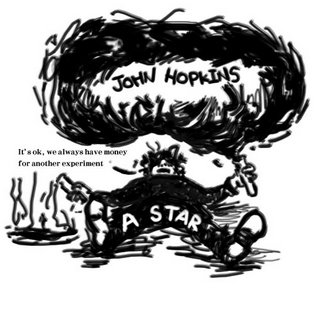
[Cartoon from the very impressive Sketchbook]
So it's an issue of reputation on the international stage - again. Attracting top notch academics to Singapore was also an issue raised by Warwick University when it pulled out of a deal in 2005. The worry then was that the campus could not attract academics of a high nature to live in a country were academics had to live and work in conditions...

[where The University of NSW's] [...] management has conceded it cannot guarantee protection of its academic staff in Singapore, given the city-state's harsh laws governing public comment and defamation.


And a situation where
[The University of NSW] would be powerless to protect its academics should they fall foul of the Government over issues of public comment.


It is yet again the case of an old formula losing impact in a new world. How long will these experiments of trying to attract top notch academics while at the same time threatening them with sanctions if they discuss certain topics last?

This issue has been going on since July 2004 and beyond. The People's Action Party must realise that their policies are keeping academics away, their empty promises of 'opening up', out-of-bound markers and dare I say it - nepotism - are what is frightening top notch academics away.

"Peter Sever of Imperial College London said the UK Royal College of Physicians "should consider advising its members of the potential dangers of accepting future posts in Singapore" because of a "lack of fairness" that "can impact upon an individual's professional reputation". The case of Simon Shorvon, who served as director of Singapore's National Neuroscience Institute


Research agency refutes accusations that it failed to meet goals
Singapore - Singapore's Agency for Science, Technology and Research (A*Star) refuted accusations by a prestigious US university that it failed to meet its side of the bargain in supporting Johns Hopkins University's research arm, news reports said on Tuesday.

The decision to wind down the facility after eight years in Singapore was 'not taken hastily and was based on nearly three years of monitoring and scrutiny,' The Straits Times quoted Dr Andre Wan, director of A*Star's biomedical research council, as saying.

The research facility failed to attract top scientists and had not met eight out of 13 performance benchmarks with the 83 million Singapore dollars (53 million US dollars) in funding, A*Star said.

The Division of Johns Hopkins Singapore (DJHS) is to be closed within 12 months.

The Baltimore, Maryland-based university was quoted as saying that A*Star had not met its 'financial and educational obligations.'

The closure was expected to leave dozens and faculty and staff without jobs and disrupt the education of four graduate students who had been offered places.

The university said this was a 'reputational issue' for Singapore and A*Star.

The city-state has been aiming to achieve the status of a major research centre and has attracted many well known specialists from abroad.

Dr Edison Liu, chairman of the scientific advisory committee appointed by DJHS, said he hoped that 'cooler heads would prevail' so that two great institutions would not fight each other.


© 2006 dpa - Deutsche Presse-Agentur

No Outrage for Nigerians in Singapore

DEATH PENALTY:
No Outrage for Nigerians in Singapore
Sam Olukoya

LAGOS, Jul 27 (IPS) - -When Uzonna Tochi picked up the phone last week he heard the most chilling words of his life. "Please do something fast to save my life; they might execute me anytime now," Uzonna's older brother, Iwuchukwu Amara Tochi, pleaded from Singapore.

Iwuchukwu Amara Tochi, 19, is sitting on death row in Singapore with Okele Nelson Malachy, 31, condemned in March after being found guilty of transporting 727.03 grams of heroin into Singapore.

Singapore's Misuse of Drugs Act carries a mandatory death sentence for anyone found guilty of trafficking more than 15 grams of heroin. The two men will be executed this year if they are not granted clemency from Singapore's president.

Uzonna and human rights organisations from around the world have not given up hope. Still, they say it is hard to garner international outrage to save the life of a poor Nigerian.

M. Ravi, a human rights lawyer and a member of the opposition party, Singapore Democratic Party, wrote in an online appeal that Iwuchukwu and Malachy, as Africans, stand in danger of being executed if nothing urgent is done to save their lives.

Unlike Iwuchukwu, Malachy is classified as stateless and no country has the direct responsibility of pleading for him. He carried a South African passport, but officials believe he is Nigerian.

"There has been a spate of executions of African nationals across Asia, which had gone unnoticed. The Australian and Western counterparts get different treatment in the media," Ravi wrote on the web site.

For instance, German national Julia Bohl, who was convicted for drug trafficking in 2002, escaped the gallows in Singapore when she was released from prison and exiled in 2005.

This year Ravi has embarked on a tour of European countries, holding press conferences and meeting parliamentarians in an effort to seek support for Iwuchukwu and Malachy.

Groups like the Amnesty International also have launched campaigns to save the lives of the condemned men. In Lagos, the country's largest human rights group, the Civil Liberties Organisation (CLO) has started a drive to force the Nigerian government to intervene on behalf of the condemned men.

"Since he lost the appeal, I always fear that the next moment might be his last," a ruffled Uzonna told IPS..

He has every reason to be concerned about his brother, who he described as the bread winner of the family. Once a football player, Iwuchukwu first took to trading before leaving Nigeria for Pakistan four years ago.

He was on a trip from Pakistan to Singapore when he was arrested at the Changi Airport 27 November 2004 on allegations of transporting heroin into Singapore. His lawyer told the court Iwuchukwu did not know the pills he was shipping contained heroin. He thought he was bringing in medicines.

The arrest and conviction of his brother is kept secret from his parents, Uzonna said. "My poor parents will die if they hear that a child who has worked so hard to sustain them is facing a death sentence," he said.

Uzonna has visited Nigeria's Ministry of External Affairs twice and that officials promised they would write letters in support of his brother's life. He added he was unsure if the promise was kept.

Officials of the Ministry of External Affairs could not give a definite answer when IPS enquired as to whether they are doing anything to save Iwuchukwu's life.

"The Nigerian government has not done anything public to show it is interested in saving Iwuchukwu's life," says Princewill Akpakpan, head of the penal reform project at CLO.

"The government is hardly bothered about Iwuchukwu because Nigeria, just like Singapore, has the death penalty," Akpakpan told IPS.

If the two had been convicted for the same offence in Nigeria, they would have earned a lighter sentence of between three years and life imprisonment, Jonah Achema, Assistant Director Public Affairs of the Nigerian Drug Law Enforcement Agency, told IPS.

"It would depend on the discretion of the judge and other factors like whether he is a first offender or not," Achema said.

A Nigerian law scrapped the death penalty for drug offenders in 1986. "This is an indication of the evolving nature of our laws," Achema told IPS.

Figures of those executed for drug-related offences around the world are not readily available. But Ryan Schlief, who works on the Singapore desk at Amnesty International in London, told IPS that Asian and Middle Eastern countries that retain the death penalty are doing so to crack down on drugs.

Singapore, in particular, has come under special criticism for its harsh death penalty laws. More than 420 persons have been executed there since 1991, the majority for drug trafficking. Singapore is believed to have the highest per capita execution rate in the world.

Critics question the justification for executing drug offenders. Instead, they say, the best way to deter crime is to increase the certainty of detection, arrest and conviction.

"Drug offenders should in effect not be made to pay with their lives," Akpakpan said.

Moreover, no study has proven that the death penalty reduces crime. In Iran, nearly 2,000 people were reportedly executed for drug offences between 1988 and 1999; a report by the country's official news agency IRNA observes that in spite of the executions, the problem of drug trafficking had not been resolved.

In 1995, 26 governments adopted laws making drug-related offences punishable by death. The countries see the death penalty as an effective and cheap way of removing criminally minded individuals from the society.

Growing pressure from civil society groups for a total abolition of the death penalty forced the Nigerian government to initiate a national debate on whether or not to retain the death sentence.

Singapore has no room for such debates, human rights workers said.

"There is usually little public debate in Singapore about the death penalty, partly as a result of tight government controls on the press and civil society organisations," Amnesty International said in a report.

Amnesty International was a victim of this government control in April 2005, when Singapore denied an AI member permission to speak at a conference on the death penalty organised by political opposition leaders and human rights activists.

Moreover, the Singaporean government rarely grants clemency for drug traffickers, Ravi and Amnesty said, making more urgent the need to keep up international pressure to save the lives of Malachy and Iwuchukwu Tochi. (END/2006)


An Old Friend - Grace

I accidentally bumped into an old friend online today . Out of the blue a link to Grace Chow's book being sold on Amazon.com just appeared. I recognised her immediately of course and then the emotions hit me again. Reading the reviews of her book on the Amazon site made me extremely proud to have known Grace if only briefly and if only online.

(Book Review) Reading this book made me look back on my own experiences of popular music, philosophy and Singapore. At first I had never imagined that all three could be combined. Perhaps my failing was due to the lack of a final ingredient, an incurable disease.

The author Grace Chow begins her story with a theme that resonates with many of our own sense of needing to escape, to get out. When I first stumbled upon the PAP's planned housing, I realised that I would have felt suffocated and atomised in Singapore. I thought that my initial response was that of an outsider, now I realise that others feel the same.

The HDB complexes are practical solutions, but some of us desire more than, 'practical solutions'. "A Pain in the Neck", contains many views on how Singapore is governed, and who it is governed by. Written in many styles, serious, insightful and I actually laughed out loud on a few occasions. Peppered with despair on the darkest of days, but there is a dogged determination within its pages to express life and to live it to the full according to her individual will and capabilities.

Grace Chow combines many elements in this autobiography; Singapore; escape, love, philosophy, religion, popular music, travel, illness, memories, hope and despair. The somewhat simplistic stereotype of the average Singaporean is that of un-questioning, consensual, and materialistic. Grace has laid the stereotype to rest. I await another book from Grace Chow. Write faster Grace.


Grace
Grace's Blog - Dying Is
A Pain in the Neck
Dying with grace By Sharon De Castro.

26 Jul 2006

Why the foreign media matters to Singapore

The following article from the Singapore Democratic Party site is rather strange as far as I am concerend as I had almost the same discussion with an ex-pat in a bar in Singapore during my last visit. The topic then was Gomez and why the government decided to back off. The targets may change but the only way to counter certain 'government aims' is to get the foreign media on your side.

25 Jul 06
Singapore Democratic Party

Piqued by the recent ruckus over the Brown matter, including all the brickbat that the PAP Government was getting from overseas, Minister Vivian Balakrishnan declared: “I am not concerned at all about what the foreign media thinks (sic).”

His boss, however, would very much beg to differ.

Mr Lee Hsien Loong, in a speech to his former PAP parliamentarians over the weekend, cited The Economist's comment that the PAP had done right by renewing its members of parliament.

This might not seem strange to some but when you consider that Mr Lee is spoilt for choice from the oodles and oodles of affection the one dozen or so local newspapers smother the PAP with – and in different languages to boot – it is indeed more than a little eyebrow-raising that he ignores these and plums for a foreign newspaper's comment.

But then, we're sure that our dear leader is all too aware that self-praise is no praise. The Straits Times gushing this-and-that about the PAP is like the dummy raving about the ventriloquist's talent.

But we digress. The point is plain: The PAP is concerned about what the foreign media think, and acutely so. Otherwise why would its leaders repeatedly sue international magazines and newspapers for defamation (The Economist included)? If the regime cannot sue because the publication does not circulate in Singapore, it registers its displeasure through the relevant Singaporean embassy. Whatever the method, the Government here needs the world to view it in more or less approving terms.

The world watches

In a world on which Singapore is increasingly dependent for trade, it would be daft for anyone to believe that this country need not concern itself with what others think about it.

And speaking of what others think, the decision by the police not to take action against the 30 demonstrators who protested at an MRT station against the Mr Brown-ban is a cleverly calculated decision on the Government's part.

The one thing that PAP leaders want to avoid more than the bubonic plague is to let the world see that Singaporeans are fed-up with its autocratic control and are ready to stand up for their rights. Prosecuting 30 people for courageously staging a protest would be the dumbest move the PAP could make. Victimizing the opposition is one thing, taking on citizen-protesters for exercising their democratic freedoms is quite another – one that would result in an unmitigated international PR disaster for the Government.

With the world marching unstoppably towards democracy and with citizens clamouring for a greater say in their countries' affairs, the PAP must realize that it is fighting the unfightable. International and regional networks, including the governmental sector, are springing up, all with one purpose – to advance democracy and human rights on this planet. This is why the SDP has been assiduously plugging Singapore into this vast and growing international movement.

The free world would undoubtedly disparage a crack down (if the PAP were foolish enough to initiate one) on a freedom movement conducted by Singaporeans through peaceful protests, and that would almost certainly spell the beginning of the end of the PAP’s dictatorial system.

Thumbing the nose

Even the late John F. Kennedy could not escape international opprobrium which was one of the factors that prodded him to address the discrimination against African-Americans when he was President in the early 1960s. When Martin Luther King Jr and the Civil Rights Movement pushed harder and bolder for equality, the US Government found it more and more difficult not to introduce legislation to outlaw segregation. Given its own condemnation of the Soviet Union's repression, it would have made the US look like it spoke with forked-tongue if it continued to ignore black-America's demands for freedom, and that position would have been untenable especially with the rest of the world looking on.

If a US President can yield to good sense coming from the rest of the world, can a Singaporean Prime Minister afford to thumb his nose at the international community?

This is where Singaporeans must press home their advantage. The freedom of peaceful assembly is one weapon citizens cannot do without in their fight against despotic regimes. Public gatherings are visually powerful and the energy they radiate are at once threatening to undemocratic systems as well as magnetic to the masses. Coupled with the fact that the PAP wants to – needs to – avoid pressure from the world to democratise this country, the people have the upper hand.

And when citizens refuse to roll over and play dead every time the Government cracks its whip, the world must be kept informed. And how is it kept informed? Bingo! The foreign media.

So the next time some minister says that he doesn't care what the foreign media think, you know the guy's fibbing.


25 Jul 2006

Singapore none too fussy about the source of wealth in its financial sector

Michael Backman
July 26, 2006

You are an Indonesian businessman. You've bribed a state bank official to give you a $US200 million ($A265 million) loan without sufficient collateral, or a risk assessment, for a business venture you know won't get off the ground.

The authorities have found out and you're facing arrest. You need somewhere to go where authorities can't touch you. So where do you go? The answer is Singapore. Why? Because it is a half-hour flight from Jakarta, or 45 minutes by ferry from the Indonesian island of Batam, and, most importantly, it does not have an extradition treaty with Indonesia.

It is largely ethnically Chinese, just like many of Indonesia's white-collar criminals, if only because Indonesians of Chinese ancestry dominate that country's business sector.

Singapore finally agreed to negotiate an extradition treaty last year after years of Indonesia begging for one. The process has been ridiculously drawn out. At least six rounds of talks have been held. Indonesia is angry and feels that Singapore is being obstructionist. But why should Singapore be slow? Probably because it is a haven for Indonesian crooks on the run, and they bring their money with them. Billions of dollars in corruptly obtained funds have flowed into Singapore's property market and its banks.

It's a sensitive matter because financial services account for 22 per cent of Singapore's economy. You can imagine the situation from Jakarta's point of view. Singapore lectures Indonesia about the importance of the rule of law while giving its criminals a haven.

Despite the billions it gets from Indonesia, it gives back only a fraction in foreign assistance but then decries Indonesia for being insufficiently grateful.

Among the Indonesian crooks and suspects believed to be on the run in Singapore are Bambang Sutrisno and Adrian Kiki Ariawan, who were found guilty of embezzling the equivalent of $US162 million from Bank Surya; Sudjiono Timan, who was convicted of improperly diverting $US120 million from a state-owned investment company; Lidia Mochtar, who is wanted over the embezzlement of $US20 million from Bank Tamara; Agus Anwar, a suspect over $US214 million that's unaccounted for from Bank Pelita; and Pauline Maria Lumowa, who is wanted over $US184 million that's missing from Bank BNI. Others whose whereabouts are unknown are able to safely visit Singapore.

The US doesn't have an extradition treaty with Indonesia but co-operation by US officials saw the fugitive Indonesian David Nusa Wijaya, wanted in connection with embezzlement of about $US140 million, return to Indonesia from San Francisco earlier this year.

The US embassy in Jakarta said at the time: "The US Government understands that returning fugitives and stolen assets from abroad in corruption cases is a top law-enforcement priority in Indonesia."

Singapore argues that because its laws are based on English common law and Indonesian law is based on Dutch codes, the two systems are incompatible, making an extradition treaty difficult.

But that didn't stop India from signing such a treaty with the Philippines in 2004, or Australia from signing one with Indonesia. Fugitive Indonesian banker Hendra Rahardja, who embezzled almost $US300 million, was on the verge of being extradited from Australia in early 2003 when he died of cancer in Sydney. His funds in Australia were frozen and returned to Indonesia.

A corollary of Singapore's reluctance to sign an extradition treaty with Indonesia is its apparent lack of fussiness about the sources of the funds attracted to its banking sector.

Singaporean officials make all the right noises when it comes to monitoring illicit funds. But there is a perception that in practice Singapore is not fully meeting international expectations and obligations. One person involved in monitoring international money flows for a Western government told me last week that the results of Singapore's efforts to date were disappointing.

And a senior fund manager in the region had this to say: "Singapore has truly become the global centre for parking ill-gotten gains. The private banking teams are huge and in practice ask almost no questions (compared with the branches elsewhere, including Switzerland).

"An acquaintance of mine who made $US13 million through a corrupt deal (in Indonesia) was not asked about how he got the money despite obviously having a job that would not have allowed such amounts to have been accumulated. Russians, mainland Chinese and Indonesians are pouring money into Singapore. High-end property has risen 30-50 per cent in the last 18 months or so."

Singapore, he argues, is out of step internationally. He cites a recent case in which even a Swiss bank co-operated with the Indonesian Government in tracking down $US5.2 million in allegedly improper funds deposited by the former head of Bank Mandiri, Indonesia's largest state-owned bank.

Attention is now being turned to China. Singapore is working hard at making itself more attractive to Chinese mainlanders, be they tourists or individuals, with funds to park. Singaporean Government representatives are trawling through China, promoting Singapore over Hong Kong as a safe destination for funds and property investment. Direct flights are being established with regional centres across China. Casinos are being set up. There has even been an influx of mainland Chinese prostitutes into Singapore's quasi-legal sex industry. And there's no extradition treaty, or little chance of one.

Of course, Singapore will argue that it takes money laundering seriously and has all types of detection methods in place. But that is not the point. It's what happens in practice that counts. After all, even Chinese laundries can have window dressing.


to continue reading...
michaelbackman@yahoo.com

www.michaelbackman.com


Singabloodypore has become a very infantile blog

From Illusio

Soci, the founder of Singabloodypore, loves to go on about how infantile the local blogosphere is. That was last April, I believe. Half a year later, there was a solicitation for co-contributors for SBP. What had me sold was this vision of a non-infantile blogosphere:

I have often contemplated the idea of running a 'socio-political blog' about Singapore that allows contributions from the public, other than just comments and has a group of editors monitoring the content.

It was all it took, really, and I began writing for SBP in October. You'll have to understand it was a time of opportunities. By 2004, SBP had become a news aggregator site where Soci would cut and paste entire news articles without comment or analysis. His call for contributors and fellow editors, could that be a start of a new blog? At that time, anything was possible. Or perhaps at that time, I believed anything was possible.

This was my statement of intent, as well as a sort of acceptance email to his call for co-contributors:

If the blog is run along the lines of crookedtimber.org, obsidianwings.blogs.com, savageminds.org, or long-sunday.net - ie. with group contributors who run/edit the site and with serious and sustained comments by contributors and members of the public, I'm all game for it.

If, on the other hand, you envision a super singaporean sociopolitical news aggregator blog along the lines of boingboing or tomorrow, where the emphasis is more on posting rather than developing a good idea from an original post through replies in the comments section, the site will have my support but I will NOT join in the running of the endeavor.

Yet almost a year later, I am still waiting for my fellow contributors - Soci included - to actually write their own articles instead of cut and pasting articles written by other people. Was there a policy message I missed somewhere down the line? Or did I not get the memo that said "Given the precarious legal position of bloggers, contributors of SBP are advised to write as little of their own opinion or analysis as possible, to protect themselves"?

With every 50-line article SBP contributors cut and paste, a little bit of our collective credibility dies. And we do this, 5 articles a day on average. What SBP has become is indeed a blog with more emphasis on posting, than on developing ideas and discussions. Indiscriminate and voluminous cut-pasting sends out a signal to all readers that the contributors don't respect the blog they run.

And so, SBP gets the readership that it deserves: hordes of anonymouses posting one liners, mostly non sequiturs. Some are spammers, like the commentor who cut/pastes entire falunggong new articles to comment on any blog post, regardless of relevance. Or ranters who just feel great posting their angry denunciations of the gahmen. All done as one-liners, of course. SBP has become a platform for anonymouses to rant and post non sequitors.

You know, once upon a time I thought the sammyboymod forums were pretty wild. Discussions there would start off fine and brilliant, but always degenerate into shouting matches by the third page. Once upon an even longer time, I thought soc.culture.singapore was the gutter of political commentary and discussion in cyberspace. Today, I am forced to change my opinion. Singabloodypore is the new gutter of online political discussion.

Indiscriminate cut/pasting encourages rants and indiscriminate commenting. Neighbourhoods with broken windows, and all that. The failure of SBP members to moderate comments, to guide discussions to a higher ground of analysis and insightful commentary, the wilful policy of benign neglect - all this encourage even more indiscriminate commenting. I have noticed, as have other contributors, the precipitous decline in the tone and quality of comments, coupled with a marked rise in anonymous commentors.

Today, Singabloodypore looks like a slum. The main column is cluttered with miles of cut-and-pasted content that go on and on. We could excerpt just one or two paragraphs, and then use either article truncation or just provide links, if we just want to cut and paste. The side bar is cluttered with too many links. Singabloodypore has not just become a site that I would not personally want to read, it has not just become a site that I do not want to be associated with, it has become the most infantile political site in Singapore's blogosphere. In fact, far more infantile than the sites Soci made fun of last April.


My reply...
Thanks for your comments and feed back.

The blog is out of my hands and I have zero intention of dictating what contributors can and cannot post or comment upon. As for rampant 'cut and pasting' you seem to have very definite notions of what a 'blog' is or ought to be.

It seems that you have already decided to quit based on the grounds that we are drifting aimlessly or without direction. In part you claim that 'thanks to the refusal to police and guide comments' that I have somehow allowed this slide into infantilism to occurr. Fine so be it. The day I assign myself as a police officer of discourse is a day I refuse to contemplate.

Sad to see you go as I am sad to see others go, but I offer you the same as you leave.

You are always welcome back.

Steven


As an after thought I realise that I have only ever been asked to censor this blog not by the police or the Singaporean government but by other contributors and bloggers. A recent example was the Jesus-Zombie cartoon. The storm in tea cup had a contributor withdraw because he thought it was direct provocation of the authorities.

Other contributors have asked me to separate items that were felt to undermine a particular post and the links were removed.

And a rather long time ago in blogtime a contributor was felt compelled to leave because their English or topics were not 'good enough'. It seems that self-censorship is alive and well.

As for the comment numbers increasing in the last 6 months this is true but that has now returned to the pre-election norm. Commentators can contribute as much as they like. Some may feel unable or unwilling to comment at length, they each have their own motivations and reasons for doing so. To say that we will only accept comments of a certain length and 'academic standard' is too much though.

This blog was my creation but it has taken on a direction of its own and I have no intention of attempting to determine its direction. Nor the time to do so. The blog items shift according to the interest of readers and contributors, to the Singaporean news items, requests from campaigners of various 'single issue' groups. NGO's approach me, individuals approach me to take up something they feel readers should be able to read simply because it is not being covered in the mainstream press.

To say 'no' to these requests because it doesn't meet our current discussion topic would be rather irresponsible.


A*STAR defends its stand

(This is a follow-up from last Saturday's Straits Times report.)

Still no official press release from Johns Hopkins. However, there is plenty of buzz in the Singapore media about the "messy split".

Monday's issue of TODAY had a letter by one Leong Sze Hian:
The contrast between the statements by the two parties is startling. Considering the immense publicity, amount of taxpayers' money, resources and time spent over the last eight years on this project, I think Singaporeans deserve a more detailed explanation on what went wrong.[...]

If you do not know what went wrong, how do you learn from your experience and mistakes, so that others may learn from it, too? How can there be accountability for failure, if we do not know who was involved and responsible for what happened? What is the financial quantum and consequences of this project and facility that has now to be closed?

I would like to suggest that an inquiry be held so that similar research tie-ups in the future may benefit from the findings.

With Singapore's international reputation at stake, as I understand that this is the first international tie-up of its kind between Singapore and the US, I urge A*Star to tell us more.


In response, the Singapore side has finally presented its view in full force. « Takchek. The most relevant is A*STAR's official letter to the Singapore media, such as the one published in TODAY:

[The Division of Johns Hopkins in Singapore (DJHS) was set up to achieve three goals.] First, to establish a centre of immunology, experimental therapeutics and cancer research with an international reputation. Second, to establish PhD training at DJHS in Singapore. Third, to recruit senior investigators with international reputation to appointments at DJHS and full-time residence in Singapore.

[...The] statements attributed to the JHU spokesman are both untrue and inappropriate.

The truth of the matter is that A*Star has fully complied with its obligations under the Agreement and continues to do so during the contractual 12-month wind-down period.

Indeed Singapore invested a total of S$54 million under phase 1 of the collaboration (1998-2004) and a further S$28 million under phase 2 to date.

The JHU presence in Singapore began in 1998 with the goals of providing clinical service, education and research. But in 1999, Johns Hopkins Singapore (JHS) was found to have significant problems in the progress of its research and education programs and a restructuring of the collaboration was then effected.

However, problems persisted. A*Star had to negotiate a significant restructuring of JHS in 2003 which led to the establishment of the DJHS, an academic department reporting to the Dean of Medicine at JHU.

A*Star put in place, with the agreement of JHU, stringent oversight criteria and the requirement for a mid-cycle review. The Agreement specified clear key performance indicators (KPIs) that would provide mutually agreed metrics for success.

The mid-cycle review was carried out by two committees in late 2005 and in early 2006. Separate reports were submitted by the independent Scientific Advisory Committee appointed by DJHS itself, and by the A*Star Grant Review Committee. The findings revealed that DJHS was still lacking in senior scientific leadership and had failed to achieve several KPIs.

For example, the Agreement required DJHS to enrol at least eight PhD students by February 2006. However, as the review date approached, DJHS still had no students. In October 2005, DJHS was urged by its Scientific Advisory Committee to take steps to address this issue. Given the pace of development, A*Star had assessed that DJHS was unlikely to meet the target of 40 PhD students enrolled by February 2009.


The Agreement also required DJHS to recruit 12 senior investigators with international reputation to appointments at DJHS and with full-time residence in Singapore by February 2006.

In truth, only one out of the 13 recruited by DJHS fulfilled these requirements.
While there were five others who held the title of full Professor, one had already tendered his resignation from JHU, two were based in Baltimore and did not reside in Singapore, one was based at the JHS International Medical Centre at Tan Tock Seng Hospital and spent only 20 per cent of his time at DJHS, and one was a visiting scientist on a 12-month contract.

Of the remaining seven faculty, six were given appointments as Assistant Professors by JHU. For five of the six, this was their first appointment as an Assistant Professor. Academics generally would not consider someone at the level of an Assistant Professor to be a senior investigator.


When A*Star raised its concerns, JHU responded that at Hopkins they prefer to hire capable and ambitious junior scientists rather than bring in "big names". A*Star feels strongly that neither the letter nor the spirit of the Agreement, in particular the requirement to recruit senior investigators, was being followed.

All in all, DJHS failed to meet eight out of 13 KPIs for scientific capability development specified in the Agreement. For seven of these KPIs, DJHS was unable to even meet the first year targets by the end of the second year.


The Agreement allows A*Star to discontinue funding DJHS if it decides after formal review and with due process, that DJHS is not likely to succeed in achieving its KPIs.

The decision to terminate the arrangement with DJHS was not taken hastily and was based on nearly three years of monitoring and scrutiny. Moreover, discussions between senior management at JHU and A*Star about the potential closure continued for over three months (mid-February to end May 2006) before the decision was finally made.

A joint A*Star-DJHS circular was then sent on June 20, 2006 to all DJHS staff and students to inform them of the decision. The wind-down process then commenced in accordance with the terms of the Agreement.

It was only in July 2006 that A*Star learnt, for the first time, that DJHS had granted its four PhD students five-year scholarships with no obligation to return to Singapore after completing their studies. Such scholarships do not qualify for funding support under the Agreement.

Instead the Agreement requires DJHS to either fund or seek external funding (ie not from A*Star) to support any student to be trained in Baltimore.


We are deeply dismayed at the implication that A*Star is somehow to blame for the current predicament of the DJHS junior faculty and students.

Under the Agreement, should the DJHS program falter, JHU alone is responsible for the redeployment of its faculty. A*Star's obligation is limited to the provision of a 12-month wind-down budget. Notwithstanding this, A*Star has been actively helping DJHS and JHU with the re-location of faculty to Baltimore and placement of those who wish to remain in Singapore.

As for the four PhD students, though their scholarships do not qualify for A*Star funding under the Agreement, A*Star has gone out of its way to offer them assistance. We have renewed offers of A*Star local scholarships to two of them, and we are still attempting to assist the other two. We have yet to hear of any offer of assistance from JHU.

As a government agency, A*Star has a responsibility to review the progress and performance of projects like DJHS that are supported with public funds. Where necessary, we will act decisively to ensure that these projects continue to create value for and contribute positively to Singapore's biomedical sciences initiative.

In this respect, we have been even-handed and fair in our other interactions with JHU as a whole.

For instance, A*Star and Singapore have a productive relationship with the JHS International Medical Centre based at Tan Tock Seng Hospital. Much of the clinical research conducted there is funded by the Singapore Cancer Syndicate, which is an arm of A*Star.

A*Star also sends its National Science Scholars to pursue undergraduate and graduate degrees at JHU in Baltimore, after which they are obliged to return to serve Singapore.

A*Star and Singapore have, over the past eight years, given JHU every possible chance to succeed. But for DJHS, JHU was unable to fulfill its obligations under the Agreement. We cannot justify the continuation of public funding for a collaboration that has failed to yield results for Singapore.

However, we continue to act in good faith to ease any disruption by the provision of a generous 12-month wind-down period and as much support as possible within the terms of the Agreement.

It is therefore most surprising that JHU should choose to lecture A*Star and the people of Singapore about our reputation when it is JHU which has not delivered on its commitments under the Agreement.


Source: Letter from Dr. Andre Wan, Director, Biomedical Research Council, Agency for Science, Technology and Research; We have kept our end of the deal: A*Star : Agency says decision to terminate agreement with Johns Hopkins taken after three years of monitoring and scrutiny, TODAY, Tuesday, July 25, 2006

This letter was also printed in the July 25, 2006 edition of the Straits Times. TODAY had another article summarizing the press release:
SINGAPORE'S eight-year relationship with Johns Hopkins University (JHU) has gone sour and the Agency for Science, Technology and Research (A*Star) has said the reason was simple: The American medical institution did not deliver what it promised.

Source:Tan Hui Leng, The experiment that failed: A*Star points to problems with Johns Hopkins' PhD programme, senior leadership, TODAY, Tuesday, July 25, 2006

The Straits Times also has secondary coverage which is notable. Excerpts:
The agency also produced a series of e-mails between its chairman, Mr Philip Yeo, and the university's president, Dr William Brody, between February and June this year.

The exchange revealed that while there were disagreements, both sides remained positive about the partnership.

On Feb 17, Mr Yeo wrote to 'dispel JHU's misconception that it is not possible to attract top scientists in Singapore to man DJHS'.

Dr Brody replied on May 2 that Johns Hopkins believed in hiring junior scientists who were talented and hungry.

The Hopkins experience 'over 100 years' was that the future belonged to such scientists, 'even though they may not have achieved stardom'.


On May 17, with talks at a stalemate, Mr Yeo informed Dr Brody that A*Star would wind down the facility, and re-focus attention on a new collaboration. Replying on June 12, Dr Brody expressed disappointment with the decision, but agreed that once staff issues were settled, both sides could review 'other opportunities that might be mutually beneficial for A*Star and Johns Hopkins'.

Faculty and staff were told about the decision eight days later.

The university declined yesterday to elaborate on its statement, but its move to stake Singapore's reputation on the failed partnership is 'completely unacceptable', said Dr Edison Liu, chairman of the scientific advisory committee appointed by DJHS.

Dr Liu, an American scientist who heads the Genome Institute of Singapore, said Singapore had done nothing reprehensible in the last five years.

Until the latest broadside from JHU, both sides had seemed headed for an amicable split.

Source: Liaw Wy-Cin, "Johns Hopkins failed to meet goals, says A*Star", Straits Times, Tuesday, July 25, 2006

Like Takchek said, it's always messy when two big egos collide. A*STAR's stand is implicit but pretty clear: they want brand name, famous professors. Don't give us anything else. Johns Hopkins' point of view: young researchers are the wave of the future, not those who have already established themselves. Apparently, neither party was willing to compromise on this issue.

Here's another article from the staff point-of-view. Arguably, these are the people worst affected by this whole spat.

WHILE senior researchers on the Johns Hopkins payroll can return to the university in Baltimore in the United States, the careers of junior staff here hang in the balance.

The Straits Times spoke to four junior researchers who have yet to have be offered an alternative job by either Johns Hopkins Singapore or the Agency for Science, Technology and Research (A*Star), since they were informed last month of the decision to close the research facility in Biopolis in North Buona Vista.

Said one researcher: 'There's no hurry, we have one year. And it's very easy to find a job here.'

But for one of the foreigners among them, if he does not find a job here, the alternative is to return home. He said he is 'very upset' at the news.

'It was a big surprise[...]

Two researchers The Straits Times spoke to said they were given a termination letter last week informing them that the research and education arm would be 'wound down' with effect from June 1.

The letter indicated that their salaries and pro-rated annual wage supplement and outpatient medical benefits will be paid until DJHS terminated operations on May 31 next year.

Also affected are four postgraduate students who had been offered PhD scholarships by DJHS to study pathobiology at Johns Hopkins University School of Medicine in Baltimore.

They were to begin their studies in two months, but were told last month that with DJHS closing, there is no more funding for their scholarships.

One of those affected by DJHS's imminent closure, Ms Yap Kai Lee, 23, a recent pharmacy graduate from the National University of Singapore, is worried that her research dreams may be short-circuited with the lack of funding.

But she said Johns Hopkins in Singapore and Baltimore have been very helpful in trying to secure funding for them. Said the youngest of three daughters of a civil servant and a housewife: 'We were told our studies for the second to fifth years would be funded by the labs we work for in the US, so what we're awaiting word on is the funding for the first year.' [...]

Source: Liaw Wy-Cin, "Closure leaves future of junior staff uncertain", The Straits Times, July 25, 2006

The Straits Times also published a summary of the Key Performance Indicators for DJHS. In short:
DJHS met these targets in both years of the review (20040201-20060131):

  1. Cumulative number of postdocs participating in research

  2. Cumulative number of joint projects with other research institutes and centres in Singapore

  3. Number of papers published in top journals per year

  4. Number of papers presented at top conferences per year

  5. Number of conferences/seminars/courses/workshops organised per year


DJHS did not meet these targets in both years of the review (20040201-20060131):

  1. Cumulative number of full-time faculty

  2. Research scientists and engineers hired and trained (cumulative, full- and part-time clinical)

  3. Cumulative number of new technologies originating at Johns Hopkins University and further developed in Singapore

  4. Cumulative number of visiting faculty on sabbatical (none in first year)

  5. Clinical research projects (investigator initiated or industry sponsored) (none in first year)

  6. Training programmes offering JHU degrees (none in first year)

  7. No patents filed

  8. No new technologies originating at Johns Hopkins University and further developed in Singapore

  9. No graduate students

  10. No new products under development or clinical testing


Commentary here.

, , , , ,

Global appeal to release jailed ST journalist


( Straits Times 2006-07-21)

THE plight of detained Straits Times journalist Ching Cheong got an international airing yesterday when groups calling for his release held news conferences in 10 cities worldwide. New York, Paris, Los Angeles, Bonn and Melbourne were among the cities where non-governmental groups such as Reporters Without Borders and The Members of the New York Press Club held media events to demand that the Chinese authorities handle Mr Ching 's case in a 'fair, just and open' manner.

The press conferences featured a video of Mr Ching 's wife, Ms Mary Lau, personally appealing for help to free her husband. In the video, she called on the world community to show support and watch the case closely to 'make sure that the Chinese government will not do anything to harm my husband'.

The appeal was the most solid show of support for Mr Ching , Ms Lau told The Straits Times, since he was detained on April 22 last year in the southern Chinese city of Guangzhou. Mr Ching , 56, a Hong Kong resident and this newspaper's Chief China Correspondent, was charged last August in Beijing with spying for Taiwan in return for large sums of money. He is currently awaiting trial in the Chinese capital.

Yesterday's initiative, Ms Lau added, was spearheaded by the Los Angeles-based Visual Artists Guild (Vag) and the Hong Kong Journalists Association. The website of Vag said it is a non-profit organisation set up in 1985 in support of free speech and expression. 'I am very thankful to all these worldwide organisations for doing this for my husband,' Ms Lau said, adding that the video was shot late last year. 'I hope that it will help in any way possible to secure his safe release.' Hong Kong's media and politicians have constantly insisted over the past year that Mr Ching 's lengthy detention is unjustified, with no show of proof.


Johns Hopkins begins severing ties with A*STAR

Johns Hopkins was one of the first research tie-ups between a prominent international institution and the Singapore research scene as negotiated through the Agency for Science, Technology and Research (A*STAR) in Singapore. Back when the academic division of Johns Hopkins Singapore was established in late 2003, A*STAR chairman Philip Yeo said: "This academic division will be invaluable in training our pool of local talents. Through this collaboration, we are strengthening our scientific links with one of the best universities in the world"."

Fast forward to today, and now it is the first tie-up to decide that it's being screwed over and is getting out of the deal.

Straits Times July 22, 2006
Johns Hopkins, A*Star 'headed for break-up'
Facility in Biopolis will close in a year, say staff of research and education tie-up
By Liaw Wy-Cin and Teh Joo Lin

AN EIGHT-YEAR-OLD marriage between a top American medical institution, Johns Hopkins University, and Singapore's Agency for Science, Technology and Research (A*Star) looks to be heading for a break-up, and a messy one at that.

Staff of the research and education tie-up - Division of Biomedical Sciences, Johns Hopkins in Singapore - told The Straits Times that they had been informed early last month that the facility in Biopolis in North Buona Vista would close in a year.

Another indication of problems came from four local students who were awarded doctorate scholarships to study at the university in Baltimore.

They too were told last month that the research division would no longer be funding their studies.

When contacted, an A*Star spokesman described the problems as a period of 'transition' - a decision taken by the leadership of the American university and the agency to replace the current 'operating model of collaboration' with a 'new model of partnership' that is still being developed.

But while the issues are worked out over the next 12 months, staff and faculty here will be given help to either relocate to Baltimore or find new employment in Singapore, said A*Star.

As of March, there were a total of 60 staff, 13 of them faculty members.

As for the four local students who were to pursue their graduate training in Baltimore, A*Star said:


'Although A*Star is not obliged to do so, we have offered assistance to all four students to facilitate their entry to a PhD programme at a local university and where possible, we have offered them the opportunity to apply for an appropriate A*Star scholarship.'


Taking a different view of the situation was the spokesman for Johns Hopkins University, who said the university had done its part to recruit faculty and graduate students, as stipulated in its agreement with A*Star.

The university maintains that its Singapore partner has not kept up its end of the deal in meeting its 'financial and educational obligations'.

'Although Johns Hopkins University has attempted to be as collegial as is possible during this very difficult phase, the displacement of outstanding junior faculty recruited from throughout the world, and the intense disruption of graduate student education, cannot be underestimated or dismissed.'

The spokesman added that this is a 'reputational issue for Singapore and A*Star' and that the university will continue to work to resolve faculty and student issues during this transition.

The recent developments came as a surprise to staff, some of whom had only recently relocated to Singapore.

As late as March this year, an editorial in Johns Hopkins Singapore's newsletter said the division 'continues its recruitment efforts'.

It also said it had 'embarked on its education programme with a bang', before going on to mention the four Singapore students who would receive the postgraduate scholarships.

Johns Hopkins came to Singapore in 1998 to carry out research, education and patient care activities. p> It also set up a medical centre here, designated as Johns Hopkins Singapore's clinical arm for patient care and clinical research.

And while the research division has hit a rocky patch, the medical centre is expanding.

The Johns Hopkins Singapore International Medical Centre last year moved from its original premises at the National University Hospital into a space at Tan Tock Seng Hospital that allowed it to see up to 750 new private patients each year.


More details here and here.

Johns Hopkins isn't quitting Singapore entirely; its medical division (treating patients at Tan Tock Seng hospital) will remain. But clearly the tie-up with the academic division (Johns Hopkins Medicine) was highly prized, at least back in 2003.

The big question on everyone's mind, clearly, is what this means for the other research collaborations. If one of the premier institutions in the biomedical sciences (one of A*STAR's primary research areas) has a falling out, will this set a precedent and trigger an exodus of institutions wanting out of their relationships with Singapore?

Both sides are keeping mum about the details. At this time of writing, Johns Hopkins had but a terse statement in their most recent quarterly newsletter. No information could be found on A*STAR's website.

It is interesting to compare this latest news from the speech given at the founding of the Johns Hopkins academic division back in October 2003:

Johns Hopkins was one of our earliest international academic partners in Biomedical Sciences [...] It has forged strong linkages with local institutions and has contributed to the development of the Biomedical capabilities in Singapore. We value this partnership with Johns Hopkins.

The signing ceremony today marks the beginning of a new phase of this partnership. Like a maturing courtship, the partnership between Johns Hopkins Medicine and A*STAR has grown from the tentative engagements of the early years to deep mutual commitments today. In the new phase of the partnership, we will build upon the early efforts of Johns Hopkins in Singapore.

I am pleased to note that the presence of Johns Hopkins in Singapore will take on a new look - Hopkins in Singapore will assume the status of an academic division of Johns Hopkins Medicine. It is the first time that Johns Hopkins Medicine has set up an academic division outside its Baltimore campus. This attests to the strength of the relationship between Singapore and Johns Hopkins Medicine in our common pursuit towards excellence in Biomedical R&D.

[...]

As you can see, the research areas in the Division are exciting, impactful and state-of-the-art. Scientists in the Division will bring additional chapter to Singapore's growing Biomedical R&D capabilities.

[...]

The most important mission of Hopkins in Singapore is the training of local PhD talents to meet the increasing demand for skilled Biomedical workforce. As an academic division, 12 Johns Hopkins faculty staff will be based in Singapore to conduct Biomedical research and training. They will be led by a full-time Director. Their mission is to transplant the reputed Johns Hopkins academic culture from Baltimore to Singapore. Johns Hopkins has a long tradition of producing world-class PhD graduates. I am fully confident that our local students doing their PhD studies at the Division will benefit from this Johns Hopkins magic formula!

Students pursuing their PhD studies at the Hopkins in Singapore will enjoy supervision by world-class scientists in world-class facilities at our new Biopolis. Some of the students will have opportunities to spend time in world-renowned laboratories in the Baltimore campus. PhD training is a critical function of the Division - I am confident that it will be a shining example of excellence in graduate education.


, , , , ,

24 Jul 2006

Ten cities call for China to release journalist

Demonstrations were held in 10 cities on four continents on Friday calling for the release of a reporter, Ching Cheong, who has been under arrest in China since April last year. Ching, a correspondent for the Singapore Straits Times, is due to be sentenced later this month after being convicted of buying political, economic and military information and passing secrets to Taiwan. He strenuously denies the charges. Organisers of the Los Angeles demonstration have posted a video appeal by Ching's wife, Mary Lau. It was shown in the other nine cities where protests were held: Bonn, Calgary, Hong Kong, Melbourne, New York, Paris, San Francisco, Seattle and Toronto. (Via asiamedia.ucla.edu)


Singapore Government Bought Off by the Chinese Communist Regime

The Epoch Times Jul 23, 2006 Singapore paid a heavy price for allying with the '610 Office' in China
By Zhang Jielien

By helping China to persecute Falun Gong practitioners in Singapore for economic trade, Singapore has lost its reputation as a democratic country.

While the US government stayed charges against Wang Wenyi, a Falun Gong practitioner who asked President Bush to help stop the persecution of Falun Gong during a White House press conference; and while Canadian investigators published their report confirming harvesting of organs from Falun Gong practitioners in China; the Singapore government is helping the Chinese communist regime to victimize Falun Gong practitioners in Singapore.

According to Xinhua News Agency, on July 14 the Singapore police charged nine Falun Gong followers with "illegal assembly" for an event that occurred last October.

Why is an incident that occurred nine months ago suddenly so important to the Singapore police? As the anniversary of the beginning of the crackdown on Falun Gong in China approaches, the "610 Offices" have stepped up their harassment of practitioners in China. Has the Singapore government been ordered to do likewise?. Singapore has shown an increasing inability to stand up to China in the face of potential economic gains. This has been evident to the international community for sometime now. Since 2001, Singapore has exerted pressure many times on Falun Gong practitioners in tandem with the Chinese government.

As the world was shocked by the contents of the report from the Canadian independent investigation team, reports in mainstream media in western society increased dramatically. So why would the Singapore government disregarded its international image and become an accomplice to the brutal regime for some petty economic rewards? We have drawn two conclusions: first the actions of Singapore's leaders show a lack of morality, and second, the Chinese communist regime is really evil.

The "illegal assembly on Orchard Road" refers to nine Falun Gong practitioners peacefully holding placards and distributing flyers to the public on October 22 and 23, 2005. But according to a report in Xinhua News Agency, "After Singapore police finished investigations into activities held on the two days and discussed their findings with Singapore's chief procurator, the police decided to file charges against the nine Falun Gong practitioners who participated in the activity."

The Singapore police took nine months to complete investigations into such a small case of "illegal assembly" (it is said that the maximum penalty for such a crime is three months imprisonment.) Moreover, the case was unimportant for nine months and suddenly became "urgent" enough to be discussed with Singapore's chief procurator before any legal action was started.

It seems that the chain of command in Singapore starts in Jiang and Luo's "610 Office" who dictate to the Chinese Communist regime's Foreign Affairs Ministry, who then direct the Singapore leaders, down to the Singapore Attorney-General, who then orders the Singapore police, and the police take action. Recently the "610 Office" started the largest attack on Falun Gong in recent years; the purpose is to sustain the suppression that is on the brink of collapse.

Since July 1, the anniversary of the founding of the Chinese communist regime, the "610 Office" has established a new website that slanders Falun Gong, has bought space on Xinhua.net to disseminate information directly, spent money outside of China for investigations, research, and frame-ups, used secret agents to collect intelligence for writing slanderous articles, and made large-scale harassing phone calls to Falun Gong practitioners allover the world. Spies of the regime have even taken over the normally orthodox Christian forum to post defaming articles. All these activities illustrate the scale of the attack on Falun Gong this time.

It is no coincidence that Singapore was chosen to assist the "610 Office" to attack Falun Gong. The government and leaders in Singapore are actually used by the Lee Kuan Yew family. Many people think that Singapore is a democracy and is ruled by a legal system; but its legal system cannot challenge the power of the Lee Kuan Yew family. Singapore is ruled by a type of family dictatorship. Lee Kuan Yew has many "famous sayings." For instance, he once publicly quoted Deng Xiaoping's speech: "Kill 200,000 for 20 years' stability." He then said: "I would do the same." Lee was the only major political figure who dared to publicly support the June 4 Tiananmen Massacre in China. It seems that when Lee sees a ruler with an iron fist he has found an equal. Therefore, under the double strike of the Chinese Communist regime's bloodstained, comprehensive suppression of Falun Gong and the enticement of economic benefits, the Lee family has taken to pleasing the Chinese leaders with increasing proficiency.

This time, one could imagine the pressure from Jiang and Luo is so strong that the "610 Office" even had Singapore revoke the registration of the Falun Dafa Association in Singapore. Therefore the Singapore police sent out a warning to the Falun Gong association: "If any registered organization in Singapore poses a threat to public peace, benefit, and order, the registration of this organization will be in danger of being terminated."

Rather than saying that the Singapore government is trying to please the Chinese communist regime, in this instance, it is more accurate to say that coercion from China is a desperate act of self-defense by Jiang and Luo. They exerted great pressure and used economic benefits to induce Singapore to be their accomplice to an illegal persecution. While the Singapore government helps the communist regime achieve its goal of persecuting Falun Gong outside of China, it has sold itself for very little and has lost its reputation as a modern and civilized country.


23 Jul 2006

International Appeal for Ching Cheong

Update: I realised that Soci has already posted a link to this video on the Visual Artists Guild website. But I shall leave the embedded Google video version posted here for your convenience.

A roughly 10-minute video appeal from Ching Cheong's wife for his release.


July 19, 2006
The International Federation of Journalists (IFJ), the global organisation representing more than 500,000 journalists in more than 120 countries, is deeply concerned about the plight of Hong Kong journalist Ching Cheong.

Ching is the chief China correspondent for Singapore' s The Straits Times newspaper. He is a Hong Kong citizen, a legal resident of Singapore, and is a well-respected and experienced journalist. According to his wife, in April 2005 Ching went to China to meet a source who was to give him a manuscript about Zhao Ziyang, the former Prime Minister of China who spent 15 years under house arrest following the Tiananmen massacre. On April 22, 2005 Ching was arrested in Guangzhou and placed under a form of detention called "residence under surveillance" in Beijing.
[...]

Press Release by The Foreign Correspondents Club', Hong Kong

- From the Visual Artists Guild.

22 Jul 2006

M. Ravi und der Kampf fur mehr Menschlichkeit

M Ravi starts his campaign in Germany against the mandatory death sentence:

Holger Weyhmüller
Gaeubote
Gaeufelden, Germany
20 Jul 06

In Singapore it is considered a crime to ask “Why” but this doesn't faze 37-year-old M Ravi. He is defending clients that face the death penalty, as well as the political opposition of the government in court and asks this important question: “Why?” At the moment, the lawyer is touring the world to look for supporters and has included Germany, where his campaign started in Gaeufelden. The Gaeubote is the first newspaper to talk to him.

One gram can decide about life or death. Whoever is caught in Singapore with 500 grams or more of Cannabis faces the gallows. One gram less and an accused will escape the noose. This is the law in Singapore. At least the law in most of the cases, because M Ravi is aware of 6 cases where the accused – even carrying a significant amount over the 500-gram limit didn't end their lives at the gallows.

Why is this not the case for everybody, the Singaporean asks. He doesn't only ask this question to himself. He asks this question to the judges, to the state attorneys and to the government. And he asks this question to the public in the world.

He is supported by Rodny Scherzer, who works in the management of Hewlett-Packard and has become aware about the work of the human rights lawyer through the Internet. In the year 2002, German girl Julia Bohl faced trial in Singapore – a touching experience says Rodny Scherzer. Then 20-year-old Bohl was carrying nearly 700 grams of Cannabis in her luggage. Under normal circumstances she would have been hanged for this but through a strong involvement of the German government she escaped the death sentence and was sentenced to a five-year prison term instead. She was released on July 15, 2005 for good behavior. Her defense was done by Singapore’s best lawyer, says M Ravi.

It is not only the fact that Ravi is spreading the word across the world about the Singaporean government's death penalty rule that makes things dangerous for him. It is also the energetic and convincing way in which M Ravi follows his path and the way he handles the pressure from the government – he just ignores it. For a long time, he has been facing the threat of suspension from his legal practice, he says. Furthermore, he has been the victim of an attack-campaign in Singapore's media where the subject of the suicide of his mother has been repeatedly raised.

Since he first decided to take on a death penalty case three years ago when no other lawyer wanted the job because of the very low possibility of success, many of his clients have left him. They were worried that his fight against the death penalty and his support for the opposition would negatively impact on their own cases, Ravi says in the Hotel Aramis in Nebringen and smiles. The political and legal system of the small country at the border to Malaysia cannot be compared to a democracy, Ravi (who did part of his studies in Cardiff, Wales) explains.

The political system is more comparable to a dictatorship and provides very serious penalties for rather small crimes. Who, for example, gets a $1,000 fine for spitting chewing gum on the street? But this is not what catches Ravi´s attention. It is the mandatory death sentence given to anyone caught in possession of 500 grams or more of Cannabis that concerns him as well as how convicted people are treated prior to their execution.

For example, photos of the convicted wearing nice cloths are taken 24 hours prior to their execution. These photos are taken in several faked situations, for example, posing whilst seated behind a desk like a manager of a large company. Ravi says he is aware of a particular case where these photos were given to the mother after the execution, as if to tell her that this is what your son could have been, a procedure that draws rage and anger in Ravi. Execution and death penalty is one thing but doing it in this particular way is incredibly cruel and inhumane. The case is well documented in his book Hung at Dawn. The English version of this book is being translated by Rodny Scherzer into German and will be released in Germany in the near future.

Ravi is also fighting another cruel aspect of death penalty. Once the death penalty has been imposed, there is no way back. The present President of Singapore has never granted presidential clemency. “An innocent man can be hanged due to procedure” even if new evidence turns up at the last minute. Clemency will not be granted. Why is must it be like this, asks Ravi.

At the moment, M Ravi is working on his third defense case of a convicted drug smuggler who has received the ultimate sentence. It is a Nigerian man named Amara Totchi. Ravi doesn't have much hope of saving him from execution. Regardless, the Singaporean lawyer, whose forefathers came from India, is taking up the challenge and spreading the message globally to help this man, and he is starting his campaign in Germany.

Why Germany? Germany has taken a strong stand against capital punishment in the case of Julia Bohl and has taken concrete action in that case. The result of this action saved Julia Bohl's life, even though she initially faced the mandatory death sentence. Germany was successful in putting pressure on the Singaporean government.

The result was different in the case of Nguyen Tuong Van, an Australia. The pressure of the Australian government in that case was not sufficient, says Ravi. The Australian government had protested but also stated that the execution would not have any consequence in the relationship between the countries. The Australian was executed in December 2005. Now M Ravi hopes for support out of Germany and hopes for the start of a fruitful relationship that ends in the abolition of the mandatory death penalty in Singapore.


Are you wondering what the Germans said to Singapore to get Julia Bohl's neck out of the noose? In a seperate article, Dr Chee explains:


In the Bohl case, the German authorities intervened and the marijuana she was carrying was subsequently “purified” and found to be less that the original amount which would have led her to the gallows. Ms Bohl was also convicted of consuming the drug ketamine, and to have possessed other drugs, not just marijuana. She was also convicted of allowing her apartment to be used for narcotics trafficking and was accused of belonging to a drug syndicate that supplied drugs to nightspots in Singapore. She was sentenced to five years in prison but served only three for good behaviour.

Compare this to the late Shanmugam s/o Murugesu who had also carried marijuana, but nothing else. A Singaporean, Shanmugam served in the army for eight years and the Singapore Sports Council for another four. He had also represented Singapore in sports. Despite the protests of Singaporeans, he was executed.


Isn't it amazing how we pretend that the justice system is justified? And even more amazing that our drug laws are non-negotiable...

21 Jul 2006

New tracking system promises to cover all of Singapore

Originally spotted on i-speak

SINGAPORE: Singaporeans will soon be able to trace almost everything, from loved ones to company property, once a new tracking system is launched later this year.

The makers say the system promises complete coverage of Singapore.

The Track and Trace system is designed to trace signals using a satellite program called Global Positioning System and the GSM mobile phone system.

The tracking device is imbedded into a mobile phone.

People who want to find where the user is just has to call in the company's operation centre.

The users will need to enter their pin in their mobile phone menu. Once registered, the mobile phone signal will appear on screen at the operation centre.

Another home monitoring device aimed at worried parents allows subscribers to see real time pictures inside their homes using certain 3G phones.

After logging on, pictures are beamed over broadband internet to a standard mobile phone account from one or more cameras in the home.

The system costs from $10 a month while a camera is more than $500.

However, the system's maker Cisco knows it is more than just an electronic system it is selling.

"It is peace of mind. I don't know what is happening there. I lift open my phone and see what's happening there. You can use it in the home, you can even use it if you're a owner of a small antique a shop to see what your sales person is doing in the shop. Is the person on the line, talking on the telephone or serving a customer? You flip open the phone you know what's happening," said Paul Chong, CEO, Cisco.


Cisco aims to have the Track and Trace product on the market by October. - CNA /dtI share Gayle's sentiments here. This is downright creepy.

Note to my friends: If any of you subscribes to this, I am cutting you off. And I am not even kidding.

Germans to help campaign against mandatory death sentence in Singapore

From the Singapore Democrats

20 Jul 06

Mr M Ravi is currently visiting Europe to publicise human rights abuses in Singapore and to alert Europe of the dubious practice of mandatory execution of small-time drug peddlers by the Government.

Mr Ravi was interviewed by Frankfurter Allegemeine, Germany’s leading national daily, regarding the impending execution of two African men for drug smuggling. The interview will be posted on this website when it becomes available. He was interviewed by Dr Peter Sturm who had also interviewed Mr Lee Hsien Loong when the Prime Minister visited Germany several months ago.

Dr Sturm’s interview of PM Lee took place on the day Nguyen Van Tuong was executed. Nguyen, an Australian, was executed for smuggling narcotics and was arrested while he was in transit at Changi Airport.

The journalist had asked Mr Lee questions about the death penalty in Singapore which the PM said was an internal matter and added abruptly that this was how the Government managed the system. Dr Sturm was stunned by the PM’s response which did not give any room for a rational discussion on Nguyen's matter or the mandatory death sentence. It is obvious that the new PM is adamant about not discussing human rights issues both in Singapore as well as internationally.

Mr Ravi also met a prominent lawyer in Heidelberg who will ask German Members of Parliament to table a question about executions in Singapore as well as to table a Motion calling on the Singapore Government to stop the imminent execution of the African men as well as the use of the mandatory death penalty. A petition will also be launched over the next couple of weeks to support the Motion.

Mr Ravi’s work in Germany is coordinated by German citizens who have shown concern about the death penalty in Singapore since the infamous execution of Shanmugam, a Singaporeans who was hanged in May 2005 for smuggling 1 kg of marijuana into Singapore.

Germans have taken an interest in the death penalty in Singapore because a German national, Ms Julia Bohl, was spared the gallows in 2001 after German authorities leaned on the Singapore Government not to execute her when she was caught for trafficking heroin. Ms Bohl served a three-year jail term.

A German publisher will translate Hung At Dawn, a book written by Mr Ravi about the death penalty in Singapore, and will publish it in Germany. Proceeds from the sales will go towards future campaigns and assistance for families of those executed in Singapore.

Mr Ravi’s campaign in Germany is fueled by private German citizens, an example of how individual citizens can take the initiative instead of relying on the government for everything.

Following his visit to Germany, Mr Ravi will travel to Sweden to highlight the lack of democracy in Singapore. Prior to his German trip, he attended a course of human rights at Central Europe University in Budapest, Hungary and was in Hong Kong to take part in Amnesty International’s conference on the death penalty. While there, Mr Ravi had met with leading democrats including Mr Martin Lee, QC.

20 Jul 2006

International appeal to release Ching Cheong, Journalist Writer Essayist


Click on the link to view the video.
WHAT: TEN CITIES PRESS CONFERENCE FOR JAILED JOURNALIST

The press conference is a coordinated public appeal for the release of journalist Ching Cheong, the chief China correspondent for Singapore's The Straits Times newspaper. He has been detained in China since April 2005 and is scheduled to be sentenced later this month. He has been accused of spying. A video appeal by his wife will be shown.

Participating cities in the press conference are:
Bonn, Calgary, Hong Kong, Los Angeles, Melbourne, New York, Paris, San Francisco/Silicon Valley, Seattle, Toronto.


WHEN: Thursday, July 20, 2006

TIME: Please see each time for each city below or the contacts

WHERE: Please see location below
Bonn, Calgary, Hong Kong, Los Angeles, Melbourne, New York, Paris, San Francisco/Silicon Valley, Seattle, Toronto.

CONTACT: removed on request


SUPPORT FOR THE INTERNATIONAL PRESS CONFERENCES FOR CHING CHEONG:

Association of Humanitarian Lawyers
Committee to Protect Journalists
Hong Kong Alliance for Democracy in China
Hong Kong Forum, Los Angeles
Hong Kong Journalists Association
International Federation of Journalists, IFJ-Asia
Loagai Research Foundation
Magazine New China, Germany
Movement for Democracy in China (Calgary)
Reporters Without Borders/Reporters Sans Frontieres
Silicon Valley for Democracy in China
The Foreign Correspondents Club', Hong Kong
Toronto Associaton for Demoracy in China
Visual Artists Guild
Wei Jingsheng Foundation
Author Mr. Ethan Gutmann,
Members of the New York Press Club,
Nat Hentoff of the Village Voice,
Bernard Stein of the Riverdale Press,
Jay Nordlinger of National Review.


Statement from the International Federation of Journalists
July 19, 2006
The International Federation of Journalists (IFJ), the global organisation representing more than 500,000 journalists in more than 120 countries, is deeply concerned about the plight of Hong Kong journalist Ching Cheong.

Ching is the chief China correspondent for Singapore' s The Straits Times newspaper. He is a Hong Kong citizen, a legal resident of Singapore, and is a well-respected and experienced journalist. According to his wife, in April 2005 Ching went to China to meet a source who was to give him a manuscript about Zhao Ziyang, the former Prime Minister of China who spent 15 years under house arrest following the Tiananmen massacre. On April 22, 2005 Ching was arrested in Guangzhou and placed under a form of detention called "residence under surveillance" in Beijing.

During the first month of Ching's detention, his wife complied with the advice of China's Public Security Bureau and did not go public with any information. Her last conversation with her husband was on May 29, 2005. Because so many of his friends, colleagues and relatives had been inquiring about Ching, his wife finally decided to publicise the information about his detention and on May 30, 2005, the media reported Ching's situation.

On August 5, 106 days after he was first detained, the Beijing State Security Bureau formally charged Ching with spying for Taiwan. Ching faces life imprisonment for > "> endangering national security> "> . Ching has been denied the rights granted to him under the China> '> s Criminal Procedure Code: he has been kept in isolation, denied all legal recourse, and refused access to family members and Strait Times colleagues.

The IFJ and its affiliates continue to demand the dropping of all charges and the speedy release of Ching Cheong.

Press Release by The Foreign Correspondents Club', Hong Kong


Our Mission
Visual Artists Guild is a non-profit organization that champions the right of freedom of speech and expression. Established in May 1985, it holds the belief that the right of freedom of expression is the lifeblood of all artists. Its mission is to bring to the world attention whenever such a right is threatened [or]suppressed.


19 Jul 2006

"Singapore and China"

I tend to squirm uncomfortably in my seat every time some mentions Singapore and China in the same sentence.

With regards to the article below I would question the assumption being made that Singapore regularly blocks URLs. As far as I am aware a recent study indicated that sites are rarely blocked and those that are tend to be pornographic like playboy.

Bloggers' fury as India blocks sites

Randeep Ramesh in New Delhi
Wednesday July 19, 2006
The Guardian

Indian censors have blocked access to a number of popular blogging sites on grounds of national security, causing outrage to thousands of bloggers.

The directive from the department of telecommunications (DoT) came days after the Mumbai blasts, and was aimed at shutting 17 blogs which carried material from religious and political extremists. But service providers were forced to cut all major sites, including the popular Geocities, Typepad and Google's Blogspot. Since then cyberspace has been filled with angry emails from bloggers in India who have attacked the government's "ham-handed, delinquent" move.

Ironically, the Mumbai blasts helped raise the profile of blog sites after many were used to update users on what was happening on the ground.
India has some 40,000 regular bloggers and their sites hum with subjects ranging from the mundane and political to matters rarely found in polite conversation in India.

"This is a clearly an infringement of fundamental right [of freedom of speech]," said Sanjukta Basu, a lawyer who blogs at meateccentricitydotcom.blogspot.com.

Ms Basu says a 300-strong Delhi blogging community is considering a petition to the high court.

"The government only ordered to block some 20 blogs and has a duty to ensure this is carried out in an orderly manner without infringing our rights. So we are looking at the courts."

Lawyers say there is a good chance the government "will be put on a tight spot" by the case. "They have a point because the inability to filter these blogs has infringed article 19 of the Indian constitution," said Pawan Duggal, a lawyer specialising in internet law.

Mr Duggal said another route for the government would be to make bloggers and blog sites liable for the content. "There are provisions under the information act. The real problem is that there is no mention of blogs and bloggers in the legislation. The technology has left the law behind."

Bloggers say they can still access their sites using a Pakistani-based service called pkblogs. "It is completely ridiculous. India is meant to be a democracy. We are not living in China here," said EM, who writes anonymously at thecompulsiveconfessor on blogspot.com. "The silly thing is I can still get to my blog by going via pkblogs."

Experts say the real problem is that Indian service providers do not have the technical expertise to block individual pages.

"Countries like Singapore and China have the ability to block specific pages and URLs. But they do it regularly. India does not and should not," said Prasanto Roy, president of the Dataquest Group, which analyses technological trends in India.

Mr Roy said the internet was designed so that if information was blocked it could be re-routed with ease. "The internet was built to resist these physical barriers. Information is mirrored and copied quickly. I think what happened here was just some idiot in some ministry decided to block these sites without thinking it through."

Government officials were scrambling to stymie the criticism of their actions. Gulshan Rai, director of the computer emergency response team, which is responsible for India's cyber-security, said: "Blogspot.com should not be blocked." He added: "What we need to do is work with service providers so that we block individual pages. Just give us some time."


South East Asian Press Alliance Blog


Great to see an NGO getting involved in the blogging scene. A move that I hope other NGO's will follow in an attempt to reach out, add support and reinforce the idea of blogging to others. Click on the image above to go to the site and add it to your list.

About SEAPA
The Southeast Asian Press Alliance is the only regional organization with the specific mandate of promoting and protecting press freedom in Southeast Asia. Established as a nonprofit organization in November 1998, the alliance works to unite independent journalists’ and press-related organizations in the region into a force for free expression advocacy and mutual protection.

SEAPA’s vision is for a Southeast Asian region where free expression and an independent and responsible press promote information and knowledge societies with transparency and pluralism as the norm.

SEAPA’s mission is to:

promote and nurture an environment of free expression in Southeast Asia;
encourage civil participation in the promotion and protection of press freedom;
foster and promote and enabling environment for a free, responsible and independent press;

build capacities of independent and pluralistic press organizations and professional competencies of individuals; and promote greater access to information and good governance.

SEAPA’s Board of Trustees is composed of representatives from the alliance’s Founding Members, namely:

The Thai Journalists Association
The Institute for Studies on Free Flow of Information (Indonesia)
The Alliance of Independent Journalists (Indonesia)
The Center for Media Freedom and Responsibility (Philippines)
The Philippine Center for Investigative Journalism
SEAPA is duly registered in Manila as a regional nongovernment organization. It has offices in Manila and its main secretariat operates out of Bangkok.


SEAPA
2nd Floor TJA Building 538/1 Samsen Road,
Dusit, Bangkok 10300 Thailand
Tel. +662-2435579 / Fax +662-2448749
Email seapa@seapabkk.org

Char's Case Dismissed

The case against Singaporean blogger 'Char', who has been undergoing police investigations for the violation of the Sedition Act, has been called off. Student Gayle Goh's latest entry in her blog stated that a friend of 'Char' had mentioned to her that the Deputy Public Prosecutor's office has dismissed the case.

The report has not been independently verified nor has it reached the mainstream press in Singapore.

A growing online community has recently prompted the pro-government Straits Times to run a feature story of citizen journalism. Gayle Goh's report could very well mark a milestone in breaking a news story.

Background:

SINGAPORE: Blogger who posted cartoons of Christ online being investigated

Blogger could go to prison for posting Jesus Cartoons

Blogger hauled up over Christ cartoons

SINGAPORE: Divided views over police checks on blogger

Much ado about citizen journalism

Link

Blogger 'Char': Case Dismissed by DPP Office

I am in contact with someone who knows Char personally, and I was intrigued to hear it mentioned over dinner that his case had been dismissed by the Deputy Public Prosecutor's office. This means that the charges no longer stand, and Char is now able to put this whole stressful episode behind him for the better. I was surprised that the news had not made it to the mainstream media, and I did feel that the public should know. There was a wave of concern about the affair when it was first reported on June 14 which was likely instrumental in hurrying the case along to the DPP's office where it was dropped in about three weeks, on July 6th. Previously, the case had been pending since February, when the charges were first made. This is all information I gained when I requested Char's handphone number through our mutual contact and gave him a call, asking him for permission (that I received) to make the news public on this blog. After his referral and more research I found that he had already released a brief note about the case dismissal through Gabriel Seah's blog, and I was surprised that the issue had not received more publicity, which I felt it deserved -- let me explain why.

Late last month, I wrote this article urging the charges to be dropped. I was only one in a great number of bloggers in addition to mainstream press agencies who had picked up on the story. This was coming on the wave of concern that the Sedition Act was being used to prosecute more bloggers along the themes of racial and religious divisions in society. In a day and age where Singaporeans are increasingly worried about our levels of online freedom, and particularly in the wake of the mr brown incident, I thought it important to point out that thankfully, the DPP office saw sense and reason, and decided to let him off with a warning from the police. We need to note the incidents where this reason prevails, and the freedom of online expression is allowed to win over, in order to remain clear-headed about the direction of our own discourse and how Singaporean legislation relates to it.

Online commentary is gaining purpose and momentum, and can only continue to do so given the government's response. Despite the sinister tone of 'light touch', the government has to date kept to its promise of not initiating any kind of crackdown on bloggers. It is important that we not conflate issues, as is convenient to do, and allow the incidents where bloggers do suffer reprimands (the racist bloggers, Char, and most recently, mr brown) to cow us into tempering our online expression. Despite the nebulous nature of OB markers, here is a certain predictability about how the government operates that we are able to assemble from precedent. Racial and religious attacks are OB. Political disagreement is not. Mainstream media is OB. Blogs are not. Even Lee Boon Yang is careful to reinforce this message:


Mr brown's comment was not posted in his blog. If he had posted the same comment on his blog, we'll treat it as part of the internet chatter and we would have just let it be! But he didn't post it - he wrote it and published it in a mainstream newspaper! That's the difference!"

-- Dr Lee Boon Yang

Disagree as I might with the mr brown incident and MICA's response, I will say one thing for them: they're not changing their tune. It is my express wish that we are able to discern this, and not fall into the trap of seeing it as some kind of crackdown on bloggers, as this article seems to do.

Learning about the dismissal of Char's case only convinces me further of this. Let's give credit where it's due :) for now at least, the authorities are pretty much giving bloggers online freedom -- even where the lines are blurred and there is potential violation of established law and precedent regarding sensitive religious issues, regarding Char's case. What we do with that rare freedom is our chance to show how powerfully responsible, and responsibly powerful, the community can be.

I hope that mr brown, distressed as he may be due to the unexpected suspension of his column, does not shy away from continuing to voice his opinions freely on his blog, as already Lee Boon Yang, on the record and for all to hear, has given him license to do. Majulah blogosphere, yadda, yadda.


Link to the offending cartoon.

Posted at 12:15 am by gaylegoh

18 Jul 2006

Royston's Shorts DVD Trailer


Trailer of the Asian Film Archive Collection: Royston's Shorts DVD. This compilation of short films from Royston Tan traces the creative journey of one of the most promising talents from Asia. Royston Shorts.


Also check out the free movies at Becoming Royston.


Indignation 2006

indig

First spotted on Mr Wang.Yawning Bread has been busily organising Singapore's gay pride season for 2006.

Almost all events are open to everybody, with free admission. However, there are a few events where admission rules may apply. For these exceptions, please see Admission guidelines.

The chair, organiser or a lead person at each event will announce the house rules regarding electronic recording at the start of each event. It is our policy to be as liberal as possible, but there may be certain events where being too liberal undercuts the mood of the event.

Many events are held at Theatreworks - who have very kindly given us use of their ample space for 2 weeks. More information on its location and bus services to the locality can be found in Getting to Theatreworks.

Reviews will be added after each event.
The above calendar is subject to change and additions

Here are 8 pictures from last year’s Pride Month: Glimpses of IndigNation 2005


17 Jul 2006

Nine linked to Falun Gong group charged with illegal assembly

Found on Singapore Window...

Associated Press
July 15, 2006
SINGAPORE


NINE people linked to the Falun Gong spiritual group have been charged with illegal assembly for allegedly gathering without a permit last year, a newspaper reported Saturday, July 15.

The eight men and a woman who were charged Friday were involved in illegal assemblies on Oct. 22 and Oct 23 in the busy Orchard Road shopping area, the Straits Times reported. Eight of them are due back in court on Friday, and the court appearance of the ninth is scheduled for Aug 4.

If convicted, they face a maximum fine of S$1000 (US$630; €498).

Falun Gong is banned in China as an "evil cult."

Authorities in Singapore, which imposes tight curbs on freedom of speech and assembly, allow the group to operate but have previously arrested members on occasion.

Earlier this week, police arrested a Falun Gong member, a 40-year-old Singaporean woman, who was protesting outside the Chinese Embassy, the newspaper reported.

The group is allowed to operate in former British colony Hong Kong, a separately ruled Chinese territory that enjoys Western-style civil liberties. The group frequently holds street displays describing alleged atrocities Chinese authorities have committed against their followers.

16 Jul 2006

On film censorship in Singapore

Cross-posted in Illusio

There's an interesting thread going on in Singabloodypore, sparked off by my fellow contributor Clyde posting a clip from Youtube, of Royston Tan's Cut, a diatribe and musical condemning the Film Censorship Board's historic and boundless butchering of films.

You'll have to understand it was made in 2004, shortly after the Film Censorship Board made an incredible 37 cuts to his arthouse homoerotic gangster film 15. You'll have to understand that in Q4 2005, the Media Development Authority of Singapore (MDA) announced a broad restructuring of the censorship system, such that
Distributors indicate preferred ratings upon submission. The Board of Film Censors (BFC) assesses if the film is suitable for the requested rating. If not, the BFC will suggest an alternative rating. Distributors may either accept the BFC's recommendation or edit the film to meet the guidelines for their preferred rating.
Anonymous posters in SBP charge that this is a purely cosmetic change, that "though MDA censorship board no longer cuts films, they can tell "distributors to edit the film" till MDA approves - which is just as good as cutting films.

You'll have to understand that the changes made to the Film Classification Board puts Singapore's film censorship procedures in line with that of the US MPAA film classification process.

You'll also have to understand that the claims made by various anonymouses about the cosmetic changes to Singapore's film censorship system can be easily verified or disproved. Surely any of you can click on this link to the Film Classification Database with me, and look at the films of 2006.

1. Controversial films with sexual content

Basic Instinct 2. R21. Passed with cuts. Of course, audiences need to be protected from sex scenes starring a 47 year old Sharon Stone.
Brokeback Mountain. R21. Passed Clean.
C.R.A.Z.Y. M18. Passed Clean.
Combien tu M'aimes (How much do you love me?). R21. Passed Clean.
Capote. NC16. Passed Clean.
Ask the Dust. R21. Passed Clean. Salma Hayek's rocks rock!
4:30. NC16. Passed Clean. Disturbing images of a 13 year old snipping of sleeping adult's pubic hair didn't get the chief censor incensed. Royston Tan complaineth too much.
Zombie Dogs. R21. Passed Clean.
Kinky Boots. PG. Passed Clean. Sympathetic account of drag queens.
The Hours. M18 DVD. Passed Clean. Lesbian kiss survives.
Chicago. M18 DVD/VCD. Passed Clean.

2. Simply controversial films believed to be blasphemous by fundie Christians
The Da Vinci Code. NC16. Passed Clean. Take that, NCCS!

3. Horror films. Presumbly the biggest beef in "Cut" was the rampant censoring out of all gore in horror films. In 2006, has anything changed?

The Devil's Rejects. M18. Passed Clean.
Boo. NC 16. Passed Clean.
House of the Dead. R21. Passed Clean.
Texas Chainsaw Massacre (2003 remake). RA. Passed CLEAN on second submission even though distributor didn't do any censorship or cutting on their own.
Frostbiten. NC16. Passed Clean.
Saw II. Distributor submitted one uncut version for M18 and one self-edited version for NC16. Both versions PASSED Clean without additional butchering from the censors.
Mortuary. NC 16. Passed Clean

All gore in horror films are intact in 2006.

Verdict: Anonymouses should just do some research before shooting off your mouths and indulging in masturbatory spiels, conspiracy theories, and rants on how the film censorship board is oppressing you.

Verdict: Since the liberalisation of film censorship and the reformation of the Film Censorship Board into a proper Film Classification Board, much less censorship has been exercised, with horror/controversial/sex-themed movies moving into NC16, M18 and R21 categories, where they tend to be overwhelming Passed Clean, i.e. passed without cuts.

15 Jul 2006

Europe learning more about Singapore's 'democracy'

From Singapore Democratic Party
14 Jul 06

Member of European Parliament Graham Watson and Leader of the Alliance of Liberals and Democrats in Europe recently tabled a question regarding the on-going abuses of human rights and the suppression of democracy in Singapore:


Subject: Situation in Singapore

WRITTEN QUESTION E-2159/06

by Graham Watson (ALDE)
to the European Union Commission


Prime Minister Lee Hsien Loong and his father, former Prime Minister Lee Kuan Yew, are suing the Singapore Democratic Party's leaders for allegedly defaming them.

Lawsuits by two of Singapore's top leaders against leaders of an opposition party ahead of the 6 May 2006 elections is what critics call a ruling party tactic to weaken or sideline its opponents.

Lawyers for the Lees – the city-state's two top leaders – issued legal notices this Wednesday (25 April 2006) to the opposition Singapore Democratic Party's Secretary, General Chee Soon Juan, and seven other officials of his party.

In order to promote pluralism, freedom of speech and free and fair elections in Singapore, will the Commission call for an end to the misuse of defamation and other laws which are being used to penalise political opponents?

In the light of the negotiations for an EU/Singapore Partnership and Cooperation Agreement and its human rights clause, does the Commission consider the use of defamation and other laws against government critics a restriction on peaceful political activity and an erosion of the right to free speech and expression?


On 27 June 2006 European Commissioner Ferrero-Waldner submitted this reply:

The Commission shares the Honourable Member’s concerns about some aspects of the political system in Singapore, especially as regards freedom of speech and of the media, as well as the possibility that some aspects of the legal framework regulating participation in the political process could limit the possibility for opposition parties to gain support from the electorate.

It must be recognised, however, that, over the past few years, there has been a gradual change for the better. Today, in response to increasing demands for more political openness, the climate of political debate in Singapore is less restricted, while the media covers opposition activities in a more objective manner. The government’s action to combat discrimination on the basis of ethnicity, religion and gender should also be kept in mind.

The Commission and Member States strongly encourage this process for increased democratisation and respect for civil rights in Singapore and, to this end, the Commission maintains a dialogue not only with civil society but also with the different levels of Government. The EU/Singapore Partnership and Cooperation Agreement (at present under negotiation) can be a platform for increased dialogue on these important issues.


Mr Watson then responded with the following statement:

In her reply to my parliamentary question ref n° E-2159/06 Commissioner Ferrero-Waldner observes that “there has been a gradual change for the better” and that “the climate of political debate in Singapore is less restricted”. In fact the opposite is true:

1. In the past, when PAP officials have sued opposition leaders, the matters have been argued in open court. In the past two defamation cases (2001 and 2006) however, the PAP has resorted to using summary judgment where judgments are awarded to the PAP without even having to go to trial.

2. Three opposition leaders will face a trial in August 2006 for a total of 17 charges for “speaking in public without a valid licence.”

3. The new Prime Minister Lee Hsien Loong, Lee Kuan Yew’s son, said during the elections in May 2006 that if more opposition candidates were elected "instead of spending my time thinking of what is the right policy for Singapore, I have to spend all my time thinking what is the right way to fix them, what's the right way to buy my own supporters over."


The above is just a small sample of the undemocratic practices that have occurred in the last few years.

Also the view that “the media covers opposition activities in a more objective manner” is inaccurate. The coverage on the Singapore Democratic Party (SDP) has been extremely skewed. This is because the SDP has been campaigning for democratic reform in Singapore. The following is a recent excerpt of an analysis of the elections in 2006 by Professor Garry Rodan (Murdoch University), foremost expert on Singapore’s political affairs:

“Although the PAP generally has little tolerance of opposition, it reserves special disdain for the variety championed by Chee Soon Juan and the SDP. Like the WP when it was led by J.B. Jeyaretnam, the SDP has been the party that has most substantively questioned and challenged PAP ideology and governance systems. As bankrupts, Messrs Chee and Jeyaretnam are not only ineligible for this election, but also barred from making rally speeches or broadcasting messages through proxies. Nevertheless, attacks on Mr Chee continue unabated in the state-controlled media.

Will the Commission now revise its view of "democracy" in Singapore?


Strange scheduling by the Court

Media Release: Strange scheduling by the Court
14 Jul 06

The case of the Lees vs the Chees gets stranger and stranger.

First, Mr Lee Kuan Yew boasted that he will take his opponents on in defamation suits and is willing to subject himself to cross-examination in the witness box. When his opponents call his bluff, he quickly applies for summary judgment so that the matter is heard in chambers and he doesn't have to appear in court.

But when Dr Chee Soon Juan and Ms Chee Siok Chin challenged the constitutionality of the summary judgment for the very simple reason that it does not allow for a trial to take place, the Courts schedule this application to be heard not only on the same day but at the same time as the summary judgment – 3 August 2006 at 10 am.

Oversight? Couldn't be because when defence counsel, Mr M Ravi, wrote to point out the problem, the Courts replied and directed that the date and time for the hearings of the two matters remain.

In addition summary judgments are heard at the level of the Registrar and not a High Court Judge. This was what happened in Dr Chee's case against Mr Lee Kuan Yew and Mr Goh Chok Tong in 2001. In the present case, however, the Courts decide to appoint a Judge instead of the Registrar to hear the case, contrary to the rules of Court. This is the same Judge who will also hearing the Chees' application to declare summary judgments as unconstitutional.

So what exactly is the message that is being sent by this arrangement of the two matters being heard simultaneously? Are the Courts saying that it won't take very long to dismiss the Defendants' application to stop Mr Lee Kuan Yew's and Mr Lee Hsien Loong's summary judgment? Even if the Chees' application is dismissed, don't they have a right to appeal the decision? Under the rules, time must be allowed for appeals.

This isn't the first time that the Court's scheduling has been questioned. In 2004 in their lawsuit against Dr Chee, Mr Lee Kuan Yew and Mr Goh Chok Tong applied for the hearing of the assessment of damages to be brought forward even though they knew Dr Chee was away in the US for a fellowship. The Courts, despite knowing that Dr Chee was away wrote to him asking him to attend court to “confirm” the new dates. Mr Lee and Mr Goh later withdrew their application because their schedules had changed.

This doesn't change the fact that the Courts had acceded to Mr Lee's and Mr Goh's request when they it knew that Dr Chee was away. Why did it ask Dr Chee to attend court to confirm the dates picked by the Plaintiffs despite knowing full well that Dr Chee would not be able to make it?

These and the question on the present case of why the hearing of Dr Chee and Ms Chee will be heard at the same time of the Lees summary judgment need to be explained.


14 Jul 2006

Fried kway teow without the kway teow

So you think Spielberg directed that recent film you saw in the cinema? Wrong. That woman at the Board of Censors did. Oscars, Golden Globe, Bafta and Academy Awards this way please...


Brilliant. Just brilliant.

"Even Andrew Lloyd Webber cannot re-edit his songs the way you can!"

The Violence Inherent in The System

Thought we could all do with a laugh this friday after a rather worrying few weeks. I believe it was recently posted on Legal janitor's blog.


A little bit of political satire on systems of government.


International appeal to release Ching Cheong, Journalist Writer Essayist

VISUAL ARTISTS GUILD

Dear Sir,
We are planning a worldwide appeal for the release of Ching Cheong.

Do you think you can join us in a week of two? It is said that Ching Cheong will be tried soon so if we can do it next week, it would be wonderful.

Please check our web site http://www.visual-artists-guild.org and click on play for the International Appeal.

We have not announced the new video yet. We hope to have a press conference worldwide in appealing for Ching Cheong's release.

Chaotic Chatter?


The recent announcements from various ministers coupled with the action taken by Today newspaper have created a window of opportunity amongst the Singaporean blogosphere. In particular the decision not to attempt to regulate bloggers, partly because it's rather difficult, has highlighted the governments attitude to online versus offline discourse.

The decision seems to hinge on the notion that the internet is 'virtual' as in virtual media, virtual reality. How can the internet and online activity which is a major information provider for the younger democraphic be described as 'secondary'? The recent IPS survey highlighted the reliance of twenty-somethings on the internet for information during the recent general election. To an older demographic the internet may be 'less real' but the young who will inherit Singapore are moving online. To the younger generation the internet is 'real', something that was in existence as they matured, not something that appeared from the mists of discovery and technology.

Studies in the UK and US have highlighted their local mass media concerns that they are losing advertising revenue and readership to the internet. They have begun trying to get their piece of the online action. One example is The Guardian running news blogs, comment is free. The Straits Times launching of Stomp may be an attempt to garner some of the online action but they have been rather slow off the starting line. The internet burst into most of our daily lives almost ten years ago. The Straits Times did host material online but then decided to start charging for access. Will Stomp go the same way? The Guardian and New York Times are still free to all.

To argue that offline media outlets are somehow superior to online outlets is the argument of a 50 year old manager who likes to sit at the breakfast table with his/her morning paper. Arguing that because someone is publishing online that their writing and information is less objective is simply showing a bias towards the PAP controlled Straits Times. No minister ever engages with the argument because they know in their hearts that uttering the sentence, "The Straits Times is an independent media outlet..." would have everyone laughing their porridge up.

Discourse online is anti-PAP because the mass media in Singapore is owned and controlled by the PAP. The recent sacking of MrBrown highlights this relationship to all. The mass media in Singapore simply reiterates the discourse of the PAP, collectivism, survivalism, economic progress above everything else as if people and the environment didn't exist. Critique is regarded as an attack as opposed to the opening up of the argument to allow the possibility of emancipation or empowerment.

The recent decision not to regulate the blogosphere was taken not out of a desire to encourage freedom of speech but a pragmatic response to a situation in which the powers-that-be feel that they have lost sovereignty over online discussion. In order to maintain a level of perceived difference regarding 'objectivity' they ridicule online discourse as 'chatter', 'chaotic' or just something to ignore. They have tried to ignore the online arguments, now they are laughing at it, in a few years time they will fight it. Then the younger generation will win, as a wise man once said.


S'pore Minister Dr Lee Boon Yang Response to Mr Brown Issue


From Youtube

Minister for Information, Communications and the Arts Dr Lee Boon Yang said the government was duty-bound to respond to unfair and unjustified comments on key government policies.

The minister said, in a mainstream newspaper, you have to be objective, you have to be accurate, you have to be responsible for your views.

He added: "And that's always been my position, or the position of this Government - that the mainstream newspaper must report accurately, objectively and responsibly.

"And that they must adopt this model that they are part of this nation-building effort, rather than go out and purvey views that would mislead people, confuse people, which will in fact undermine our national strategy!"

Singabloodyshop


With the National Day rapidly approaching I thought it might be a good idea and a chance to make a few dollars by giving you the dissenting reader the ability to opt out of the yearly PAP celebrations.

Click the image above or to the right to be taken to the Singabloodyshop and purchase the item that you like best and contribute one dollar to Singabloodypore.

If enough money is donated I intend to get off blogspot and find a host server.


13 Jul 2006

Show solidarity against World Bank/IMF meetings in Singapore

Show solidarity against World Bank/IMF meetings in Singapore - Sept. 14 - 20, 2006
by Mobilization for Global Justice ( mgj [at] riseup.net )
Wednesday Jul 12th, 2006 11:25 AM
Mobilization for Global Justice (MGJ) has endorsed the following call, written and distributed by Jubilee South, a coalition of social movements throughout the Global South who are resisting illegitimate debts and IMF/World Bank policies. The statement calls on people worldwide to take action in their own communities against the IMF/World Bank the week of September 14-20, while the institutions meet in Singapore.
)
Mobilization for Global Justice (MGJ) has endorsed the following call (at http://www.jubileesouth.org/news/EEVpllFFFFAtYxlIPx.shtml ), written and distributed by Jubilee South, a coalition of social movements throughout the Global South who are resisting illegitimate debts and IMF/World Bank policies. The statement calls on people worldwide to take action in their own communities against the IMF/World Bank the week of September 14-20, while the institutions meet in Singapore.

In the spirit of the call, MGJ is calling for all peoples to engage in their own actions to contribute to the resistance and solidarity of peoples everywhere against the international financial institutions.

We encourage people to organize and act in their own communities first and foremost. If you need names of corporations in your area who benefit from IMF/World Bank policies and would be appropriate targets for protest, please let us know, and we will help you find their names and locations. And please let us know about your plans! We will compile a list of local actions and organizing contacts, to help better nationwide coordination in our movement in the future.

Realizing that not all people can protest locally, we encourage people who are not acting locally to go to where they feel they would be most valuable in furthering the goals of our movement. (For example, you could go to the local action that is closest to you.) Should that be DC, we would be honored to accept your contribution to the actions that we in MGJ are planning. We will provide a space to coordinate effective decentralized direct actions in Washington, DC, through a spokescouncil.

As such, MGJ will be organizing and acting in September, but we are not organizing mass housing nor are we requesting a large presence of people from outside of the region. We are planning creative direct actions, but not a mass mobilization.

Looking forward to the April 2007 International Monetary Fund and World
Bank meetings, MGJ calls for people to think about and organize resistance to the April 2007 meetings here in DC; we will be holding meetings in the future and welcome the participation of all who share our goals of a more just world, free of the bondage of the International Financial Institutions.


For more information:
http://www.globalizethis.org :: mgj [at] riseup.net :: 202-898-5953


Singaporeans the least happy people in Asia

Smile everyone, for the IMF even though your heart may be breaking. Smile...

Jul 13, 2006
The Straits Times

Happy Planet Index
LONDON - OF ALL the countries in the Asean region, Vietnam has the most to smile about and Singapore the least, according to a list of the happiest countries on the planet.

A new study published yesterday ranked the small South-east Asian country as 12th on a list of 178 nations, beating big-economy behemoths such as Britain and the United States in a survey that measured people's well-being and their impact on the environment.

Singapore, on the other hand, fared the worst of all the Asean and Asian nations ranked, coming in at 131st.

Compiled by the British think-tank New Economics Foundation (NEF), the Happy Planet Index painted a different order of world wealth.

Abandoning what it termed 'crude ratings' of countries according to economic indicators like gross domestic product, the NEF intended the new index to strip life back to the basics - measuring life satisfaction, life expectancy and environmental impact.

Island nations did well in the rankings, with the tiny South Pacific nation of Vanuatu topping the list. 'People are generally happy here because they are very satisfied with very little,' said Mr Marke Lowen of Vanuatu Online, the republic's online newspaper.

Industrial countries, perhaps unsurprisingly, fared badly on the index - Britain came in at 108th while the US ranked 150th. Most of the bottom 10 countries were African nations, with Zimbabwe coming in last.

'The order of nations that emerges may seem counter-intuitive. But this is because policymakers have been led astray by abstract mathematical models of the economy that bear little relation to the real world,' said NEF's policy director Andrew Simms. -- AGENCE FRANCE-PRESSE, REUTERS


Air NZ dumps Singapore

So the route from NZ to Sg is anything but profitable. But routing passengers through Hong Kong is. Did NZ and Hong Kong just became best bud?

Mr Creedy, I look forward to the profits as promised by Rob Fyfe in Air NZ' next year's annual report.
---
Steve Creedy
July 13, 2006


AIR New Zealand expects to boost long-haul seat capacity by 9 per cent in the 2007 financial year as part of network rationalisation that will see it pull out of Singapore in favour of a bigger emphasis on north Asia.

The airline announced yesterday that it would suspend its daily Boeing 777-200ER flights between Auckland and Singapore from October 2 as part of a strategy aimed at replacing unprofitable routes with more lucrative destinations.

Air New Zealand has sustained significant losses on the Singapore route in recent years and said most passengers were connecting to another service, primarily in the northern hemisphere.

It believes most of those destinations can be serviced just as effectively through Hong Kong and the 5 per cent of its passengers travelling to Singapore can be accommodated through code-share deals with its Star Alliance partners.

The Kiwis will start a second daily service to London via Hong Kong in October and says bookings for its new non-stop Shanghai service, due to start November 6, are also strong.

Chief executive Rob Fyfe said north Asian routes were much stronger growth prospects than well-serviced routes in southeast Asia. "The moves we are announcing today are the beginning of a carefully thought-out repositioning process to continue profitably growing Air New Zealand," Mr Fyfe said.

"I am committed to seeing Air New Zealand grow. Air New Zealand will continue to increase its long-haul seat capacity by 9percent in the 2007 financial year and by 6percent in total for the Air New Zealand group."

The route review will also see Air New Zealand's new Boeing 777 aircraft deployed on flights from Auckland to London via Los Angeles, which are now served by Boeing 747-400s.

However, the airline will axe summer season flights from Christchurch to Los Angeles, and Mr Fyfe said it was reviewing the frequency of operations to Tahiti.

The decision to shut down Singapore affects 22 staff based in the city state. The airline said it was investigating alternative employment for them.

12 Jul 2006

My sketchbook


Thought I should alert everyone to the arrival of a satirical cartoonest My Sketchbook. I have been visiting regularly. It is updated on an almost daily basis. I have included a few of my favourites here.


Crackdown on Satirical Blogging

MEDIA-SINGAPORE:
Crackdown on Satirical Blogging
Marwaan Macan-Markar

BANGKOK, Jul 12 (IPS) - Among the popular T-shirts that a tourist can buy on a visit to Singapore is one that, tongue-in-cheek, describes that affluent island country as a 'Fine City'.

The reasons are creatively displayed at the back of the shirt. One could be fined for breaking the laws against chewing gum, fined against littering the streets, fined for not flushing the toilet and fined for indulging in unnatural sex.

But it appears that attempts at satirising government, known for its authoritarianism, will soon be added to this illustrious list of offences.

Already the state has harshly rebuked one of the country's most popular bloggers, Lee Kin Mun who writes under the online moniker of ‘'mr brown.'' His offence was poking fun at a spike in prices and the rising cost of living for the country's 4.2 million people.

‘'It is not the role of journalists or newspapers in Singapore to champion issues, or campaign for or against the Government,'' wrote Krishnasamy Bhavani, press secretary to the ministry of information, communications and art in an article to the state-owned ‘Today' newspaper last week. ‘'If a columnist presents himself as a non-political observer, while exploiting his access to the mass media to undermine the Government's standing with the electorate, then he is no longer a constructive critic, but a partisan player in politics.''

Over the weekend, another high ranking official of the same ministry echoed a similar piece of Singaporean government-speak. ‘'If you feel there is a problem with cost of living, say so, let's collectively explore solutions. But don't in the name of humour distort or aggravate on an emotional level,'' Dr. Vivian Balakrishnan, second minister for the ministry of information, communications and art, was quoted saying by the website of Channel NewsAsia, a Singapore-based television station. ''That sort of discourse does not generate solutions. It generates more heat than light.''

And as is typical in Singapore, where the mainstream media serve as cheerleaders for the government, the ‘Today' newspapers did the obvious --on Jul. 7, it suspended the column written by ‘'mr brown.'' It was the previous Friday that the paper ran the blog on the economy, which is still available on Lee's website, that roused the ire of officialdom.

In his witty commentary, titled ‘'Singaporeans are fed, up with progress!'' the 36-year-old blogger writes: ‘'As sure as Superman Returns, our cost of living is also on the up. Except we are not able to leap over high costs in a single bound.''

Yet, this confrontation between the government and a symbol of the country's expanding cyberspace community is giving rise to resistance by sections of the Singaporean public that are nor ready to fall in line with the government's iron law of thought control.

On Sunday, some 30 supporters of the banned blogger conducted a silent protest at a busy subway station. They were dressed in brown clothes as a mark of solidarity to this latest victim of state censorship, media reports said. Such open defiance is rare, given the laws that require a police permit if more than five people want to gather in public to stage a demonstration.

The censured writer is also finding support within the country's blogging community. One blogger, who goes by the identity ‘'yawning bread,'' says: ''The equation (that Bhavani) insisted upon was, effectively this: if you criticise, it must mean you are out to undermine the government. If you are out to undermine, then you are no longer neutral, but a partisan player. If you're partisan, the government reserves the right to destroy you.''

Others have responded differently to the Singaporean government's latest absurdity. ''Humour is not encouraged in Singapore. I am predicting that we might be caned if seen laughing at jokes, some day. But it is OK to smile at tourists,'' writes another blogger.

For media rights groups, however, this confrontation was inevitable, given the new challenges posed by Singapore's expanding blogging community. According to the state-owned ‘Straits Times,' there are over 22,000 Singapore blogs. And like other bloggers across the world, these writers communicate directly with their audience rather than having to depend on the editorial whims of the mainstream media.

‘'This is a defining moment for Singapore's blogging community, most of who are sophisticated and highly educated,'' Roby Alampay, executive director of the South-east Asia Press Alliance, a regional media watchdog, said in an interview. ‘'Things may come to a head, because blogging enables citizens to reach out. And ‘mr brown' is one of the pioneers of this trend.''

The harsh restriction Singapore imposes on bloggers has earned it a place among other South-east Asian countries notorious for censoring free expression on the Internet, such as Burma, Laos and Vietnam. Such impositions -- together with the government's reputation of going after its critics with defamation cases and the threat of prison terms have stymied the growth of an independent media..

In 2005, the Paris-based watchdog Reporters Without Borders placed Singapore 140th out of 167 countries surveyed. That was the worst ranking for a developed country.

What is more, the restrictions show up how far short the government of Prime Minister Lee Hsien Loong has fallen from a pledge made in August, 2004, shortly after Lee took on the mantle of premiership. Then, in a speech that stressed he wanted to see a more open and free Singapore, Lee said: ''Our people should feel free to express diverse views, pursue unconventional ideas or simply be different.''

Parliamentary elections in May this year offered more than a hint about the true nature of politics under the Lee administration. Leaders from opposition groups like the Singapore Democratic Party (SDP) were banned from using the electronic media to campaign. And bloggers and website managers were warned by a minister that they do not have the right to endorse the political policies of a particular candidate.

''To ban ‘mr brown' does not say much for Lee Hsien Loong's promise of an open political culture,'' Chee Siok Chin, a ranking member of the SDP, told IPS. ‘'More people are tapping into the blogging world because there is a lot of political value.''

This trend, she said, is because of the lack of openness in the media. ‘'Bloggers are coming out and airing their political views more and more. This is largely because of the restrictions on the mainstream media we have here.'' (END/2006)


Express yourself

In a state where protests are rare, John Aglionby sees a columnist inspire a small band of Singaporeans to take to the streets

Tuesday July 11, 2006
Guardian Unlimited


The 30 people dressed in brown who gathered outside Singapore's City Hall underground station on Sunday were probably not noticed by most passersby.

But that is not too surprising considering they did not stand in one group, they did not shout slogans and only one person, who had the words "I am fed, up with progress" printed on the back of his t-shirt, gave any hint as to why they were there.

But the illegal demonstration - it is against the law in the tightly controlled city state for more than four people to hold an outdoor gathering without a permit - marked one of the first times Singaporeans have so publicly marked their dissatisfaction with the nation's lack of freedom of expression.

They were stirred into action by the reaction to a column written in the Today daily tabloid on June 30 by one of country's most popular bloggers, Mr Brown.

Mr Brown, 34, whose real name is Lee Kin Mun, wrote a harsh, humourous and satirical attack on the government over the growing disparity in people's incomes, rising living costs and the fact that about a third of households had seen their incomes shrink since 2000.

He also had a dig at the government for not releasing the data on which his article was based before the May general election, in which the ruling People's Action party won 82 of the 84 seats and 66% of the votes cast.

"We are very thankful for the timing of all this good news, of course," Mr Brown wrote in his article titled "S'poreans are fed, up with progress!"

"Just after the elections, for instance. By that I mean that getting the important event out of the way means we can now concentrate on trying to pay our bills.

"It would have been too taxing on the brain if those price increases were announced during the election period, thereby affecting our ability to choose wisely."

The government did not take the criticism kindly.

Three days later Today published a letter from Krishnasamy Bhavani, the press secretary of the minister for information, communication and the arts.

She branded the "diatribe" as "polemics dressed up as analysis" and said the "piece is calculated to encourage cynicism and despondency".

Her most stinging rebuke was left for last. "It is not the role of journalists or newspapers in Singapore to champion issues, or campaign for or against the government," she wrote.

"If a columnist presents himself as a non-political observer, while exploiting his access to the mass media to undermine the government's standing with the electorate, then he is no longer a constructive critic, but a partisan player in politics."

Three days later Today "suspended indefinitely" Mr Brown's column.

"No reason was given and he didn't ask for one," Edmund Tan, a friend handling media enquiries for Mr Brown told Guardian Unlimited. "But we think it was related to the letter."

When Mr Brown posted Ms Bhavani's letter on his blog it attracted 686 comments. His announcement that Today had fired him has so far garnered 889.

The vast majority are supportive and many complained about the fact that the newspaper was refusing to publish any correspondence relating to the matter.

Mr Tan said Mr Brown's blog was one of the world's most popular, with his podcasts regularly surpassing 20,000 downloads, and during the election the figure topped 200,000.

When approached by Guardian Unlimited, Mano Sabnani, the managing director of Today, would only say the decision to suspend the column was taken by the editors and would not comment on anything else.

Ms Bhavani, when contacted by Guardian Unlimited, reiterated the contents of her letter, saying that Mr Brown's comments were unfair and unsubstantiated. She declined to comment on whether the government had participated in the decision to dismiss Mr Brown.

Chee Soon Juan, the secretary-general of the opposition Singapore Democratic party said he was not surprised by the government and newspaper's response to the column.

"What is surprising though is that for once Singaporeans are not sitting back and taking it silently," he told Guardian Unlimited. "Only a few years ago nothing would have happened."

Mr Chee said the government reacted so strongly because the article was in a traditional media outlet. "If it had just been on his blogsite, then I think they would have left him alone," he said.

Although Singapore has one of the world's highest internet penetration rates at more than two-thirds of the population, the government allows greater freedom of expression than in traditional media, although the rules were tightened for the election campaign.

Ministers argue that if greater freedom of expression were allowed, Singapore's economy, and consequently its society, would collapse.

Many people think that with its inability to control the internet, the government is fighting a losing battle.

"With the internet generation we hope there will be acceptance of a greater diversity of views," Mr Tan said.

Mr Chee predicts that the growing disparity between what is available online and offline in Singapore will force the government either to open up the mainstream media or clamp down harder on the internet.

"They have to work on one or the other to make the divide less apparent than it is or else the mainstream media will lose all credibility," he said.

Meanwhile some of the brown-clothed protesters say they are "spooked" after the police took names and identity card details from some of them, and the Straits Times newspaper reported yesterday that the police were "looking into" the incident.

Email
john.aglionby@guardian.co.uk


CALD Resolution No. 5 S. 2006

CALD resolution regretting the practice of the Singapore government in disadvantaging opposition candidates in national elections through politically-motivated bankruptcy, noting the tendency of the PAP-dominated government to use selectively laws that are detrimental to non-controlling party members and urging the government to manage its elections independently of bias towards any particular party

Believing that free and fair elections upheld by an independent judiciary are the backbone of any democracy;

Alarmed by the government’s decision to ban the use of podcasting and videocasting during elections, an effective silencing of alternative voices without access to centrally-directed media;

Citing that some opposition leaders have been barred from participating in elections after having been declared by the Singaporean courts as bankrupt;

Noting that the Asian Network for Free Elections (ANFREL) has observed that “The system of Group Representation Constituency should be reformed; there are better ways of achieving the important objective of ensuring representation of minority groups than winner-take-all block voting";

The Council of Asian Liberals & Democrats hereby regrets the practice of barring Singapore oppositionists from standing in elections through bankruptcy, notes the tendency of the PAP-dominated government to use selectively laws that are detrimental to non-controlling party members and urges the Singapore government to manage its elections independently of bias towards any party.

For the Council of Asian Liberals & Democrats:

Liberal Party of the Philippines
Democratic Progressive Party Taiwan
Democrat Party of Thailand
Sam Rainsy Party Cambodia
Liberal Party Sri Lanka
National Council of the Union of Burma
Singapore Democratic Party

(sgd.)
Dr. J.R. NEREUS ACOSTA, MP
Secretary General
Chairman of the Council of Asian Liberals and Democrats

May 22, 2006

The original link: http://www.cald.org/website/resolution_no5_s2006.htm

11 Jul 2006

CHINA - Blogger Hao Wu freed after being held for five months

Reporters Without Borders / Internet Freedom desk

Reporters Without Borders voiced "immense relief" at the news of the release today of blogger and documentary filmmaker Hao Wu after nearly five months in detention. His release was reported by his sister, Na Wu.

"Let us not forget, however, that Hao was kidnapped by the Chinese security services, which violated his most basic rights by claiming that his case was a matter of national security," the press freedom organisation said.

"At the same time, 50 other people are currently in prison in China for writing about 'subversive' subjects online," Reporters Without Borders continued. "China is by far the world's biggest prison for bloggers and cyber-dissidents. We would also like to pay tribute to the courage of this blogger's sister, who battled relentlessly for his release."

Hao was arrested on 22 February while preparing a report about an underground Protestant church. He was held in isolation for 140 days, during which he was never allowed to receive the help of a lawyer. The Beijing Public Security Bureau (PSB) never revealed the reasons for his arrest. He was said to be "under house arrest" but he was never allowed to receive a visit from his relatives or to telephone them. The PSB said this was necessary because there had been a "breach of national security."

Reporters Without Borders wrote to Chinese President Hu Jintao in March asking him to intercede on Hao's behalf. The organisation also addressed requests for help to the European Union, including a 10 July letter to European Parliament president Josep Borrell asking him to raise the cases of Hao and two other imprisoned cyber-dissidents during his 8-14 July visit to China. This request was made just four days after the European Parliament adopted a resolution about online free expression that mentioned Hao.

Hao had a blog called Beijing or Bust in which he wrote under the pseudonym of Beijing Loafer. His sister, Na, kept a blog (http://wuhaofamily.spaces.msn.com/) all the time he was detained in which she reported on her fight to have him freed.


Singapore's Lee Says GIC Has Earned Average 9.5% Over 25 Years

I am not an economist but wouldn't the figure which takes inflation into consideration make more sense? And simply announcing an average that runs over 25 years really means very little when we can't look at the yearly figures, investments, losses and gains.

So the questions remain, just how 'healthy' is the Government of Singapore Investment Corp? And why does the lack of ransparency continue? The release of the '9.5%' figure has done little to undermine concerns, merely highlight the fact that the GICs lack transparency.

There are three types of lies...

July 11 (Bloomberg) --

The Government of Singapore Investment Corp., which manages more than $100 billion of the city-state's reserves, has earned an average 9.5 percent a year since its inception in 1981, Chairman Lee Kuan Yew said.

Lee, 82, said the annual rate of return on the foreign reserves managed by GIC averaged 9.5 percent in U.S. dollar terms, and 8.2 percent in Singapore dollar terms in the 25 years ended March 2006. It was the first time that GIC has publicly disclosed details on the performance of its investments.

``GIC has fulfilled its mandate of preserving the international purchasing power of our reserves,'' Lee said at an event marking the company's 25th anniversary. ``Indeed, the GIC has significantly enhanced the value of our savings.''

GIC has expanded in tandem with the island's economy through investments ranging from U.K. shopping malls to Malaysia's biggest automaker. Singapore's foreign reserves swelled to $128.9 billion in May to become the seventh largest in the world, from ``only a few billion dollars'' in 1970, according to GIC and data from the city-state's central bank.

GIC, which doesn't publish its financial statements, aims to achieve a rate of return exceeding the average inflation rate in the U.S., Japan and Germany, according to its Web site. Its average rate of return over global inflation was 5.3 percent per annum since 1981, Lee said.

China, South Korea

The company's success has prompted governments including South Korea and China to consider setting up their own investment firms to oversee foreign reserves that have surged to records. Korea Investment Corp., South Korea's state-run fund, began operations in July 2005 to manage $20 billion, part of the world's fourth-largest currency reserves.

``The fact that people are following Singapore's example shows that GIC has been quite successful,'' said David Cohen, director of Asian Economics Forecasting at Action Economics LLC in Singapore. ``GIC is a microcosm of the Singapore economy.''

Singapore, Southeast's Asia's fourth-largest economy with a population of 4.4 million, is the only country in Asia with triple-A ratings from Moody's Investors Service, Standard & Poor's and Fitch Ratings.

GIC plans to invest more in emerging markets including China, India, South Korea and Taiwan, the company's Managing Director for Public Markets, Ng Kok Song, told reporters at a separate event in Singapore today. GIC will also consider investing in Russia, Brazil, Mexico and South Africa, he said.

``As ever, the devil's in the detail,'' said Hugh Young, Singapore-based managing director at Aberdeen Asset Management Asia Ltd., which manages $27 billion in Asian assets. ``It depends on what you buy.''

The U.S. is home to as much as 45 percent of GIC's assets, Ng said today. Europe accounts for as much as 25 percent and Japan as much as 10 percent, GIC said.

Equities, Bonds

GIC currently invests half its assets in equities and between 20 percent and 30 percent in bonds. About 20 percent is allocated to private equity, real estate, commodities and other investments, Deputy Chairman Tony Tan said. GIC lets institutional investors manage 25 percent of its funds.

The company will increase investment in hedge funds and commodities, Ng said. The company has invested in 50 hedge funds to date and started investing in commodities 2 1/2 years ago, he said. These include oil, metals and soft commodities, Ng said.

``We have invested in about 50 hedge funds and I'd say probably about 15 to 20 presently are included in the GIC portfolio,'' Ng told reporters. ``Asia hedge fund space is an important area for us. We are looking for more opportunities to invest there.''

The company's buyout arm, GIC Special Investments, has teamed up with Goldman Sachs Group Inc. and other partners to bid for Associated British Ports Holdings Plc.

BAA Buyout

GIC was part of a group led by Spain's Grupo Ferrovial SA that last month agreed to buy BAA Plc, the owner of London's Heathrow airport, for 10.1 billion pounds ($18.6 billion).

GIC Real Estate, one of the world's top 10 real estate companies, manages about a 10th of GIC's assets and benchmarks its return on ``government bonds plus several hundred basis points,'' Seek Ngee Huat, the unit's president, said in January.

Its assets include AT&T Corporate Center in Chicago, Shiodome City Center in Tokyo, Star Tower in Seoul, the IBM headquarters in Madrid and Chifley Tower in Sydney.

Lee, the founder of modern-day Singapore, has been GIC's chairman since the company was established in 1981. Ng has served since 1999 as managing director for the public markets.

Some investors have called on GIC to provide more information about its investments and returns. State-owned investment company Temasek Holdings Pte, which has stakes in companies including Bank of China, started publishing its financial results in 2004.

``Transparency is generally seen as beneficial to companies,'' Cohen said. ``It would be positive for GIC.''


The Brown Freedom Movement

From Sammyboy, where I first saw the flashmob announcement for MrBrown.

Join the Brown Freedom Movement

1. Wear Brown (anytime any place you like)
2. Look out for others wearing brown
3. Smile and shout "So say we all"

Get to know the person if he/she shout back. It's really fun as I personally got to know 4 new friend this morning.

We have decided to extend this movement till Nation Day.

This is a free will, open source, One-to-One freedom movement based on the colour brown. It only take a spark to get the fire going. The spark has started, will you past it on? You are free to decide.

Freedom releases the creativity in free citizens.

We are free citizens of Singapore.
We live in a free nation.
All dictators & corrupts should be remove from our land of freedom.

Those who agree and willing to take part, please sign in.


Singapore’s ‘Martyr,’ Chee Soon Juan

July/August 2006
By Hugo Restall


Striding into the Chinese restaurant of Singapore’s historic Fullerton Hotel, Chee Soon Juan hardly looks like a dangerous revolutionary. Casually dressed in a blue shirt with a gold pen clipped to the pocket, he could pass as just another mild-mannered, apolitical Singaporean. Smiling, he courteously apologizes for being late—even though it is only two minutes after the appointed time.

Nevertheless, according to prosecutors, this same man is not only a criminal, but a repeat offender. The opposition party leader has just come from a pre-trial conference at the courthouse, where he faces eight counts of speaking in public without a permit.

He has already served numerous prison terms for this and other political offenses, including eight days in March for denying the independence of the judiciary. He expects to go to jail again later this year.

Mr. Chee does not seem too perturbed about this, but it drives Singaporean Prime Minister Lee Hsien Loong up the wall. Asked about his government’s persecution of the opposition during a trip to New Zealand last month, Mr. Lee launched into a tirade of abuse against Mr. Chee. “He’s a liar, he’s a cheat, he’s deceitful, he’s confrontational, it’s a destructive form of politics designed not to win elections in Singapore but to impress foreign supporters and make himself out to be a martyr,” Mr. Lee ranted. “He’s deliberately going against the rules because he says, ‘I’m like Nelson Mandela and Mahatma Gandhi. I want to be a martyr.’”

Coming at the end of a trip in which the prime minister essentially got a free ride on human rights from his hosts—New Zealand Prime Minister Helen Clark didn’t even raise the issue—this outburst showed a lack of self-control and acumen. Former Prime Minister Lee Kuan Yew, the man who many believe still runs Singapore and who is the current prime minister’s father, has said much the same things about Mr. Chee—“a political gangster, a liar and a cheat”—but that was at home, and in the heat of an election campaign.

Mr. Chee smiles when it’s suggested that he must be doing something right. “Every time he says something stupid like that, I think to myself, the worst thing to happen would be to be ignored. That would mean we’re not making any headway,” he agrees.

But one charge made by the government does stick: Mr. Chee is not terribly concerned about election results. Which is just as well, because his Singapore Democratic Party did not do very well in the May 6 polls. It would be foolish, he suggests, for an opposition party in Singapore to pin its hopes on gaining one, or perhaps two, seats in parliament. He is aiming for a much bigger goal: bringing down the city-state’s one-party system of government. His weapon is a campaign of civil disobedience against laws designed to curtail democratic freedoms.

“You don’t vote out a dictatorship,” he says. “And basically that’s what Singapore is, albeit a very sophisticated one. It’s not possible for us to effect change just through the ballot box. They’ve got control of everything else around us.” Instead what’s needed is a coalition of civil society and political society coming together and demanding change—a color revolution for Singapore.

So far Mr. Chee doesn’t seem to be getting much, if any traction. While many Singaporeans don’t particularly like the PAP’s arrogant style of government, the ruling party has succeeded in depoliticizing the population to the extent that anybody who presses them to take action to make a change is regarded with resentment. And in a climate of fear—Mr. Chee lost his job as a psychology lecturer at the national university soon after entering opposition politics—a reluctance to get involved is hardly surprising.

Why is all this oppression necessary in a peaceful and prosperous country like Singapore where citizens otherwise enjoy so many freedoms? Mr. Chee has his own theory that the answer lies with strongman Lee Kuan Yew himself: “Why is he still so afraid? I honestly think that through the years he has accumulated enough skeletons in his closet that he knows that when he is gone, his son and the generations after him will have a price to pay. If we had parliamentary debates where the opposition could pry and ask questions, I think he is actually afraid of something like that.”

That raises the question of whether Singapore deserves its reputation for squeaky-clean government. A scandal involving the country’s biggest charity, the National Kidney Foundation, erupted in 2004 when it turned out that its Chief Executive T.T. Durai was not only drawing a $357,000 annual salary, but the charity was paying for his first-class flights, maintenance on his Mercedes, and gold-plated fixtures in his private office bathroom.

The scandal was a gift for the opposition, which naturally raised questions about why the government didn’t do a better job of supervising the highly secretive NKF, whose patron was the wife of former Prime Minister Goh Chok Tong (she called Mr. Durai’s salary “peanuts”). But it had wider implications too. The government controls huge pools of public money in the Central Provident Fund and the Government of Singapore Investment Corp., both of which are highly nontransparent. It also controls spending on the public housing most Singaporeans live in, and openly uses the funds for refurbishing apartment blocks as a bribe for districts that vote for the ruling party. Singaporeans have no way of knowing whether officials are abusing their trust as Mr. Durai did.

It gets worse. Mr. Durai’s abuses only came to light because he sued the Straits Times newspaper for libel over an article detailing some of his perks. Why was Mr. Durai so confident he could win a libel suit when the allegations against him were true? Because he had done it before. The NKF won a libel case in 1998 against defendants who alleged it had paid for first-class flights for Mr. Durai. This time, however, he was up against a major bulwark of the regime, Singapore Press Holdings; its lawyers uncovered the truth.

Singaporean officials have a remarkable record of success in winning libel suits against their critics. The question then is, how many other libel suits have Singapore’s great and good wrongly won, resulting in the cover-up of real misdeeds? And are libel suits deliberately used as a tool to suppress questioning voices?

The bottling up of dissent conceals pressures and prevents conflicts from being resolved. For instance, extreme sensitivity over the issue of race relations means that the persistence of discrimination is a taboo topic. Yet according to Mr. Chee it is a problem that should be debated so that it can be better resolved. “The harder they press now, the stronger will be the reaction when he’s no longer around,” he says of Lee Kuan Yew.

The paternalism of the PAP also rankles, especially since foreigners get more consideration than locals. The World Bank and International Monetary Fund will hold their annual meeting in Singapore this fall, and have been trying to convince the authorities to allow the usual demonstrations to take place. The likely result is that international NGO groups will be given a designated area to scream and shout. “So we have a situation here where locals don’t have the right to protest in their own country, while foreigners are able to do that,” Mr. Chee marvels. Likewise, Singaporeans can’t organize freely into unions to negotiate wages; instead a National Wages Council sets salaries with input from the corporate sector, including foreign chambers of commerce.

All these tensions will erupt when strongman Lee Kuan Yew dies. Mr. Chee notes that the ruling party is so insecure that Singapore’s founder has been unable to step back from front-line politics. The PAP still needs the fear he inspires in order to keep the population in line. Power may have officially passed to his son, Lee Hsien Loong, but even supporters privately admit that the new prime minister doesn’t inspire confidence.

During the election, Prime Minister Lee made what should have been a routine attack on multiparty democracy: “Suppose you had 10, 15, 20 opposition members in parliament. Instead of spending my time thinking what is the right policy for Singapore, I’m going to spend all my time thinking what’s the right way to fix them, to buy my supporters’ votes, how can I solve this week’s problem and forget about next year’s challenges?” But of course the ominous phrases “buy votes” and “fix them” stuck out. That is the kind of mistake, Mr. Chee suggests, Lee Sr. would not make.

“He’s got a kind of intelligence that would serve you very well when you put a problem in front of him,” he says of the prime minister. “But when it comes to administration or political leadership, when you really need to be media savvy and motivate people, I think he is very lacking in that area. And his father senses it as well.”

However, the elder Mr. Lee’s death—he is now 82—is a necessary but not sufficient condition for change. Another big factor is how civil society is able to use new technologies to bypass PAP control over information and free speech. The government has tried to stifle political filmmaking, blogging and podcasting. Singapore Rebel, a 2004 film about Mr. Chee by independent artist Martyn See, was banned but is widely available on the Internet.

Meanwhile, pressure for Singapore to remain competitive in the region has sparked debate about the government’s dominant role in the economy. Can a top-down approach promote creativity and independent thinking? The need for transparency and accountability also means that Singapore will have to change. That is the source of Mr. Chee’s optimism in the face of all his setbacks: “I realize that Singapore is not at that level yet. But we’ve got to start somewhere. And I’m prepared to see this out, in the sense that in the next five, 10, 15 years, time is on our side. We need to continue to organize and educate and encourage. And it will come.”

He doesn’t dwell on his personal tribulations, but mentions in passing selling his self-published books on the street. That is his primary source of income to feed his family, along with the occasional grant. As to the charge of wanting to be a martyr, once he started dissenting, he found it impossible to stop in good conscience. “The more you got involved, the more you found out what they’re capable of, it steels you, so you say, ‘No, I will not back down.’ It makes you more determined.”

Perhaps it’s in his genes. One of Mr. Chee’s daughters is old enough that she had to be told that her father was going to prison. She stood up before her class and announced, “My papa is in jail, but he didn’t do anything wrong. People have just been unfair to him.”


Mr. Restall is editor of the REVIEW.

The Intelligent Singaporean


The Intelligent Singaporean is here to aggregate the fragmented commentary in the blogosphere on political, social and other issues regarding Singapore. This web hopes to provide an alternative news & commentary source to other more 'edited' sources of information. Articles are summarised with accompanying hyperlinks to the full articles on the respective blogs.

Deaths at Singapore worksites up this year

Bangkok Post

Singapore (dpa) - Deaths at Singapore worksites have soared this year, with the worst accident rates in the construction, ship building and manufacturing sectors, figures from the Ministry of Manpower showed Tuesday.

Twenty-six workers died on the job in the first six months of the year, compared with 47 in the whole of 2005 despite a nationwide focus on workplace safety in the last two years.

The construction industry is a particularly large employer of foreign workers from Thailand and other nearby countries, while efforts are preceding to woo cadets to the maritime sector from as far as China.

Singapore's death rate in the workplace stands at 4.9 per 100,000 workers per year, nearly double the 2.5 average among 15 European Union countries.

The ministry is aiming to halve Singapore's fatality rate by 2015.

Proposed steps compiled by experts who advise the government on safety issues include constant review of laws to keep up with industry changes, a new way of grading internal safety systems and encouraging developers to consider construction firms with good safety records when awarding contracts.

Most major private developers make it a point to hire only safe contractors, but "many others in the industry still do not have this practise," The Straits Times quoted committee member Eugene Yong as saying.

The committee plans to visit next month in the Australian state of Victoria, where the construction industry went a full year without a single worker dying on a jobsite.

"We want to ask them some specific questions and hopefully gain some insights as to how they achieved this zero fatality rate," Yong said.


A Singapore Quilt - Threads of Peace

History 101 of past riots, that has surely lent a hand in the creation of tight crowd control laws, the Sedition Act and such. But after 4 decades of peace, are Singaporeans mature enough to peacefully protest? I think so...


The smart malay man recounting how he evaded a chinese mob speaks freakishly good catonese..


10 Jul 2006

Dr Vivian Balakrishnan Commenting on Mr Brown Article!


From Youtube.

And it appears that MrMiyagi has quit from Today.
There is a divide between the online and the offline which we both felt my column would continue to bridge but following the events of last week and many many long discussions between brown and myself, today I told TODAY that I quit.


An Intolerant Government


The response of Ms K. Bhavani, Press Secretary to the Minister for Information, Communications and the Arts, to Mr Brown’s article, "S'poreans are fed, up with progress!” is a poignant reminder that no one party should stay in power for too long (40 years is definitely too long) or be given absolute power.

After 40 years of almost absolute power, the PAP has become extremely allergic to criticism.

At first it was against the opposition from political opponents with different ideologies. When ideologies were no longer the issues, it then objected to the style of opposition - confrontational, hooligan-like, etc. Subsequently, it couldn’t even stand objective, rational and well-intentioned discourse on the public life of the nation. It said that there were sensitive areas which were out of bound, or alternatively known as OB markers. And now with the censuring of Mr Brown, it seems to be trying to pre-empt all forms of civic participation by Singaporeans.

The PAP should take note that if it continues to deny the people of any civic participation, they would lose their sense of ownership of the country. Some of them may leave the country while those who stay would not put in their best performance. This would undermine the nation and the PAP may eventually not have any nation to lead at all.

Flash mob for Mr Brown

The AFP has reported on the flash mob organised to support Mr Brown.

Unfortunately for the news wire agency, the real news wasn't that 30 people in Singapore bothered to take part in a flash mob for a proscribed blogger-columnist. I could think of several more newsworthy stories on the top of my head, such as:

How did a secret SMS-only invite leak out to the press, which turned up in battle positions and recording equipment shoved up the noses of participants, even before the flash mob was scheduled to begin?

Or how's this for a more newsworthy story:
Plainclothes police accost flash mob participants at end of event

Stop harassing Mr Brown and let him speak freely

Media Release: Stop harassing Mr Brown and let him speak freely

9 Jul 06

The worst of the PAP’s pubescent mind has surfaced yet again with the latest silencing of Mr Lee Kin Mun and the removal of his newspaper column. It is an act worthy of a regime insecure and untrusting of its own citizens.

It is confirmation, as if more is needed, that the PAP governs from a political fortress isolated and under siege. It dictates that criticism and dissenting views are unwelcome, and moves swiftly to eradicate them. The arbitrariness and top-down-we-couldn’t-care-less-how-the-people-feel approach is wielded with increasing frequency.

The treatment of Mr Lee aka Mr Brown is not unlike that of Dr Catherine Lim in years past. This is testimony to the fact that under the PAP – whether it is Mr Lee Kuan Yew or Mr Goh Chok Tong or Mr Lee Hsien Loong as prime minister – the wrapper may change but the package remains decidedly antiquated.

Dr Vivian Balakrishman then fans the flame by saying that "if someone says something which we disagree with, we will say so. If someone says something which is unhelpful we have a right to say it is unhelpful.” The minister ignores the fact that citizens, in whatever capacities, have just as much right to tell the Government what we disagree with and find unhelpful about policies that affect our lives.

Such disagreements between the governors and those governed are bound to exist. The attendant debate and their resolutions must, however, be carried out in an open manner through the mass media – not shut down with Communist-like excuses that no one understands, much less believes.

The Singapore Democrats call on the Government to stop harassing Mr Lee Kin Mun and to restore his rights as a citizen to freely express his views. It goes without saying that this can only be done if the PAP desists in its unconstitutional control of the media.

The PAP needs to catch up in its development with the rest of the Singapore.

Chee Soon Juan
Secretary-General
Singapore Democratic Party


http://www.singaporedemocrat.org/articlemrbrown.html


9 Jul 2006

Supporters of suspended Singaporean blogger hold silent protest

SINGAPORE (AFP) - Supporters of a Singaporean blogger have gathered at a busy subway station for a silent protest at the suspension of his weekly newspaper column after the government criticised his latest satirical piece about high living costs.

At least 30 supporters turned up at City Hall station at 2:00 pm dressed in brown attire in support of the blogger, who goes by the moniker Mr Brown.

"I think most of us feel that it is very important to have an independent voice in the print media," said a 25-year-old man who declined to be named.

He said he was told of the planned protest via a SMS text message on Saturday evening, like many of the others.

"For them to suspend the column is ridiculous," said a 19-year-old Canadian student who only wants to be known as Bronwyn. She was at the subway station with her sister and mother to take part in the silent protest.

The 36-year-old blogger, whose real name is Lee Kin Mun, is aware of the 30-minute silent protest but friends say he is not the organiser.

"We are aware of it but we did not organise it. We are touched by the gesture and we hope that nobody gets into trouble because of us," the blogger's friend Edmund Tan told AFP.

In Singapore any public protest of at least five people without a police permit is illegal.

A few policemen patrolled the subway station but no arrests were made.

The Today newspaper's publisher MediaCorp confirmed Thursday it has suspended Mr Brown's weekly column from July 7 but gave no reason.

His latest satirical piece entitled "S'poreans are fed, up with progress!" drew a strong rebuttal from the government who said the writer was distorting the truth.

Paris-based Reporters Sans Frontieres (RSF or Reporters Without Borders) has described the government's condemnation of Mr Brown's column as "disturbing" in light of its already strict curbs on the media.

In April RSF condemned Singapore's restrictions on political discussions in blogs and websites ahead of general elections in May.

Last year the group ranked Singapore 140th out of 167 countries in its annual press freedom index.

8 Jul 2006

Singabloodypore on Your Mobile Phone

Mobile URL:
winksite.com/singabloody/moblie
or


Put the address [winksite.com/singabloody/moblie] on your wap enabled phone and read Singabloodypore on the move.

WINKsite's feed aggregation service provides 100% fresh access to site feeds from any web-enabled phone. No learning curve here, in under a minute you're on your way.

About WINKsite
In minutes, you can set-up a free mobile site that's available worldwide on any web-enabled phone or desktop PC. Each WINKsite is outfitted with easy-to-use mobile channels including mobile chat, blog, syndicated feeds, surveys, journal, rant/rave, agenda, guestbook, links, field reports, notes, email and more. Navigating WINKsite's channel-based interface is simple and intuitive, bringing clarity to the mobile experience. No programming knowledge or software installation is necessary. visit WINKsite.

WINKsite

singabloodypore (ID #8071)
http://winksite.com/singabloody/moblie

Singabloodypore has a WINKsite ID. It is the quickest way to navigate to Singabloodypore before you have bookmarked it on your mobile phone. Launch your mobile Web Browser and enter the URL "winksite.com". Once at WINKsite, click "Direct Access", then click "Site by ID", then enter the WINKsite ID for the site you wish to visit. The WINKsite ID for "singabloodypore" is #8071.

If you need help with anything on WINKsite visit our "Help Desk":
http://winksite.com/site/help.cfm

Happy-Face Fascism!!!!

[See it as you will but you have got to at least recognise the reality of your situation, Singapore is a 'totalitarian state'.] You would not know freedom if it kissed your god damn arse.

Yes I know it was first published in 1995 by 'Ann Tellman'[not a real name of course] and I know how much you like things to be all 'shiny and new'. But the following is so good I had to draw your attention to it. Has Singapore changed since 1995?

In a past article I posed the question, 'Is Singapore Fascist?' and of course was told off in a later comment for doing so. Very few agreed or even discussed it via the comments section. Well it looks like I might have been on to something...

It's not Big Brother but the Parent State that presides over official family values in Singapore, the technocrat's Utopia. Sue Ann Tellman reports on a place where no-one is supposed to grow up.

The caning for vandalism last year of the American teenager, Michael Fay, by the Singapore Government brought strong protests from the West. The punishment may have been cruel and inappropriate but the protests reeked of hypocrisy a high-profile diplomatic and media defence of one American teenager accompanied by the usual silence on the numerous world situations where every day millions face death, torture, hunger and forced migration.

The Singapore Government made much of this hypocrisy, helped by individual law-and-order Americans who praised Singapore for its harsh response to teenage vandalism. But the Fay caning represents just one element of a good metaphor for Singapore as a whole: parental authority institutionalized in a nation-state.

The rules sound familiar from childhood and adolescence: flush the toilet (public toilets are monitored and non-flushers fined); no gum allowed (it clogs the subway doors); cross at the stoplight (jaywalkers are resolutely fined); cut your hair (backpackers stay away); no sex (eroticism not encouraged unless it produces marriages between university graduates who will improve the stock); no drugs (mandatory death penalty, non-negotiable); above all, don't disagree with your parent (a one-party state, a controlled press, import of foreign publications restricted).

The punishments are typical of a dysfunctional family: beatings (the bamboo cane); large fines (for infractions of small rules); isolation (imprisonment of political dissidents); expulsion (for those who won’t live by the rules); and, in extreme situations, death.

However, this is also a very rich parent, one of the richest in Asia. It is a parent whose primary purpose seems to be to make money, the more the better. BMWs and Mercedes Benzes abound. Anything shabby has been torn down and replaced so far upscale that only the wealthy can enter. Economic growth is a matter of national security. In 1993 three economists were put on trial under Singapore’s Official Secrets Act for revealing the country’s economic growth rate in advance of the Government’s official announcement.

Rich families are often not happy families and Singapore is no exception. All the control makes for boredom, cultural sterility and a certain infantilism. Want to see good theatre or go to an exciting rock concert? Want to read incisive political satire or even a good Singapore novel? Want to have a stimulating discussion on culture, politics, economics, psychology or sociology? Forget it not in Singapore. Quite seriously, conversations are more open and stimulating in Rangoon or Pyongyang the capitals of notorious dictatorships. In Singapore idle chat could lead towards either of the Government’s two big enemie ‘communist conspiracy’ or 'Western liberalism'.

Instead, the Government promotes 'family value' to provide the social stability needed for continued economic growth. In the Singaporean context this means complete subservience to the state and its social dictates. And despite all the Government’s preaching of 'family values'social alienation and boredom increase with rising rates of divorce, teenage crime, single-parent families and drug abuse. One crucial element in addressing these developments a recognition of responsible human freedom is missing, identified as it is with 'Western liberalism'. Instead, the Government keeps lecturing away on family values while increasing the social control, denying unmarried mothers access to government housing as this would confer 'respectability' on them. And, of course, more canings and more executions.

One way the Singapore Government has tried to address its people's unhappiness has been, in the best fascist tradition, to impose happiness on them. A shiny Disneyland atmosphere abounds spotless fast-food and entertainment franchises (McDonalds, KFC, Hard Rock Café); theme parks (one of which is in a building that until recently housed a political prisoner for 26 years surely one of the most creative 'cruel and unusual punishments' ever devised); mini-rainforest eco-parks (next to weapons-testing ranges); controlled areas for stalls of traditional Chinese, Malay and Indian food; and shops, boutiques and shopping malls galore. Happiness is making money, spending it and helping Singapore flourish.

But the Disneyland atmosphere with its money and its happiness-message does not seem to produce very happy people. While family life continues to flourish among the poorer, less-educated minorities (the Indians and Malays who are not really a part of ‘the official family’), the next generation of leaders – the money-making young Chinese professionals – show remarkably little interest in sex, marriage and family life. With the best parental concern the Government has developed its own dating service for unmarried university graduates, the Social Development Unit, housed in the Ministry of Finance. State television has gone on a family-life-is-fun campaign with commercials showing a happy family playing together and singing "Fun, fun, fun, fun... Families are fun, fun, fun, fun."

Part of the problem is that with all this attention to money, many people do not know much about sex. Any public expression of it is commonly connected with demonic 'Western liberalism'. Singapore gynaecologists routinely report women coming to them complaining of barrenness only to be told they are virgins. Reports one doctor: 'So many just do'’t know where to put what'. For many men masturbation by a masseuse at the health centre in the shopping mall or a visit to the sex clubs of Bangkok is enough to keep the moneymaking juices flowing.

The growth of Christianity in Singapore, especially among Chinese professionals, can be seen as another sign of people’s unhappiness. Unhappy with simply making money, many Singaporeans seek transcendent meaning. The Christianity that develops is evangelical, charismatic or fundamentalist, providing ecstatic experience but also sanctifying the making of money. The names of a few of the churches give a sense of the otherworldly spirituality of Christianity in Singapore: Glory Joy Christian Church, Pearly Gates Christian Fellowship, Singapore Charismatic Church, World Revival Prayer Fellowship, Harvester Baptist Church, Praise Evangelical Church – the list goes on and on. The gospel of prosperity is common – if you are a faithful Christian, God will reward you with prosperity. The Government is uncomfortable with the notion that there may be a higher power than itself and has instituted a Religious Harmony Act which prohibits any preaching on social or political issues.

The patriarch of this large dysfunctional family, where free and autonomous adulthood is so elusive, is Lee Kuan Yew, leader of the People’s Action Party. Lee was Prime Minister from 1959 to 1990 and is now Senior Minister advising Prime Minister Goh Chok Tong. Interviews with Lee portray an authoritarian, eccentric and, at times, quite angry Confucian patriarch laying down in minute detail family stability for the whole nation.

Singapore is keen to spread its brand of happiness elsewhere. In dealing with regimes in the region even more repressive than itself – like Burma – Singapore is an advocate of ‘constructive engagement’. Singapore companies continue to invest and make money while governments support one another. Recently a group of Singapore companies including Singapore Airlines set up the Singapore-Myanmar International Leisure Enterprise (SMILE an appropriate Singapore acronym), a consortium to develop tourism in Burma. Singapore, loaded with capital and management expertise but short on natural resources, is a prime candidate for the role of economic colonizer in the region.

It is easy enough from the outside to argue that people should be braver and openly criticize Singapore’s repressive policies. But the fear is all-pervasive. Even one political joke told in the wrong place can ruin a career. One Singaporean’s comments explain much: Boundaries have been drawn on our lives, governing everything from how to live our private lives to how extensively we can participate in the political arena. Through local newspapers, radio, television, the community centres, resident committees, People's Association and the People's Action Party itself, we have been told to have unquestioning faith in our leaders. Even if we don't, many of us will not dare to say so publicly. Those who have challenged the Government have faced imprisonment, torture, loss of all political rights or exile.

Singapore faces a clear choice of futures: continued control by an authoritarian parent producing citizens lacking autonomy and freedom but materially richer and richer or, if everything collapses, poorer and poorer. Or, in the context of continued economic planning and development, a new liberation in which free expression of human reason, faith and imagination becomes possible.
Sue Ann Tellman is the pseudonym for a writer who would still like to be able to get through Singapore immigration


SINGAPORE: Bloggers don't need to register after all

Yeah right!!! They will still have your IP address anyway!!! So...please take note of how to blog anonymously.

Big Brother can't ask you to register therefore we won't ask you to register. Regardless of what you think, we, Big Brother, ARE still in control.

Ask who to register? We are anonymous and you don't like that.

SINGAPORE: Bloggers don't need to register after all
National Internet Advisory Committee decides questionable material on blogs can be dealt with using existing laws

Straits TimesFriday, July 7, 2006

By Chua Hian Hou

An idea to make it a must for bloggers to register with a media watchdog has been abandoned because existing laws are deemed enough to rein in errant online diarists.

The wild popularity of blogs or online journals prompted the National Internet Advisory Committee to consider requiring their authors to register with the Media Development Authority (MDA).

Political and religious parties, Internet service providers, and online newspapers already come under this rule.

At last count in August last year, there were more than 22,000 Singapore blogs, according to a study by the Singapore Internet Research Centre.

Fortunately for bloggers here, the 27-member committee, which is made up of government officials, industry leaders and academics who advise the MDA on Internet and new media-related content issues, concluded that blogs were simply "old wine in new wine bottles" -- no different from websites or Web forums where people can post what they do or think.

In its ninth annual report, the committee said bloggers who put up material against "public and society interest" can be dealt with under existing laws.

It cited the examples of former government scholar Chen Jiahao, who had to apologise for his defamatory remarks, and three other bloggers who were convicted under the Sedition Act for racist remarks.

Blogger James Seng said he hopes the committee had not been "seriously thinking about registering bloggers." He pointed out that China tried to do it, but the enacted law was largely unenforceable -- and ignored. "In light of this, the committee's recommendation to drop the idea was a smart one," he said.

Today, only one in 10 blogs in China is registered, despite hefty penalties for flouting the law, according to Beijing-based media consultancy BDA China.

Another area that came up for debate by the committee was whether mass e-mail should be regulated under broadcasting laws.

The committee decided against it for now because e-mail is an "indispensable tool of communication for business and society" -- even if mass e-mail can "technically" be considered broadcasting.

Date Posted: 7/7/2006


7 Jul 2006

Singapore Newspaper Suspends Internet Blogger's Column

From Playfuls.com
A regular column by a well-known internet blogger called "Mr brown" was suspended on Friday after the Singapore government criticized his piece about the high cost of living, said editor-in-chief Mano Sabnani.

"It is the decision of the editors of Today," he said, five days after the state-owned free tabloid published the government's blast.

"As for the column, I cannot say ... how long it will be suspended," Sabnani said in an e-mail to Deutsche Presse-Agentur dpa.

The columnist, whose real name is Lee Kin Mun, a 36-year-old writer, said in his June 30 column that increases in taxi fares and electricity tariffs had come after the recent elections and at a time when a government survey showed a widening income gap.

"Singaporeans are fed up with progress," was the title.

In a response which Today published on Monday, K Bhavani, press secretary to the Minister of Information, Communications and the Arts, said the views "distort the truth" and offered no solutions.

Opinions widely circulated in a regular column in a serious newspaper should meet higher standards, Bhavani said. "It is not the role of journalists or newspapers in Singapore to champion issues, or campaign for or against the government."

The suspension triggered hundreds of responses to Lee's own blog, or web log, predominantly critical of the suspension of the column.

While renowned as an economically advanced country, Singapore's restrictions on press freedom and free expression are among the strictest in Asia.

Bloggers and podcasters were even warned against participating in political discourse during the campaigning for the May 6 general election.

Within the city-state, political observer Tan Tarn How said he did not support Today's decision.

"If you believe that pluralism is good, this is an unfortunate case of mass media censorship, or self-censorship," The Straits Times quoted him as saying.


Mr Brown Causes Some Waves


It appears that the global mass media and global blogging community are starting to take notice of the MrBrown debacle as well as 'I am Singaporean'. Check out number 8 and number 13 of today's top technorati searches.

Singapore paper axes column after government parody

SINGAPORE (Reuters) - A Singaporean state-owned newspaper has suspended the column of one of the city-state's most popular bloggers just a week after he satirised post-election price hikes for taxi fares and electricity.

A spokesman for Today told Reuters on Friday the paper had suspended the column of Lee Kin Mun, better known under his online moniker "mr brown". He refused to elaborate.

In a June 30 column, Lee poked fun at a string of price rises announced after the May 6 poll, saying: "It would have been to taxing on the brain if those price increases were announced during the election period, thereby affecting our ability to choose wisely."

The government said last month that it would raise utility prices by 3.2 percent. Taxi companies, which are state-linked, said last week that they would double surcharges for peak hours to help cope with higher diesel prices.

Lee's comments drew a rebuttal from the government, which said that if a columnist exploited his access to the media to "undermine the government's standing with the electorate, then he is no longer a constructive critic, but a partisan player in politics."

"It is not the role of journalists or newspapers in Singapore to champion issues, or campaign for or against the government," the Ministry of Information, Communication and the Arts wrote in a reply published on July 3.

Lee could not be reached for comment.

"This incident confirms in every way the fears we have about the government stranglehold on the media," Paris-based media watchdog Reporters Without Borders said in a statement.

Singapore is ranked 140th out of 167 countries on Reporters Without Borders' press freedom index -- after Russia and Yemen and by far the lowest ranked for any developed nation
.


Singapore newspaper suspends blogger's column

Asia-Pacific News
Singapore - A regular column by a well-known blogger known as 'mr brown' was suspended on Friday after the Singapore government criticized his piece about the high cost of living, said editor-in- chief Mano Sabnani.

'It is the decision of the editors of Today,' he said, five days after the free tabloid published the government's blast.

The columnist, whose real name is Lee Kin Mun, a 36-year-old writer, said in his June 30 column that increases in taxi fares and electricity tariffs had come after the polls and at a time when a government survey showed a widening income gap.

'Singaporeans are fed up with progress,' was the title.

In a response which Today published on Monday, K Bhavani, press secretary to the Minister of Information, Communications and the Arts, said the views 'distort the truth' and offered no solutions.

Opinions widely circulated in a regular column in a serious newspaper should meet higher standards, Bhavani said. 'It is not the role of journalists or newspapers in Singapore to champion issues, or campaign for or against the government.'

The suspension triggered hundreds of responses to Lee's own blog, predominantly critical of the suspension of the column.

Singapore's restrictions on press freedom in the past have evoked criticism from abroad.

Within the restrictive city-state, political observer Tan Tarn How said he did not support Today's decision.

'If you believe that pluralism is good, this is an unfortunate case of mass media censorship, or self-censorship,' The Straits Times quoted him as saying.


State-owned paper suspends Singaporean blogger

6 July 2006
Source: Southeast Asian Press Alliance

A state-owned newspaper in Singapore has suspended the column of blogger Lee Kin Mun, following an information ministry official's warning that "it is not the role of journalists or newspapers in Singapore to champion issues."


A 30 June article by Lee in the state-owned TODAY newspaper, sarcastically discussed how many Singaporeans cannot make ends meet despite all the "progress" trumpeted by government. The comments of Lee - better known to his readers as the blogger "Mr. Brown" -- prompted Miss K Bhavani, the minister's press secretary and an official of the Ministry of Information, Communications and the Arts, to warn in a letter to TODAY editors that "it is not the role of journalists or newspapers in Singapore to champion issues, or campaign for or against the Government."

Engaging in the types of social commentary that Mr. Brown is known for, Bhavani said in her letter on 03 July , disqualifies one as "a constructive critic." He is, instead, "a partisan player in politics," the press secretary said.
On 06 July, three days after Bhavani's response to his article, Lee said on his blog (www.mrbrown.com) that he has been informed by the newspaper that his weekly column has been suspended.

Notwithstanding its standing as Southeast Asia's richest and most economically advanced nation, Singapore has some of the strictest controls on free expression in the region. State-owned companies have a monopoly over the print and broadcast industries, the editors and managers of which submit to very rigid self-censorship. The country's Films Act bans works that have political content and themes. Its defamation laws, meanwhile - notorious for their potential to bankrupt individuals and corporations -- are ever hanging over the heads of writers, editors, publishers, and political dissenters. In the last round of elections, Singapore officials warned bloggers and podcasters not to engage in political discourse.

Another Singaporean blog, Singapore Rebel (www.singaporerebel.blogspot.com) notes that "Lee is recognised as one of Singapore's pioneer bloggers. As part of the traditional printed media's attempt to engage the younger generation, Lee was given a regular column in TODAY. When the government banned political podacsting during the recent elections, Lee became the de facto spokesman for "responsible blogging". The mainstream media quoted his slogan "Prison got no broadband" in discouraging political bloggers from confrontational online postings. Lee himself, however, tested the ban by uploading a sarcastic series of "persistently non-political podcasts" on his blog, one of which spoofed the state's arrest of an opposition candidate.


Light touch with blogs is still best

But Web-enabled mobile phones a concern for Internet Advisory Committee

Friday • July 7, 2006

Tor Ching Li

chingli@newstoday.com.sg

WHEN it comes to new media platforms such as the blogosphere, the light touch is still the right touch, says the National Internet Advisory Committee (NIAC).

The 27-member committee, appointed by the Ministry of Information, Communication and the Arts, said in its 2005 annual report released yesterday that "from a legal perspective, (blogs) are simply 'old wine in new wine bottles'".

As the blogs — or online journals — are "not sufficiently distinct from a web-based discussion forum where users can post entries and comments", the NIAC deemed that there was no need to update the Media Development Authority's (MDA) Class Licence regulatory framework to accommodate blogs.

Currently, blogs operated by an individual for commercial, political or religious purposes would automatically fall under the jurisdiction of the Class Licence. The Class Licence scheme, introduced in 1996 together with a code of practice, allows regulators to ask operators of political or religious websites to get registered. The code outlines what the community regards as offensive or harmful to Singapore's racial and religious harmony.

This is the second time in three years that the NIAC has been tasked with reviewing the regulatory framework to take into account emerging new media services.

The report stated that existing laws are sufficient to deter errant blogging, citing the examples of the possible legal action from A*Star against one of its scholars for alleged defamatory comments on his blog, and the conviction of three racist bloggers under the Sedition Act last year.

Technology lawyer Brian Tan from Keystone Law Corporation agreed that the Government has been able to regulate blog content within the existing framework.

"It's good that the community can regulate itself and has been given the opportunity to do so," he said.

The committee reiterated the need for a three-pronged approach to ensure Internet safety, comprising a light-touch regulatory framework, industry self-regulation and empowering and educating parents and users on responsible usage.

Said NIAC chairman Professor Bernard Tan: "New media services such as mobile technology, from SMS to mobile Internet access, have become increasingly popular and an integral part of everyday life. Such rapid advancements in technology increase the risk of exposure to undesirable materials online, especially to young children."

One technology of concern highlighted by the committee was Internet-enabled mobile phones.

The NIAC strongly recommended mobile Internet service providers to offer tools such as the Family Access Networks currently available to wired Internet access to manage their children's Internet access on mobile phones.

But recognising the "strong concerns" of the mobile phone operators regarding the software and hardware costs of setting up such a network, the committee accepted instead, the operators' offer of deactivating the General Packet Radio Services (GPRS) for mobile phone accounts as a more practical option.

Since last year, StarHub, SingTel and MobileOne have also entered into a voluntary code for self-regulation of mobile content in Singapore to protect users from undesirable mobile content.

This move was "a positive development that will complement the existing light touch regulatory framework for mobile and Internet services whilst providing a safer environment for mobile users in Singapore," said Ms Ling Pek Ling, MDA's director of media policy.


Today sacks blogger “mr brown” after government criticism

WELCOME TO CHINA...

Daily newspaper Today sacks blogger “mr brown” after government criticism
From Reporters Without Borders

Blogger Lee Kin Mun, alias mr brown, has had his weekly column axed in the daily Today, after a member of the government criticised the blogger in the newspaper.

“This incident confirms in every way the fears we have about the government stranglehold on the media,” the press freedom organisation said. “The outspokenness of mr brown will be sadly missed in the Singaporean press”.

The newspaper, part of the state-owned Mediacorp Press group, had given the blogger a column to try to attract a younger readership. Despite the 6 July 2006 decision to oust him from the paper, Lee Kin Mun continues to run his blog www.mrbrown.com, one of the most popular in the country.


6 Jul 2006

Political Singlish

Political Singlish from yuenchung


One of the very unique terms of Singapore's political lexicon is "OB Markers" - OB being short for "Out of Bound". While the meaning of this is very clear in Singapore, what would a foreign journalist make of this? Is this about soccer? (World Cup Round 1 is going on right now) Is it related to Outward Bound (an organization to promote youth travel to gain experience and exposure)? A brand of whiteboard pen?

To explain using, again, unique Singaporean expressions, OB Markers draw the line where "sensitive" ends and "insensitive" begins; in other words, where you get into trouble. You are allowed to talk about "sensitive" issues, as long as you do not become so "insenstive" that you begin to say things you should not say. How do you know when you have strayed across the OB Markers by talking insenstively about sensitive issues? When someone in power gets upset at you of course. But if you mean before that... It is up to your own judgement not to become insensitive when talking about sensitive matters... If you are unable to judge that, you should not be talking about sensitive matters.

Now foreigners might say "someone gets upset; what's the big deal?" Well, Singapore is a company town, the headquarters of Singapore Inc, and everyone is working for the same employer; so people are anxious about being "insensitive" and would like to see all the OB Markers; unfortunately, people who determine where the markers are might prefer not to lay all their sensitivities out for others to see.

"Civic Society" was once a frequently heard expression; I even vaguely remember people organizing public seminars to discuss how to promote it. Obviously, a civic society exists and consists of many aspects; by doing something to improve a particular aspect, say public facilities for disable people, art museums, or antique car restoration, you have in some way made a contribution to "civic society", but what exactly does "promoting the concept of civic society" mean?

It is first necessary to explain that "civic society" is generally speaking not "sensitive" and does not give rise to the need for "OB Markers". If people are involved in those aspects that interest them, they cease to be apathetic; if they are involved in organizational activities, they get experience in following democratic procedures and public rules of conduct. Hence. promoting "civic society" gives people scope to learn to be good citizens without risking the crossing of OB Markers and upsetting someone with power.

I can cite two incidents to show how naive this idea was. First is the case of National Kidney Foundation. Second is the Singapore Roundtable (Now does anyone still remember it?) The first has already generated a series of lawsuits, including a current criminal case involving its former CEO and Management Board. The second simply disappeared. The first involved large sums of money from the public; its experience shows that ultimately the government has to exercise authority to manage public money. The second thought that there are meaningful things which they can discuss and organize besides power and money, and soon found that nobody, themselves included, was interested.

Since Hegel and Marx are long dead, people forget that ideas progress through thesis, antithesis and synthesis. You need antithesis to fully understand thesis and to progress through synthesis, whether you are talking about civic society or politics and money. I already forgot which Greek philosopher said "Give me pivot and I shall move the earth"; I say "give me marker and I shall show where theses end and antitheses begin".
From the same author...
Press and Blogger Bias in Singapore


Ms. K Bhavani


Ms. K Bhavani
President

Institute of Public Relations of Singapore

Ms. K Bhavani's Biography


Into her fourth term as President of Institute of Public Relations of Singapore (IPRS), Bhavani is currently working for the Ministry of Information, Communications and the Arts (MICA) as Co-Director of Organisational Management Division, Director of Corporate Communications and Press Secretary to the Minister.

She was seconded to the Ministry of Trade and Industry as Head of Public Affairs from 1993 to 1996 and subsequently to the Ministry of Defence as Head of Media Relations Branch.

Bhavani has lectured in various business related and mass communication subjects over the last 15 years. Currently she lectures the Certificate and Diploma in PR and Mass Communications classes at IPRS.

Besides lecturing, she also speaks in conferences locally and internationally, conducts talks for communication students in the polytechnics, contributes articles to newspapers and magazines, and speaks on various topics at seminars/talks for members and non-members of IPRS.


Why not let Ms K Bhavani know how you feel. You might want to get yourself an anonymous email address first though.
Director, Corporate Communications
Tel: (65) 6837 9865
Fax: (65) 6837 9837
Email: bhavani_k@mica.gov.sg


The Government Took a Blogger to Task for "Sarcasm"

From Yawning Bread of course...

Once again, the government is telling the newspapers not to give space to any talking point that the government has not approved; they must not "champion issues". No one can claim to be non-political if he criticises the government, Bhavani wrote. The equation that she insisted upon was, effectively, this: if you criticise, it must mean that you are out to undermine the government. If you're out to undermine, then you are no longer neutral, but a partisan player. If you're partisan, the government reserves the right to destroy you.

This is an old, old streetfighter's challenge from the Lee Kuan Yew days.

But meanwhile, there is censorship. Mr Brown's column has been suspended by the editors of Today. All of us saw that coming, didn't we?


to read on.


S'poreans are fed, up with progress!

As this is the offending article there has to be a certain level of truth to it so I am publishing it here for my own records and I would encourage others to do the same. This is what upsets the government so publish it widely, print it on posters, leaflets etc...

S'poreans are fed, up with progress! by Mr Brown.


THINGS are certainly looking up for Singapore again. Up, up, and away.

Household incomes are up, I read. Sure, the bottom third of our country is actually seeing their incomes (or as one newspaper called it, "wages") shrink, but the rest of us purportedly are making more money.

Okay, if you say so.

As sure as Superman Returns, our cost of living is also on the up. Except we are not able to leap over high costs in a single bound.

Cost of watching World Cup is up. Price of electricity is up. Comfort's taxi fares are going up. Oh, sorry, it was called "being revised". Even the prata man at my coffeeshop just raised the price of his prata by 10 cents. He was also revising his prata prices.

So Singaporeans need to try to "up" their incomes, I am sure, in the light of our rising costs. Have you upped yours?

We are very thankful for the timing of all this good news, of course. Just after the elections, for instance. By that I mean that getting the important event out of the way means we can now concentrate on trying to pay our bills.

It would have been too taxing on the brain if those price increases were announced during the election period, thereby affecting our ability to choose wisely.

The other reason I am glad with the timing of the cost of living increases and wages going down, is that we can now deploy our Progress Package to pay for some of these bills.

Wait, what? You spent it all on that fancy pair of shoes on the day you saw your money in your account? Too bad for you then.

As I break into my Progress Package reserves to see if it is enough to pay the bills, I feel an overwhelming sense of progress. I feel like I am really staying together with my fellow Singaporeans and moving forward.

There is even talk of future roads like underground expressways being outsourced to private sector companies to build, so that they, in turn, levy a toll on those of us who use these roads.

I understand the cost of building these roads is high, and the Government is relooking the financing of these big road projects.

Silly me, I thought my road tax and COE was enough to pay for public roads.

Maybe we can start financing all kinds of expensive projects this way in future. We could build upgraded lifts for older HDB blocks, and charge tolls on a per use basis.

You walk into your new lift on the first floor, and the scanner reads the contactless cashcard chip embedded in your forehead. This chip would be part of the recently-announced Intelligent Nation 2015 plan, you know, that initiative to make us a smart nation?

So you, the smart contactless-cashcard-chip-enhanced Singaporean would go into your lift, and when you get off at your floor, the lift would deduct the toll from your chip, and you would hear a beep.

The higher you live, the more expensive the lift toll.

Now you know why I started climbing stairs for exercise, as I mentioned in my last column. I plan to prepare for that day when I have to pay to use my lift. God help you if some kid presses all the lift buttons in the lift, as kids are wont to do. You will be beeping all the way to your flat.

The same chip could be used to pay for supermarket items. You just carry your bags of rice and groceries past the cashierless cashier counter, and the total will be deducted from your contactless cashcard automatically.

You will not even know you just got poorer. And if your contactless cashcard runs out of funds (making it a contactless CASHLESS cashcard), you just cannot use paid services.

The door of the lift won't close, the bus won't stop for you, taxis will automatically display "On Call" when their chip scanners detect you're broke.

Sure, paying bills that only seem to go up is painful, but by Jove, we are going to make sure it is at least convenient.

No more opening your wallet and fiddling with dirty notes and coins. Just stand there and hear your income beeped away. No fuss, no muss! I cannot wait to be a Smart e-Singaporean.

I also found out recently that my first-born daughter's special school fees were going up. This is because of this thing called "Means Testing", where they test your means, then if you are not poor enough, you lose some or all of the subsidy you've been getting for your special child's therapy.

I think I am looking at about a $100 increase, which is a more than a 100 per cent increase, but who's counting, right? We can afford it, but we do know many families who cannot, even those that are making more money than we are, on paper.

But don't worry. Most of you don't have this problem. Your normal kids can go to regular school for very low fees, and I am sure they will not introduce means testing for your cases.

We need your gifted and talented kids to help our country do well economically, so that our kids with special needs can get a little more therapy to help them to walk and talk. And hey, maybe if the country does really well, the special-needs kids will get a little more subsidy.

Like I said, progress.

High-definition televisions, a high-speed broadband wireless network, underground expressways, and contactless cashcard system — all our signs of progress.

I am happy for progress, of course but I would be just as happy to make ends meet and to see my autistic first-born grow up able to talk and fend for herself in this society when I am gone.

That is something my wife and I will pay all we can pay to see in our lifetimes.


mr brown is the accidental author of a popular website that has been documenting the dysfunctional side of Singapore life since 1997. He enjoys having yet another cashcard, in addition to his un-contactless one and the ez-link one to add to his wallet.


5 Jul 2006

Singapore needs to change, not continue repression

Spotted on Singapore Democratic Party
Arthur WaldronProvidence Journal (26 Mar 06)
Philadelphia
5 Jul 06

The Government of Singapore, it appears, is intent on burning the bridges that should lead to their country's future. What other conclusion can one draw from the trial of Dr. Chee Soon Juan, a leader of the island's determined but absolutely peaceful and law-abiding democratic movement?

Singapore is one of my favorite countries, and as an American, I do not take sides about its internal affairs. But I did happen to hear Dr. Chee speak last year, at a democracy conference in Taiwan, and to meet him. The talent scout in me was deeply impressed.

Hearing him, I could not help thinking that this man would be the first prime minister of a politically mature Singapore to be chosen in a fully democratic election.

Dr. Chee speaks brilliantly, with great clarity and simplicity, and formidable intellectual and moral power. He is certainly up to the high standard set by the great founding fathers of today's Singapore, including David Marshall and Lee Kwan-yew, whom ordinary people packed the parliamentary galleries to hear, back when debate was more common in that country.

No doubt exists in my mind that in an open televised discussion Dr. Chee would verbally dice and mince any member of the current Singapore government. They were once razor sharp and quick on their feet, but decades of power and privilege have dulled them.

Now Dr. Chee is caught in the coils of the sadly familiar Singaporean political repression by means of the courts. Found guilty of various technical violations and saddled with fines he cannot pay, he is now bankrupt -- and thus, conveniently, ineligible to run for office. This time he may be imprisoned.

But at age 42, he can afford some time. Dr. Chee is as fully prepared for imprisonment as was Jawaharlal Nehru in British India 70 years ago. He will make good use of the time.

At some point he will be released and, sooner or later, Singapore will begin to change. Ideas will be needed about how to make those changes.

A generation ago, the People's Action Party led change and dealt with setbacks brilliantly, making a territory that had seemed doomed -- poor, ethnically divided, without employment, and viewed with hostility by its neighbors -- into one of the most prosperous and well-administered of countries.

Sadly, that momentum now seems to have been lost. The man who did so much to rescue the territory and transform it, Lee Kwan-yew, is now in his 80s, but still dominating the island's politics and showing no sign of genuine retirement. Once a powerful advocate of democracy, he has more recently tended to take the side of authoritarian rule.

Thirty years ago, Lee looked set for real greatness. And he could have achieved it if he had used his time in the power he had earned to create an institutional system for Singapore that would survive him. This he never did. Today his vision for the future seems to be limited to turning over politics to his son and management of the island's vast government assets to his daughter-in-law.

The task of creating a Singapore run by laws and institutions, rather than by a family and its associates, Mr. Lee has bequeathed to his successors.

That is why Dr. Chee is so important. Lee Kwan-yew's generation is exhausted; having realized one vision, it is not capable of producing another.

Dr. Chee's trial testifies to this. If those leaders still had the vigor and intellect of their early years, they would be debating Dr. Chee in public or parliament -- trading argument for argument fearlessly in front of their fellow citizens, confident that their ideas would prevail. Instead, these once formidable parliamentarians are seeking to disqualify and silence Dr. Chee without ever facing what he has to say.

This will not work. Singapore has transformed itself economically, socially and intellectually since the days when the People's Action Party pulled it back from the brink of the abyss of wretched poverty and ethnic conflict. The challenge now is almost the opposite: to create political institutions and politics appropriate to one of the wealthiest, best-educated and most sophisticated populations in the world.

Doing this will mean involving the population directly in ruling itself, far more than is the case today. The state media monopolies will have to be dismantled, the gerrymandered electoral system rectified, political speech encouraged, and parliamentary debate revived from its decades-long slumber.

The People's Action Party of Mr. Lee may surprise us all by rising to these challenges, as it did to face comparably complex difficulties early in its career. But even should it do so, one doubts that a future of unbroken domination by that party would be either feasible or good for Singapore.

Changes have to be made, and will be. The only question is when and by whom? Debating with Dr. Chee Soon Juan, instead of dragging him through the courts, would be a good, not to mention a wise, initial change.


Arthur Waldron is the Lauder Professor of International Relations at the University of Pennsylvania and a regular visitor to Singapore.


GOVERNMENT CRITICISED FOR CONDEMNING "UNCONSTRUCTIVE" ARTICLE

Reporters Without Borders / Internet Freedom desk


SINGAPORE

GOVERNMENT CRITICISED FOR CONDEMNING "UNCONSTRUCTIVE" ARTICLE


It is not the job of government officials to take a position on newspaper articles or blog posts unless they are clearly illegal, Reporters Without Borders pointed out today after the Singaporean newspaper Today published an opinion piece by an official on 3 July condemning a recent post by blogger Lee Kin Mun as over-politicised and unconstructive.

"This reaction from a Singaporean official is disturbing," the press freedom organisation said. "It reads like a warning to all journalists and bloggers in a country in which the media are already strictly controlled. The media have a right to criticise the government's actions and express political views. Furthermore, a newspaper's editorial policies depend solely on its editors. They should under no circumstances be subject to instructions issued by the government."

Lee, who uses the pseudonym "mr brown," wrote an article entitled "S'poreans are fed, up with progress!" for Today's opinion pages on 30 June in which he criticised recent government measures and the constant cost-of-living rises in an amusing and acerbic fashion.

Krishnasamy Bhavani, a press secretary to the ministry of information, communications and arts, responded with an article published in Today on 3 July in which she defended her government's policies but went on to criticise Lee for taking a political position.

"It is not the role of journalists or newspapers in Singapore to champion issues, or campaign for or against the Government," she wrote. "If a columnist presents himself as a non-political observer, while exploiting his access to the mass media to undermine the government's standing with the electorate, then he is no longer a constructive critic, but a partisan player in politics."

Lee is one of Singapore's most popular bloggers. When the government banned political podcasts during the recent elections in April, the media largely took its cue from Lee's position that, "Prison got no broadband," in which he seemed to discourage bloggers from violating the new rules. But he nonetheless tested the authorities himself by posting a series of "persistently non-political podcasts" on his blog.

Reporters Without Borders was not able to reach Lee for a comment.


Related Issue

Handbook for bloggers and cyber-dissidents

Blogs get people excited. Or else they disturb and worry them. Some people distrust them. Others see them as the vanguard of a new information revolution. Because they allow and encourage ordinary people to speak up, they’re tremendous tools of freedom of expression.

Bloggers are often the only real journalists in countries where the mainstream media is censored or under pressure. Only they provide independent news, at the risk of displeasing the government and sometimes courting arrest.

Reporters Without Borders has produced this handbook to help them, with handy tips and technical advice on how to to remain anonymous and to get round censorship, by choosing the most suitable method for each situation. It also explains how to set up and make the most of a blog, to publicise it (getting it picked up efficiently by search-engines) and to establish its credibility through observing basic ethical and journalistic principles.


Handbook for bloggers and cyber-dissidents
Pdf, 1,6 Mo


4 Jul 2006

From light to lighter, to no touch?

Although I am posting this rather late I am glad to have received a soft copy from the reporters named below. Thanks guys.

Suddenly though the talk of 'lighter touch' seems like a load of rubbish.

Pub Date: Jun 17, 2006 Pub: ST Page: S8
Headline: From light to lighter, to no touch?
By: Sim Chi Yin and Elgin Toh


The May 2006 election has been dubbed Singapore's first Internet election', with reports, photos and videos of the election posted online. The Government has since pledged to consider a lighter touch' on regulating the Net. Sim Chi Yin and Elgin Toh report on how regulators have played catch-up with technology when it comes to regulating the Internet

FOR nine days in late April and early May, teacher Cai Guanghui was glued to his computer almost every night.

With a few clicks of his mouse, the rousing speeches and blurry video images of Workers' Party (WP) chief Low Thia Khiang filtered into his bedroom.

Like many Internet-savvy Singaporeans, Mr Cai, 30, was struck by the General Election fever ablaze on the Web.

About 50 websites and blogs had 'political' or 'semi-political' content during the election, according to a recent report by the Institute of Policy Studies (IPS).

A handful also offered photographs, and video and audio clips (vodcasts and podcasts, in Netspeak) of election rallies - almost all posted anonymously.

This was despite the Government's pre-election statements that 'persistently', political sites or blogs would be asked to register with the authorities.

Despite the plethora of audio and video clips of opposition rallies during the election, no blogger was asked to stop, although the Singapore Democratic Party (SDP) was ordered to remove a podcast on its website.

Minister for Information, Communication and the Arts Lee Boon Yang noted recently that the already 'light-touch approach' adopted at this election may evolve to an even 'lighter touch' by the next election.

The laws

SINCE Internet regulations were introduced almost exactly 10 years ago in July 1996, a 'light touch' has been the favoured approach.

The 'class licence' scheme was introduced in 1996, together with a Code of Practice. These allow regulators to ask operators of 'political' or religious websites to get registered.

Then, the Parliamentary Elections Act (PEA) was amended in 2001 to allow candidates and parties to use the Internet for election advertising for the first time.

While the laws are on the books, they have rarely been enforced and have more impact as a deterrent measure. Mr Colin Goh, who runs the popular satire site TalkingCock.com, said: 'Like most laws, the regulations hang over our head like the Sword of Damocles. One never knows when the guillotine will fall because they can be interpreted and enforced to suit particular ends.'

One example was before the 2001 election, when leading political discussion website Sintercom was asked to register as a political website. Founder Tan Chong Kee chose to shut it down instead.

Another instance of the Sword of the Law descending on netizens was last year when the State invoked the Sedition Act and successfully prosecuted three young bloggers for racist comments.

While rare, each occurrence of State enforcement had a chilling effect on netizens, note observers.

GE2006: The tide turns

BUT things changed at this election. In April, a month before the election, Senior Minister of State for Information, Communications and the Arts Balaji Sadasivan sent out a caution that cyberspace activities are being watched.

Websites or blogs which 'persistently propagate, promote or circulate political issues relating to Singapore' will be required to register. Once registered, they cannot engage in any election advertising, defined as having material that support a candidate or party. The pronouncement caused initial confusion - and then was ignored.

Candidates like the WP's Mr Goh Meng Seng did stop posting on his personal blog(Singapore Alternatives) during the GE. But his WP compatriot James Gomez did not. The blog that he runs, together with other contributors, continued to post entries during the GE.

Other man-in-the-street bloggers continued to write on politics – though some chose to go underground, or become anonymous, to avoid detection.

The implicit defiance of Mica's pronouncement against 'political' blogs and content was made possible with technology. Digital cameras, phones with video-recording functions and free online video sharing services like YouTube made it easy for people to upload and distribute material quickly – and anonymously, noted IPS senior research fellow Tan Tarn How in a recent paper.

Blogosphere, which did not figure in the last election, was a hive of activity this time, leading former newspaper editor Seah Chiang Nee (www.littlespeck.com) to term this 'Singapore's first Internet elections'.

The number of daily blog postings on 'Singapore election' jumped 11 times: from 18 before the Writ of Election was issued on April 20 to about 200 at the peak of the campaign (between April 28 to polling day on May 6), according to local website tracking firm NexLabs.

Just what impact did those podcasts and videocasts have on the election? An audio spoof of the James Gomez issue has been downloaded 110,000 times since it was posted on May 1, with one-third of that downloaded in the first three days. But some commentators think the impact was indirect, via the competitive pressure such sites exerted on the mainstream media.

Several people interviewed note that newspapers published pictures of huge opposition rally crowds days after businessman Alex Au first posted them on his popular website, yawningbread.org.

Still, even with gaps in coverage, the mainstream media (newspapers and television) ranked higher than the Internet as a source of influence on the vote in an IPS study, notes Mr Tan.

The case for regulation

DESPITE its limited impact, the Government makes the case that regulation of the Internet - especially of political content online - is necessary.

It has probably got one eye on the post-65ers who already made up 40 per cent of voters in this GE - and who are more likely to be influenced by what they hear and see online, said Mr Tan.

There is also a need, the Government argues, to 'safeguard the seriousness of the electoral process' and not let politics descend to the level of entertainment, with 'unhealthy, unreliable and dangerous discourse flush with rumours and distortions to mislead and confuse the public', said Dr Balaji in April.

Vodcasts and podcasts have 'greater power to influence', putting them in the same category as party political films and videos, argued Dr Lee. The Government has to take a 'cautious approach' because 'anyone, anywhere can blog anything, anyhow'.

Despite the discomfort with exuberant online political content, the Government said recently that 'moving forward, we will consider how to better embrace these changes so that by the next GE, we may be able to adopt a lighter-touch approach during the election period'.

Litigation lawyer Adrian Tan is not surprised, pointing out there is no other option. 'It is a fundamental mistake to react to new technology by banning it ... The World Wide Web is so vast, our resources are so limited. There cannot be any future in heavy-handed policing.'

The best way

BUT it is not clear yet what this 'lighter touch' might mean.

Nanyang Technological University's (NTU) School of Communication and Information dean Ang Peng Hwa suggests lifting the ban on political parties' use of video and audio casts on their own websites during elections as a first step.

For individual netizens, more clarity on what 'persistently' political means might help ease jitters, he argued.

Mr Au says no regulation is the best rule of thumb: 'There is nothing special about this medium that traditional laws of libel, hate speech and so on can't take care of.'

Mr Tan, while welcoming the 'lighter touch', added: 'It would be even better for the Government to get rid of the arsenal of legal big sticks' it has acquired in the last decade and adopt a no-touch approach ... We must trust people to be able to decide what is true, and what is not.'

Netizens also say there is no need for the State to step in, as the Net has a 'self-regulating' mechanism - misguided information will be shouted down by others online, as NTU media lecturer Cherian George noted in a recent vodcast interview with the Straits Times Online Mobile Print (Stomp).

Intellectual property rights lawyer Cyril Chua adds that draconian laws will not work but will simply drive Net users into anonymity or other forms of subterfuge.

But the practical difficulties of policing the Web should not be the reason for no regulations, argues Associate Professor Ang, who notes that the Government has already shown that it can go after individual bloggers by prosecuting the three bloggers for racist comments.

As many commentators point out, the traditional power structure which privileges the State over the citizen, is topsy-turvy in cyberspace. As a result, regulators have to engage 'in a process of negotiation with online producers' and are not in a position of 'authority from which they are 'managing us', says research student Steven McDermott, a one-time resident herewho now runs singabloodypore.blogspot.com out of Scotland.

As even Dr Lee Boon Yang has acknowledged, regulators too have to 'feel our way forward'.

Will light touch evolve to lighter and eventually no touch? The truth is that as technology advances, the State will have less leverage to count on in its dealings with netizens. As the last 10 years shows, the trend has been towards a more liberal approach to regulating the Internet.

That being the case, the State might want to make a virtue out of necessity. Rather than change late, and reluctantly, it could be more pro-active in engaging netizens and get their support by relaxing rules early.

How fast will the 'lighter touch' approach materialise? Netizens will be watching.

simcy@sph.com.sg
elgintoh@sph.com.sg

SMS or e-mail us your views

WHY do you think bloggers continued to be so active making this the 'first Internet election' here, despite Government warnings? How can political discussion on the Net be regulated with a 'lighter touch'? Tell us what you think. E-mail stpol@sph.com.sg or SMS to 75557. For SMS messages, type Insight, followed by a space and then your message and name.


The PAP and the people - A Great Affective Divide

First noticed on Xeno Boys comment section and referred to by anonymous of course...

I just read the essay by Catherine Lim. Its amazing, what she said 12 years ago is the same as now. what she got is what brown is getting down. Surreal. Scary.

By Catherine Lim

IT IS no secret that while the PAP Government has inspired in the people much respect for its efficiency and much gratitude for the good life as a result of this efficiency, there is very little in the way of affectionate regard. It is also no secret that the Government is not much bothered by this attitude. The familiar PAP stance is: better to be unpopular and do a good job than to be popular and lead the country into chaos and ruin. At a time of peak economic prosperity and social stability, an estrangement between the government and the people must appear odd. Whence arises this Great Affective Divide?

The answer lies partly in Singapore's history. In its early years, the PAP leadership faced enormous hardships including the traumatic expulsion from Malaysia, the earlier-than-expected withdrawal of the British forces resulting in the loss of thousands of jobs, the threat of Communist influence in the unions and schools and the increasing hostility of the Chinese-educated for the newly emerging, socially ascendant English-educated. On top of all these problems was the ultimately daunting one of nature's remissness: a total lack of natural resources.

With characteristic energy and enthusiasm, the PAP leaders set about the task of taking the beleaguered country out of the woods. From the start, they decided that there was only one way to do it: establish the primacy of economic development and link it with political security to form a tight, incontrovertible equation of national survival, so that whatever fitted into the equation would be rigorously promoted and whatever threatened to disrupt it would be slapped down ruthlessly. Thus a linguistic and cultural issue --that of the English language - was resolved in its favour on the economic grounds that its adoption and use as the main language would enable the country to plug into world trade and technology. The dissenting voices of the Chinese educated were seen accordingly as subversive of the well-being of the country, and duly dealt with.

Over the years, this simple but highly effective approach has taken the country from one astonishing level of achievement to another, until today, it takes its place among the most successful nations in the world, ranking 18th among 230 countries in terms of per capita income.

Clearly, such a purposeful, uncompromising commitment to the economic imperative calls for special qualities of mind and temperament. The PAP leaders are distinguished for their intelligence, single-mindedness, sternness of purpose and cool detachment. Their methods are logic, precision,meticulous analysis and hard-nosed calculation and quantification. Their style is impersonal, brisk, business-like, no-nonsense, pre-emptive. Their pet aversion is noisy, protracted debate that leads nowhere, emotional indulgence, frothy promises, theatrics and polemics in place of pragmatics. This PAP approach, by reason of its amazing effectiveness, has been raised to o political credo that uniquely defines the Government.

But while the PAP ideology remains the same, the people have not. Higher education, a more affluent lifestyle and exposure to the values of the western societies, have created a new generation that is not satisfied with the quantitative paradigm but looks beyond it to a larger qualitative one that most certainly includes matters of the heart, soul and spirit. While idealism, charisma and image have a special appeal for the young, feeling in general is an essential element in everybody's life, occurring at the deepest and most basic level of human need.

The absence of this affective dimension in the PAP framework is what has alienated the people from their leaders. It is easily seen that the main criticisms levelled against the PAP point to a style deficient in human sensitivity and feeling -- "dictatorial", "arrogant", "impatient", "unforgiving", "vindictive".

The Government, puzzled and exasperated by the charges, has often invited these disaffected to come forward to explain their stand clearly and support their criticism with hard data, for instance, the oft-heard complaint that the authoritarian style of the Government has denied them freedom of expression.

But the disaffection remains largely coffee-house and cocktail party rhetoric only. Singaporeans continue to prefer the cover of anonymity. One reason may be the fear that the outspoken person will be marked out and victimised; another may be the sheer presence of so much proof of concrete well-being, such as a good job, a good bank account, a comfortable lifestyle.

Whatever the reason, the negative feelings go underground. Now subterranean hostility is all the more insidious for being that, and has away of surfacing in the most trenchant way, for example, applauding any rambunctious opposition party member in pre-election rallies. A once-in-five-years occurrence, it shows all the intensity of unbottled resentment. The most serious consequences, as the Government is very well aware, is the giving of the vote to the opposition, simply to deny the Government majority that would presumably make it more arrogant than ever.

The Great Affective Divide has created a model of government-people relationship that must be unique in the world: solid, unbreakable unity of purpose and commitment on the economic plane, but a serious bifurcation at the emotive level, resulting in all kinds of anomalies and incongruities. A kind of modus vivendi appears to have developed, by which each agrees to live with the other's preference as long as both work together for the good of the country. Hence the Government continues to say: "We know you dislike us, but...", and the people continue to think: "We are totally grateful to you for the good life you've given us and will vote you again, but ..."

Judging by the results, it is not too bad an arrangement, and many governments who were wildly popular one year and fell the next must be envious of the PAP for being returned to power at each election by a people who allegedly don't like them. The conclusion is that in the large equation of Economic Prosperity and Party Continuity, the factor of feeling cannot be a significant one.

Or can it? Is the equation as stable as it looks?

Concerned Singaporeans must be aware of the emergence of a secondary equation that could bust the major one and create a whole range of unexpected problems. It is the equation of the PAP with Singapore. While in other countries, political parties come and go, but the country remains the rallying point for the people's feelings, in Singapore, the Government has become synonymous with the country. Indeed, Singapore is often seen as the creation of the PAP, made to its image and likeness. Hence, dislike of the PAP, even though it does not translate into dislike of Singapore, effectively blocks out any spontaneous outpouring of patriotic emotion. The best evidence is in the attitude towards the national flag. Singaporeans continue to be reluctant to put it up in their homes on National Day for fear of being thought PAP supporters and sycophants.

If loyalty towards the country is blocked, it has to be directed elsewhere. In Singapore, it is directed at the good life which the country has come to represent. Hence, the object of the people's fervour is not the Government, nor the country, but the good life made possible by the first in its successful leadership of the second. There is by now an almost adulatory quality about the attachment of Singaporeans to the affluence which their parents never knew and which came their way so quickly. It has been wryly described as the new religion of "moneytheism".

This kind of loyalty is, of course meretricious. It changes with its object. Hence, when the good life diminishes, so will it. When the good life disappears, so may it. But the most insidious aspect is its mobility. It will uproot and move with the good life. Hence, if economic prosperity is no longer in Singapore but moves to Canada, Australia, the United States, China, it will re-locate itself accordingly. This is already happening, say some cynical observers: the current buying up of properties and businesses in other countries by the more affluent Singaporeans may be more a quiet preparation for this eventuality than a straightforward investment.

Such a volatile, mobile loyalty is of course a travesty of the patriotism it has displaced and a mockery of all the earnest effort that the Government and the people have put into the building of the country over three decades.

Even if such a sinister scenario does not arise, a growing emotive estrangement between the Government and the people is not a healthy thing. It could create a schizoid society where head is divorced from heart, where there is a double agenda and double book-keeping with people agreeing with the Government in public but saying something else in private.

Neither side of course wants this to happen. Both want this discomfiture to go away. The slogan of "a gentler, wiser society" borrowed by the Prime Minister to signal a new dispensation of greater sensitivity, concern and communication, reinforces an earlier one of "gracious society". The new concern with the aged, the handicapped and the destitute is clearly an attempt to put a human face on public policy that is often accused of being elitist. The new encouragement of the arts is an acknowledgement that man does not live by bread alone but also by creative expression, energy and passion. In the process of narrowing this Affective Divide, the Government will learn that lecturing and hectoring are sometimes less effective than a pat on the back, that mistakes may be just as instructive as success and are therefore forgivable, that efficiency and generosity of spirit are not mutually exclusive, that compassion is not necessarily a sign of effeteness.

The people, on their part, will learn to praise and commend as readily as they are to criticise and complain, to appreciate the hard work of the leaders and possibly the personal sacrifice and frustrations that must lie behind some of the achievements that have contributed to the good life and above all, to realise that whatever the Government now says about its accepting the fact that it does not have the people's regard as long as it has their respect, it needs and wants both.

The Great Affective Divide is an incongruity, to say the least, at a time of phenomenal achievement and intense awareness of the need for a national identity. If openness and tolerance are to be the new temper of the times, they must, first and foremost, address this problem, a definite thorn in the side of the body politic.

3 Jul 2006

Almost Anonymous Blogging

With the recent increase in the main stream media's chatter regarding bloggers and should we or shouldn't we be blogging anonymously the government does seem to be readying the population for a clamp down.

I thought it would be a good time to repost some helpful hints, tips etc on how to blog, email, anonymously. Read the powerpoint slides from the beginning to make sure you have as sound an understanding of the issues and requirements as possible.


Each blogger decides as an individual whether or not they wish to be known. With the continuing climate of attacks on bloggers some may feel that the risk is not worth the effort. Others who are a little more net savvy can quite easily circumvent any restriction that maybe started.

If you are feeling the fear - follow the instructions carefully on the powerpoint above.

Lees reveal their true selves in summary judgment application


Singapore Democratic Party Media Release: Lees reveal their true selves in summary judgment application
2 Jul 06


Cowards, Shakespeare wrote, die many times before their deaths. And so it is that the Lees have yet again shown their true selves by applying for summary judgment in the present lawsuit – just as I had predicted.

I had forewarned when the Lees first launched the suit: “The only worry is that the plaintiffs will try to prevent the matter from going to trial and avoid being cross-examined.”

I wrote this because I had known that from the beginning the Lees, despite their show of bravado, would ensure that they did not present themselves in court for cross-examination. Their application for summary judgment has proved this observation correct. It speaks volumes of their real character.

It is obvious that they cannot substantiate their accusations and prove their case. Another reason, and perhaps a more important one, is that the Lees are terrified of being cross-examined in open court where the public can hear and see for themselves the real facts.

Especially disconcerting is Mr Lee Hsien Loong. As the new leader of Singapore, he ought to be able to subject his statements and claims to scrutiny especially when he takes out a lawsuit and makes allegations against his opponents.

But instead of facing Ms Chee and I like a true leader, he now backtracks and doesn’t want to go to trial and allow us to cross-examine the truthfulness of his remarks. If this is going to be the trademark of Singapore’s younger leadership, this country is in a lot more trouble than we think.

Mr Lee Kuan Yew for many years used detention without trial to silence his critics. Mr Lee Hsien Loong now wants to use defamation without trial for the same ends. This practice, while protecting his regime, will ultimately ruin the future of Singapore.

But why does the Prime Minister want to go for a summary judgment when he has the perfect opportunity to prove his case and avoid the odium of being labeled as a leader who lacks courage to take the witness box? (Even the Straits Times is trying to lessen the impact: Note the headline “PM Lee's, MM's lawyers apply for summary judgment” when it was clear that it was the Lees – and not their lawyers – who applied for summary judgment.)

The answer is simple: It’s the lesser of two evils. Going to court and testifying under oath is worse, much worse, than having to die many times before their deaths.

Chee Soon Juan
Secretary-General
Singapore Democratic Party


To Adsense or Not to Adsense

The new Adsense in the side bar was prompted by a recent interview I gave to the Business Times in Singapore and the desire to make a few bob. I imagine however that no company in Singapore will be willing to take up the offer.

Why have you refrained from putting up ads/sources of revenue on your blog?
Not an anti-commercial stance but more to do with not being aware of companies or educational establishments willing to align their brand with a site that can be politically controversial. The demographics of the readership would require a Singaporean based target market in order to be a practical endeavour.

Engaging in politics in Singapore is seen by many as a risky endeavour with few material gains to be made unless you align your opinion to that of the dominant party.

Individual Singaporeans seem to be less risk adverse than Singaporean companies.