30 Mar 2006

Email gaffe highlights Temasek's image sensitivities

Wed Mar 29, 2006 2:59 PM GMT


By Sara Webb

SINGAPORE (Reuters) - Reporters rarely get a glimpse behind the scenes at Singapore's notoriously secretive state investor Temasek Holdings.

But the company accidentally revealed more than it intended this week when it emailed an internal document to journalists that set out how Temasek officials should reply to tough questions from the press.

"We are trying to find out what happened," said Temasek spokeswoman Eva Ho in an email to Reuters on Wednesday.

The briefing document, received by Reuters and other news media, covers 59 potential questions ranging from the firm's government ownership and potential conflicts of interest to its motivation for buying banks and telecoms companies overseas.

While it is standard practice around the world for company officials to be briefed by "spin doctors" on how to handle the media, the document shows which areas Temasek considers particularly sensitive.

The 13-page briefing spells out what to say when the media ask whether the appointment of Temasek CEO Ho Ching -- the wife of the prime minister -- was "politically motivated" and whether there are conflicts of interest because Lee also heads the Ministry of Finance, which owns Temasek.

"We are not here to discuss politics since we are not politicians or a political organisation. Our CEO is accountable to the board of directors, who is headed by an independent chairman just like any other commercial organisation," is Temasek's official response.

SNAPPED UP

Temasek's chairman, S. Dhanabalan, is a former cabinet minister who entered politics in 1976 and who held several cabinet positions between 1980 and 1993 including Minister for Foreign Affairs, and Minister for Trade and Industry.

He was also chairman of DBS Group Holdings , Singapore's biggest bank, which is partly owned by Temasek.

Temasek, which has been snapping up stakes in banks and telecom companies in Asia, already has major holdings in Singapore's blue-chip companies such as Singapore Airlines and telecoms firm SingTel, whose CEO is the Prime Minister's brother.

The document, which mainly covers Temasek's purchase this week of an 11.55 percent stake worth $4 billion in emerging markets bank Standard Chartered, shows how sensitive Temasek is about its image at home and abroad, as well as its relationship with Singapore's government.

"The Singapore government, as a shareholder, is not involved in our investment decisions and business operations, much less in the businesses of our portfolio companies," is the official reply to questions about the government's involvement in business.

Temasek has helped spark a political crisis in Thailand and attracted hostility when it led a consortium that paid $3.8 billion for Thai Prime Minister Thaksin Shinawatra's Shin Corp..

"Our investment in Shin Corp reflected our confidence in Thailand's long-term growth," is the answer to two different questions -- question 46, on the Shin takeover, and question 47, which reads: "Now with Standard Chartered, you are seen as taking over Thailand's financial services as well. Isn't this politically motivated?".

One stock reply in the document sounded all too familiar to reporters covering the firm. In case of a news leak about the StanChart deal before the signing of the deal, Temasek spokespeople are instructed to say: "We do not comment on market speculations."


All 59 Questions available here.

Upgrading should be a separate issue from the General Election


To: The Secretary-General of the People's Action Party

We are concerned about the linking of public housing upgrading and estate renewal programmes to electoral support for the PAP in a constituency.

The prioritisation of upgrading programmes should be based on sound criteria and be kept a separate issue from the general election.

These are the reasons:

1) In selecting a precinct for upgrading, the age and condition of the estate and the flats should be foremost considerations. As national agencies, the HDB and the MND have the responsibility to improve the living environment of all Singaporeans.

2) Residents in the opposition wards are fellow citizens and they contribute to this country just like you and me. It is against national cohesion and irresponsible for the government to alienate them by denying them of upgrading programmes and public amenities in their constituencies. The people of Singapore certainly have not entrusted the PAP government to misuse public funds to advance its self-interests.

3) It is important not to turn our parliamentary elections into local council contests. The government should be elected based on their policies and plans for Singapore - not municipal issues. To intimidate voters with withholding upgrading programmes seems to suggest that the ruling party is trying to avoid serious debates on national policies.

The elected government of the day should work for and together with all Singaporeans transcending political factions. The provision of upgrading programmes and public amenities must not be dominated by narrow party self-interests.

We, the undersigned, request that the vote in a general election not be linked to upgrading programmes.

Sincerely,

The Undersigned


View Current Signatures
Send this to a friend

Singapore Anti-Death Penalty Committee Movie Screening

DEADLINE: The Screening
Guinness Theatre, Substation
8 pm. Wednesday, 5th April, 2006
Free Admission.

Deadline is a documentary on Illinois Governor George Ryan, who, with 60 days left in office, makes a decision on the fate of death row prisoners. Directors Katy Chevigny and Kirsten Johnson tackle the volatile topic of the American capital punishment system with intelligence, compassion and balance. Furthermore, they capture the extraordinary transformation of one man who holds the power of life and death in his hands.

Deadline is New York-based Big Mouth Productions's sixth feature-length documentary film and both Johnson and Chevigny's second film. Chevigny's directorial debut was Journey to the West: Chinese Medicine Today (2002), distributed by Wellspring Media. Johnson's previous film, Innocent Until Proven Guilty, premiered at the Berlin International Film Festival in 1999 and was featured on HBO.

Among other awards, Deadline has won the 2005 Cine Golden Eagle Special Jury Award, the Thurgood Marshall Journalism Award, Best Feature Documentary and Best Director at the Black Point Film Festival, Lake Geneva.W!. It has also screened at Amnesty International Film Festival, Human Rights Watch International Film Festival and The Independent Film Festival of Boston.

This screening is organized by The Singapore Anti-Death Penalty Committee, which is a group of concerned individuals who believe that it is wrong for the state to take someone's life. We have organized this film screening as part of our public outreach. We hope to show more people the facts and the myths behind the death penalty.

---

The Singapore Anti-Death Penalty Committee had gone all quiet since the hanging of Nguyen Tuong Van. When Took Leng How's appeal was disallowed, the group did not push for Took's clemency, in spite of the name of the group. Not sure if this constitutes to double standards for I believe if a group is against the death penalty, they should push for clemency regardless of the crime committed. Maybe Nguyen's case was more unique, an Australian Vietnamese whereas Took is from a neighbouring country whom is about to erect a scenic bridge. Hmm.

28 Mar 2006

More Openness needed in Singapore

In response to the TODAY online news report of, "Mystery of the no-go Feelin' Good Party", I wrote a letter to the press.


What appears to be a mystery about the no-go 'Feeling Good' Party is the lack of written or recorded documentation from the various parties.

Nevertheless, the episode appears to be a repeat of the PLU3 open/closed meeting at the new National Library's Visitor Centre on 10 November 2005. The National Arts Council prevented the group from holding the event at the very last minute even though PLU3 has assured the body that the meeting will not touch on certain issues.

In both instances, it appears the “middle man” are forced into a difficult position in which they are forced to remain silent on the controversies.

Both episodes highlight the the need for local governmental bodies; whether be it the National Arts Council or the police to take an active approach in providing written documentation on their side of the story, so that they would not be accused of being prejudicial. Using phone calls to communicate is by no means professional.

Therefore, organisations which are either the middle-man or who are organising large-scale events should also be wary of further disputes and demand written proofs from the authorities.

While it appears that Fridae is the party that have suffered economic losses; we should also consider the party-goers who have been denied a chance to experience the music of Kate Monroe. As consumers, they have a right to know what has transpired.

This no go party highlights the need for more openness and transparency within our bureaucracies and business. To become a fairer society, whether to companies, consumers or citizens, the bureaucracy, especially, needs to be made more accountable.

==

This is the original article which appeared on TODAY online...

Mystery of the no-go Feelin' Good Party
Advertised extensively, then cancelled at the very last minute
Tuesday • March 28, 2006

Vinita Ramani
vinita@newstoday.com.sg


THE party was to have taken place on Sunday, but it was called off at the last minute — on its eve.

And no one seems able to agree on why the Feelin' Good Party, organised by gay and lesbian media events company Fridae.com, was suddenly cancelled.

Boasting Ministry of Sound as its venue, the party — which was advertised in local publications such as I-S and Juice, as well as on radio — was going to feature Australian house music DJ Kate Munroe.

According to a press statement issued and published on its website by the organiser, the same entity behind the banned annual Nation gay party, the "Ministry of Sound received a telephone call from local police demanding that the party be cancelled".

Its CEO Stuart Koe added: "Feelin' Good is simply a party, not unlike any other party held at clubs all around Singapore."

A police spokesperson, however, denied that they had intervened in any way.

What they did after receiving "information from the public" about the party on March 24 was to contact the Ministry of Sound's management to "obtain more details" to plan for possible "traffic or law and order situations that might arise".

Said the spokesperson: "At no time did we advise the management of the Ministry of Sound to cancel the event."

Mr Clement Lee, executive director of the venue's parent company LifeBrandz, also said that Fridae.com's statements were "not completely true" and hinted at other underlying reasons.

"If everything had been above board, the Ministry of Sound would have allowed the party to go on as planned," he said, declining to explain what he meant.

Up to 1,000 tickets had been sold for the event, which was planned with a capacity of 3,800 in mind. The organiser is now offering refunds on the $20 tickets.

DJ Kate Munroe played at Happy, a bar in Tanjong Pagar, instead.

Last year, the Nation party, touted as Asia's largest gay celebration and held here annually since 2001, was thrown into the spotlight after police here denied its organisers a licence.

The party was eventually moved to Phuket.

Copyright MediaCorp Press Ltd. All rights reserved.

27 Mar 2006

Homophobic Lee

Spotted on Singapore Election.

Comments made in October 2005 by Lee Hsien Loong


PM Goh liberalises hiring of gays in Singapore Civil Service, 2003
Channel i
1 min 58 sec - Mar 17, 2006


Singapore Inc on the nose

March 27, 2006

Singapore's Temasek is rich, powerful and on the prowl. But it didn't count on the latest backlash from Thailand, Eric Ellis reports.

IF IT looks, walks and quacks like a duck, then it's a duck, as goes the old axiom.

And as effigies of Singapore's leaders burning in the streets of Bangkok suggest, millions of grumpy Thais haven't needed a zoology degree to work out that Singapore's Temasek Holdings is a government-owned duck.

Temasek's $3 billion deal to buy Thai Prime Minister Thaksin Shinawatra out of his family business, Shin Corp, has precipitated Thailand's most serious political crisis in more than a decade.

Thais have poured into the streets demanding "Asia's Berlusconi" resign his five-year rule and pay taxes from the deal on his way out. Thailand's baht wobbles - its collapse prompted Asia's 1997 financial crisis - and worries economists, while deals are put off. The twitchy Thai military stays in the barracks, for now, while Thaksin toughs out this high-stakes game of brinkmanship versus the people.

But what of Temasek, Singapore's self-styled paragon of transparency whose opaque deal making has precipitated South-East Asia's latest economic crisis?

One of the world's most powerful investors, boasting an $US80 billion ($110 billion) portfolio, its Thai adventure is looking increasingly like a spectacular misjudgement for its boss, Madame Ho Ching. She's the wife of Singapore's Prime Minister, Lee Hsien Loong, whose family's authoritarian 50-year rule of Singapore inspired the inner autocrat in Thaksin that could now prove his undoing.

Temasek's tactic is to effect an air of "Crisis? What crisis?" and deny it has anything to do with Official Singapore. Indeed, its descent to duckdom is never more absurdly displayed as when its army of immaculately groomed spinners demand the world's press and market analysts stop referring to it as "Singapore government-owned" and call it instead an "Asian investment company".

But Thais simply join the dots: Temasek is 100 per cent owned by Singapore's Ministry of Finance. Singapore's Finance Minister is its Prime Minister, Mr Lee, and his wife is Temasek's chief executive.

Thais would probably be furious with whoever did such a backroom deal with Thaksin. But every insistence by either Singapore side that they have nothing to do with the other simply further ignites the Thai touchpaper.

"Come on," says Professor Thitinan Pongsudhirak of Bangkok's Chulalongkorn University. "We Thais aren't idiots."

Indeed, as Asia moves to wind back government involvement in the private sector, Thais view with alarm what they see as Thaksin's sell-out to the Singapore Government of their economy: hotels, banks, airlines, property and, now, the main telephone company, a strategic communications satellite and a popular television station. Notes one columnist in the Thailand's The Nation newspaper, "Singapore might change Bangkok's Sathorn Road into Orchard Road and declare it a bubble-gum-free zone".

Sometimes Temasek is its own worst enemy. As Thais raged, a placatory Temasek presented its "managing director, investments," Mr S Iswaran, as the go-to guy to explain the Shin deal.

As a veteran Singapore civil servant, Iswaran was once responsible for Singapore's negotiations at the World Trade Organisation and APEC. He is also the Parliament's deputy speaker and a loyal lieutenant of the Lee family-led People's Action Party. A more faithful flack of the ruling clique would be hard to find.

Singaporeans aren't Thais but they know a good deal when they see one, and many would like to see Temasek out of Singapore's economy too, where government companies control as much as 60 per cent of the action.

They privately question what in fact it was that Ho brought to Temasek in 2001, apart from a powerful husband they already knew. She was hired in 2001 to enliven Temasek's sluggish returns but, in Bangkok at least, the value she purchased for Singapore disappears by the day as protesters vote with their pockets by cancelling subscriptions to Shin's main asset, Thailand's leading mobile phone company, AIS.

Shin shares have fallen 25 per cent since Ho's deal. Her stewardship of Temasek since she became CEO - an appointment her spinners insisted was on merit - has been unremarkable, with some big misses offsetting a handful of medium successes.

Many of Temasek's deals have a strong whiff of national interest about them and Temasek's forays abroad come as Singapore's political leaders worry their developed but tiny economy is maturing, exhorting its business community to secure the city-state's future offshore.

In Jakarta, influential politicians want the Singapore Government to exit its two-year-old investment in one of Ho's better deals, the communications giant Indosat, particularly as another Temasek company, Singapore Telecom - owner of Australia's Optus - already has half of Indosat's competitor Telkomsel. That's too much strategic telecommunications in Singapore hands for their taste and Jakarta has offered Temasek $1.2 billion to buy back the Indosat stake.

But as dissent simmers with the threat of political sanction hanging over it, Temasek has so far refused to sell.

In Beijing too, bureaucrats are questioning last year's wisdom of allowing Temasek a $2.5 billion stake in the Bank of China, believing it might have got it too cheap while wondering what Singapore brings to the table apart from cash.

In New Delhi, the Indian Government recently denied Temasek approval to buy into mobile operator Idea Cellular, India's fifth largest, because SingTel already part-owns another, Bharti, the largest.

Temasek struggles too in the US. It paid $US250 million in 2003 for 62 per cent of ailing cable operator Global Crossing, believing it got a bargain for a fibre optic network that cost $15 billion to build. But the company has since been dogged by one disaster after another and Global Crossing lost $US600 million in 2004-05.

There have also been setbacks in Australia, where Canberra recently denied Temasek's 57 per cent owned Singapore Airlines access to the lucrative route between Sydney and Los Angeles.

Surgery is needed at home too. Temasek-controlled DBS Bank recently took an unexpected $700 million charge on its Hong Kong operation, the former Dao Heng Bank.

Its wafer business, Chartered Semiconductor, has been a headache on Ho's watch, accumulating losses of more than $1 billion, while its share price has fallen 90 per cent since 1999.

Temasek's own figures described shareholder returns of just 1 per cent over the five years to March 31, as against the gain in Singapore's Straits Times index of 2.7 per cent over the same period.

Still, at least Singaporeans now know what's happening to their money. Notoriously secretive, Temasek only first publicly revealed its accounts in 2004.

Says Thai academic Pongsudhirak: "This is the last straw. Temasek has underestimated the political fallout here. This deal has not been transparent, everything has not been fully accounted for. Whether they like it or not, Temasek has made itself a player in Thai politics and that puts its investment at risk."

Meanwhile, Asia looks on with a bemused combination of mild concern that Thailand's worries could again spill outside its borders as in the late 1990s but more Schadenfreude at Singapore Inc's discomfort. As many in the region tactfully like to say, wealthy Singapore is admired by its neighbours if not necessarily always loved.


Eric Ellis is Fortune magazine's South-East Asian correspondent.


Tired election strategies

A party desperately clutching at straws.
An election gimmick that didn't quite work the first time round.
The same election gimmick used yet again this year.

Gentle readers, I refer not to the "by-election" strategy in this post, but the Whiteshirt "lifting of the whip" strategy.

This year, Mr Peanut Goh has promised to allow Messrs Eric Low and Seetoh Yih Pin, the challengers in the opposition-held Hougang and Potong Pasir ridings, freedom from the party whip in the next Parliament if voters deliver these two long-time oppo wards to the Whiteshirts.

Never mind that some political experts in the Channelnewsasia article see Peanut Goh's move as inconsistent, unprincipled, and damaging Whiteshirt credibility and party discipline - we've been here before. Cue to the previous general election, where Mr Peanut Goh promised to select new MPs to form a Shadow Cabinet to keep policymakers on their toes.
When criticised during the recent General Elections of a lack of checks and balances on the Government, PM Goh Chok Tong had this response - the People's Action Forum. The group, described by the PM as a Shadow Cabinet, is to ensure more debate in parliament. However, unlike other countries where the Shadow Cabinet is formed by the Opposition, Singapore's Shadow Cabinet will be drawn from the ruling party, with 20 PAP MPs and Ministers serving a 2-year run. The Party whip will be lifted so they don't have to toe the party line and can even vote against party decisions.

Whither Peanut Goh's Shadow Cabinet today?

26 Mar 2006

Fridae’s Feeling Good party cancelled. Deja-vu anyone?

This is a duplicate article of the one posted in http://blog.sayoni.com by the same author.

March 25, 2006 (Singapore) – Feelin’ Good, a party organised by gay and lesbian media and events company Fridae, has been cancelled after the venue, Ministry of Sound, received a telephone call from local police on Friday evening demanding that they cease venue provision for the event.

According to Mr. Clement Lee, executive director of Ministry of Sound’s parent company LifeBrandz, Mr Kelvin Yeo, Compliance Management Officer from Tanglin Police called on Friday evening after office hours demanding that the club cancel the event, failing which enforcement officers would come to the club on Sunday to shut the party down. The reason given by the police to Mr. Lee over the telephone was that the party would “promote gay activities.”

Whilst Singapore laws prohibit gay sex, there are no laws against being gay. As recently as 2003, then Prime Minister Goh Chok Tong was interviewed in Time Magazine about the Singapore government’s non-discrimination policy for employment in the civil service, and was quoted saying gays are “just like you and me.”

Singapore has a thriving gay scene that includes more than dozen organisations, bars and establishments catering primarily to a gay or lesbian clientele. Feelin’ Good would have been Fridae’s first party in Singapore in more than a year and a half, featuring popular Australian DJ Kate Monroe.

In response to previous criticism by current Prime Minister Lee Hsien Loong that Fridae’s parties “should not be targeted at gays alone” (December 2004), Feelin’ Good has been actively promoted to the mainstream public through a variety of media, including Lush 99.5FM radio and local publications IS and Juice.

“The reaction from the police has been completely unexpected,” said Dr Stuart Koe, CEO of Fridae. “Feelin’ Good is simply a party, not unlike any party held at clubs all around Singapore. There is no legal justification for what the police has done. This is yet another example of institutionalised discrimination against gays and lesbians.

Fridae regrets the turn of events and will offer full refunds to ticket holders. Please refer to the website www.fridae.com/feelingood for the refund process. We would also like to thank the community and our sponsors for your continued support and understanding.

First off, I would like to say that yours truly hasn't been to a single gay party, pub or club in her entire life. So I am really wondering how the Homosexuals were able to "encourage" me to enter a gay lifestyle. I am sure it has absolutely nothing to do with all those cute girls I was fawning over from young, when I didn't even know that lesbians could get it on.

Secondly, I'd like to offer my condolences to Mr Kelvin Yeo for having been made the national (and international) laughing stock, and having to be the mouthpiece for our darling government who just LOVES to control the lives of its citizens to a tee.

Thirdly, I'd like to tell all the gay citizenry in Singapore: emigrate, darlings. As soon as you can - leave this hell-hole behind, and don't look back. Don't hope for anything from Minilee, or that he is any different from his father.

Maybe what Fridae should do is to organise mass deportation to other countries for all gay and lesbian people - let's see if Minilee steps in and says that it would promote a "gay lifestyle", or is not "in their national interests".

Thai senator expresses concern over Shin Corp sale in letter to PM Lee

Thailand's Chairman of the Senate Committee on Foreign Affairs, Senator Kraisak Choonhavan, has written a letter to Prime Minister Lee Hsien Loong and Speaker of Parliament Abdullah Tarmugi.

He has expressed concern over the potential effect on bilateral relations because of the acquisition of Shin Corp by Temasek Holdings.

The sale of Shin Corp caused massive protests in Thailand with many protesters calling for the resignation of Thai Prime Minister Thaksin Shinawatra over charges of corruption.

In Thailand, protestors have taken to the streets, claiming that the Thaksin family profited through legal loopholes to avoid paying tax.

In his letter to Mr Lee, Senator Kraisak Choonhavan stressed that the relationship between the two countries must not be jeopardised because of a single business transaction.

He said: "The relationship between our two countries must not be jeopardised as a result of a single business transaction, especially since Singapore is respected throughout the international community for her belief in the values of transparency, accountability and good governance."

In his reply on behalf of PM Lee, Singapore's Ambassador to Thailand, Peter Chan said the Republic shared the same concerns over the protests in Thailand.

And said that Singapore's stand is that Temasek and any other Singapore company that invests in Thailand must comply with Thai laws.

He added the government believed this is what Temasek is doing, and it does not expect any special exemptions.

Mr Chan said: "Temasek and any other Singapore company that invests in Thailand must comply with all Thai laws and regulations. That is what we believe Temasek is doing, and we do not expect any special exemptions or privileges for it."

In their replies, Mr Chan and Speaker Mr Abdullah both hoped that Singapore-Thailand relations will continue to strengthen. - CNA/ch

24 Mar 2006

Backlash for Temasek over ‘Singapore imperialism’

By John Burton of The Financial Times
Published: March 24 2006 00:27 Last updated: March 24 2006 00:27

When Thai protesters recently set alight pictures of Ho Ching, chief executive of Temasek Holdings, it was a further indication that the Singapore state investment company was facing growing political problems as it expands across Asia.

The burning of images of Ms Ho and her husband Lee Hsien Loong, the Singapore prime minister, was part of protests in Bangkok over Temasek’s $1.9bn (£1.1bn) purchase of Shin Corp from the family of Thaksin Shinawatra, the Thai prime minister. Demonstrators are angry that the family used legal loopholes to pay no tax on the deal.

But the protests also underscored the fact that Temasek is becoming a target of a nationalist backlash in Asia, with critics raising questions about its close links with the Singapore government and its secretive nature.

Singapore “should adhere strictly to transparency and good governance”, said the People’s Alliance for Democracy, which is leading the Thai protests. It also accused Temasek of “colluding” with Mr Thaksin.

“I’m worried about how this will affect Singapore’s standing in south-east Asia, since Thailand is probably our closest friend in the region,” said a Singapore-based political analyst.

It is not the first time that investments by Temasek and its affiliated companies have been greeted with suspicion.

When Singapore Telecommunications bought Australia’s Optus mobile phone operator in 2001, opponents warned of “Singapore imperialism”.

Indonesian lawmakers are lobbying for Temasek’s ST Telemedia to give up control of Indosat, a mobile phone operator, because they worry about Singapore’s dominance in the local telecoms sector, with SingTel a main shareholder in another mobile operator, Telkomsel.

China decided to halve Temasek’s proposed 10 per cent investment in Bank of China because of concerns about Singapore’s growing influence in the local banking sector. Temasek is the only foreign investor to have stakes in three Chinese banks, including China Construction Bank and China Minsheng Banking.

Temasek has tried to distance itself from the Singapore government in spite of being 100 per cent owned by the Finance Ministry. It describes itself as “an investment company based in Singapore” whose decisions are based solely on commercial criteria. It says associated companies act independently of Temasek in making investment decisions in spite of Temasek being represented on their boards.

But some foreign authorities do not find that explanation persuasive. South Korean regulators this week blocked Singapore’s DBS Bank from buying Korea Exchange Bank because of its links to Temasek, which is the bank’s biggest shareholder.

Temasek is classified in Korea as a non-banking group, barring it from owning more than 10 per cent of a Korean bank. The regulators suggested DBS’s ownership structure meant it was acting on behalf of Temasek, although DBS denies the bank’s management is influenced by Temasek.

India last year vetoed a bid by ST Telemedia to buy a stake in Idea Cellular, a mobile operator, because SingTel already held a interest in Bharti Televentures, the market leader.

Indian law prevents a foreign investor from having big stakes in two telecoms companies. Temasek argued unsuccessfully that SingTel and ST Telemedia were separate entities in spite of having common ownership.

Some critics have seen a political agenda in Temasek’s investments as Singapore seeks to increase its influence in the region. Temasek says there is no government involvement in making deals.

Analysts suggest Temasek could gain greater trust by becoming more open about its operations. But Ms Ho and other Temasek executives have refused to make themselves available for media interviews, which has given rise to an image of secrecy.

“It would be better for Temasek if it engaged the media more actively to allay suspicions,” said Mr Bhaskaran.

Singapore Courts Friends, Wins Enemies

From The Guardian

Singapore's business-minded leaders say they want to be friends with everybody. That makes sense for a tiny island state of 4 million people trying to make a living in a volatile region increasingly dominated by China and India.

But as protests in Thailand against the prime minister, Thaksin Shinawatra, have intensified, Singapore has found itself on the receiving end of a highly unamicable barrage of insults and threats from its large neighbour to the north.

Posters of Singapore's prime minister, Lee Hsien Loong, have been burned in public; the Singaporean embassy in Bangkok has been besieged; and a boycott of the country's products has been urged. Protesters brandish placards saying: "Thailand not for sale" and "Singapore get lost".

Sondhi Limthongkul, a leader of the Thai opposition People's Alliance for Democracy, accused Singapore of "economic imperialism", and warned of serious consequences this week. "If you don't stop, should the Thaksin government change - and he will go down soon - we will make sure that your activities in Thailand go down with him," he said.

Thai anger centres on January's tax-free $1.9bn (£1bn) sale of Shin Corp, a telecoms conglomerate founded by Mr Thaksin and owned by his family, to Temasek Holdings, the Singapore government's state investment arm.

The opposition portrays the deal as a threat to Thai sovereignty and control of key national assets such as satellites. It wants the sale rescinded and allegations of insider dealing investigated as part of its wider campaign to strengthen democracy and public accountability.

But Singaporean officials say the Shin Corp row has nothing to do with them. "Temasek operates like any other company," said Angelina Fernandez of the Monetary Authority of Singapore, the country's central bank. "Even though it is government owned, it is not government directed. The ministry of finance does not tell Temasek what to do."

Lim Hng Kiang, Singapore's minister for trade and industry, said the sale had become enmeshed in domestic Thai politics but admitted the government had been caught on the hop. "Obviously we were surprised," he said. "We didn't expect it would provoke such a reaction." Mr Lim said the opposition's boycott had "not gained traction" and predicted bilateral relations would suffer no lasting harm.

Singapore's hard-nosed brand of free-wheeling, free-market capitalism, and what critics see as a concomitant lack of concern for democratic rights and civil liberties, has caused controversy before. Campaigners say significant Singaporean investment in Burma, which is run by a military junta, undermines UN-led efforts to encourage reform.

And Singapore's enthusiastic pursuit of regional free trade agreements is not wholly shared by some fellow members of the Association of South-East Asian Nations (Asean) concerned at the social and cultural impact of too-rapid economic change. Mr Lim would like to see Asean function as a European-style common market of 500 million people. "Others don't share Singapore's sense of urgency," he said.

Majority-Chinese Singapore's be-friends-with-everybody policy is further complicated by history. The prime minister urged expanded trade with China during a recent visit to Beijing. But the former British colony remains an important western ally that affords naval facilities to the US Pacific fleet, keeps on good terms with Japan, and harbours secret sympathies for Taiwan. As Sino-American strategic competition in Asia hots up, it may eventually be forced to take sides.

Singapore's precociousness has also fuelled regional jealousies, illustrated by a bizarre row with Malaysia (from which it broke away in 1965). Malaysia wants to replace the causeway linking the countries with a bridge. Singapore has not agreed so far. It cites the high costs - but deeper concerns about its "over-bearing" neighbour are also in play.

Impatient at the delay, Malaysia has now decided to build its half of the bridge anyway, regardless of whether it actually leads anywhere. "Singapore is the most insolent neighbour in the world," one Malaysian MP said this week - showing once again that friendly bridge-building is uphill work.

23 Mar 2006

Bubble, Bubble, Toil and Trouble

You Tube Link


Does government control produce a utopian society or an oppressed people?

This fast-paced, music video style documentary explores this through the chewing gum ban in Singapore.


From Final Destiny.

Singapore film-maker says again questioned by police

Tue Mar 21, 12:25 PM ET
Yahoo News


A Singapore film-maker says he has been questioned again by police over his documentary about an opposition politician.

Martyn See told the Foreign Correspondents Association that he was questioned for about 30 minutes on Monday over his short documentary "Singapore Rebel" about Chee Soon Juan, secretary general of the Singapore Democratic Party.

See's "Singapore Rebel" has been classified by local censors as having violated the Films Act because of its political content.

The Films Act bans political advertising using films or videos, as well as movies directed towards any political end such as promoting political parties.

See has not been charged but the maximum penalty for making a political film is two years in jail or a 100,000-dollar (61,850 US) fine.

"It's arbitrary, the way they term a political film, what constitutes a political film," See said. "Until today I've not been told why 'Singapore Rebel' is a political film."

He said he has now been questioned three times by police since last May after he was asked to withdraw the film from the Singapore International Film Festival following the censor's verdict that it was political.

"I think it's a landmark case," said See, 38.

Prime Minister Lee Hsien Loong last September denied backtracking on his promise to encourage political debate in Singapore, saying the trend has been towards opening up.

"But that doesn't mean the laws don't have to be enforced," he said.

Chee, one of Singapore's few opposition politicians, was jailed Friday for an unprecedented eight-day term after questioning the integrity of the judicial system.

It is the first time a Singapore court has jailed anyone for an offense known as "scandalizing the court".

The attorney general lodged the contempt application with the High Court after a February 10 hearing at which Chee was declared bankrupt.

That declaration followed his failure to pay 500,000 Singapore dollars (307,000 US) in damages to the city-state's founding father Lee Kuan Yew -- the current prime minister's father -- and another former prime minister, Goh Chok Tong.

Lee Kuan Yew, Goh and other members of the People's Action Party, which has ruled Singapore since independence in 1965, have a history of taking legal action against their political opponents and media critics. They argue they do so to protect their reputations.

Surreal or Banal Moment for Protests in Singapore?

Originally spotted on Asiapundit and clicked through to bobafett81


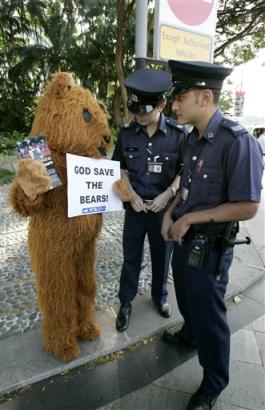
Jodi Ruckley, 33, a volunteer with PETA (People for the Ethical Treatment of Animals), drressed as a bear, protesting the use of the palace's Houseguards bearskin hats, struggles with a policeman as she is placed into a police van at the gate of the Istana or Presidential Palace where Britain's Queen Elizabeth II was expected to arrive on Friday March 17, 2006 in Singapore. The queen, who arrived in Singapore late Thursday after completing a five-day visit to Australia, is making her first trip to the city-state in nearly two decades at the invitation of the city-state's President S.R. Nathan.


A policeman questions Jodi Ruckley, 33, a volunteer with PETA (People for the Ethical Treatment of Animals), dressed as a bear, protesting the use of the palace's Houseguards bearskin hats, as she stands at the gate of the Istana or Presidential Palace where Britain's Queen Elizabeth II was expected to arrive on Friday March 17, 2006 in Singapore.

Singapore police detained an Australian animal-rights demonstrator dressed in a bear suit (L) who staged an illegal protest as Queen Elizabeth II started a state visit


Related Article:
Aussie disrupts Queen's Singapore visit

It reminds me of Jeff Koons 1988 sculpture, apart from the notion that the above images are more menacing.

22 Mar 2006

Take 3 for Rebel director

Sign the Petition to END THIS HARASSMENT .

Martyn See questioned about Singapore Rebel again; new film goes to the censors this week

Wednesday • March 22, 2006


Derrick A Paulo of Today
derrick@newstoday,com.sg

IT HAS been 10 months since the police opened the case on Singapore Rebel — a documentary on opposition politician Chee Soon Juan — and its director Martyn See, and investigations are still underway.

On Monday, Mr See was called down to the Police Cantonment Complex for a 30-minute interview to "clarify what (he) had said before" to investigators, the 38-year-old told reporters yesterday, at a luncheon with the Foreign Correspondents Association.

It was the third time he had been questioned about his 26-minute movie on Dr Chee, following a report lodged last year by the Board of Film Censors. The Board believes Singapore Rebel is a party political film, and hence, an offence under the Films Act.

Last August, Mr See was asked to surrender his video camera and tapes of the documentary to the police. On Monday, he asked if he could have his equipment back, but was told he had to wait until the "completion of the case".

The police confirmed that Mr See had been interviewed on Monday, but said that it would not comment any further as the matter was still under investigation.

Mr See's latest venture is a 49-minute feature on former journalist Said Zahari, 78, who had been arrested in 1963 by the Government on suspicion of subversive activities. He was detained for 17 years.

The film, Zahari's 17 Years, may be screened at this year's Singapore International Film Festival (Siff), despite what happened to Singapore Rebel last year.

Siff is sending the film to the censorship board for approval this week. Mr See does not believe that his new film would be considered "party political" as it covers a current event, namely the launch of Mr Said's book next month.

The freelance film editor is considering more such documentaries, including one on Chia Thye Poh, who was detained under the Internal Security Act from 1966 to 1989.

"They're getting old. How many more years do they have to live? And their stories have not been documented," said Mr See.

The film-maker said that he made Singapore Rebel to get people interested in political issues.

If Mr See is charged, however, he faces a maximum penalty of two years in jail or a $100,000 fine for making a party political film.

Thais march on Singapore embassy

From the BBC...
Protesters are demanding Mr Thaksin's resignation
Thousands of people have marched on the Singaporean embassy in Bangkok in the latest of a series of protests aimed at ousting the Thai prime minister.
Thaksin Shinawatra's opponents are particularly angry about a tax-free sale of his family's stake in a Thai telecoms giant to a Singapore company.

The latest protest came as Thailand's election chief reportedly said he could not postpone a controversial poll.

Mr Thaksin called the snap election for 2 April in a bid to regain legitimacy.

Election Commission chairman Vasana Puemlarp last week cast doubt on whether the poll could go ahead due to a vow by the main opposition to boycott the election, leading to concerns over whether enough MPs could be returned to fill parliament.

But on Tuesday he told a Bangkok radio station that such a ruling was not within his powers, according to Reuters news agency.

"The law doesn't allow me to set the election date," he reportedly said, adding that only the prime minister could make that decision.

Mr Thaksin is campaigning hard in rural areas

There are particular concerns about the election in two-thirds of the constituencies where the ruling Thai Rak Thai party would be unopposed if the election boycott goes ahead, as candidates need to win 20% of the available vote to be elected.

This could be a problem in the restive south, where the party's unpopularity in the face of a long-running insurgency meant the party did not win a single seat in the last election in February 2005.

On Sunday, the main opposition Democrat Party alleged that Thai Rak Thai officials were involved in a plan to hire candidates to stand for small opposition parties to get round this problem.

The Election Commission has pledged to look into the claims, and on Tuesday said it had ordered the transfer of the three officials in question pending an investigation.

Protests

Traffic came to a halt in Bangkok's commercial district on Tuesday as the marchers moved towards the embassy chanting "Thaksin get out".

"I politely ask Singapore to stop cooperating with Thaksin to loot Thailand," protest leader Sondhi Limthongkul told the crowd, calling the deal "economic imperialism".

Mr Thaksin, who denies any wrongdoing, continued his campaign in rural areas, where he is still popular.

Addressing a crowd in the northern city of Chiang Rai on Monday evening, he criticised the protest leaders.

"They want a new government, but they forget that there is big support for this government," he told a cheering crowd.


See more images of the protests.

Singapore - Least "Dear"

Singapore boasts the lowest business costs of any major industrialised country, according to a new study.

The cost of launching and running a business in Singapore is much lower than in the US, Japan or any major European nation, KPMG found.

This was mainly due to its much lower labour costs, with average wages well below other countries in the study.

France and Italy have overtaken the UK in terms of "cost-competitiveness" since 2004, the study found.

Labour costs key

The bi-annual study - which covers 128 cities in nine countries - is based on the costs of setting up and running businesses across different industries over a 10-year cycle.

The research takes into account key factors such as wages, business taxes, rent, and energy costs.

COST-COMPETITIVENESS LEAGUE
1: Singapore
2: Canada
3: France
4: Netherlands
5: Italy
6: United Kingdom
7: United States
8: Japan
9: Germany
Source: KPMG-2006

Singapore topped the "cost competitiveness" league after being included in the study for the first time.

Average wages there are considerably lower than in the other countries included in the study, despite the fact that Singapore now boasts GDP per capita equivalent to some European countries.

The study concluded that labour costs are the most important factor for businesses when deciding where to locate their operations, followed by the cost of finding and securing premises and taxes.

"What we are really seeing here is the price that the UK is paying for having a successful economy" Ian Barlow, KPMG quotes.

Canada was judged the second most competitive country in terms of business costs. The US came seventh while Germany was deemed the least competitive.

The UK lost its position as the most "cost-effective" European country, falling behind both France and Italy.

Not cheap option

KPMG said wage costs were higher in the UK than in France and Italy, a product of its low employment and its skilled workforce.

"What we are really seeing here is the price that the UK is paying for having a successful economy," KPMG partner Ian Barlow said.

"The UK no longer really markets itself as a low cost option to access the European Union market."

Employer groups have called on the British government to reduce the tax burden on companies in Wednesday's budget.

Ahead of the budget, Chancellor Gordon Brown announced he had asked 12 top business leaders to advise the Treasury on improving the UK's competitiveness.
---
In other words, Singapore is cheap!

21 Mar 2006

A potential problem

Survey shows 10% Indonesians justify suicide bombing, 40% want sharia laws.
Ridwan Max Sijabat, Jakarta Post.
Mar 18, 2006

Islamic conservatism is a growing force to be reckoned with across the country, with research indicating about 40 percent of citizens would support the replacement of state laws with sharia and one in 10 consider suicide bombings justified in some circumstances.

A survey conducted in late January by the Indonesian Survey Institute (LSI) found 40 percent of respondents approved of adulterers being stoned to death, 34 percent did not want to see another female president and 40 percent accepted polygamy.

On a thief's hands being chopped off, 38 percent of respondents said the punishment fitted the crime.

The survey involved 2,000 respondents from different backgrounds nationwide.

In presenting the survey results on Thursday, a senior researcher at the LSI, Anis Baswedan, said it was clear that certain Muslim groups had already embraced sharia as a value system as evidenced by their support for conservative organisations, such as the Islam Defenders Front and the Indonesian Mujahidin Council.

On the whole, respondents were less acquainted with right- and left-wing extremist groups, such as the Eden sect, the Liberal Islam Network, Syiah, Hisbut Tahrir and Ahmadiyah.

Anis said, however, that despite the obvious support for conservative organisations, the majority of Muslims did not want to see the existing election system replaced, as was indicated by the results of the 2004 general election.

Muslim-based parties advocating the adoption of sharia did not fare well in the legislative election.

Likewise, the presidential candidates nominated by them did not get the support they were counting on from mainstream Muslim groups.

Yet, the majority of respondents saw eye to eye with the country's largest Muslim organisations -- Nadhlatul Ulama and Muhammadiyah.

On the other hand, the survey also revealed that one in 10 people tolerate suicide bombing and other attacks on civilian targets in the name of Islam.

Anis said the strong support for conservatism and "radicalism" had much to do with what respondents called the negative influence of Western culture and the global injustice blamed on the US as a superpower representing the West.

Sixty two percent of respondents were of the opinion that Western influences had brought no good to Indonesian Muslims and between 22 and 49 percent held the US responsible for global injustice.

Amin Abdullah, rector of Sunan Kalijaga State Islamic University in Yogyakarta, said he was not surprised by the survey results as conservatism had long flourished in the country but, despite strong conservatism, Muslims did not want to replace the existing state ideology with an Islamic one.

"The majority of Muslims have been moderate and accepted pluralism because Indonesia - as the most populous Muslim nation - lies far from the centre of Islam, the Middle East, and this has made Islam in Indonesia rather different from that in Pakistan and Afghanistan," he said, adding that conservatism here had gotten stronger on the eve of the reform era in 1998.

Imam Prasodjo, a sociologist of the University of Indonesia, disagreed with the parameters the survey used to measure radicalism, saying they were relative.

"Women oppose polygamy, all communities dislike mixed marriages and all human beings are against terror acts," he said.

The two agreed that, despite the strong grip of conservatism, the "silent majority" supported the two largest Muslim organizations, which see themselves as tolerant of modern ways of thinking.


Oh my, this is quite worrying for the SEA countries.

Looks like the US will have to work very hard to improve its image with the Muslims to pare the growing radicalism of Islam in Indonesia.

Consumer boycott gaining momentum

By Lan Anh Nguyen 20 March 2006 21:01


Consumer groups leading the boycott campaign against Singaporean products and services yesterday claimed that the campaign is gaining momentum, with a particularly significant impact on mobile-phone service provider Advanced Info Service Plc (AIS), a Shin Corp subsidiary.

The consumer activists cited a recent ABAC opinion poll that shows that 11 percent of AIS subscribers who were interviewed said that they have already stopped using AIS services, while 10.5 percent said that they are planning to do so.

“The number is getting higher,” said Saree Aongsomwang, executive director of Foundation for Consumers, which has been calling on Thais to boycott Singaporean services and products as a way to pressure Singapore’s Temasek Holdings into withdrawing from the Shin Corp deal.

“Right now, AIS has 16.5 million subscribers. If 20 percent of them drops out, that means AIS will lose more than three million customers.”

AIS yesterday said that it can’t measure the impact of the boycott because the statistics are not yet available, but confirmed that there is a wave of customers dropping out from the company, and “ a few hundred” customers have canceled their subscriptions because of political reasons.

“People didn’t give us the main reason, only a few hundred subscribers said they are boycotting our services,” said Wichian Mektrakarn, AIS vice president.

Wichian said the company feels threatened by the boycott and has been trying to fix the situation by explaining its position to customers and launching several promotion programs, but the effort seems to be yielding no visible results.

“We try to explain to the ones who want to listen to us, and we are launching lots of promotion programs. But most people don’t pay attention, they are overwhelmed with political sentiment. It’s the emotional effect. There is nothing we can do [about it],” said Wichian.

The activists said their ultimate objectives are to pressure caretaker Prime Minister Thaksin Shinawatra into stepping down and stop the Singaporean government from buying into Thailand’s core businesses and so-called natural resources, such as Shin Corp.

“Normally, customers think they are powerless. We believe customers are king and they can do their own reform by boycotting services and products. We want to use the same power to support political reform,” said Saree.

AIS said its business has been slowing down in comparison with the same period last year, a situation shared by many other businesses, as most people are in a “wait and see” mood.

Wichian said, however, AIS won’t denounce the consumer groups for their campaign.

“They have the right and liberty [to do so]” said Wichian. “ We just try to provide the best services.”

20 Mar 2006

Submissions by Dr Chee

[Below]is from the desk of Dr. Chee. Pse consider to carry it on your blog.

Cheers!
k.h.


Submissions
(Revised with additional references)
As the AG has preferred a charge against me, I believe I am entitled to a trial here. I can call witnesses to demonstrate the truth of my tatements and to document with precision how the courts in Singapore have been used by the PAP Government to maintain its chokehold on the country.

I have said before I will not run away. I am here to face my accuser and the very people whom I have criticised. I am here to speak the truth, whatever the consequences may bring. If you are going to charge me for contempt of court, at least have the decency to allow me the opportunity to defend myself. There is nothing honorable in a fight wherein you blind and incapacitate your opponent.

Defamation without trial

This hearing has it roots from the defamation suits that Mr Lee Kuan Yew and Mr Goh Chok Tong took against me in 2001.

In my applications I had indicated to the courts that I needed the services of Queen’s Counsels (QC) as no Singaporeans would take up my case. I am not alone in this predicament. Mr Tang Liang Hong also had great difficult in finding local representation when he was fighting his own defamation suits with the PAP. Mr J B Jeyaretnam experienced a similar plight, saying "No lawyer in Singapore wants to do political cases. It's a very sad commentary. Lawyers here are too scared for their own livelihood.” Mr Charles Gray QC who had represented Mr Tang in 1997 said in his submission to the court of appeal that it was “no credit on the legal community that Tang had been unable to find any lawyer (apart from Mr Jeyaretnam himself and, briefly, Mr Peter Low) willing to represent him.”

It is a telling indictment of the legal and judicial systems in Singapore when Singaporean lawyers fear doing what they have been trained to do and sworn to uphold – justice and the rule of law. The judiciary must ask itself how and why Singaporean lawyers are afraid to take up such cases when foreigners are not.

I was told by the courts that my case wasn’t complex enough to warrant my engaging a QC. The funny thing was that my opponents had solicited the services of Mr Davinder Singh, Senior Counsel which I understand is the Singapore version of a Queen’s Counsel. Mr Singh, whom I am sure you are aware, is an experienced lawyer in defamation suits.

How much more onesided can the fight be? In one corner you have a Senior Counsel and the chief of one of the biggest law firms in Singapore of more than 150 lawyers, I believe, and in the other corner, a psychologist with zero training in law. But the referee didn’t seem to care and allowed the fight to proceed. How the courts could be assisted to come to a fair decision when one side did not have legal representation did not seem to be a matter of concern to the judiciary.

So my case hobbled along and came to its inevitable demise when Messrs Lee Kuan Yew and Goh Chok Tong applied for summary judgment where the case was heard in chambers before the registrar. Expectedly, the matter was awarded to the plaintiffs which meant that there would be no trial, no calling for witnesses and no crossexaminations.

In the meantime, I had gotten legal advice that the matter contained issues that necessitated a trial. But what could I do? So no lawyer and no trial. The courts then proceeded to award the plaintiffs $500,000. I have already paid $400,000 in costs and damages in another defamation lawsuit involving my dismissal from NUS and, as a result, I don’t have much left to pay Lee and Goh.

The question that I want to ask is: Why have the courts been so unfair to me? By not allowing me QCs and thereby legal representation, and then not giving me a trial, and subsequently ordering me to pay Lee Kuan Yew and Goh Chok Tong half a million dollars, both of whom are millionaires by the way, and then making me a bankrupt when I am unable to, is to not only punish me but also my wife and children. Is this how justice is meted out in Singapore? If you were me, would you also not have grave doubts about the entire system?


Trials gone bad

One need look no further than the suits of the PAP leaders against Mr Tang Liang Hong to understand how problemaic our judicial system is. The legal events that led to the bankruptcy of Mr Tang make for sordid reading.

I will cite a few instances:

During the 1997 elections Mr Tang had made a police report complaining about the accusations PAP leaders had made about him. The PAP leaders accused Mr Tang of making public the contents of the report to the news media and proceeded to sue Mr Tang and ultimately obtained more than $3 million in judgment. This subsequently made Mr Tang, who now lives in exile, a bankrupt.The horror of it all was that it was later revealed, during crossexamination by the late George Carman QC, who was representating Mr Jeyaretnam, that Home Affairs Minister Wong Kan Seng had ordered the police to give him a copy of the report, which by the way is confidential, passed it on to Mr Goh Chok Tong who was then the prime minister and who then gave it to Senior Minister Lee Kuan Yew who disseminated the report’s contents to the media.

Two questions begged to be asked:

Why was a confiential report made available to the PAP when it was confidential? Remember, the information was later used by the PAP leaders to sue Mr Tang in their private capacities. Why was Mr Tang found guilty of defamation when it was Mr Lee Kuan Yew who had released the information contained in the police report to the media? Does it make sense for Mr Lee to disseminate the information and then sue Mr Tang for defamation? More incredibly, Mr Jeyaretnam had held up an envelope during an election rally and informed the public that Tang had made a police report. For that he was also sued and convicted of defamation despite he fact that he neither revealed the contents of the police report nor mentioned anything in detail about the PAP politicians. In the Tang Liang Hong case, it will be remembered that Mr Lee Kuan Yew had made a statement in his affidavit that the town of Johor Baru was “notorious for shootings, muggings and carjackings.”

In the ensuing uproar on the Malaysian side, Lee was forced to retract his statement and apologize to Malaysia. Lee then applied to have his statement removed from his affidavit. But Tang queried the move on a point of law: that the rules of court stated that an affidavit or parts of it may be struck off only on the grounds that it was “scandalous, irrelevant, or oppressive.”

The judge allowed Lee’s application saying that the judiciary “should help Singapore maintain good bilateral relations.” Maintaining good bilateral relations is the work for the Executive Branch of the Government, in particular the Foreign Ministry. The judiciary’s role is to ensure that justice is meted out in accordance with court rules and the law to contesting parties. I will submit more on this point a little later.

To heap insult upon the already enormous injury, the judiciary then ordered Tang to pay cost for the application even though Mr Lee was the one who had made the statement about Johor Baru and it was Lee who had applied to have the offending words removed! Similar occurrences happened in my own case. In 2004, I had informed the courts that I would be away in the United States to do a fellowship until September that year. In July while I was still away, Mr Lee Kuan Yew and Mr Goh Chok Tong applied for the hearing to assess damages to be brought forward. The Registrar then wrote to me, knowing that I was away, to attend court to ”confirm the new dates” proposed by the plaintiffs. I found out about this only when I returned to Singapore in September. The fact that the plaintiffs changed their minds about the application and decided to stick to the original dates was cold comfort to me. Going back to the Tang case, It will also be recalled that Mr Tang’s wife was named a codefendant to the suit even though she had nothing to do with case. Be that as it may, when Mrs Tang tried to visit Johor Baru one day, she was stopped by immigration officials who proceeded to impound her passport. Mr Lee Kuan Yew later said in court that “we were compelled to seize her passports for the purpose of satisfaction of judgments to be obtained by [the plaintiffs].” We? Since when was there a law to allow plaintiffs in defamation suits to seize the passports of defendants? Where was the judiciary to prevent such an abuse of power?

International criticisms


These events were not conjured by me for fun. They were actual occurrences. They are incontrovertible facts that demonstrated how the judiciary has bent over backwards to accommodate those in power at the expense of the political opposition in Singapore. These occurrences have led international observers to come to the conclusion that the judiciary is indeed influenced by the executive. Ross Worthington, in his paper Hermes and Themis: An Empirical Study of the Contemporary Judiciary in Singapore, listed the observers: (p. 492)

“Criticism of the Singaporean judiciary has been made by international human rights organizations such as Amnesty International and Asia Watch, by judicial institutions such as the Bar Association of the City of New York, the International Commission of Jurists in Canada, Australia, and its international office in Geneva, the Privy Council and eminent internationally renown senior counsel such as John PlattsMill QC, Frank Galbaley QC, Anthony Lester QC, Geoffery Robertson QC, Judge Paul Bentley, and Stuart Littlemore QC. These critisims have usually been based on judgments in political cases in Singapore, not on the basis of political belief, but according to the established legal principles of common law nations, the same standards Singapore professes to follow.”

[Defamation lawsuits have] done little to overcome the courts’ reputation as improperly compliant to the interests of the country’s ruling People’s Action Party. – International Commission of Jurists “What emerges…is a government that has been willing to decimate the rule of law for the benefit of its political interests. Lawyers have been cowed to passivity, judges are kept on a short leash, and the law has been manipulated so that gaping holes exist in the system of restraints on government action toward the individual.” – New York City Bar Association Lawyer’s Rights Watch Canada: “The use of defamation suits in Singapore to prevent political statement belies any notion that Singapore is a democracy. Democracy is the right to participate in one’s governance and to receive, distribute and debate information regarding issues of public concern and the performance of public officials without the risk of civil or criminal penalties. Singapore has failed to protect these rights. Singapore has also failed to honour its obligation to promote and protect the rule of law (a state of affairs in which there are legal barriers to government arbitrariness and legal safeguard for the protection of individuals.)” Retired Canadian judge Paul Bentley: “The issue of' whether the filing of' defamation suits affects freedom of expression and peaceful democratic discourse in Singapore is beyond question for me. The more pressing concern is whether international condemnation of the practice and faint signs of growing domestic distaste for it, will be sufficient to change the government's tactics against its political opponents.”

Professor Ross Worthington had conducted an empirical study on the judiciary in Singapore and this is what he found: On the subjugation of the judicial branch of government (p. 491) “This is a system of governance which, however, has been extensively criticized for its lack of transparency, accountability, and democratic behaviour. In particular, there has been a continuing concern that the ruling Peoples Action Party (PAP) governments have produced a political system in which all branches of government, including the judicial, have been subjugated to the executive branch. This has led to considerable criticism of the Singaporean judiciary…”

On the control of the subordinate courts (p. 497)
“This practice of actively ensuring that there is no professional judiciary within the subordinate courts subjugates these courts directly to executive power; they are not part of an independent judiciary but an arm of executive government, part of the Singapore Legal Service, and they carry into that role the norms characteristic of the civil service including implicit support for the political executive and its power arrangements.”

On appointees to the Supreme Court (p. 499)
“Almost half of appointees to Supreme Court are drawn from the Attorney General’s Chambers or were formerly senior officers of this department before going into private practice and then into the judiciary. If we accept that it is irrelevant for senior civil servants to be PAP members or cadres as it is both illegal for them to be members of a political party and they can have allegiance to the party without such a formal status, those appointed with formal or informal affiliation to the PAP form 85 percent of Supreme Court appointees. Those not obviously linked to the PAP comprise 15 percent.”

On the abolition of appeal to the Privy Council (p. 502)
“The last vestige of complete independence in the judicial system, appeal to the Judicial Committee of the Privy Council, was abolished in February 1994, despite Lee Kuan Yew’s previous insistence that Singapore should ‘allow a review of the judicial process that take place here in some other tribunal where obviously under influence cannot be brought to bear’. The abolition of appeals to a nonSingaporean tribunal is, in itself, no cause for concern; New Zealand acted in 1996 to do likewise, as has Australia. The principle concern is that the indigenous judicial system be sufficiently mature to defend the rule of law, maintain the independence of the judiciary and, at the most basic level, be able to provide balance in the exercise of state power over citizens.

Given that the Privy Council and several international judicial organizations had castigated the Singaporean judiciary for failing to uphold such standards, it is difficult not to conclude that the executive replace the Privy Council with a domestic Court of Appeal as a means of maintaining executive control of the judiciary and minimizing international criticism of the judicialexecutive nexus and the executive’s occasional overt abuses of power.” In the US State Dept Human Rights Report 2005, it is stated that “The following human rights problems were reported” one of which was “executive influence over the judiciary.”

The report went on to say that “Some judicial officials, especially supreme court judges, have ties to the ruling party and its leaders… Government leaders historically have used court proceedings, in particular defamation suits, against political opponents and critics. Both this practice and consistent awards in favor of government plaintiffs raised questions about the relationship between the government and the judiciary...”

All the instances that I have cited, there seems to be almost universal agreement about the lack of judicial independence in Singapore. Given this isn’t there a possibility that there may be, just may be, a kernel of truth in all their observations.

You may say that all these organizations and individuals are somehow stupider than the judicial and legal officials in Singapore when it comes to interpretation of the law. Or may be they are all angmohs (Caucasians) who are intensely jealous of Singapore’s success and want to sabotage it. They are all either telling lies or deeply mistaken, the whole lot of them: AI, ICJ, Professor Ross Worthington, the US State Dept and so on.

Maybe you can try to make this to be the case that everyone else is wrong except you. But what is most important is what does the average reasonable person thinks.

But let us for the moment assume that everyone else is wrong and that the AG and the Courts are right. You will recall that in the Christopher Lingle case, the AG admitted, and the courts agreed, that when the American academic said that some Asian governments used “compliant” judiciaries to bankrupt opposition politicians, he was referring to Singapore.

Let’s pause for a moment here and take a closer look at the absurdity of the present case. The AG and the courts acknowledge that“compliant” judiciaries are used to bankrupt opposition politicians in Singapore. That’s what you said. Yet when I agree with you and say the same, I am charged for contempt of court. Does this make any sense to you?

The only way that I can be convicted for contempt of court is if you admit that the AG and the Courts had lied in the Christopher Lingle case because it is not true that the Singapore judiciary is “compliant” when it came to defamations suits involving opposition politicians. But if you are speaking the truth, then so am I. And if I am speaking the truth, how can I be in contempt of court. Isn’t truth what courts seek? On this point allow me to point out that in Nationwide vs Mills
(p 39):
“It is not neccesary, even if it be possible, to chart the limits of contempt scandalizing the court. It is sufficient to say that the revelation of truth—at all events when its revelation is for the public benefit—and the making of a fair critisim based on fact do not amount to a contempt of court though the truth revealed or the critisim made is such as to deprive the court or judge of public confidence. The critical difference between the scope of s. 299(1)(d)(ii) and the scope of contempt of court is that the latter does not purport to supress justifiable or fair and reasonable critisim which exposes grounds for loss of official repute, but s. 299(1)(d)(ii) purports to supress all critisim which is likely to bring the Commission into disrepute including critisim that is justifiable, fair and reasonable.”

Conclusion
The truth of the matter is that convicting and punishing me for contempt does not and cannot change reality, it cannot elevate the reputation of the Singapore courts. Its like the big bully punching out the little guy for calling him a bully. Please don’t for one minute think that I am attacking you, sir. I respect you as a person and I hold have only the highest regard for your intellect.

But I cannot in good conscience continue to allow it to go unremarked when our judicial system is in such a dismal state. I am not foolish. I know the power that you wield. It is power backedby handcuffs, prison cells and, utimately, guns, the combination of which keep heads bowed and mouths shut. I don’t possess or have at my disposal such enormous power. I have only my freedom with which to wage this battle. But I also have something that is far more powerful than all the physical force that you can muster – and that is, the truth. And if you realise the power that truth posseses you will see how lopsided this contest is, and you will have the wisdom, I pray, to get on the right side. What you do to me today, the sentence that you will hand down, will be temporary. But the infamy that you will have to live with will go down in the annals of Singapore’s history and that will last forever. I plead not for leniency but for reform, that good and wise minds prevail in this room today.

Speaking truth to undemocratic power is never easy for it invariably invites reprisal. I do not want to go to prison for I have have a lovely wife and three beautiful children wanting me to come home. Having to leave them under such circumstances is the most painful thing I have had to do. But living with the shame of keeping my head bowed when injustice permeates our society is infinitely worse. I want to be free but freedom is nothing when one cannot speak the truth to power.

19 Mar 2006

Thai protesters burn images of Singapore PM


Fri Mar 17, 2006 4:07 AM ET
By Pracha Hararaspitak

BANGKOK (Reuters) - Protesters burned posters of Singapore Prime Minister Lee Hsien Loong outside the city state's Bangkok embassy on Friday as a campaign to oust his Thai counterpart, Thaksin Shinawatra, took a nationalist twist.

Waving placards saying "Thailand Not for Sale, Get Out", several hundred protesters urged a boycott of all things Singaporean in answer to the takeover of telecoms giant Shin Corp by its state investment arm, Temasek, from Thaksin's family.

"If Singaporeans faced the same situation as we do now, we believe Singaporeans would also rise up to do what we are doing," said Somsak Kosaisuk, a key member of the People's Alliance for Democracy (PAD), which is trying to kick Thaksin from office.

They also torched models of Singapore Airlines planes, its "merlion" national mascot and pictures of Lee's wife, Ho Ching, the Temasek boss.

The political crisis has already caused the Thai stock market and baht to wobble and is now raising long-term economic concerns, with ratings agencies looking at growth forecasts and companies delaying public flotations or investment projects.

The anti-Singapore sentiment, which stems from outrage at Thaksin's family paying no tax in January's $1.9 billion Shin Corp deal, now appears to be hurting business.

According to Chainid Ngow-Sirimanee, head of builder Property Perfect PCL, Singapore firms have delayed decisions on potential Thai property investments worth $256 million.

DBS Group Holdings, which had been thought keen on raising its stake in Thailand's TMB Bank PCL, had yet to make up its mind on whether to go ahead, a spokesman said. Analysts attributed the delay to politics.

"I AM DEMOCRACY"

Thaksin, who remains defiant in the face of the middle-class metropolitan movement to oust him, hit the provincial campaign trail once again, rallying his core rural support base for snap elections called on April 2.

The Election Commission says the poll, which Thaksin has billed as a referendum on his leadership, may have to be postponed as a boycott by the three main opposition parties is likely to render it constitutionally unviable.

Thaksin, who is accused of corruption, cronyism and eroding the checks and balances of the 1997 constitution, does not agree.

"April 2 is the day for people to choose whether to let mob rule prevail or give the democratic process a chance to work," he told sugarcane farmers in the western province of Kanchanaburi, home to the famous "Death Railway" bridge over the River Kwai.

"I represent the democratic process. If you agree with the opposition boycott, you can abstain," he said, referring to one of the options on Thai ballot papers.

More than 100,000 people hit the streets this week calling for his head, sparking fears in the royal palace and army of a repeat of the bloodshed during a "people power" uprising against military rule in 1992.

However, both sides appear to be going out of their way to avoid violence.

Police marshalling the protests have been good-natured and unarmed and Thaksin switched a meeting from Government House to avoid confrontation with thousands of protesters camping on its doorstep.

A 20,000-strong pro-Thaksin "caravan of the poor" which arrived in northern Bangkok on Friday also vowed to steer clear of its political adversaries.

"We don't want to clash with them," said Attarit Singhlor, head of the 3-km (2-mile) convoy of trucks and home-made tractors which snaked its way slowly down from the impoverished northeast as the political crisis in the capital deepened.

"We'll make statements and express our requests for the prime minister to help on land, land deeds and funding for organic fertilizer projects, then leave Bangkok," he said.

Dr. Chee Soon Juan has a Petition

To: Singapore Judiciary

We, the undersigned, would like to request that Dr Chee Soon Juan be released from prison. It is the strong belief of the undersigned that the sentence was uncalled for. We also denounce the heavy damages awarded in the recent libel suit against him.

Sincerely,

The Undersigned

View Current Signatures


The Petition for the Release of Chee Soon Juan from prison for wrongful conviction Petition to Singapore Judiciary was created by and written by Diana Chua Tian Qi (dianachua@hotmail.com). This petition is hosted here at www.PetitionOnline.com as a public service. There is no endorsement of this petition, express or implied, by Artifice, Inc. or our sponsors. For technical support please use our simple Petition Help form.

Send this to a friend

Message from behind bars

Received via email

Dear friends,

Chee Soon Juan's wife and three children visited him at the remand prison this afternoon (Sat, 18 March). This will be the only visit until his release on 24 March.

During this short visit, he had asked Mrs. Chee to convey this message to you:

"I am doing fine. My spirits are up and I have you to thank for this. There are many individuals and organizations whom I would like to send my personal thanks but am unable to do so from here and through this very brief visit.

The Amnesty International, the ICJ, Human Rights First, SEAPPA are among the many organizations that have lent their invaluable help.

I am grateful to the diplomatic community in Asia, Australia, Europe and the US for all that they have done. It is precisely due to the involvement of and attention from the international community that has deterred the Singapore government from wielding its usual unbridled power.

The Singapore authorities are keenly aware that the world is watching them and that it is due to this that they cannot continue to use such oppressive and unjust measures to silence democracy advocates and dissenting voices.

I also thank friends and supporters from Singapore and beyond. Thank you for your thoughts, prayers, well-wishes and tireless efforts."

Chee Soon Juan

17 Mar 2006

Dr Chee's Podcast

Dr. Chee Soon Juan was declared a bankrupt after failing to pay $500,000 in libel damages awarded to Lee Kuan Yew and Goh Chok Tong. In Feb 2006, Dr. CSJ was charged with contempt of court for a statement he made at the above bankruptcy hearing in which he stated that the judiciary is not independent and fair, especially in cases involving opposition politicians. On 17 Mar 2006, he was sentenced to jail for 8 days after refusing to pay his fines of $6,000. Dr CSJ should not be in jail at all.


From Dr Chee's personal/family blog.

Listen to the podcast made an hour before Dr Chee was sent to prison - again!
http://www.sgdemocrat.org/radioSDP/judiciary1.MP3

Thai protesters burn images of Singapore PM

"If Singaporeans faced the same situation as we do now, we believe Singaporeans would also rise up to do what we are doing," said Somsak Kosaisuk

Actually I don't think Singaporeans would or could rise up...
By Pracha Hararaspitak | March 17, 2006

BANGKOK (Reuters) - Protesters burned posters of Singapore Prime Minister Lee Hsien Loong outside the city state's Bangkok embassy on Friday as a campaign to oust his Thai counterpart, Thaksin Shinawatra, took a nationalist twist.

Waving placards saying "Thailand Not for Sale, Get Out," several hundred protesters urged a boycott of all things Singaporean in answer to the takeover of telecoms giant Shin Corp by its state investment arm, Temasek, from Thaksin's family.

"If Singaporeans faced the same situation as we do now, we believe Singaporeans would also rise up to do what we are doing," said Somsak Kosaisuk, a key member of the People's Alliance for Democracy (PAD), which is trying to kick Thaksin from office.

They also torched models of Singapore Airlines planes, its "merlion" national mascot and pictures of Lee's wife, Ho Ching, the Temasek boss.

The political crisis has already caused the Thai stock market and baht to wobble and is now raising long-term economic concerns, with ratings agencies looking at growth forecasts and companies delaying public flotations or investment projects.

The anti-Singapore sentiment, which stems from outrage at Thaksin's family paying no tax in January's $1.9 billion Shin Corp deal, now appears to be hurting business.

According to Chainid Ngow-Sirimanee, head of builder Property Perfect PCL, Singapore firms have delayed decisions on potential Thai property investments worth $256 million.

DBS Group Holdings, which had been thought keen on raising its stake in Thailand's TMB Bank PCL, had yet to make up its mind on whether to go ahead, a spokesman said. Analysts attributed the delay to politics.

"I AM DEMOCRACY"

Thaksin, who remains defiant in the face of the middle-class metropolitan movement to oust him, hit the provincial campaign trail once again, rallying his core rural support base for snap elections called on April 2.

The Election Commission says the poll, which Thaksin has billed as a referendum on his leadership, may have to be postponed as a boycott by the three main opposition parties is likely to render it constitutionally unviable.

Thaksin, who is accused of corruption, cronyism and eroding the checks and balances of the 1997 constitution, does not agree.

"April 2 is the day for people to choose whether to let mob rule prevail or give the democratic process a chance to work," he told sugarcane farmers in the western province of Kanchanaburi, home to the famous "Death Railway" bridge over the River Kwai.

"I represent the democratic process. If you agree with the opposition boycott, you can abstain," he said, referring to one of the options on Thai ballot papers.

More than 100,000 people hit the streets this week calling for his head, sparking fears in the royal palace and army of a repeat of the bloodshed during a "people power" uprising against military rule in 1992.

However, both sides appear to be going out of their way to avoid violence.

Police marshalling the protests have been good-natured and unarmed and Thaksin switched a meeting from Government House to avoid confrontation with thousands of protesters camping on its doorstep.

A 20,000-strong pro-Thaksin "caravan of the poor" which arrived in northern Bangkok on Friday also vowed to steer clear of its political adversaries.

"We don't want to clash with them," said Attarit Singhlor, head of the 3-km (2-mile) convoy of trucks and home-made tractors which snaked its way slowly down from the impoverished northeast as the political crisis in the capital deepened.

"We'll make statements and express our requests for the prime minister to help on land, land deeds and funding for organic fertilizer projects, then leave Bangkok," he said.

Interview with Martyn See

A radio programme [approx. 13 mins] emailed to me by Brian C. Johnsen which includes audio extracts from Singapore Rebel and an interview with Martyn See.

Centre Street Or visit the site.

Summary: We are privileged here to have our democratic rights honoured. Except for the occasional violent protest, all is peaceful in the West. So why should we worry about politics in the island state of Singapore?


Credits: A heartfelt thanks to filmmaker Martyn See Tong Ming, who was willing to be interviewed.

Aussie disrupts Queen's Singapore visit

A protest in Singapore, are you sure? I want pictures to prove this.

Jodi Ruckley even had her placard and bear suit returned to her, luckily she wasn't carrying a placard and wearing a T-shirt demanding transparency of the CPF and NKF.

From The Age
March 17, 2006 - 4:55PM

An Australian animal rights activist in a bear suit disrupted a Singapore visit by the Queen to protest against the bearskin hats worn by the soldiers who guard Buckingham Palace.

Two police officers detained the member of People for the Ethical Treatment of Animals (PETA) near the presidential palace, not long before the Queen arrived for a ceremonial welcome from head of state SR Nathan.

It also occurred hours before Prince Philip was to open a new Singapore office for the environmental group WWF International, of which he is president emeritus.

Jodi Ruckley, 33, from Sydney, was led to a police van after brandishing a placard saying "God save the bears".

She was released later without charges. Her bear suit was also returned.

Protests are banned in tightly-governed Singapore unless organisers obtain a police permit in advance.

Ruckley threatened further protests during the queen's two-day Singapore visit, saying she was prepared to risk further police action on behalf of the bears.

"To tell you the truth it is risky but ... that's nothing compared to what they're going through," she said.

The Queen arrived in Singapore, once a colony and now a republic, on Thursday night for a two-day state visit after she opened the Commonwealth Games in Melbourne.

PETA opposes the use of Canadian black bear pelts for the Grenadier Guards' furry ceremonial hats.

The Grenadiers are a part of the regular British army but are best known as the Royal Guard in London.

"We are not giving up till they change to synthetic fur," said PETA spokesman Jason Baker.

As well as the Grenadiers, bearskins are worn with ceremonial tunics by Britain's Welsh, Irish, Scots and Coldstream Guards regiments.

The bears are hunted in Canada and their skins shipped to Britain, and activists as well as some parliamentarians say they should be replaced with fake fur.

The bearskins are thought to have been adopted from France's Imperial Guard after Britain defeated Napoleon at Waterloo in 1815.

It features in ceremonies such as the Trooping of the Colour, which are traditionally led by the monarch.

Recently a group of British Labour MPs tabled a motion seeking a ban on the towering headgear.

The UK Ministry of Defence said that it had begun trials of synthetic materials as a response to animal welfare worries. Early results have shown fake material goes frizzy in London's weather.

© 2006 AAP

Hundreds marched to Singapore embassy

The Bangkok Post

Bangkok (dpa) - Hundreds of Thai protestors marched on the Singapore embassy Friday renewing calls for a boycott of goods and services, after the city-state's purchase of the former business empire of Thai premier Thaksin Shinawatra.

More than 600 protestors marched from Lumpini Park to the embassy compound waving banners reading "Close Relations With Singapore," Don't Buy Singapore Products, Don't Use Singapore Services and Banks,"and "Corrupt Thaksin Get Out, Don't Support Corrupt Temasek."

The protestors passed a letter to the embassy demanding the Singapore government end its 15-year agreement with Thailand to rent military bases in the kingdom and calling on Singaporeans to help their cause.

"We, on behalf of the Thai people, would like to call upon the people of Singapore to assist us by scrutinizing the business conduct of Temasek Holding and the rental of military bases in Thailand, as well as applying pressure on the Singapore Government to adhere strictly to transparency and good governance and to abstain from interfering in other countries' internal affairs by cancelling the purchase of Shin Corporation's shares and removing its military bases from Thailand," the letter said.


On January 23 Thaksin's family sold its 49 per cent stake in Shin Corp. - a holding company with investments in Thailand's mobile phone service, the national satellite network, a TV station, an Internet service and a no-frills airline - to Temasek Holding, an investment arm of the Singapore government.

The 73.3-billion-baht (1.9-billion-dollar) sale has outraged many Thais because it was tax free and amounted to selling off sensitive sectors to a foreign government.

The sale ignited mass protests against Thaksin that have spilled over into anger at Singapore. Last week about 1,000 anti-Thaksin demonstrators marched on the embassy to demand the Singapore government rescind the purchase.

Embassy officials told the protesters that the Singapore government has no say over Temasek transactions even though the holding company is wholly government-owned.

Temasek has acquired additional shares in Shin Corp. via a public tender and now holds 96 per cent of the corporate conglomerate.

The protestors gave Singapore until Friday to reconsider their demands, before they would renew calls for a boycott on Singapore goods and services.

Protests leaders claimed earlier Friday that their boycott would lead to at least 3 million subscriber cancellations of the Advanced Info Service (AIS), the mobile phone service owned by Shin Corp.

AIS is Thailand's largest hand phone service with more than 16 million users. Other services that have been targeted by the boycott include Singapore Airlines, the Singapore-owned UOB and DBS banks.

Singapore opposition leader sentenced to day in jail

The Star

SINGAPORE (Reuters) - A Singapore court sentenced an opposition leader to one day in jail and fined him S$6,000 ($3,700) on Friday for questioning the independence of the city-state's judiciary.

Failure to pay the fine by 5 p.m. on Friday would result in a one-week prison sentence, the High Court said.

Chee Soon Juan, secretary-general of the tiny Singapore Democratic Party, had criticised the judiciary during a February court hearing in which he was declared bankrupt following a defamation suit brought by two former prime ministers.

"I will not pay the fine," Chee told Reuters after being sentenced. Chee and his lawyer had been expecting a much more severe sentence of two to three months.

Chee was immediately arrested and transferred to the Queenstown Remand Prison.

He had been found guilty of contempt of court on Thursday. Singapore's attorney-general charged that he had "scandalised" the judiciary during his Feb. 10 bankruptcy petition when he "imputed that he and other opposition politicians had suffered grave injustice because the Singapore judiciary was not independent and compromised the law in order to gain favour with the government".

Chee, whose party has no seat in parliament, cannot run for election because, under Singapore law, bankrupts are banned from standing for Parliament. Prime Minister Lee Hsien Loong is widely expected to call a general election in the next few months.

The U.S. Department of State, in a March 8 report on human rights practices in Singapore, criticised the city-state's judiciary and questioned its independence in defamation cases targeting opposition leaders, citing Chee's case as an example.

Singapore's leaders say the defamation suits are necessary to safeguard their reputations.

The High Court declared Chee bankrupt last month for failing to make libel damages payments to former prime ministers Lee Kuan Yew and Goh Chok Tong.

In January 2005, Chee lost a three-year legal fight against defamation suits brought by Lee and Goh, and was ordered to pay them S$500,000 ($306,000) for questioning the government's use of public funds.

Copyright © 2005 Reuters

High Court Hearing Debates Controversial Issues on what Constitutes Contempt of Court, Freedom of Speech and Political Persecution amongst others

Date of Hearing: 16th & 17th March 2006

The hearing of Attorney General versus Singapore Democratic Party (SDP) secretary general, Dr Chee Soon Juan for contempt of court over his bankruptcy statement which he submitted on 10th February opened in the High Court yesterday before Justice Lai Siu Chiu.

Starting slightly later than the scheduled 10 am, the hearing was first addressed by M Ravi, who also acts as counsel to Dr Chee. He explained that he was not the solicitor in record and that the submissions would be addressed in two sections, the first part from himself and the other by the defendant. He explained that he could not deliver the second part as it may impute him if he were to make those comments. AG Chambers, which was represented by Second Solicitor General Lee Seiu Kin did not have any problems with the representation after Justice Lai queried the prosecution.

M Ravi started off by distinguishing contempt in the face (or not) of the court and continued to argue that Dr Chee's conduct does not constitute contempt. He said that since the assistant registrar, who had the power to allege Dr Chee for contempt had not done so during the bankruptcy petition, henceforth, AG's pressing charges on Dr Chee constitutes as a procedural defect amongst other contentious issues.

Confusion broke out when Mr Lee said that Dr Chee had been served with an affadavit on 13 February of whom the latter had denied receiving. Nevertheless, the hearing adjourned for a 15 minutes break for Dr Chee and counsel to read the “lost” statements.

The prosecution argued that AG has pressed the charges according to order 52 Rules of The Court citing respondent for contempt. He argued subsequently that Singapore courts does not distinguish between contempt in the face (or not) of court after M Ravi cited precedent cases in Malaysia and Canada. He also argued that commonwealth countries have developed in different directions with regards to what constitutes contempt, hence inadmissible in Singapore's situation.

During the hearing, the prosecution read the bankruptcy statement (which was also posted on the Singapore Democratic party website - of which there was only minimal difference between the two, the latter containing the Canadian Oakwell case) that Dr Chee delivered during the bankruptcy petition and cited specific sections which Lee claimed were “scurrilous attacks” on the judiciary that “undermine the integrity and independence of the courts and the judiciary”. The prosecution further posited that Dr Chee was being “selective” in singling out Jeyaretnam and other Opposition and that his statements were “baseless” and “malicious”. He went on to refute the claims Dr Chee made in his bankruptcy statements.

After the lunch break, M Ravi touched on issues of freedom of speech; and that Dr Chee's statements were based on “fair comments” which henceforth does not constitute contempt of court. He argued that there is a need for a balance of approach. He said that the Singapore judiciary needs to be open to criticism in the balance of public interest. The current system in Singapore which lacked a parliamentary ombudsmen or an independent human rights commission effectively meant citizens had no channels of redress. He opined that there is a need to raise the threshold of judicial tolerance and adverse comments on judiciary independence.

Dr Chee who represented himself for his last part of the submission was stopped half-way when Justice Lai felt he was not focusing on rebutting the points made by Mr Lee. He was allowed to proceed after he argued that he was only trying to provide the background for making those comments. Besides narrating the personal reasons and observations, of which he believed he was politically persecuted by the PAP government, he also quoted from the United States Department 2005 Human Rights Record that commented on the Singapore judiciary.

Mr Lee further argued towards the last hour of the first hearing that it will be a sad state of affairs if Dr Chee is not held in contempt as Singapore needs to adopt to “local sensitivities”. He said that allowing precedents with Dr Chee case would slowly erode the basic foundations of the judiciary.

Justice Lai ended the session at 5 pm and remarked that Dr Chee and M Ravi had not addressed the issue of contempt. She has however reserved sentence and adjourned the case until the next morning.

The hearing which re-opened at 10 the next morning concluded within an hour.

Mr Lee, the prosecutor said that Dr Chee has not shown remorse but instead compounded his contempt for court during yesterday's trial and by giving an interview with Straits Times. He suggested that the nature and extent of Dr Chee's case warranted imprisonment though it will be a first for contempt of court in Singapore. He added that if Dr Chee thought being a politician would “immunize” and gave him “unlimited” freedom of speech, then he is wrong. He added that changes to the constitutional system should stay within the parliament and political arena, not the courts.

Besides summarizing yesterday's arguments, M Ravi added that Dr Chee should also be protected under the clause of Article 12, the Equation Clause of the Constitution which states that “All persons are equal before the law and entitled to the equal protection of the law”. He made this reference to the fact that Dr Chee was merely citing quotations from various bodies (not plucking out from thin air). He also used the analogy of foreigners being allowed to protest during the upcoming IMF-World Bank Protest whereas Singaporeans are denied this freedom to highlight Dr Chee's situation.

At the end of the hearing, the court sentenced Dr Chee to a day's jail and an additional jail term of seven days if he did not pay the fine of 6,000 Singapore dollars (3,700 US) by 5:00 pm (0900 GMT). He is also to pay for the AG costs tax on standard basis.

Justice Lai found Dr Chee in contempt of court as she found that Dr Chee has quoted from bodies which contains “half-truths, untruths and lies”. She also agreed with Mr Lee that it is one of the worst cases in “scandalising the courts” and that there were no mitigating circumstances for lenient sentences which M Ravi had earlier pleaded.

Dr Chee's contempt case has received international attention. Yeshua Moser-Puangsuwan, International Council Member of Nonviolence International, NGO in Consultative Status with UN ECOSOC, has filed a complaint to the Office of the United Nations Commission for Human Rights requesting “prompt intervention on his pending imprisonment for speaking his opinion”. A second complaint was sent to United Nations' Special Rapporteur of the Commission of Human Rights by 11 law-makers and activists, including Singapore's former solicitor general, Mr Francis Seow. The World Forum for Democratization in Asia (WFDA) of which Dr Chee, is a steering committee member of, has released a statement calling on the Singapore government to cease this act of political persecution.

Links:

1.AG Application on Dr Chee for contempt of court can be accessed from the SDP website, specifically at this link, http://www.singaporedemocrat.org/articlecontemptofcourt.html

2.Dr Chee's statements delivered during his bankruptcy petition can be accessed from the SDP website, specifically at this link, http://www.singaporedemocrat.org/articlecheebankruptcy.html

3.US Department, Singapore, Country Reports on Human Rights Practices - 2005, Released by the Bureau of Democracy, Human Rights, and Labor, March 8, 2006, http://www.state.gov/g/drl/rls/hrrpt/2005/61626.htm

4.Complaint to UN human rights commission lodged on “contempt of court” case, 6 March 2006, by Non Violence International can be accessed from the SDP website, specifically at this link, http://www.singaporedemocrat.org/articlecontemptofcourt1.html

5.Second complaint sent to the UN on CSJ case, 10 Mar 06, can be accessed from the SDP website, specifically at this link, http://www.singaporedemocrat.org/articlecontemptofcourt3.html

6.WFDA Steering Committee statement, 15 March 2006, can be accessed from the Alliance for Reform & Democracy website specifically at this link, http://www.asiademocracy.org/content_view.php?section_id=1&content_id=675

Opposition leader braces himself for lengthy jail term

From The Star.

A SINGAPORE opposition leader fears he is facing a lengthy jail term after questioning the independence of the country's judiciary.

Chee Soon Juan, one of Singapore's few opposition figures, is to appear in court tomorrow to answer contempt of court allegations.

“I'm looking at jail time, prison time. How long, I don't know. It's really basically up to the judge,” said Chee, 43, secretary-general of the Singapore Democratic Party.

Chee said he had served three previous jail terms – a total of about two months – for speaking publicly without a permit, but he expected a more severe sentence this time.

The attorney-general filed a contempt of court action after a Feb 10 High Court hearing at which Chee was declared bankrupt. The bankruptcy order followed his failure to pay S$500,000 (RM1.14mil) in damages to the city's founding father Lee Kuan Yew and another former prime minister, Goh Chok Tong.

During those proceedings, Chee criticised the judiciary.

“The judiciary in Singapore is, sadly, not independent especially when it comes to dealing with opposition politicians,” he told the court.

The Law Society of Singapore, in comments reported by the local press, called Chee's allegations deeply detrimental to the rule of law. The Society was responding to Chee's public request for it to get involved in his contempt case.

“The Law Society rejects the allegations that you have made concerning the independence of the judiciary,” the Society's president was quoted as saying.

A member of the Singapore Democratic Party since 1992, Chee is a neuropsychologist with a doctorate from the University of Georgia in the United States. He said his practice lapsed because his political stance made it hard to receive referrals from medical professionals.

He is the author of four books about politics and another about parenting, and says he earns an income by selling them on the street. – AFP

16 Mar 2006

SDP chief Chee found in contempt of court


Time is GMT + 8 hours
Posted: 16 March 2006 1753 hrs

By S Ramesh, Channel NewsAsia

SINGAPORE : Singapore Democratic Party leader Chee Soon Juan has been found guilty of contempt of court.

The ruling was made by Justice Lai Siu Chiu at the end of the hearing on Thursday.

She has deferred sentencing till Friday to give both Dr Chee and his lawyer another chance to reply to points raised by the Attorney General.

Both of them failed to do so today.

The Attorney General had taken action against Dr Chee after he made a statement about the independence of the Singapore judiciary on February 10 during a hearing on his bankruptcy before an assistant registrar.

Arguing the case for the Attorney General was Second Solicitor General Lee Seiu Kin.

He told the court Dr Chee had scandalised the entire Singapore judiciary by alleging that it was biased and unfair, and that it acted at the instance of the government or conspired with the government in cases involving opposition politicians.

Dr Chee had also insinuated that judges were controlled by the government and were liable to be removed from the Bench if they were perceived to be lenient towards opposition politicians.

During the hearing, the SDP leader, who was given an opportunity to make his statement, spent much of the time referring to defamation cases he and other opposition politicians had faced in the Singapore courts to substantiate his claim about the independence of the country's judiciary.

At one point, the Judge had to intervene, urging Dr Chee not to turn the court of law into an election rally.

Before adjourning for the day, Justice Lai said the hearing was a chance for Dr Chee to show cause as to why he should not be cited for contempt of court.

But she ruled there was no basis for her not to grant an order.

The court will sit again on Friday at 10am to allow Dr Chee and his lawyer to reply to points raised by the Second Solicitor General, before sentence is passed. - CNA /ct


Copyright © 2006 MCN International Pte Ltd

Singapore as regional suicide hub, or Suicidopolis!

Singapore now a suicide capital

Suicide is now a significant public health risk in Singapore, responsible for an average of one death every day, a senior government official said yesterday.

For every suicide, there are seven unsuccessful attempts and suicide is now among the top three causes of death among 15-to-35 year olds.

These disturbing findings were presented at the start of a three-day Asia-Pacific conference on suicide prevention.

They are the product of a study of Singapore's suicide figures by psychiatrist Chia Boon Hock, who has shed light not only on the main groups at risk of suicide but also the reasons why people choose to take their own lives. Mental and physical illnesses, it appears, are a significant factor.

Of the more than 1,700 people who killed themselves here between 2000 and 2004, up to seven in 10 were affected by mental illness in one form or another.

Yesterday's main speaker, Permanent Secretary (Health) Yong Ying-I, said local suicide rates were a significant concern.

And though, as elsewhere in the world, rates are highest among the elderly, youth suicide has become a particular problem.

"This is potential lost," she said, "the potential to contribute to their societies and economies ... to live full and meaningful lives."

She urged those who have direct contact with at-risk groups, such as bereaved elderly people or young people with relationship problems, to help identify them early.

Experts agree suicides are often the result of an interaction of factors, which need a "multi-pronged, integrated and comprehensive" approach. Moreover, causes of suicide vary depending on the person's age, gender, ethnic group, marital status and other social aspects.

Generally, young people take their lives because of relationship woes, such as unrequited love, or study stress.

Among adults, mental illness, or stress brought on by marital, financial or employment problems, are frequent "push factors".

But while financial woes do push some elderly people over the brink, many kill themselves because of health or family related issues.

"They fear being a burden to the family," said Chia.

15 Mar 2006

Abused maids tell of their ordeals

From the BBC
Debate about the rights of foreign domestic workers in Singapore is continuing, after authorities rejected calls for maids to be given a mandatory day off each week.

About one in six families in Singapore employs a maid

A ministry official said that changing the law would inconvenience households but a recent report from Human Rights Watch showed maids could face overwork, small food rations and the denial of social contact.

The BBC's World Have Your Say programme spoke to two Filipina women who went to Singapore to become domestic workers, but suffered at the hands of their employers.

Esther and Thona (not their real names) escaped their abusers and found safety in a house for victims called Home. They spoke to us from the refuge.
ESTHER, 30

I worked every day. I didn't have a day off because it was stated in the contract that only after six months did I get my off day, and after that I would get one each month.

I worked in two houses but after five months I ran away because of insufficient food and insufficient sleep.

I worked every day from 6 o'clock in the morning to midnight but sometimes I had to get up in the middle of the night because I was also looking after a three-year-old child.

After dinner I had to wait for all the members of the family to finish their meal and then I would be allowed to eat, but only their leftovers.

They always scolded me for little things. They were very fussy and wanted everything to be perfect. I could not do the work because I didn't have enough food and I didn't have enough strength. Sometimes I received a scolding because I didn't have the strength to work.

I wanted to go out but they said they had to accompany me. I didn't have any freedom. They wouldn't let me talk to my Filipino colleagues. They didn't want me to make friends with them.

It felt like I was in a prison. I couldn't bear it any more and that's why I ran away.

Every time I looked for a new employer the pain was still there. I felt that this history was haunting me.

I am trying to move on. Here at Home I feel I have found a family but I still really miss my mother.


THONA, 26
My employer did not treat me well. If I did a simple mistake they shouted at me, telling me bad words and sometimes they beat me.

The first time was 20 May 2005, I cannot forget it. She slapped me because I forgot to cook the porridge on time.

The second time she beat me was 30 May 2005. She pushed me in my breasts and it is still very painful.

I was upset and I said to my employer 'Why do you beat me?' and my employer said 'Why should I not beat you?'.

My employer sent me back to my agency and then I ran away.

I ran away on 17 June 2005. I went to Home. I found Home and I have stayed here in the shelter for nine months already.

I really miss my family. I don't have money to go back. I would be happy if I could go back to the Philippines, if I could reach my own country.


Related:
Singapore rejects maids' day off

Bankrupt opposition leader now faces possible imprisonment

AMNESTY INTERNATIONAL
14 March 2006

SINGAPORE: Bankrupt opposition leader now faces possible imprisonment

Singapore’s public prosecutor (Attorney General) has filed contempt of court charges against former prisoner of conscience Dr Chee Soon Juan, Secretary-General of the Singapore Democratic Party (SDP) The SDP is a small political party with no representation in Parliament, where the ruling Peoples Action Party (PAP) holds 82 out of 84 seats.

Dr Chee was declared bankrupt by Singapore’s High Court on 10 February 2006 for failure to pay former prime ministers Lee Kuan Yew and Goh Chok Tong approximately US$300,000 in libel damages awarded against him for questioning in 2001 a US$10 billion loan Singapore offered to former President Suharto of Indonesia.

The contempt of court charge followed his refusal to answer the court's questions during the bankruptcy hearing. Instead, Dr Chee read a prepared statement, in which he said, "After much observation and having personally gone through the judicial process, I cannot but come to the conclusion that my case has not received the justice that it is entitled to; it has been crippled right from the beginning… I wish I could say my country’s judicial system is independent and fair. But I can’t because that would be a lie”.

Amnesty International is concerned about the continuing misuse of civil defamation suits and other laws for political purposes in Singapore to penalise and silence critics of the government. A pattern of politically motivated defamation suits in Singapore has served to maintain a climate of political intimidation and self-censorship which stifles freedom of expression, deters the expression of views alternative to those of the ruling PAP and dissuades many Singaporeans from exercising their right to full and free participation in public life.

The organization believes the application of civil defamation suits against government critics in Singapore have been disproportionate, and have undermined the requisite balance between the right to protection of reputation and the right to free speech

The impositions of a series of large damages awards to PAP leaders have driven prominent opposition members into bankruptcy. As bankrupts, they are automatically expelled from parliament or barred from standing in parliamentary elections.

The contempt charges against Dr Chee will be heard on 16 March 2006.

Background

The example of Dr Chee Soon Juan’s political career has deepened concerns that the Singaporean authorities use a variety of means to curb and deter the free expression of peaceful dissenting opinion – including the application of restrictive legislation and defamation suits. After Dr Chee ran unsuccessfully as an opposition party candidate in 1993, he was dismissed from his post in the Psychology Department of the National University of Singapore for alleged irregularities involving the use of his research funds. He was sued by the Department’s chair, a ruling PAP parliamentarian, for making allegedly defamatory remarks. Ultimately, the plaintiffs were awarded approximately US$300,000 in costs and damages.

In November 1995, Dr Chee was censured by Parliament for not contradicting criticisms or statements by fellow panellists at a forum in the United States, who allegedly criticized the judiciary in Singapore. In December 1996, Dr Chee and other party members were fined by Parliament for perjury, after they were accused of fabricating statistics in a parliamentary committee. In 1999 Dr Chee was imprisoned twice for making public speeches without a permit.

Lawyers in Singapore generally have been reluctant to represent opposition critics. When the defamation case brought by former Prime Ministers Lee Kuan Yew and Goh Chok Tong against him went to court in 2002, the judiciary refused to allow Chee to engage an overseas lawyer to act for him and he was therefore unrepresented.

Dr Chee is recognised internationally as a leading human rights campaigner. He is the 2003 recipient of the prestigious Defender of Democracy award by Parliamentarians for Global Action, chairs the Alliance for Reform and Democracy in Asia and is a member of the Directors for Democratic Leaders in Asia-Pacific.


Watch the documentary by Martyn See about Dr Chee Soon Juan online at:

TAKE ACTION

AI considers the use of defamation and other laws against government critics, such as Dr Chee, a restriction on peaceful political activity and an erosion of the right to free speech and expression.

1. Write a letter to the Singapore authorities (please fax if possible):

Express concern about the misuse of defamation suits and other laws against government critics, including Dr Chee Soon Juan, which contribute to a climate of self-censorship in Singapore and restrict the right of those Singaporeans with dissenting opinions to participate fully and freely in public life;

State that defamation suits against government critics have been disproportionate and have undermined the requisite balance between the right to protection of reputation and the right to free speech;


State that freedom of expression is a fundamental right guaranteed by the UN Universal Declaration of Human Rights and the UN International Covenant on Civil and Political Rights;

Express concern that Dr Chee Soon Juan should have a legal representation; and

Call for an end to the misuse of defamation and other laws, which are being used to penalize political opponents.

To: His Excellency President S R Nathan Salutation:Your Excellency
Office of the President
Istana Annexe
Singapore 238823

Fax: +65 6738 4673
Telegrams: President S R Nathan, Singapore

copy to
Professor S Jayakumar Salutation: Dear Minister
Minister of Law
Ministry of Law
100 High Street
The Treasury #08-02
Singapore 179434

Fax: +65 6332 8842


2. Please write (fax if possible) a courteous letter to your country’s embassy in Singapore and copy to your Ministry of Foreign Affairs., enclosing a copy of your letter to the Singapore authorities and asking for a diplomatic initiative in this case.
Embassy contact information is available at: http://www.embassiesabroad.com/embassies-in/Singapore.cfm

For Canada: His Excellency Alan Virtue, High Commissioner, Canadian High Commission, 1 George Street #11 - 01, Singapore 049 145 Fax +65 6854-5930

cc The Honourable Peter MacKay, Minister of Foreign Affairs, Lester B Pearson Building, 125 Sussex Drive, Ottawa, Ontario K1A 0G2 Fax 613 996 3443)

14 Mar 2006

Concern after Singapore broadcaster withdraws from Commonwealth Games

I would imagine that the decision to remove Singaporean state owned media from the Commonwealth Games coverage might have had something to do with the protesters who held red placards with the words "Shame Singapore Shame" as Father Norden went past. Of course there is no way anyone could have anticipated such demonstrations before-hand. Especially after the deal regarding Singapore Airlines' bid to compete on a transpacific route fell through and the protests regarding the death of Van in December 2005.

Is this round three or four? Ding-Ding!

The decision by Singapore's national broadcaster to pull out of its Commonwealth Games coverage has angered Games officials, who say the move will leave the exploits of the country's athletes unreported.

The Asia-Pacific Broadcasting Union has confirmed MediaCorp's decision, but has declined to comment on how it will affect Games coverage in Singapore.

Our reporter James Panichi says MediaCorp's decision not to send a crew to Melbourne to cover the Games is believed to be linked to concerns over the cost of buying broadcast rights.

With 63 athletes in competition, the Singapore contingent is its largest in Commonwealth Games history.

Its size reflects the country's strong performance at the 2002 Manchester Games, in which it picked up 13 medals, including its first-ever gold.

A team of seven MediaCorp production staff had be scheduled to fly to Melbourne last week, before it was told of the station's decision.

Officials at the Games say they are angered by the move, and that it will be a disappointment to local sports fans, including Singapore's large expatriate Commonwealth communities.


ABC Asia Pacific TV / Radio Australia


Related:
Baton protest 'disappointing': Madden
Peter Norden will carry the baton past the home and church of drug-smuggler Nguyen Tuong Van, who was executed last year by Singapore, which is also part of the Commonwealth.

The St Ignatius parish priest campaigned to save Van Nguyen from the noose, then conducted the young man's funeral.

Shame Singapore Shame

Protesters take part in Queen's baton relay
A Queen's baton relay runner has campaigned against the practice of capital punishment in Commonwealth countries.

Father Peter Norden was supported by a group of silent protesters as he ran through inner-city Melbourne this afternoon.

The protesters held red placards with the words "Shame Singapore Shame" as Father Norden went past.

Father Norden, who campaigned against Singapore's hanging of convicted drug trafficker Van Nyugen last year, has rejected criticism of the protest.

He says the Commonwealth Games baton relay is an appropriate place to champion his cause.

"Thirty-five of the 37 Commonwealth countries that have capital punishment still put a noose around people's necks," he said.

"We don't believe that in a civilised society that this practice should continue."

He has compared the protest to the Queen's campaign against AIDS and says the Commonwealth Games is an appropriate place to raise the issue.

But Commonwealth Games Minister Justin Madden says the baton relay is not the appropriate event to champion other causes.

"If anyone individual purports to use it for any other message that's disappointing," he said.

"But we still maintain that the baton is about the goodwill of the Commonwealth, the Queen's message and the opportunity for those unsung heroes to carry the baton."

13 Mar 2006

A Chronology of Authoritarian Rule in Singapore

The following list has not been compiled by myself but received via an email from an anonymous source. If there are any errors or omissions, please reply in the comment section.

"You can get anything you want in Singapore. You can travel, you can bring it in. You can - you can organize what you want. You can say anything you want, and all sorts of things are said and debated in Singapore."

- Prime Minister Lee Hsien Loong, interview with Charlie Rose, Aug 2005

"No group is oppressed, suppressed or depressed. Instead we have a political culture that values integrity, meritocracy and fairness."
- Minister Mentor Lee Kuan Yew, speech at the 50th Anniversary of the ruling People's Action Party, Nov 2004

__________________________________________

Oct 1994 : In connection with a commentary he wrote in the International Herald Tribune stating how judiciaries in some Asian countries are compliant to ruling powers, American academic Dr.Christopher Lingle was questioned for 90 minutes by the Singapore police for possible contempt of court and criminal defamation. Within a week, he returned to the United States. Dr.Lingle and the Singapore printer were subsequently fined for 'contempt of court by way of scandalising the judiciary' and ordered to pay the government's legal costs, totalling in excess of $100,000. Dr Lingle did not return to Singapore to face the charges.

Dec 1994 : Although the International Herald Tribune published an apology for the above article, Senior Minister Lee Kuan Yew filed a civil libel suit. The IHT agreed to pay the Senior Minister US$213,000 in damages plus costs for the civil suit.

Feb 1995 : Singapore police mounted a major crackdown codenamed "Operation Hope," raiding private homes where Jehovah's Witnesses members were holding prayer meetings. Officers seized bibles, religious literature, documents and computers, and eventually brought charges against 69 members, many of whom went to jail. A month later, 73 year old grandmother Yu Nguk Ding was arrested for carrying two "undesirable publications" - one of them a bible printed by the group. She spent a week in jail rather than pay a fine.

Jul 1995 : Prime Minister Goh Chok Tong, Senior Minister Lee Kuan Yew and his son, deputy Prime Minister Lee Hsien Loong, won a libel suit against the International Herald Tribune for an article, published in August 1994, suggesting that the younger Lee was appointed to his post on account of his father. The High Court awarded a record judgment of $950,000. The Asian Wall Street Journal (AWSJ), Asiaweek, and the Far Eastern Economic Review remained gazetted in 1995.

Nov 1995 : Parliament censured Dr Chee Soon Juan and the Singapore Democratic Party for allegedly endorsing attacks on the judiciary made by Chee's fellow panelists, dissident Francis Seow and academic Dr Christopher Lingle, at a forum held at Williams College, USA. Government leaders said that the failure of Chee and other SDP leaders to contradict the attacks made by Seow and Lingle constituted positive assent by "clever omission."

Jul 1996 : The SBA (Singapore Broadcasting Authority) issued a set of broad regulations for the internet. Prohibited material was defined as "objectionable on the grounds of public interest, public morality, public order, public security and national harmony." Authorities underlined that the Sedition Act also covers the internet. The guidelines were subsequently elaborated on in SBA's Internet Code of Practice in 1997.

Aug 1996 : The Government denied the Singapore Democratic Party a request to produce and distribute video tapes on the grounds that visual images can be used to evoke emotional rather than rational responses. Moreover, according to the Government, the use of videos could allow political parties to sensationalize or distort information to capture the maximum attention of the viewer.

Dec 1996 : Parliament levied fines in excess of $36,000 against Dr Chee Soon Juan and three other SDP members, claiming that they had committed perjury and other offenses during the proceedings of a special parliamentary committee examining government health care subsidies.

Dec 1996/Jan 1997 (General Elections) : Despite being returned to power on polling day due to lack of opposition representation, Prime Minister Goh Chok Tong threatened to turn constituencies into slums lest the rest of the electorate voted the ruling People's Action Party.

The Elections Department, under direct command of the Prime Minister's Office, redrew electoral boundaries. Amongst others, residents of Braddell Heights, located in central Singapore, suddenly found themselves registered as voters under Marine Parade, a constituency on the east coast helmed by PM Goh.

The Workers' Party complained to the police that PM Goh and other PAP leaders had been speaking to voters inside a polling station on polling day, an act deemed illegal under the Parliamentary Elections Act. But the Public Prosecutor ruled that the PAP ministers had been inside the polling stations as opposed to "loitering" on the outside, so no offence had been committed.

Name-calling by the PAP dominated hustings as Workers' Party candidate Tang Liang Hong was labelled an "anti-Christian, anti-English-educated and Chinese-language chauvinist." But it wasn't the PAP men who got sued. A group of senior PAP leaders - PM Goh Chok Tong, SM Lee Kuan Yew, DPM Lee Hsien Loong and eight other MPs - sued Tang for allegedly defaming them in a police report which he had filed to seek police protection. The police had handed Tang's report to PM Goh and SM Lee. Citing death threats, Tang fled to Malaysia shortly after the election results were announced. He did not return home that night and has remained in exile ever since.

For producing the police report at the election rally, Workers' Party leader JB Jeyaretnam was also sued. All in all, PAP leaders filed a total of 21 defamation suits against both Tang and JBJ.

Jan 1997 : While on their way to meet Tang Liang Hong in Johor Bahru, Mrs Tang Liang Hong and her daughter were stopped by immigration officers at the causeway exit. Her passport was confiscated. On her return home, they found a group of lawyers representing PM Goh Chok Tong, SM Lee Kuan Yew other PAP leaders waiting to serve 13 worldwide Mareva Injunctions to freeze their assets. Shortly after, Inland Revenue officials stormed into their house and carted away tons of documents and articles. A similar raid was carried out at Tang's office in the city.

Apr 1997 : PAP leaders cancelled the passport of Mrs Tang Liang Hong because her name appeared as a co-trustee in one of Tang's documents. If she was allowed to leave Singapore, PAP leaders had feared that they may be unable to recover damages from Tang.

July 1997 : Political prisoner Chia Thye Poh was allowed to travel to Germany to study but was not allowed to make any public statements or address public meetings. He also needed written permission to take part in any political activity or be a member, adviser, helper, official or participant in any organisation or association. Chia, previously an opposition Member of Parliament - was detained without trial in 1966 at the age of 26.

Aug 1997 : The Singapore Government demanded that the Foreign Correspondents Association cancel a speech by then Indonesian opposition leader Megawati Sukarnoputri. The group's executive committee acceded to the Government's demand.

Aug 1997 : The Internal Security Department, Singapore's secret police, was alleged to have burglarised the home of an American academic helping political exile Tang Liang Hong take up a six-month fellowship at an American university. The break-in, which seemed intended to find computer files and other records listing people interested in Singapore affairs, was investigated by local police and the FBI. According to a recent US State Department's human rights report on Singapore, it is "widely believed that the authorities routinely conduct surveillance on some opposition politicians and other critics of the Government." The same report also stated that the ISD is believed to run a network of part-time informants in the US, Australia and other countries.

Sept 1997 : JB Jeyaretnam was found guilty of defaming Prime Minister Goh Chok Tong at an election rally when he told the crowd police reports had been filed against the PM and his PAP colleagues. He was ordered by Justice J. Rajendran to pay $20,000 in damages plus legal fees. After a subsequent appeal by Mr Goh, the damages awarded were increased five-fold, to $100,000.

Nov 1997 : The High Court ordered political exile Tang Liang Hong to pay the PAP leaders $4.53 million in damages.

1997/98 : In 1997 two persons were detained and in 1998, four were detained under the Internal Security Act, all for alleged espionage. Of these six, two remained in detention at the end of 1998. The names of the six detainees remained undisclosed.

Feb 1998 : Tang Liang Hong was declared bankrupt by the High Court after failing to pay $739,976 in damages and interests owed to PAP leaders. Assets belonging to him and his wife were seized. In addition, he was charged with thirty-three counts of tax evasion and there is presently an outstanding warrant for his arrest.

Mar 1998 : The Films Act was amended to ban political films and videos. The Government justified the ban as protecting politics from sensationalism, innuendo, and inaccuracy. The legislation defines a party political film as one "made by any person and directed toward any political end in Singapore" or one that contains "partisan or biased references on any political matter."

Mar 1998 : The Singapore Government asked foreign TV stations to restrict coverage of political parties that do not have a wide following. "If we are not careful, foreign broadcasters, like foreign newspapers, can undermine some of our important social and other policies," the Straits Times quoted Minister George Yeo as saying.

July 1998 : The Government passed the Computer Misuse (Amendment) Act, the Electronic Transactions Act and the National Computer Board (Amendment) Act. Under the amended CMA , the police now has lawful access to data and encrypted material in their investigations of offenses under the CMA as well as other offenses disclosed in the course of their investigations. Under the ETA, the police has been given broad powers to search any computer for an offence related to the act without a warrant.

Sept 1998 : The Undesirable Publications Act was amended to include CD-ROMS, sound recordings, pictures, and computer-generated drawings, and to raise the fine for distribution or possession of banned publications. The Government also publicized the list of banned English-language publications, which is made up primarily of sexually-oriented materials, but also includes some religious and political materials.


Nov 1998 : Political detainee Chia Thye Poh was granted unconditional release. He had spent 22 years, six months, two weeks and four days in jail, mostly in solitary confinement. He then spent another 9 years in Sentosa under severe restrictions.

"The best years of my life were taken away just like that without a charge or trial. As a victim of the notorious Internal Security Act, I sincerely call on the government to abolish the act," said Mr Chia.

Dec 1998 : JB Jeyaretnam and Workers' Party were ordered by the High Court to pay ten members of a committee which organised the first Tamil Language Week in 1995, including PAP MP R. Ravindran, $265,000 in defamatory damages plus legal costs for the 14-day trial.

Feb 1999 : Opposition leader Dr Chee Soon Juan was jailed twice for giving two speeches at Raffles Place without a licence. For both convictions he was fined a total of $3,900 but chose instead to serve two prison terms of seven and 12 days respectively. Chee's colleague, Wong Hong Toy, was also imprisoned for 12 days after refusing to pay a fine for adjusting the microphone and the volume of the speaker. Amnesty International named both men prisoners of conscience.

Mar 1999 : The ten members of the Tamil Language weekly filed a petition with the High Court to wind up the Workers' Party after it failed to pay over $500,000 in libel damages and legal costs.

Mar 1999 : Dr Chee Soon Juan was fined for selling his book, To Be Free, without a permit. He had pleaded not guilty to the charge as book stores and vendors had refused to sell his books out of fear of prosecution.

May 1999 : When JB Jeyaretnam and Dr Chee Soon Juan applied to register Open Singapore Centre, an official said the application would have to be sent for clearance to the Internal Security Department.

May 1999 : After a law student complained to police that someone with an account in the Home Affairs Ministry had hacked into her computer, the Ministry disclosed that it had secretly scanned the computers more than 200,000 SingNet and SingTel Magix customers, ostensibly for viruses. Singnet apologised to its customers - by email - and says the security check has since been abandoned.

However, according to a recent US State Department's human rights report on Singapore, the "Internal Security Department and the Corrupt Practices Investigation Board, have wide networks for gathering information and highly sophisticated capabilities to monitor telephone and other private conversations and conduct surveillance. It is believed that the authorities routinely monitor telephone conversations and use of the Internet.. The law permits government monitoring of Internet use."

May 1999 : In a Straits Times interview, Minister George Yeo warned Singaporeans: "We have had occasions to tell women's magazines not to get involved in partisan matters. If we did not do this, every political party will use women's magazines to get their views across. I do not think that is healthy for Singapore...If you are a civic organisation, whether you are an organisation, if you want to get yourself involved politically, please get into the political arena and not hide behind a religious group, a tuition class, or a theatre troupe."

Aug 1999 : The police rejected two applications by Dr Chee Soon Juan to hold public rallies.The application was rejected because the venues were outdoors, and there was "a potential for trouble" and public "inconvenience," said the head of the police licensing division. But in a letter to the Home Affairs Ministry, Chee said officials and MPs from the ruling People's Action Party "routinely give political speeches in outdoor areas." Public gatherings of more than five people in Singapore require a police permit.

Sep 1999 : Mrs Tang Liang Hong lost her appeal for damages from PAP leaders, whom she claimed had caused her financial loss. The Court of Appeal also found that she was not entitled to damages for mental distress and anxiety.

Sep 1999 : Elected President Ong Teng Cheong resigned but not before criticising the PAP Government for not providing details of Singapore's financial reserves. They had told him that it would take "52 man-years" to provide the information. In rapid succession, Parliament passed four constitutional amendments to grab back some of the powers that had been vested in the elected president, like his right to veto both defense spending and laws that curtailed his own authority. In a news conference, Ong said that some Ministers and public officials had treated his office as a "nuisance."

"The elected presidency was Lee Kuan Yew's initiative. He came out with the idea way back in '82, '83," said Mr Ong.

2000 : According to the US State Department's human rights report on Singapore, the Singapore Government released a statement confirming that an individual detained by the Internal Security Act in 1998 was still in detention.

May 2000 : Parliament passed the Political Donations Act. Apart from disallowing political organisations from receiving foreign funding, the Act also prohibits anonymous contributions of more than $5000 in any financial year. The Home Affairs Minister has the freedom to define which civil societies are political in nature and are thus bound by the law.

Nov 2000 : Following a four-hour standoff at the Drama Centre, police arrested the president of a theatre company after she tried to rehearse a banned play about marital violence in Singapore's Indian Muslim community. The government said the ban was necessary because artistic works must "respect religious sensitivities in multiracial and multi-religious Singapore." Ms S. Thenmoli, who heads the Agni Kootthu theater group, was given "a stern warning in lieu of prosecution."

Dec 2000 : A Radio Corporation Singapore (RCS) radio report on a Human Rights Day event at Speakers Corner was re-edited after the first report went on air containing comments by JB Jeyaretnam and a letter by Kofi Annan. Shortly after, a spokesperson for RCS said that the journalist Fauziah Ibrahim had "resigned."

Dec 2000 : On Dec 31, police arrested and later charged 15 Falungong adherents for conducting a protest without a permit; only 2 of those arrested were Singapore citizens. The 15 persons arrested had participated in an assembly of 60 Falungong members who sought to draw attention to the arrest and killing of Falungong members in China. The group had not sought a permit, asserting that police had not responded to their previous efforts to obtain permits. In March 2001 seven of the group were sentenced to 4 weeks in jail for refusing to hand over placards to the police.

Jan 2001 : JB Jeyaretnam was declared bankrupt after missing by one day the deadline for a $23,450 payment to eight claimants, members of the organising committee of Tamil Language weekly of 1995. As a bankrupt he is effectively disqualified from elections.

Feb 2001 : Police called up two activists from the Open Singapore Centre and Think Centre for questioning in connection with the above Human Rights Day event at Speakers Corner. In a strongly worded release, the Singapore Police Force pointed out that "it is one thing to have a group of people gather to hear a person or persons speak; but quite another when people come together for a specific cause, and in the process, they chant slogans, display placards and show gesticulations, such as clenching of fists. Police treat such actions as indicative of a demonstration or of disorderly behaviour."

Feb 2001 : Police rejected a permit by Think Centre who had wanted to protest outside a Singapore radio station next month to mark World Press Day.

Feb 2001 : The Public Entertainments and Meetings Act was revised to double the fines for holding a public talk or delivering a political speech without a police permit from $5,000 to $10,000.

Mar 2001 : The Government named Open Singapore Centre and Think Centre political associations, so making them ineligible to receive foreign funding. "An organisation which is not registered as a political party but carries out activities to influence the domestic political process should logically also be prohibited from accepting donations," the Government said in a statement.

Apr 2001 : Police summoned political discussion group Roundtable members Kevin Tan and Zulkifli Baharudin for questioning following an event in November to discuss freedom of assembly. Police had wanted to investigate whether the event had provided public entertainment without a license.

Apr 2001 : Parliament passed a law that allows punishment of foreign news broadcasters deemed to be "engaging in the domestic politics of Singapore." The rules are similar to those placed on the foreign print media in 1986.

Apr 2001 : Government officers raided Ngee Ann Polytechnic and confiscated film equipment and tapes after three lecturers had made a documentary about JB Jeyaratnam. The three were told that they could be charged in court if they went ahead with a planned screening of the film at the Singapore International Film Festival. They submitted written apologies for making the film and withdrew it from the Festival.

July 2001 : JB Jeyaretnam lost his Non-Constituency Member of Parliament (NCMP) seat in Parliament after he lost a final appeal against a bankruptcy order. He has been subjected to lawsuits, fines and jail throughout his political career and is estimated to have paid more than $1.6 million in damages and costs so far. Three months later, he resigned from the Workers' Party.

Aug 2001 : Home Affairs Minister Wong Kan Seng warned that Singapore could face the chaos that hit Indonesia after the fall of Suharto if there were too much emphasis on democracy, human rights and press freedom. "We do ourselves a great disservice if we import unthinkingly and wholesale fashionable and hollow abstractions...So do not believe those few Singaporeans who tell you that with democracy, human rights and press freedom a hundred flowers will bloom and Singapore will prosper," said Mr Wong.

Aug 2001 : Parliament passed new laws to restrict political campaigning on the internet. All political websites are to register with the authorities. Non-party political websites are not allowed to campaign for any party, such as displaying party banners and candidate profiles. Election surveys and exit polls are banned.


Aug 2001 : Sintercom, a popular political discussion website, shut itself down after eight years due to pressure by the Government to register as a political site.

Aug 2001 : The Singapore Democratic Party called off a planned political rally after a permit from the police came too late. Approval from the police licensing division had come only four days before the planned rally. "Approval for political rallies is rare in the strictly-governed city-state where the government has been accused of restricting freedom of speech," reported AFP.

Oct 2001 : Despite earlier promises to allow overseas voting, Parliament passed a bill to suspend overseas voting for citizens in the coming general elections, citing security concerns due to ongoing US military strikes in Afghanistan.

Oct 2001 (General Elections) : Snap elections were called 17 days before polling day - the shortest in Singapore Elections history. Parties were given only 9 days to campaign. Election deposits for each candidate were increased to $13,000, up from $5000 in 1997.

A Workers' Party team of candidates were disqualified by the Elections Department from contesting after submitting incomplete forms, resulting in the opposition contesting only two-thirds of the total number of seats, the lowest since 1968.

Under the New Singapore Shares scheme implemented before polling, Singaporeans were given between $200 and $1,700 worth of shares which could be converted to cash.

Non-party political websites were prohibited from political campaigning, while exit polls and appeals for funds over the Internet were banned. Restrictions were also imposed on campaigning via mobile text messaging service. Citing terrorist scare, police banned lunchtime rallies at the central business district.

Dr Chee Soon Juan of the Singapore Democratic Party was labelled a "cheat, congenital liar and political gangster" by Senior Minister Lee Kuan Yew. Defamation suits followed, and again it wasn't Lee who got sued. Chee was sued by both PM Goh Chok Tong and SM Lee Kuan Yew for questioning a $17 billion loan to former Indonesian President Suharto in 1997.

15 men and a woman were arrested for alleged "rioting" after an opposition rally. The police said the arrests occurred after about 200 people had gathered at a roadside and waved flags in support of the Singapore Democratic Alliance (SDA). The crowd held up traffic and tapped on windows of passing cars, the statement added.

The US State Department's human rights report on Singapore's electoral system noted that "the PAP completely controlled key positions in and out of government, influenced the press and courts, and limited opposition political activities,"

Nov 2001 : Police arrested internet critic Robert Ho Chong at his home after being charged with an offence punishable by up to three years in jail. The 51-year-old former journalist had posted articles before the general elections urging opposition candidates to enter polling stations, as did the PAP leaders in the 1997 elections. The police classified Ho's article as an attempt to incite violence or disobedience to the law that was likely to lead to a breach of peace.

Dec 2001 : Singapore security police detained without trial fifteen suspected Jemaah Islamiah members. Thirteen of whom were ordered subsequently to preventive detention for a period of 2 years; two others were released with restrictions on their travel and their contacts. In August of 2002, additional terrorist suspects were detained. Three were subsequently released with restrictions. The Government does not allow human rights monitors to visit prisons although previous cases of torture in prisons have been documented by Amnesty International.

Jan 2002 : The Government attacked Muslim website fateha.com for postings which allegedly condones violence. Information Minister David Lim called for fateha to be registered as a political website. "Spreading anything that goes against the public interest, public order or national harmony would be in breach of the SBA's Code of Practice," reported the Straits Times.

Jan 2002 : The Ministry of Education suspended four 6-year-old girls after their Muslim parents had refused to heed school warnings regarding the headscarves ban in public schools. One subsequently returned to school in June, and another moved to Australia in July. The parents of the other two challenged the ban, and attempted to bring in longtime Malaysian opposition leader and lawyer Karpal Singh to present their case. However, the application for Singh's employment permit was refused.

Feb 2002 : Dr Chee Soon Juan's application to admit Queen's Counsel Stuart Littlemore to represent him in the defamation suit brought by PM Goh Cok Tong and SM Lee Kuan Yew was rejected by the High Court. The court demanded that he post a $10,000 bond before appealing against the ruling.

May 2002 : The police aborted a Labour Day rally outside the Istana State compound by arresting speakers Dr Chee Soon Juan and Gandhi Ambalam. The two men were whisked away into a police van moments after they arrived at the scene. The police had earlier turned down Chee's application to stage the 'People Against Poverty' rally on the grounds that it might disrupt law and order.

May 2002 : The court again rejected Dr Chee Soon Juan's bid to have QCs Martin Lee (Hong Kong) and William Henric Nicholas (Australia) represent him in his legal battle against PM Goh and SM Lee. Judicial Commissioner Tay Yong Kwang had ruled that the cases were "not complex" enough to warrant the admission of QCs. Both Mr Lee and Mr Goh were represented by Senior Counsel and PAP MP Davindar Singh.

Jun 2002 : UnionWorks' Mandarin radio station was fined $15,000 for adding "injections of personal remarks and observations by the newsreader, which were unwarranted in normal news bulletins," said the Singapore Broadcasting Authority (SBA).

Jul 2002 : Dr Chee Soon Juan was charged and convicted with violation of the Public Entertainment and Meetings Act for speaking at the Speakers' Corner in February to criticize the government's enforcement of the headscarves ban in public schools. The $3,000 fine imposed on Chee meant that he cannot stand in a parliamentary election for 5 years.

Jul 2002 : The police again raided internet critic Robert Ho's home and confiscated his computer for two articles posted on soc.culture.singapore. On the same night, social activist Zulfikar Mohamad also had his computer carted away by the police for an article posted on fateha.com. Both postings had raised the issue of nepotism. The two men were being investigated for criminal defamation which can result in a prison sentence of up to 2 years, a fine, or both. Mr Ho complained that, 2 weeks after seizure of his computer, authorities had compelled him to stay in a mental facility for more than a week. Zulfikar Mohamad has since left for Australia.

Aug 2002 : Bloomberg news service publicly apologized and agreed to pay $595,000 in damages to Prime Minister Goh Chok Tong and Senior Minister Lee Kuan Yew for an internet-distributed column which had alleged that Ms Ho Ching, Deputy Prime Minister Lee Hsien Loong's wife, was promoted to the senior position in government investment firm Temasek Holdings because of her relationship with the senior leadership.

Aug 2002 : The court ruled that there will be no trial for the defamation suits brought by PM Goh Chok Tong and SM Lee Kuan Yew against Dr Chee Soon Juan. In a summary judgment pronounced by the registrar, Chee was found guilty of defamation.

Sep 2002 : Ho Peng Kee, the People's Action Party second organising secretary, dismissed a proposal by groups such as the Feedback Unit and Roundtable for an independent electoral commission to oversee the running of national polls. Singapore's Elections Department comes directly under the command of the Prime Minister's Office.

Oct 2002 : Dr Chee Soon Juan was charged under Public Entertainment and Meetings Act for holding an unauthorized "People Against Poverty" rally on Labour Day outside the Istana. Chee was fined $4500 and his colleague Gandhi Ambalam was fined $3000. Chee chose to serve a 5-week prison sentence rather than pay the fine. Amnesty International issued a scathing attack on the Singapore Government, saying that the detentions "typify a pattern of unreasonable restriction on public gatherings and on the free expression of opinion".

Oct 2002 : In response to calls to allow bar-top dancing in pubs, Minister of State Vivian Balakrishnan told Parliament "If you want to dance on the bar top, some of us will fall off that bar top. Some will die as a result... Usually it is a girl with a short skirt who's dancing on it, who may attract some insults from other men. The boyfriend starts fighting. Some people will die. Blood will be shed for liberalising the policy."

Nov 2002 : A report by the Asian Human Rights Commission stated that Dr Chee Soon Juan was being "incarcerated in a poorly ventilated 7 foot x 15 foot cell with two other prisoners. Having been assigned to a straw mat next to the toilet "bucket", he sleeps only two to three hours each night. Dr Chee is afflicted with nausea and dizziness, and he lost 10kg of weight during his first ten days of incarceration."

Dec 2002 : Police rejected an application by JB Jeyaretnam to hold an anti-GST march on the grounds of maintaining "law and order", despite JBJ's assurance that "no one will be carrying any sticks or shouting anything, except perhaps the slogan 'Say No to GST'."

Dec 2002 : Muhamad Ali Aman, recently-appointed Secretary-General of the Singapore Democratic Alliance, was expelled by his union after he refused to resign over ties with the opposition. He was a branch chairman of a union which comes under the purview of the National Trade Union Congress (NTUC), an affiliate of the PAP Government. Following Aman's dismissal, Melvin Tan, a member of the Workers' Party, resigned from his union post.


Feb 2003 : On the weekend of 17 February 2003, while six million people all over the world were out on the streets in anti-war demonstrations, Singapore police arrested six Singaporeans who had turned up or were en-route to the US Embassy, and which prompted Home Affairs Minister Wong Kan Seng to decree that "the government does not authorise protests and demonstrations of any nature."

US Ambassador Franklin Lavin saw it differently, "I don't see why a group of people who want to stand in front of my Embassy and tell me they don't agree with a policy of my country should not be able to do so. The right of peaceful expression of opinion is an important element of a successful society"

Feb 2003 : The Ministry of Defence disallowed a woman to open her home to the public for an anti-war candle-light vigil because her rented home was located within the Seletar Army Camp. An army spokesman told the press that "certain activities are not allowed within that area." Police spokesman, Philip Mah, referring to venues outside army jurisdiction, added, "When you have an assembly of five or more people in a location where the public can have access to, a permit is required under the law."

Apr 2003 : The police denied the Open Singapore Centre its application to hold a march for May Day. The OSC has applied for the march to take place starting at the Ministry of Manpower and ending in front of Parliament House where a rally will take place.

Sept 2003 : Think Centre's application for a proposed display of dolls to mark Children's Day at Raffles Place and Stamford Road was rejected by the police on grounds of "law and order considerations".

Oct 2003 : Information Minister Lee Boon Yang publicly reprimanded a London-based writer, Michael Backman, over the latter's article on Today, which had said that Singapore still maintains "the old-fashioned, outmoded trappings of a Third World dictatorship." Mr Lee told the Singapore Press Club audience that Backman "had clearly crossed the line and engaged in our domestic politics." He further said that one rule "that remains firmly in place is the requirement that foreign journalists stay out of Singapore's politics."

Nov 2003 : Following a report in Today newspaper on the trauma of SM Lee Kuan Yew in London after his wife had suffered a stroke, an advisor to Mr Lee reprimanded Today editor Mano Sabnani for allowing the report to be published. The young journalist who wrote the story, Val Chua, reportedly had her press card suspended.

Nov 2003 : The police rejected three applications by a White Ribbon Campaign group to stage outdoor events to mark International Day Against Violence Against Women. Police had first denied the group a permit for a march - and later turned down its application to hold a children's drama presentation - because such events could threaten "law and order." The group then applied to hold an outdoor children's choir performance, but that was also rejected.

Nov 2003 : The Computer Misuse Act was amended to allow government agencies to patrol the internet and swoop down on hackers suspected of plotting to use computer keyboards as weapons of mass disruption. Violators of the Act such as website hackers can be jailed up to three years or fined up to $10,000. A PAP MP described the Act as "the cyberspace equivalent of the Internal Security Act." An online poll by internet portal Yahoo Singapore showed that 70 percent of respondents felt the new laws gave the authorities too much power, and they were afraid they were being watched.

Nov 2003 : Labour Minister Ng Eng Hen accused the Air Line Pilots' Association-Singapore of being "self-serving and confrontational" after its members voted to sack its entire leadership over controversial wage cuts imposed by Singapore Airlines. The Government then announced it will amend the Trade Unions Act in a bid to restrict members' rights.

"(SIA) Pilots believe they are special, they got huge egos, I am told...I can assure you that in Singapore, when we decide that they are breaking the rules of the game, the unspoken rules as to how we survive, how we have prospered, then either their head is broken or our bones are broken," SM Lee Kuan Yew told an audience at the World Brand Forum.

Dec 2003 : The Government banned a public forum entitled "Democracy in Burma: How can Asians help?" In a terse reply, the police stated that the application by the Open Singapore Centre was rejected because the "proposed event is likely to be contrary to the public interest."

Mar 2004 : The Government revoked the permanent residency of SIA pilot Captain Ryan Goh after the ministry deemed him an "undesirable" immigrant. SM Lee Kuan Yew had previously singled him out as "the instigator" to get the previous leaders of the pilots union sacked.

Mar 2004 : Young drama group The Fun Stage's planned series of talks and forums on gay representation, entitled The Lover's Lecture Series, was denied a licence by Public Entertainment Licensing Unit (Pelu). Pelu said the talks involving academics, critics and theatre practitioners "were contrary to the public interest."

Apr 2004 : Gay rights group People Like Us' second bid to register itself as a society was rejected. Its first application was turned down in 1997. According to the Societies Act, groups may be turned down because they are either likely to be used for unlawful purpose or purposes "prejudicial to public peace, welfare and good order," or are likely to act against "national interests."

Aug 2004 : Shortly after Lee Hsien Loong was sworn in as the country's new Prime Minister, he promised an "open and inclusive society."

But his father, Minister Mentor Lee Kuan Yew, told an international audience at the Global Brand Forum that "political reform need not go hand in hand with economic liberaliastion." He also invoked the ghost of Deng Xiaoping and said, "He took over, and he said: 'If I have to shoot 200,000 students to save China from another 100 years of disorder, so be it.'"

Sept 2004 : Despite amending the law to allow certain interest groups to register on a fast track, the Government announced that the following will not be included - groups whose activities relate to human rights, political rights, civil rights, animal and environmental rights, gender issues, religion, ethnicity and martial arts.

Sept 2004 : The Economist paid $390,000 in damages plus legal costs to PM Lee Hsien Loong and MM Lee Kuan Yew for an article it ran mentioning "a whiff of nepotism'' upon the appointment of the Prime Minister's wife, Ho Ching, as chief executive of Temasek Holdings.

Sept 2004 : The Government extended for another two years the detention of 17 suspected Jemaah Islamiah members held under Internal Security Act. Eighteen other suspected members remain under ISA detention.

Nov 2004 : The Court of Appeal upheld a High Court decision to deny the application by JB Jeyaretnam to be discharged from bankruptcy. His liabilities are estimated at more than $600,000.

Dec 2004 : Minister Mentor Lee Kuan Yew issued a stern warning to foreign media against meddling in Singapore's politics. In a forum with the Foreign Correspondents Association, Lee said, "We are not that daft. We know what is in our interest and we intend to preserve our interests and what we have is working. You are not going to tell us how to run our country."

Dec 2004 : Police rejected an application by a Hong Kong based gay portal to hold a Christmas party as "the event is likely to be organised as a gay party which is contrary to public interest."

Jan 2005 :The Internal Security Department arrested two Singaporeans for alleged involvement in terrorist groups, bringing the total number of ISA detainees to 36.

Jan 2005 : Dr Chee Soon Juan was ordered by the High Court to pay $500,000 in damages plus legal costs to MM Lee Kuan Yew and SM Goh Chok Tong.

Mar 2005 : The High Court dismissed a defamation lawsuit by Dr Chee Soon Juan against MM Lee Kuan Yew. Chee had filed the counter suit in 2001 after Lee had called him a "political gangster, a liar and a cheat".

Mar 2005 : Police rejected an application by a local gay Christian support group to hold a concert because the Media Development Authority said that the show would "promote a homosexual lifestyle."

Mar 2005 : Chief Justice Yong Pung How sued his former remisier, Mr Boon Suan Ban, for defamation because Mr Boon was apparently pestering the Chief Justice on an outstanding financial matter when Mr Yong was the chairman of a bank. The Attorney-General charged Mr Boon for criminal defamation. The financier was subsequently acquitted because he was of "unsound mind", but was ordered to be detained at the Institute of Mental Health where he now remains at the President's pleasure. In June, CJ Yong ordered all court files relating to the case sealed.

Mar 2005 : The police rejected an application by JB Jeyaretnam for a march to protest the Government's decision to allow casinos to be built, saying it would have disrupted civil order.

Apr 2005 : The Government barred Amnesty International's Tim Parritt from speaking at a public forum entitled "Death penalty and the rule of law in Singapore". The police justified the ban by saying that it does not need a foreigner to lecture it on its criminal justice system.

May 2005 : Student blogger Chen Jiahao received an email from Mr Philip Yeo, a powerful state executive, who threatened to sue Chen because he had made disparaging remarks in his blog about Mr Yeo's company. The blogger apologised and shut down his website.

May 2005 : Police threatened filmmaker Martyn See with prosecution for a film he made about Dr Chee Soon Juan. See was forced to withdraw the film from the Singapore International Film Festival after authorities warned that he could be jailed for up to two years or fined up to $100,000 if it was screened. See withdrew his entry but got a call from the police for questioning anyway.

May 2005 : Two Falungong practitioners were imprisoned for handing out VCDs and gathering in public without permits. Singapore Falun Buddhist Society spokeswoman Diana Wang said in a statement that Singapore was the only country outside China that had brought charges against Falungong practitioners for carrying out "truth-clarification" activities. Handing out VCDs without a license is punishable by a fine of up to $40,000, or a one-year jail term, or both.

May 2005 : American activist Yeshua Moser-Puangsuwan was denied entry and deported from Singapore. The government said that he has been banned indefinitely for interfering in the nation's domestic politics. Mr Yeshua had been invited to conduct a non-violence workshop for Singaporean activists.

May 2005 : In its annual report, Amnesty International criticized Singapore for its highest rate of executions in the world, and for its "broad array of restrictive laws" that curtail the rights to freedom of expression, association and assembly.

Jun 2005 : Police denied the gay group Fridae permission to organise a public party, saying that this would be contrary to public interests.

Jun 2005 : Police warned would-be protesters at the Olympic vote held in Singapore that they would be arrested. A group of small businesses had threatened to stage protests against London's bid for the 2012 Olympics.

Jul 2005 : Police attended and videotaped Dr Chee Soon Juan's book launch on non-violence. They also seized a VCD and took down the particulars of the speakers. Investigations are on-going.

Aug 2005 : Police threatened organisers of an anti-death penalty concert that it would not give the licence if the photograph of Shanmugam Murugesu was not removed from the concert posters. The police said that they did not want to glorify an executed person. Shanmugam was executed in May 2005 after he was convicted of smuggling marijuana into Singapore.

Aug 2005 : Riot police, in full battle gear, were sent in to break-up a peaceful protest by four activists who were protesting against the non-transparent nature of charity organisation NKF, and government institutions such as the CPF, GIC and HDB. About 40 police officers were deployed. They confiscated the protesters' T-shirts and placards.

Aug 2005 : Filmmaker Martyn See was questioned for the second time by the police and was asked to surrender his video camera and six existing tapes used as part of his banned documentary. Police also called up blogger Mr Jacob George and filmmaker Ms Tan Pin Pin for questioning in relationship to See's making of his film. Investigations are on-going.

Sep 2005 : Police launched investigations into cardboard cut-outs of white elephants displayed in front of a railway station. The cartoons were put up to protest the non-opening of the Buangkok MRT station.

Sep 2005 : FinanceAsia.com, an Asian online publication, issued an apology and agreed to pay an unspecified amount of damages and legal costs to PM Lee Hsien Loong, SM Goh Chok Tong and MM Lee Kuan Yew for an article about the Lee family and Temasek Holdings.

Oct 2005 : Two bloggers who allegedly posted racist remarks online were sentenced to jail under the Sedition Act, a colonial-era law used by the British to fight communist insurgency, and invoked for the first time since independence. In the same month, sedition charges were also brought against another blogger who allegedly posted inflammatory remarks about Muslims. The district court placed the 17-year old student on probation.

Oct 2005 : Prime Minister Lee Hsien Loong told the Foreign Correspondents Association that Singapore will not adopt a Western liberal democracy with a multi-party system during the next 20 years.

Oct 2005 : Home Affairs Minister Wong Kan Seng announced in Parliament that people who are arrested in Singapore have no right to immediate legal counsel. Giving the accused access to lawyers during investigations could impede police work, said Mr Wong.

Oct 2005 : Senior lecturers at Warwick University in the UK voted against setting up a branch campus in Singapore due to worries about limits on academic freedom.

Oct 2005 : The outgoing US ambassador to Singapore criticised Singapore's restrictions on free speech in a rare public rebuke. Ambassador Franklin Lavin said Singapore's 20th-century political model may prove inadequate for the 21st century, warning that the government "will pay an increasing price for not allowing full participation of its citizens."

Nov 2005 : The Government criticised Reporters Without Borders (RSF) for giving it low marks on press freedom. RSF had placed Singapore at 140 out of 167 countries. Senior Minister Goh Chok Tong defended Singapore's pro-government media by echoing Lee Kuan Yew's 1959 statement to the foreign press, "You are not going to teach us how we should run the country. We are not so stupid. We know what our interests are and we try to preserve them".

Nov 2005 : Information Minister Lee Boon Yang told Parliament that the ban on satellite TV in homes is still valid as "we must remain vigilant against external influences which may seek to split and divide our society."

Dec 2005 : The Singapore Government rejected appeals from the United Nations, two Popes, human rights organisations and the Australian government to spare the life of Australian citizen Nguyen Tuong Van, who was executed on December 2 after being convicted of smuggling heroin through Singapore's Changi Airport. More than 400 prisoners have been hanged in Singapore since 1991, the highest per capita rate of execution in the world, according to Amnesty International.

Dec 2005 : The Media Development Authority ordered Mr Benny Lim, a theatre director, to remove all references to the death penalty in his new play.

Dec 2005 : High Court Judge VK Rajah dismissed an Originating Motion taken up by three of the four peaceful protesters against the Home Affairs Minister and the Police Commissioner. Mr Rajah ruled that Singapore citizens had no right to stage protests because this would undermine the stable and upright stature of Singapore.

Jan 2006 : US billionaire philanthropist George Soros told a Singapore audience that the city-state could not be an open society as long as its leaders use libel suits against opposition politicians. "The use of libel ...can be a tremendous hindrance to freedom of expression. Obviously, Singapore doesn't qualify as an open society," said Soros.

Jan 2006 : The police warned a group of schoolgirls that the wearing of T-shirts en masse might be misconstrued by some as an offence under the Miscellaneous Offences (Public & Order & Nuisance) (Assemblies & Processions) Rules. The students had planned to help raise money for charity by selling white elephant T-shirts at the Buangkok MRT station's inauguration ceremony.

Jan 2006 : Singapore was singled out by a rights group for its denial of individual rights. The Asian Human Rights Commission described the city-state as a place where "freedom of assembly, freedom of expression and the capacity to assert one's rights do not exist at all."

Jan 2006 : Home Affairs Minister Wong Kan Seng told Parliament that the Government will not hesitate to cane and imprison protesters who commit violent acts during the International Monetary Fund and World Bank meeting to be held in Singapore later this year.

Jan 2006 : The Economist apologized to MM Lee Kuan Yew and agreed to pay damages for statements in the magazine's obituary on Devan Nair, Singapore's former president.

Feb 2006 : Dr Chee Soon Juan was declared a bankrupt by the High Court after he failed to pay $500,000 in libel damages awarded to MM Lee Kuan Yew and SM Goh Chok Tong. "Almost all of Singapore's leading opposition figures have faced legal action at some time by prominent members of the ruling PAP," reported Reuters.

"Not only did I not have legal representation but I also did not get a trial. It is well-known that Singapore has detention without trial. Now it seems that we also have defamation without trial," said Chee.

Feb 2006 : Dr Chee Soon Juan was charged with contempt of court for a statement he made at the above bankruptcy hearing in which he alleged that the judiciary is not independent and fair, especially in cases involving opposition politicians. The Attorney-General is pressing for a jail term.

PM: Temasek's Investment in Thailand a Commercial Decision

Prime Minister Lee Hsien Loong says Temasek Holdings' investment in Thailand is their commercial decision.

He says relations between Singapore and Thailand remain strong.

Mr Lee was asked to comment on the protests in Thailand against the Temasek-Shin Corp deal.

Mr Lee says: "We encourage them to go regional, we encourage them to take long-term stakes in our neighbours because we have confidence in Southeast Asia and our neighbours, and so does Temasek.

"But they make their own commercial decisions and when they go in they have to comply with the laws and all the rules of the countries which they go into.

"Just like when foreign companies invest in Singapore, we expect them to comply with all our laws and rules. We have very good relations with Thailand which we would like to develop and prosper in all fields."

Malaysia and Singapore Near Pacts to End Spats

KUALA LUMPUR, March 12 (Reuters) - Malaysia and Singapore have moved closer to resolving longstanding disputes, including a row over a bridge to replace a causeway linking the two nations, news agency Bernama said on Sunday.

This comes amid warmer ties between the two Southeast Asian states. Both sides have been locked in protracted talks over a number of bilateral issues, ranging from the supply of drinking water to the use of railway land.

"In principle, there have been several agreements achieved. Now we need to go into the details and make the agreements final," Bernama quoted Malaysian Foreign Minister Syed Hamid Albar as saying in Malaysia's Johor state bordering Singapore.

Asked about the proposed bridge to replace the causeway, Syed Hamid said: "In principle, they (Singapore) are agreeable to see how best both parties can construct a straight bridge. The negotiations look very positive and they won't take very long."

He did not elaborate.

Kuala Lumpur had vowed to proceed with plans to build the bridge to replace its half of a causeway despite reservations by Singapore.

Malaysia's former Prime Minister Mahathir Mohamad had unveiled an unusual plan to build a bridge to replace half of the 500-metre (yard) causeway spanning the Johor strait in 2003 after the island state rejected his original plan to jointly build a bridge to replace the entire causeway.

Malaysia says its "crooked" bridge, so called because of its convoluted design, would boost traffic flow and ease jams on its side of the 82-year-old causeway, allow ships to pass beneath and improve water quality by unblocking the waters of the strait.

Singapore opposes the original plan on grounds of cost and has also raised environmental concerns over the bridge.

As talks on the issue have dragged on, Malaysia has gone ahead with a key part of its 1.1 billion ringgit ($296 million) project, a customs and immigration complex at Johor Baru, the main gateway to Malaysia from Singapore.

Other pending issues include the price of water Malaysia supplies to water-scarce Singapore, opening up Malaysian airspace to Singapore for air force training and releasing Malaysians' retirement funds locked within the city-state.

Singapore lies at the southern tip of the Malay peninsula. The two nations, which separated in 1965 after a brief union in the years following independence from Britain, have deep economic ties but relations have sometimes been prickly.

12 Mar 2006

Standardised maid contract delayed

From The Star online.

A STANDARDISED contract that was to have spelt out minimum working and living conditions for maids here is going to be late by up to six months.

This is because the Association of Employment Agencies Singapore and the consumer watchdog Case – the two agencies charged with accrediting maid agencies – have not been able to agree on minimum standards of accommodation, food, lodging and payment.

The contract, which was to have been ready by January, is now expected to be finalised by the end of this month and implemented by June at the latest.

As to what exactly the contract will spell out, Case executive director Seah Seng Choon said on Thursday that the details still had to be ironed out.

All that is firm for now: Maids have to be given at least one day off a month, leaving the upper limit to be decided between maids and employers. – The Straits Times/Asia News Network

Dr Chee Soon Juan faces contempt of court charges, says jail "inevitable"

Via email from Amnesty International Canada


SINGAPORE: News Update -- Dr Chee Soon Juan faces contempt of court charges, says jail "inevitable"

11 March 2006

Former prisoner of conscience Dr Chee Soon Juan, Secretary-General of the small opposition Singapore Democratic Party (SDP) and now bankrupt, is to face contempt of court charges that may result in a prison term. Dr Chee, a neuropsychologist by training, was said by the Attorney-General to have acted in contempt of court when he asserted that the judiciary is not independent in its judgments on opposition politicians. Dr Chee made the critical comments after a bankruptcy petition hearing in February related to his failure to make libel payments to former prime ministers Lee Kuan Yew and Goh Chok Tong. He said that his imprisonment is "inevitable". The contempt of court charge will be heard March 16. Amnesty International (AI) is closely monitoring this development.

A letter of complaint has been sent to the UN Special Rapporteur on the Independence of judges and lawyers. It is signed by prominent human rights campaigners, including Francis Seow, Wang Dan (Chinese protester at Tiananmen Square), Yeshua Moser-Puangsuwan (Nonviolence International) and several Swedish parliamentarians.

After joining the SDP in 1992, Dr Chee has been fired from his university position, convicted of defaming prominent ruling party members, imprisoned and bankrupted. As a bankrupt, he is now barred from contesting elections and therefore from debating his views in Parliament. Instead, he has continued to speak out publicly, including to the foreign media, calling for fundamental human rights and democracy. In the past year, he has been involved in organizing public meetings and demonstrations for freedom of expression and an end to executions. His call for Singaporeans to take action is expressed in his recent book The Power of Courage -- Effecting Political Change in Singapore Through Nonviolence. In a written statement (2 March) , he called on Singaporeans and the international community to join him "in the struggle to make Singapore's judiciary independent, and from there turn Singapore into another bastion of democracy and freedom in Asia." Dr Chee has been recognised internationally as a leading human rights campaigner. He is the 2003 recipient of the prestigious Defender of Democracy award by Parliamentarians for Global Action, chairs the Alliance for Reform and Democracy in Asia, and is a member of the Directors for Democratic Leaders in Asia-Pacific.

AI and numerous human rights organizations, including Lawyers' Rights Watch Canada, Human Rights Watch, the Sotheast Asia Press Alliance and Parliamentarians for Global Action, along with and the Liberal International, have expressed concern about the treatment of Dr Chee. AI regards the use of defamation suits against government critics such as Dr Chee as a restriction on peaceful political activity and an erosion of the right to free speech. AI has sent trial observers (including two from Canada) to Singapore on several occasions. AI considers defamation suits against government critics have been disproportionate and have undermined the requisite balance between the right to protection of reputation and the right to free speech. Dissenting political activity continues to be deterred -- despite calls for a more open society by Prime Minister Lee Hsien Loong -- by the knowledge that no PAP leader has ever lost a defamation suit against an opposition figure in a Singapore court.

Margaret John
Coordinator for Singapore and Malaysia
Amnesty International Canada

11 Mar 2006

Economist says Singapore should speak out on Temasek Holdings' takeover of Shin Corp

Here is your answer...

"Temasek's problem--and advantage--is that it is 100% owned by Singapore's Ministry of Finance. Its board is studded with bureaucrats and businessmen." Eric Ellis
[March 10, 2006]


Thailand: Economist says Singapore should speak out on Temasek Holdings' takeover of Shin Corp

(Thai Press Reports Via Thomson Dialog NewsEdge)Section: General News - Local economists on March 8 urged the Singaporean government and Temasek Holdings to break their silence before the simmering anti-Singaporean sentiment gets out of proportion, The Nation reports.

Sompop Manarungsan, an economics lecturer at Chulalongkorn University, suggested that the Singaporean government and state-owned Temasek Holdings should end their silence over the controversial sale of Shin Corp to Temasek, the deal that sparked the current political turmoil. Temasek has to provide more information to the Thai public about its investment intentions in Thailand and its broader business strategy.

He said Temasek should also to make clear the Singaporean government's role in Temasek Holdings.[see above for answer.] "The Thai public has questions about the transparency of Temasek and the Singaporean government," Sompop said. He warned that public resentment against the Shin Corp deal could lead to a boycott of Singapore's interests beyond the Shin Corp empire.

"It would be a great loss if other businesses - in which both sides mutually gain - would also be hurt," said Sompop.

Somkiat Tangkitvanich, researcher at the Thailand Development Research Institute, said Temasek should consider selling off sensitive businesses such as iTV and other enterprises that use Thailand's limited resources New buyers have to be accepted by Thais, he suggested. Somkiat agreed with protestors who are threatening to boycott products and services of Singaporean businesses to express their disapproval of the Shin Corp deal.

Aat Pisanwanich, economist at the University of the Thai Chamber of Commerce, said Thais felt that Singapore was using its financial clout to take advantage of the weaker Thais.

"A threat of boycott could be real and it will hurt AIS, the operator of largest mobile phone system [in the country] and part of the Shin Corp empire. A large numbers of academics and students in Bangkok who have joined the rally against caretaker Prime Minister Thaksin Shinawatra are currently customers of AIS," said Aat.

Moreover, the campaign against Thaksin will not end soon, and therefore Temasek faces higher risk, he said. Aat surmised that Temasek wanted to pull out of the deal.

An investment analyst from a research institution in Singapore told The Nation, "I am also worried about the impact this might have on bilateral relations going forward. Even after the saga ends, there may be some negative attitudes towards Singapore . . . I hope that bilateral relations will withstand this unpleasant period." Senator Kraisak Choonhavan predicted that Temasek Holdings might find it difficult to unload two problematic subsidiaries - Shin Satellite Plc and iTV Plc - because the two are not a good buy. Many Thais have expressed concerns over the sale of the two companies that are deemed part of the national security.

Kraisak said at a meeting with foreign chambers of commerce that eventually Temasek would have to sell the two companies because under the foreign business law, foreigners are not allowed to hold a major stake in them. For instance, foreigners can own only up to 20 per cent in a broadcasting business, which will directly affect Temasek's acquisition of iTV.

"The only legal sale in this deal is Advanced Info Service Plc," he said.

However, the other two companies are not a "profitable buy" because of their financial burdens. For instance, iTV still has an overdue concession fee of Bt450 million on its books.

The People's Alliance for Democracy has threatened to launch a campaign against Singapore on March 9 if it does not drop the Shin Corp deal.

Meanwhile, Lim Hwee Hun, Singapore's minister of state for finance and transport, on Tuesday met with Finance Minister Thanong Bidaya, who refused to say if they had discussed the Shin Corp- Temasek deal.

Singapore's opposition aims for 57 parliamentary seats

M&G News

Singapore - Singapore's opposition parties are gunning for 57 seats in Singapore's impending general election to prevent the ruling party from being returned to power on nomination day for the first time since 1991, members said Saturday.

Political sources said that the goal was ambitious. A more realistic figure in the city-state, dominated by the People's Action Party (PAP), would be closer to the low 40s, they said.

The agreement reached at a Friday night meeting among the fragmented opposition was described as 'fruitful' by veteran opposition leader Chiam See Tong, leader of the Singapore Democratic Alliance (SDA).

The PAP has dominated parliament since independence from Malaysia in 1965. It currently holds 82 out of 84 seats and has never lost more than four seats in any election.

Opposition members agreed to contest in all nine single-seat constituencies and nine out of the 14 group representation constituencies.

No date has been announced for the polls, but Singapore's leaders have made it clear an election will be held soon.

Prime Minister Lee Hsien Loong, who became premier when his predecessor stepped down two years ago, recently challenged the opposition parties to contest all 84 seats.

Chiam, who has held his seat since 1984, said that the government would have to first lower the election deposit of 13,500 Singapore dollars (9,385 US dollars) per candidate for the asset-scarce opposition to consider contesting more seats.

'You reduce the deposit amount, and maybe we'll consider,' Chiam said.

He stressed the importance of capturing a group representative constituency (GRC), which includes as many as six candidates.

The psychological effect would be 'tremendous,' Chiam said. 'Once one stronghold is toppled, the rest may just follow like falling dominoes.'

Opposition parties have never won a GRC since they were introduced in the 1988 polls.

Opposition veteran J.B. Jeyaretnam is going to court Tuesday to make a bid to emerge from bankruptcy in time to run.

The 80-year-old politician, who was bankrupted by libel suits brought by leaders of the PAP, has applied to pay off his debts totalling 600,000 Singapore dollars (369,200 US).

People in bankruptcy cannot contest elections in Singapore.

If he does run, it will be the eighth time that the former Workers' Party leader takes part in an election.

He broke the PAP's 15-year complete dominance of parliament in 1981 but lost the seat in 1986 when he was declared bankrupt in a libel suit. He returned to parliament in 1997 but lost that seat in 2001 when he became bankrupt again.

Many of the best-known opposition figures have faced legal action filed by prominent PAP members.

Critics such as Amnesty International maintain that the defamation lawsuits are aimed at crippling the opposition. Singapore's leaders say they are necessary to safeguard their reputations.


© 2006 dpa - Deutsche Presse-Agentur

Singapore Stumbles

Fortune Magazine via Singapore Window
March 20, 2006
By Eric Ellis


IS Ho Ching Losing Her Touch? That's what some are asking about Temasek Holdings' formidable chief executive after a string of embarrassing setbacks.

In February the Singapore government investment agency's wholly owned PSA was trumped by Dubai's deep-pocket sheikhs, who outbid it for Britain's port operator, P&O.

Temasek walked away with a $50 million profit on its stake, but it was cold comfort for losing the chance to become the world's No. 1 port operator (though subsequent challenges could yet undo the Dubai deal). Then Temasek's $1.9 billion purchase of Thailand's Shin Corp, owned by Prime Minister Thaksin Shinawatra's family, filled Bangkok's streets with protest.

Thais are grumpy that Thaksin paid no tax on his windfall and that he sold strategic assets to a foreign-government-owned agency.

"Temasek underestimated the political fallout," says Thitinan Pongsudhirak, a professor at Bangkok's Chulalongkorn University. "The deal has not been transparent. Whether they like it or not, Temasek has made itself a player in Thai politics, and that puts its investment at risk."

Temasek is also under fire in Jakarta, where politicians want it to unwind its investment in communications giant Indosat. With another Temasek-owned company, SingTel, owning a half stake in competing mobile operator Telkomsel, they fret about Singaporean domination of Indonesia's phone market. That was after the Indian government denied Temasek approval to buy into mobile operator Idea Cellular, India's fifth-largest, because SingTel already owns part of Bharti, the No. 1 operator.

Temasek's problem--and advantage--is that it is 100% owned by Singapore's Ministry of Finance. Its board is studded with bureaucrats and businessmen.

Its $80 billion portfolio includes majority stakes in most of the city-state's leading companies, including Singapore Airlines and defense contractor Singapore Technologies. CEO Ho is the wife of Prime Minister Lee Hsien Loong, who is also Finance Minister.

With that pedigree, it is little wonder Temasek gets its calls returned. But it also makes it a magnet for controversy across Asia, where the trend is for governments to get out of business. Even in Singapore some consider Temasek too powerful. "Singapore would be better served," says Manu Bhaskaran, CEO of Centennial Asia Advisors, a Singapore economic-risk consultancy, "with companies in the hands of an array of private-sector shareholders."

Some of Temasek's investments are proving troublesome on the financial as well as the political front. Fiber-optic cable operator Global Crossing, in which Temasek took a 62% stake in 2003, lost $336 million in 2004 and another $278 million in the first nine months of last year. In February the Temasek-controlled DBS Bank took a $700 million writedown on its Hong Kong operation, the former Dao Heng Bank, which it bought in 2001 for $5.4 billion, a price it said then was fully valued. And Temasek's 60%-owned wafer business, Chartered Semiconductor, although poised for a turnaround, has had losses of more than $1 billion since 2001. Chartered shares have lost 90% of their value since 1999, an affront to Ho's mantra that Temasek is a value investor.

To be sure, market leaders like Singapore Airlines and SingTel are stellar performers, helping bring Temasek profits of $4.7 billion on revenue of $42.2 billion for the past fiscal year. But some, like Steve Chia, a member of Singapore's Parliament, don't think that's good enough. Chia described Temasek's shareholder return of 1% annually over the past five years as "poor," compared with the Singapore Straits Times Index's 2.7% gain over the same period.

Temasek, which declined to make Ho or any other executives available for comment, has maintained that it is simply a benign investor and that there's no government involvement in its dealmaking. Perhaps. But that's not how others see it. "We hear a lot from Singaporeans about transparency and what integrity they have in business," says Thitinan, the Thai professor, of the Shin Corp. deal. "But I'm afraid that by their own standards, Temasek has failed the test."

More Singaporeans die from suicide than from accidents

P.S. Inserts in brackets and italics are my own comments. Suicide should not be taken lightly as a topic but the way the national press goes on about the issue is just too simplistic and patronistic. Get to the root of the problem. Why are Singaporeans so unhappy to the extent that they want to end their lives?


10 March 2006
Channel News Asia

SINGAPORE : More Singaporeans die committing suicide than from traffic accidents. (now we know our roads are safer, our drivers and pedestrians are more careful and that Singaporeans are smart. At least they know how to off themselves)

This is according to statistics revealed at the 2nd Asia Pacific Suicide Prevention Conference which bring together experts from around the region.

An average of one Singaporean dies from committing suicide every day. (Alarm bells! Who can claim we are a happy nation anymore if so many of us are intent on leaving for the next world? Thats 365 Singaporeans a year, not including the foreigners. Very scary.)

Even then, Singapore's suicide rates are one of the lowest in Asia. (National Press trying to soften the blows? Who are we comparing ourselves to in Asia?)

But what is getting authorities worried is a rising trend of youths committing suicide. (Try caging teenagers up in their homes by slapping them with a 11pm curfew. The problem is more complicated than that.)

Suicide rates among the elderly, on the other hand, have dropped significantly. (Note it reports rates, not actual numbers. Has it dropped significantly inadvertendtly due to more of our youths committing suicide propping up the figures?)

Dr Chia Boon Hock, Psychologist and Suicide Researcher, said: "The older people now are much better off. They have their HDB flats, CPF, they are married, not single, previously you had a old cohort where the elderly are single immigrants. For young suicide.. the level is steady, it is high." (Really Meh? The elderly now more better off?)

Suicide is the second main cause of death among girls under 20 and the third among boys of that age. (I wonder what is the first main cause of death among girls under 20 and what are the first two causes of deaths for boys, which makes me wonder the actual number of youths who die)

Studies show that women are more likely to attempt suicide then men and in Singapore, most of the female teenagers who kill themselves do so because of relationship problems as well as study stress.(Girls watch out!)

At the same time, psychologists also say that those who are single and unemployed are more likely to attempt suicide. (Perhaps a high proportion of those who are single are gays or lesbians who have absolutely no future or rights in this happy RA-RA hetereonormative family society. If you are unemployed, with no social welfare, how to survive???...)

Between the year 2000 and 2004, the number of unemployed males killing themselves were 17 times higher than their employed counterparts. (Males take note.)

The Health Ministry says what is important is that front-line staff like family doctors know how to identify signs that someone has suicidal tendencies.

Dr Alex Su, Head of Emergency Services at the Institute of Mental Health, said: "In Singapore, more than 50 percent of the people, if they were to end their lives, they would have left some form of message before that but unfortunately these messages were being ignored or not taken seriously.

"They may have made some arrangements to give away things that they had, or made some arrangements, as in after their death who will get what things, sometimes they may even release their pets."

"More importantly, they will leave some kind of suicide notes and these are very important things to note and should be taken seriously."

The Institute of Mental Health is currently running courses for family doctors to help them manage mental and suicidal conditions.

But psychologists say what is needed is a national suicide prevention strategy. (National strategy to prevent suicide. World's First I believe! How many more campaigns do we need? Do we need to instill more policing into our already unprivate lives? Watch out for suicidal signs from your neighbours.)

Dr Su said: "Depression is very treatable, you do not have to wait until depression evolves into a severe state, and all things around you have fallen apart, leading up to suicide.

Singapore has also launched a new website offering information and support from qualified professions for people who are depressed.

DepNet is a way for people to discreetly seek help and advice for their problems. - CNA/

The Apolitical Singaporean

Weekend • March 11, 2006
Reported by Lee u-wen

Abstract from TODAY online news reports on the Apolitical Singaporean,

In a recent survey of more than 500 people conducted by the Political Development Feedback Group, a body under the Ministry of Community Development, Youth and Sports (MCYS), 63.4 per cent of Singaporeans said they knew little or nothing about the Constitution and the organs of state.

But wait, it gets more worrying.

Two-thirds or more than 66 per cent of Singaporeans believe that they have little or no influence at all on national issues.

A whopping 92.7 per cent have never given feedback to the Government.

94.9 per cent have never written letters to a newspaper.

And 94.5 per cent don't know what it's like to sign a petition..."

The entire report can be read here.
===

Questions to ask, "How accurate are the statistics? Are Singaporeans really that apathetic? Fear Factor? etc etc "

10 Mar 2006

Singapore rejects maids' day off

I read in the Jakart Post that the agencies are drawing up plans so the women can have one day off a month. Very generous I am sure. But if they can be given one day off every month then doesn't that render the argument from Hawazi Daipi as redundant?

The maids usually come from other Asian countries

From the BBC.
The authorities in Singapore have rejected calls for foreign maids to be given a mandatory day off each week.
Prescribing minimum terms and conditions for the maids would inconvenience many households, a manpower ministry official said.

Human rights groups have long expressed concern over the way many foreign maids are treated in Singapore.

The 150,000 foreign maids employed in the country mostly come from Indonesia, the Philippines and Sri Lanka.

About one in six families in Singapore employs a foreign maid.

Hawazi Daipi, senior parliamentary secretary to the Ministry of Manpower, told Singapore's parliament that specifying a compulsory day off for the maids would lead to "rigidities".

"For example, some households have elderly or infirm members with special needs who require constant attention, and may find it difficult to release the domestic worker for a prescribed period every week," he said.

But Mr Daipi stressed that maids nevertheless had to be given "adequate rest", and employees who did not ensure this was the case could be fined up to 5,000 Singapore dollars (US$3,066) and jailed for up to six months.

Overwork was just one of the abuses suffered by foreign maids in Singapore as highlighted by US rights group Human Rights Watch in a report in December.

The report also alleged that the maids were frequently denied food, pay and social contact, as well as suffering physical abuse.

Singapore's government said the report was grossly exaggerated.

In Hong Kong, where an even larger number of maids work, they are granted one day off every week and a day off on public holidays.

Democratic ideals are not negotiable

The Nation
Fri, March 10, 2006
Last updated 14:44 pm (Thai local time)

Any end to the political crisis is unacceptable if it means Thaksin's transgressions are left unpunished

Thailand appears to have reached a political impasse, with the mass campaign to oust Prime Minister Thaksin Shinawatra intensifying and the embattled leader showing no intention of loosening his grip on power. With the conflict between the two sides seemingly on a collision course, a call for a negotiated end to this political crisis appears to offer an attractive alternative to a potentially violent confrontation.

On Wednesday, Privy Councillor Surayud Chulanont lent credence to the idea that differences between Thaksin and his opponents could still be ironed out at the negotiating table when he said dialogue between the two sides would be the best course of action to end the stalemate. He added that the political disturbance, if allowed to drag on, could cause further divisiveness among the people and hurt national interests.

Reacting to Surayud's suggestion, a beleaguered Thaksin said he was ready to hold talks with his opponents, whom he has described as troublemakers bent on subverting the country's democracy. The anti-Thaksin movement, comprising mainly the middle class and members of civil society, is demanding that Thaksin resign unconditionally, a prerequisite for comprehensive political reform to be followed by a free and fair election.

Speaking to reporters yesterday, Thaksin continued his tirade against his opponents, accusing them of causing political turmoil by organising frequent street protests and faulting the main opposition parties, led by the Democrats, for short-circuiting the parliamentary process and vowing to boycott the snap election scheduled for April 2.

Thaksin has tried to portray himself as a man of principle who plays by the rules, pointing out that his decision to dissolve the House of Representatives was made so that the political conflict between him and his opponents could be resolved by voters at the ballot box.

But Thaksin's self-praise and condemnation of opponents must be taken with a grain of salt.

It must be made clear that elections are only one of several key features of a democracy. There are other important elements, such as functioning independent watchdogs to provide checks and balances against the government and a level playing field for political parties to compete in the poll, as well as unfettered civil liberties, including freedom of the media and citizens' rights to freedom of expression.

Through ruthless machinations, including skilful manipulation of populist policies, Thaksin, the richest man in Thai politics, has bankrolled his Thai Rak Thai Party to two consecutive landslide electoral victories and an unprecedented parliamentary majority. As the most powerful elected politician and wielding virtual absolute power, he has proceeded to undermine constitutionally sanctioned watchdog agencies, intimidate the bureaucracy into submission, muzzle the media and bend rules and regulations to his advantage.

His strategies and tactics were designed to enable him to achieve and monopolise political power and then perpetuate his grip on it, so that his self-serving agenda could be pursued unchallenged and his personal gains maximised. His close associates, including some Cabinet members, have also benefited from their alleged involvement in an unbroken string of corruption scandals over the past five years.

The manner in which his family sold its controlling stake in Shin Corp, a conglomerate founded by Thaksin, to Singapore's Temasek Holdings for a tax-free Bt73.3 billion encapsulates his masterful exploitation of legal loopholes, tendency to use political power to advance selfish interest and slight regard for those he vowed to serve.

From this perspective, there really is nothing that can be gained from negotiations between Thaksin and his opponents. Or to be more precise, there is nothing that can be negotiated in the first place unless one is prepared to compromise on such democratic principles as sound governance, the rule of law and public accountability.

In other words, a negotiated end to this political conflict will be acceptable only if it is acceptable to allow a politician like Thaksin to escape punishment for alleged corruption, abuse of authority, conflicts of interest - the kind of transgressions that fly in the face of democratically minded people everywhere.

===

This is not an editoral about Singapore but Thai's Opposition reluctance to an election is aptly explained. Can someone see the similarity between what is going on now in Thailand and Singapore? In fact, I think we can replace "Thailand" with "Singapore" in many instances in this piece of editorial... The Thais refuse an election because the system is unfair. Can Singapore take a leaf out of the book?

9 Mar 2006

Imminent threat of detention and imprisonment of Singapore Opposition figure

http://www.singaporedemocrat.org./articlecontemptofcourt1.html

6 Mar 06
Urgent Action
Prompt Intervention Requested

Imminent threat of detention and imprisonment of Singapore Opposition figure

Dr. CHEE, Soon Juan, the Secretary General of the Singapore Democratic Party was cited for Contempt of Court for comments he made which the court considered critical of the Judiciary in Singapore.

Contempt carries no maximum penalty, and the court is now considering imprisoning the opposition leader for his comments.

This is on top of a suit brought against Dr. Chee by a former Prime Minister, in which Dr. Chee question the policy of loans to Suharto at an election rally. The results of the previous suit prohibits Dr. Chee from standing for any elected seat under the Singapore law system.

I request prompt intervention on his pending imprisonment for speaking his opinion be made by the OHCHR [Office of the United Nations Commission for Human Rights http://www.ohchr.org/english/] immediately.

Yeshua Moser-Puangsuwan
International Council Member
Nonviolence International
NGO in Consultative Status with UN ECOSOC

Singapore - Country Reports on Human Rights Practices - 2005 by US Department of State

Abstracts of The report focusing on events in the year 2005, "

.... The government generally respected the human rights of its citizens; however, there were significant problems in some areas. The government has broad powers to limit citizens' rights and to handicap political opposition, which it used in practice. Caning was an allowable punishment for numerous offenses. The following human rights problems were reported:

* preventive detention
* executive influence over the judiciary
* infringement of citizens' privacy rights
* restriction of speech and press freedom, and the practice of self-censorship by journalists
* restriction of freedom of assembly and freedom of association
* some restriction on freedom of religion
* some trafficking in persons

....

... At year's end, 36 detainees were being held under the ISA as suspected terrorists. Of these detainees, 33 were suspected of belonging to the terrorist group Jemaah Islamiyah, and 3 were suspected of membership in the Philippines-based Moro Islamic Liberation Front. The first arrests of suspected terrorists occurred in 2001; another group was arrested in 2002, additional arrests took place in 2003 and 2004, and on August 5, a suspected Jemaah Islamiyah terrorist was arrested. Some of those detained have been released under restriction orders (ROs). A person subject to an RO must seek official approval for a change of address or occupation and for overseas travel and participation in any public organization or activity. Approximately 19 persons were under ROs as of mid-October; this number included both released detainees and suspected terrorists who were never arrested but who have been placed under ROs ...

... Government leaders historically have used court proceedings, in particular defamation suits, against political opponents and critics (see sections 2.a. and 3). Both this practice and consistent awards in favor of government plaintiffs raised questions about the relationship between the government and the judiciary and led to a perception that the judiciary reflected the views of the ruling party in politically sensitive cases. On January 6, the High Court awarded former prime minister Goh Chok Tong and former senior minister Lee Kuan Yew $300 thousand (S$500 thousand) in damages for comments made by opposition leader Chee Soon Juan the 2001 election campaign...

.... In August 2004 the government relaxed the Public Entertainment and Meetings Act (PEMA), which requires a permit for virtually any form of public speech or entertainment (see section 2.b.). Citizens do not need a permit to speak at indoor public gatherings outside the hearing or view of nonparticipants, unless the topic refers to race or religion. Nevertheless, police continued to invoke the PEMA for minor public protests. On August 28, eight cardboard cutout white elephants were placed outside a subway station to coincide with the visit of a government minister. Area residents complained that the station remained unopened despite being completed and thus was a "white elephant." Police initiated an investigation under the PEMA to determine the identity of the perpetrators, who could have been fined up to $6 thousand (S$10 thousand) for violation of the PEMA...

... In April the government allowed a foreign researcher from Amnesty International to attend a public forum on the death penalty but not to speak. Plainclothes police who were present at the forum demanded to see the forum moderator's identity card to verify that she was a citizen. In May the government denied entry to a foreign national, Yeshua Moser-Puangsuwan, who had been invited by the opposition Singapore Democratic Party (SDP) to speak at a public workshop on nonviolent action. The Ministry of Home Affairs noted that foreigners were not allowed to interfere in domestic politics. The government also reportedly banned the workshop on nonviolence that he was scheduled to attend...

... The Films Act bans political advertising using films or videos as well as films directed towards any political purpose. The act does not apply to any film sponsored by the government, and the act allows the MICA minister, subject to such conditions as he sees fit, to exempt any film from the act. Under government pressure a local filmmaker withdrew his film Singapore Rebel, about opposition leader Dr. Chee Soon Juan, from the Singapore International Film Festival in March. Police questioned the filmmaker about his film on May 16 and August 29. They ordered him to surrender his video camera, courier invoices, and tapes of his film. Although no criminal charges have been filed against him, authorities claimed that his film violated the Films Act, which prohibits films "directed towards any domestic political end." If charged and convicted, the filmmaker could be jailed for up to two years or fined up to $60 thousand (S$100 thousand). In protest of this investigation, an activist filed a complaint against the national broadcaster, MediaCorp, for screening two programs about the ruling People's Action Party leaders. The activist claimed that the Films Act is politically biased in favor of the ruling party. Other restrictions tightly control the types of campaign materials that can be distributed by or about candidates and parties during an election...

...The government prosecuted three individuals for allegedly racist remarks they made on the Internet, accusing all three of violating the Sedition Act. The court sentenced one to one month in jail, another to one day. The third individual, who was 17 years old, was placed on probation and ordered to do 180 hours of community service in Malay welfare organizations...

... On August 11, four protestors assembled outside the Central Provident Fund building to demand greater transparency and accountability in the state-managed pension fund and other government agencies. After more than a dozen antiriot police and several other officers warned the protestors they could be charged with "public nuisance" and ordered them to disperse, the protestors left. On September 30, three of the protestors petitioned the High Court asking that it declare the police dispersal "unconstitutional"; on December 7, the court dismissed the action...

... The government closely monitored political gatherings regardless of the number of persons present. Plainclothes police officers attended and videotaped a July 9 book launch by opposition figure Chee Soon Juan. After his presentation, the police questioned Chee and seized a video of protests by Hong Kong residents that had been playing in the background. The police claimed that Chee did not have a certificate for public display of the video...

....In August police allowed a concert opposing the death penalty on condition that the photograph of a drug trafficker executed in May be removed from all publicity and information materials about the concert. In July police disapproved the permit for the fourth annual gay and lesbian beach festival, after having approved the festival in prior years. On April 27, two female practitioners of Falun Gong were fined $12 thousand (S$20 thousand) and $14,400 (S$24 thousand) respectively for unlawful assembly and distribution of video compact discs about the group. In April police rejected the application of former opposition leader J.B. Jeyaretnam to demonstrate against the decision to license the city's first casino. In March the MICA minister upheld an MDA decision not to allow a concert organized by a gay group to raise money for HIV/AIDs...

... On August 13, the committee decided that the PAP‑endorsed incumbent, President S.R. Nathan, was the only qualified candidate out of four applicants. The election was cancelled and Nathan was inaugurated for a second term on September 1. The government placed significant obstacles in the way of opposition political figures' presidential candidacies...

... On December 6, the international NGO Human Rights Watch (HRW) issued a detailed report on actual and potential abuses of foreign domestic workers and recommended remedial actions. On December 7, the Ministry of Manpower issued a press statement citing its efforts over the past few years to address the concerns highlighted in the HRW report and reiterating that it does not tolerate abuse or exploitation of foreign domestic workers... "

The entire report can be read here.

===
Strangely, there is no mention of the death penalty in the entire report ... could be attributed to the fact that certain states within USA still has capital punishment.

Campaign against Thai PM blasts Singapore

Thu Mar 9, 2006 4:10 PM IST

By Nopporn Wong-Anan

BANGKOK (Reuters) - Protesters trying to oust Thai Prime Minister Thaksin Shinawatra marched on the Singapore embassy on Thursday demanding the city state scrap its $1.9 billion telecoms purchase of the business empire he founded.

The demonstration was peaceful, but a small bomb went off outside the residence of the chief adviser to King Bhumibol Adulyadej, slightly wounding a British man.

There was no immediate explanation for the bomb, the latest of several in Bangkok linked to the campaign against Thaksin but the first in daylight and the first to hurt anyone.

The embassy protesters, who accuse Thaksin of selling off national security assets such as satellites and phone networks to Singapore state investment firm Temasek, threatened to boycott Singaporean goods and services if their demands were not met.

The protest by the 2,000-strong crowd, chanting "Thailand's not for sale" and "Singapore shouldn't join Thaksin to rob Thailand", was an off-shoot of the growing push to oust Thaksin.

The campaign has taken off since Temasek bought a controlling 49.6 percent stake in Shin Corp from Thaksin's relatives in January. Other shareholders had until Thursday to accept a 49.25 baht ($1.26) mandatory tender offer.

The tax-free nature of the sale, which Thaksin said was intended in part to answer opposition charges of conflicts of interest, outraged Bangkok's middle classes.

He called a snap election for April 2 to try to neutralise foes who accuse him of corruption and abuses of power.

The three main opposition parties are boycotting the election, saying it cannot be free and fair as Thaksin has taken over institutions meant to be independent.

But, at least on Thursday, the focus of the campaign by the extra-parliamentary People's Alliance for Democracy (PAD) switched to Singapore.

BOYCOTT THREAT

Kraisak Choonhavan, chairman of the Senate Committee on Foreign Affairs, urged Singapore Prime Minister Lee Hsien Long to "help address allegations of impropriety from this transaction and clarify any misunderstanding between our peoples".

"I truly feel the relationship between our two countries must not be jeopardised as a result of a single business transaction," he wrote in a letter to Lee.

Consumer rights advocates issued a list of Singapore or Shin-related boycott targets ranging from mobile phone firms to banks.

"We don't oppose foreign investment in Thailand, but we oppose foreign investors who exploit Thai legal loopholes by using Thai nominees to own national strategic assets of Thailand," said lead protester Rosana Tositrakul.

"Who would give a damn if they were buying a cake factory?"

The Singapore embassy said in a statement the deal was a private-sector affair executed "purely on a commercial basis".

"The Singapore government is not involved," it said.

Temasek, 100 percent owned by the Singapore government and run by Ho Ching, the wife of the prime minister, has not responded directly to the call by protesters to pull out of the deal, but has said it is happy with its investment.

Some in the Thai market are not so sure.

"It has become a political issue and we don't know whether there will be any change," said Solaya Sariyalak of Kim Eng Securities.

One veteran Singapore businessman said the boycott threat worried compatriots, who own a wide spectrum of businesses in Thailand from banks to breweries.

"This thing will affect us if it comes to full momentum," said the businessman, a resident of Thailand for 20 years.

"If they boycott the goods, we cannot sell products, deal with customers, so what's the point of being in Thailand?"


© Reuters 2006. All Rights Reserved.

Singapore rejects calls for maids' mandatory day off


SINGAPORE, March 9 (Reuters) - Singapore's government has rejected calls to give foreign maids a mandatory rest day -- a standard practice for workers covered by its Employment Act -- because such time off could "inconvenience" many households. New York-based Human Rights Watch (HRW) last year urged Singapore to provide better legal protection for foreign maids.

By excluding maids from its Employment Act, Singapore's labour laws failed to comply with international law, it said, urging Singapore to follow Hong Kong's example by protecting maids' rights to a weekly rest day and a minimum wage.

But Senior Parliamentary Secretary for Manpower, Hawazi Daipi, told parliament on Wednesday that prescribing minimum employment terms and conditions for maids would inevitably lead to "rigidities and inconvenience" for many families.

"Some households have elderly or infirm members with special needs who require constant attention and may find it difficult to release the domestic worker for a prescribed period every week," Daipi said.

About one in six households in Singapore employs a foreign maid, enabling couples to work and raise families. About 160,000 such workers -- mainly from Indonesia, the Philippines and Sri Lanka -- are currently employed in the city-state.

The Ministry of Manpower, which said the HRW report grossly exaggerated the abuse and lack of rights of maids in Singapore, urged consumer watchdog bodies and maid agencies to produce standard employment contracts to include terms such as rest days.

"Employers are held responsible for the well-being of their foreign domestic workers, including the provision of adequate rest," said Daipi.

Employers who breach these work permit conditions can be fined up to S$5,000 and served with a jail term of up to six months, he added.

8 Mar 2006

Autocracy Backed by Influence, Money and Control of the Media

The following extract appeared in the Guardian Newspaper and the insightful observations are provided by Simon Tay of the Singapore Institute of International Affairs. Mr Thaksin appears to have been paying particular attention to a fellow member of ASEAN.
[...]
A number of factors have contributed to Mr Thaksin's plight, said Simon Tay of the Singapore institute. "Many reformers and civil society groups feel Thaksin is undermining democratic institutions and free media ... They suspect he is moving towards a new form of autocracy backed not by military force but by influence, money and control of the media."

[...]
Which country could Mr Thaksin be trying to emulate?

While media and democratic freedoms matter to some, many more Thais focus on jobs and economic growth," Mr Tay said. "The different [opposition] groups are not united ... There seems no clear alternative to Thaksin."


To read the article in full.

6,000 Vietnamese women, children trafficked abroad in 2005

From People's Daily Online

Vietnam reported 6,000 local women and children were trafficked abroad mainly for disadvantaged marriage, child adoption, and labor and sex slavery in 2005, a local official told Xinhua on Tuesday.

The victims were sent overseas mainly in the forms of touring and working abroad, and illegally crossing borders through border gates, the official from the Ho Chi Minh City Children Sponsoring Association said, declining to be named.

Many victims were trafficked to Cambodia, some of them, using fake passports, were eventually sent to a third destination like Thailand, Malaysia and Singapore, she said.

The Vietnamese government has recently adopted four projects on combating trafficking of children and women in the 2005-2010 period, which focus on four areas, namely strengthening propaganda and education on preventing children and women trafficking in the community, intensifying fights against human trafficking, building up legal documents on the issue, and giving stronger support to victims.


Source: Xinhua

Thai protest group calls for Singapore goods boycott

Boycotting is so last year...Well 2nd of December 2005 to be exact. Why is the Australian media paying so much attention?
By South-East Asia correspondent Peter Lloyd

A protest movement trying to force the resignation of Thailand's Prime Minister Thaksin Shinawatra has called for a boycott of products from Singapore.

The purchase of Mr Thaksin's family-run telecommunication business empire by the Singapore government investment arm Temasek sparked big demonstrations after the Prime Minister's family paid no tax on the deal.

The anti-Government protest movement operates under the name of the People's Alliance for Democracy, or PAD.

Today the umbrella group published a list of 100 products or companies it says have ties to Thaksin Shinawatra and called for a consumer boycott.

The list includes Singapore Airlines, several banks and beer companies as well as multinationals with ties to the prime Minister's ruling Thai Rak Thai party.

The PAD is planning another major protest in Bangkok next Tuesday to coincide with the next scheduled meeting of cabinet.

Mr Thaksin says he won't resign and is preparing to fight elections on the second of April.

A boycott of the poll by the three main opposition parties has created a political crisis, and led to calls for Thailand's revered King to appoint an interim prime minister.

A political comeback for opposition politician in Singapore

A veteran opposition figure in Singapore says he will continue to fight the system put in place by the ruling People's Action Party if he returns to Parliament.

J. B. Jeyarentam has announced he plans contest upcoming elections in the city-state if his bid to get out of bankruptcy succeeds.

The former leader of the Workers' Party says he can now pay off his debts worth hundreds of thousands of dollars, incurred after he was sued for defaming leaders of Singapore's ruling party.

But he says if the bankruptcy is anulled, other opposition groups may not share his approach.

"Ever since I went into parliament I've been talking about the system. And the others, even my own party, the present leadership, and even when I was there the leaders under me, they seemed quite happy with the system. The Singapore Democratic Party, they don't make too much complaints about the system, they're quite happy to work within the system that the PAP have put in place, but I am not" he said.

ABC Asia Pacific TV / Radio Australia

Protesters demand Singapore pullout

By David Ogan 8 March 2006 11:54


Protesters hold banners at the demonstration outside the Singaporean embassy yesterday.


The anti-Thaksin Shinawatra alliance launched its “urban guerilla warfare” campaign yesterday by demonstrating outside the Singaporean embassy and calling on the city state to annul Temasek Holdings’ purchase of Shin Corporation.

A leader of the People’s Alliance for Democracy (PAD), Somsak Kosaisuk, led a small protest outside the embassy on Sathon Road yesterday afternoon and handed over a letter addressed to Singapore Prime Minister Lee Hsien Loong stating that the deal represented a serious threat to Thailand’s national security and would damage good relations between the two countries.

Essentially, the letter stated that Shin Corp owns various national concessions in telecommunications, satellites, airlines and television and that Thaksin may have abused the law to benefit his family.

PAD demanded that Temasek Holdings, a Singapore state enterprise, disclose details of the contract and stop the deal going through, or face a large-scale boycott of Singaporean products and services in Thailand.

“The secretary of the Singaporean ambassador accepted our letter and promised to send it quickly to his government,” Somsak told ThaiDay.

“We also told him that we would come back again on Thursday en masse to receive their answer.”

The protest outside the embassy was the first in a series of planned “guerilla warfare” tactics that will continue daily, culminating in a mass march on Government House next Tuesday while the Cabinet is in session.

“We are adapting our strategies and will utilize urban guerilla warfare tactics. We will divide our forces to target the power base of the Shinawatra family,” Suriyasai Katasila, a founding member of PAD, told ThaiDay.

“These venues include the Stock Exchange of Thailand, the Revenue Department and the Shinawatra Building. We will be holding daily activities until we march on Government House.”

This morning, a female workers’ group is scheduled to march from the Royal Plaza to Government House to demand Thaksin’s resignation, according to Suriyasai.

Somsak added that at 9am on Thursday, 5,000 protesters will march from Lumphini Park to the Singaporean embassy.

“We will ask for their answer,” he said.

In justification for their actions, Suriyasai said that it was a matter of national security.

“The Shin Corp sale represents a threat to national security, particularly in the case of satellites,” he said.

“If Shin Corp decides at some point in the future to move the ThaiCom 4 control station to Singapore then it will affect the safety of our country.”

Suriyasai added that details of other planned marches had not yet been finalized, adding that they would be worked out on a daily basis.

“We decided to monitor the situation daily before making any move. But all the little moves will culminate in the march on Government House on March 14.”

Pian Yongnu, president of the Metropolitan Electric Authority Union and a leading PAD member, told ThaiDay that various state enterprise workers’ groups plan to join Tuesday’s march on Government House.

“We will meet with other groups within the State Enterprise Labor Relations Confederation this week and expect there will be up to 100,000 state enterprise workers joining the march on Government House,” Pian said.

Protesters Rally At Singapore Embassy in Thailand

Boycott! It's in fashion
---
BANGKOK (Dow Jones)--A group of protesters rallied Tuesday in front of the Singapore Embassy in Bangkok, demanding that Temasek Holdings Pte. Ltd. (TEMAH.YY) pull out of its takeover of Thailand's Shin Corp. PCL (SHIN.TH) or face a boycott of all Shin products and services, The Nation reported Wednesday.

About 50 activists from the People's Alliance for Democracy, which has led rallies against Prime Minister Thaksin Shinawatra in the past few weeks, also submitted a letter to a senior embassy official.

The letter, addressed to Singapore's Prime Minister Lee Hsien Loong, called on Temasek to nullify the Shin deal by Thursday, citing a threat to Thailand's national security, the report said.

Temasek's units, Cedar Holdings and Aspen Holdings, bought a 49% stake in Shin Corp. from the family of Thaksin in late January. The sale sparked anti-Thaksin sentiment as many critics said the deal lacked transparency.

Cedar and Aspen are making a public tender for the remaining shares of Shin.

Thursday is the last day of the tender offer and the deadline for Temasek to alter the terms of its public tender if it concludes there are factors that could significantly damage Shin's status and assets, according to the Nation.

Law Society Rejects Chee's Allegations Against Judiciary

SINGAPORE : The Law Society has responded to allegations by the Secretary-General of the Singapore Democratic Party, Chee Soon Juan, that Singapore's judiciary is not independent in its rulings, especially when they involve opposition politicians.

Dr Chee was charged over these accusations and had asked the Law Society to weigh in.

He made these comments during a bankruptcy hearing.

Responding on Tuesday, the society's president Philip Jeyaretnam rejected these allegations, saying its members' daily experiences in the courts assured it of the judiciary's independence.

He added the Law Society is duty-bound to uphold the rule of law.

That meant it would condemn incursions on judicial independence.

It also means it would condemn unfounded allegations against the judiciary, whether as a whole or as individuals. - CNA /ct

Joining hands to Condemn Censorship of Blogs in Pakistan

LAUNCHED BY THE ALVI-E TEAM (Awab Alvi & Omer Alvie) on March 3rd 2006, this is an online campaign to support free speech of Pakistani bloggers and internet free speech in general. Support our cause by copying the banner code (below) to your web site.

Over the past few days, Pakistani Bloggers’ Freedom of Speech has been under attack by some, if not all, Internet Service Providers (ISPs) who has chosen to block all blogs hosted on the blogspot.com domain. Political pressure groups have protested to the government to block those web sites displaying the controversial cartoon images of Prophet Muhammed (PBUH) that were hosted on the net. But instead of blocking specific sites, ISPs have simply blacklisted the entire domain, causing thousands of blogs to be inaccessible for viewing or authoring in Pakistan.

News Reports Appearing Globally Fighting for the Cause

The News - (Ethan Casey - www.ethancasey.com)
Reporters Without Borders
Global Voices Online

We as Pakstani Bloggers object to this action and would like to request you to join in our cause and display either one of the banners condemning this action and appealing for an immediate change.

7 Mar 2006

Contempt case: Chee asks Law Society to step in

Singapore Democrats Party

OPPOSITION politician Chee Soon Juan has asked the Law Society to weigh in on his contempt of court case.

The secretary-general of the Singapore Democratic Party has been charged over his accusations that the Singapore judiciary is not independent in its rulings, especially when they involve opposition politicians.

Yesterday, in an open letter to Law Society president Philip Jeyaretnam, Chee said he stood by his comments.

'My statements are not fiction but borne out from my own dealings with the judicial system in my lawsuit and, more important, substantiated by previous cases in Singapore as well as assessments of reputable organisations and individuals well versed with law and jurisprudence from around the world.'

Chee had made the offending remarks on Feb 10 during a hearing that declared him a bankrupt, after he failed to pay $500,000 in court-awarded damages to Senior Minister Goh Chok Tong and Minister Mentor Lee Kuan Yew.

The ministers had sued Chee for defamation because of allegations he made during the 2001 General Election.

In the letter, Chee also reiterated his statement in court to the effect that Mr Francis Seow, a former solicitor-general, had also criticised the judiciary for lacking independence.

'Whichever position it takes, I hope that the Law Society, given the important role the organisation plays in this country, will not assume the stance of the proverbial ostrich with its head in the sand,' he wrote.

S'pore says SE Asian nations may have to distance themselves from Myanmar

From Singapore Window

Associated Press
March 3, 2006
SINGAPORE


SINGAPORE'S foreign minister said the Association of Southeast Asian Nations, or ASEAN, may have to distance itself from Myanmar if the military junta does not keep the bloc in the loop over moves toward democracy.
But George Yeo ruled out expelling the military-ruled nation from the 10-member bloc during a speech to Parliament Thursday, Mar 2.

"I think we will have to distance ourselves a bit if it is not possible for them to engage us in a way which we find necessary to defend them internationally," Yeo said.

The United States and European countries have complained that ASEAN has done little to force the pace of democracy in Myanmar, where pro-democracy leader Aung San Suu Kyi is under house arrest and hundreds of dissidents are jailed.

Yeo said it was becoming increasingly difficult for ASEAN to defend Myanmar at the United Nations and other international forums because Myanmar's internal developments were sometimes a "mystery" to the group.

He noted the decision to shift the seat of government from Yangon to Pyinmana, which Yeo described as "sudden" and "bizarre."

Myanmar officials announced in November the government was moving to a new administrative capital about 400 kilometers (250 miles) north of Yangon, called Pyinmana.

Yeo said he expected some "hard decisions" to be made on ASEAN's approach toward Myanmar at a ministerial meeting in Bali, Indonesia on April 17-18.

"If Myanmar needs time out to attend to its own domestic pre-occupations, I think we should respect it, but, at the same time, the rest of ASEAN should not be held back," he said, without elaborating.

Death penalty's unlikely victim


The Standard

Globalization throws up some odd linkages. Take, for instance, the connection between these two events: a young man is executed by hanging in Changi Prison after being convicted of drug trafficking; a few hours later, an international jet lifts off from Sydney airport chock- full of passengers on a lucrative daily flight to Los Angeles.
James Rose

Monday, March 06, 2006


What's the link? Well, no one's admitting it, but a line can be traced between the execution of Australian citizen Nguyen Tuong Van - known in Australia as Van Nguyen - on December 2 last year, and the decision by the Australian government last week to thwart Singapore Airlines' attempts to get access to the Sydney-LA route.

It looks like Singapore Airlines has become another, possibly innocent, victim of the death penalty.

The major clue to this is the fairly lame reasoning offered by Australian Transport Minister Warren Truss in announcing the decision to cut SIA from access to the trans-Pacific route.

The minister explained that he wanted to give locally owned, low-cost operator Virgin Blue time to establish itself on the route.

He admitted this was some years away, but he argued Virgin's cost cutting credentials will provide better competition to Qantas and United, the only two to have access to the Pacific run.

Even a cursory glance over the issue suggests there is more to it than this.

The minister, a member of the pro- rural National Party, which is in a coalition government with the ruling Liberals, is an experienced cabinet player, having been on the front bench since 1997. He would have been well aware of the politics of his decision.

When Nguyen was put on death row in March 2004, few Australians raised an eyebrow.

However, as the hanging loomed and the Australian media ramped up its coverage, the issue captured the public's attention.

During October, November and into December, it was arguably the lead story in the Australian media.

The issue split the country down the middle. In November, 2004 a poll recorded that 47 percent of Australian agreed with the execution, while 46 percent disagreed. Australia ceased executions in 1973, with the last in 1967.

As the execution loomed, those numbers seemed to move further away from supporting the death penalty for Nguyen. Twelfth-hour entreaties by the Australian government, human rights advocates, lawyers and the man's family were met with what many Australians saw to be intransigence bordering on inhumanity by the Singaporean government. No leeway, no clemency was seen to be given.

On its own merit, therefore, the issue is red hot. But there is even more heat being applied.

The Howard government is suffering the indignity of being up to its neck in an inquiry into the AWB oil- for-food scandal.

The government was pressured to initiate the investigation following claims made in the Volcker report into kickbacks to the regime of Saddam Hussein during the oil-for-food program run by the United Nations to offset damage being done by sanctions following Iraq's invasion of Kuwait in the early 1990s.

AWB - the former government- run wheat exporting authority which was deregulated in 1999 - was named in the report as being the largest payer of off-record payments to Saddam's cronies of all the 2600 individuals and organizations named, to secure access to Iraq's massive wheat market.

So, in the context of the SIA decision, the government has to ensure it is not entering into agreements with companies and regimes which are seen, rightly or wrongly, to be representing values somehow counter to the mainstream views of the average Australian. The politics would be too pointed.

The purchase of a majority interest in major Australian telecommunications company C&W Optus by Singtel in 2001 was met with outcry by many lobby groups and advocates.

However, the same government passed the sale, despite the fact that Optus holds the license for some 70 percent of the Australian defense force's satellite communications infrastructure.

That decision seemed a lot more weighty and carried heavier implications. Now, clearly, the stakes are higher and the politics more advanced.

Assuming the link between politics and business has been made then, notwithstanding denials from the Australian government, the question is raised: is this appropriate?

One way of looking at this is to note that it happens all the time. Australia is attempting to rescue its trade relations with post-Saddam Iraq, which has refused to deal with AWB until the inquiry is complete and appropriate measures taken. It is clearly a linking of moral foundations underlying the political superstructure and the myriad exigencies of business.

But, at a deeper level, even the widespread presence of a practice does not suggest its appropriateness. One way of looking into this further is as an extension of the stakeholder concept.

This orbits a belief in the fact that all organizations have an impact on a number of often disparate social environments and individuals. The stakeholder ideal is that large organizations are open to dialogue with such groups to ensure their impact on them, and to ensure the counter impact issue groups can have on organizations is minimized.

Under this ideal, the Australian government's decision is absolutely correct as it has deduced that broadly defined Australian values may be crossed by the entry into the local market of an organization that a substantial number of Australians consider to be owned by a demonstrably immoral government.

It has therefore protected the interests of its stakeholders and upheld the moral constitution the government is obliged to maintain.

While many Australians might be duly dubious about the Australian government's balance between protecting stakeholder interests and the bald realities of politics - past actions suggest the latter motivation has held sway - many Australians would no doubt agree with the government's apparent view that Australia just can't do new deals with Singapore in the current context.

Business has tried for centuries to remain separate from considerations of morality and values. For much of this time, it has managed do to so.

But today's world is more integrated, aware, and mobilized. Like it or not, that disconnect has a limited future. If the Singapore government is not swayed by the ethical arguments surrounding the death penalty, then perhaps the potential loss of business opportunities in the future might focus the minds of legislators to rid themselves of what many see as an ugly and ill- conceived policy, out of place in an advanced society.

It would be well-advised to remember that the death penalty creates many victims, some of them unwitting.

James Rose is an Australia-based business commentator specializing in corporate responsibility issues in Asia

Singapore Plans Audacious New Twisting Bridge

Yup. Singapore is off to clinch another first.
---
SINGAPORE unveiled an audacious plan to build a helix-shaped bridge that will link a massive new tourist development, including a giant Ferris wheel and casino complex on reclaimed land.

The bridge, which will cost around S$68 million, is believed to be the world's first to resemble the structure of DNA, the genetic material.

Singapore aims to double visitor arrivals to 17 million and triple tourism receipts to S$30 billion by 2015 with new projects such as two planned casino-resorts and a 170-meter high (558 feet) Ferris wheel.

The nearby resort island of Sentosa is also being developed.

Tourism is one of the biggest service industries in the city-state of 4.4 million people, generating more than 5 percent of gross domestic product.

The government said construction of the bridge, consisting of a six-lane motorway and six-metre wide pedestrian walkway, will begin at the end of the year and is targeted for completion in 2009.

A Singapore Documentary with a Sound Bite


A heartfelt Singapore documentary that can either pass off as a tribute to the unsung heroes who entertain us with their sounds or music in some of the most inconspicuous places; or a thinly veiled sarcastic dig at the socio-political climate of an authoritarian contemporary society, Singapore GaGa succeeds by being a palate of sound clips that speaks to everyone.

It is the oft-unseen story of the lives of the minorities, outcasts or characters from the fringe of our society. Whether be it the madrasahs school girls in their tudungs (headscarves) belting out cheerleading tunes in Arabic or English during their sports day or Ying, the old man who does a wonderful rendition of tap dancing, juggling and playing the harmonica simultaneously at MRT stations, these Singaporeans continue their endeavours and unconsciously created their individual identity and what it means to be a Singaporean.

The documentary also poses pyscho-social dilemmas of being a citizen. In Margaret Leng Tan's performance of 4”33 at the HDB (government housing) void deck in which the audience is confronted with the clash of voices within our heads and the sounds of our environment, Pin Pin deftly juxtapose a shot of the MRT train door closing announcement with passengers staring blankly into space to contrast the idea of sounds.

In other instances, Pin Pin films the maker of sounds from an older and forgotten generation. We are witness to the dialect news report that caters to the elderly Singaporean Chinese. The famous ventriloquist, Victor Khoo, who has entertained children in his performances with Charlee lamented that they have yet to receive a national award despite all their years of bringing laughter to kids. Yew Hong Chow, a skilled harmonica player tells the story of how the musical instrument was sidelined.

In short, Tan Pin Pin's Singapore GaGa is one of those few Singapore films that is uniquely Singaporean; yet with a global appeal that will bring a smile to most audiences with a receptive listening sense.

---
Singapore GaGa will open at the Arts House, 11 March – 16 April 2006.
Showtimes: Every Wednesday, Saturday and Sunday
$8, $6 (Students with ID)
Ticket Hotline:6332 6919
Official website:singaporegaga.com
---

6 Mar 2006

Open letter to Singapore PM

Open letter to Singapore PM on WB-IMF meeting on Sept 19-20, 2006
By hegelchong
Created Feb 21 2006 - 08:34

During the SAPA (Strategic Action Planning for Advocacy) meeting in Bangkok (Feb. 3-4), many participants, from Singapore and other national, regional and international organizations expressed their concerns about possible restrictions and threats (including caning for protestors) being made by Singaporean authorities regarding civil society actions at the September meeting of World Bank and IMF in Singapore.

Participants decided that as the first response, concerned civil society groups should send a letter to the Singaporean authorities expressing our concerns.

Below is the open letter drafted by some participants. Should you want to endorse this open letter, please email your name and the name of your organization to ruki@forum-asia.org. Please circulate this also amongst your networks and encourage more civil society groups to join this campaign. Thank you.

8th February 2006

Mr Lee Hsien Loong
Prime Minister
Republic of Singapore

CC.
Ms. Louise Arbour, UN High Commissioner for Human Rights,
Ms. Hina Jilani, Special Representative of the (UN) Secretary General on Human Rights Defenders
Mr. Ambeyi Ligabo, Special Rapporteur on the promotion and protection of the right to freedom opinion and expression of the UN Commission on Human Rights
Mr. Manfred Nowak, Special Rapporteur on torture and other cruel, inhuman or degrading treatment or punishment of the UN Commission on Human Rights
Mr. Paul Wolfowitz, President, World Bank
Mr. Rodrigo de Rato y Figaredo, Managing Director, IMF

Dear Mr. Lee Hsien Loong;

As a network of the national, regional and international civil society organisations, we the undersigned express our grave concerns about the impending restrictions and threats reportedly being made that will hamper meaningful civil society participation at the upcoming WB-IMF meeting in Singapore, 19-20 September 2006. These threats and restrictions will jeopardize civil society engagement with various inter-governmental bodies on strategic issues such as trade, aid, debt, sustainable development, human rights, peace and human security.

We understand that your government, as well as WB-IMF, are making some arrangements for actions by foreign NGOs, during the above meetings. In our experience such regulated processes tend to be selective, exclusive and provide very limited opportunities for the expression of civil society voices, particularly of marginalised groups who are directly affected by the deliberations and decisions of these meetings. Thus, we would like to highlight the importance of spontaneous and unrestricted civil society actions before, during and after the WB-IMF meeting.

We are also concerned by reports that only selected foreign organisations may be “allowed” to stage peaceful protests – waiving the rules that normally apply in Singapore – and that like-minded Singaporean organisations will not be allowed to do so. We emphasise that freedom of expression and freedom of assembly, particularly the right to organize and participate in peaceful protests are universal rights that should be enjoyed by all people, including Singaporean people and organisations.

We consider statements such as the one reportedly made by Mr Wong Kan Seng, Singapore Home Affairs Minister, that certain civil society actions may “attract severe punishment, including caning and imprisonment”, as veiled threats towards civil society.

The World Bank – IMF meeting in September is not a meeting that concerns only Singapore. Its deliberations and decisions will affect millions of people in hundreds of countries. Hence it will bring thousands of activists from all parts of the world to Singapore, and the eyes of the world will be on this country.

This will be an excellent opportunity for Singapore to display its respect and commitment to uphold universally-recognised human rights standards, particularly freedom of expression and freedom of assembly. Restrictions on peaceful civil society actions of any kind and threats of using cruel, inhumane and degrading punishments such as caning will only erode Singapore’s credibility in the eyes of global civil society.

We look forward to your response to our concerns.

Sincerely yours,

1. Anselmo Lee, Executive Director, FORUM-ASIA
2. Sinapan Samydorai, President, THINK CENTRE
3. Debbie Stothard, Coordinator, ALTSEAN-Burma
4. Lucia Victor Jayaseelan, Coordinator, Committee for Asian Women
5. Al Alegre, Executive Director, Foundation for Media Alternatives
6. Aileen Bacalso, Secretary-General, Asian Federation Against Disappearance
7. Fred Lubang, Regional Representative, Nonviolence International
8. Lidy Nacpil, International Coordinator, Jubilee South
9. Jenina Joy Chavez, Senior Associate, Focus on the Global South
10. Irene Xavier, Coordinator, TIE Asia
11. Hye-Woo Na, Coordinator, Leaders and Organizers of Community Organization in Asia
12. Zinithiya Ganespanchan, Coordinator, Women's Network for Peace and Freedom
13. Wilfred Dcosta, General Secretary, Indian Social Action Forum
14. Khalid Hayat, Balochistan Rural Development & Research Society
15. Sultana Kamal, Executive Director, AIN O SALISH KENDRA
16. Anis Hidayah, Migrant Care, Perhimpunan Indonesia
17. Agnes Khoo, Executive Director, Asian Regional Exchange for New Alternatives
18. Mohiuddin Ahmad, Regional Committee, Jubilee South/Asia-Pacific Movement on Debt and Development (APMDD)
19. Hemantha Withanage, Executive Director, NGO Forum on ADB
20. Ana Maria R. Nemenzo, Freedom from Debt Coalition
21. Steve Hellinger, President, The Development GAP
22. Bernadette T. Aquino, World Council of Churches Women and Globalization Program
23. Danielle Mahones, Executive Director, Center for Third World Organizing
24. Deus M. Kibamba, Gender Networking Programme
25. Andrew Mushi, Tanzania Association of Non Governmental Organisations
26. Mouafo Florent Noel, Centre for Promotion of Social and Economic Alternatives
27. Novita M. Tantri, Yayasan NADI
28. Rosemarie R. Trajano, Executive Director, Kanlungan Center Foundation
29. Nikki Reisch, Africa Program Manager, Bank Information Center
30. Dr. Mala Bhandari, Social and Development Research & Action Group NOIDA, India
31. Virgilio da Silva Guterres, President, Timor-Lorosa'e Journalists' Association (TLJA
32. John Mihevc, Chair, Halifax Initiative Coalition, Canada
33. Chris Wangkay, Coordinator for Debt Campaign, INFID (International NGO Forum on Indonesian Development)

Please contact Ruki Fernando, Coordinator of Human Rights Defenders Program of FORUM-ASIA (+66-4-0991538 / ruki@forum-asia.org) for further details and information.

4 Mar 2006

Singapore Oppn. leader defends claims on judiciary

Singapore, March 3 (AP): Opposition politician Chee Soon Juan today defended his claims that Singapore's judiciary lacked independence, despite having been charged with contempt of court over the verbal attack.

Chee was charged after making the allegations at a February 10 court hearing at which he was declared bankrupt for failing to pay 500,000 Singapore dollars in damages to Singapore's two former prime ministers, Lee Kuan Yew and Goh Chok Tong, for defaming them in 2001.

Chee, Secretary-General of the Singapore Democratic Party, said he hoped his case would draw international attention on Singapore's courts, which he accuses of lacking independence.

"The Singapore judiciary must be the bulwark between the people and an authoritarian government," Chee said in a telephone interview. "I hope this will be able to focus attention on the judiciary. This has got to stop for the sake of Singapore."

In a court document posted on the opposition party's website, Singapore's attorney-general said Chee refused to answer the court's questions during the bankruptcy hearing.

The document said Chee instead read a statement which "imputed that the Singapore judiciary was biased and unfair, and that it acted at the instance of the government or conspired with the government in cases involving opposition politicians".

It said Chee had alleged that "the judiciary in Singapore is, sadly, not independent, especially when it comes to dealing with opposition politicians".

S'pore Should Not Issue Intimidating Statements - Shahrir

bernama.com


JOHOR BAHARU, March 3 (Bernama) -- The Singapore Government should not issue statements in the form of threats and intimidation towards Malaysia pertaining to Kuala Lumpur's decision to go ahead with its decision to build a half-bridge on the Malaysia side of the Johor Causeway.

Backbenchers' Club Chairman Datuk Shahrir Abdul Samad said Singapore's strong statement towards Malaysia showed the republic did not want a solution to bilateral problems.

"I and Johor Baharu residents are very disappointed with the way Singapore made statements like threatening and intimidating us when negotiations are ongoing.

"It is too much," he told reporters after presenting financial aid under the Johor Baharu Parliamentary Tekun Assistance Scheme to 19 recipients here Friday.

Shahrir said the statement in Parliament by Singapore Foreign Minister George Yeo did not reflect the goodwill of a country physically a close neighbour of Malaysia.

Yeo in the republic's parliament yesterday reiterated the country's stand that any move by Malaysia to demolish its part of the causeway and replace it with a half-bridge will bring about serious implications.

He said the matter had been explained to Kuala Lumpur through a third party note.

Yeo made the remark in response to the issue raised by members of parliament during the debate on the 2006 budget.

In January, Malaysia said it was going ahead with the plan to replace its side of the causeway with a crooked half-bridge, to be known as the "scenic bridge", after talks between the two countries had dragged on without any conclusion.

Shahrir, who is also Public Accounts Committee chairman, said although Yeo said negotiations would continue, he believed it would not reach any decision.

"It will not reach any way out because Singapore will continue to ask for something which we cannot give, namely sand and use of Johor airspace for its air force," said the Johor Baharu Member of Parliament.

He said the statement smack of a threat and intimidation by Singapore was a clear signal to the Malaysian Government that the republic would never agree with Kuala Lumpur's proposal to build a new bridge replacing the Johor Causeway.

"It's like pointing a gun at a man's head and forcing him to say yes," he added.

-- BERNAMA

Anti-Thaksin Anger Vented on Singapore

Marwaan Macan-Markar

BANGKOK , Mar 3 (IPS) - Singaporeans living in Thailand or visiting as tourists may have reason to feel nervous at the manner in which the affluent city-state is portrayed in the increasingly bitter political debate that has engulfed Bangkok.

Three anti-government demonstrations in February, which attracted thousands of largely middle-class Thais, offered glimpses of this hostile sentiment towards South-east Asia's richest country.

''Welcome to Thailand: The Second Branch of Singapore,'' read one of the lesser provocative banners held up by the demonstrators at one public rally. During these rallies, all a speaker has to do is castigate Singapore as a nation trying to buy its way into Thailand and the crowds roar in agreement.

Singapore as the scapegoat has its antecedents in a deal, made public late January, between Shin Corp., a telecommunications conglomerate founded by Prime Minister Thaksin Shinawatra and Temasek, the investment arm of the Singapore government.

Shin Corp. was sold to Temasek by the Shinawatra family, which ran the company after Thaksin shifted from being billionaire tycoon to running the government, in a deal which fetched 1.88 billion US dollars. No taxes were paid.

Almost immediately, a bout of Singapore-bashing began to manifest itself in sections of the Thai-language media. ''Our country has become a colony of Singapore,'' wrote a columnist in the Jan. 25 edition of 'Kom Chad Luk,' one of Thailand's leading local language dailies.

There even was a racial slant to the editorial. ''We should be aware of the danger from the black-haired and small-eyed foreignersร  ''We won't have anything left over the next few years because those black-haired and small-eyed foreigners came to be involved in every single policy in Thailand.''

The warning that rising hostility against Thaksin could get transferred to Singapore manifested in February during protests by a group of activists in front of the Singapore embassy here, calling on Temasek to cancel the deal.

Thailand's English-language newspapers have drawn attention to ''xenophobia'' and the ''anti-foreigner'' sentiment in articles reflecting the mood of a city angry at the Shinawatra family for an act of betrayal. Shin Corp., say the critics, owned key sectors of the country's economy and controlled an industry with sensitive security issues that should continue to remain in Thai hands.

This week, the leader of Thailand's opposition Democrat Party, Abhist Vejjajiva, told journalists at the Foreign Correspondents' Club of Thailand that there was reason for worry. He added, though, that ''most Thais do not want us, as a nation, to slip into that kind of nationalism.''

''If Temasek cooperates (in making known the conditions of the Shin Corp. sale), I don't see why there would be a reason for resentment to be directed at Singaporeans,'' he said.

The Democrat Party's decision to boycott a snap parliamentary election in early April, called by Thaksin as a way to resolve the current crisis, is expected to push up the political temperature. Two smaller opposition parties have also thrown their weight behind the Democrats.

The Shin Corp. deal is only one of the many issues that have angered the government's critics. The Thaksin administration is also being charged with corruption and financial irregularities, intimidating the media and undermining independent institutions set up to check the power of the government.

Singapore is currently Thailand's second largest investor after Japan. In 2004, its investments were estimated at 600 million dollars. The portfolio includes banks, blue-chip property development and shares in the hospital and hotel sectors. The largest stockbroker in Thailand's Securities and Exchange Commission is a Singaporean entity, Kim Eng Securities.

But foreigner- bashing is not new here. In the wake of the 1997 financial crisis, there was an eruption of anti-foreigner sentiments by the Thai middle class that lasted up to 1999. Foreigners -- largely Westerners -- were faulted for creating the conditions that led to the Thai economy plunging. Helping to propagate the notion of ''the innocent Thai being at the receiving end of the rapacious foreign businessmen'' were the local broadcasting and print media.

In the early 1970s, the target of ultra-nationalism was the Japanese. In the vanguard were university students enraged at Thailand's trade deficit with Japan and the latter's dominance of the local economy. The students called for a boycott of Japanese goods, a Japanese-owned gym was attacked and, most dramatically, hundreds of students surrounded the hotel where the then Japanese prime minister Kakuei Tanaka was staying and chanted anti-Japanese slogans.

Analysts of Thai political culture are not surprised by these outbursts from a people who, in the course of their normal lives, appear gentle, calm and are known for their captivating smiles.

''It stems from the way the sense of 'Thainess' and the Thai identity has been constructed over the past century,'' David Streckfuss, a U.S. academic specialising in Thai political culture, told IPS. ''There is a certain narrowness that has the potential to erupt into xenophobia under particular conditions.''

A similar argument has been made by a Thai academic, Pavin Chachavalpongpun, in a book published late last year, 'A Plastic Nation,' about identity formation. ''Historically, the farang (foreigner) threat was ingrained into the Thai minds during the peak of Western colonisation in Asia. Today, the threat of the farang remains,'' he writes. ''Tam kon farang (worshipping foreigners or foreignness) is deemed as a crime to Thainess.''

Ironically, Thaksin was a leading exponent of such anti-foreigner sentiment when he set up his Thai Rak Thai (Thais Love Thai) party in 1998 and he road a wave of extreme nationalism to secure an emphatic victory at the January 2001 elections to begin his first term in office.

''Thaksin is now at the receiving end of this Thai nationalist streak after selling Shin Corp.,'' says Streckfuss. ''The Singaporeans are the unfortunate targets of this feeling that foreigners cannot protect and represent the interest of Thais.'' (END/2006)

3 Mar 2006

Boycott Singapore


Boycott Singapore Airlines in protest against government repression during World Bank and IMF Annual Meeting. <http://www.foei.org/about/BoycottSingapore.html>

The Singapore Government has issued a warning that it is prepared to cane or imprison protestors who commit �violent crimes� during the forthcoming Annual Meeting of the World Bank and International Monetary Fund (IMF), which will be held in Singapore in September this year.

As part of a policy of constructive engagement, the World Bank and IMF have allowed non-governmental organisations to hold rallies at annual meetings as long as the groups are accredited by the two organisations.

Singapore: Not Wise for Malaysia to Replace Bridge

Singapore has reiterated yesterday that any unilateral move by Malaysia to demolish its half of the causeway and replace it with a half-bridge will bring about serious implications, “however scenic” the bridge may be.

Foreign Minister George Yeo said the republic had explained the matter to Kuala Lumpur through a third party note.

Yeo made the remark in Parliament in response to the issue raised by MPs during the debate on the 2006 budget.

In January, Malaysia said it was going ahead with the plan to replace its side of the causeway with a crooked half-bridge, to be known as the “scenic bridge”, after talks between the two countries had dragged on without any conclusion.

To a suggestion that both sides tackle first the “the low hanging fruits” in resolving the outstanding bilateral issues between Malaysia and Singapore, Yeo said: “Some are on our tree and some are on theirs. We have to decide what is the correct balance of fruits to be plucked, otherwise no fruit can be plucked at all”.

Yeo said Singapore’s relations with Malaysia were good as they rested on “a bedrock of common history and common interests”.

One recent example was the manner in which the police of both countries cooperated in tracking down a Singaporean man who was on the republic’s wanted list in connection with the murder of a nightclub owner here on Feb 15.

The man was arrested by the Kuala Lumpur police on Saturday and extradited to the republic on Wednesday.

On the overlapping claim by Singapore and Malaysia on Pedra Branca or Pulau Batu Putih, Yeo said the case before the International Court of Justice was expected to be heard next year.

“Both sides have already put in their written submissions,” he said. – Bernama

2 Mar 2006

Singapore opposition leader charged for court contempt

1 Mar 06
Reuters

A prominent Singapore opposition leader said on Wednesday he has been charged with contempt of court because he made critical comments about the Singapore judiciary.

Chee Soon Juan, secretary-general of the tiny Singapore Democratic Party, was declared bankrupt by Singapore's High Court last month for failing to make libel payments to two former Singaporean prime ministers, Lee Kuan Yew and Goh Chok Tong.

In a court document seen by Reuters, the attorney-general said that Chee had acted in contempt of court during his bankruptcy petition on Feb. 10 when he refused to answer the court's questions and proceeded to read his statement.

The attorney-general also said that Chee had scandalised the judiciary when he "imputed that he and other opposition politicians had suffered grave injustice because the Singapore Judiciary was not independent and compromised the law in order to gain favour with the Government".

During the hearing, Chee made a statement to the effect that the city-state's judiciary is not independent when it comes to dealing with opposition politicians. The statement was later distributed to the media, Singapore government members and international human rights organisations.

"They are coming after me for the statement I made. But the point that I want to make is that we’ve got to put a stop to all these defamation lawsuits which are used for political ends," Chee told Reuters on Wednesday.

Opposition politicians and human rights groups say that defamation lawsuits brought by Singapore's leaders are designed to cripple the opposition. Singapore's leaders say such action is necessary to safeguard their reputations.

Chee's February statement quoted passages from Amnesty International, the International Commission of Jurists and the New York City Bar Association, which he said have all criticised Singapore's judiciary.

Legal action

Many Singapore opposition figures have faced legal action at some time by government members.

Under Singapore's laws, there is no maximum penalty for charges related to contempt of court and Chee is not the first person to be charged with contempt of court.

In 1995, Christopher Lingle, an American professor who lectured at the National University of Singapore, wrote in the International Herald Tribune that judiciaries in some Asian countries are compliant to ruling powers.

Although the article did not mention Singapore, the Singapore attorney-general pressed contempt of court charges against Lingle, charging that he was referring to Singapore.

The academic left the country, was tried in absence and fined S$10,000, which was paid from his frozen assets in Singapore.

Known for his strong criticism of the government, Chee lost a three-year legal fight against defamation suits brought by Lee and Goh in January 2005, and was ordered to pay S$500,000 ($306,200) in damages for questioning the government's use of public funds.

Chee has already lost his right to contest the next general election -- expected later this year -- after being fined for speaking in public without a permit. He will remain barred from contesting elections as long as he remains bankrupt.

The ruling PAP -- now led by Lee Kuan Yew's son, Prime Minister Lee Hsien Loong -- has dominated parliament since independence in 1965. It won 82 of 84 seats in the November 2001 general election, and has never lost more than four seats in any election. Chee's party has no seats.

A High Court official told Reuters on Wednesday that the attorney-general filed the contempt of court charges against Chee on Feb. 24.


Defamation suits against the opposition must stop
Chee Soon Juan
2 Mar 06

Singapore is probably the only country that cannot produce enough opposition candidates to contest in more than half of the seats during elections thereby conceding power to the ruling party even before the first vote is cast. The coming general elections expected in a few months will be no exception.

A major cause of this crisis is the use of defamation lawsuits brought by ruling party officials against opposition leaders to obtain crippling amounts of money in costs and damages, and subsequently making them bankrupts when they cannot make the payments. Bankrupts are barred from contesting in elections. Mine is but the latest in a series of cases that have terrorized Singaporeans into submission. Below is a list of previous cases:


Year Litigants Damages awarded

1979 Lee Kwan Yew v J. B. Jeyaretnam S$130,000

1988 Lee Kwan Yew v Seow Khee Leng S$250,000

1989 Lee Kwan Yew v J. B. Jeyaretnam S$230,000

1990 Lee Kwan Yew, Lee Hsien Loong, & S$650,000

Goh Chok Tong v International Herald Tribune

1994 Lee Kwan Yew v International Herald Tribune S$400,000

1996 Lee Kwan Yew & Lee Hsien Loong S$1,050,000

v Tang Liang Hong

1997 Lee Kuan Yew et al v Tang Liang Hong S$3,630,000

1997 Goh Chok Tong v J. B. Jeyaretnam S$100,000

2005 Lee Kuan Yew & Goh Chok Tong S$500,000

v Chee Soon Juan

(US$1 = S$1.7)


The above cases are those that went to trial. There were several others that were settled out of court where opposition defendants agreed to pay PAP plaintiffs hundreds of thousands of dollars in damages because they felt that going to trial was futile and served only to increase damages and costs that would be ultimately awarded.

Apart from the International Herald Tribune, foreign news companies such Time, Newsweek, The Economist, Asiaweek (defunct), Far Eastern Economic Review (defunct), Bloomberg and Yazhou Zhoukan, a Chinese-language news weekly, have also been sued by Singapore government officials.

For the sake of democracy, freedom of speech, and openness, these defamation suits must stop. And they can be stopped if the country’s judicial system exercises its powers to become a bulwark to protect the people from an authoritarian executive bent on crushing the opposition and the media.

I have now been charged for contempt of court for making the statement that Singapore’s judiciary is unfair and not independent. Imprisonment for me is inevitable. But as one who cares deeply about democracy and freedom, I could not have done otherwise.

For too long the international community has ignored this injustice and repression that has gone on in Singapore. And because of the silence, the practice has spread to other countries in Asia: Cambodia’s Hun Sen recently sued Sam Rainsy and colleagues for defamation, Thaksin Shinawatra has sued the media in Thailand and openly professed his admiration for the Singapore system, and Malaysia’s establishment has also used defamation suits to silence its critics. Even Martin Lee has raised concerns about the “Singaporization” of Hong Kong.

In order for the region to not continue the slide towards oppression through laws, effort must be taken to examine and reform judicial systems that have come, or are in danger of becoming, co-opted by undemocratic regimes. As Singapore remains a major economic-political player in Asia, such effort must perforce start with the city-state.

In a few weeks I will face my accusers in court and will be judged by the very institution I have spoken out against. The outcome is a foregone conclusion. I will accept whatever penalty that is meted out for as much as I dread going to prison, continuing to keep quiet when injustice is used to subvert democracy is even more painful.

It is my hope therefore that Singaporeans and members of the international community alike will join me in the struggle to make Singapore’s judiciary independent, and from there turn Singapore into another bastion of democracy and freedom in Asia.


Chee Soon Juan
Secretary-General
Singapore Democratic Party

The govt wants to jail Dr Chee.Where is democracy?

Below was posted anonymously in the comment section. I am trying to find where it was first published in order to verify. If anyone can help please place the link in the comment section.

Latest News: The govt wants to jail Dr Chee..Where is democracy?

AG wants CSJ imprisoned for “scandalising” courts
28 Feb 06

The Attorney-General (AG) wants to have Dr Chee Soon Juan imprisoned for contempt of court. Dr Chee had criticised the judicial system during his bankruptcy hearing on 10 February 2006.

Mr Lee Kuan Yew and Mr Goh Chok Tong had sued the SDP leader for defamation in 2002 over the question of a loan made to the Suharto regime in 1997.

The courts had refused to allow Dr Chee to engage the services of Queen's Counsels (QC) even though Dr Chee could not find local lawyers who would dare to represent him. The courts said that the case was “not complex enough” to warrant the admission of a QC. Mr Lee and Mr Goh, however, had engaged a Senior Counsel (Singapore's equivalent of a QC) to act for them.

The courts had also denied Dr Chee an open trial by awarding the case to the plaintiffs in a summary judgment.

In his application the AG applied for the order that Dr Chee “do stand committed to prison or receive such other punishment as the court may impose for his contempt in the face of the court.”

The AG added that Dr Chee had published statements that “scandalised” the Singapore Judiciary.
The hearing is scheduled to take place on 16 March 2006. Dr Chee has applied for an adjournment to seek legal input.


What follows is a statement issued by Dr Chee on the 10th of Feb 2006 and available in pdf form here.

Statement of Chee Soon Juan submitted to the High Court, Singapore at the Bankruptcy Petition Hearing on 10 February 2006

Background: Dr Chee Soon Juan, secretary-general of the Singapore Democratic Party,was sued in 2002 by former Singapore prime ministers Mr Lee Kuan Yew and Mr GohChok Tong for defamation. The courts awarded the case to the plaintiffs and ordered Dr Chee to pay $500,000 in damages. Messrs Lee and Goh then took legal action to declare Dr Chee bankrupt. In response Dr Chee submitted this statement at the bankruptcy hearing.

After much observation and having personally gone through the judicial process, I cannot but come to the conclusion that my case has not received the justice that it is entitled to; it has been crippled right from the beginning.

First, I was denied the services of QCs when the case commenced in 2002 because according to judge Tay Yong Kwang, the matter was not “complex enough”. This is in spite of the fact that I had made known the problem that few Singaporean lawyers would act for me because this involved politics. In this regard, it is instructive to note an AP report said criminal lawyer, Mr Subhas Anandan, was happy to represent “thieves and even terror suspects – but no dissidents, please.”

The fact that the plaintiffs, Mr Lee Kuan Yew and Mr Goh Chok Tong, had engaged Senior Counsel, Mr Davinder Singh, who is seasoned in handling PAP defamation lawsuits and the fact that I had no lawyer to argue my case for me seemed to not bother the courts at all. The US-based Lawyers Committee for Human Rights commented:

Neither at the hearing, on February 7 [2003], nor in the course of his judgment, did Justice Rubin display the least concern that Dr. Chee was unrepresented. The Lawyers Committee considers that this apparent lack of concern, coupled with the considerable latitude extended to Mr. Singh in his submissions to the Court, resulted in manifest unfairness in the course of the hearing and, specifically, the denial to Dr. Chee of a fair hearing that met the international norms to which we have referred.

Second, the case was awarded to the plaintiffs through Summary Judgment, which meant that I could not call witnesses and defend myself in open court. Again, the Lawyers Committee wrote:

The Lawyers Committee considers that there appear to be triable issues in this matter, such as whether or not the words spoken by Dr. Chee were defamatory and whether there was pressure brought to bear on Dr. Chee that should render his apology and admission void for duress.

In summary, not only did I not have legal representation but I also did not get a trial. It is well-known that Singapore has detention without trial. Now it seems that we also have defamation without trial.

To be sure my case is only the latest in several that have taken place through the years. Mr J B Jeyaretnam, one who has suffered the most under this legal tyranny, has had to endure much injustice. One case which he had appealed with Mr Wong Hong Toy to the Privy Council of London in 1988 will perhaps go down in judicial infamy. The Law Lords then had concluded that both the defendants had “suffered a grievous injustice” at the hands of the Singapore Judiciary and Law Society.

Another instance was the removal of former judge Mr Michael Khoo from the bench after he had passed a lenient sentence on Mr Jeyaretnam.

Through the years Mr Jeyaretnam has been hounded and was finally made bankrupt in 2001 which made him ineligible for the 2001 elections. He looks set to also be disqualified for this coming elections.

Then there was the case of Mr Tang Liang Hong who likewise was sued for defamation and made bankrupt in 1997. If ever there was any doubt as to the partiality of Singapore’s courts, this case and all its attendant proceedings removed it. It involved a police report that Mr Tang had made during the 1997 general elections about PAP leaders. Mr Lee Kuan Yew then got hold of the report, distributed it to the media, and then proceeded to sue Mr Tang for defamation.

The above have been but a small sample of instances showing the lack of independence and fairness of our judicial system. This has prompted international organizations to comment:

“Civil defamation suits are being misused by the Executive to intimidate and deter those Singaporeans holding dissenting views.” – Amnesty International

“[Defamation lawsuits have] done little to overcome the courts’ reputation as improperly compliant to the interests of the country’s ruling People’s Action Party.” – International Commission of Jurists

“What emerges…is a government that has been willing to decimate the rule of law for the benefit of its political interests. Lawyers have been cowed to passivity, judges are kept on a short leash, and the law has been manipulated so that gaping holes exist in the system of restraints on government action toward the individual. Singapore is not a country in which individual rights have significant meaning.” – New York City Bar Association

Our own former solicitor-general, Mr. Francis Seow said, “the judiciary…contort themselves into obscene positions to favour…the government.”

The US embassy in Singapore expressed concern over “the ruling party’s use of the court system to intimidate political opponents.”

Stuart Littlemore, QC, reporting for the International Commission of Jurists wrote:
“The Singapore leadership has a long-standing record of using the high court as a mechanism for silencing its opponents – by suing them for statements that, in any comparable jurisdiction, would be seen as part of a robust political debate inseparable from democratic freedoms, and by being awarded such unconscionably high damages and costs as to bankrupt the defendants, forcing them out of parliament.”

More recently, Chief Justice Yong Pung How sued his former remisier, Mr Boon Suan Ban, for defamation when Mr Boon allegedly harassed Mr Yong over some financial matters. Mr Boon was subsequently arrested and remanded at the Institute for Mental Health at the “pleasure of the President.” The papers pertaining to the case were then sealed.

In 2005, High Court Judge Mr V K Rajah ruled that a silent protest staged by four activists calling for transparency and accountability from the Singapore Government was “incendiary” and that such protests would “improperly undermine both a hard-won national dignity and a reputable international identity.” This is in spite of the fact that the Singapore Constitution clear states that only five or more persons gathered in a public area constituted an illegal assembly.

The question of the independence of Singapore’s judiciary is also the subject of a dispute between two commercial companies that is taking place presently in Ontario, Canada. The arguments of one party can be found on:
http://uy.http3.net/Corrupted_
Singapore_Regime_Judiciary.pdf


Through the decades opposition politicians have been, and continue to be, hounded, persecuted, and prosecuted by the PAP through the courts. All this time no one in Singapore has dared to say anything. There comes a time, however, when one must look deep into oneself and ask how much more of the persecution one has to suffer in silence. Today I have made the decision not to remain silent any more and tell you what you don’t want to hear: That the judiciary in Singapore is, sadly, not independent especially when it comes to dealing with opposition politicians.

I wish I didn’t have to do this. I wish I could say that my country’s judicial system is independent and fair. But I can’t because that would be a lie. It would be a much easier decision for me, and more importantly for my family, to walk away from this bankruptcy hearing and accept the punishment that the court has meted out. But my conscience dictates otherwise and I must take the path that in all likelihood will lead to dire consequences. However, making this statement is a decision that I have chosen and, having made it, to accept the consequences that it brings.

I hope to make this statement a start to a campaign to pry the country’s judiciary from the clutches of the PAP Government. I may or may not succeed in my endeavour, but I would rather live my life having spoken and fought for the truth than to share it with cowardice and deceit. In my little way, I would have stood up for Singapore, my home too.

Chee Soon Juan
10 February 2006
cc
Mr Lee Kuan Yew, Mentor Minister
Mr Lee Hsien Loong, Prime Minister
Mr Goh Chok Tong, Senior Minister
Mr Yong Pung How, Chief Justice
Mr Philip Jeyaretnam, President, Law Society
Mr J B Jeyaretnam
Mr Francis Seow
Mr Tang Liang Hong
Amnesty International
Human Rights Watch
Human Rights First
Asia Human Rights Commission
International Commission of Jurists
Lawyers’ Rights Watch Canada
American Bar Association
New York City Bar Association
Indonesian Bar Association
India Bar Association
Council of Asian Liberals and Democrats
Alliance for Reform and Democracy in Asia
National Endowment for Democracy (NED)
International Republican Institute (IRI)
National Democratic Institute (NDI)
Kim Campbell, President (Club de Madrid)
Korea Democracy Foundation
Taiwan Foundation for Democracy
Forum Asia
Swedish International Liberal Centre
Olof Palme Centre
Jarl Hjalmarsson Foundation
World Movement for Democracy
Community for Democracies
George Soros Foundation
International Freedom for Exchange and
Expression
Southeast Asia Press Alliance
Reporters Without Borders
Freedom House
Political and Economical Consultancy
Transparency International
Non-violent International
John McCain, Chairman (IRI)
Madeleine Albright , Chairman (NDI)
David Kilgour, MP (Canada)
Raynell Andreychuk, Senator (Canada)
Graham Watson, MEP, Leader (ELDR)
Martin Lee, QC
Stuart Littlemore, QC
David Wingfield, Council for Enernorth
US Embassy
German Embassy
Swedish Embassy
Belgium Embassy
French Embassy
Netherlands Embassy
Canadian High Commission
Australian High Commission
New Zealand High Commission
British High Commission
European Commission

1 Mar 2006

Ads run foul of SingaBLOODYpore rules

Ads run foul of Singapore rules


By Nassim Khadem, Canberra

March 1, 2006

SINGAPORE will get a censored version of Tourism Australia's "So where the bloody hell are you?" campaign because the advertisements do not comply with its strict censorship laws.

When the $180 million campaign is launched in Singapore, a series of Xs will replace the word bloody in print advertisements. The television version will not be aired there.

But the advertisement already appeared uncensored in Singapore's Straits Times last week, when the newspaper ran a story about the campaign.

So far 45,000 foreigners, including 24,000 Americans and 10,000 Britons, have logged on to the campaign website. Tourism Australia spokesman Sasha Grebe said extensive market research had shown the advertisements were a hit.

The Advertising Standards Bureau has received three complaints about the advertisement and it would go before the review board for a decision on whether it breached advertising's code of ethics.

Meanwhile, the Association of Australian Commercial and Media Photographers president North Sullivan said the decision by the advertisement's creators, M&C Saatchi, to use a British photographer to shoot the print advertisements was a "slap in the face for Australian creative talent".

Activists Concerned over Singapore's "Caning" Threat

Emad Mekay

WASHINGTON, Feb 28 (IPS) - Concern is brewing among advocacy groups and civil society organisations that monitor the International Monetary Fund (IMF) and the World Bank, a staple of protests during the annual meetings of the two organisations, after Singapore threatened a crackdown on some of their activities.

A number of international civil society groups are drafting a letter to the government of Singapore to dissuade the country from vows that its chief security official made against their activities.

Singapore's Home Affairs Minister Wong Kan Seng had reportedly said that certain civil society actions may "attract severe punishment, including caning and imprisonment" in this southeast Asian country where a political gathering of more than four people requires a security permit.

Activists interpreted this as a more or less veiled threat towards civil society organisations and wrote a letter to be sent to Prime Minister Lee Hsien Loong, possibly later this week, asking him to roll back the warning and allow full access to the groups during the Sept. 19-20 meetings.

"Many groups are concerned about these threats and intimidations, but are determined not to let such threats undermine actions being planned," said Rukshan Fernando of the Bangkok-based Asian Forum for Human Rights and Development (FORUM-ASIA) in an email message to IPS.

The 184-member IMF and the World Bank will hold their annual meeting amid what is expected to be highly tight security in the wealthy city-state, where public demonstrations are banned and the last police licence for a demonstration in Singapore was issued in the late 1980s.

The annual meetings, held outside of Washington D.C. once every three years, are the largest and most comprehensive gathering of global financial representatives in the world. They are expected to draw about 16,000 visitors this year.

Organisers in Singapore, a country of 4.5 million people, expect some 300 to 500 non-governmental organisations to be accredited by the IMF and World Bank for the meeting.

Meetings for international financial and trade institutions, which often discuss the course of global economic development and plan the underpinning policy strategies, have attracted heated activities from advocacy groups along with street protests, some of them marred by violence.

Around 30,000 demonstrators turned up for the 1999 World Trade Organisation (WTO) talks in Seattle in the United States, and more than 20,000 protested against the Bank and Fund in Washington the following year. However, fewer numbers have protested since the Sept. 11, 2001 attacks in the United States.

Some critics have pointed out that these institutions have been holding their meetings in tightly controlled countries, including the last IMF/World Bank meeting outside Washington, held in Dubai. In 2001, the WTO organised its ministerial conference in Doha, the capital of Qatar, ruled by an authoritarian regime with close military ties to the United States.

Singapore, however, where people are penalised for failing to flush a public lavatory, for instance, had to accept a request by the IMF and World Bank to allow demonstrations during the meeting in order to be able to host the gathering, which usually attracts finance, trade ministers and central bank governors from around the globe.

But activists say that if implemented, the threats from Singapore to place restrictions on the activities of civil society groups could in fact impede their engagement during the meetings on strategic issues such as trade, aid, debt and sustainable development.

"Thus, we would like to highlight the importance of spontaneous and unrestricted civil society actions before, during and after the WB-IMF meeting," the groups said in their draft letter to the Singapore government.

Dozens of organisations have endorsed the letter so far. These include Focus on the Global South, the Halifax Initiative Coalition in Canada, the Think Centre, and Jubilee South.

Singapore says that the IMF and World Bank have an 'established process' to engage these civil society groups, including having them take part in activities throughout the annual meetings.

The groups said they expect that even the regulated processes, agreed upon by the IMF and the World Bank with the government of Singapore, will likely follow previous patterns where participation has been selective and exclusive, and has provided limited opportunities for the expression of civil society voices.

But a spokesperson for the IMF told IPS that the security issue for the meeting is under discussion with the government of Singapore and said his institution will press for the full participation of civil society groups.

"The bottom line is that we want to have an inclusive meeting, with active and open NGO participation. That's the whole plan," said William Murray of the IMF. "I am not aware of any desire by anybody to cane anybody. This is a hypothetical situation and frankly security is an issue of ongoing discussions."

Civil society groups have long criticised the IMF and the World Bank, both dominated by industrialised nations, for placing the interests of international corporations, the rich and local elites before the middle classes and the poor around the world.

Another point of alarm for civil society groups were statements by the government that it would only allow peaceful protests by foreign organisations - waiving the rules that normally apply in Singapore รป and that local groups will not be able to participate

The activists said that peaceful protests are universal rights that should be extended "to all people, including Singaporean people and organisations."

Earlier in January, the Consumers Association of Penang and Friends of the Earth Malaysia called for a boycott of Singapore Airlines, the national carrier, to protest the warning issued by the Singapore government that it is prepared to "cane" or imprison protesters.

"Imposing restrictions on demonstrations by civil society to express their outrage at the brutal policies of the IMF and World Bank that impoverish societies and destroy the environment, is indeed a restriction on the freedom of expression and the right to dissent against unjust policies", said Mohd Idris, who heads the two groups.

Activists fear that Singapore's vow to place restrictions on civil society groups is likely to be translated into unwarranted screening of participants in the events and anyone who enters Singapore during that period.

The Singapore government has been keen to use the opportunity to promote tourism and showcase the country as a leading financial centre.

During the last annual meetings in Washington, it set up a colourful booth to advertise its housing in 2006. It has already launched a website in anticipation of the event that touts the country's glittering skyscrapers and thriving port. Singapore says it has also prepared a visual arts extravaganza that will take place for the first time in Southeast Asia. (END/2006)