31 Aug 2006

Singapore Justice System Tested by Falun Gong Trial


Proper judicial procedure comes into question on first day of trial of human rights demonstrators

By Jaya Gibson and Steven Smith
On Assignment in Singapore Aug 29, 2006

[A passerby takes a look at a placard against the killing of Falun Gong practitioners in China, in the financial district of Singapore, 02 August 2005. Practitioners were recently arrested for handing out flyers about the persecution. (Roslan Rahman/AFP/Getty Images)]

SINGAPORE—In a miniscule room, tucked away in the furthest corner of the Subordinate Court, a trial of remarkable human rights interest got underway today. The accused are two Falun Gong practitioners who were peacefully protesting outside of the Chinese Embassy on July 20th, exercising their democratic right to practice their freedom of belief. Their protest consisted of displaying a banner bearing in Chinese the words, "7.20 - Stop the inhumane persecution of Falun Gong in China." (The persecution of Falun Gong in China started on July 20, 1999.)

This statement is allegedly 'insulting' and is 'harassing the Chinese Communist Party' and these are the allegations that resulted in the protesters' arrests.

Trial Treated Differently—Overseas Influence?

From the outset of the trial today, an inordinate number of police restricted court access to anyone who was not a witness or a family member of the defendants. Initially foreign press was also not allowed access as local press went straight through.

The feeling among the many interested parties waiting outside the court—some who had traveled from overseas; Australia, UK and Hong Kong to name a few countries—was that Courtroom 36 was deliberately chosen so as to restrict access and restrict public visibility.

Prior to the trial truly getting underway it was made apparent that the prosecution witnesses were present in the courtroom when the defendant's witnesses were not, thus undermining correct judicial procedure.

One such motion of serious contention was that a VCD containing footage to be submitted as evidence for the prosecution was denied to the defense due to fears that it might be made available to the public via the Internet and other channels. This raises the question: Why does the prosecution fear this footage reaching the public domain?

Defense lawyer M. Ravi put forward several impassioned motions outlining the various discrepancies surrounding the trials circumstances, suggesting a miscarriage of justice. All these motions were denied.

He also stated that article 12 of the constitution—(1) All persons are equal before the law and entitled to the equal protection of the law—had been breached and that the AGC is deliberately targeting Falun Gong practitioners under pressure from the government and Beijing.

73-Year-Old Defendant Ordered Deported Prior to Trial

One such example of this discrimination is clearly evident in the case of Chen Peiyu, one of the three arrested. She was finally able to attend the trial after an unusual series of events.

Chen Peiyu, a 73-year-old lady, who had been handcuffed and detained in July 2005 for handing out leaflets, was abducted by Immigration officials on August 10, 2006 prior to the trial set for August 28, 2006.

Plainclothes police and Immigration officials approached her while she was shopping, asked her name, which she gave, and then requested her passport. She refused and instead offered a duplicate copy of her passport. They then forcibly carried her to a car and drove her to the immigration office. Her green card was then revoked without explanation and she was told she had seven days to leave the country. She had to conclude her affairs and be gone by August 17.

Defense lawyer M. Ravi issued a letter to Immigration on August 14 explaining that Chen was required to attend trial on the 28th and couldn't leave Singapore.

On the August 16, police then hand-delivered a notice requesting that Chen appear in court on the 17th. On August 17, after a very short hearing, charges against her were dropped, allowing immigration to continue deportation proceedings.

Immigration then informed her that she must leave on August 21, as she was no longer required for trial. On the 21st she traveled to Batam but was refused entry and had to return to Singapore. After talking with their superiors, immigration officials granted her an extension until August 22. On the 22nd, Chen traveled to Malaysia.

She was later subpoenaed as a witness for the trial by defense lawyer M. Ravi and granted permission to return for one day to attend trial on the 28th.

This raises the question of why officials went to such trouble to prevent a 73-year-old lady from attending a trial, a lady who has committed no apparent crime, an elderly woman arrested for passing out leaflets.

Chen, who practices Falun Gong, believes she was targeted after Chinese officials put pressure on the Singapore Government to crack down on Falun Gong.

Falun Gong is an exercise and meditation practice which cultivates the universal principle of truthfulness, compassion, and tolerance. It was banned in China by former head of state Jiang Zemin in 1999 when it became very popular. Since then, many thousands have been tortured or killed and hundreds of thousands sent to labor camps without trial for practicing the exercises and principles.

Recent reports have exposed that organs for China's booming organ transplantation industry are obtained from living Falun Gong practitioners who are imprisoned for their beliefs. Such illicit organ harvesting is widespread in China, with hospitals and the military profiting. In a press conference held in Melbourne, Australia, at the Sir Thomas More Center last week, Edward Macmillan-Scott, the Vice President of the European Parliament, called such use of Falun Gong prisoners of conscience nothing short of genocide.


Singapore threatens shoot-to-kill measures against violent protesters

Received via email today...

Just two weeks ahead of the annual IMF/WB meetings in Singapore, the police issued a warning that security forces will not be averse to the use of firearms against protesters who threaten the life or health of others.

Although Article 14 of the Singapore Constitution states the rights of its citizens to assemble peaceably, it also provides for Parliament to impose restrictions in the interest of security. (see below)

In reality, all manner of public protests and demonstrations are banned in Singapore. The last officially-sanctioned public protest was held in 1988 when 4000 members of the State-aligned trade union rallied against alleged American interference in domestic politics.

Last August, a silent protest by four activists in the business district was broken up a team of riot police. The incident was recorded on video.


In 2002, the police aborted a planned rally by two opposition politicians outside the presidential complex by arresting them just as they set foot on the scene. The arrest was also captured on video by filmamker Martyn See in his short video Singapore Rebel.


Despite the police warning, opposition politcian Chee Soon Juan has vowed to stage a public demonstration during the IMF/WB proceedings to highlight the country's growing income gap. His application for a march had been earlier rejected by the authorities.

Meanwhile, NGOs and civil society groups said they are planning mass protests in the Indonesian resort island of Batam, a boat ride from Singapore.

Freedom of speech, assembly and association
14. —(1) Subject to clauses (2) and (3) —


(a) every citizen of Singapore has the right to freedom of speech and expression;

(b) all citizens of Singapore have the right to assemble peaceably and without arms; and

(c) all citizens of Singapore have the right to form associations.

(2) Parliament may by law impose —


(a) on the rights conferred by clause (1) (a), such restrictions as it considers necessary or expedient in the interest of the security of Singapore or any part thereof, friendly relations with other countries, public order or morality and restrictions designed to protect the privileges of Parliament or to provide against contempt of court, defamation or incitement to any offence;

(b) on the right conferred by clause (1) (b), such restrictions as it considers necessary or expedient in the interest of the security of Singapore or any part thereof or public order; and

(c) on the right conferred by clause (1) (c), such restrictions as it considers necessary or expedient in the interest of the security of Singapore or any part thereof, public order or morality.

(3) Restrictions on the right to form associations conferred by clause (1) (c) may also be imposed by any law relating to labour or education.


Peaceful assembly the key to change in Singapore

Chee Soon Juan
30 Aug 06

Admit it. Most of us have little understanding of what our national anthem means beyond 'mari kita.' Still, it beats singing God Save the Queen.

There is something else that many Singaporeans know very little of and that is how we came to rid ourselves of our British overlords.

Pictures produced ad nauseum by the state media of a certain youthful-looking Lee Kuan Yew shouting vein-popping "Merdeka!" have been irreparably seared onto our visual cortices so much so that independent Singapore has become synonymous with the PAP.

Pardon our French, but this is pure, unadulterated bovine scatology.

The independence putsch came not from the PAP but from Singaporeans who cared enough and were courageous enough to publicly demonstrate their disdain for colonialism.

The PAP expertly rode the waves of public enthusiasm, waxing lyrical about freedom and democracy along the way, and came to power on the backs of courageous, ordinary Singaporeans.

Why peaceful assembly

Once ensconced in the Istana, the ruling party made illegal all the democratic freedoms that enabled us to remove the British in the first place.

The most important of these is the freedom of peaceful assembly. It was the right of assembly that enabled Singaporeans to register their voices against colonialism and all the attendant injustice, including discrimination against the locals. Public protests were the staple of the independence movement.

The PAP now makes peaceful assembly to be an evil from which Singapore must exorcise itself. It restricts the people to indoor forums and passes off MacDonald's-suggestion-box type of feedback for national debate.

Imagine if luminaries like Lim Chin Siong and company were confined to just writing petitions to the Governor and contributing their views to Her Majesty's Feedback Unit, where would Singapore be today? Yes, one can see that the British would have been quaking in their boots and after enough letters from the public, packed up and left.

Let us not delude ourselves. No regime will voluntarily relinquish power. It is only when those they govern demand it that autocrats will pay heed.

To this end, peaceful assembly is the only tool that citizens have to pry open the tight grip of tyranny. It is the most basic right of citizens without which ordinary folks are rendered powerless.

Still not persuaded? Let's do a simple demonstration. Take a piece of paper and divide into two columns. On one side write down all the political grievances that you can think of: the use of the foreigners to compete with Singaporeans, the continued increase of living costs coupled with the downward spiral of wages, the atrociously expensive medical costs in this country, the creaming off of our hard-earned CPF savings, and so on.

In the other column, write down all the ways that the people can register their unhappiness publicly and, more important, the number of times the Government has heeded your call.

Now do you see the point?

Effecting change

The right of peaceful assembly is a right guaranteed not only by our Constitution but also one that is enshrined in the United Nation's Universal Declaration of Human Rights.

It is a terrible shame for our nation that we remain one of the very few Asian countries that prohibits the peaceful gathering of citizens (see Like Burma, like Singapore). When we should be up there competing with dynamic Asian societies like Japan, South Korea, Taiwan, and Hong Kong (and increasingly India, Thailand, and Malaysia), we instead find ourselves in the same political league with the likes of Vietnam, Cambodia, Laos, and Burma.

Being in a political straitjacket creates a double whammy for Singaporeans. Not only does it produce inane policies from a Government that is becoming increasingly out of touch with reality, it also ensures that our economy cannot benefit from the energy that would otherwise be generated by a free and dynamic people.

The truth of the matter is that as long as the citizens are deprived of their political rights, especially the right to freedom of peaceful assembly, our problems will remain. Without vehement opposition and, more important, a very public display of that vehemence, there is absolutely no incentive for the Government to acquiesce to public demands.

Over the years, the PAP Government has become impervious to the voice of the people, resulting in economic and social injustice that we currently witness. These ills will, if they haven't already, drive our nation into a morass of problems that we will find impossible from which to extricate ourselves.

(For example, we have yet to examine fully the unintended socio-political problems that may arise from the influx of foreigners into this country – yes, very much like the repercussions of the unthinkingly harsh Stop-At-Two policy of the 1970s.)

The coming together of citizens in peaceful protests is not the only thing to do; it is the right thing to do. It is the duty of every citizen to stand up and be counted at a time when our country needs us most. Shorn of this right, our citizenship is absolutely meaningless.

Most of you would be able to see the importance and the necessity of peaceful assembly. That's the easy part. What is significantly more difficult to do is to take that first step to take part in a peaceful assembly.

I would like to take this opportunity to encourage you to exercise your right as a citizen of Singapore and participate in the Empower Singaporeans Rally and March to be held during the WB-IMF meeting in September.

Remember, wresting back our rights of free speech and peaceful assembly is the ultimate honour one can claim as a citizen of this country.

Note: Details of the Empower Singaporeans Rally & March will be announced on this website soon.


Nigerian footballer sentenced to death in Singapore

August 31, 2006.

By AND West Africa

The House of Representatives today agreed not to interfere in the plight of Nigerian footballer Amara Iwuchukwu sentenced to death in Singapore for carrying a prohibited drug,the Nigerian News Agency said.

NAN said Iwuchukwu,19, was arrested at Changi Airport in Singapore on Nov. 27, 2004 for allegedly being in possession of a substance suspected to be heroin.

The footballer was consequently sentenced to death by a Singapore High Court and his sentence was later confirmed by an appeal court. The Deputy Chairman of the House Committee on Human Rights, Rep Abdul Oroh, had earlier moved a motion, pleading to the House to intervene in the matter.

Oroh said that he was particularly disturbed by the refusal of the president of Singapore to grant clemency to the convict.

He noted that the refusal meant that Iwuchukwu would soon be executed by
hanging, adding that Singapore was reputed to have the highest rate of executions in the world.

He urged the House to persuade President Olusegun Obasanjo to plead with his Singaporean counterpart to grant Iwuchukwu clemency on the ground that he was just 18 years old when he was arrested and for being a first offender.

Oroh also wanted the parliament of Singapore and the Commonwealth Parliamentary Association (CPA) to plead with the president of Singapore to grant amnesty the footballer.

Those who contributed to the motion, including Reps Tam Brisbe, Lola Abiola-Edewor, Tongu Tsegbe and Obenten Obenten, however, kicked against the motion.

They all argued that the footballer had tarnished Nigeria's image by indulging in criminal activities and should be left to face the music.

NAN reports that when the Speaker, Alhaji Aminu Masari, called for a voice vote, a clear majority of the legislators voted against the motion.


Security stepped up in Singapore ahead of major IMF conference

Talk about living under martial law. Would I be correct in interpreting the Senior Assistant Commissioner Aubeck Kam's statement as 'protest and we will/might/could kill you'.

What is the IMF and World Bank doing in Singapore apart from undermining any argument they had that they wish to encourage civil society groups to engage with them?

Deutsche Presse Agentur
Published: Wednesday August 30, 2006

Singapore- Security has been tightened in Singapore ahead of a major international conference, with a warning issued Thursday that police will take all appropriate measures against protestors threatening the life or health of others, including the use of firearms. More than 10,000 police officers are working with the military and other agencies to ensure the largest international gathering ever held in the city-state - hosted by the International Monetary Fund and World Bank from September 13 to 20 - goes without a hitch.

"If anybody behaves in a way that threatens the life of another or threatens serious injury to another, then the police will use all necessary means to prevent that from happening," The Straits Times quoted Senior Assistant Commissioner Aubeck Kam as saying.

"In appropriate situations, this may extend to the use of firearms and the possibility of death," he said.

"We will not entertain any notion of allowing groups of people to gather and form into larger and larger groups," he added.

The public has also been advised to expect random checks at shopping centres, commercial buildings and transit points.

Sixteen-thousand delegates are due to attend the conference and run-up meetings.

Despite the World Bank's call for advocates of different causes to be allowed at outside venues, police reiterated the only venue for engagement with the delegates is a section of the lobby in Suntec City, where the meetings will be held.

"We are prepared to deal with protesters in a firm, decisive, but fair manner," Kam said.

Additional police are coming to help from Indonesia, the Antara News Agency reported.

A warning on Australia's travel advisory Web site cited potential civil unrest and political tension in the city-state.

"Penalties include heavy fines and imprisonment," the Australian government said in advising its citizens.

Thousands of protestors have indicated they will confine their activities to the Indonesian island of Bintan, a short ferry ride away from Singapore, where authorities warned earlier that violent protesters could be caned.

Only 400 people from groups outside Singapore will be allowed at Suntec City to assure that the scenario at last December's World Trade Organization meeting in Hong Kong is not repeated. Police had fired tear gas at violent protest groups and arrested more than 1,000 people.

Apart from plainclothes police officers, video cameras and air force helicopters will also monitor crowds. Officers armed with intelligence from foreign police forces have started looking out for known troublemakers at immigration checkpoints.

The ongoing security sweep caps more than five years of planning and rehearsals, which started in 2001 after Singapore was selected as host city for this year's IMF/World Bank session.

"We examined security street by street, floor by floor of all the venues affected," Kam said.

© 2006 DPA - Deutsche Presse-Agenteur

China jails Singapore journo for spying

August 31, 2006 - 4:30PM

A Chinese court jailed a reporter for a Singapore newspaper for five years on a charge of spying in the latest in a series of high-profile cases illustrating China's curbs on the media and dissent.

Ching Cheong, a Hong Kong-based China correspondent for the Straits Times who has been detained in China since April 2005, was also deprived of his political rights for a year and had personal property worth 300,000 yuan ($A49,500) confiscated, Xinhua news agency said.

Ching, 56, was charged with spying for Taiwan.

He was detained in the southern province of Guangdong where, his wife has said, he had travelled to collect documents related to disgraced former Chinese Communist Party leader Zhao Ziyang.

Singapore Press Holdings Ltd, the parent of the Straits Times, urged China to consider freeing Ching on medical parole.

"As he is known to be suffering from high blood pressure and is not in the best of health, we appeal to the Chinese authorities to show him leniency and compassion," it said in a statement.

Xinhua said Ching received $HK300,000 from a Taiwan foundation, which it did not identify but described as a front for the island's intelligence apparatus.

Ching dealt with two people from the foundation surnamed Xue and Dai with full knowledge the pair were spies, Xinhua said, adding that using an alias he sent via fax and email information involving state secrets and intelligence which he had gathered from others in Beijing.

China is the world's leading jailer of journalists, with at least 32 in custody and another 50 Internet campaigners also in prison, rights group Reporters Without Borders says.

On Friday, a Beijing court dismissed charges that a Chinese researcher for the New York Times had illegally leaked state secrets, but sentenced him to three years for fraud.

Zhao Yan, 44, had been accused of telling the US newspaper details of rivalry between Chinese President Hu Jintao and his predecessor, Jiang Zemin, over military appointments in 2004.

A day before Zhao's sentencing, China jailed blind human rights activist Chen Guangcheng for four years and three months for damaging property and disrupting traffic in what critics considered an unusually harsh sentence.

Sharon Hom, executive director of New York-based Human Rights in China, said she had serious concerns about the Ching case.

"Coming close on the heels of the sentences announced for Zhao Yan and Chen Guangcheng, this sentence also sends a chilling message to journalists, lawyers and other rights defenders," she said via email.

The Hong Kong Journalists Association said it was "very dissatisfied" with the verdict and the lack of transparency and that Ching was likely to appeal.

© 2006 Reuters, Click for Restrictions


30 Aug 2006

A Case for Civil Disobedience

The police has rejected a permit for Singapore opposition politician, Dr Chee Soon Juan's application to stage a protest march during next month's IMF-World Bank meetings. The government has also banned outdoor protests; and demand that regional NGOS be accredited and confine their demonstrations to indoor areas.

In crafting such restrictions, it is apparent that the Singapore government is hoping to manage protests or marches. The risk and probability of riots and violence outbreak during the IMF World Bank meeting is a serious concern for the Singapore government and a police force which has had no previous experience in handling large scale demonstrations. As such, one can predict with certainty the amount of nervousness that the PM Lee government is having. After all, the whole world is watching them.

The question of whether regional and international NGOs will obey Singapore's government heavily curtailed limitations, will, of course, depends on how they organise themselves and whether they are determined to flout the rules and protest on the streets. My guess is as good as yours.

Nevertheless, the focus of my essay is not on the international NGOs. Instead, I am putting my attention on the local civil society front. It seems, with the exception of Dr Chee, Singapore NGOs seem to have remained rather quiet on this event.

Is Singapore completely immune from the effects of globalisation, environmental issues or IMF-World Bank policies? If the answer is no, we certainly have an axe to grind when the institutions hold their meetings here.

Even if we are to suspend our beliefs for one moment and believe that Singapore is not affected by globalisation, the fact that the actions of these organisations have a great impact and effect on the greater environment; including affecting the lives and livelihoods of people in other parts of the world should be enough to make us feel indignant. As such, how can we allow these global issues that affects millions, be discussed without any expression of protests, even by Singaporeans? Whatever happened to compassion for fellow human beings?

You may think my argument is a tad dramatic. But there are certainly global issues that we (that means you and me, and Singaporeans in general) should be concerned about. I am not an expert on these complicated problems but that does not mean I should do nothing or worst, keep quiet.

The IMF-World Bank meeting is a perfect opportunity for us to network and show solidarity with other external NGOs on international issues. It is the time for us to show that we do care about the world. This is the time for us to show that we want the world's largest financial institutions to hear the voices of the disprivileged.

As such, I urge Singaporeans, to come out and protest, to show concern for people from other parts of the world, particularly those in the South. Whether one chooses to protest against the multilateral debts; the imposition and promotion of neoliberal policies and projects; US Imperialism or even the Israeli war in Lebanon and Palestine, you have every reason and right to do so.

The need for civil disobedience could not have been greater.

29 Aug 2006

Lawyer in Singapore Falungong case claims "unfair treatment"

Deutsche Presse Agentur
Published: Monday August 28, 2006

Singapore- The trial of two members of the Falungong religious group was scheduled to resume Tuesday after a Singapore judge refused to halt the proceedings based on a lawyer's allegations of "unfair treatment." M Ravi, representing computer engineer Erh Boon Tiong, 49, and housewife Ng Chye Huay 42, complained Monday that the prosecution had not handed over a video compact disc (VCD) showing the two displaying insulting words on a banner on July 20 opposite the Chinese Embassy.

The banner read, "7:20 Stop prosecution of Falungong in China." July 20 marked the anniversary of China's crackdown on the Falungong movement.

Chinese characters were translated to read, "On hunger strike to protest the Chinese Communist Party's prosecution of Falungong practitioners."

Erh and Ng were charged with using words that were likely to cause harassment to Chinese embassy staff, visitors and passers-by.

The Falungong is banned in China but legal in Singapore.

Ravi told District Judge Siva Shanmugam that his clients' rights had been violated as two prosecution witnesses were present when he revealed that he would cite political motivation as a defence.

"Singapore is being influenced by the Chinese government in pressing the charges, and now the witnesses will tailor their testimony to prevent me from making this argument," The Straits Times quoted him as saying.

The judge said that nothing the two witnesses had heard would prejudice the case. He refused to halt the proceedings so that Ravi could file a criminal motion in the High Court.


© 2006 DPA - Deutsche Presse-Agenteur


28 Aug 2006

The Class Compromise in Singapore

Having come across an article written in the Financial Times by John Burton it struck a cord with a research proposal I am currently mulling over regarding the nature of Singapore's regime. It also seemed to confirm the use of a particular indicator and its reflection on income inequality. The debate outlined below goes even further than the FT article. The question is whether or not the widening gap between the rich and poor coupled with other indicators shows a slide towards authoritarianism? Below is merely a selected extract of the proposal which is still an ongoing endeavour.

Kollmeyer (2003) asserts that, “if we equate democracy with a governing system that equitably mediates class conflict […]” we can measure changes in outcomes theoretically linked to effective democratic governance by using four macro-level social and political indicators; income inequality, voter participation rates, incarceration rates and union membership.

The number of households with monthly incomes in Singapore below S$3,000 increased to 42% in 1999 up from 40% in 1998. The difference in income inequality between the top quintile and the bottom quintile increased to 20 in 2000, resulting in an income inequality at a higher rate than that of the United States of America in 2000.

According to Kollmeyer (2003), Muller (1998) finds a positive correlation between rising levels of income inequality and the probability of an authoritarian takeover of a previously democratic regime.

The next indicator is 'voter participation rates' however in Singapore, voting is compulsory, thereby complicating the use of this indicator when trying to gauge the level of political participation.

The incarceration rate for Singapore in 2005 according to the International Centre for Prison studies was 350 per 100,000 based on a population of 4.3 million with a total number of 15,038. This figure is well below the rate of the USA which stands at 800 per 100,000 but more than double the rate in European countries. Kollmeyer seems to argue, using the indicators he provided, that the USA is undermining the class compromise and shifting towards authoritarianism.

The incarceration rate for Singapore, according to the source, does not include persons in Drug Rehabilitation Centres.

With reference to union density, Singapore ratified Convention No.98 but not convention No.87 of the International Labour Standards Commission. Convention 87 refers to freedom of association and protection of the Right to Organisation Conventions. No. 98 refers to the Right to organise for the purpose of collective bargaining. The level of union density in 1999 (Campbell, 1999 cited Serrano, 2005) was 20.0%. The biggest union in Singapore is the National Trade Union Congress (NTUC) which “is a family of 63 trade unions with more than 470,000 members in support of the labour movement.” The NTUC chief has always been a Peoples Action Party member and a member of cabinet. Rendering the union density indicator redundant.

The two indicators that appear to be incompatible with providing an accurate account of the system of governance are ‘voter participation’ and ‘union density’, both engaged in measuring political involvement of the population.

Are Singaporeans politically involved, at what levels, are civil groups facilitated?


Sources
Prison Brief for Singapore, International Centre for Prison, Kings College London, http://www.kcl.ac.uk/depsta/rel/icps/worldbrief/continental_asia_records.php?code=110, Last visited 21.03.2006.

Kollmeyer C.J. (2003) ‘Globalisation, Class Compromise, and American Exceptionalism: Political Change in 16 Advanced Countries’, Critical Sociology, Vol. 29, (3), Leiden: Koninklijke Brill NV.

Muller, E. N. (1988) ‘Democracy, Economic Development and Income Inequality’, American Sociological Review 53 (1): pp. 50-68.

National Trade Union Congress, (Singapore) (2006), http://www.ntuc.org.sg/, Last viewed, 21/03.2006.

Serrano, M.R. (2005) Addressing Union Decline in The ASEAN in the Era of Globalisation: Some Strategies and Initiatives, University Extension Specialist II, U.P. School of Labor and Industrial Relations, Quezon City: Diliman.

Singapore’s social contract under strain

Financial Times
August 19, 2006
By John Burton in SINGAPORE


WHEN Today, a state-owned newspaper, recently published a satirical article by a popular internet blogger known as Mr Brown, the Singapore government was not amused.
The information ministry sent a sharp letter saying his views could undermine national stability. The editors quickly decided to suspend Mr Brown's regular column indefinitely.

The incident appeared to contradict promises by Lee Hsien Loong, the prime minister, to promote more political discussion in the tightly ruled city-state. “We are building a more open society and encouraging freer debate,” he claimed in a National Day speech last week.

The reason the offending column hit a raw nerve was that it complained about the rising cost of living when the income gap is widening.

The social contract under which Singaporeans gave up certain civil liberties in return for prosperity is under threat.

There are other signs of official nervousness. New conditions for the circulation of foreign publications were recently imposed. Singapore banned outdoor demonstrations by international non-governmental organisations during next month's IMF/World Bank annual meeting. And Chee Juan-soon, a leading opposition leader, is being tried for alleged defamation against top government leaders and speaking in public without a police permit.

The moves come after the long-ruling People's Action party suffered an 8-percentage-point drop in support during May's general election, which focused on widening income disparity.

Shortly after the election, the government revealed that the income gap was bigger than at any time since independence in 1965. The bottom 30 per cent of households have seen incomes fall since 2000.

Singapore's Gini coefficient, a measure of income inequality, places the city state at 105th in the world, between Papua New Guinea and Argentina, based on data from the latest United Nations Development Programme report.

A two-speed, dual economy appears to be emerging in Singapore,” said Citigroup.

“Globalisation, for a small open economy, may be having a disproportionately large impact.”

The government has allowed some forms of freer _expression, particularly in terms of theatre performances because they attract a small audience.

The recent Singapore Theatre Festival included several plays that were critical of the political and social climate.

“The younger generation of journalists is trying to challenge the government and push the envelope on what it can report,” said a senior editor with Singapore Press Holdings, which publishes most of the local newspapers.

But the government is pushing back, warning journalists not to overstep what it calls “out-of-bounds markers”.

The information ministry said Mr Brown was “exploiting his access to the mass media to undermine the government's standing with the electorate,” when instead he “should offer constructive criticism and alternatives”.

Singapore has tightened regulations this month on leading international publications, including the Financial Times, the International Herald Tribune, Time, Newsweek and the Far Eastern Economic Review (FEER).

The rules, which already apply to the Wall Street Journal Asia, require the publications to post a security deposit of S$200,000 (US$127,000, €99,000, £68,000) and appoint a representative in Singapore who could be sued, and gives the government the power to restrict their circulation. Reporters Without Borders, a Paris-based press freedom group, said the rules were meant to intimidate the international media from reporting on Singapore's domestic affairs and encourage them to practise self-censorship.

The information ministry said the press act “serves to reinforce the government's consistent position that it is a privilege, and not a right, for foreign newspapers to circulate in Singapore.”

“They do so as foreign observers of the local scene and should not interfere in the domestic politics of Singapore.”

The move came shortly after FEER published an interview with Dr Chee, whom it called Singapore's “martyr”, and ahead of the IMF/World Bank meeting in Singapore next month, the biggest international conference it has ever held.

Dr Chee, who promotes the idea of civil disobedience, had suggested he might use the occasion to stage public protests.

Under an agreement with the IMF and World Bank, Singapore pledged to allow an approved list of NGOs to take part in the proceedings. But it recently said the NGOs would have to get police permits to gain access to the lobby of the conference centre, where they can “gather and engage” delegates.


26 Aug 2006

Our Denial

A short film by Antithesis I came upon on tomorrow.sg and was originally sent in by Recreativo Narcótico
in 2 mins, it slams the education system, racism, death penalty, mass media, consumerism, exploitation, political apathy etc etc...


George Lakoff on Moral Politics: How Liberals and Conservatives Think

A video I came upon while reading here...


Legalism

The following is posted by special request. If you feel like reading the entire article click here.

Identifying the Ideological Construct used by the ruling party the first step towards defeating it?
While doing research for my final university course on culture, I came across a really interesting entry on Wikipedia that happened to describe Singapore very well:


Legalism

- a pragmatic political philosophy,
with maxims like "when the epoch changed, the ways changed"
as its essential principle, than a jurisprudence.
(Source: wikipedia)


(Jurisprudence: Jurisprudence is the theory and philosophy of law. Students of jurisprudence aim to understand the fundamental nature of law, and to analyze its purpose, structure, and application. Jurisprudential scholars (sometimes confusingly referred to as "jurists") hope to obtain a deeper understanding of the law, the kind of power that it exercises, and its role in human societies. At a practical level, some jurists hope to improve society by studying what the law is, what it ought to be, and how it actually operates. They seek a deeper understanding behind law's seemingly unpredictable and uncertain nature. Source: Wikipedia)

Now, what really intrigued me was how each of the core principles described in the wiki entry, could easily be reflected in the political approach to governing Singapore:

Fa (法 fǎ): law or principle. The law code must be clearly written and made public. All people under the ruler were equal before the law. Laws should reward those who obey them and punish accordingly those who dare to break them. Thus it is guaranteed that actions taken are systemically predictable. In addition, the system of law ran the state, not the ruler. If the law is successfully enforced, even a weak ruler will be strong.


Continue reading....

25 Aug 2006

Think Global and Act Local

With the ongoing debate over whether or not the civil society groups should or should not be allowed to protest on the streets of Singapore it seems that the wishes and aims of these organisations have been kept out of the ensuing debate. With the police arguing that protests could be used to further the activities of 'terrorists', the civil society groups deciding to move their protest to Batam, and the WB/IMF asking the police to allow the protests it is probably time to ask what do these groups desire to such an extent to go to such great lengths?

Jubilee South
Call for Global Actions Against International Financial Institutions
For more than sixty years, the International Monetary Fund and the World Bank together with their partner regional development banks and export credit agencies, have used international finance capital to exercise control and restructure the societies of the South to serve the interests of global private corporations and the economic and geo-political agenda of the few powerful nations that control these institutions. The resulting effects on people's lives, on communities, on the environment, and on the economic as well as political structures in the South have been profound and over the years have generated numerous resistance struggles against these institutions.

Despite well-documented evidence and countless testimonies to the destruction, displacement and dispossession their policies and operations have caused, these institutions persist in legitimizing their role. In recent years they have declared themselves to be champions of "poverty reduction" and "good governance."

This year, 2006, we pledge to intensify our struggles against these institutions and raise the level of international coordination and concerted action. In particular, we commit to organizing different forms of mobilization and direct action in many countries across the globe during the week of the IMF and WB Annual Meetings, September 14-20, 2006. This will include various activities and actions in the vicinity of their meetings in Singapore.

WE CALL on all people's organizations, social movements, labor movements, women's movements, farmers groups, first peoples, religious and cultural groups, community organizations, NGOs, political forces, and all concerned citizens around the world to join us in mounting vigorous actions that will focus the world's attention on the destruction and human rights violations caused by the IMF and World Bank, the regional development banks, export credit agencies, and the neoliberal global system they enforce.

Our actions will identify issues and articulate demands that reflect the particular impacts of these institutions on each of our countries but will also be united on the following global demands:
[the list below truncated. to read in full click here.]

1. Immediate and 100% cancellation of multilateral debts as part of the total cancellation of debts claimed from the South, without externally imposed conditionalities.

2. Open, transparent and participatory External Audit of the lending operations and related policies of the International Financial Institutions, beginning with the World Bank and IMF

3. Stop the imposition of conditions and the promotion of neoliberal policies and projects.

a. In this 50th anniversary year of the International Finance Corporation (IFC), the IFIs end the promotion of privatization of public services and the use of public resources to support private profits.
b. Stop IFI funding and involvement in environmentally destructive projects beginning with big dams, oil, gas and mining and implement the major recommendations of the Extractive Industries Review.
c. Immediately stop imposing conditions that exacerbate health crises like the AIDS pandemic and make restitution for past practices such as requiring user fees for public education and health care services.


As we take to the streets and plazas on September 14 to 20, in Singapore and around the world, we stand united in our call for an end to the destruction visited upon the South by the IMF, the World Bank, the other multilateral banks, and the countries that control them.

We call upon activists to tell us about their planned activities so that we may publicize them, and about the outcomes of their actions.


Maybe it is time we all started to 'Think Global and Act Local'.

How NOT to succeed in the conventions business

Yawning Bread. August 2006


We shouldn't forget that one of the winning reasons why we awarded the first casino licence to Las Vegas Sands was because they had the best proposal for bringing large conventions to Singapore. Their architectural plans included huge convention halls and their business plans highlighted their ability to attract super-sized meetings.


Once again, Singapore is demonstrating our world-class ability to be totally schizophrenic. We want people's money, but we don't want to give people the freedom to do what they wish to do. We want Sands to go all out to attract conventioneers at the same time that we give ourselves all the bad press about how North Korean we are.


Having the World Bank issuing statements objecting to the way we run the show after they had agreed to locate their conference in Singapore is a fine way to secure our share of the conventions business. Here we're talking about upgrading our customer service standards so that the thousands of World Bank/IMF delegates will see a smiling side of Singapore, and there our chief customer -- the World Bank -- is feeling dissed. Brilliant!


to read the article in full.

Related Link:
World Bank: S'pore Should Waive Ban on Outdoor Protests

Singapore: Make love, not work

[Cartoon from My Sketchbook]

This article is rather late but it does have a special resonance with myself as I intend to return to Singapore in the near future. Having lived in Singapore for a number of years I actually love the place and it is close to my partner's relatives. There are however two important concerns that we have and that is our children's education and the fact that our son or son's will have to do national service if we became full citizens.

I am no pacificist but no child of mine will ever hold a gun. I grew up in a city with guns on every street corner, soldiers and paramilitaries patrolled the streets late at night and parents and relatives mourned during the day. While my extended family was relatively untouched by violence it was happening all around us and we did live in fear. When I see a gun today whether it be on television or at Heathrow airport I remember the amazing, brutal and indiscriminate death that guns inflict on the innocent as well as the guilty. The greatest weapon of mass destruction is the gun whether it be fully automatic or not. No child of mine will ever be placed in the position of holding a weapon or standing at the end of the barrel if I can help it.

The second is the education system in Singapore where every parent dreams of creating yet another managing director or CEO. If my children are unable to attend an international school then we will uproot and move back to the UK.

By Kalinga Seneviratne


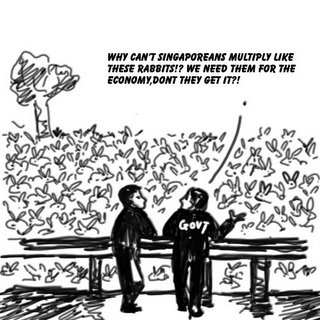
SINGAPORE - Prime Minister Lee Hsien Loong has warned Singaporeans that they will either have to produce more babies or welcome more migrants if the country is going to sustain economic growth and living standards.

Lee, during his recent National Day speech, estimated that at current birth rates Singapore will need an additional 14,000 babies each year to ensure that the population is large enough to sustain the economy.

A slew of policies introduced two years ago to boost birth rates, such as longer maternity leave and infant-care subsidies, have so far had no visible effects, with the affluent city-state's fertility rate last year recording an all-time low of 1.24 per female.

The alternative, according to Lee, is for Singapore to open its doors to permanent immigrants. Last year's General Household Survey shows that new permanent residents have risen by 8.7% to 30,000 per year between 2000 and 2005. During the same period, the number of citizen births rose by a mere 0.9%, or an average of 28,000 births per year.

"If we want our economy to grow, if we want to be strong internationally, then we need a growing population," argued Lee.

A growing number of Asian professionals, especially from mainland China, India, the Philippines, Malaysia and Hong Kong, have recently uprooted themselves from their home countries to take up employment in Singapore. Yet while many immigrants have taken up permanent-residency status, few go on to become Singaporean citizens.

Kwan Chee Wei, a regional human-resource consultant for a multinational company, argues that many professionals go to Singapore hoping to advance their careers or for the upscale lifestyle, but are not interested in changing their citizenship.

That said, an increasing number of Indian and Chinese nationals have recently taken up Singaporean citizenship, creating a measure of resentment among the local ethnic Chinese and Indian populations, who see the new immigrants as competition for jobs.

Lee has tried to defuse those tensions, contending that many Asian migrants have actually created jobs for other Singaporeans through their entrepreneurship. "If you get the right foreigner here, he creates thousands of jobs for Singaporeans," he said.

He also noted that developed countries, including the United States, Canada and Australia, frequently headhunt and hire Singaporean talent, often offering scholarships and high-paying jobs to lure them away from Singapore.

"Countries know, people know Singapore. They no longer think Singapore is somewhere in China. But they don't know Singapore is out there looking for talent," said Lee. "We have to promote our immigration program overseas."

Since Lee's speech, letters to the editorial pages of newspapers in Singapore have been flooded with comments - or more precisely xenophobic complaints - about the apparent new policy toward immigrants. One letter writer, Lim Boon Hee, said, "Be open to foreign talent, but do not forsake our own. One more clever foreign talent means one place less for our local-born sons in institutions of higher learning."

Another writer, Jimmy Ho Kwok, suspects that employers will welcome foreign degree-holders from such countries as India and China so they can pay them less than the threshold salaries offered to local graduates and diploma-holders.

Unionist G Muthukumar points to information-technology professionals from India and sales assistants from the Philippines and Myanmar as examples of employers paying foreigners less than they would pay local hires. On the other hand, Manpower Minister Ng Eng Hen referred to how foreign technicians helped to set up Singapore's aircraft maintenance, repair and overhaul industry quickly - while it took Singapore six years just to set up the training courses to develop local technicians for the industry.

The debate has since turned focus to the politically volatile issue of the rising cost of living and its impact on raising a family. "Welcoming migrants to our shores is not the solution to our declining birth rates," argued Zeena Amir, a single sales executive in her late 20s. "What would be more beneficial to Singaporeans and also make more sense in the long term is to work on controlling the increasing cost of living."

Singapore has arguably become a victim of its own success. Over the past two decades, the island nation has produced a large number of highly educated young women, many of whom now have high-powered jobs and find child-rearing not only an economic burden but a liability to their career development.

"Children are no longer an asset but a liability," argued young lawyer Shirley Tan. "Child care and education are so expensive, and I can't afford to stay at home to look after them."

As this ambitious nation of 4 million people tries to build further on its economic successes, the debate on whether Singaporeans should have more babies or more migrants seems set to intensify.

"Some view foreigners as competition to their livelihoods," noted ruling-party parliamentarian Alvin Chan. "We will have to explain to them that this is not really the case."

(Inter Press Service)


Singapore Immigration

In his 2006 National Day Rally speech, PM Lee Hsien Loong spoke long on immigration: because the low birth rate of Singapore citizens and the shortage of local talent, Singapore has to accept the importation of manpower.

While the two reasons are cogent enough, it is necessary to match them with the situation on the ground. The largest number of imported workers, mostly construction workers, domestric maids, and other service industry workers (e.g., waiters) are on the work permit scheme, which is not intended to lead to long term residence. In fact, marriages between such work permit holders and citizens are discouraged and in any case do not guarantee long term residence.

In other words, immigration, permanent residence and citizenship is not for any kind of manpower, but for educated or highly skilled manpower, of which imports occur in much smaller numbers than construction workers/maids. For example, the management personnel of multinational corporations and anaylists/traders in the financial industry have a high representation of foreigners on employment passes. In recently years, the R&D system has also recruited a large number of expatriates.

These people generally rate Singapore highly as a job assignment location: married expatriates with children find the low crime, cosmopolitan environment and international education system quite satisfactory for family life, while single American and European male expatriates suffer no shortage of female company with large numbers of local girls keen to have Caucasian boyfriends. With good expatriate salaries and the low tax regime, they can save a considerable sum of money during a few years to take home. However, few such people would consider going native in view of the considerable cultural differences.

People of Asian origins who have degrees from universities in the West, maybe with a bit of working experience after graduation, have a greater chance of choosing to settle in Singapore. There are also a large number of students from the region who were given scholarships to come here for undergraduate studies, with the requirement to work in Singapore for six years after graduation.

While the cultural differences are smaller with these people, they come with particular mixes of eastern and western/old and new cultural experiences, which need to mesh with Singapore's own mix of east and west. For example, they might have been exposed to a particular version of politics, social hierarchy and mass media, and might find that while Singapore uses many of the same words, the meanings that the words carry may be different; this awareness might take some years to develop, and in the mean time, they find it difficult to form a coherent picture of the situation around them.

Taking my own case: on the one hand I am one of the long-staying foreign recruits, having been here (and with the same employer) since 1983; on the other hand, both my children went to college in USA and are unlikely to return here to work. Any benefit I might have provided, whether in terms of work or in terms of population numbers, is transient. I also know that a significant portion of the students here on scholarships intend to apply for MBA admission in USA some time after graduation, so that their 6-year employment obligation provides a double benefit: in addition to not having to pay back the financial assistance they received, the work experience is used as MBA admission qualification. They too would only provide a transient benefit.

24 Aug 2006

Debate and Forum to prevent execution of Amara Tochi


Sunday, 27 August
Asia Hotel, Scotts Rd
2.30 to 5.30 pm
organised by the

Singapore Anti-Death Penalty Committee


Speakers:

*Lee Weng Choy
*Alex Au
*M Ravi
*Letchumi Murugesu
(mother of executed Shanmugam s/o Murugesu)


Video plea from
Amara Tochi's brother


World messages:

*Amnesty International
*World Coalition Against the Death Penalty
*Nigerian Civil Liberties Organisation
*Australian Council Against the Death Penalty
*UN Desk for Extra Judicial Killing


V for Vendetta banned in Singapore?

Can someone out there confirm this?


Like many of you out there who made V for Vendetta the number one box office hit when it opened in Singapore, I was all hyped about getting the DVD upon release. So I headed down to my favourite DVD store, and was subsequently told that it was banned in Singapore for language that was anti-Christian.Tribolum


Anti-IMF protestors to shun Singapore for Indonesia

Singapore (ANTARA News) - Over 2,000 activists who plan protests at the IMF and World Bank conference in Singapore next month said they will hold their rallies on a nearby Indonesian island because of Singapore's ban on demonstrations.

Trade unionists, farmers and activists from Jubilee South, a network of non-governmental organisations, plan to demonstrate on Batam, less than an hour by boat from Singapore, participating in a worldwide protest linking 350 activist groups in 74 countries.

"Since Singapore doesn't respect the rights of people to express their views, we are moving the demonstrations to Batam, where there is more democratic space," Lidya Nacpil, international coordinator of Jubilee South, told Reuters on Wednesday.

The group is already in touch with Indonesia about logistics, she said.

Anti-globalisation activists usually gather at similar international summits, but Singapore will make no exceptions to its ban on demonstrations and has said it will arrest lawbreakers and cane vandals.

Public protests are rare in Singapore. Any public gathering of more than four people requires a police permit and a person convicted of unlawful assembly can be fined up to S$1,000 ($650).

Caning is commonly used as punishment for offences ranging from vandalism to drugs. Offenders are strapped to an A-shaped wooden frame and lashed across the bare buttocks by a professional caner with a rattan rod.

In 1994, Singapore made international headlines when it caned American teenager Michael Fay for spray-painting cars.

Singapore, which expects over 16,000 delegates and officials to descend on the city-state for the Sept. 11-20 World Bank/IMF meeting, has said outdoor protests are banned because they could be exploited by terrorist groups to stage attacks.

Indoor protests allowed

The city-state has only conceded that it would allow indoor protests within a designated area in the lobby of the conference venue. The lobby area is smaller than a football field.

According to guidelines issued by the police, activist groups must not move out of the designated areas, and are not allowed to use sound amplification systems or burn items or behave in a manner that would "provoke a breach of peace".

Protesters must also be properly attired at all times.

The World Bank has said outdoor protests should be allowed during the conference, but Singapore police said they would not waive the current rules.

"The Bank's preference for these meetings and all others has been to seek space for civil society to protest peacefully outside. That remains our preferred position," Peter Stephens, spokesman for World Bank Singapore, said in a statement.

Some groups said they plan to organise indoor seminars.

"We still need to maximise our space and make ourselves heard, so we will be organising seminars at hotels around the conference centre to discuss issues such as agrarian reforms," said Indra Lubis, a project assistant at La Via Campesina (The Peasant Way), an international group which represents over 80 million farmers worldwide.

"But frankly, it is not a very effective way to voice our concerns. How are the delegates going to hear us when we are put in separate rooms?" (*)


23 Aug 2006

International lawyers write to LKY over Falungong persecution

From Singapore Democratic Party site.
August 21, 2006

Lee Kuan Yew
Minister Mentor
Prime Minister’s Office
Orchard Road
Istana Annexe
Singapore 238823

Dear Mr. Lee

We are writing this letter with deep concern and serious indignation for the attitude shown by the government of Singapore towards the peaceful citizens in that country who are exercising their rights of freedom of expression in order to expose the truth about the brutal persecution that he Chinese Communist Party is waging against millions of practitioners of the Falun Gong spiritual movement.

It has been confirmed that the government of Singapore has initiated legal proceedings against various individuals for the simple reason that they were distributing pamphlets in a peaceful manner in public places to expose the genocide committed against Falun Gong in China. This decision, which in any democratic state is clearly illegal, has caused great outrage throughout the entire international community, which is especially sensible to the atrocities that are being committed by the Chinese government and which also cannot understand or accept that honorable citizens are being denounced, fined and even deprived of their freedoms by a government such that of Singapore which claims to be democratic and respectful of all fundamental liberties.

For all of the above, international human rights lawyers and the representatives of international associations that investigate the Falun Gong genocide wish to firmly state the following points:

1. We are very surprised and indignant to hear that in Singapore, where a Constitution exists that guarantees the rights and freedom of expression and belief, is adopting decisions that impede the free exercise of those rights and liberties, and which also creates doubts about the existence of a true democratic system in Singapore.

2. Acting this way, the government of Singapore could in essence be collaborating and justifying the strategy designed by the Chinese Communist Party in its efforts to exterminate the peaceful Falun Gong practice, including torture and mass murder.

3. International lawyers who are coordinating these legal cases against Chinese communist leaders in this genocide, will not hesitate to initiate legal actions at the international level against all those individuals or authorities who in any way are direct and indirectly collaborating or are complicit in this genocide by repressive acts such as those that have taken place in Singapore.

4. At the same time, different independent international organizations and associations which defend Human Rights will not remain passive in front of illegitimate acts that violate the very Constitution of Singapore, and the international norms of rights and liberties established by the United Nations, which could be denounced before the Human Rights Commission of the United Nations.

5. We ask the government of Singapore to show true evidence that it is a legitimate democracy and an independent country that is not subject to the requirements of the Chinese government. Therefore we urge the government of Singapore to dismiss the lawsuits filed against those individuals who have been unjustly accused, withdraw all charges and declare complete innocence to those involved.

We will be vigilant and closely follow the decision that your government takes. We trust that this letter helps to rectify these attitudes which without doubt are neither compatible with democracy nor the defense of human rights.

Co-signers:
Guo Guoting, Attorney, China
Terry Stenerson, Attorney, USA
Patrick M. O'Brien, Attorney, USA
Joshua Lanning, Attoney, USA
Stravos Tsakyrakis, Attorney, Greece
Keppy Wong Khai Pun, Attorney, Malaysia
Nik Mohamed Ikhwan, Attorney, Malaysia
Akira Yoshida, Lawyer, Japan
Chin-Nan Gu, Judge, Taiwan
Karen Chen, Attorney, Taiwan
Fran Wang, Attorney, Taiwan
Henry K.M. Chuang, Attorney, Taiwan
Tony Sihdu, Attorney, India


22 Aug 2006

Global protests set at IMF-WB annual meet

By Veronica Uy
INQ7.net

Last updated 06:14pm (Mla time) 08/22/2006

A TOTAL of 350 organizations from 74 countries will be mounting global protests against the International Monetary Fund-World Bank during the latter's annual meetings in Singapore next month, the Jubilee South announced Tuesday.

At a press conference, Jubilee South convenor Lidy Nacpil said the twin initiatives -- the Global Actions against International Financial Institutions (IFIs) from September 14 to 20 throughout the world and the International People's Forum against IMF-WB from September 15 to 17 in Batam, Indonesia -- are demanding:

• immediate and 100 percent cancellation of multilateral debts claimed from the South without externally imposed conditions;

• open, transparent, and participatory external audit of all IFIs;

• a stop to privatization of basic services like power and water;

• a stop to funding environmentally destructive projects like dams, gas, and mining; and

• a stop to conditions that exacerbate the health crises such as requiring user fees for public education and health care services.

Nacpil admitted the difficulties in organizing protest actions in Singapore because of the city-state's strict internal security policy.

“More than the deportation is the fine,” she said, noting that in Singapore, three persons wearing the same colored shirts are considered staging a mass action.

Milo Tanchuling, convenor to the forum and secretary general of the Freedom from Debt Coalition, said local protest actions were being planned starting September 11.

“This is not because of 9/11, but because of the birthday of former dictator [Ferdinand] Marcos, whose policy of borrowing started all this,” Tanchuling said, adding that the Philippines has a standing national government debt of 3.8 trillion pesos and a public debt of 5.9 trillion pesos.

Tanchuling said 32 percent or about 300 billion pesos of the annual budget automatically goes to debt payment.

9/11 refers to the Sept. 11, 2001 terror attacks in the United States. September 11 is also the birthday of the late Marcos, the Philippine president for at least 20 years before his ouster in 1986 by a bloodless people power revolt.


Sending bloggers to school

Here is my contribution to the syllabus and I would like to put myself up for the position of lecturer as I have several years experience in the area and numerous years lecturing at an undergraduate and postgraduate levels.

Almost anonymous blogging.

Stay anonymous everyone as it appears to me that the government have now ropped in the willing academics in the quest to control you. On this occassion 'control via re-education'.


Some basic training could help keep them out of trouble
Tuesday • August 22, 2006

Ang Peng Hwa

IT'S official: The Government is not against blogs or bloggers and in fact may even do some podcasting of its own to get its message across. So declared Prime Minister Lee Hsien Loong in his National Day Rally speech.

For a while now, the local blogging community has been abuzz as to whether our strict rules governing the local media would be applied to the Internet and to blogs in particular.

This concern was compounded by a recent call by a columnist to regulate blogs like newspapers. Mr Lee's statement that the Government will treat new media with a lighter regulatory hand should therefore reassure bloggers.

It is also a logical and progressive move because regulating blogs like newspapers would, literally, be like using regulations from a different century on the newest technology of our age. Besides, blogs are like websites and should be subject to the rules of websites, as the National Internet Advisory Committee has said in its annual report.

In sum, rules that apply to blogs and bloggers are sufficient for the day. Instead, blogging should be encouraged but the bloggers properly educated in the niceties of writing.

There is a lot to be said for blogging. It is done by amateurs, a word that has the same root word as "love".

Often, blogs are diaries. Few will be read beyond a small circle of netizens who can be counted on two hands. Most will not make big money or last even a year. But like mobile phones, they are something every schoolgirl and boy today aspires to have.

And in Asia — and Singapore — where speech is silver and silence golden, such aspirations of expression should be encouraged. Also, blogging contributes to a culture of writing, and writing requires a thinking and reflective mindset.

Where blogging falls down is in its very origin from amateurs. As I have said elsewhere, because bloggers are non-professionals, they are likely to stumble into the pitfalls of writing. That is, bloggers are likely to get into trouble because of the lack of training.

They are unaware of controls on freedom of expression that exist even in the United States. They seem to think the US First Amendment has been coded into the Internet.

In reality, there are rules regarding what can appear on a website and many, though not all, of these rules come from the offline world. The laws of defamation, copyright, racist expression and obscenity continue to apply, although it is true that monitoring and enforcement may be difficult.

Having seen students doing journalism, I myself have been surprised at the difference that media training makes. I have seen how even students who have been considered good writers and editors have fallen into legal pitfalls when they have not had the proper training.

The importance of training was brought home to me in a recent research project done by a colleague in the Philippines. The Philippines has one of the most free press systems in the world; but by some reckoning, it is the second most dangerous place in the world to be a journalist, second only to Iraq.

In her research, she found that 90 per cent of the journalists killed had no training in journalism whatsoever. In many of the cases, they were radio journalists who so defamed, harangued and harassed their news subjects that these people felt that they had no recourse other than violence.

Had the journalists been trained, they would probably have known to what legal limits they could go. In other words, without intending to trivialise or condone the violence, 90 per cent of the murders of journalists could have been averted with proper training.

In Singapore, the bloggers who have had trouble because of racist remarks have apparently not had any training in Singapore media laws.

The solution is some professional training for the bloggers to help them avoid trouble. At a minimum, defamatory, copyright, racist, obscene and other objectionable material, as well as OB (out of bounds) markers, are matters that need to be covered.

Training will not guarantee a trouble-free blogging existence. But from my observation and that of my Filipino researcher colleague, it should help most bloggers stay out of most difficulties most of the time.

The author is Dean of the School of Communication and Information, Nanyang Technological University. He will be leading a half-day workshop on blogging and the law on Aug 26, to help bloggers understand the legal and political terrain. For more information, visit www.ntu.edu.sg/sci/sirc or email blogginglaw@ntu.edu.sg

20 Aug 2006

Singapore's Man with a Plan

I am sure Philip Yeo much prefers the title given to him by Economist,

http://www.economist.com/displayStory.cfm?story_id=3084417

Singapore's man with a plan, compared with the one given to him by Today

The bio-mad man http://www.todayonline.com/articles/137300.asp

I myself prefer to call him "the crash programmes man", crash programmes because they are a few years late.

In the early 80s Singapore went into a crash programme on IT, with the new National Computer Board (now part of Infocomm Development Authority) spearheading a Civil Service Computerization Programme, and rapid expansion of the NUS Computer Science Department from less than 100 grduates in 1983 to 500 10 year later. Curiously, the University of Singapore never had a CS Department: a small one was set up in 1975 in Nanyang University through the initiative of some staff from Mathematics and Physics; it then become part of NUS when the two universities merged. At the time it only had 10 academics and had to scramble madly to cope with growth.

Whereas in the 70s people from Hong Kong and Taiwan were going to USA to study computer science in substantial numbers, and some from Malaysia too, virtually no Singaporeans were doing this. Why? the economic planners thought computers were for rocket science, nuclear research, etc, which Singapore was not interested in. It was nearly 1980 when message began to come through that computers are important for the industry, making it necessary to start a crash programme.

In the 80s molecular biology was making big progress, but in NUS the Biology Department was busy growing better varieties of orchids and fish, things seen to be relevant to Singapore's economy. When Life Sciences got started in a big way, it too was an "a few years late" kind of crash programme. Despite the best intentions, economic planners are some distance away from actual scientific developments, and ideas take time to filter up to them.

Crash programmes allow efforts and resources to be focused. However, there are certain things that are better done through organic growth, and such things are disturbed when competing crash programmes pumped full of money, often more than people know what to do with, are going full blown. It is not the way I myself would prefer to get things done.

To what extent do the problems in Neuroscience Institute and Johns Hopkins Institute relate to the speed at which things get implemented? About these I cannot say, but about IT, I can say that the crash programme was a successful one. In the level of penetration of technology in daily life and economic sphere, there is no doubt Singapore is ahead of Hong Kong and Taiwan, and comparable to the most advanced countries, though with little technology creation as compared to utilization.

18 Aug 2006

Who will rid me of this troublesome priest?

Who will rid me of this troublesome priest? England's King Henry II said that in the presence of four knights, who took it literally as a royal command and the politically "meddlesome" Archbishop of Canterbury, Thomas Becket, was subsequently murdered in 1170.

Modern day Singapore. Since the 1990s, the PAP regime posted signs everywhere that they want SDP's Chee Soon Juan silenced. Who will rid me of this troublesome priest? Maybe Justice Belinda Ang. Maybe the Straits Times and the other local media. Maybe the instruments of the regime like the ISD and the police. The PAP probably never told the media, the courts and the government what to do about Chee. But they probably made pig faces, grunting noises and winked. The supposedly politically-neutral media, courts and government then carried out the instructions of the PAP regime that were never given. They did what the PAP wanted them to do but cannot say.

But not High Court Justice Woo Bih Li who disqualified himself from the case on Chee Soon Juan and others for speaking in public without a permit. In the interest of justice, although it is never said openly, but deep down inside, Justice Woo probably chose not to get himself into what is seen as a politically-inspired court case.

The closing of the Martyn See Singapore Rebel film case is another example that the government might be tired of the charade. Similarly, only a few months ago, the James Gomez's GE blunder and the resultant police warning despite the blustering of the regime leaders showed that the government is tired of playing Master and Puppets.

Dissent is finally becoming public, although slowly, in the courts and the government. These institutions are gradually asserting their neutrality in the PAP vs opposition saga. Why the change in heart? As the government recently created restrictions for the foreign media, it clearly means that the foreign media's role in leading Singaporeans to political enlightenment by truthful reporting is pivotal and the PAP fear it. Foreign NGOs and media interest in free and fair politics in Singapore is paving the way for constructive political change at home.

There is no better way to give this political transformation a boost than the coming IMF World Bank September meeting. The world is watching very closely at Singapore then. The PAP fears such prying eyes because they know that the government, media and court would withdraw their support if these three institutions know their actions are scrutinised by the world. During the IMF World Bank meeting, the courts, media and the government might be at their most neutral and this could be the chance for Singaporeans to speak up and smile wide for the right reasons.

Who will rid me of this troublesome priest? And the knights looked at each other and looked away, pretending not to hear.

16 Aug 2006

social welfare

Singapore government's official policy is to have no comprehensive welfare provisions, based on the premise that welfare encourages dependence, reduces incentive to work hard, and saps a country's economic competitiveness. This makes the country very different from the "first world" where old age pension, medicare, child endowment ("milk money)", unemployment insurance, negative income tax, etc are familiar features. The argument is that whereas these countries have abundant natural resources making it reasonable for the government to guarantee a minimum standard of living to the people, Singapore is not in that situation. Where welfare assistance is provided, it is done on an individual case basis with people with demonstrable need seeking help from government or private welfare agencies.

I believe there is also a second consideration: the unwillingness to foster an attitude of entitlement among citizens, causing the government budget to be pre-committed to various social programmes leaving the decision makers limited room to invest in future economic development initiatives. In other words, the anti-welfare policy goes hand in hand with the wide control of the government over the national economy, rather than being paradoxial "why a rich government cannot give more".

I have no wish to start an ideological debate on this issue here, but would like to make a couple of points of a pragmatic nature.

First, we now live in a world where divorce rates are much higher than they used to be. A typical situation is that the husband gets involved with a younger woman, possibly starting a new family, leaving the wife to cope on her own with the earlier children. While in most cases the divorced wife and her children would have sufficient access to financial resources, such as the wife's own salary, division of family assets, and assistance from grandparents and other relatives, to provide for their own needs, a significant portion of such single mother families are badly off, and this number can be expected to keep increasing. Providing adequate financial resources in such situations not only alleviates current sufferings, but also generates future social benefits in giving the children a better chance to be educated and to develop normally.

Second, a social safety net makes it less likely that temporary economic setbacks, such as loss of job or major sickness, would lead to long term adversities putting people into desperate frames of mind. People would be less likely to go to loan sharks or engage in minor fund misappropriations, activities that have a tendency to snowball into more serious crimes in time. A small amount of assistance at appropriate moments can have very significant long term benefits by preventing small misfortunes from turning into major ones.

15 Aug 2006

China to try Singaporean journalist on Tuesday

4.20pm Monday August 14, 2006

BEIJING - A Singapore reporter accused by China of spying for Taiwan is likely to be tried on Tuesday, a Hong Kong-based rights group has said.

Ching Cheong, a Hong Kong-based China correspondent for Singapore's Straits Times, was detained on a visit to the mainland in April 2005 and later charged with espionage for Taiwan - the self-ruled island that rejects Beijing's claims of sovereignty.

Ching's family and the newspaper have rejected the charges and called for his release.

The Information Centre for Human Rights and Democracy cited an unnamed Beijing prosecutor as saying Ching would be tried on Tuesday.

Ching's case is one of several that have highlighted China's harsh controls on the media and the flow of information.

Zhao Yan, a New York Times researcher accused of providing state secrets to foreigners, remains in detention awaiting a verdict in his case.

And a Beijing academic, Lu Jianhua, is also likely to be tried this week in connection with Ching, the Information Centre said.

On Friday, a court in east China's Zhejiang province sentenced an environmental activist, Tan Kai, to a year and a half in prison for "illegally obtaining state secrets", Radio Free Asia reported.

Last year, Tan helped farmers in Zhejiang protest against factory pollution threatening their crops and health.

- REUTERS


Dissent off the agenda in Singapore

Connie Levett
August 14, 2006

WHEN the International Monetary Fund and the World Bank meet in Singapore next month there will be no placard-waving protesters clogging the streets, despite earlier promises that there would be space for dissent.

Using the threat of terrorism and concern that protests would disrupt the everyday lives of its diligent citizens, the Government has refused to waive its strict controls on public protests. A gathering of more than four people outdoors without permission is illegal.

The decision, while not surprising, is the latest in a string of restrictive moves by the Government, which has also targeted foreign and local media.

Appeals to Singapore's Government to allow the protests have gone unanswered.

"Frankly, we knew it would be very difficult for civil society to have any form of protest in Singapore," said Jenina Joy Chavez, a senior associate with the think tank Focus on the Global South, based in Manila.

"The bank wanted to bring the meeting back to Asia but it's a tricky situation to find (a country) who would welcome it other than Singapore," she said.

Singapore, a small island republic with a population of 3 million, is South-East Asia's wealthiest nation. The meeting will attract 16,000 delegates from 184 countries to discuss global initiatives ranging from poverty reduction to international finance. Every three years, the meeting is held outside Washington.

"For many groups, it is more symbolic than having any notion of getting redress," Ms Chavez said. "The World Bank and the IMF are largely inaccessible to the people affected by their programs (and) these meetings give them a chance to air their grievances."

Even non-government organisations with accreditation to meet delegates "will only be permitted to express their views inside the convention centre, in a special area", according to the Government-controlled Straits Times. "Even then, they must stick to police rules, which include bans on wooden or metal poles to hold up placards."

The decision on World Bank meeting protests comes as the Government reinforces controls on foreign press.

The Ministry of Information, Communications and the Arts issued a statement this month warning the Far Eastern Economic Review, International Herald Tribune, the Financial Times, Newsweek and Time magazines to steer clear of domestic politics.

"(It is) a privilege, and not a right, for foreign newspapers to circulate in Singapore," the statement said. "They do so as foreign observers of the local scene and should not interfere in the domestic politics of Singapore."

The statement came after the Review published an article titled Singapore's Martyr, on opposition politician Chee Soon Juan. Mr Chee, secretary-general of the Singapore Democratic Party, was recently sued by Prime Minister Lee Hsien Loong.

Since the Singapore's Martyr article appeared, the ministry has redefined the status of the monthly Far Eastern Economic Review as a "declared foreign newspaper". From September 11 it must appoint a representative in Singapore to accept service of legal documents in any future legal actions, and to submit a security deposit of $S200,000 ($A165,000). Its circulation will still be capped at 10,000 copies, the statement says.

The Government has lifted the "exempted" status of the four other publications and they will have to meet the same conditions.

For local dissenters, the situation is even more difficult. In a recent incident, a satirical blogger "Mr Brown" whose work appeared in the tabloid Today newspaper was suspended after the Government complained. His column titled "S'poreans are fed, up with progress!" focused on increases in transport and electricity costs.

14 Aug 2006

Protest Diaries in Sydney - Rally To Stop the Bombing - Israel Out of Lebanon and Palestine


The Saturday rally on 12 August started at Sydney Town Hall which proceeded with a march to Hyde Park.

By the time it was 12, the crowd had swelled to at least a few hundreds (close to at least a thousand) to peacefully protest against the Israeli occupation in Lebanon and Palestine.

After a few speeches were given, the march started with a jubilant mood. The protestors were chanting simple yet powerful anti-war slogans such as “George Bush: Terrorists”, “ Free Free Lebanon; Free Free Palestine”, or “Israel, USA, How many kids have you killed today?” which helped to bolster the atmosphere of the crowd; as well as drawing the public’s attention.

By the time the protestors had marched to Hyde Park and gathered around the protest vehicle van, everyone was uplifted. At one point in time, certain groups of protestors were getting too rowdy that the MC had to ask all the protestors to sit on the green grass to allow the speakers to speak. More speeches continued, including a moving poem from a kid on his perspective on the war; as well as a mother who spoke about the war crimes committed against children in the war.

13 Aug 2006

A Lesson on Basic Politics? – Listen to both sides of the story

Another reply on a TODAY article. Our Senior Minister, who makes a comment about Middle East politics, needs to get his facts right.

===
I read with disdain and alarm on the report, entitled, “A lesson on basic politics; It was wrong decision for Hezbollah to 'test' Israel's new Prime Minister: SM Goh”

It appears that the TODAY news report has painted a one-sided view of the current Israel - Lebanon conflict. Our SM has also chosen to comment on an issue which is seemingly pro-Israel and US; and does not reflect my views as a Singaporean.

As such, I felt it necessary to write in to clarify, with the hope that my letter will be published and to allow Singaporeans to form their own opinions.

While PM Goh felt that the capturing of the two Israeli soldiers is a good reason for Israel to start the war, the truth is far more complicated. The capturing of the Israeli soldiers was to negotiate a prisoner exchange - swapping them for Samir Kuntar and other Lebanese prisoners held by Israel.

TODAY also reported that our PM “gave another take on the Israeli point of view, which is that Hezbollah wants to destroy all of Israel and its people.”

This is again not the entire truth. Hezbollah was formed to combat the Israeli occupation following the 1982 invasion of Lebanon which fundamentally opposes the existence of the Israeli state; BUT not to kill or annihilate Israel or its people.

In Hezbollah's website, there is a distinction between "Zionist ideology" and Judaism. The former is an attitude across "races, religions, and nationalities". Zionism is defined as "the concept of creating 'Israel' by the use of force and violence, by stealing the Arabs’ lands and killing Palestinians". "[O]pposing the Zionists ideology is not opposing setting a home for Jews".

What is of most significance important at this immediate point in time is a ceasefire, rather than openly supporting the Israel or Lebanon government as our SM has done; as innocent civilians from both countries are suffering from the wanton destruction of warfare.

In particular in Lebanon, its infrastructures such as the Beirut airport, residential buildings, ambulances, United Nations posts and personnel, ports, bridges, roads, factories, medical and relief trucks, mobile telephone and television stations, fuel containers and service stations has been destroyed by Israeli air strikes.

According to a BBC report, “Hezbollah 'will observe UN truce' “ dated 12 August 2006, http://news.bbc.co.uk/2/hi/middle_east/4787179.stm, “more than 1,000 Lebanese and more than 120 Israelis have been killed in the conflict since Hezbollah militants captured two Israeli soldiers on 12 July in a cross-border raid.”

A lesson on basic politics
It was wrong decision for Hezbollah to 'test' Israel's new Prime Minister: SM Goh
Friday • August 11, 2006

Call it an outsider's point of view or call it Politics 101, but Senior Minister Goh Chok Tong believes Hezbollah should not have captured two Israeli soldiers five weeks ago.

The move by the Islamist organisation preceded Israel's offensive in Lebanon, which has now killed more than 1,000 people.

While he described the conflict as a tragedy, Mr Goh called it a wrong decision to test Israel's leader Ehud Olmert, who was sworn in as Prime Minister two months before the abduction.

"When two soldiers are kidnapped, a new Prime Minister must not show weakness; that is basic politics," said Mr Goh, who was speaking two weeks ago to journalists from the Middle East.

He gave another take on the Israeli point of view, which is that Hezbollah wants to destroy all of Israel and its people.

Mr Goh revealed his own shock to hear that the militia group had 13,000 missiles not under the control of the Lebanese government.

"Therefore, Israel says if that is your aim, I must disarm you, and this is in fact its motive," he said, in a report Wednesday by Arab News.

On Iran's involvement in the current conflict, he described it as speculation but added: "I do have reports that some Iranian Revolutionary Guards have been killed among Hezbollah fighters. What are they doing there? Are they supplying missiles to Hezbollah?"

Asked if the Islamic Shia organisation was fighting a war on behalf of Iran, he said: "I think it is in part a war on behalf of Iran."

Still, he said he is hopeful the conflict will not engulf the region.

"The Americans don't want an expansion because Washington has enough problems in Iraq and America would be vital to Israeli success if the war was expanded. Israel, on its own, will not expand to involve Iran and Syria. That would be very risky," he said.

What is needed for a ceasefire to be called, he said, is to "get the friends of both involved in order to calm things down".

For a long-term solution, he called on Palestinians and Hezbollah to recognise Israel's right to exist.

"That's important because if others don't recognise Israel's existence, then what is there for Israel to do other than fight and destroy you?" he asked. "Israel also must recognise the rights of others."

Mr Goh said that Singapore is just an outsider to the current Middle East problem, as the conflict is too big for the city-state to play a role in resolving. The big powers have to settle it in the United Nations.

"We would be happy to express a view on the conflict based on principles and we have done so. We aim to be even-handed," he said.

"We don't take the side of Israel or the Palestinians; we look at the problem as outsiders and we express our view of a particular problem.

"It is a kind of principled role which we hope we can play in the United Nations. We must always argue from the basis of justice, equality, fairness."

Copyright MediaCorp Press Ltd. All rights reserved.
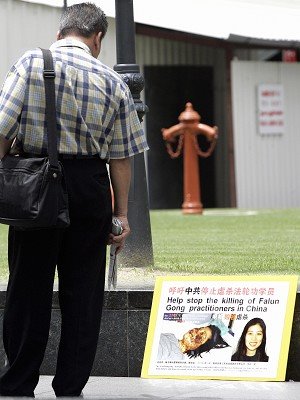
The perils of illegalizing Subutex

I wrote a reply to three TODAY articles on Subutex dated 11 August. Reproduced as follows.

===
I refer to the three articles, “Its promise distorted, Subutex fades on a low”, “Subutex fix for addicts available in JB”, and “Doctors investigated for lax prescription” which revolves around classifying Subutex as a “Class A Controlled Drug, alongside the likes of cocaine, morphine and heroin.”

While I might not be a trained physician, possible problems may arose due to the new legislation.

Although the drug could be abused by heroin addicts undergoing treatment, classifying Subutex as a Class A drug to an already currently long list will not necessarily solve this problem.

Classifying it as a serious drug will only drive addicts or users into sourcing for subutex in the black market; inadvertently creating more criminals. In addition, by classifying subutex as a Class A drug, we need to question if its heavy handed penalties, which includes canning, are overly harsh or improper.

In addition, there will also be problems when administrating the new program. As patients need to take the medicine in the presence of their doctors, both parties will have to work their schedules to ensure they are both physically available. The right dosage, which needs to be prescribed every time, will create administrative nightmares for the clinics. Doctors will fear about prescribing the right dosage or even being entrapped by narcotics officers posing undercover as heroin addicts.

As it is, as many as 10 doctors are already being investigated by the Singapore Medical Council (SMC) for being lax while dispensing Subutex to heroin addicts. By illegalizing subutex, it will only create more stigma and force more doctors to stop prescribing the treatment to needy patients. It may even force addicts already in the current subutex program to turn back to heroin.

According to the US Food and Drug Administration website, Center for Drug Evaluation and Research, http://www.fda.gov/cder/drug/infopage/subutex_suboxone/subutex-qa.htm, subutex is currently prescribed by trained doctors and can be used at home prescription as it is less susceptible to abuse.

As FDA is a reputable regulatory body, we need to question if there is a need for the Singapore authorities to be overtly cautious by classifying it as a Class A drug and to impose extreme strict regulations on how it is being prescribed.

IMF/World Bank Riots

Singapore likes to get important meetings to be held here - it generates news and gets the attention of future tourists, and shows to its citizens that the country is taken serious internationally, to the credit of the government. It is something the government is willing to invest in, not just by helping in the financial and logistic aspects, but also in fostering the right atmosphere. In fact, for the World Bank - International Monetory Fund meeting of September 2006 here, the government organizers asked people to provide smiling images of themselves to be displayed in various kinds of publicity material, including street side TV screens which normally show product advertisements paid for by marketeers - presumably the organizers have already pre-booked the screen display slots during the meeting period.

Around the world, various protest organizations have people who specialize in going to demonstrate on particular issues wherever such important meetings are held. When WTO held its December 2005 meeting in Hong Kong, Korean farmers were the most prominent demonstrators, much overshadowing the environmentalists and peace activists. The Falungong guys were expected to be present in force, but their blows were somewhat blunted by a number of their activists being stopped at the airport and denied entry. The June 4th guys are by now such a negligible force that they made virtually no stir.

Singapore seldom has demos and riots, but its riot control capability is not to be belittled, having been retained from the colonial and early independence days of the 60s. It last came into action during the 1997 general election, when the crowd leaving one opposition rally got rowdy and began demonstrating in the streets, for which they had no permit. (The rally had a permit of course, but it only applied to the specific rally venue). The party leaders tried to persuade the crowd to go home, but to no avail, and the small number of police squad cars sent to the scene could not handle the crowd. In accordance with standard procedure, they withdrew to avoid becoming the target of attack if the mood got more hostile, to wait for the arrival of the properly equipped and trained riot control team. In the mean time, plain clothes men would mingle with the crowd and identify the ring leaders, so that these could be pointed out to the riot squadmen and be arrested. Without the leaders the urge them on and show them what to do, and faced with a wall of shields and batons, the crowd would lost heart and be ready to disperse, and even the most hardened members would usually retreat when the wall threatened to advance. Any remaining ringleaders would hesitate to initiate anything knowing that such signs would usually cause them to be arrested and pulled to the other side of the shield wall. The team was also deployed in small ways during a Falungong demo in McRitchie and one by workers from China over losses with a defaulting remittance firm.

The police has designed some specific indoor areas for demonstrations that have obained permits, which organizations known to WB-IMF can apply for. Police presence in the streets around the meeting venue is likely to be strong, and any sign of a crowd gathering is going to be immediately dealt with and the people will be told to move on. Since the immigration department would already have prepared lists of banned individuals by collecting names of people involved in previous demonstrations at Davos, WTO, and past WB-IMF meetings, it is not clear whether enough demonstrators would enter Singapore during the period to hold co-ordinated gatherings at different locations in order to overwhelm the police capability. Demonstrators need to arrive early and become familiar with the locality in order to make such coordination possible, but that requires financial outlays for accommodation and other expenses, or get local supporters to help them. This seems unlikely here.

12 Aug 2006

Speak Chiniese Also Can


If you are a Chinese Singaporean, is Chinese your Second Language or Mother Tongue?

What's the difference? If you were born in an English speaking family, you might learn Chinese at school and use it for the purpose of work or cultural appreciation. You would have learnt it as a foreign language, using material similar to what is given to American or Korean students, usually designed for functionality in an environment likely to be encountered by a businessman or tourist. More advanced courses might include some literature, art or history, to make the learning more interesting and increase functionality in a social context. Only a small minority of the most advanced students would learn the language details needed by language specialists, so that they can teach future students who learn Chinese as a foreign language, or Chinese medium journalists/PR specialists who have to write highly polished articles for publication to be read by a native Chinese population, in order to propagate foreign information among them.

If Chinese is your mother tongue, you started speaking it when you were a toddler, and were already fairly fluent speaking it when you started school, whose Chinese classes would provide you with the written version of something you already knew, before strengthening it with regular practice and enhancing it both at the linguistic level and at the content level. Most probably lessons on other subjects, whether science, civics or history, would be conducted in Chinese, so that you would get practice in the formal use of the language in addition to daily informal use.

A typical Chinese Singaporean student would probably find that his/her situation does not quite fit either description; certainly it cannot not fit both; yet, we find that educationists here sometimes call Chinese "mother tongue" and sometimes "second language", and something is not right at the basic conceptual level.

For a simple illustration of the divergence between concept and practice: the title of this article "speak Chinese also can" is actually Chinese but being said in English, something referred to here as Singlish. Second language or Mother tongue? Well it is more complicated than I want to explain here; for now, just say that there is a problem and the solution is not yet obvious.

10 Aug 2006

Singapore Likes to Remake Itself Often


I remember a number of political maxims. One is that for any government "Good things should be done a little at a time; bad things should be done all at once", so that the pain passes and people keep hearing the good news. The other is that "When you are making big changes, always reassure people these are just minor adjustments, with all kinds of familiar features and precedents, so that the people do not get frightened and confused; when nothing much is happening, keep telling people all those exciting things you are doing to make their life more interesting." To me those rules are not Machiavellian, just simple practical sense.

If you read Straits Times regularly, you would keep hearing that Singapore is remaking itself. In fact, a few years ago there was actually a Remake Singapore Committee working out a programme for Singapore to remake itself. More or less at the same time, bartop dancing was hotly discussed, and eventually legalized; a briefer discussion about the pros and cons of allowing bungee jumping was carried out, ending with the installation of the Clark Quay bungee machine (which was recently in the news again because of a cable coming loose). There was some kind of announcement that homosexuals can now be appointed to senior positions in the public sector - they were previously considered to have higher security risks due to the possibility of closet blackmail. This encouraged the gay community into seeking permits to bring in various activities, but after a few rejections things quietened down again on that front. The Crazy Horse troupe came into Clark Quay (causing, among other things, the closing down of the weekend flea market which I used to go to regularly!!), followed by the long-awaited decision to allow the construction of two casinos.

So is Singapore really remaking itself, or are all these just "weapons of mass distraction" from the lack of real changes? If you use the recent election as the indicator, then you can see that the political processes, from the selection of new parliamentary candidates and their public introductions, the comparison of their first world qualifications to the lesser credentials of the opposition party candidates, the streneous search for evidence to show that opposition candidates have poor characters, the far from subtle message that voting opposition would result in poorer estate redevelopment prospects, etc, have remained the same. When a group of young people met Lee Kuan Yew for a televised dialog session, he was asked when he planned to retire. Actually, this question has been arousing attention since the early 1980s, when he approached the then standard public service retirement age of 60.

In one of the 2005 NUS centennial celebration dinners attended by a group of international university presidents (mostly from USA), PM Lee Hsian Loong was the guest of honour; following his formal speech he engaged in a dialog session with the international guests, and was asked how he saw the fostering of entrepreneurship among Singaporeans. He gave the conventional wisdom reply "reduce the role of the government". This too is very old. Starting in the 80s, companies like DBS, SIA, Capitaland (originally two parts DBS Land and Pidemco at different times), parts of the Singapore Technology Group (later all consolidated into ST Engineering), SingTel, etc were listed on the Stock Exchange by selling shares to the pubilc, originally termed "privatization" but later more accurately described as "divestiture", since control of the companies has remained under the government holding companies. During the 90s and after, these government linked companies, with deep pockets and high technical expertise, grew very large, and overshadow the few privately owned companies under local tycoon clans. (The kind of diversely held companies one sees in USA, often dominated by large pension funds in share ownership, is little known here.)

Whatever the original intentions, a number of events occurred in the business and political spheres all pushing against reducing the span of control. The Pan Electric stock market crisis, started by the collapse of several companies headed by the Malaysian politician-businessman Tan Koon Suan with a chain of debts to a number of stock broking companies forcing the market to suspend trading for several days, initiated a process whereby the stock exchange changed from a club of local stock broking firms to a listed company under government supervision. The discovery of a Marxist network in the Catholic church community started a chain of events that led to a confrontation with members of the Law Society, in which both opposition party figures and a foreign embassy played a part (leading to the expulsion of one foreign diplomat). Even the horse racing club had to be put under the control of a Totalization Board and Island Golf Club under PUB whose reservoir land the Club uses for the courses. Privatization is risky because some people who know how to pull strings can get very rich out of it (as occured in Russia in the 90s and Taiwan more recently); loosenig political control is risky because many parties, political and other kinds, are waiting to fish in the murkier waters. Singapore Inc has to stay together so that it has some weight to throw around.

A monolithic system is bound to be a ponderous one. It absorbs new ideas mostly by having these filter upwards till they stop somewhere, or hit a receptive spot where idea turns into action; it renews itself by having younger people work their way up the hierarchy till they get stuck (Peter Principle) or hit receptive openings that happen to be there. Now and then it might even stir things up a bit by bringing some ideas from the outside by hiring consultants that attach their brandnames to the ideas, or even fill vacancies with different types of people. But the system as a whole cannot easily change itself because there are so many pieces that have to fit together in order for it to operate.

In the mean time, a World Bank/IMF meeting will come to town in September, and there is a Four Million Smiles campaign right now to get people to contribute happy faces to electronic and other displays that will greet the delegates all over the country. Good things are being done, a little at a time.

9 Aug 2006

Protest Diaries in Sydney - David Hicks Vigil in Sydney Town Hall


David Hicks turned 31 on 7 August., However, he is unable to celebrate it at home with family and friends because the man has been imprisoned at Guantanamo for over four years.

To campaign for his release and promote the cause, a vigil was held at 5pm outside Sydney Town Hall.

Upon arriving with a friend, we light our candles and place it on a placard on the floor which says, “Free David Hicks”.

The organizers had also set up a table with a written petition and anti-war materials on it. Orange balloons with the words, “Bring Hicks Home” were tied around trees and columns along the sidewalks while activists engage passer-bys on the story of the imprisoned Australian.

Detainment without access to legal advice and a free and fair trial is a human rights atrocity and abuse. The detention of David Hicks in Guantanamo Bay, along with other undisclosed thousands of US government alleged suspected terrorists in other prison camps around the world has shown how far right the modern world has become.

Protest Diaries in Sydney – Hiroshima Rally in Sydney


I was strolling along Hyde park, Sydney, last Saturday, August 6, when I coincidentally walked into the Hiroshima rally, without any prior knowledge.

By the time I was at the rally, there was already a campervan parked in front of the fountain. In my estimation, that there must have been at least two to three hundreds gathered in the park to hear the speeches. Various speakers from Australia, including a Member of Parliament in Philippines took to the microphone and gave inspiring speeches on US imperialism, nuclear plants in Australia and the historical disastrous effects of war.

Occasionally, some protestors who had gathered right in front of the van broke out in chants of “SHAME ON THE US!” in protest of the Lebanon – Israeli war.

After listening to some fiery speeches and taking pictures of protest placards and posters, I found myself talking to a woman activist who was distributing leaflets on the secret military base, Pine Gap, located in Australia, Alice Springs.

Apparently, there is a current campaign going on to lobby for 4 non-violent activists, from a group, Christians Against ALL Terrorism, who had entered the military base without permission. They are now currently charged under the Defence (Special Undertakings) Act 1952; which has not been used; and carries a maximum jail sentence of 7 years, with an additional two years for taking photographs within the base.

For a very warm day in cold wintery Sydney, it was a somber reminder that some of the world’s terrible and unjust wars continue to be waged against innocent civilians.

8 Aug 2006

Singapore Criticised for Changing Regulations on Foreign News Media

From the Voice of America
By Barry Newhouse
Bangkok
07 August 2006

Newhouse report - Download 386k
Listen to Newhouse report

Singapore
Media rights advocates are criticizing the Singapore government's recent decision to close what it described as a loophole in its restrictive media laws. Several foreign news organizations now face more stringent controls.

Singapore officials say five publications, the Far Eastern Economic Review, the International Herald Tribune, the Financial Times, Newsweek and Time magazines, must follow the same rules as other foreign publications, if they want to continue publishing in the country by appointing a legal representative in Singapore, and paying a deposit of about $126,000.

In a statement e-mailed to VOA, the press secretary to Singapore's minister for information, communications and the arts said officials revoked the five publications' exemptions to the rule as part of a policy review.

Foreign publications in Singapore are subject to the Newspapers and Printing Presses Act. The press secretary wrote that the law reinforces the government's position that it is "a privilege, not a right, for foreign newspapers to circulate in Singapore."

The media group Reporters Without Borders has ranked Singapore a low 140th out of 167 countries in its 2005 worldwide press freedom index. It said the loophole closure follows the Far Eastern Economic Review's recent interview with government critic and opposition leader Chee Soon Juan.

Senior editor at the Thai daily newspaper The Nation, Kavi Chongkittavorn, agrees that the closure is meant to send a message to the media.

"I think the Singaporean government wants to send a strong message that when a foreign publication wants to write about Singapore, and [is] on sale in Singapore, it's the Singapore government that makes the rules, not the foreign publication," said Kavi.

Roby Alampay of the Southeast Asia Press Alliance says Singapore is also signaling that it will not tolerate protests or reports on protests during the forthcoming summit of the International Monetary Fund, to be held in Singapore in September.

Cherian George, a professor of communication at Singapore's Nanyang Technological University, says the Newspapers and Printing Presses Act gives the government broad powers, although it has used those powers selectively.

"The law is written in rather sweeping terms, so a newspaper can be deemed to be interfering in domestic politics," he said. "In practice, though, the government has used this legislation in cases where publications have not given it the unedited right of reply."

News organizations that criticize Singapore's government have faced tough penalties. The government is renowned for initiating lawsuits and blocking advertising or circulation to control coverage of the city-state. In recent years, the International Herald Tribune and Far Eastern Economic Review have had their circulation cut, or paid steep fines after losing lawsuits in Singapore.


Blogger Gets Ball and Chain

Hi everybody,

thought that I should let you know that I will be taking a break for a few days from 'cut and paste' activities and I will be away from the internet.

I should return sometime next week but not at my usual level. The reason is that even though I spend way too much time on this damn blog thing, I have managed to keep a relationship going long enough to actually propose and receive a positive response. That's right I am getting married this Friday and will have a few days break after that.

So I hope you don't think I have abandoned the site. I have not been abducted by the ISA or MI5 in the UK.

Take care.


7 Aug 2006

'Singapore Rebel' saga ends after police issues 'stern warning'


Reuters report
http://asia.news.yahoo.com/060807/3/2o4sb.html

http://singaporerebel.blogspot.com/
'Singapore Rebel' [26 mins] saga ends after police issues 'stern warning'.

After 16 months of investigation, three interrogation sessions, 120 questions, and not discounting a covert round of interviews with some friends and associates, the police has finally decided to close their case against me.

It all ended under 10 minutes at noon today at the Cantonment Police Complex. Seated at the interview room where I had expected yet another round of questioning, I was instead informed by Assistant Superintendent Chan Peng Kuang that upon the conclusion of their investigation, the police has decided to issue a warning in lieu of a prosecution. The camera, seized in August last year, will be returned to me. The tapes, however, will remain in police custody unless I should make a formal claim. After two minutes of wrangling a deal, which included my suggestion that the police donate the footages to the National Archives, I decided not to make a claim for the tapes, considering that it would be subjected to an undertaking whereby should any of the footages be distributed, I would be called in for investigation once more. The police now reserves the right to destroy the tapes, as they do, I suppose, for seized pornographic material.

I was then ushered to a "warning" room where another officer arrived to read out the warning letter. I stood like a schoolboy in front of the principal's desk, only that the officer's delivery was more perfunctory than stern.

This whole episode has been rather surreal, but no less worrying (I still haven't told my mother about it). It would have been out-of-whack in any First World nation, but it actually did happened in modern-day Singapore - the production of one short video featuring an opposition figure sparked off a ban, a police inquiry and much undue publicity for everyone involved. If the censors had cleared the film, it would have been screened to an audience of no more than 80 people, and not all of them would be interested or much less impressed with its content. It would have died a natural death not long afterwards. But by banning it and subjecting its filmmaker to police investigations, the Media Development Authority has created a publicity monster for themselves, precipitating a seemingly amenable remark from the Minister Mentor himself.

And it gets even more surreal, if one considers the fact that amid all the questioning from the police, I still haven't been told exactly how 'Singapore Rebel' had breached the Films Act.

Where do I go from here? I've obviously crossed the OB (out-of-bounds) markers of expression in Singapore. As much as I like to find my way back to stay within its limits, it's mightily difficult when these boundaries, already amorphous as they are, are constantly shifting back and forth, catching off-guard just about anybody with an opinion deemed contrary to "national interest."

Finally, just a note of irony - I'm finishing up an edit for Jack Neo's new comedy, slated for a Chinese New Year release, entitled "Just Follow Law!"

And may all the wishes of anyone who had generated a single moment of kind thought toward this whole saga be fulfilled.

Yours sincerely,
Martyn See

A Happy 41st Birthday to Singapore.

Dissent is not disloyalty.

A summary of the Singapore Rebel saga

6 Aug 2006

TRUTH IS THE GREATEST ENEMY OF THE STATE


[An undated photo of award-winning Singapore playwright P. Elangovan.]

Could everyone reading this who owns a website or has access to any media outlet publish this as wide as possible. Your government is making Singapore the 'village idiot' of the global village.

Date: Sun, 6 Aug 2006 17:01:16 +0800
Subject: A SINGAPORE JOKE


hi

The 'muzzled lapdog 140 out of 167' Singapore media has projected that SMEGMA portrays Muslims negatively.

In fact, there are 5 Muslims acting in the play.

The play does not project Muslims wrongly, but exposes how Muslims are exploited by the Singapore powers that be through the experiences of :

Muslim Southern Thai woman raped by Singapore soldier in a covert operation, Indonesian underaged girls in Rainbow Hotel - Bintan/Tanjung Pinang, Indonesian Maid whose virginity is bought by her employer etc.

Freedom of Expression is blasphemous to the 66.6% Animal Farm called Singapore.
Cheers

S Thenmoli


The Media Development Authority of Singapore's (MDA) censorship of the arts has become an unbearable joke today.

We applied for a public entertainment licence for the play SMEGMA, written and directed by Elangovan (bilingual poet-playwright-director) a month ago to the MDA for censorship vetting.

I called the MDA on Tue 1 Aug afternoon at about after 2pm to find out about the licence.

I was told that MDA has approved the licence and it was ready for collection.
About half an hour later, I received a call from an MDA officer saying that the licence was not ready and they were still processing.

When I asked her whether it was a joke and also added that I would go the media, she immediately did a full roundabout and said that the licence was ready and
we could collect it.

We collected the black & white approved licence document from MDA at 4.55 pm on Tue 1 Aug 06 after paying them S$20 by NETS at the counter.

The conditions in the licence were as expected- RA18 with advisory: 'The play is Rated RA18. The play contains strong language and adult themes that may be objectionable to some members of the public. The advisory must be reflected in all publicity materials.'

Today, at about 2.30 pm, I received a call from an MDA official who did not reveal her name.

She informed me that the licence which MDA issued to our group Agni Kootthu (Theatre of Fire) for the play SMEGMA has been cancelled.

She did not give any reasons and I demanded for a written letter.

She said that MDA would follow up.

Meanwhile, MDA had a press conference for the local media at 3pm at its premises to inform that they had cancelled the licence issued for the play SMEGMA. The script of SMEGMA was given to the press members for private reading and collected back.

I finally received a letter by fax today from Ms Amy Tsang,confirming the cancellation of our licence with the following reasons:

[para1. Further to our teleconversation today, we would like to inform you that the Media Development Authority (MDA) is cancelling the arts entertainment licence No: 005/08/2006 issued on 1 Aug 2006 for the play 'SMEGMA'.

[ para 2. After careful consideration, we find that the play undermines the values underpinning Singapore's multi-racial, multi-religious society, and may negatively impact upon our bilateral relations with our neighbours.

para3.The play portrays Muslims in a negative light. Two playlets featuring Muslim terrorists are also provocative in view of the increased tension in the Middle east.

para 4. In view of this, MDA has decided not to let the play be staged.]

After the above fax, I received a call from MDA saying that they would be faxing another letter soon and it would supercede the fax sent earlier.

I received the final fax at 5.29 pm with a cover letter saying - "Please ignore the earlier letter on the above subject which we had faxed to you before 5 pm today. The attached supercedes the previous letter."

Now, this fax had only one para (para 2) to give a reason for the cancellation:

[para 2: After careful consideration, we find that the play undermines the values underpinning Singapore's multi-racial, multi-religious society, and portrays Muslims in a negative light."

Paragraph 2 from the earlier letter disapperaed and paragraph 2 has been amended.

Elangovan's TALAQ faced a different sort of problem in OCT 2000 from the then PELU of the Police. The licence was not issued and the whole situation ended in a fiasco, that led to a relook at the censorship laws for plays in Singapore.

But now, six years later, the esteemed MDA has created a mess for a small minority theatre group, by issuing the licence and then cancelling the licence, and also changing their reasons for the cancellation, the same day.

MDA had a month to vet the play. They claim on their website that they would usually vet a play and respond after two weeks.

MDA had sufficient time to vet the play and inform us.

We would have made the necessary amendments if MDA had informed us earlier.

What's wrong with the Censorship panel of MDA and its super-efficient officers?
Why are MDA officers behaving like this?

Why cancel the licence on the eve of our production, which is tomorrow and Sunday?
If MDA had cancelled the licence much earlier, we would not have proceeded with our production.

We would have saved our finances but now we have lost so much.

It only confirms that liberalisation of the arts in Singapore is just lip-service of the 66.6% powers that be.

What happened to us ( worse than the TALAQ incident in 2000) may happen to fellow artistes in this country.

With the National Day celebrations to glorify nation-building next week, and the IMF meeting in September, what Freedom of Expression are we talking about in Singapore?
It is a painful joke.

Grateful if you would globalise this Singapore Joke.

Thank you.

S Thenmoli (Ms)
President
Agni Kootthu (Theatre of Fire)


"climate of fear"


"Climate of Fear" is a regularly used expression in Singapore, and a rather weird one: when challenged to explain "Fear of what?", the speaker is usually unable to do so. Some point to the case of Chee Soon Juan, but this is unenlightening, because the specific activities that led to trouble: his dismissal by NUS for using his research grant to send his wife's thesis for examination in Georgia, the public comments on GCT, LKY and LHL that led to the defamation lawsuits, and the civil disobedience acts that led to his brief imprisonment, could all be easily avoided. Even the cases of Catherine Lim and Mr Brown were atypical: a critic of the government normally does not receive a letter of reprimind from the prime minister or get so publicly dropped by a newspaper - such matters are usually handled quietly.

So those who say "climate of fear" were merely being oversensitive, or just finding excuses for their own timidity? Some commentators, such as our late NUS Business School collegue Jennifer Mao, who used to write a regular column in Lianhe Zaobao, would mock others "what's there to fear; see I often criticize but nothing heppens to me", but this merely reveals a failure to appreciate the basics of Singapore's social psychology. A behaviour may be irrational, but if an irrational behaviour is widespread, there must be a reason for it. My answer to "Fear of what?" is "Fear of official disapproval".

To explain this, it is first necessary to explain, why does the government show official disapproval so often? Given its grip on political and economic power, why should it worry about little pinpricks from the likes of Catherine Lim and Mr Brown? Can a few cartoons about Jesus Christ or jokes about Islam really do much harm? In the west, no one would expect the government to take action since these minor matters are obviously beyond its control. Curiously as it may sound, it is precisely because of the government's power and wide span of control that it has to intervene even in little matters: since it is so much in control, anything happening in public is assumed to be "the government allows it to happen", and the government would get the blame for anything anyone does not like. If the government is responsible for everything, then it has to be cautious about everything.

It then naturally follows that anything, anyone, is labelled as "approved" or "not approved"; since speaking up could cause one to be classified as "not approved", one need to be extremely cautious, even fearful, about anything one says.

Singapore's Elected Presidency

Ong Teng-cheong, the only President of Singapore who took office by a popular vote, in 1993. Previously the largely ceremonial post was filled by a vote of parliament, so that the decision was made by the party that had majority control, i.e., PAP. However, in 1991 the constitution was changed to provide for an elected president, with the power to approve the use of certain financial reserves accumulated in the national accounts. The nature and the amount of these reserves have not been released to the public, and from Ong's own statements after completing his term, were not fully revealed to him either. Thus, the thinking behind the establishment of the institution remains somewhat obscure. In fact, when the idea was being discussed in the late 80s, many people thought the motivation was to elevate Lee Kuan Yew into the position after his retirement from cabinet, and he felt it necessary to publicly pledge that he would not become the first elected president.


The procedure devised for the election also has some unique features: a presidential candidate must meet certain criteria indicating extensive managerial experience at a senior level in public service or business. It is estimated that no more than a few hundred Singaporeans, at most a couple of thousand, could meet the criteria. The candidates are required to be non-partisan, so that to put himself up for the 1993 election, Ong, till then a Deputy Prime Minister, had to first resign from both his post and his party membership. The candidates submit their curriculum vitae to a 3-member committee appointed by the government before each presidential election to determine whether each candidate qualifies.


Despite the non-partisanship, Ong and his successor Sellapan Ramanathan, a retired senior civil servant, were clearly seen as "official" candidates endorsed by the "establishment", and therefore expected to win. It is relatively easy to find a "qualified winner" - while some of the senior people who meet the qualification criteria might not have sufficient interest, there are bound to be enough retired or soon-to-be retired people with the necessary qualifications who can be persuaded to take on this well paid and highly prestigious job. The problem lies in finding a "qualified loser": the chance of winning against the establishment-endorsed candidate is negligible; so why would a person who has the necessary qualification and importance want to put himself/herself through what is essentially a quixotic process? While many of these people would agree that it is a good idea for someone to come forward, so as to enable a contest to occur, they usually mean someone "else".


In 1993 a former Accountant-General was persuaded to stand against Ong, and actually managed to get over 40% of the vote even though he did very little campaigning. This percentage, higher than the amount going to opposition parties in a general election,  basically amounts to an anti-establishment gesture when control of government itself is not at stake. The thought "since the committee approved him he must be all right" must have played a part in deciding to make the gesture. The outcome probably had two significant consequences: on the establishment side, it confirms the need to apply stringent qualification criteria to ensure that whoever that gets elected would be suitable; on the other side, any individual that can win 40% of votes against the "official" candidate would gain considerable limelight and prestige, and while for the people who already qualify, standing as the "qualified loser" provides little benefit, for the people who do not quite qualify, getting the chance to stand is by itself a good prize. Thus, in both 1989 and 2005 several individuals came forward to have their qualifications assessed but were rejected by the 3-member committee, so that the "official candidate", Sellapan Ramanathan, twice took office unopposed. In effect, he was "elected" by the committee, instead of election by parliament before the constitutional change.


Given that the underlying dynamics is difficult to change, it is perhaps a good idea to give the task of assessing presidential candidates' qualifications to an elected body; for example, see


Non-Constituency Parliament Members and Senators


http://blog.360.yahoo.com/blog-XIIfDzQobqO5oCYM9UTvZzgKHH4Org--?cq=1&p=133

Non-Constituency Parliament Members and Senators

Cross Posted

The NCMP Non-Constituency Members of Parliament Scheme and NMP Nominated Members of Parliament are unique features of the Singapore political system, with the objective of ensuring the presence of opposition party members in Parliament.

From 1968 to 1981, the People's Action Party was so predominent that it won all the seats, e.g., in the 1968 general election it only had to face 7 opposition candidates. It was only in 1981 that Worker Party's Jeyaratnam entered Parliament after winning the Anson by-election. Even then, the number of returned opposition members in the 1984, 1988, 1991, 1997, 2001 and 2006 elections were 2, 2, 4, 2 and 2. Thus, elections were not really about who will form the next government, but more a referendum giving the PAP government a "mark" indicating voter satisfaction with its performance.

The issue of whether it is necessary to have alternative voices in Parliament to keep complacency and yesmenship in check, has been frequently raised. The NCMP and NMP schemes were meant to address this issue. After each election the Electoral Office can invite up to three unsuccessful opposition party members to become NCMPs, using their vote percentages as selection criteria, in order to ensure there are at least 3 opposition members of parliament. In a separate exercise, up to 9 non-partisan members may be appointed by the government, usually based on achievement in some significant social causes.

These schemes are actually double edged: it has been hinted that, since the system guarantees the presence of alternative voices in Parliament, there is no need to ensure their presence by voting for opposition parties. In other words, people are encouraged to give the government a high "mark" and hopefully a clean sweep, and they are still going to have 3 opposition MPs.

In my view, a better way to meet the same objectives is to have an Upper House (usually called a Senate) elected by a proportionate representation system, with the right to review and discuss legislations but no executive power, since cabinet ministers are only appointed from the Lower House. Based on the vote percentages of the 2006 election, the PAP would appoint 2/3 of senators, Workers' Party and Singapore Democratic Alliance about 1/7, and Singapore Democratic Party 2-3% (meaning that, unless the Senate is quite large, SDP would not have any members).

The significant points are:

1. All voters will take part in a General Election: even if their electorate has no opposition standing against the government (so called "walkover"), they still need to take part in the senate vote, and the current situation of many voters not having the chance to vote will cease.

2. PAP can send retired ministers to the Senate where they can continue to advise the cabinet using their accumulated knowledge and experience.

3. The opposition parties and prominent individuals who can gain enough votes nationally to qualify for a senate seat, have a forum to discuss government policies and national issues even if they are unable to win enough votes in an individual constituency to qualify for the Lower House.

4. The Senate can take over the task of assessing and approving the qualifications of candidates who wish to stand in the Presidential election; currently this is done by a 3-member committee appointed by the government for each election. Having this done by an elected body would make the process more authoritative.

View Table...

5 Aug 2006

Pseudonymity


Using a pseudonym and remaining anonymous doesn't mean I do it out of fear. Instead, one of the uses of a pseudonym is to direct & focus the attention of readers to my posts in this blog. And not on who the blogger might be; what are his/her pet peeves; what colour undergarments does he/she use; what's his/her political or sexual orientation blah blah blah!!

I post using the pseudonym article19. There is a reason why I chose that as a pseudonym. Article 19, is one of the articles in the Universal Declaration of Human Rights, which states: Everyone has the right to freedom of opinion and expression; the right includes freedom to hold opinions without interference and to seek, receive and impart information and ideas through any media regardless of frontiers. Thus, I found it rather appropriate to use it as my pseudonym.

I'm an average Singaporean. I was born and raised here. I've lived here all my life. I'm no degree or honours holder, scholar, expert, elite, etc, etc. I'm just one of the very ordinary Singaporean struggling to survive trying to make ends meet. I live where 90% of Singaporeans live - in an HDB flat. Now, there wouldn't be any point of calling my blog Pseudonymity & being anonymous as article19, if i go further and tell you more about myself, would it.

Workers Rights in Singapore

Vatican Radio
(04 Aug 06 - RV) A law seeking to address discrimination against migrant workers in Singapore has been criticized for not doing enough to protect workers. Thousands of workers come to Singapore each year from countries like the Philippines, Sri Lanka and India. Men usually work in the construction industry, while women work as domestics.

Elizabeth Tan is the Chairwoman of the Commission for the Pastoral Care of Migrants and Itinerant People in the Archdiocese of Singapore. She told us some of the problems migrants face...

Singapore: N. Korea’s New Money Haven

AUGUST 05, 2006 03:14
It is reported that after the U.S. froze North Korea’s accounts in Macao’s bank, North Korea changed its account to a bank in Singapore.

The U.S. Department of Treasury listed this bank as being related to North Korea’s illegal funds and is currently conducting an investigation. There are also speculations that North Korean Foreign Minister Baek Nam Soon’s two visits to Singapore around the time of the ASEAN Regional Forum (ARF) that was held in Kuala Lumpur, Malaysia, had a connection to the funds.

Singapore Becoming the New Safe Haven—

Recently, a source in Washington D.C. said, “With the American administration raising its pressure on North Korea’s funds in Macao, North Korea attempted to change its bank to Singapore, and the new haven is known as a small bank referred to as O Bank.”

On August 3, a U.S. government official also said in an interview with Dong-A Ilbo, “O Bank is a problem bank. This bank is on the list of banks related to North Korea, which the U.S. government keeps a close eye on.” With the U.S. tracing its funds, North Korea tried to disperse them, and by the official’s statement it was officially confirmed that Singapore, an international finance city, has become one of the safe havens.”

Mystery Regarding Minister Baek—

With the relation between O Bank and North Korea surfacing, Foreign Minister Baek’s two visits to Singapore around July 28, while ARF was held, are also drawing attention. Minister Baek left Pyongyang on July 25, stopped in Beijing, spent two days in Singapore and finally arrived at Kuala Lumpur in the afternoon of July 27. At the time, the South Korean government explained, “Minister Baek stopped by Singapore for kidney dialysis. It wasn’t for any particular reason.” Nevertheless, on his journey back home, Minister Back spent three days, from August 1 to 3, in Singapore, meeting with Singapore government officials.

When asked by Dong-A Ilbo if Minister Baek’s stay in Singapore was related to O Bank, the U.S. government official answered, “Don’t you think that it would be logical to think so?”

North Korean Cooperates in Counterfeit Dollar Investigation—

It was also reported that the U.S. government has grasped considerable information regarding the creation and distribution of North Korean counterfeit dollar bills, based on the testimonies of one or two North Koreans apprehended last year.

In the first half of last year, the Department of Justice arrested 87 Taiwanese triad gang members in Long Beach, California, and Atlantic City, New Jersey. They were charged with smuggling counterfeit dollar bills and tobacco. A U.S. government official stated, “It is true that some North Korean were among the arrested 87. However, they will not be punished because they cooperated with the investigation.”


Singapore gets apology from Hopkins

Criticism of troubled project caused outcry
By Gadi Dechter
Sun reporter
Originally published August 5, 2006

The Johns Hopkins University apologized this week to the Singapore government, two weeks after a university spokesman's criticism of that country's science agency - essentially blaming it for the failure of a Hopkins-Singapore medical research partnership - sparked an outcry in the Asian media.

"Johns Hopkins had no intention to impugn the reputation and standing of [Singapore's Agency for Science, Technology and Research] and Singapore, and any such impression is regretted," said the university in a statement issued jointly with the Singapore science agency on Thursday.

The dispute became public when a Singapore newspaper reported July 22 about the impending closure of the Division of Johns Hopkins in Singapore, eight years after the launch of the ambitious medical education and research partnership.

The Straits Times newspaper quoted an unnamed Hopkins spokesman who said the break-up would create a "reputational issue" for Singapore's science agency, which had not met its "financial and education" obligations in the partnership.

That article prompted a scathing letter to the editor by Andre Wan, an official of the science agency known as A*STAR, who took umbrage at the university's apparent insinuation that Singapore was the negligent partner.

Recruiting question

Wan said that Hopkins had failed for years to recruit enough senior researchers or doctoral students to the Singapore-based division of the Baltimore medical school, and that was the reason his government had decided to stop funding the project.
"We cannot justify the continuation of public funding for a collaboration that has failed to yield results for Singapore," Wan said, adding: "It is ... most surprising that [Johns Hopkins University] should choose to lecture A*STAR and the people of Singapore about our reputation when it is [Hopkins] which has not delivered on its commitments."

Singapore has invested more than $80 million in the collaboration since it launched in 1998, Wan said.

In exchange for the funding, he said, Hopkins was expected to meet certain "key performance indicators," including the enrollment of at least eight doctoral students by February of this year. But as of late 2005, there were no doctoral students enrolled in the division, he said.

Hopkins also committed to recruiting a dozen "senior investigators with international reputations," who would live full time in Singapore, according to Wan. In his letter to the Straits Times, he said only one of 13 researchers working at the Hopkins-run program in February of this year satisfied Singapore's definition of "senior investigator."

Thursday's joint statement did not address Wan's claims that Hopkins had failed to attract sufficient research talent to Singapore, except to say, "Johns Hopkins recognizes that there were differences with A*STAR over the progress of the [Division of Johns Hopkins in Singapore] research and education programs."

Johns Hopkins Medicine spokesman Gary Stephenson said yesterday that the university would not comment further on the matter.

"We're not going to inject life into this situation through the media," he said.

Thriving partnerships

A spokeswoman for the Singapore Embassy in Washington said yesterday that tensions between the Baltimore university and Singapore have eased, noting that a Hopkins-managed hospital in Singapore is still "chugging along quite nicely," as is a collaboration between Hopkins' Peabody Institute and the Singapore Conservatory of Music at the National University of Singapore.
"I suppose ties are still pretty good," said Lynette Cheng. "It was just one project."


gadi.dechter@baltsun.com

Singapore bans play for negative portrayal of Muslims

Arts Hub? Starting to sound like Singapore is the censorship capital of the world.
Sat Aug 5, 2006 11:45 AM IST

SINGAPORE (Reuters) - Singapore authorities banned a play just hours before it was due to be staged because it portrayed Muslims in a negative light, local media said on Saturday.

In its first banning of a play since its was formed in 2003, the government's Media Development Authority said it was withdrawing the performance licence for "Smegma" as it was "insensitive and inappropriate for staging", the Today paper said on Saturday.

"Smegma undermines the values underpinning Singapore's multi-racial, multi-religious society. The play portrays Muslims in a negative light," the media authority was quoted as saying in Today.

The media authority, which initially agreed to the public performance of "Smegma", back-peddled on Friday and said it was worried that the play "could create unhappiness and disaffection amongst Muslims", the newspaper reported.

According to the Singapore law, all public performances must be approved and licenced by a government-appointed official.

Both the media authority and "Smegma" playwright P Elangovan could not be reached for comment on Saturday, but Elangovan was quoted as saying in Today that he was "unsurprised" by the ban.

His play "Talaq", about rape within an Indian Muslim marriage, was also banned in Singapore in 2000, according to the paper.

The paper said "Smegma", which was full of expletives, included depictions of Singaporeans' overseas sexual romps with under-age girls, a class of young children calling a Member of Parliament a pig, and an analyses of the Singapore national flag.

Singapore authorities regularly censor content deemed too salacious or too sensitive for public viewing, saying censorship is needed to reflect the country's social norms and values.

The city-state ordered a theatre director to remove all references to the death penalty in December last year, a day after it executed an Australian drug smuggler amid much public controversy.

Government tries to make five foreign publications censor themselves

Reporters Without Borders today condemned the Singapore government for putting pressure on on the Far Eastern Economic Review and four other foreign publications to censor themselves.

“The authorities are looking for effective ways, including fear of prosecution and heavy fines, to intimidate these publications into censoring themselves,” the worldwide press freedom organisation said. “This is the latest threat against the foreign media, which are the only means of reporting independently on political and economic events in the country since the local press is controlled by the government.”

The information, communications and arts ministry gave the monthly Far Eastern Economic Review until 11 September to comply with section 23 of the Newspapers and Printing Presses Act. The magazine has been registered as a foreign publication since it criticised the government’s domestic policy in 1987 but had an exemption from some legal requirements which has now been cancelled. It must have a legal representative in the country by the ministry’s deadline and pay a deposit of 200,000 Singapore dollars (100,000 euros). For other foreign publications, the International Herald Tribune, Time magazine, the Financial Times and Newsweek, have been ordered to do the same when their licences come up for renewal.

This crackdown follows an interview in the Far Eastern Economic Review with opposition leader Chee Soon Juan, who the magazine called a national “martyr” because of the many lawsuits against him.

The ministry said the press law “serves to reinforce the government’s consistent position that it is a privilege, and not a right, for foreign newspapers to circulate in Singapore” and that foreign media should simply “observe the local scene and not interfere in the domestic politics of Singapore.”

The Far Eastern Economic Review, the International Herald Tribune, the Asian Wall Street Journal and The Economist were heavily fined in 2004 after they ran articles considered “hostile” or “libellous” by the government. As well as paying a fine of 200,000 euros, The Economist had to apologise for an article criticising the appointment of the prime minister’s wife as head of a large financial institution.

Reporters Without Borders ranked Singapore 140th out of 167 countries in its 2005 worldwide press freedom index.


4 Aug 2006

FEER required to comply with conditions for offshore newspaper: govt

Friday August 4, 6:17 AM
Taken from Channel News Asia

The government has notified the Far Eastern Economic Review (FEER) that it will have to comply with conditions required of offshore newspapers under Section 23 (3) of the Newspapers and Printing Presses Act.

From September 11 this year, FEER will have to appoint a legal representative in Singapore to deal with any lawsuits that may arise against the publisher.

It will also have to post a security deposit of S$200,000.

But there will be no change to FEER's current circulation cap of 10,000 copies.

This change is to correct an anomaly for FEER, which currently does not have to comply with conditions for offshore newspapers.

It follows the FEER's move from a weekly to a monthly publication in 2004.

But FEER is still a declared foreign newspaper, defined as one engaging in the domestic politics of Singapore.

K Bhavani, Press Secretary to the Minister for Information, Communications and the Arts, says it was an administrative oversight not to have subjected the news magazine to the same conditions required for declared foreign newspapers.

She adds that the conditions for offshore newspapers are not something new.

Several offshore newspapers have already posted the security bond and appointed representatives in Singapore.

The FEER was gazetted as a declared foreign newspaper on 26 December 1987 for interfering in the domestic politics of Singapore.

Subsequently, the FEER was also classified as an offshore newspaper following the amendment to the Newspapers and Printing Presses Act on 30 August 1990, and was subjected to the conditions under the Act.

The government has also reviewed the exempt status of offshore newspapers circulating in Singapore as a result of changes in the media scene.

It has notified four publications - the International Herald Tribune, Financial Times, Newsweek and TIME - that the exemption granted to them will be lifted when their current permits expire.

This means they will then have to appoint a legal representative in Singapore and post a bond of S$200,000.

The government says these publications now regularly report on political issues in the region and Singapore, and have significant circulations here.

Since 1990, some offshore newspapers were exempted from certain provisions under the Newspapers and Printing Presses Act before they were permitted to circulate in Singapore.

But the Minister may allow declared foreign newspapers, defined as those engaging in the domestic politics of Singapore, to continue circulation in the country.

This approval may also be granted subject to conditions.

The Ministry of Communications, Information and the Arts says the Newspaper and Printing Presses Act serves to reinforce the government's consistent position that it is a privilege and not a right for foreign newspapers to circulate in Singapore.

It adds that they do so as foreign observers of the local scene and should not interfere in the domestic politics of Singapore. - CNA/ch

3 Aug 2006

Singapore Judge Withdraws From Libel Case Involving PM

Thursday August 3rd, 2006 / 7h15

SINGAPORE -(Dow Jones)- The Singapore judge hearing a defamation suit brought by the city-state's top leaders against democracy campaigner Chee Soon Juan has disqualified himself from the case to avoid a perception of bias, lawyers said Thursday.

The hearing for a summary judgment against Chee, who is secretary-general of the opposition Singapore Democratic Party, and his sister Chee Siok Chin has been adjourned until a new judge is named, the lawyers said after a closed session of the High Court.

Chee's lawyer M. Ravi told reporters that his heated argument with High Court Justice Woo Bih Li in another case had created an impression in the media that there would be "likelihood of bias" if Woo heard the defamation case.

Jeffrey Chan, a lawyer representing the Attorney General's office, told reporters this was the first time in Singapore's judicial history that a judge had disqualified himself from a case.

Woo isn't biased but "feels it is the interest of justice that he disqualifies himself from the case," said Ravi, a high-profile campaigner against the death penalty in Singapore.

Prime Minister Lee Hsien Loong and his father, former prime minister Lee Kuan Yew, allege they were defamed by an article in the SDP's newspaper that linked corruption at the National Kidney Foundation to the way the city-state is run.

Chee is barred from campaigning or standing in elections after being bankrupted in February for failing to pay S$500,000 in libel damages to Lee Kuan Yew and former prime minister Goh Chok Tong.

He was jailed for eight days in March for contempt of court after criticizing the independence of the city-state's judges.

-By Saeed Azhar, Dow Jones Newswires; 65 6415 4157; saeed.azhar@dowjones.com
-Edited by Stephen Wright and Mary de Wet


2 Aug 2006

The Real Source of PAP's Fear

New Media Power:
The Internet and Global Activism [pdf]

W. Lance Bennett
(Chapter in CONTESTING MEDIA POWER, Edited by Nick Couldry and James Curran, Rowman and Littlefield, 2003)


Extract...
When networks are not decisively controlled by particular organizational centers, they embody the Internet’s potential as a relatively open public sphere in which the ideas and plans of protest can be exchanged with relative ease, speed, and global scope –all without having to depend on mass media channels for information or (at least, to some extent) for recognition. Moreover, the coordination of activities over networks with many nodes and numerous connecting points, or hubs, enables network organization to be maintained even if particular nodes and hubs die, change their mission, or move out of the network. Indeed, the potential of networked communication to facilitate leaderless and virtually anonymous social communication makes it challenging to censor or subvert broadly distributed communication even if it is closely monitored. These points are elaborated by Redden:

The fact that it is a decentralised, distributed network currently makes it hard for any elite to control online activities. It allows fast one-to-one, one-to-many and even many-to-many communication in web and conferencing forums. Together, the technological and economic aspects of the Net allow for cheap self-publication without mediation by corporate publishing....Of course, cheap is a relative term. The Net is cheap, not in absolute terms, but relative to the efficiency of message distribution. It is clearly not a panacea that guarantees freedom of speech for all. But while it is not accessible to everyone who has something to say, it does dramatically increase the numbers of people who can afford the time and money to distribute information translocally to large numbers of other people. In short, it allows individuals and community groups to reduce the influence gap between themselves and wealthier organizations (Redden, 2001, n.p).


The capacity to transform time, space, costs, and the very roles of information producers and consumers also enables the rapid adaptation and transformation of political organizations, and the creation of new sorts of power relationships (Bennett, forthcoming). W. Lance Bennett


Debates on whether those in power should try to control this new media tend to centre around issues of 'objectivity' and anonymity. They allude to the issue that the new media is having a decentralising effect on information dissemination. The new power relationship is that the PAP are having to 'deal', 'manage' and possibly attempt to 'control' this new media that is open to all in Singapore who have crossed the digital divide.

The 'fear' issue that for so long resulted in those who contributed to this online open society 'self-censoring' has infected those institutions that have for so long had unfettered access to information dissemination.

Is all this talk of 'chaotic chatter' and attempts to undermine the work of bloggers, podcasters, etc mere verbal manifestation of their fear for the future of their hegemonic domination of Singaporean discourse?

Being Deaf in Singapore

From An Equal Voice
Today, I spent the day touring Johor Bahru, a Malaysian city north of Singapore.

I was with 37 other deaf people, four of whom were volunteers like me, who organised today's trip as part of the Singapore Deaf Association's adult outreach programme.

The programme is a noble one. Started 21 years ago, it holds informal sessions with illiterate deaf adults every Saturday. During these sessions, volunteers teach them life skills, such as how to apply for jobs, manage their money, even how to read, write and sign.

Most of the early deaf immigrants who came to Singapore did not speak English, and used signs that originated from Shanghai.

Others did not sign at all. They use what is known within the community as "home signs". Simply, they are crude gestures that are not understood outside the family, since no standardised grammar system guides their expression.

Many of these deaf adults were left behind by an uncompromising government. When the government instituted English as the nation's official language in the 60s, they failed to set up measures to help assimilate these deaf adults into mainstream society.

There were no schools to teach this new and strange language. There was no effort to help them acquire skills which, in time, could lead to industry expertise. The average age of the first generation of deaf people here educated in English is only 35.

Today, the situation of our deaf Singaporeans is not much better.

Schools lack the government support to provide equal quality education. Interpreters, like myself, are mostly volunteers, untrained. Television programmes, including news broadcasts, are not captioned.

Every day, some basic right is ignored - and the relevant ministries' official response is that demand has not yet reached a critical mass to justify the allocation of such resources.

Today, I looked into the faces of these people, and felt ashamed that I was the by-product of a government that took the sensible, economic decision to cultivate only the mainstream.

For many of them, it was the first time they travelled out of Singapore. I saw many passports that were new, applied for in the last month. One of my biggest challenges today was to explain what was "foreign currency", and why they couldn't use Singapore money in the department store.
posted by Cliff


Scholar Immigrants

Since 1992 Singapore's Ministry of Education has operated a scholarship programme for regional students to study in Singapore universities. Like the scholarship programmes to send Singaporean students overseas Scholars in Singapore the scheme is really a manpower recruitment programme, since the students are required to work in Singapore for 6 years after graduation. (Officially, the students sign a contract with a consortium of government owned companies rather than with the government itself, but this distinction is pretty nominal.)

Initially, the scheme operated by arrangement with a number of top universities in China, with students already admitted to these participating insititutions being selected based on the results of an aptitude test and math/english tests shortly after they start their freshman year. The awarded students then withdraw from the host universities and move to Singapore to undergo a 8-month matriculation programme before being admitted as freshmen to NUS or NTU. Later the scheme was extended to other countries such as India, Indonesia, Vietnam, etc, and also to high school students in selected localities by arrangement with the local governments, with the students undergoing a longer matriculation programme before college admission.

For some time, Singaporean students have been trending away from technological studies towards business, life sciences and arts (they seem to be imitating USA, which has been relying on Asian hightech manpower for several decades), and the regional students have conveniently filled this gap. However, students from China and India have lately also been turning away from technology too, and the gap has been filled for the moment by students from later participating countries like Vietnam. North Korea could very well be a new participant. While these countries may have a social and economic system very different from modern Singapore, their schools can still be doing an adequate job in teaching the fundamental knowledge preparatory for university education, and the main remedial instruction the students require is in English language. The situation has allowed the scholarship programme to fulfil its intended purpose.


1 Aug 2006

Come see Singapore's justice system at work on 3 Aug

From Singapore Democratic Party
1 Aug 06

The defamation suit between Messrs Lee Kuan Yew and Lee Hsien Loong against Dr Chee Soon Juan and Ms Chee Siok Chin will take place on 3 Aug 06, Thursday, at 10 am at the Supreme Court before Judge Woo Bih Li.

The Chees' lawyer, Mr M Ravi, will argue in the Originating Summons that the Chees have applied for that the summary judgement hearing should not proceed in the first place. This is because justice will not be served if the Defendants are not given a trial (see Mr Ravi's submissions). The Attorney-General Chambers will oppose the Summons.

The Lees are dead set against the matter going to trial as they want to avoid at all cost getting into the witness box and being cross-examined. Another reason why they don't want to go to trial is because the Chees have indicated that they would like to call witnesses such as:

1. Mr Goh Chok Tong (Senior Minister)
2. Mr Khaw Boon Wan (Minister for Health)
3. Mr Lim Hng Kiang (2nd Minister for Finance)
4. Mdm Ho Ching (Managing Director of Temasek Holdings and wife of PM Lee)
5. Mr Lee Suan Yew (brother of MM Lee)
6. Former NKF Board members
7. Head of the National Council of Social Services
8. Head of the Housing and Development Board
9. Head of the Government of Singapore Investment Corporation

10. Mr Tang Liang Hong (sued by PAP leaders)
11. Mr Francis Seow (former solicitor-general and detained under the ISA)
12. Mr Tan Wah Piow (former University of Singapore student leader and jailed)
13. Ms Tang Fong Har (detained under ISA in the so-called Marxist conspiracy)
14. Mr Said Zahari (detained under the ISA for 17 years)
15. International experts/academics

The second argument against a summary judgement hearing is that the matter will take place in the judge's chambers away from public scrutiny. In any jurisdiction it is rare, if at all, that ordinary cases, let alone a case as high profile as this one involving the Prime Minister and Minister Mentor, are heard and decided in chambers.

The public must be allowed to hear first-hand what the arguments are on both sides and be able to see for itself if justice has been properly meted out.

Drew & Napier will represent the Lees for the summary judgement hearing which, if it proceeds, will take place after the Originating Summons hearing.

Queen's Counsel Mr Richard Gibbs from the Lawyers' Rights Watch Canada will be present to observe and record the proceedings.

So make your way down to the Supreme Court this Thursday and see if the matter will be conducted openly where the public can judge for itself the quality of justice administered in Singapore.


Death Penalty: SONGS FOR SAM


From the Think Centre

SONGS FOR SAM: a benefit compilation for victims of capital punishment. It is a memorial to Shanmugam Murugesu, who was executed in May 2005 for possession of just over 500 grams of cannabis - which qualifies as a mandatory capital offence here in Singapore.


This CD is both a memorial and a celebration. First of all, it is a memorial to Shanmugam Murugesu, who was executed in May 2005 for possession of just over 500 grams of cannabis - which qualifies as a mandatory capital offence here in Singapore. But in a larger sense, this is a celebration of the spirit of Shanmugam and his courageous fight to have the harsh sentence imposed on him reduced.

The CD compiles 12 local original compositions with themes relating to issue of capital punishment. Some of the 12 artistes featured include X' Ho, Zai Kuning, Six T Nine, The Escapist Theorist and Ila Mitra. It will be selling at SG$10 each and will be officially launched with a concert in August 2006.

We hope that in listening to this CD, you will also feel that spirit of people who joined the fight to save Sam's life and to prevent any similar miscarriages of justice from taking place again. Part of the proceeds from the sales of this CD will be given to Sam's family. Before his arrest and subsequent execution, Sam was the sole support of his disabled mother, Madam Letchumi, and his twin teenage sons. (Sam was a single father supporting the family with a series of jobs held simultaneously.)

In buying the CD, you will not only be helping this family so recently visited by avoidable tragedy, but will be supporting a cause that argues for the value of life and fights for that.

For more information contact us at songsforsam@gmail.com

An official website will be online soon featuring a music video for the track "Sam's Song" by Six T Nine.