31 Aug 2005

BlogDay 2005


BlogDay was created with the belief that bloggers should have one day dedicated to getting to know other bloggers from other countries and areas of interest. On that day Bloggers will recommend other blogs to their blog visitors.

Here are my five recommendations;

C**S**F From Democracy to Deleuze, India and Bombay.

Dan Gillmor Running an appeal for cash and I imagine prayers for those caught up in Katrina's rage. A promoter of Citizen journalism in the USA.

Here is the truth about Zimbabwe Does exactly what it says on the tin.

Glutter Her somewhat popular blog that is banned in China for its support of the democratic movement in Hong Kong.

Burma Underground The goal is that 'Ethnic Voices' will serve as a valuable resource providing news and commentary on issues relating to Burma, particularly the ethnic resistance movement.

Radio Rendezvous with Yeshua Moser-Puangsuwan,

Radio Rendezvous with Yeshua Moser-Puangsuwan,


Nonviolence International

For those of you who are unaware, Yeshua Moser-Puangsuwan was denied entry into Singapore in May 2005. Below is an article that appeared on Forbes. Click here to hear the mp3 file.

Singapore bans US activist for political interference

Forbes
05.16.2005, 02:54 AM

SINGAPORE (AFX) - A US democracy activist has been banned from entering Singapore indefinitely for interfering in the nation's domestic politics, the government said.

Yeshua Moser-Puangsuwan, the Southeast Asian coordinator for the group Nonviolence International, was turned away from Changi Airport and sent back to Thailand when he tried to enter Singapore on Friday.

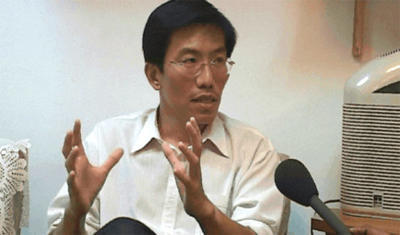
Opposition politician and Singapore Democratic Party secretary general Chee Soon Juan told Agence France-Presse (AFP) that Moser-Puangsuwan had been invited to Singapore to give a lecture at a weekend training workshop on non-violent political action.

The Home Affairs Ministry said in an e-mailed statement sent to AFP: 'Foreigners like Yeshua with no stake in the future of Singapore and of Singaporeans will not be allowed to interfere in Singapore's domestic politics, much less to instigate, agitate and promote civil disobedience among targeted segments of society, against the laws of the country.'

The statement concluded: 'The government has therefore decided to bar Yeshua Moser-Puangsuwan from entering Singapore indefinitely.'

The Nonviolence International website says Moser-Puangsuwan, a US citizen, is the organization's 'main facilitator of training programs in movement strategy and political struggle' in Southeast Asia.


Worrying Development - Can Someone Confirm This?

The following has yet to be confirmed... I had been reading the exchanges online at the Pilot n Jo site. I however did not realise that Dr Lim might actually be Dr Lim.

Bloggers Niraj and Johal of http://pjshow.blogspot.com/ were warned by a person posting in their comments column of their blog that they may have violated the law because their podcast of an interview with oppoistion leader Dr Chee Soon Juan of the Singapore Democratic Party may be deemed to carry political content.


A certain 'Dr Richard Lim' had posted the following comments on
http://pjshow.blogspot.com/2005/08/

imagine_112462795073393621.html#comments


Dear Pilot n' Jo Show,

I refer you to Section (c) of MDA regulations on "Registration of Internet Class Licensees" - "Content providers who engage in the propagation, promotion or discussion of political issues relating to Singapore on World Wide Web through the Internet are required to be registered with MDA. The objective of registering political websites is to ensure that those who run sites engaging in the discussion of domestic politics are accountable and take responsibility for the content of their sites."

As a concerned citizen, I advise you to (1) register your website as a political website, (2) cease and desist distribution of all abovementioned and upcoming multimedia content, and (3) delete all unsanctioned comments and follow-ups by the public.

Without prejudice,
Dr. Richard Lim


-----------------------

Free Speech Singapore has yet unable to determine if 'Dr Richard Lim' is the same person who heads Majulah Connection, described on its website as an organisation that connect "Singaporeans and Friends of Singapore (collectively called the Singapore Alumni) with Singapore, and provide platforms that offer business and personal opportunities to this community."


http://www.majulah.net/about_management.html
http://www.majulah.net/about_us.html

Board of Directors and Management
Board of Directors

Dr. Richard Lim
Chairman


Richard started Majulah Connection in November 2002 and currently serves as the Chairman of the Board of Directors. He is based in San Francisco, California.

Richard spent over 16 years in the US where he attended business school and founded several technology companies funded by top US venture firms. He was Chairman and CEO of iMarket, a software company funded by Sierra Ventures, Oak Technology Partners and Technology Crossover Ventures. iMarket was later acquired by Dun and Bradstreet (NYSE: DNB). Richard was also Chairman and CEO of Co-nect, an education technology company that was supported by GE Capital, ICG, and David Mixer, a founder of Columbia Capital. He seed-funded and served as a director of Quickdot Corporation, an internet startup that was financed by Charles River Ventures. Prior to starting his companies, Richard was an executive at Lotus Development Corporation in Boston. He was also a key member of the founding management team for National University Hospital in Singapore before he went to the US in 1986.

As Chairman of the Singapore Overseas Network (SON) (US), he was actively involved in the Economic Review Committee (ERC). He received an MBA from the Stanford Graduate School of Business, where he was designated as an Arjay Miller Scholar (top 10% of graduating class) and acquired an MBBS from the National University of Singapore on a PSC scholarship.


-----------------------------------


http://www.mda.gov.sg/wms.www/devnpolicies.aspx?sid=161#5

Who Needs to Register:
(a) Internet Access Service Providers, Localised and Non-localised Internet Service Resellers providing computer online service;
(b) Political parties registered in Singapore, providing any content on the World Wide Web through the Internet;
(c) Individuals, groups, organisations and corporations engaged in providing any programme for the propagation, promotion or discussion of political or religious issues relating to Singapore on the World Wide Web through the Internet; and
(d) Internet Content Providers who are in the business of providing through the Internet an online newspaper for a subscription fee, or other consideration.


In 2001, political chatsite Sintertcom was forced to shut down following governmental pressure to regsiter as a political website. Its owner Dr Tan Chong Kee told Straits Times that SBA (predecessor of MDA) gave him 14 days to provide details such as his salary, employer's name and particulars. And sign an undertaking that he would be fully responsible for all Sintercom content. "It gave them a contractual right to sue me. That's very serious," he said.


http://www.yawningbread.org/arch_2001/yax-244.htm

http://it.asia1.com.sg/newsarchive/08/news007_20010816.html


30 Aug 2005

Six Recommendations to Ensure Freedom of Expression on the Internet

Something I should have posted a long time ago.

Reporters Without Borders and the OSCE make six recommendations to ensure freedom of expression on the Internet.

This declaration by Reporters Without Borders and the representative of the OSCE (Organisation for Security and Cooperation in Europe) on Freedom of the Media aims to deal with the main issues facing countries seeking to regulate online activity. Should the Web be filtered ? Can online publications be forced to register with the authorities ? What should the responsibility of service providers (ISPs) be ? How far does a national jurisdiction extend ?

Reporters Without Borders thinks the six recommendations go beyond Europe and concern every country. It hopes they will provoke discussion in the run-up to the World Summit on the Information Society (WSIS).

Full text of the Declaration :

1. Any law about the flow of information online must be anchored in the right to freedom of expression as defined in Article 19 of the Universal Declaration of Human Rights.

2. In a democratic and open society it is up to the citizens to decide what they wish to access and view on the Internet. Filtering or rating of online content by governments is unacceptable. Filters should only be installed by Internet users themselves. Any policy of filtering, be it at a national or local level, conflicts with the principle of free flow of information.

3. Any requirement to register websites with governmental authorities is not acceptable. Unlike licensing scarce resources such as broadcasting frequencies, an abundant infrastructure like the Internet does not justify official assignment of licenses. On the contrary, mandatory registration of online publications might stifle the free exchange of ideas, opinions, and information on the Internet.

4. A technical service provider must not be held responsible for the mere conduit or hosting of content unless the hosting provider refuses to obey a court ruling. A decision on whether a website is legal or illegal can only be taken by a judge, not by a service provider. Such proceedings should guarantee transparency, accountability and the right to appeal.

5. All Internet content should be subject to the legislation of the country of its origin ("upload rule") and not to the legislation of the country where it is downloaded.

6. The Internet combines various types of media, and new publishing tools such as blogging are developing. Internet writers and online journalists should be legally protected under the basic principle of the right to freedom of expression and the complementary rights of privacy and protection of sources.


27 Aug 2005

Singapore police asks filmmaker to turn in camera

From Reuters
SINGAPORE, Aug 26 (Reuters) - Singapore police have asked a filmmaker to surrender a video camera and tapes he used to make a documentary on opposition figure Chee Soon Juan as part of its investigation for possible breach of film laws.
Martyn See, a 36-year-old Singapore filmmaker, told Reuters the demand was made after he had been questioned for three hours at a police station on Thursday in connection with his film "Singapore Rebel".

See said on Friday it was the second time Singapore authorities interviewed him about the 26-minute documentary he withdrew from the city-state's annual film festival in March under pressure from government censors, who told festival organisers the work violated the Films Act.

"The questions were more political than last time and I think they were intended to find out about my political affiliation," he said, adding that while the talk took place in a relaxed atmosphere he would object to the request to hand in his camera.

"I don't mind them inspecting the camera but I need it back to do my work," he said.

See said the police officer had offered no explanation as to why they wanted the video camera.

A police spokesman declined to comment.

Under provisions introduced to the Films Act in 1998, anyone involved in producing or distributing "party political films" -- including those containing commentaries on government policies -- can be fined up to S$100,000 ($59,840) or jailed up to two years.

The film at the heart of the controversy focuses on the life of Chee Soon Juan, who lost in January a three-year legal battle against defamation charges brought by Singapore's founding prime minister, Lee Kuan Yew, and his successor.

In 2002, a documentary about veteran opposition politician J.B. Jeyaretnam was pulled from the film festival after its filmmakers were told it breached the act.

Opposition politicians have said the Films Act stifles political debate in the city-state, which has been ruled by the People's Action Party since independence in 1965. Its 84-member Parliament has only two opposition members.

Lee Hsien Loong, the eldest son of Lee Kuan Yew, took over as the island republic's third prime minister last year, promising greater openness and saying Singaporeans "should feel free to express diverse views...or simply be different".

International free-press advocates have repeatedly criticised Singapore for its tight media controls, such as a government ban of non-commercial private ownership of satellite dishes. Films and TV shows are routinely censored for sex and violence.

The government says a high degree of control over public debate and the media is needed to maintain law and order.

The U.S. State Department, in its February annual report, sharply criticised Singapore for using libel suits to intimidate the opposition, saying the threat inhibits opposition politics and has led to a culture of self-censorship in the media. ($1 = 1.671 Singapore dollar)


Update from Martyn See:
My tapes and camera were handed over to the police at the Police Cantonment Complex at about 6.45 pm this evening. When asked if I can get my camera back soonest, ASP Chan said "No promise."


26 Aug 2005

Police to confiscate camera and tapes relating to 'Singapore Rebel'

From SingaporeRebel. The links will take you to the documentary in question.
This evening, I was again interviewed by the police regarding the making of my short video Singapore Rebel. The interview lasted about 3 hours and was conducted at the Cantonment Police Complex. The officer interviewing me was Assistant Superintendent Chan Peng Khuang. Again, the mood was relaxed until near the end of the interview when I felt many questions were totally irrelevant to the making of Singapore Rebel and I threatened to walk out. ASP Chan told me it is alright to refuse to answer questions which I deemed to be irrelevant. At the end of the interview came the cruncher that I was to surrender all tapes, courier invoices and even the video camera that were used for the filming of Singapore Rebel. I agreed to surrender them to him on Monday 29 August 2005.

Before the interview began, I asked ASP Chan : So I am here to answer further questions about the making of Singapore Rebel. Right?

ASP Chan : Yes

Here are a sample of some of the questions which totalled about 60.

When asked what inspired you to make this film, you claimed that political opposition in Singapore is marginalised. What do you mean by "marginalised?"

What in your opinion should the media do?

So you mean that the Singapore media is being unfair to political opposition?

You claimed that you took two and a half years to make the film. So is it normal for filmmakers to take such such a period to make a 26 minute film?

What sort of activities of Chee Soon Juan were you waiting that you think was worth shooting?

You mentioned that a friend of yours named Peter did the voiceover for the film? Is he contactable?

You mentioned that you edited the film on a friend's Macintosh laptop. Is he contactable?

How was the item (laptop) passed to you and how was it returned to him?

Did you save any of the footages in his computer?

Do you own a computer now?

There were some newspaper articles on your blog? How did you secure those articles?

In your film, there were footages of Chee Soon Juan making speeches at a election rally. Where did you secure the footage?

Did you duplicate the video before returning?

Why was the election rally audio muted?

When did you know that Singapore Rebel was classified a party political film?

I am informing you that Lesley Ho's (of Singapore International Film Festival) email dated March 2005 had mentioned that Philip (co-director of SIFF) was told that Singapore Rebel was objectionable pertaining to party political films. You were told that if you did not withdraw the film, the "full extent of the law" will apply. What do you have to say to that?

So you agree that at this stage when you read Lesley's email, you knew that Singapore Rebel was classified as a party political film?

Since you knew that the film "may have been" a party political film at that stage, why would you want to circulate the film to overseas film festivals?

Can you recall participating in any activities organised by any political party in Singapore?

(Somewhere at this point of the interview, I told ASP Chan that I would walk out if questions continue along this line).

Did Chee Soon Juan direct you to do the filming on May Day (arrests of 2002)?

On 19th July, 2005, Chee Soon Juan and some members was speaking at Speakers Corner? Were you there to film the event? Who directed you to film the event?

On August 11, 2005, were you present in front of CPF Building when Chee Soon Juan and other SDP members gathered for a protest?

Did you contact Chee Soon Juan after the video interview on Singapore Rebel?

Are you still in contact with Chee Soon Juan now?

I do not want to go to your house. Are you able to produce to the police the following items?

1) Two remaining copies of Singapore Rebel
2) Receipts from courier services of you mailing the film to New Zealand and USA (as mentioned in your earlier statement)
3) The Samsung mini-DV camera you used to make Singapore Rebel, and
4) Any raw footages of Singapore Rebel before the editing.

I ask : When are you going to return them to me?

ASP Chan : On completion of the case. Won't be too long.


24 Aug 2005

Female prisoners work in call center behind bars in Singapore

Working a twelve hour shift is bad enough, but are these people being paid? "Chan also declined to say whether the prisoners are paid for their work, or to give any other details about the program’s finances." Working without monetary remuneration is slavery.

Simply because someone has commited a criminal offence does not mean the state has the right to deny the individual of their human rights.

The fact that the "clients did not want to be named due to concerns that links with a prison could hurt their business," is indicative of a wider issue. If the conduct of the Singapore Corporation of Rehabilitative Enterprises is adherring to human rights and proper treatment of inmates then surely the clients have nothing to fear.

Is the policy put in place to make money for Changi prison or rehabilitate offenders? What evidence is there that working 12 hours a day as a telemarketer will rehabilitate?

Questions need to be answered.

24 August 2005


khaleejtimes

SINGAPORE - Female inmates at a Singapore prison are working 12-hour shifts as telephone call-center operators and telemarketers in a state campaign to rehabilitate lawbreakers, an official said on Wednesday.


“It’s pretty much the same as a commercial call center, except it’s behind bars,” said Vincent Chan, a senior manager at the Singapore Corporation of Rehabilitative Enterprises.

“It’s our way of upgrading the old prisons’ industries and enhancing the inmates’ employability,” Chan said.

He said the call center is a cubicle-filled room about the size of a basketball court at the Changi Women’s Prison and Drug Rehabilitation Center.

The duties of the 38 inmates working there include answering questions about prepaid mobile phone cards and consumer products, he said, adding that supervisors monitor the calls to make sure they are limited to business.

The operators are trained to speak clearly and to soothe difficult customers.

The call center operates around the clock and has 10 clients, including a telecommunications company, Chan said. Clients did not want to be named due to concerns that links with a prison could hurt their business.

Chan declined to say whether the prisoners are paid for their work, or to give any other details about the program’s finances.

“I was a workaholic before, and not having anything to do in jail made me feel down,” Singapore’s Straits Times newspaper quoted a 32-year-old operator, who identified herself as Aris, as saying. “Being in this program helped me to be myself once again because I feel useful.”


23 Aug 2005

Lee wants Singapore to ape Las Vegas

Lets hope Singapore emulates the good that takes place in Las Vegas as opposed to the bad.

AP , SINGAPORE Tuesday, Aug 23, 2005,Page 1
Singaporean Prime Minister Lee Hsien Loong (李顯龍) urged this tightly controlled city-state to take a cue from freewheeling Las Vegas, as he stuck to economics and largely avoided politics and free speech in his second annual address to the nation.

"It must be a totally different Singapore. Because if it's the same Singapore [as] today, we're dead," Lee said, referring to his country in the future. "We have to remake Singapore -- our economy, our education, our mindsets, our city," he added in his National Day Rally address, an annual policy speech.

At one point in the nearly two-hour speech late on Sunday, the usually unflappable politician's eyes teared up as he tried to rally his citizens, recounting his past participation in independence day parades.

On Aug. 9, Singapore celebrated its 40th year of independence from Malaysia. It had previously been a British colony.

Lee, 53, said that Singapore -- one of Asia's wealthiest countries, which has long relied on its efficiency and clean government to attract foreign investment -- will move to "foster innovation and enterprise."

He said the island republic's citizens must look at Las Vegas for new direction.

"Out of nothing in a desert, they have built a city. Forty million people visit every year," Lee said. "We don't want to become Las Vegas, but we should learn from their spirit."

Lee's administration has approved the building of two casinos in resource-poor Singapore by 2009. Several Nevada casino moguls are bidding for the jobs.

Lee's speech also touched on terrorism, Singapore's service culture and improved relations with China, which were damaged after he visited Taiwan last year.

"Our relations with China are back on track. We are friends with key players who matter to us," said Lee, who visited Taiwan just before assuming leadership of the city-state.

Singapore has been attempting to retool its formerly manufacturing-based economy, focusing more on areas like biomedical sciences and the arts.


22 Aug 2005

Increase in divorces a worrying trend

It is a worrying trend for a predominantly patriarchical society. I doubt however that the women who filed for divorce would see it as 'worrying'. So even though I may not agree with the tone of the article it is posted here. One solution to this worrying trend is to redefine 'the family' set up new indicators, accept other forms and structures of the 'family'. So this article is one for all my ex-students out there.

First spotted on Singapore Window

Star, Malaysia
August 21, 2005

Insight Down South By Seah Chiang Nee

GLOBALLY connected and well-educated, Singapore is undergoing great social changes, one of which is a weakening of the family unit.

Like in other Asian cities, Singaporean couples are filing for divorce in worrying numbers, some of them barely months after tying the knot. At the same time, marriage and birthrates are in decline.

This may have an impact on the city’s long-term future. Singapore has about a million families, and its leaders have repeatedly said that the country can do well only if these units are well.

Last year, the number of divorces hit a peak of 6561 cases, doubling over 10 years. Among Muslims, more than three in 10 marriages broke up within the first five years. This means that for every seven marriages registered in Singapore, two ended in divorce, or some 28.5%.

This rate, however, is nowhere near the US and West Europe, where half the marriages end up in divorce. It is also lower than South Korea (47%), Hong Kong (41%) and Japan (38%) but higher than China (15%).

Divorces are rising here because the younger generation has been brought up differently. They are more individualistic and when faced with a problem in marriage, each thinks of his or her own interests instead of family harmony. Traditionalists blame it on Western culture.

Forty years ago, divorce was unthinkable but today’s MTV generation feels less attached to the concept of marriage.

It’s the wife who initiates many of the break-ups. Today’s women are no longer subservient to their men. Independent-minded, many of them no longer tolerate their husbands’ abuse or infidelity. In fact, some women even rival man’s propensity for adultery.

The Women’s Charter protects their financial interests in the event of a break-up, often ensuring the husband contribute to his divorced wife and estranged children. It’s hard to believe, but many Singaporean men see themselves as the victims of these social changes.

“We can succeed financially on our own without a man,” said a single mother with a seven-year-old son.

The women’s assertiveness has come as a blow to those men who are raised to believe that their role in a marriage should be unquestioning.

It isn’t only 20-somethings breaking up. Like in Japan, divorce is becoming more frequent among mature couples, too. After tolerating it for years, many suffering spouses (often the wives) wait until their children have grown up before taking action.

About 21% of last year’s divorces in Singapore were between spouses who had been married for 20 years or more.

According to cases, the danger age is 35 to 49, most of them having wedded before they were 25. Half the couples said problems had cropped up in the first four years of marriage. Dual-income couples often struggle with juggling the need to earn money and enjoying a healthy family life. Surprisingly, infidelity accounts for only 9% of divorces.

A high level of education is scant help; half the divorced people were graduates or diploma holders. Recent economic hardship is an added cause, although failure to communicate is said to be the biggest factor.

One divorcee remarked: “We don’t live in a land of milk and honey – you need money to survive. So when you have insufficient money, there’s stress on the marriage.”

Divorce is evidently an excruciatingly painful affair, but because of changing social mores, the younger set doesn’t feel the stigma that was once attached to it.

An open, modern city, Singapore lies on the crossroads between East and West.

At least a quarter of its 4.2 million population are foreigners. It receives 8.5 million tourists a year, and some 150,000 Singaporeans are working or studying abroad.

With these exposures, the society has become more vulnerable to outside influences than most of its rural neighbours.

A generation ago, its people began moving into high-rise housing, bringing to an end the traditional extended family under one roof. More than 90% of Singaporeans are now flat dwellers.

Unhappy couples are left without the mediation or advice that aged parents had provided in the past.

The transformation also stems from the vast number of educated women joining the labour force.

Singaporeans are a very competitive lot and this leaves a toll on home leisure. To improve family life, the civil service has just reduced the work-week to five days.

And creeping into the picture are such 21st century practices as separate bank accounts between husband and wife, pre-nuptial contracts and having private investigators to check into spouses’ lives.

Overall, the tone for social changes is the globalisation of ideas and popular culture with their new role models for any woman thinking of doing it alone.

The influence of TV, the Internet and other imported entertainment may have contributed to the phenomenon. Unfortunately, the trend is accompanied by a steady drop in the number of marriages. In 2003, only 21,962 couples registered to be married, a year’s drop of 5%.

The transformation of the family has, however, been tempered to an extent by bilingual education and organised efforts to retain cultural values. A Family Day is celebrated every year in Singapore’s heartland. Although most Singaporeans live in small nuclear families, many opt to live near parents for practical reasons. No one can care for their children better than dad and mum.

It helps to ensure a passing down of generational values.


o Seah Chiang Nee is a veteran journalist and editor of the information website littlespeck.com

Related Article:
"The Flight From Marriage" in South and South East Asia by Gavin W. Jones (pdf)
The Battle of Sexuality


Pilot n Jo with Dr Chee Soon Juan


I really got to take my hat off to these two guys. Great work, great interview.
At long last real journalism in Singapore. You may not agree with everything that Dr Chee has to say but he has a right to say it and be heard.

In this episode, they speak to SDP Secretary-General, Dr Chee Soon Juan about free media, free speech, censorship and podcasting as a tool to reach out to the heartlander.

Please help spread the word. They have also informed us that a video will be up soon.


21 Aug 2005

Stuffy Singapore to Host Its 1st Sex Expo

Look at the words used to describe Singapore, 'staid','tightly-controlled', 'stuffy' are just a few. Do these words refer to the political situation or your right to buy an erotic toy? The idea that these images can be shaken off by turning to the lowest common denominator is just cheap.

So the idea is to change the image of Singapore from 'staid' to 'cheap'. Recent images of FOUR protesters and the over-reaction of the police sending in 40 police officers in riot gear cannot be erased from the international image of Singapore with the use of an erotic toy section. Allowing someone to buy a sex toy is not an indicator of the existence of democracy. A free market allowing someone to buy a sex swing is not freedom of expression, or freedom of assembly.

The argument that Singaporeans 'want censorship' is commonly mentioned but I have yet to see the empirical evidence that this is based on. In the article below it refers to "they are trying to loosen the shackles to cater to a generation exposed to overseas influences". Do Singaporeans become swingers on mass overseas or return to Singapore smuggling in case loads of erotic toys?

The argument that Singaporeans may not have wanted to be confronted by a large plastic phallus on the streets, is not somehow justification for denying freedom of speech, trade unions, allowing gerrymandering, maintaining lack of transparency, lack of openness and lack of accountability.

The staid image is an image of the political situation. Allowing an erotic toy will not somehow undermine that image. It will merely cheapen it.

By Associated Press

August 21, 2005, 6:04 AM EDT

SINGAPORE -- Staid Singapore will host its first-ever Sex Expo in November after receiving in-principle approval from the tightly-controlled city-state's authorities, a local newspaper reported Sunday.

The Singapore police have already imposed certain conditions for organizers -- no obscene acts can be put on display and all exhibits and promotions will face government scrutineers, the Straits Times newspaper reported.

Only patrons aged 21 or older will be admitted, the paper added.

The exhibition will feature furniture "designed to enhance lovemaking" and an erotic toy section, the paper said. An exhibition on the history of condoms is also scheduled for show.

Singapore, a tiny, wealthy Southeast Asian city-state of 4.2 million, has been attempting to shake off its well-known stuffy image, and officials say they are trying to loosen the shackles to cater to a generation exposed to overseas influences.

But restrictions abound: Cosmopolitan magazine can only be sold if wrapped to avoid browsing by minors, and programs like HBO's "Sex and the City" and "Six Feet Under" have been screened with cuts by the country's censors. Singapore also outlaws oral sex and homosexuality.

Officials say its citizens want censorship. Police could not immediately be contacted for comment

20 Aug 2005

Free speech and opposition parties in Singapore


This paper evaluates the use of free speech by opposition parties in Singapore. In particular, it looks at the impact, several key legislations such as the Public Entertainments and Meetings Act, the Defamation Act and Parliamentary Privileges, have on opposition party communication. Although cases of free speech restriction with regards to opposition parties and its members have received great publicity, in real terms the value of free speech for opposition parties in Singapore is limited. First, defamation laws in Singapore continue to extract caution from the opposition, creating a pressure within the opposition movement to ensure political comments do not result in defamation suits. Second, free speech in itself is politically not useful for opposition parties if the content in their free speech exercises are not disseminated by the local media. Hence both the fear of defamation suits and the limited dissemination of content in free speech exercises by the local media, keep the political value of free speech for opposition parties limited in Singapore. This has prompted one opposition leader to declare that perhaps non-violent civil disobedience may be a way to go. Thursday, 04 August 2005

by James Gomez

19 Aug 2005

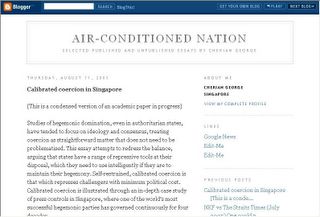
Air-Conditioned Nation


Meet Dr Cherian George, an ex-senior journalist with The Straits Times who then moved into academia.

I have included a section of Calibrated coercion in Singapore here to encourage you to go and read the entire article.

How long these circumstances can last is largely a matter of speculation. Determined challengers could try to expose the repressive core of the state by deliberately provoking a strong response. Following Arendt’s logic, a violent reaction by the state would reduce its power. This appears to have been the tactic adopted by opposition leader Chee Soon Juan, who flouted public speaking rules and refused to pay a fine, landing him in prison. The degree of public outrage was limited, partly because the authorities did not respond to Chee’s well-attended talks with any show of force, but simply dealt with the speaker and organisers later through the courts. Still, Chee’s action drew attention to the taken-for-granted licensing rules for public events, and the ensuing public discussion led to accommodation by the government, which instituted a Speakers’ Corner and then liberalised the licensing rules for indoor talks.

Calibrated coercion could also be compromised internally, by less astute political leaders. In this respect, the widely-held stereotype of Lee Kuan Yew as more “hardline” than younger leaders may be profoundly misleading. The central argument in this essay has been that calibrated coercion is more a matter of political nous than of ideological position. It is the product of long-term strategising, shaped through experience and honed through practice. Lee Kuan Yew and his two successors – who make up the three most senior members of the current government – have had a total of more than 90 man-years of cabinet experience. Future leaders will inherit formidable means of repression, but not necessarily the long-term vision or the expertise to use them in a calibrated manner. Like many other leaders around the world, they may reach quickly for the seemingly decisive weapons that are so easily within reach, at great cost to their legitimacy and power.

AIR-CONDITIONED NATION


First stumbled upon at Mr Wang Says So.

Singapore NKF Seeks Help From CAD - Report

August 18, 2005 02:01 ET

Singapore NKF Seeks Help From CAD - Report

SINGAPORE (Dow Jones)--The National Kidney Foundation, Singapore's largest charity, has asked police to look into "certain matters of grave concern," Channel NewsAsia reports Thursday, citing a statement from NKF.

The news channel said the problems were uncovered by the charity's interim board of directors, which the government appointed about a month ago.

NKF said it's not at liberty to discuss these matters as they have been referred to the police's Commercial Affairs Department, or CAD, Channel NewsAsia said.

The NKF saga started in mid-July when it took Singapore Press Holdings Ltd. (T39.SG) and one of its writers to court for defamation.

In the course of the trial, details emerged on the pay and perks that its then-chief executive T.T. Durai was getting. Lawyers for SPH also showed that NKF had overstated the number of patients at its dialysis centers and understated about how long its S$200 million-plus reserves would last if it discontinued its fund-raising activities.
Public pressure led to the resignation of Durai and the NKF board, and the Health Ministry stepped in to appoint an interim board and chief executive.

NKF officials weren't immediately available for comment.


Youth, 16, faces 5 years in jail

p2pnet.net News:-

Big Music’s RIAS (Record Industry Association of Singapore) sicced local cops onto a 16-year-old they say was sharing files.

The youth and two others, the oldest of whom was 22, were arrested in Singapore and charged with distributing digital music files "in the city-state's first crackdown on illegal file sharing," Singapore police said on Thursday, according to Reuters.

“Under the amended Copyright Act, anyone who illegally downloads files on a ‘commercial scale’ could face criminal charges, including five years in jail and fines of up to S$100,000 (33,322 pounds or about $60,000)."

Police were “tipped off" by the association "representing local and foreign record companies,” says the story, adding, “The suspects used an Internet chat programme as well as a music-sharing programme to distribute the music files.”

Reuters neglects to say it's never been demonstrated, let alone proved, that file sharing equals even a single sale lost.

Nor does it point out that with file sharing, nothing has been stolen and no money changes hands.


18 Aug 2005

Internet Filtering in Singapore in 2004-2005: A Country Study


Before you read, there is a shorter journalistic piece below covering the release of this material by OpenNetInitiative. So if you are currently suffering from a low attention span, scroll down to the next article where you can read very small extracts.

Below is a short extract for my own use. The links that show in detail the references used have been removed, as I do not have enough time. The entire document includes information on methodology, data analysis etc. For those of you not interested in the methodological details I have included here the main argument and details of how the internet is controlled in Singapore. I do however believe they have missed one very important method of controlling the internet. A method of control that can not be explicated when using the methods the OpenNetIniative have employed.

1. EXECUTIVE SUMMARY

The Republic of Singapore is an economic leader in Southeast Asia, with a vibrant information and communications technologies sector; however, the state maintains strong formal and informal controls over the information to which its citizens have access.Singapore’s official position is that the state filters Internet content to promote social values and maintain national unity,with the goal of denying access to objectionable material, especially pornography and content encouraging ethnic or religious strife. The Media Development Authority (MDA) claims to block only a symbolic list of 100 Web sites (primarily pornography) as a symbol of the state’s disapproval of this content. In addition, the MDA encourages, and each of Singapore’s three primary Internet Service Providers offers, optional, filtered Internet access services that block additional sites for a minimal monthly fee.

In our testing, the OpenNet Initiative (ONI)found extremely minimal filtering of Internet content in Singapore, as only eight sites of 1,632 tested (.49%) were blocked: www.cannabis.com, www.chick.com, www.formatureaudiencesonly.com, www.penthouse.com, www.persiankitty.com, www.playboy.com, www.playgirl.com, and www.sex.com. The limited blocking that our testing revealed focuses on a few pornographic URLs and one site each in the categories of illegal drugs and fanatical religion. Similar content is readily available at other sites on the Internet that are not blocked in Singapore. Thus, Singapore’s Internet content regulation depends primarily on access controls (such as requiring political sites to register for a license) and legal pressures (such as defamation lawsuits and the threat of imprisonment) to prevent people from posting objectionable content rather than technological methods to block it. Compared to other countries that implement mandatory filtering regimes that ONI has studied closely, Singapore’s technical filtering system is one of the most limited.

2. POLITICAL, TECHNICAL, AND LEGAL CONTEXT IN SINGAPORE

A. Internet Infrastructure and Access

Singapore restricts media coverage of topics both formally and informally. According to a recent censorship review by a government-appointed committee, access should be denied to content that “undermines public order and the nation’s security, denigrates race and religion, or erodes moral values.”In evaluating moral values, the committee defined as “clearly immoral and demeaning” content that includes “pornography, deviant sexual practices, sexual violence, child pornography, [and] bestiality.”It noted, though, a range of opinion in Singapore on “violence, nudity and homosexuality,”recommending in particular that the ban on homosexual content be eased.(This may be because Singapore has become a hub for gay culture in Asia.The first category, protecting public order and national security, is quite vague; dissidents allege that the state has used similar language in its Internal Security Act to deter political protest and hinder opposition parties.Defamation lawsuits against dissidents and news organizations are also used as a method of control.Singapore views discussion of religious and ethnic issues as risky given the background of its population; these topics must be approached carefully in public discourse.The state is also concerned about Islamic extremist groups such as Jemaah Islamiah.

B. Internet Infrastructure and Access

Singapore has achieved tremendous Internet penetration. In 2002, 61% of the population of Singapore had access to the Internet from home, work, or cybercafés.Three firms provide Internet access for most of the state’s 2.31 million subscribers: StarHub, SingTel’s SingNet, and Pacific Internet.While all three Internet Service Providers are public entities, the government was the majority shareholder in each as of April 2001.Whether a viable independent Internet access provider is possible in Singapore remains in question.

C. General Media Regulation

Singapore lacks a free and independent press. According to one group of observers at the University of Hong Kong, the Singapore media is used as a “semi-official bridge between the government and the public.”The University of Hong Kong report found overwhelming evidence that the state owns an equity stake in the press and broadcast conglomerates it supports.Singapore fiercely criticized a report by Reporters Sans Frontières, which ranked the state at 147th in its annual Worldwide Press Freedom Index — by far the lowest ranking of any wealthy, developed nation.The committee chartered with reviewing Singapore’s censorship laws urged the state to reduce censorship in June 2003, and the state has accepted the committee’s recommendations. Formal action to control content is frequent; Singapore recently imposed sanctions on a radio station for broadcasting sexual content and on a print journalist for reporting on a foreign trip by the former prime minister’s wife for medical treatment.

Media ownership is carefully monitored by the government, which exerts influence over content through investment and informal ties. Singapore Press Holdings (SPH), a company with close ties to the ruling People’s Action Party (PAP), controls all of Singapore’s daily newspapers.The Media Corporation of Singapore (Mediacorp), which is owned by a state investment agency and controlled by PAP supporters, dominates the broadcasting media.Mediacorp and SPH merged partially in late 2004, reducing greatly media competition in newspapers and television.

Formally, the Media Development Authority (MDA), which was created on Jan. 1, 2003 (formerly the Singapore Broadcasting Authority), is the agency responsible for media regulation. The MDA’s primary authority derives from the Media Development Authority of Singapore Actthat established it; however, other laws, notably those relating to pornography and election material, have been applied to the Internet and users. Overall, the state influences newspaper editorial decisions through its links to the SPH,and television programming is controlled and censored by the MDA.

An important, informal means of media control in Singapore is the use of lawsuits under the state’s stringent defamation laws.Defamation suits in Singapore are a common tactic for controlling speech, especially that related to Singapore’s government and politics; defendants who lose such suits often face hundreds of thousands of dollars in liability.There have been repeated allegations that judges in political defamation cases are linked to – and favor – government officials.Self-censorship by the media is common since the standard of proof in a defamation suit is easily met -- the burden rests upon the defendant to prove the truth of the statements (absent a claim of privilege, which is quite limited in scope) by substantial evidence, without the benefit of a jury trial.Thus, “The law of defamation presumes that defamatory words are false and the plaintiff need do no more than prove that the defamatory words have been published by the defendant. The burden is then on the defendant, if he wishes to rely on the defence of justification, to prove that those words are true.”The United States Department of State has condemned the scope and effect of Singapore’s defamation laws, stating that “government pressure to conform resulted in the practice of self censorship… [law]suits, which have consistently been decided in favor of government plaintiffs, chilled political speech and action and created a perception that the ruling party used the judicial system for political purposes.”

A recent example that demonstrates the reach of these laws, and their effects on Internet communication, targeted a blogger studying at the University of Illinois. Jiahoa Chen, a Singapore citizen, was forced to shut down his blog “caustic.soda”(hosted on the university’s server) under threat of a defamation lawsuit from A*STAR (Agency for Science, Technology, and Research), a state-funded agency that provides scholarships to Singaporeans studying abroad in return for a commitment to public service after graduation.Chen broke his contractual agreement with A*STAR and had to repay his scholarship to the agency.Subsequently, he criticized A*STAR in an interview with Singapore’s The Electric New Paper and also on his blog. Chen stated that A*STAR treats its students “merely [as] a human resource”and that the agency’s recently instituted 3.8 grade point average requirement for maintaining scholarship funding was “unnecessarily draconian and counterproductive.”Shortly thereafter, A*STAR chairman Philip Yeo sent a series of e-mail messages to Chen threatening legal action and demanding the immediate removal of the blog.Under the threat of a defamation suit, Chen closed his blog, issuing a statement that “the price of maintaining the content that used to be available at this URL has become too high for the author to afford.”Following continued pressure from Yeo and A*STAR, Chen later posted a more explicit apology that reads, “I admit and acknowledge that these statements are false and completely without any foundation. I unreservedly apologize to A*STAR, its Chairman Mr. Philip Yeo, and its executive officers for the distress and embarrassment caused to them by these statements.”Chen’s case reinforces the power of Singapore’s defamation laws to alter Internet content and has led other Singaporean bloggers to write more cautiously.

D. Internet Access Regulation

The Singapore Broadcasting Act requires Internet access service providers (IASPs), political parties, Internet service resellers (ISRs), Internet Content Providers (ICPs), and entities with Web sites related to political or religious topics to register with the MDA under a class license scheme.Under the law, both service and content providersare required to comply with the Internet Code of Practice, which “outlines what the community regards as offensive or harmful to Singapore’s racial and religious harmony.”Political parties, religious groups, or individuals discussing these topics on their Web sites must “provide the [MDA] with such particulars and undertakings as the Authority may require”.ISPs (comprising ISRs and IASPs) must conform to terms of the Class Licensethat mandate enforcing compliance with the MDA’s Internet Code of Practice.In addition, the license requires that sites providing material about or hosting discussions regarding politicalor religious topics register with the MDA and conform to MDA requests regarding that content.Thus, Singapore has erected barriers to creating Internet content that augment its regulations for content itself.

E. Internet Content Regulation

Singapore has regulated Internet content since 1996.The state claims to use a “light-touch” approach to regulation.The primary legal instrument establishing control over access to Internet content is the Broadcasting Act. Under the Act, the MDA has authority to require the blocking of specific external sites or domains and to mandate the removal or moderation of “objectionable” content hosted by service or content providers. The MDA’s Internet Code of Practice defines prohibited content, which ISPs must block, as that which depicts nudity in a titillating fashion; promotes sexual violence; shows people engaged in explicit sexual activity; advocates homosexuality or lesbianism; shows sexual activity by a person who is or appears to be less than 16 years old; depicts incest, bestiality, pedophilia, or necrophilia; depicts extreme violence or cruelty; or “glorifies, incites or endorses ethnic, racial or religious hatred, strife or intolerance.”In practice, the MDA claims to have established a “symbolic” list of 100 sites that are officially blocked; persons attempting to view any site on this list will be informed that the site in question is blocked.The MDA states these sites are primarily well-known pornographic domains.As discussed below, ONI’s testing calls this statement into question; we found only eight sites filtered at any point in our testing, including one illegal drugs site and one site devoted to Christian evangelism.

The MDA can issue penalties for violations, including fines or a license suspension or termination for non-compliance. Corporate Internet access is exempt from the requirement to block these 100 sites prohibited under the MDA Class License.The MDA has encouraged ISPs to develop and offer Family Access Networks that filter out pornographic and other objectionable Web sites for an additional fee; fees for this service were roughly $3 Singapore per month in July 2005 The government has encouraged the development of a ratings system and filtering software but has not yet publicly announced the adoption or endorsement of any such system or software.

In addition to explicit attempts to block pornography, hate speech, and similar content, the MDA’s predecessor (the Singapore Broadcasting Authority, or SBA) was accused by members of the political opposition of using its authority to disrupt the PAP’s political opponents and to suppress dissent.For example, during the 2001 parliamentary elections, the SBA was accused of selectively applying electoral laws to registered opposition Web sites.The SBA was also criticized for its treatment of fateha.com, a Muslim site that protested the ban on Muslim students wearing head scarves. In addition, the Computer Misuse Act and e-commerce legislation adopted in 1998 give Singapore’s police wide powers to seize and search computers without a warrant and to decrypt online messages.

The Internet Code of Practice does not provide for any restrictions or penalties imposed on users; however, violation of other laws, such as those banning possession of pornography, may subject an Internet user to criminal penalties. In addition, the government has been accused of manufacturing charges against political dissidents and of monitoring the Internet use of suspected dissidents; the Computer Misuse Act and similar legislation have greatly increased the government’s authority to monitor and decrypt Internet content. Even if few such charges are filed, the threat thereof may serve to deter political opposition in Singapore.

In addition to filtering that occurs under the mandates of the MDA, other providers of Internet access (such as universities) implement blocking of sites as well. Like the MDA, these providers generally do not reveal which sites are blocked or the precise rationale for filtering the sites to which access is prevented.


Related Links:
The entire document can be found at Opennetinitiative.
PDF version available here.
U.S. Newswire

Singapore's net controls shun filters

The AgeNew York
August 18, 2005 - 10:40AM

Singapore maintains some of the world's tightest restrictions on free expression on the internet, but unlike other regimes, it doesn't do it with technological filters.

Instead Singapore controls the web through an unusual mix of legal pressures and access restrictions, according to a new study by three universities.

Testing of 1632 websites by the OpenNet Initiative found only eight blocked, mostly for pornography.

"If you look at it alongside places like China and Iran, Singapore's technical internet censorship regime is mild by comparison," said John Palfrey, executive director of the Berkman Centre for Internet and Society at Harvard University, which formed the OpenNet Initiative with the University of Toronto and the University of Cambridge.

Singapore's government manages to restrict discussions on politics and religion by requiring sites on those topics to obtain licences, the report found.

Internet service providers also must comply with regulations banning speech deemed offensive or harmful.

To discourage dissent, the government also uses defamation laws that favour plaintiffs and puts defendants at risk of hundreds of thousands of dollars in liability, the report found.

The report cited the case of a University of Illinois student from Singapore who was threatened with a lawsuit over comments made on his web journal.

Singapore's Agency of Science, Technology and Research agreed not to sue after he shut down his blog and apologised for comments he had posted about the agency.


Singapore cracks down on music file-sharing offenders

The issue has finally arrived in Singapore. It has been well covered in the UK and USA. I am rather surprised that only 3 people have been arrested.

From Reuters
By Nur Dianah Suhaimi

SINGAPORE (Reuters) - Three Internet users have been arrested in Singapore and charged with distributing digital music files in the city-state's first crackdown on illegal file sharing, Singapore police said on Thursday.

The three young men who were arrested, between the ages of 16 to 22, had shared more than 20,000 files in internet chatrooms.

It was the first time Singapore police have clamped down on web surfers who download pirated music and films since new copyright laws came into effect in January this year.

Under the amended Copyright Act, anyone who illegally downloads files on a "commercial scale" could face criminal charges, including five years in jail and fines of up to S$100,000 (33,322 pounds).

Police were tipped off by the Record Industry Association of Singapore (RIAS), an association representing local and foreign record companies. The suspects used an Internet chat programme as well as a music-sharing programme to distribute the music files, a police statement said.

RIAS, which conducts constant checks to curb illegal file sharing told Reuters it has sent warning letters to those engaged in illegal file-sharing on the Internet.

"Prosecution was a last-resort measure," said RIAS Chief Executive Officer Andrew Neubronner.

Industry analysts say the rollout of high-speed broadband Internet in Asia, particularly in countries with high piracy rates like China, India and Indonesia, has sent the number of people downloading free music off the Web spiralling up by millions a month -- and recorded music sales to tumble.

Singapore has one of the world's highest Internet penetration rates, with over 60 percent of its 4.2 million people living in homes wired to the Internet.


Presidential contest: the end

From Yawning Bread
18 August 2005

And so it has come to pass: the presidential contest ended even before it began.

When Andrew Kuan first announced that he would seek the presidency, many people hoped that he'd be allowed to, and that for once there would be a genuine contest.

However, by the time the CEO of Jurong Town Corporation, Kuan's employer from 2001-2004, trotted out to make negative comments about Kuan's ability and his job history, most knew how it would end.

A day later, on 13 August 2005, the Presidential Elections Commission (PEC) did the dirty work. It announced that no one other than the incumbent, S R Nathan, was qualified to run for President. Andrew Kuan, the most likely other candidate to qualify, was ruled ineligible.

* * * * *

There are no winners in this affair. Not even S R Nathan who has been returned unopposed.

I heard him speak on TV news tonight (17 Aug 2005). He said, "I want to thank all Singaporeans who came forward to support me." What a poor choice of words, for it reminded everyone how his support has never been tested. If there was any 'support' evident, it was only that engineered by the so-called labour movement that the PAP government captured and neutered long ago.

It was quite pathetic, and I thought to myself, the best thing he can do to redeem his personal honour is to resign.


To continue reading yet another excellant article from yawning bread click here.


17 Aug 2005

How to become a CFO in a billion-dollar S'pore Stat Board

From: "unemployedorstressedworker"
To: Sg_Review
16 Aug 2005
Accountancy 101 - How to become a CFO in a billion-dollar S'pore
statutory board


In the first place, the problem started when Mr Kuan was "headhunted" (or "highly recommended" perhaps) to be the Group CFO of JTC. And this is an important lesson for all Singaporeans (especially those who need "help" in finding high-paying jobs in government departments, statutory boards, GLCs, etc..). You first "volunteer" as a member of the RC, NC (and all the various "CCs") in your constituency and rub shoulders with the MPs (and ministers if possible). What is the 8-letter word for all this, starting with "ne------"? (Of course, they call it "networks", but sorry if you're thinking of another word). As for what happens next, the sky is the limit....even the President one fine day !!


Having got in, what do these stat boards and GLCs do when they find your work performance "unsatisfactory"? Of course, through their "networks" again, they try to "help", failing which, they'll try to keep you "employed" (for as long as possible, but maybe 27 months is long enough with all that salary and bonuses to tide you over for some time, lest you accuse the government as an "employer with no heart").


It is high time the Prime Minister sets up a market-based and international-standard appraisal system (market-based salary must come with market-based responsibility and appraisal) and ensures that such senior appointments in the government (including statutory boards and GLCs) should not be allowed to remain in their positions if their performance is found to be unsatisfactory. For those whose performance is bordering on the "unsatisfactory" range, they should be subject to a "review period" of 3 or 6 months during which they must exhibit marked improvement in their performance. Furthermore, senior officials under "review" must require the approval of the respective Minister to remain in their job at the expiry of the "review period" (If certain key appointments require the approval of the President (a post Mr Kuan was on the verge of becoming), certainly appointments of CEOs and CFOs (and other C-Os) of statutory boards and GLCs (whose reserves can easily run into billions of dollars) should also require similar stingent scrutiny?)

"Why keep Andrew Kuan on if he was unsuitable?

Puzzling questions came to mind when I read excerpts of the press conference by JTC Corp on former presidential aspirant Andrew Kuan ("JTC was not satisfied with Kuan's work"; ST, Aug 12).

For a high-level position in a statutory board such as the JTC, where corporate transparency is critical - and so is the bottom line - I wonder how it is possible and justifiable that Mr Kuan kept his position as group financial officer just because JTC board members were "reasonable employers" and hoped that will "help him to tide over and find a job elsewhere".

If Mr Kuan did not make a bid for the presidency, this would probably have not come to light.

The chief executive officer and members of the board should make decisions based on the capability of the employee and not on the two reasons given for extending his tenure, especially when they were dissatisfied with his performance in such a senior position ("and came the second year, when we were quite sure that we were not satisfied...").

Why did JTC rate his performance as "good" if it was not satisfactory? JTC should also explain why performance bonuses and pay rises were given to him.

Statutory boards are semi-independent agencies that carry out specific plans and policies of the ministry, meaning that officers serving such boards are funded by taxpayers.

I believe taxpayers do not support the retaining of high-level, highly-paid employees if they are deemed to be not suitable for a position.

Jennifer Tan Ban Ban (Ms)"


15 Aug 2005

Silent Protest in Singapore Video

The details and links to the video were emailed to me anonymously, so I have no idea who produced the video or who uploaded it. It lasts for 14 minutes and is basically silent except for moments when Dr Chee is in frame. Other than that it documents what was a peaceful silent protest, until the police arrive.

--------------------------------------

Below are links to a 14 minute video of a silent protest staged by 4 Singaporean activists on August 11, 2005 outside the Central Provident Fund building on Robinson Road.

Download video here (low resolution 40MB)http://www.archive.org/download/LoResSilentProtest
/Silent_Protest_Lo.rmvb


Video link page here (low resolution 40MB)
http://www.archive.org/details/LoResSilentProtest

Download video here (high resolution 107MB)
http://www.archive.org/download/SilentProtestSingapore
11Aug2005/Silent_Protest_Hi.rmvb


Video link page here (high resolution 107MB)
http://www.archive.org/details/SilentProtestSingapore11Aug2005


You will require a RealPlayer in your computer in order to play these files. If you do not have a RealPlayer, you can download it for free at

RealPlayer - 10.3MB here:
http://www.real.com/international/

Or, RealPlayer - 9.56MB here:
http://www.download.com/RealOne-Free-Player/3000-2139_4-10073040.html


14 Aug 2005

Singapore Incumbent President gets sole Certificate of Eligibility


Nothing happening here, please keep moving along, nothing to see here, nothing happening here, no change, everything is still the same, move along now please...

From the Peoples Daily

The incumbent President S. R. Nathan got the only Certificate of Eligibility issued by the Presidential Elections Committee, said the Committee in a statement on Saturday.

"He has all the credentials for the office of the President and is well regarded and respected for his public service. The Committee considered Mr. Nathan as a man of integrity, good character and reputation," the statement read.

The Committee deemed that the other three applicants, Andrew Kuan, Ooi Boon Ewe and Ramachandran Govindasamy Naidu, "could not have the experience and ability in administering and managing financial affairs as to effectively discharge the duties and responsibilities of the office of the President" according to their career history.

The decision made Nathan the only eligible candidate in the third presidential election in the city state since the Constitution was amended to provide for a President elected by the people in 1992.

It is expected that Nathan, who became Singapore's second Elected President in 1999 without any contestant, will win a second six-year term in office on the Nomination Day on Aug. 17.


A related article from Channel News Asia titled "Many Singaporeans welcome Presidential Elections Committee's decision " By Wong Siew Ying/May Wong writes the following joke of an attempt at a journalistic piece. Three anonymous people are happy with the decision, so the entire population of 4 million are obviously happy. Marvellous work, truely outstanding piece of journalism.

I have one question for Wong Siew Ying/May Wong, how the hell do you sleep at night?

Said one Singaporean, "He tries to participate in all activities organised by the grassroots; he tries to be close to the people."

Another said, "He interacts with the people, he comes down to the people's level. I think that is important for a leadership role."

Said a third person, "I am pretty happy with his performance as a president. Before, he was an ambassador for Singapore to Americans; I thought he did a good job."

SINGAPOREANS PLAN MASSIVE PROTEST [joke]

Do not PANIC - It is a hoax. Singaporeans don't care that much.

Something tells me that this is a joke posted on a newsgroup website and then posted on the comment section of this site. It has got to be a joke as the links take you to an unrelated site and I have never heard of Simon R. Nigel. It is a real pity that the idea that Singaporeans would actually protest in public is a joke.

Nice try!

REPORT: Singaporeans plan massive protest against Nathan

By: Simon R. Nigel
South East Asia Correspondent,
Asia Press Service


SINGAPORE, Aug 13 (APS) - A mass rally is being planned on August 17, nomination day for Singapore's presidential election, to protest against the government's refusal to allow potential candidate Andrew Kuan to run for the post of president.

The organisers plan to hold the protest at the People's Association headquarters at around 11 am, when the incumbent, Mr SR Nathan, arrives to file his nomination for re-election.

On Saturday, the island's Presidential Elections Committee granted Mr Nathan a "Certificate of Eligibility" to contest the election and rejected the bids by three other applicants.

This means that come Nomination Day on August 17, the 81 year-old former internal security chief will be returned unopposed for a second six-year term.

In a statement, the committee said that Mr Nathan has "all the credentials for the office of the President and is well regarded and respected for his public service".

It also announced its reasons for rejecting the other three applications.

It said two of them, Mr Ooi Boon Ewe, a former tutor, and Mr Ramachandran Govindasamy Naidu, a retired senior store keeper, were rejected due to their lack of qualifications.

"The career history of these two men obviously showed that they did not hold any similar or comparable position of seniority and responsibility in any other organisation or department of equivalent size or complexity in the public or private sector, which is necessary for the office of the Presidency," said the statement.

As for Mr Andrew Kuan, the former Group Chief Financial Officer of JTC, the committee argued that "the seniority and responsibility of that position was not comparable to those needed for the office either".

Singaporeans by and large were shocked at the announcement and newspaper offices were flooded with calls from irate readers calling on the government to explain the rationale for rejecting Mr Kuan's application.

Meanwhile, online newsgroups and blogs saw tons of angry postings calling for the government to allow Mr Kuan to stand for the election.

A posting on the soc.culture.singapore newsgroup said: "it's pretty obvious the MW ("men in white", here referring to the ruling PAP government) is NOT READY for the TEST".

As the public outcry triggered by a huge scandal at the government-backed NKF (National Kidney Foundation) is still fresh on many people's minds, the reader said the government was afraid that Mr Nathan could be defeated at the polls.

Speaking to reporters, the organisers of the protest rally said they hoped Singaporeans would turn out in force to pressure the government to review their decision to reject Mr Kuan's bid.

"The PAP government obviously owes the people of Singapore an explanation," said the spokesman, who refused to be named.

Meanwhile, an online petition calling on Singaporeans to support Mr Andrew Kuan for the presidency (http://www.petitiononline.com/sg050817/) has been gathering steam since it was launched by a mass organisation calling itself The Singapore Patriotic Front (SPF) here on Sunday.

The SPF said Mr Kuan's "distinguished record in public service, strong professional financial training and experience" would allow him to do well as a "People's President", provide "a watchful eye over the Singapore's national assets and foreign reserves", as well as push for "greater transparency and accountability in the Government-Linked Companies".

The petition also slammed the incumbent, Mr Nathan, for failing to discharge the responsibilities of his office "despite having received close to $10 million in salary over the last five years".

It added: "this could be attributed to his lack of financial training and his being appointed by the Singapore Government instead of being elected by the Singapore citizens".

Expressing shock at the government's rejection of Mr Kuan's bid, the SPF argued that "if the incumbent, despite his poor performance and his alleged connections with the Japanese Kempeitai during World War II, is allowed to run for the Presidential Election, there is no reason for a more qualified candidate like Mr Kuan to be denied the 'Certificate of Eligibility'".

"Unless the Singapore Government is trying to manipulate the outcome of the election to suit its nepotic & despotic needs," it added.

The SPF also took the state-controlled media to task for launching a smear campaign against Mr Kuan.


"We demand that the Singapore Government stop treating Singaporeans as fools and manipulating the media to cast the incumbent in the best of light while conducting smear campaigns against all those who are running against the incumbent. This is childish & unconstitutional," said the SPF.


Mr Nathan's office could not be reached for comment Sunday. - APS


Copyright: Asia Press Service
URL: www.asiapress.com


13 Aug 2005

Will Singapore remain the outlier?

A group of people appear to be talking about Singaporeans and the future of Singapore, maybe they might acquire a 'truer' picture if you gave them your two cents worth over at danieldrezner.

Will Singapore remain the outlier?

Whenever people start talking about the interrelationships between regime type, the rule of law, economic development, and political corruption, the outlier is always Singapore.

Think that economic development inexorably leads to freedom of the press? Hello, meet Singapore.

Think that authoritarianism automatically leads to corruption? Have you met Singapore?

Think that no government can plug its country into the Internet while still retaining a vast web of censorship? Yes, yes, that is Singapore over there in the corner giving you the raspberry.

[So what do political scientists say whenever the Singapore is brought up as the counterexample to the general rule?--ed.] There are a few options available:

OPTION #1: "Oh, you say a small city-state violates my covering law? I say 'feh.' All statistical relationships will have outliers. The general observation still holds."

OPTION #2: "Unless Lee Kuan Yew can be cloned, this is a unique example of political leadership that doesn't generalize beyond the borders of Singapore."

OPTION #3: "Oh, Singapore won't remain an exception for long. A one party state cannot be combined with information technology and a free market and live to tell the tale. You just wait.... yes, you wait right over there in the corner."

OPTION #4: "Singapore is merely the exemplar to demonstrate that these kind of feel-good generalizations break down when applied outside of OECD countries. Deal with it."

Some of these options are not mutually exclusive.

My thought piece on information technology and regime type takes some steps towards the third position. So I'm pleased to see that Associated Press reporter En-Lai Yeoh is also moving in that direction:


Amnesty International Report 2005

A round up of the current situation in Singapore from Amnesty International. I have removed material that refers to Malaysia, but if anyone would like to receive a copy of the entire correspondence please feel free to ask me via email. Or you can click here to get the entire document.

The document has been compiled by Margaret John Coordinator for Singapore and Malaysia, for Amnesty International.


To: Singapore/Malaysia Network


Friends,

The following notes include unconfirmed (though usually reliable) information from various sources. I have given media sources where possible and in most cases further information is available. AI documents are accessible at www.amnesty.org or www.asiapacific.amnesty.org I would appreciate updates on developments.


SINGAPORE

Calling for more openness, Prime Minister Lee Hsien Loong said in his inaugural 2004 National Day speech that his vision for Singapore was of a "community where every citizen counts, where everyone can develop his human potential to the full." At the same time, Singapore has defended its media laws and balked at the suggestion that citizens live in a climate of fear.

Yet AI's Annual Report 2005 again underlines continuing tight political control of expression. Nevertheless, critics are once more challenging the government on issues of fundamental human rights. These include: the death penalty (Singapore still has the highest per capita rate worldwide, with six recorded executions from January to September) and curbs on freedom of expression. The death sentence and execution of Shanmugam Murugesu sparked unprecedented anti-death penalty activity, including demonstrations and a public death penalty forum, to which AI's Singapore researcher was invited. And there is now an opposition Internet radio programme, set up by the opposition Singapore Democratic Party. Prominent human rights defender and former prisoner of conscience Dr Chee Soon Juan recently published a new book: The Power of Courage -- Effecting political change in Singapore through Nonviolence. In addition, AI continues to express concern about restrictive legislation, the threat of defamation suits, the detention without trial of alleged Islamic militants held under the ISA; and the detention of Jehovah's Witnesses who are conscientious objectors. Reuters (27/5) refers to the US State Department Human Rights Report that sharply cirticises Singapore for using libel suits to intimidate opposition politicians.

Canadian Foreign Minister Pierre Pettigrew, in correspondence with AI Canada's Secretary General, gave assurances that Canada will continue to seek appropriate opportunities to express concern to the Government of Singapore and looks forward to continuing the excellent cooperation with Amnesty International.


Margaret John
Coordinator for Singapore and Malaysia
Amnesty International Canada ( English speaking)


SINGAPORE

DEATH PENALTY


The death penalty in Singapore, which AI's 2004 report highlighted as having the highest per capita rate worldwide, is now being increasingly questioned within the country -- though still by a small number of Singaporeans . The case of Shanmugam Murugesu, who was hanged for drug trafficking, sparked unprecedented campaigning in the country. GIven tight controls on the press and civil society organizations, public discussion of the death penalty is rare in Singapore. The international media, however, regularly underline its execution record -- a recent travel article in Canada's Globe and Mail began with "We arrive in Singapore on hanging day "(16/7). However, the Shanmugam case sparked public sympathy within Singapore. Sinapan Samydorai, President of the Think Centre, commented: "This is definitely the first time the local community has come forward to look at the death penalty issue.... At least we now have people saying that things should change."

One outcome was an NGO public forum on the death penalty, at which AI's lead researcher on Singapore was invited to speak. At the same time, several articles by Singaporean lawyers have posed questions about its constitutionality. A recent concert against the death penalty -- as part of a regional series -- was allowed to go ahead in Singapore It has not, however, become a debatable issue at government level. It is thought that some eight people are on death row.

AI's researcher on Singapore, Tim Parritt, was allowed to enter Singapore in April to attend the NGO-sponsored Forum on the Death Penalty, but was denied a Professional Visitor Pass. He was not, therefore, permitted to address the forum, which focussed on the death sentence of Shanmugam Murugesu. The Singapore government was reported as saying it did not need a foreigner to lecture it on its criminal justice system. (Age 18/4) Mr Parritt's statement, which was read out for him, stressed that "Human rights are for the best of us and the worst of us" and that

"Amnesty International is disappointed not to be able to address this forum today....AI welcomed this opportunity to participate in today's forum and to report on death penalty developments worldwide. And as another execution, that of Shanmugam Murugesu, becomes imminent, AI appeals once again to the Singapore authorities to exercise clemency."

The statement referred to the global trend towards abolition and called for Singapore to provide the complete statistics on executions to show key criteria, including crimes, nationality, age, as well as background in terms of education, professional status and socio-economic status of those sentenced to death. (Full statement on request)

Mr Parritt was later interviewed by international media who attended the forum and who continue to refer to AI's 2004 groundbreaking report on executions in Singapore. He later met an official of the Singapore Foreign Ministry.

Police in uniform were present at the public forum and the Chair was questioned as to citizenship. The forum drew some 120 participants, though few were willing to be quoted. The Observer (UK, 8/5) reported that a woman who printed T-shirts with the words "Highest per capita execution rate in the world" admitted that she had been terrified to do so -- and police shut down the open mike session just as the first person spoke.

- Shanmugam s/o Murugesu

Despite high-level campaigning in Singapore and internationally, the former taxi driver aged 38 was hanged on 13 May. He had been sentenced to death for possession of just over one kilogram of cannabis. His lawyer, M Ravi, unsuccessfully applied for a stay and a Constitutional Court review. Ravi argued that Shanmugam had been treated unfairly , citing other cases where people arrested for trafficking in more than 500 grams of cannabis (an offence carrying the mandatory death sentence) had received prison terms after the charges against them were reduced. Ravi was reported as planning an appeal to the UN Special Rapporteur on extra-judicial,summary or arbitrary executions in a last-ditch attempt to save his client (AFP 10/5, 12/5)

Shanmugam was given custody of his twin sons after his divorce, reportedly lost interest in life and became a victim of drug abuse. Coming from a poor Indian family, his desperate financial circumstances led to his offence. Petitions, vigils and other campaigning events raised awareness in Singapore about the cruel and arbitrary nature of the death penalty. Shanmugam's 14-year-old twin sons handed out leaflets in the streets. Dana Lam, former president of the Association of Women for Action and Research (AWARE), called the death penalty a "harsh law....Mercy is precisely what is asked for....Just when and how will that Mercy be free to flow?" The Singapore Democratic Party called the President's rejection of Shanmugam's application for clemency "a black day for Singapore." AFP reported that when family and friends made their final visit to Shanmugam on the eve of his execution, he urged them to press on with a rejuvenated campaign to end the death penalty in Singapore. (15/5) Following his execution, Shanmugam's mother was reported by the Singapore Democratic Party (25/5) to have asked for regular government financial support for the twin sons amounting to $500. The welfare department offered her S$150. The SDP pointed out that PAP ministers make S$500 an hour.

- Lawyers speak out: - K S Rajah's article, The Mandatory Death Sentence (published in Inside the Bar), concludes: "Singapore cannot for long be a global city and player in the world's affairs in every respect, except when it comes to punishing offenders for wrongs done. It is now open to an accused to show through experts in international law that a mandatory death sentence is cruel and inhuman punishment under customary international law. " (ksrajah@harryelias.com.sg)

- Michael Hor, in his article The Death Penalty in Singapore and International Law, addresses a number of issues, including minimum standards under which capital punishment may legitimately be employed, mandatory and discretionary death, and due process, and concludes: "At the very least the fact that so many other states of all persuasions (and they are not all Western liberal democracies) are not willing to execute, or execute so often ...should cause decision makers to ... reconsider what the value of life is in Singapore." (2004 Singapore Year Book of International Law and Contributors).

As part of an ongoing series of regional concerts against the death penalty, the first Concert Against the Death Penalty was held in Singapore early August entitled Songs for Sam: Hung at Dawn in memory of the execution of Shanmugam Murugesu. A CD is being compiled. The police banned the use of Shanmugam's face on posters and publicity material, because it would "glorify" an ex-convict and "executed person." The Think Centre expressed disappointment at the ban. (www.thinkcentre.org 4/8)

- Australian Nguyen Tuong Van waits for the outcome of his appeal to the President for clemency on the grounds that he had cooperated fully with the police investigation into an international drug ring. The Catholic Archbishop of Sydney called upon the Pope to intervene. (AFP 17/3)

- Julia Bohl, a 22-year-old German student , who had faced the death penalty for drug possession and trafficking but was instead given a five-year sentence, was released in July after three years, her lawyer was reported as saying, because of good behaviour. She had escaped the death penalty after tests showed the marijuana seized in her possession was less pure than previously thought and therefore below the 500 gr. level. Reportedly lengthy legal and diplomatic manoeuvring had helped her avoid the death penalty. (http://www.faz) The SDP (3/6) called the government shameless for executing Shanmugam Murugesu for smuggling marijuana, while releasing Julia Bohl after three years.

- Other reported cases:

Lim Thian Lai: sentenced to death under the Arms Offences Act for shooting with intent to cause physical injury.

20-year-old Indonesian maid, Rohana, faces the death penalty after being charged with the murder of her employer . There are now more than 140,000 foreign maids in Singapore -- many with stories of abuse. (AFP 4/7)

Factory supervisor Leong Siew Chir, 50, was charged in June with the murder of staff member Miss Liu Hong Mei. (ST 19/6)

Took Leng How was charged with the murder of 8-year-old girl Huang Na. (ST 21/7) His claims that he had seen three Chinese men commit the murder were suspected by a psychiatrist as not truthful. (ST 27/

Two Africans are to hang for heroin trafficking. Nigerian Iwuchukwu Amara Tochi, 19, and garment wholesaler Obeke Nelson Malachy, 33. Iwuchukwu Amara Tochi said he had been told the pills he carried contained "African herbs." (ST 22/7) The Think Centre issued an Urgent Action, pointing out that the death penalty is considered a "form of cruel, inhuman and degrading punishment." (8/8)

Of the "high-profile"drug group of 23 people: fourteen were charged and the rest released. Among the fourteen:
Interpol was alerted to look out for three men who had jumped bail. Singaporean Hamdan Mohamed, Tunisian Guiga Lyes Ben Laroussi and Sri Lankan Jeremy Hahen Chanmugam had all been charged with consuming or selling drugs. (ST 3/3) Bail for Chanmugam's wife, Nadia Celina Seraphina Cornelis, was withdrawn, as authorities had received "intelligence" that she would flee. She was later jailed for three weeks and fined S$5,000 for lying, as she had said she did not know of his whereabouts -- yet she had seen him off to Sri Lanka. (ST 29/3) Marx Oh Chi Wee, one of two alleged ringleaders, was jailed for one year. He faces further trials for trafficking and possession. (ST 18/3) Dinesh Singh Bhatia was sentenced to eight months for cocaine use. (ST 7/4 )


FREEDOM OF EXPRESSION

A year ago, Prime Minister Lee Hsien Loong "urged politically timid Singaporeans to...speak up. " (AFP 8?/8) More of them are doing so. Yet those who speak up -- for example film-maker Martyn See -- also speak of the risk of serious consequences. Reports from the international media and NGOs repeat criticisms that the Prime Minister's call does not reflect the reality i.e. Singapore maintains its tight grip on the media and the political opposition.

Singaporeans:

- Film-maker Martyn See withdrew from a Singapore International Film Festival his short film on Dr Chee Soon Juan, Singapore Rebel , after the Board of Film Censors said he could be jailed up to two years and fined S$100,000. The "party political" film was judged to contravene the Film Act. The film is being shown outside Singapore, including in the USA and possibly Canada. See comments on Singapore's announced "opening up" as a "pretty schizophrenic situation"given the ban on a gay concert, "biased" political films and anything that is deemed by the authoritities to be "contrary to public interest". (weblog: singaporerebel.blogspot.com) Dr Chee comments: "Such is the abuse of power by the People's Action Party." Martyn See was to meet again with the authorities. (AP 22/3 http://asia.news.yahoo.com; SDP 12/5, 18/5 www.singaporedemocrat.org; weblog: singaporerebel.blogspot.com) AI views the Films Act as fitting into the broader context of excessive curbs on freedom of expression and their potential to be misused by the authorities.

- Three Polytechnic lecturers made a brief film in 2001 on J B Jeyaretnam, "Vision of Persistence": It was banned. (AFP 20/6)

- The Singapore DemocratIc Party says it is "determined to break this arm-lock on the media by the Government. A vibrant and free media will foster a dynamic and enterprising society." (http://www.singaporedemocrat.org 2/7) It has now established its Internet radio broadcasts, which can be accessed via its website. Dr Chee's first broadcast calls for democracy and the need to address the issue of poverty in Singapore.

- Charles Tan, President of Young Singapore Democrats, comments on permission given to three hundred foreign organizations that will be allowed to hold peaceful demonstrations at the 2006 IMF and World Bank meeting in Singapore. But Singaporeans who have faced problems trying to demonstrate in the past point to authorities warning them or punishing them. (Reuters 18/3)

- The Falun Gong Working Group submitted a formal appeal to the UN regarding two members who had been arrested in May 2004 and fined S $20,000 and S$24,000, after they had handed out material about China's persecution of the Falun Gong. Both refused to pay fines, were reported to be on hunger strike for several days before their release 3 May, and planned to appeal to a higher court. Falun Gong is a legally registered society in Singapore. (Epoch Times 2/5, 5/5)

- Coffee Shop Talk at http://forums.delphiforums.com has issued a series of views in the past few months. In July, it focussed on Singapore's National Day, stating that Singapore was formed with five ideals -- of democracy, peace, progress, justice, equality -- but all now restricted or destroyed by the PAP. (31/7) Another article dealt with the increased cost of living (1/8), and one asked why Chia Thye Poh was detained for 32 years. (3/8).

- Four protesters assembled in a public place to show their concern at what they see as a lack of transparency and accountability by the government in dealing with public funds. Approximately 40 police officers in riot gear told them to disperse. (SDP 11/8)

- Businessman Andrew Kuan plans to run against President S R Nathan, who has declared his intention to run for a second term. Newstoday reported that a lawyer is to study Mr Kuan's statements for possible defamation. He had claimed that a resolution to remove him as chairman at his condominium management council was "improperly tabled" and that signatures had been forged. (derrick@newstoday.com.sg www.andrewkuan.com)


Government action:

- Singapore banned a planned weekend concert by gay Christian support group. (AFP 30/3)

- The Ministry for Information, Communications and the Arts stated that local newspapers must carry a Singapore perspective -- otherwise readers might be misled into thinking foreign views reflected those of the newspapers. (ST 9/3)

- Police rejected J B Jeyaretnam's application to demonstrate against a proposed casino, saying it would disrupt civil order. Jeyaretnam commented that political freedom remains elusive, despite government claims to loosen social controls. (Reuters 31/3)

- In March, a forum on politics was held at the National University of Singapore, at which five panellists were invited to offer their views on how much or how little Singapore had achieved in embracing the Prime Minister's vision of a "dynamic city that is open and inclusive...." (ST 2/3)

- In April, Yeshua Moser-Puangsuwan of Washington-based Nonviolence International was banned from entering Singapore indefinitely for interfering in the nation's domestic policies, the government said. ( Reuters 17/5) He had conducted a workshop in Singapore in January. The Singapore Democratic Party published a letter by Moser-Puangsuwan that the Straits Times had refused to publish. In the letter, he said he had read the Straits Times Editorial Opinion, which encouraged Singaporeans to act for political change, not just talk about the need for it. (www.singaporedemocrat.org 20/5)

- Police banned the annual beach festival of the gay and lesbian community, which then defied the ban by launching a month-long program of events, IndigNation, ending August 26 to assert their place in society (AFP 28/7) No laws were planned to be defied. (ST 29/7) Gay activists accused the government of promoting homophobia and irresponsibility for comments on Aids and the 2004 gay festival. They have urged the decriminalisation of homosexuality. (NZ Herald11/3)

- Member of Parliament Steve Chia, speaking on amendments to the elections bill, urged: "if the government genuinely wants to have a more genuine 'open and inclusive' society, then it should learn to play fairly with its worthy opponents....I hope the Government will make it mandatory to have at least four months' notice before a General Election is being called."


Judgments from abroad

- In June, AFP reported that there had been little local media coverage of Shanmugam's execution, and instead Singaporeans were taking to the Internet for free speech. "Indeed, with the traditional media shackled by press controls and a virtual blanket ban on public rallies -- Reporters Without Borders ranks Singapore 147th out of 167 countries on press freedom -- the Internet has emerged over recent years as a hotbed for Singapore's dissenting voices." (4/6)

- In May, Falun Gong newspaper Epoch Times described Singapore as "in actuality...a country with complete dictatorship and autocracy....The small number of people who dare to step forward and challenge the government...will simply be brought to court in the name of 'slandering the system....The judicial system of Singapore basically obeys the government'." ( http://english.epochtimes.com)

- Three Swedish parliamentarians (all members of the Sweden-Singapore Initiative for Democracy) strongly criticised the ban on a workshop in May on non-violent political action, and urged the government "to be more tolerant of dissenters, as any modern society fully embraces an active civil society and its international participants." (SDP 27/5)

The South China Morning Post wrote (30/5) "Singapore does not fool its critics...the island nation remains the same as it - has always been -- a virtual police state where the media is tightly controlled, political opposition is barely tolerated and free speech is allowed only with permission."

- In June, Freedom House ranked Singapore 139th out of 194 countries in its Global Survey 2005. "Media freedom is constrained to such a degree that the vast majority of journalists practise self-censorship rather than risk being charged with defamation....The vast majority of print and broadcast media outlets, as well as Internet service providers and cable television services, are either owned or controlled by the state or by companies with close ties to the ruling party."

- Reporteurs Sans Frontières: Its Annual Report, issued in May, records Singapore as having for several decades "a very sophisticated strategy for silencing Singaporean and foreign journalists who wrote stories that are embarrassing for the political elite....the two large national press groups, Singapore Press Holdings and Mediacorps, are run by ruling party allies...the government also continues to censor dozens of films and TV programmes." (www.rsf.org)

- Alliance for Reform and Democracy in Asia (ARDA), issued its full report in May on Singapore's elections system. (www.asiandemocracy.org)


HUMAN RIGHTS DEFENDERS AND GOVERNMENT CRITICS

- Dr Chee Soon Juan, Secretary General of the Singapore Democratic Party, said in March that he could not afford to pay S $500,000 damages, as ordered by the court, to former prime ministers Goh Chok Tong and Lee Kuan Yew. He said he expected bankruptcy proceedings to start, but that bankruptcy would not stop him from fighting for democracy in Singapore. (AFP 15/3)

Dr Chee's new book, The Power of Courage: Effecting Political Change in Singapore Through Non-Violence, is an explanation of "the concept and philosophy of non-violent action and why it is important for Singapore....The book also examines the laws that the PAP introduced to strengthen its grip on power and how these laws are applied selectively against the opposition." The Forewords are by prominent critic and writer Francis Seow (a former prisoner of conscience) and Robert Helvey (President -- Albert Einstein Institute and an expert on non-violence). J B Jeyaretnam provides the Introduction. (www.singaporedemocrat.org) At the July 9 book launch, police filmed the proceedings, seized a CD and demanded particulars of two young activists, Charles Tan and Jonathan Siow, who had spoken. Lawyers' Rights Watch Canada issued a press release July 18, stating that "the attendance of police at the event was a disappointing indication that the Singapore government, while professing to 'open up Singapore' and adhere to democratic values, continues to use heavy-handed methods to rein in peaceful political dissent." (www.lrwc.org) In May, the UN Non-Government Committee recommended that LRWC be given Special Consultative Status.

In April, the SDP called on Asian governments to support democracy, and at a panel for Asian countries, Dr Chee stated that they must "provide the vision to entrench democracy in the region." As SDP Secretary General and Chairman of the Alliance for Reform and Democracy in Asia, he spoke at a conference in Chile, that was attended by government officials and civil society leaders from some 100 countries. (www.singaporedemocrat.org)

Interviewed for Malaysiakini article, Singapore -- republic of fear, by James Wong Wing On (16/5), Dr Chee compared Singapore with Hong Kong: "One society has thrived on the go-getter attitude, and the other on government direction... .[T]he PAP for all intents and purposes is a dictatorship....With the elections system, media, laws, and the ISA the way they are, there is no way that the opposition can be any stronger. But...dictatorships always look good until the very last minute....Singapore is run on fear." (www.malaysiasiakini.com)

Dr Chee and the SDP have launched an Internet Radio programme in order to "breach the control of the media by the PAP government." Dr Chee's first broadcast message called for democracy and rapped the government over issues such as high salaries of ministers and the lack of transparency and accountability. (Reuters 5/8) The radio broadcasts are accessible at www.singaporedemocrat.org.

- J B Jeyaretnam made a further application in June for discharge from bankruptcy by offering S$258,683.82 (40% of his debt). Goh Chok Tong and Jayakumar, two of his creditors, however, refused to accept the offer. (www.jbjeya.org)

- Singapore Democratic Party: Quoting the Prime Minister that "Ours must be an open and inclusive Singapore," the SDP pointed out many of the contradictory curbs on freedom of expression, including the detention in the Institute of Mental Health of Remisier Boon Suan Ban at the President's pleasure. The SDP's Manifesto: The Distribution of Wealth, called on the government to address the issue of poverty in Singapore. "An economy that boasts of large financial resources but has little compassion for the poor, that rationalises, indeed celebrates, grotesque wealth ....cannot be sustained -- morally or practically." (7/7 www.sinagporedemocrat.org) The SDP referred to the UN Development Index, which ranked Singapore 28th behind countries such as Barbados and Malta, pointing to the 2,000 children in 1999 who had not attended school because parents could not afford it, and to the rise in the gap between rich and poor. The party issued a statement in July expressing concern about Singapore's treatment of workers -- The Truth About Labour. (SDP 23/7)

- Remisier Boon Suan Ban was ordered detained in the Institute for Mental Health until it pleased the President to release him. Critics, including J B Jeyaretnam, believed his detention was to prevent allegedly damaging information about Chief Justice Yong Pung How from being revealed to the public. http://jbjeya.org)

- Robert Ho was remanded at the Institute of Mental Health(IMH), following his distribution of flyers about Singapore's election system. He was later released without charge. Police told his wife that he could be detained in IMH "at the President's pleasure if he continued his activities." A few years earlier, he had been investigated for criminal defamation for posting on a website an article about Lee Kuan Yew's daughter-in-law. (SDP 8/4)

- Chen Jia Hao, a Singaporean 23-year-old graduate student in the USA, shut down his blog and apologised unreservedly after Singapore officials threatened to sue him for defamation. The US-based Committee to Protect Journalists and Reporteurs Sans Frontières expressed alarm. Chen was reportedly not informed of the reasons that his blog was considered offensive. (http://escapefromparadisecom/NewFiles/Chen.html) RSF referred to the ranking of Singapore as being among the 20 lowest-scoring countries in its press freedom index. (www.cpj.org)

ILLEGAL IMMIGRANTS/FOREIGN WORKERS

Dozens of migrant workers in the Working Forum on Justice for migrant workers protested outside the Singapore embassy in Indonesia, demanding the abolition of the death penalty for domestic helpers and other migrant workers in Singapore. Anis Hidayah of Migrant Care was hoping to meet Singapore's ambassador to Indonesia. (Antara News 9/7 www.antara.co.id)

TORTURE/ILL-TREATMENT

Caning as a penalty for criminal offences continues to be handed down. Victims include bank robber Brian Khoo, who was sentenced to four and a half years in prison and nine strokes of the cane. His claims, which were later questioned, were that he had been unemployed, had children, was in poor health and had become depressed. (2/4 ST?)

Robber Koh Hock Seng was sentenced to 18 years preventive detention and 15 strokes of the cane. (ST 31/5)

Mohamed Shariff Samsudin, 21, was sentenced to three years and the maximum 24 strokes. He was reported as preying on nine young girls. (ST 1/7)

ETC

President S R Nathan declared his intention of running for a second six-year term. Critics have called for a loosening of candidates' eligibility criteria of business or government experience. (AFP 12/7)

There has been local anger at published information about alleged misuse of funds and the S$600,000 annual salary of National Kidney Foundation chief T T Durai and perks including first-class travel. (Today 14/7 val@newstoday.com.sg) The SDP invited people to meet representatives at Speakers' Corner to discuss the issue. (SDP 16/7 www.singaporedemocrat.org )

------------------------------------


Chinese man gets death penalty for trafficking children to Singapore

From Singapore Windows.

Agence France Presse
August 8, 2005
BEIJING


A CHINESE court has sentenced a man to death for running a child trafficking ring that sold 44 children to Singapore over a five-year period, a state newspaper reported Monday, Aug 8.

Ke Pangjie was sentenced in China's southeastern city of Quanzhou, with partners Wu Wenbin and Sheng Zhenzhong getting life imprisonment and 15 years in jail respectively, the Beijing News reported.

The court said the severity of the verdict reflected the large number of children sold beginning in 1998, with no hope of winning their return.

In 1998 Ke met He Yidi, a person running an adoption agency in Singapore, the newspaper said.

While He and an accomplice set about identifying families in Singapore that wanted to adopt a child, Ke searched for children in Fujian's Quanzhou, Yongchun and Anxi cities.

The children were bought from willing parents for between 5000 to 10,000 yuan (US$600 to US$1200) and were then shipped to the Southeast Asian city state, it said.

Once in Singapore, they were sold for at least S$8000 (US$4800).

The report did not say what happened to the traffickers in Singapore. A total of 10 people were involved in the ring.

China's "one child" birth control policy, coupled with the country's long tradition of favoring boys, are seen as catalysts for the trafficking of children.

Last year, 3500 children were rescued from their captors in 1975 cases, state media reports said, although most of these were domestic cases.

Few instances of international child trafficking from China come to light.


Indian, Malay job seekers complain of discrimination in Singapore

From Singapore Window

Hindustan Times
August 9, 2005
Singapore
Indo-Asian News Services


INDIAN and Malay job seekers have complained of discrimination by employers who ask if they are proficient in Chinese, not if they can do the job, labour chief Lim Boon Heng said in a report on Tuesday, August 9.

Unfair recruitment practices that discriminate against minority race applicants will lead to tension, warned Lim, secretary-general of the National Trades Union Congress.

Some of the job interviewers ask if the Indians and Malays speak Mandarin, Lim said in the report.

"The few who responded that they could were then asked if they could write Chinese," the Straits Times quoted Lim as saying.

He urged employers to wipe out the ignorance that persists despite the high level of racial integration in the city-state. "Businesses thrive here because we have a harmonious society," he said.

Lim made the comments at a National Day observance marking Singapore's 40th birthday.

"If any minority group feels strongly that there is discrimination, there will be tension," he warned.

Singapore's population is predominantly Chinese. It includes 14 per cent who are Malays and six per cent Indians.


Internet essayist Zhang Lin sentenced to five years in prison

I am driven by forces unknown to me to reinforce the existence of the following web blog which resides in Singapore.

Internet essayist Zhang Lin sentenced to five years in prison
Free lance Internet journalist Zhang Lin has been sentenced to five years in prison followed by 4 years of deprivation of political rights on charges of inciting subversion in China. Both Zhang Lin and his lawyer received notice on the 28 of July that the Intermediate People's Court of Bengbu in central China's Anhui Province had found him guilty of crimes related to articles he has posted on the Internet, and to a radio interview. China is the world's leading jailer of journalists; 42 writers and editors were behind bars at the end of 2004. They have submitted a written appeal to the sentence.

A well-known dissident, Zhang had spent eight years in prison and labor camp since 1989. Zhang has written prolifically for overseas news Web sites that are blocked in China, including Boxun News and Epoch Times. The six articles cited in the May 23 indictment against him were harshly critical of Communist Party rule, calling it oppressive and illegitimate

12 Aug 2005

Two Africans sentenced to death

From the Think Centre in Singapore.

The court in Singapore has imposed the death penalty on two Africans for violation of prohibited drugs. The two, namely Iwuchuku Amara Tochi (19) and Okele Nelson Malachy, were arrested on 27 November 2004 at the Changi Airport in Singapore.

Tochi was arrested for allegedly carrying heroine drugs with him while Malachy was nabbed in a subsequent police operation after Tochi identified him as one of his companions. The court in Singapore handed the sentence on them reportedly after concluding its 13-day trial.

Singapore is one of the many countries in Asia who have not yet abolished or repeal capital punishment in their justice system. The death penalty, just like torture, is considered as a form of "cruel, inhuman and degrading punishment". It is a violation of a person's right to life as guaranteed under the Universal Declaration of Human Rights (UDHR). The abolition of the death penalty is essential for the protection of this right to life.

In May 2005, a father of two children was hanged amidst the appeals from various human rights organization, including the Think Centre, asking clemency to save his life. The groups have been asking for jail terms and rehabilitation instead. There are number of prisoners, including foreign nationals, facing death in Singapore however, the government has continued carrying out punishment instead of addressing these problem.

Think Centre's call to right to life in connection with capital punishment is guided by the desirability of abolition of the death penalty which has been expressed on numerous occasions by the UN General Assembly, the Human Rights Committee, the Economic and Social Council and Security Council [in its resolutions 808 (1993) of 22 February 1993 and 955 (1994) of 8 November 1994]

Article 3 of the Universal Declaration of Human Rights, affirms the right of everyone to life, the abolition of the death penalty is essential for the protection of the right to life. The right to life is also defended by article 6 of the International Covenant on Civil and Political Rights and articles 6 and 37 (a) of the Convention on the Rights of the Child.


Related Links
Sign the petition
Singapore: Calls for immediate moratorium on the death penalty

A protest in sunny Singapore


Originally spotted at Omeka Na Huria and traced back to Singapore Democrats. The story of what happened is retold by Chee Siok Chin one of the four protesters. The large number of police officers in riot gear appears rather heavy handed. The police officer, Dominic Baptist, stated that they were responding to a 'public nuisance' complaint received from a member of the public, so they sent 40 police officers with 10 or 12 in full riot gear. Could they inform the public who this member of the public is?

A protest in sunny Singapore
Chee Siok Chin
12 Aug 05

It would have been an activity of little significance in most parts Asia, save for perhaps Burma. A group of four citizens had donned on similar T-shirts and created quite a stir in the Central Business District area yesterday by calling for transparency and accountability from the government. One of them was me.

We had come together to make a statement – we want the PAP government to be accountable to the citizens. We want to know how our money is being invested or used by the GIC and CPF Board.

In our over-sized T-shirts that had messages asking for transparency and accountability, the four of us walked up to the entrance of the CPF Building at 12.30pm. We were greeted by a host of photographers and reporters. We took our positions and stood along the kerb. The cameras zeroed in on us and the messages we had on our Tees. The reporters also began to ask our spokesperson, Monica Kumar, a host of questions.

After answering all the questions, the four of us were left to our peaceful and quiet protest, with the reporters milling around. We were calm, unoffensive and relatively passive.

Suddenly a dozen or so riot policemen turned up in four riot vans (someone said that it was probably for one van for each of us). They were dressed in “warrior” garb, complete with darth-vader-looking helmets, truncheons and shields. Two more troops of regular uniformed male and female officers swarmed around us. All this on two female and two male activists who were were armed only with transparencies and silent? One reporter told us that this “drama” by the police was unnecessary. Thank you.

It was a ridiculous sight when one of the officers started shrieking: “Those of you not involved, move away from here!” It was as if 9/11 had happened in Singapore, except that the only “terrorists” were four of us armed with only two transparency signs. (I guess from the PAP's standpoint, signs calling for transparency in the GIC and CPF were potential explosives.)

A senior police officer by the name of Dominic Baptist told us to disperse or we would be arrested. But on what grounds? He said someone had called to say that we were a public nuisance. Public nuisance? You mean the police always send in the riot squad in response to public nuisance complaints? And besides, the four of us were standing still and keeping very quiet. Mr Baptist muttered something which we didn't quite understand and repeated that we were a nuisance and that our actions were an offence. Watch out, moms and dads! The next time your kids get a little too rowdy, you could be negotiating with the riot squad.

The group had agreed that we would do a 45-minute protest and it was about three minutes before we were going to disperse anyway. So one of us told the officer that we would go in three minutes, which we did when the three minutes were up.

We then walked to back of the building to wait for our transport. Perhaps feeling that they didn’t “win” this battle, Officer Baptist, accompanied by some junior officers and plain-clothes policemen approached us. By this time we had taken off our Tees. Then, like an after-thought or having taken instructions from someone who felt that it was insufficient that we had dispersed, he asked for our Identity Cards. They took down our particulars and demanded that we handed them our signs and T-shirts “for investigation”. I wonder what they'll do with our sweaty Tees. CSI fans, what’s your guess?

But jokes aside, we want our T-shirts back as they are priceless. Priceless because they will always remind us of the day the four of us found our courage and stood up to demand accountability and transparency from the Singapore government.

Reuters' Interview with Andrew Kuan

Posted anonymously in an earlier comment section. I will post the link to the original article if I can track it down.

Singapore hopeful tries for political hole-in-one

By Sebastian Tong


SINGAPORE, Aug 12 (Reuters) - In a corner of Andrew Kuan's three-bedroom, book-cluttered apartment hangs a photo of him, grinning as he receives a trophy from former Singapore Prime Minister Goh Chok Tong. "That was in 2002 when I scored a hole-in-one in a golf tournament," said the 51-year-old chartered accountant, who has created a stir by seeking to run for president in the city-state, a largely ceremonial but potentially powerful post.

The political establishment has turned decidedly less cordial after Kuan, a member of the ruling People's Action Party (PAP), emerged last week as a possible contender in what had been seen as a second-term shoo-in for the 81-year-old government-backed incumbent, S.R. Nathan, a former internal security chief.

An unknown before his surprise bid, Kuan has come under attack for his employment record. This week, Prime Minister Lee Hsien Loong called on him to be "completely open" about his past.

On Thursday, the government agency that employed Kuan as chief financial officer for three years issued a public statement saying that he was asked to resign after an "unsatisfactory" performance. It would not give details.

State-controlled media have also cited the unhappiness of another former employer, water treatment firm Hyflux , over not knowing of Kuan's "ambitions" when it hired him.

Kuan told Reuters he was unperturbed by the adverse publicity as he was "physically, mentally and spiritually prepared".

"I believe in the letter of the Singapore Constitution and the spirit of the national pledge," he said. "It's for all of Singapore to see if we are a truly democratic society based on justice, equality and meritocracy."

POWER OVER $116 BILLION

Kuan is one of three candidates seeking to enter the race against the incumbent. But he is the most likely to meet the strict requirements for the post, which has custodial powers over the city-state's vast reserves of $116 billion.

Before facing Singapore's 2.1 million eligible voters, candidates must display experience in heading a state body or a firm with minimum capital of S$100 million ($61 million).

Kuan, an avid reader of political biographies and motivational books, said he decided six years ago to run for the post, which has been uncontested since 1993.

Singapore's constitution was modified in 1991 changing a government-appointed post to an electoral one and giving the office veto power over government budgets.

Garry Rodan, Director of Murdoch University's Asia Research Centre in Australia, said the government's response to Kuan's bid throws into question its promise for greater openness.

"If he is deemed ineligible for the contest in spite of a lack of any wrongdoing on his part, then the government displays a complete lack of confidence in the Singapore people to judge for themselves," he said.

This could have consequences for the ruling party in the next general elections, expected later this year, he said.

Kuan, however, insisted he was not interested in testing political limits in the wealthy Southeast Asian state.

"I'm just doing what the Constitution allows me to. I am pro-Singapore and not anti-PAP ... Let the people see if we really walk the talk," said the father of two adult children.

CONSULTING FIRM

Prior to his government stint, Kuan ran his own business consulting firm for more than 13 years and worked in foreign multinational companies.

The eighth of 15 children, Kuan said his father became a locksmith to support the family after he lost his goldsmith business. "I have known hardship," he said.

Kuan said he joined the ruling party six years ago to better understand its inner workings ahead of his bid: "They are very well-organised. It's a systematic and well-oiled machine. I've learnt from the best."

The first directly elected president, Ong Teng Cheong, was openly critical of the government, complaining that information about Singapore's national reserves was withheld from him in spite of his custodial role.

His successor, former civil servant Nathan, has had a more harmonious relationship with the government since his tenure began in 1999. A government-appointed committee will determine by August 17 if Kuan or the other two applicants can run. If the presidency is contested, the election will be held on August 27.


Demonstration in Singapore Makes Headlines


Riot police have broken up a rare demonstration in Singapore of four people demanding greater transparency and accountability in the state-managed pension fund and other government-linked agencies.

A dozen anti-riot police wearing helmets and knee-high protective gear and carrying shields and batons formed a phalanx outside the offices of the Central Provident Fund (CPF) as a commanding officer approached the demonstrators.


To continue reading at Aljazeera.net click here.

Japan Today
The Irrawaddy - Burma
Gulf Daily News
Radio Australia

11 Aug 2005

Riot police break up demonstration of four people in Singapore


From Yahoo

Could all those lawyers out there explain how a demonstration of less than 5 people can be broken up by 12 police officers in full riot gear, for causing a 'public nuisance'. Is the offence of causing a public nuisance an arbitrary, catch all offence? Who decides when something is a public nuisance?

Thursday August 11, 06:50 PM

SINGAPORE, (AFP) - Riot police broke up a rare demonstration by four people demanding greater transparency and accountability in Singapore's state-managed pension fund and other government-linked agencies.

A dozen anti-riot police wearing helmets and knee-high protective gear and carrying shields and batons formed a phalanx outside the offices of the Central Provident Fund (CPF) as a commanding officer approached the demonstrators.

"You are committing an offence of public nuisance. If you don't disperse you will be arrested," the officer told the protesters as business people and employees watched in the central business district.

The four protesters, among them an office administrator and the sister of an opposition leader, Chee Soon Juan, voluntarily dispersed. They denied being part of any political group.

Police later asked them to hand over their protest materials -- T-shirts and placards -- as part of an investigation to determine whether they had violated any laws.

The two men and two women assembled at lunchtime outside the CPF building in the business district. They said they did not need a permit and staged their protest for about an hour.

Under the law, any public protest of at least five people without a police permit is deemed illegal. The protest took place as Singapore was in the midst of official celebrations of its 40th anniversary of independence.

The protesters hoisted placards calling for greater openness in how the government handles public funds used for retirement pensions, overseas investments and the building of subsidized high-rise apartments.

A police officer said they had received a telephone call from a "member of the public" about the protest, prompting them to send in the riot police.

Monica Kumar, 45, one of the protesters, said they had been insipired by public outrage that followed revelations last month that the chief executive of Singapore's biggest charity, the National Kidney Foundation (NKF), was being paid 350,000 US dollars annually.

The scandal sparked an online petition signed by more than 40,000 people and forced the NKF chief executive, T.T. Durai, and the entire board to resign.

"In reality, the NKF is reflective of the entire system in Singapore where public matters are run in a non-transparent and non-accountable manner," the protesters said in a statement.

The statement called on the Housing Development Board and the Government of Singapore Investment Corporation (GIC) to open their books for public scrutiny.

GIC manages more than 100 billion US dollars in funds and invests globally.

"We call on the government to make Singapore more transparent and accountable, starting with the state organisations mentioned above," the protesters said.


For more pictures of the protesters click here. Pictures were first seen at Majulah Singapura's Journal.

To read a break down of the laws surrounding the legality of the demonstration I suggest you go to Mr Wang Says So of Commentary Singapore for a truly enlightening experience. In order to get your attention I have included a very short extract below...

My intuitive sense told me that four people standing peacefully at a public place without obstructing human traffic and with their clothes on are unlikely to fall within any legal definition of "public nuisance". Essentially, the situation is very similar to four young students standing together in a public place selling flags for charity (except that the hypothetical four young students, if over-enthusiastic, are even more likely to be a literal nuisance to the public).

To verify my intuition, I decided to investigate further. I checked the Miscellaneous Offences (Public Order and Nuisance) Act. As I suspected, the facts of our 4-man case at the CPF Building do not seem to fit into the definition of "nuisance", which is as follows:


Nuisances

11. —(1) Any person who commits any of the following offences shall be liable on conviction to a fine not exceeding $1,000:

(a) without authority in the case of public property, or without the consent of the owner or occupier in the case of private property, affixes or causes to be affixed any advertisement, bill or notice, or any paper against or upon any building, wall or fence, or writes upon, defaces or marks any such building, wall or fence with chalk or paint, or in any other way;

(b) bathes or washes himself, or any other person, animal or thing on any public road, or in, upon or by the side of any public tank, reservoir, watercourse or stream;

(c) obstructs or causes trouble or inconvenience to a person bathing at any place set apart as a bathing place by wilful intrusion, or by washing any animal at or near that place, or in any other way;

(d) being the owner or person in charge of any animal does not, if the animal dies, dispose of its carcase in such a way as not to be a common nuisance;

(e) places any dead animal on or near any public road;

(f) spits in any coffee shop, market, eating house, school house, theatre or public building, or in any omnibus, railway carriage or other public conveyance, or on any wharf or jetty, or in any public road, or on any five-foot way or sidewalk of any public road, or in any other place to which the public has or may have access;

(g) suffers to be at large any unmuzzled ferocious dog or other animal, or sets on or urges any dog or other animal to attack, worry or put in fear any person or animal.


To continue the enlightenment at Commentary Singaporeread here.

Singapore:Rich-Poor Divide Increases


Singapore, 10 August (AKI) - As Singapore celebrated its fortieth year of independence, the divide between the rich and poor in the city-state is widening. Taxi drivers, sales staff and factory workers do long shifts at minimum wage, while the number of millionaires - some 48,500 - rose at the world's fastest rate in 2004, according to consultancy firm Cap Gemini Merrill Lynch. “Twenty percent of the population earns less, in real terms, than ten years ago and a third of the working population does not earn enough to pay income tax," Sinapan Samydoray of Singapore's Think Centre told Adnkronos International (AKI).

At forty, Singapore is South East Asia's pearl, a real political and business miracle which made the city-state far richer than its neighbouring countries.

But according to most, living in Singapore requires a minimum monthly wage of 1,500 Singapore dollars, around 734 euros. AKI spoke to three average Singaporeans who live in the city who say that they don't earn that much.

“I work twelve hours a day, seven days a week. I never go to the movies, never take holidays and yet I don't earn enough to support my family”, said Lion, a 52-year-old taxi driver.

Another Singaporean Fil, a 20-year-old saleswoman who works at the Suntec commercial centre, said that her wage doesn't allow her to live by herself. “I work extra hours but the extra 990 Singapore dollars (440 euro) that I earn are not enough to make me independent. I still live with my parents and if I want to move out, I would have to find another job," she said.

A security agent, Razman, 30, who works at the supermarket chain Carrefour also works extra hours and has a second job in a gym. “I work 14 to 16 hours a day, 6 days a week. And then I work as a private gym instructor 3 days a week”, he said, adding that he does all these jobs to earn a total of 1,600 Singapore dollars (783 euro).

According to Samydoray of Singapore's Think Centre, these three cases represent the living conditions of the majority of the city's inhabitants.

Samydoray explains that Singapore doesn't have minimum wage and each employee has work out the conditions of his or her own salary. The local population has been left with virtually no negotiating power since cheap labour is available from neighbouring states and the government tries to limit the wages in order to attract foreign investments.

The situation is completely different for the wealthy portion of the population which rose at the fastest pace in the world in 2004, according to a report by the consultancy firm Cap Gemini Merrill Lynch.

Singapore's millionaires rose 22.4 percent to 48,500 people, the report said. In the US, the number increased 10 percent to 2.5 million and in Hong Kong they rose by 18.8 percent to 67,500. Asia had 2.3 million millionaires last year, up 8.2 percent, the research showed.

Mukhopadhaya Pundarik, a professor at Singapore's National University, said the rich-poor divide in the city-state has increased during the economic crisis which hit South East Asia in 1997. In that period, said the professor, the average income of Singaporeans fell by 2.7 percent, while the that of the poorest families fell by a staggering 49 percent.

Despite the gap, Singapore remains an efficient state. The former British colony, which gained independence in 1965 from Malaysia, has become in just a few decades a financial and technological centre as well as one of the world's busiest ports.

“For the rich and for foreigners, Singapore is an exceptional place. I have no doubt about it. I only hope the majority of the local population could have the chance to benefit from the city," said Samydoray.


Non Violent Civil Protest Thursday

From: UncleYap
Singapore Review
10 August 2005
Non Violent Civil Protest Thursday !!!!

This is a small a symbolic but very meaningful protest, to take place in front of CPF building next morning Thusday (11.Aug.2005) which I will also take part. There will be just less then 10 protesters.

I announce here NOT to ask the public to take part. Because we will conduct very specifically, with only the members who took part in entire planing and knows precisely what to do.

However, you may like to watch the event outside Robinson Road's CPF Board office, from a distance. This is a non-violence civil action. My concern is the famiLEE Regime will sabotage this by bringing in their own dogs to act as part of this civil action and cause public disorder to tannish our peaceful moto.

Thus I call supporters to stay calm, and cooperate with police there. And help us to use video / digital camera / handphone to capture mata or sabotagers who cause troubles there, and be public witness for the matter. Email the evidence to us in the event if you have some thing useful.

All protesters will wear a specific clothe, painted with unique words. And our team all know each other and have coordination. We consist of multiracial, male and female Singaporeans, who are expressing demands on:

TRANSPARENCY & ACCOUNTABILITY

Especially, but not just limited to national assets.

NKF scandal is a lession, that our national reserves; CPF; GIC investments & other huge public interests are at stakes in the hands of people alike TT Durai from NKF.


to continue reading click here.

10 Aug 2005

Activists to stage NKF-CPF protest

Planning to hold a protest in Singapore is not the greatest idea. I actually find it rather worrying. Surely you need to get permission before, and I can't see it being given. I first saw this at Singapore Democratic Party website but who is organising this protest? Those attending will be facing an arrest I imagine. There will probably be more reporters and police officers than protesters.

10 Aug 05

A group of Singaporean activists will hold a protest outside the CPF Building in Robinson Road tomorrow, 11 August 2005, Thursday, at 12:30 pm.

A statement released by the group said that the protest is aimed at NKF, CPF, GIC, and HDB because of the non-transparent and non-accountable nature of the organisations.

“As news of the National Kidney Foundation subsides, questions regarding the reform of the organization and how its operations will be made transparent and accountable to the public remains unanswered,” the statement read.

But “as the NKF is reflective of the general system, the protest will also be targeted at the HDB, CPF and GIC.”

The protesters will be demanding transparency and accountability in these organizations as they are “owned by the public”.


9 Aug 2005

Presidential contest - panic in the PAP?


Spotted at NewSintercom. A contest that was being billed as a non-starter and merely a matter of returning the presidency to Nathan is suddenly starting to get interesting.


Ever since Andrew Kuan announced his intention to seek the presidency, Singaporeans have been treated to an unaccustomed spectacle – the PAP coming out with all guns blazing, almost as if they're in panic.

Daily since Andrew Kuan was first mentioned by the Straits Times on Friday 5 August, PAP politicians and the media have been badmouthing him. He has been described as arrogant, too full of himself, and now dirt is being dug up by the New Paper about something that might or might not have happened at a condominium.

Minister Lim Swee Say today was quoted by the Sunday Times as saying that Singaporeans should not hope for a contest in the presidential election just for the sake of it.

What matters more is whether those who want to run for president have the qualities to perform the duties of the highest post in the land, the Sunday Times reported him to have said.

Lim was reacting no doubt to a heightened interest on the part of the public, in the presidential contest that had just days before looked like it would be another walk-over.

Of course, the rejoinder is: who is going to decide whether someone is qualified? Shouldn't it be the electorate? Isn't that what elections are for?

But not in Singapore though. Like in Ayatollah-ruled Iran, interested candidates must first be prequalified by unelected guardians of the faith (the PAP faith in Singapore's case). Only safe candidates can be presented to voters.

Was Lim preparing the public for a disqualification?

Andrew Kuan has to obtain a COE – not a certificate of entitlement to buy a car, but a certificate of eligibility – before he can stand for election. Two issues now appear to possibly stand in his way.

The committee determining eligibility has to decide firstly, whether his job (2001 - 2004) as the Group Chief Financial Officer (CFO) of Jurong Town Corporation (JTC), which Kuan says has $11 billion in assets, is equivalent to management experience leading a company with at least $100 million in paid-up capital – one of the statutory requirements for eligibility.

Secondly, whether he is a person of "good character and standing" – the other statutory condition.

It is possibly difficult to persuade the public that a CFO of JTC is not sufficiently experienced, and thus to disqualify him on this ground would create a credibility nightmare for the PAP and for future presidential elections. Having said that, we should remember that the PAP has often enough undermined electoral systems and state institutions whenever their party fortunes were at risk, so if they're not confident that Nathan can win reelection, I won't be at all surprised if Kuan's CFO experience is ruled as insufficient, never mind what people in the street think, never mind the damage it does to already low public respect for the electoral system.

The less nightmarish course would be to disqualify Kuan on the ground that he is not of good character. Hence, the determined effort you see now to dig up dirt on him.


to continue reading click here.

8 Aug 2005

The Questionnaire - No Comment

Recently, as I am sure other bloggers will be aware, we have been getting a few requests from students and researchers asking us to fill in their questionnaire or return answers to a few open-ended questions. Usually I do fill them in and return them out of common courtesy.

One thing that I have noticed is that the requests tend to come from people who do not blog. So they are outsiders observing us in the old 'scientific' tradition. Claiming objectivity is fine but it is only one side of the picture.

I am however getting tired of answering the same questions repeatedly. You know what they are. Recite them after me, "Why did you start blogging?, Why do you blog? What was the reason you decided to start a blog? How long have you been blogging?" Now as some of you will be aware I am very interested in social research, in fact I am as you read this 'doing' social research. What I have found though is the vast majority of researchers who have approached me are using research tools that were not initially designed to be used online. The questionnaire, a series of questions with multple choice responses, or open-ended questions where we are supposed to carefully give a detailed hand typed response.

Has anyone ever heard of interpretivism or for that matter realism? There are other methods and methodologies other than 'positivism'. Try some participant observation, dramaturgical analysis anything other than a questionnaire. What is causing this focus on the questionnaire? I have a niggling suspicion that what we have are 'IT' students, graduates, researchers conducting research in this overt fashion.

Why not start your own blog and get some insight from inside the group as opposed to observing the rats from outside the maze. After a few years and having formed some relationships with other bloggers you might find that if you happened to circulate a questionnaire that doesn't ask the same old questions, simply because you already know the answers, you might get a higher response rate. You would then have multiple types of data, which would make your research much more comprehensive and you could make even wilder assertions.

So unaccustomed as I am to actually 'blogging', whatever that means, as opposed to copying and pasting articles on a daily basis, and thereby hopefully avoiding defamation cases, or being accused of writing anti-PAP literature and therefore being banned from entering the country. There is method to my madness, and a methodology actually. I have a little puzzle...

Does zero comments after an article indicate zero interest or is it an indication of something else, fear, embarrassment, values?

Sorry but I need to ask a question.

After posting a comment over at Commentary Singapore with heavenly sword. Heavenly sword got me thinking, which can be a dangerous activity and must only be attempted when accompanied by a trained adult.

Heavenly sword stated, "No comment is itself a comment."

I have often thought that myself.[ but -p therefore p?]

That posting an article and receiving Zero comments somehow indicates zero interest. However, I am having trouble justifying such a methodological assumption. As it's an attempt at comprehending the motivation for inaction as opposed to action.

After posting articles for over two years now, is it possible for me to claim that Singaporeans 'Don't Care' or care less about the 'death penalty' or 'sex trafficking' because I get Zero or fewer comments? Are the bloggers and readers more interested if I say something like, 'infantile' or talk about other bloggers?

Max Weber immediately springs to mind with his typology of motivation for action. Technocratic, Affective, Traditional, or Value-orientated. But I am trying to assess motivation for in-action. In-acting is acting according to Heavenly Sword. A contradiction in terms. -p = p. Philosophers follow the 'law of contradictions'. This is research not a purely philosophical endeavour.

Can I claim 'less interest' rather than 'absolutely zero interest'? I think I can claim that there is 'less interest' in the problem of sex trafficking within Singaporean blog readers than there is in the Singlish versus English debate. If I move away from the two extremes I can form a group of continuums upon which the number of responses can be placed. Is it possible to construct a three dimensional representation of responses. Where do the responses cluster?

The more interesting bit starts when I try to ascertain whether it is as a result of Technocratic, Affective, Traditional, or Value-orientated motivations or in what combination. A four dimensional representation could be built. That would mean grouping posted articles according to four motivations and then counting the number of responses.

Assigning the articles to the motivations could be construed as extremely subjective. I want to gain insight into commentators subjectivity not impose mine on the results. Get the commentators to assign articles to topic headings related to the motivations. Low chance of that actually happening.

And I will of course be expecting ZERO comments. Or was that last sentence a pathetic attempt at reverse psychology. Go on you know you want to go to the comment section and annoymously type 'pathetic', go on it would be so funny.


If, hypothetically...

Copied this entire article in order to highlight one particular section. The entire process would benefit from a greater level of transparency, but which governmental body in Singapore would not benefit from a greater level of transparency?

The right choice for President

To remove any doubts about process, open up vetting of candidates to scrutiny

Monday • August 8, 2005

Wayne Soon
news@newstoday.com.sg

POLITICAL scientists have argued that electoral institutions are created by political elites to achieve certain social and political outcomes.

In a young nation like ours — and speaking as a young Singaporean — I hope they reinforce our sense of shared purpose and destiny.

The Presidential election on Aug 27 has prompted some debate among Singaporeans about whether there will be a "genuine contest" — a question that will be answered on Nomination Day on Aug 17.

But it is important to look beyond the election, to the underlying implications of the Elected Presidency and the role of the Presidential Election Committee.

At the end of the day, do we perceive the office intuitively as an elite-centred, elite-serving one that is set apart from the people — or as one that is people-centred and potentially a unifier and a guardian of the nation's interests?

The answer may lie partly in Singaporeans' perceptions of the committee and its workings.

The committee's role, in a nutshell, is to certify, through issuing the necessary Certificates of Eligibility, that a candidate is "a person of integrity, good character and reputation"; and that the person has, in its opinion, the "experience and ability" to carry out the duties of the office effectively.

While the committee is guided by qualifying criteria dictated by the Constitution — such as executive and financial experience in a Government body or company worth at least $100 million — the detailed proceedings of the committee's decision are not revealed publicly. Nor is there a judicial review of the committee's decision.

If, hypothetically, a corrupt Government were to come to power, a more transparent committee would make it harder for an irresponsible Government to install a crony as President, or to arbitrarily dismiss their own nominee's opponents as people lacking "integrity, good character and reputation". [Falls off chair laughing][Surely the use of 'if' and then 'hypothetically' is an example of redundancy for all of you out their studying TOEFL, or is the young student smarter than the editors at Today?]

The importance of having a non-partisan President cannot be underestimated, as he or she must perform the role of safeguarding the country's interests and reserves.

To secure the constitutional purpose of the Elected Presidency, as well as to overcome any perception of elitism, the committee might find it advantageous to open up the selection procedure to scrutiny.

One way might be to introduce a review system of the committee's decision so as to make the certification process more transparent.

A bolder suggestion would be to remove the pre-qualification process altogether. The committee would then act as an advisory body which would recommend to the public its preferred candidates.

Do Singaporeans derive a sense of unity from the Elected Presidency?

Arguably, many heads of state around the world, regardless of their constitutional powers, inspire a sense of patriotism in citizens.

What would it take to strengthen Singaporeans' sense of respect for and affinity with the President?

In times of crisis, we have looked to the Government for guidance. However, in times of a major crisis, would we also look to the President to serve as the embodiment of our nation, as a source of unity and strength, regardless of one's political, economic and social positions?

The Constitution spells out the office's specific veto powers over critical appointments and budgetary purse-strings. Can the people expect the President to ensure that the nation's best interests are looked after — even if he or she might have to battle with a less-than-honest Government, or arbitrate in the face of competing visions of the public good?

Singaporeans who have thought critically about their expectations and their potential contributions to the Elected Presidency will have developed a purposeful approach towards the election of the seventh President.

Instead of indulging in cynical conversations, as some do, they would do well to express their wishes for the Elected Presidency and the committee to their representatives.

They should also educate the young about the roles of the Elected Presidency and the committee, and cast their vote on Aug 27 — assuming they have the chance to.

The writer is a Singaporean student at Carleton College, Minnesota, and a research intern with a local think-tank.


Protest punk, blogs and gay pride

First spoted at Singapore-Window
Protest punk, blogs and gay pride: dissent takes root as S'pore turns 40

Agence France Presse
August 7, 2005
SINGAPORE


WHEN Prime Minister Lee Hsien Loong was sworn into office a year ago, he urged politically timid Singaporeans to shed their inhibitions and speak up on important issues.
As Singapore prepares for its 40th National Day celebrations on Tuesday, the son of independence leader Lee Kuan Yew will find that young Singaporeans are taking him up on his offer -- but not necessarily in the manner he expected.

Last Friday, in an arts center just off the smart Orchard Road shopping belt, dissident artists and punk rock musicians staged their own pre-National Day indoor concert to demand an end to executions in Singapore.

After police barred them from displaying the image of a man hanged in May on drug trafficking charges, some concert participants wore black T-shirts saying "Abolish Death Penalty" and "F--k Your Politics".

Earlier, gay and lesbian professionals, angered by a police ban on a yearly beach party coinciding with the official celebrations, launched IndigNation, a month-long series of forums to assert their place in society.

Independent websites and blogs have also mushroomed, questioning everything from Singaporeans' prudish sexual conventions to the government's decision to lift a ban on casinos.

And, in a high-tech version of people power, an Internet-based petition helped force officers of the National Kidney Foundation, a charity identified with the political establishment, to step down in July after its chief executive admitted earning over US$350,000 a year.

For younger Singaporeans who did not experience the racial strife and poverty of the republic's early years before it became Southeast Asia's richest society, prosperity is no longer enough -- a point Lee himself acknowledged.

"We've been successful, wildly successful," Lee said in his first policy speech after taking over as prime minister in August last year, "but we can't stand still because the world is changing, our people are changing and so must Singapore and so must the way we govern Singapore."

"I can connect with the young people," said Lee, 53, a former brigadier general educated in Britain and the United States.

He vowed to "empower" young Singaporeans and encouraged them to "engage your ideals, your ideas, your energies, build a new generation, build tomorrow's Singapore" by getting involved in politics and other activities.

The contours of what has been termed "civil society" -- a non-partisan political space of free speech and alternative ideas -- appear to be taking shape in Singapore, powered by the Internet and driven by young, educated and dissatisfied citizens.

"I do not belong to any political party. What we want is a more compassionate society," said lawyer M. Ravi, 36, who had defended Shanmugam Murugesu, 38, a former soldier and champion athlete hanged on May 13 for trafficking about one kilo (2.2 pounds) of marijuana.

Ravi was speaking on the sidelines of last Friday's Hung at Dawn indoor concert at the Substation arts center, which began with an emcee declaring the event was held to remember Murugesu and other people "who are victimized by this capitalist system."

Human rights watchdog Amnesty International said last year that more than 400 people had been executed in Singapore between 1991 and 2003, which it described as a "shocking number" for a nation of just over four million people.

Ravi and other young Singaporeans are finding their voice outside the pro-government media and the traditional political party system dominated by the ruling People's Action Party (PAP) since independence.

"The opposition parties need to also address or contend with civil society and not just be preoccupied with votes because the structures need to be taken down before you see change," Ravi said.

But despite their defiance, young dissidents remain wary of the apparent new openness in Singapore.

"There's always that fear of incarceration," said Seelan Palay, a 21-year-old guitarist who belongs to the band Ila Mitra, named after a late Bangladeshi peasant activist.

Speaking during a break in the concert, he said he was part of a "collective" of fringe artists and musicians who "choose not to conform to mainstream media and all its corporate control."

"The day that we can do things like this without the fear of being implicated is the day that Singapore truly becomes a more open and free society," he said.

While the government appears to be tolerating a greater degree of political expression and some groups keep testing the limits, the fundamentals remain firmly in place.

In an official National Day gathering last Friday, Home Affairs Minister Wong Kan Seng, who oversees internal security, warned that the government will never compromise on "the rule of law" and civil disobedience is not an option.

"When anyone advocates the wilful breaking of the law, regardless of whether you think it is a silly law or not, he does violence to the rule of law even if his actions are peaceful," he said.

"No one is above the rule of law," he added


7 Aug 2005

Video blogging

From the Undertones show. Interesting interview conducted with Professor Randolph Kluver. One issue I do have with the interview is the small amount of time allotted to it by, I can only imagine, editorial concerns of air time. Such an interesting topic and an interviewee who would have a wealth of knowledge and yet the interview never really gets beyond surface matters. Suddenly throws podcasting and skype into a whole new light.

August 2, 2005

Click to listen to the interview

Apple is rumored to be launching an iPod for videos at the year end while bloggers are moving from writing their dailies to filming them down as video blogs.

Do we smell something in the horizon?

Jump on the Undertones tech mobile with me, Justin Teo, as I speak to Prof. Randolph Kluver from the Singapore Internet Research Center at the Nanyang Technological University, to find out what new media conquests will video content lead us to.

Blogs have changed the way we communicate with the world through the written word.

Bloggers reveal their daily lives on online diaries, exposing personal opinions about politics and society, or even displaying photos of their nude selves.

Now with have video blogs, the video version of online diaries where bloggers could literally present their content without saying a single word.

These visual diaries will eventually swamp the Internet as did blogs when they first came about.

But what has pushed us from being consumers of media to becoming producers of media?

Prof. Randolph Kluver from the Singapore Internet Research Center at the Nanyang Technological University explains.

Click to listen to the interview


6 Aug 2005

China accuses journalist of spying

By Jane Macartney in Beijing

China yesterday charged a journalist for a Singapore newspaper with spying for Taiwan, alleging that Ching Cheong had accepted hundreds of thousands of dollars to carry out espionage.

The arrest of the veteran journalist, who has reported on China for more than 20 years and is familiar with numerous government officials and prominent academics, may be intended to send a message to the media about the limits placed on press freedom by the Communist leadership.

Mr Ching, a China-born Hong Kong citizen - and thus a Chinese national in the eyes of Beijing - disappeared on April 22 while in southern China, where he was attempting to obtain a manuscript of interviews with a Communist Party leader purged for opposing the 1989 Tiananmen Square crackdown on student demonstrators.

The Chinese Foreign Ministry waited until May to reveal for the first time that Mr Ching, Hong Kong-based chief China correspondent for Singapore's Straits Times, was being held on espionage charges. His arrest has now been formally approved by a Beijing court.

Mr Ching, 55, has confessed to spying, including taking hundreds of thousands of dollars to buy classified and military secrets on behalf of Taiwan's National Security Bureau, the official Xinhua news agency reported.

Continue reading here.


Remove all Photos of Shanmugam Murugesu

Bizarre


From Sg Review
An anti-death penalty concert held indoors at the Substation Arts Centre was allowed to go ahead yesterday after police told the organisers to remove all photos of Shanmugam Murugesu, who had been executed after being convicted on alleged drug-trafficking charges.

The organisers duly abided police instructions by blackening out the face of Shanmugum in their photocopied concert flyers. Also printed on the flyer was a list of licensing regulations issued by the police for the concert.

LICENSING CONDITIONS FOR CONCERT 'HUNG AT DAWN' HELD AT SUBSTATION ON 5 AUGUST 2005

1. Prior and during the event, no imagery of Shanmugum S/O Murugesu or any other convicted individual, who had been executed or is facing execution, shall be used. This is inclusive of any publicity platform/material such as internet website, displays, banners, posters, T-shirts and any other paraphernalia.

2. The organizer shall ensure that participants of the event are also similarly restricted from using imagery of Shanmugum S/O Murugesu or any other convicted individual, who had been executed or is facing execution.

3. The licensee shall take all measures to ensure that no public order such as fights, stampede or damage to property occurs during the performance. He shall deploy sufficient number of security personnel relative to the size and composition of the audience or the number of such personnel stipulated by the licensing officer for crowd control duties. Except for in-house security personnel, security guard deployed for such duties must be from agencies that are credited/certified by the security Association Singapore (SAS) or the association of Certified Security Agencies (ACSA). THe licensee must stop the performance at any time if instructed by the police.

4. Unless waiver is granted by the licensing office, the licensee shall place heavy barricade at least 2 metres away from the the stage or the audience as stipulated by the Licensing Officer to prevent the audience from surging forward to the stage. Sufficient number of security personnel must be deployed to exercise control over the audience. The barricades must be interlocked to ensure that they cannot be easily pushed or moved away from their position.

5. For concerts with performance by transvestite(s), the licensee shall ensure that only those above the age of 18 are admitted.

6. The licensee shall advise the performers to refrain from mingling with the audience, especially if there is a risk of an over-zealous audience. If the performer wishes to come down from the stage to interact with the audience, this should not be more than 15 minutes for the entire performance unless otherwise stipulated by the Licensing Officer. If necessary, the performer must be escorted by sufficient security personnel. The licensee shall also pre-select/limit the number of audience who wish to go on stage to present flowers or perform with the performer.

7. If the licensee wishes to allow dancing by the audience, he shall ensure that there is sufficient area(s) for such dancing. He shall also ensure that the dancing exhibited by the audience is not violent or offensive and that avoids obstructing the view of other audience. He is responsible for ensuring that no public disorder situation arises from such dancing.

8. The licensee shall not sell alcoholic beverages, canned or bottled drinks inside or outside the concert area and ensure that such drinks are not brought into the concert area by the audience.

9. The licensee shall ensure that performers do not carry out indecent acts or make vulgar gestures, actions or remarks during the performance. He shall also ensure that the attire of the performers does not offend the general public, eg. attire which expose the groin, private parts, buttock or female breast(s).

10. The licensee shall ensure that approval is obtained from the Director, Singapore Immigration and registration before allowing any foreign performer to perform.

11. The licensee shall ensure that sounds which are obscene, vulgar or banned in Singapore are not played or performed during the performance.

12. The licensee shall not use pyrotechnics unless approval is obtained from the Licensing Authority under the Arms & Explosives Act.

ISSUED BY LICENSING DIVISION

_______________________________________________

In response to the above, the organizer questions the reason for conditions 1) and 2). The response from the police licensing officer was that Shanmugum S/O Murugesu (Sam) had received a free and fair trial and was convicted and executed as a consequence of this and that such figures should not be "glorified."

On our further appeal that the organizer was using Sam's picture without the intention of glorifying this individual, the police responded that it was not really the intention behind how the photograph was used that was at stake, stating merely 'you cannot use it'.


5 Aug 2005

Police investigation on Singapore Rebel resumes

From See Tong Ming, Martyn at Singapore Rebel.

Hi all,

Police Assistant Superintendent Chan Peng Kuang called me today, 5 August 1600 hours, to request for a second interview regarding the making of my short film Singapore Rebel.

The first interview was conducted on 16 May 2005 by the same officer.
http://singaporerebel.blogspot.com/2005/05/interview-over-but-investigation-will.html

I've told ASP Chan that I'll call him to arrange a date for the next interview.

Singapore Rebel Urges Free-Speech Podcasting

RADIOSDP

Democrats launch historic RadioSDP
4 Aug 05

The Singapore Democrats have launched RadioSDP, the first political podcast in Singapore (see announcement on the Home page). SDP secretary-general Chee Soon Juan has given the inaugural address, in which he highlighted the Party's manifesto as well as raise issues regarding transparency and accountability (or the lack of it), NKF, ministers' pay, minimum wage, foreign talent, etc.

The podcast is a way for the Party to by-pass the state-controlled media in Singapore. Airwaves in the country are monopolised, cable television is owned by a government-linked company, satellite dishes are banned, and the press is controlled by the ruling party. The Internet remains a medium that the Government finds it hard to censor, although it has enacted many laws aimed at curtailing the use of the Internet for political purposes.

RadioSDP will webcast speeches of its leaders, analysis of political developments, interviews of dissidents living in exile, and at a later time, feature call-in programmes for citizens.

The new feature will help in the Democrat's communication of its messages to Singaporeans. Where necessary or feasible, the messages will be podcast in the four main languages of English, Chinese, Malay, and Tamil. We encourage Internet users to play the podcasts to the older generation of Singaporeans such as your parents and grandparents who may not have the necessary computer and literacy skills to read our website. Dr Chee's address will be translated in the four languages in due course.

While this will change the way political messages are communicated to the people it remains, however, a tool with limitations when compared to mass media. Nevertheless, the SDP would like to encourage Singaporeans to use Internet podcasting to breach the control of the media by the PAP Government.


Related Link:
Forbes.com


Tomorrow.sg and Racist Blog

Steven,

Since you asked on your blog what the 'spat' was - I thought I would send you the comments in that post which may give you a hint of what happened. The fun bit to Bloglines is that anything that gets fed via RSS is kept in the buffer until it is pushed out by new entries. Deleting the source does not remove entries remaining in the buffer. Hence I was able to go back and retrieve the actual comments instead of trying to reconstruct things and getting it wrong.

There was a lot said, not all relevant, but I'm passing you every comment made in that post so to retain the spirit of the discussion. I've highlighted the two pertinent comments from jseng and fembot which would give us a hint as to the spat. I admit I'm only guessing that it is jseng that La Idler is talking about, but having been part of the grapevine for some time (though no longer), and knowing some of the editors personally, I think my guess is not too far off the mark. Plus certain behaviours displayed in public had already made a number of us wary of the direction of Tomorrow, though I was thinking perhaps cooler more sensible heads can prevail. Obviously not. Below is a link to an entry in Nicholas Liu's blog where you can witness the exchanges in full 'glory'.

http://buttermilk.blogspot.com/2005/06/thank-you-sir-may-i-have-another.html

Anyway, do what you wish with this information - it doesn't matter to me. I would like to request anonymity - mainly because I do know some of the editors as friends and do not wish to have this be taken as some personal attack.

rgds-


Racist blog on Malays

*sigh* this is getting tiring so this will be my last post on this "why it this on tomorrow" red-herring.

Tomorrow dont work by consensus. Tomorrow dont work by popular opinion. That job is a for mainstream media, not us. Most important for all, Tomorrow works by POSITIVE not negative enforcement.

What this means is we value people who contributes positively more then those who is all-talk-no-action. We value those who recommends article constantly (which is why we feature them on our sidebar) over those ask us to take things down.

This also apply to the editorial process. Even if 12 out of the 13 editors say no, the odd one out say yes, then it is a yes. The plus is more important then the all the minuses. That's why we pick our editors carefully to ensure we come from very diverse background and because of that, we disagree a lot. If we find ourselves agreeing all the time, then we are not diverse enough.

Now, there are many reasons why the editor click publish. Sometimes we think it is a good article, sometimes we think it is worthwhile to highlight it and sometimes we put it up to be burn alive.

ps: you either believe in freedom of speech or you don't. there is no such thing as a line.

Posted by jseng on 3 August, 2005 - 3:34pm


Comment on "Racist blog on Malays" by fembot

Racist blog on Malays

so if I as an editor deems it unappropriate, can I unpublish it? After all it takes just one doesn't it?

Posted by fembot on 3 August, 2005 - 4:33pm


For the entire email, plus the comments that appeared with it click here.

Related Links:
Tomorrow.sg
Stupid White Men
http://juzbren.blogspot.com/
Born on Nineth of August

Hung at Dawn: Police Ban Sam's Face


I am very concerned about the development of the suppression of an image. Under what law is the image banned?

From The ThinkCentre

Think Centre's Working Group Against Death Penalty is disappointed that Shanmugam's face has been banned from posters and information material at the concert. HUNG AT DAWN concert by local bands to remember Sam, Shanmugam Murugesu, who was executed at 6 am, Friday, 13th May 2005


Iconoclasm in Singapore:
The police have slapped a ban on the use of Shanmugam's face in all publicity and information material pertaining to Friday's concert against the death penalty in Singapore.

The reason given that they were concerned that the organisers would be "glorifying" an "ex-convict" and "executed person".

This marks a new development in Singapore history of censorship--that someone's image is censored because the person looks too nice--too decent a human being.

It is also gravely worrying that because a person has been executed the authorities then believe they have ownership--copyright over his image.

Above the original flyer before the censorship ban came into effect.

HUNG AT DAWN

Local Bands Remember Sam
Shanmugam s/o Murugesu was executed
at 6am, Friday, May the 13th 2005.


CONCERT INFO:
FRIDAY 5th, & THURSDAY 18th August 2005
THE SUBSTATION GUINNESS THEATRE
6pm to 11pm
Entry $7


FRIDAY 5TH AUGUST LINE UP
Harakiri
One Man Nation
The Leaven Trait
Carburetor Dung
Blankshot
Slowjaxx
Ila Mitra
Molotove


THURSDAY 18TH AUGUST LINE UP INCLUDES
Cyril Wong & Ang Song Ming
sixTnine
George Chua
Chong Li Chuan
Yuen Chee Wai
One Man Nation
Zai Kuning


HUNG AT DAWN is organised by an independent group of sound artists and individuals called Songs for Sam. It marks the start of an ongoing series of regional concerts Against the Death Penalty in Southeast Asia. A CD with music Against the Death Penalty is being compiled with input from regional bands.


4 Aug 2005

Open Letter to the Editors of Tomorrow.sg

Stumbled upon this while NOT looking at Expat@Large's pictures of pole dancers. Appears that La Idler has had enough. Enough of what is not clear but it appears that one person in particular has been the straw that broke the camels back. Does anyone know what the actual spat was about and does anyone care enough to let others know?

Dear Editors:

While it was fun working with you guys, I really think it is now no longer a possibility for me to work with you guys anymore. considering how certain things were run and how things have been handled, it has left me thinking how some of you are really impossible to work with (or rather, one of you).

Yes, I am raising the white flag, but I have seen the likes of you in life in times past and cannot be arsed to spend my precious time arguing with you over issues, trying to change you or work around you. I believe I am a person with a high tolerance level and only speak up when an issue needs to be highlighted. But I am sorry to say I cannot tolerate such persistent methods/behaviour/attitudes/whatever, because I have better things to do with my time.

All I can say is that I thought Tomorrow.sg was to be run democratically, but apparently for someone, democracy was just a load of bull for your dictatorship.

I wish you guys all the best and also wish Tomorrow.sg success. It was a pleasure to work with you (or at least, some of you).

Yours,

La Idler a.k.a. fembot


Singapore leaders ease up on social engineering without ceding political control

First seen on tomorrow.sg and printed here in full for my own records.
Turning 40, Singapore leaders ease up on social engineering without ceding political control

By: EN-LAI YEOH - Associated Press

SINGAPORE -- Singaporeans are seeing HBO's "Sex and the City" on TV. Actors may utter four-letter words on stage. Opposition parties can gather without police permission -- as long as they do it indoors.

Tiny and famously disciplined Singapore is turning 40 on Tuesday, and continuing to lighten up. Gone are the days when chewing gum and long hair were banned. Singaporeans are even being allowed to bungee-jump and dance on bar tables.

Apart from letting censorship ease up a bit, Singapore's leaders are lifting a longstanding ban on casinos and allowing not one but two to open.

In April, Prime Minister Lee Hsien Loong explained: "We risk being relegated to the second league if we rely only on past achievements. We must continue to reinvent ourselves."

Political analyst Ho Khai Leong of the Institute of Southeast Asian Studies says the ruling People's Action Party is being pragmatic without relaxing its grip on power over the island and its 4.2 million citizens.

"It can't remain authoritarian when globalization is on your doorstep," he said. "There is a dynamic to the desire to be more open."

In 40 years, Singapore has gone from malarial backwater of the British empire to gleaming financial center with one of Asia's most modern economies. It is also a model of social engineering, where homosexuality remains punishable by jail, and the citizenry, mostly ethnic Chinese, is regularly targeted in civic improvement campaigns -- speak proper English! Get to weddings on time! Have more babies! Wave to your fellow motorists!

The unusual meld of capitalism, authoritarianism and state-encouraged behavior modification was perfected by Lee Kuan Yew, the British-educated father of the present prime minister, who led Singapore to independence in 1965 and ruled it for 25 years. At 81, he is regarded as an elder statesman of Asia, and remains a powerful influence on the Cabinet where he holds the title of "minister mentor."

But while the economy has leaped forward, political reform has been glacial.

The People's Action Party has never lost an election, holds 82 of the 85 seats in parliament and is likely to trounce the ragtag opposition again in the next election. Its two most prominent opposition figures have been bankrupted by defamation suits won by ruling party members, and Singapore law disqualifies bankrupts from running for office.

While government leaders say such lawsuits are intended to protect their reputations, the U.S. State Department and the human rights group Amnesty International say they are designed to cripple the opposition.

Leading foreign newspapers also have been frequently sued by ruling party stalwarts, and the international media rights group Reporters Without Borders ranks Singapore 147th in its press freedom index. North Korea and Cuba rank 156 and 157.

Analyst Ho said the government's call for "responsible media ... is a code word for media to support government policy."

State-linked broadcaster MediaCorp controls all free TV channels here, and Singapore Press Holdings Ltd. -- which rarely deviates from the administration line -- runs most newspapers.

The new challenge is the Internet, and it puts the government in a quandary. It knows the future depends on an Internet-savvy public, but also recognizes the Web's power to bypass state-controlled media and foment its own kind of people power.

The Internet effect was evident in June, when an online petition became a driving force behind the ouster of the head of the largest government-backed charity, the National Kidney Foundation, for allegedly misusing funds.

"Rarely have Singaporeans showed such unanimous purpose in demanding change, and it worked -- an undeniable plus for democracy," said political commentator Seah Chiang Nee.

Officials say they have eased up on social policies to satisfy a generation more exposed to overseas influences. But they also insist Singapore's generally conservative citizenry cherishes order and wants censorship and government involvement in social affairs to preserve it.[Preserve what? Order! Censorship and a Nanny State creates Order? What does ORDER mean, regularity, sameness, predictability?]

Prime Minister Lee spelled it out in clear language recently: "Social mores must not be corrupted and Singapore must remain a safe and wholesome society."


2 Aug 2005

Matchmaking or human trafficking?

If anyone has any other related stories, please feel free to post them here in the comments section, anonymously if you like, or email them to me. If you wish to report directly to an international organisation then email:

Report'AT'PolarisProject.org

From Yawning Bread and first spotted on Tomorrow.sg.


I have written two previous articles about the quickie-bride business in Vietnamese brides and Vietnam's house of virgins. In both, I expressed my strong opinion about how unsavoury this kind of quickie match-making is.

Now, a reader of Yawning Bread -- let's call him Terence -- has provided me with information about an even seamier underside of this business, which may qualify as human trafficking. Terence seems convinced that Singapore is looking the other way while other countries have been doing something about it.

Naturally, it is very difficult to get hard proof about the most disturbing aspects of his story, for the more sensitive the matter, the more closely the businessmen involved will guard those secrets. This is something that only determined investigators, able to set up undercover operations, can penetrate.

But Terence's inside information has an internally consistent logic and is very plausible as a business method. Perhaps not all matchmaking agencies operate like this, but among the lot, some will be using the business model described below, not least because Singapore and some other countries aren't doing anything to stop it.
to continue reading click here.

Yawning Bread finishes the article with a request for others to forward this information on to either local or international authorities who might be able to do something. I have forwarded the information regarding contacting Polaris to Yawning Bread as they currently have the first hand email they received from 'Terrence'.

Related Articles and Links:
Sex trafficking growing in S.E.Asia
Trafficking in Persons Report
Conference on Tackling the Demand for Child Tourism and Sex Trafficking in East and Southeast Asia
UNIFEM Singapore
Polaris Project
Standing Against Global Exploitation
Protection Project
Coalition Against Trafficking in Women
Captive Daughters


1 Aug 2005

Blogheads or What?


Why are all the other blogs mentioned while the blog that referred to the infantile nature of the Singaporean Blogosphere is ignored? First spotted the article and picture at A Moo Point, who writes a rejoinder of sorts.

While US blogs have made great strides in gaining credibility with analyses and exposes, S'pore bloggers seem stuck in a self-absorbed groove. Why?

By Skye Tan

August 01, 2005


ME. My body, my thoughts, my dog... et cetera.

If you are new to the local blogging phenomenon, you could be forgiven for thinking that our bloggers are, as one fellow blogger once observed, infantile.

Sure, blogs are by nature biased, containing opinions and reflections from their owners.

But a cursory browse of some of the more popular local blog sites seem to reveal them as vain, navel-gazing and, well, rather self-absorbed.

Not exactly similar to the blog power we have seen in the US. (See report below.)

There are exceptions, sure.

But they are rare, and not getting much attention.

Instead, the ones which make the most impact and score the most number of hits appear to be those that yak on and on about well, me, my body, my thoughts and my dog.

Not that anyone is apologetic about it.

As one of the latest additions to the ranks of local 'blogebrities', or celebrity bloggers, Ms Sandra Ng, 20, revealed: 'I blog to share with people my thoughts and feelings.'

True to form, the pretty freelance camp instructor, known to her fans as Sandralicious, writes about, well, her life.

That, and perhaps the sensual photographs she posted on her blogs, gets her about 3,000 unique hits on her site every day.

A unique hit is one recorded by a hit counter based on the user's computer. It would not be recorded if the same user visited the website again.

Not bad for someone who's only started blogging in 2003.

Our original blogebrity, Ms Wendy Cheng, 21, better known as Xiaxue, gets even more hits on her blogsite - up to 10,000 daily unique hits.

Well-known for her caustic wit and biting comments, Ms Cheng has blogged tirades against cab-snatchers and her chagrin and detailed opinions on why certain female celebrities who her male friends think are hot are not.

Flippant? Perhaps.

Sorry? No, she doesn't 'apologise for it', she says in her usual frank manner.

Popular blogger Mr Brown - who gets 5,000 to 7,000 unique hits on his site daily - was self-deprecating enough to rename his site Mr Brown: L'infantile terrible of Singapore.

MANY CHILDISH BLOGS

Sarong Party Girl (or 'Izzy'), the 19-year-old fine arts undergraduate who found herself the subject of much discussion after she posted nude photographs of herself, admitted: 'There are many childish (Singaporean) blogs out there that do not talk about anything worthwhile.

'Mostly because I think people want others to read their blogs, and they would rather talk about things other people like their friends or family can accept.'

Besides tales of her sexual exploits, SPG frequently expounds on religion and prejudice.

Izzy, who boasts 12,000 unique daily hits on her blogsite, is another 'I-blog-what-I-am'.

''My life is full of salacious details... and I like modelling and post those photographs up because at the end of the day, the blog is about me,' she said.

But navel-gazing does not always equal fluff, insist some local bloggers.

Wannabe Lawyer or 'Shianux', 25, belongs to the small breed of 'serious' bloggers.

The law student, who's doing his degree in Melbourne, regularly expounds on his opinions on media, economics, law and political policies, and his 'two pet topics - issues about race and rights for people with alternative sexual preferences'.

'I write the way I do because it's a personal blog and I write about things I care for. I'm aware that my blog is a publishing platform and I can reach people with it but I write for myself primarily,' said the articulate young man, who called Mr Brown's writing about his family and autistic daughter a 'very powerful way of sharing about family social issues'.

BREAD AND BUTTER POLITICS

Mr Miyagi - or businessman Benjamin Lee, 36, - insists he too is political.

'For me, politics is defined as whatever issues that concern ourselves and our lives. So you could say we are always political. Bus fares up? Complain. Political what,' he wrote in an e-mail reply.

A recent blog entry dwelled on his grocery shopping.

Both Mr Miyagi and Wannabe Lawyer's site are one-year-old. The former gets 3,000 unique hits daily while the latter, 400.

But do they go beyond merely complaining? Unlike some top US bloggers who indulge in their own brand of investigative journalism, Singapore bloggers are generally armchair critics.

Which begs the question: Do Singapore surfers want - or deserve - more? Judging by the popularity of the bloggers, no. A peek into someone's personal life seems enough of a thrill.

Said Wannabe Lawyer: 'It's like human interest stories in newspapers. Each blog is a walking, self-centred human interest story.'

In any case, politics isn't a big part of Singaporeans' lives, said Mr Randolph Kluver, director of the Singapore Internet Research Centre.

But Mr Brown - or Mr Lee Kin Mun, 36, an Internet consultant - also pointed out there are local blogs on topics 'which have nothing to do with what they took for breakfast or how they feel about love'.

He cited a few blogs dedicated to technology, culture and travel and language.

And he reckons that 'given time', the local blog scene will 'see more citizen journalists come out'.

US bloggers: The Fifth Estate?


DURING the Iraq War, the question on many lips was: Where is Raed?

That was the title of Salam Pax's site, a blogger posting under a pseudonym right from the heart of Bagdhad.

Every development of the ongoing war was chronicled - he got the news before the news hounds - and the rest of the world read, riveted.

His writings were duplicated in books and he was offered a regular column in The Guardian.

Someone even offered to fund him to shoot a movie titled Baghdad Bomber.

Forbes.com nominated him for their Best Blogs, in the category of Best War Blogs.

His site also won a Bloggie (the blogosphere equivalent of the Grammys) in 2004 in the category of Best African or Middle Eastern Weblog.

Talk about blog power.

GAINING RECOGNITION

Political blogs are fast gaining recognition too.

In the US, John Kerry's men issued press accreditation to political bloggers to cover the Democratic National Convention in June.

In March, the New York Times reported that US political blogger Garrett Graff, 23, whose blog www.mediabistro.com/fishbowldc analyses the Washington news media, was given a daily White House pass.

NYT reported that Mr Graff 'may be the first blogger in the short history of the medium to be granted a daily White House pass for the specific purpose of writing a blog'.

This was echoed by a White House spokesman.

Also in recent events, this time in Europe, a teacher's blog expressing why he disagreed with the proposed EU Constitution garnered up to 25,000 daily hits in the days leading up to the vote in July.

FOLK HERO


In reporting on this event, which caused the teacher to be lauded as 'a folk hero', the BBC noted the 'enormous force' of 'grassroots power' that blogs can be.

Bloggers Blog, which reports on blogging happenings, estimates that the current number of blogs worldwide exceeds 60 million.

Livejournal.com, a US-based website which hosts blogs, ranks Singapore among the top 10 countries with the largest number of registered blogs.

Our little red dot has 22,000 registered accounts.

The blogging phenomenon is truly international. Time Magazine estimated in their 9 May issue this year that even in conservative Iran, there are 100,000 bloggers


DFAT warns gay sex illegal in Singapore

The Age

August 1, 2005 - 5:54PM

Australians travelling to Singapore are being warned they could go to jail if they are caught having gay sex.

In an updated travel advisory, the Department of Foreign Affairs and Trade (DFAT) reminds Australians about the stringent laws in Singapore that can incur penalties that may sometimes appear harsh.

"Australians are reminded that when overseas, they are subject to local laws," the DFAT website says.

"Local laws and legal processes can be very different from those in Australia.

"A violation of local laws may result in a jail sentence, served in a local prison.

"Consular assistance cannot override local law, even where local laws may appear harsh or unjust by Australian standards."

In particular, the website warns that gay sexual acts are illegal in Singapore and can lead to jail.

"Homosexual acts are illegal in Singapore and penalties include imprisonment," the DFAT website says.


Who is Lee Kuan Yew?


Asked an online demo of the Quartz , Natural Language Question Answering system "Who is Lee Kuan Yew?", and I was impressed that it provided a list of possible answers, many out of date though as he is now the Minister Mentor or is it Mentor Minister. Some straight forward answers to a straight forward question, and I was rather surprised when I read the last suggested answer. Will the MM be starting another defamation case?

Google Earth


Go here download and have your mind blown away.