22 Feb 2007

Socialist Swastika Symbolism in Singapore & its Peoples Action Party

February 22, 2007

Rex Curry


A recent Opinion Editorials column gained attention for showing the swastika's modern use as overlapping S-shapes for "Socialism." The column, which exposed the British Union of Fascists and National Socialists and its logo (an S-shaped lightning bolt for "Socialists") led to new discoveries regarding symbolism in the Peoples Action Party (PAP) of Singapore.
http://rexcurry.net/peoples-action-party-pap-singapore-socialism.html

The PAP began as a socialist party and adopted as its logo the same S-shaped symbolism of the British Union of Fascists and National Socialists (BUFNS). The noted historian Dr. Rex Curry (author of "Swastika Secrets") has established that the PAP's logo originated as an "S" letter for "Socialists."
http://rexcurry.net/british-union-of-fascists-sir-oswald-mosley.html

Wikipedia is announcing the amazing discoveries concerning the PAP and the BUFNS. Dr. Curry's research about the BUFNS ranks at the top of internet searches. Recent articles at opinioneditorials.com report on the many references to the research on Wikipedia. Even Wikipedia's founder Jimbo Wales has publicly commented on Dr. Curry's influence on Wikipedia. His work is probably be the most referenced historical research on Wikipedia. The work has been reviewed and verified by wikipedia writers. Some Wikipedia writers use Dr. Curry's work without attribution in apparent attempts to bolster their own credibility.

Of course, Wikipedia is a glorified anonymous bulletin board and is constantly changed, often at the hands of vandals and even neo-nazis. A recent web search for "British Union of Fascists and National Socialists" showed Dr. Curry's work at the top, and indicated that there is no wikipedia article in existence. Wikipedia gives the mis-impression that the BUFNS never existed, or that its name-change never occurred. It is more air-brushed revisionist history on wakipedia.

Amazon.com adopted as its policies recommendations advocated by Dr. Curry to combat neo nazism like that on wikipedia.
http://rexcurry.net/amazon-com-book-reviews-tags-discussions.html

The PAP smeared its way onto the political scene in 1954 when it was formed by English-educated middle-class men who had returned to Singapore from Britain. The PAP became a member of the Socialist International. The PAP logo has a double connotation for "Singapore Socialists."

http://rexcurry.net/peoples_action_party_pap_logo_singapore_socialist_swastikas.gif

The PAP's logo supports Dr. Curry's discovery that the swastika was used as alphabetic symbolism for overlapping "S" letters for "socialism" under the National Socialist German Workers' Party.

http://rexcurry.net/swastika3clear.jpg

In the early 1950's, when the socialist symbolism was adopted in Singapore, the leader of the BUFNS (Oswald Mosley) was trying to revive his socialist movement in Britain and was still using the same S-shaped symbol for socialism in his Union Movement (UM). Mosley had returned to the leadership of British national socialism by founding the UM in 1948 at a meeting in London's Farringdon Hall, where as many as fifty one separate groups came under the new umbrella. Mosley re-emerged as a candidate in 1959 in North Kensington (which included Notting Hill), in the first parliamentary election for him since 1931.

There is evidence that the PAP also adopted the stiff-arm salute of the National Socialists.
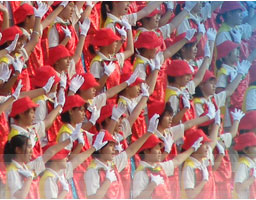
http://rexcurry.net/peoples-action-party-pap-singapore-nazi-salute.jpg

to continue reading...


Wage Hike For Filipino Maids In Singapore Seen As Unlikely

The Philippine government's call for 400-US- dollar monthly salaries for maids overseas is unlikely to have any impact in Singapore, maid agents said Thursday.

Wages in the city-state are determined by market forces, agents told The Straits Times. There is no government-to-government agreement on the issue.

Maids from the Philippines earn 330 dollars to 350 dollars a month.

Half of the 160,000 maids in Singapore are Filipinos. Domestic workers from Indonesia, the second-largest source of maids, are paid far less, along with Sri Lankans.

A Philippine Embassy official told the newspaper that the "reform package" also requires maids going overseas to be at least 23 years old, up from 21. It calls for hiking salaries to 400 dollars from a 200-dollar minimum implemented in the 1970s.

Taiwan and Hong Kong are abiding by the new rules, he said.

"It's high time for a salary increase," he noted, but acknowledged that the new policies will be difficult to enforce in Singapore.

The city-state's Ministry of Manpower maintains that there is no minimum wage for foreign domestic workers. Terms and conditions are negotiated individually between workers and employers.

Filipinos working overseas sent home more than 10.7 billion US dollars in 2005, equal to 12 per cent of their country's gross domestic product, the report said.

© 2007 DPA


to comment

Singapore court rejects Far Eastern Economic Review's bid to have defamation suit dropped

The Associated Press
Thursday, February 22, 2007
SINGAPORE: The Far Eastern Economic Review has failed to convince a Singapore court to throw out defamation lawsuits filed against it by two of the Southeast Asian city-state's leaders, the magazine's lawyer said Thursday.

Review Publishing Company Ltd. and Hugo Restall, the Review's editor, were sued for defamation by Singaporean Prime Minister Lee Hsien Loong and his father, Lee Kuan Yew, in August last year over an article about a prominent Singapore opposition activist.

Peter Low, the two defendants' lawyer in Singapore, said they had sought to question the authority of the city-state to hear the lawsuits, but were rejected in a judgment issued Wednesday. Low declined to comment further, saying he was awaiting instructions from his clients.

Because the Review is a Hong-Kong-based monthly which does not have any employees in Singapore, the defendants challenged the right of the Singapore court to enforce damages outside of the city-state, as well as the way the Lees served their legal papers on the two parties overseas.

Judicial Commissioner Sundaresh Menon turned down the magazine's appeal, writing in his judgment that it was clear that the Lees were limiting their claim for damages to Singapore and that the legal papers had been served on the magazine in an appropriate manner.

In the Review article that the Lees say defamed them, Restall wrote about the opposition Singapore Democratic Party's secretary general Chee Soon Juan's campaign for more democratic freedoms in the tightly controlled city-state and how the ruling party has sued a number of opposition politicians.

Singapore's government later banned the Review, which has more than 1,000 subscribers in Singapore, because it did not appoint a legal representative and pay a 200,000 Singapore dollar (US$126,150; €99,430) security bond — new requirements that are unrelated to the lawsuit, but that the Review has called unjustified.

Singapore's leaders have drawn criticism over several successful defamation suits in past years against journalists and political opponents. The leaders say they have sued to defend their personal and professional reputations.


to comment


21 Feb 2007

SINGAPORE: Portrait book's nudity 'excessive'


Book featuring near-nude celebrity photpgraphs banned while Communication and the Arts Minister Lee Boon Yang says he will continue to revise censorship rules

Straits Times
Saturday, February 17, 2007


A photography book that featured near-nude images of celebrities was banned here because it exceeded the current content standards for publications.

Information, Communications and the Arts Minister Lee Boon Yang said the Public Consultative Panel, made up of members of the public, agreed that the book Superstars -- by Singapore photographer Leslie Kee -- should not be allowed to be sold here.

to continue reading...

Date Posted: 2/17/2007


20 Feb 2007

THAILAND: Singapore asks for explanation over satellite row

From ABC

Thai's coup leader is involved in a row with Singapore over the sale of Thai satellites to a government-owned Singapore company. Singapore's foreign ministry has asked for a diplomatic explanation from the Thais.
Presenter - Karon Snowdon, Speaker - Robert Broadfoot, managing director, Political and Economic Risk Consultancy


listen via windows media

SNOWDON: The Head of the Thai army, coup leader and political king maker, General Sonthi wants to get Thailand's satellites back.

They're the assets of the Shin Corporation satellite subsidiary.

They were sold off last year to the Singapore government's investment company Temasek as part of a controversial multi-billion dollar sale by the Thaksin family.

General Sonthi says the satellites are national assets and should be returned to Thailand.

Managing Director of Hong Kong based Political and Economic Risk Consultancy, Robert Broadfoot.

BROADFOOT: So that's why it's even more important because the comments are by the military which has put the government in place.
Read the rest of the transcript


Wacko Creationist Indoctrination Footage

Something to give you nightmares...


What does Singapore Permanent Residency mean to a Filipino?

Culture Shiok!

One known reason (if it's not the main reason) of why Filipino workers take Singapore Permanent Residency (PR) is security. If an employment pass (EP) holder leaves the company, the EP is canceled and he must leave Singapore unless employment with another company.

This was addressed when the Singapore government introduced the Personal Employment Pass (PEP) scheme. The new PEP allow the holder is not tied to the employer and will be granted on the holder's individual merits. The PEP allows the holder to remain in Singapore for up to six months in between jobs to evaluate new employment opportunities.

But for a Filipino who has become as "kiasu" (Singlish, afraid to loose) as a Singaporean, this is not secured enough. Changing jobs in Singapore won't be that easy and there's always the risk of being rejected when you apply for an EP.

to continue reading...


Journalism in Singapore

From Holland Village Voice

Losing Faith of the Printed Word

I just spent the past hour and a half watching a BBC documentary on Tehran, and somehow what struck me was the spirit of journalism, both of the BBC journalist and the journalists in Tehran. If Prof. Mahbubani said journalists have a tough job in Singapore, I suppose he was not speaking in relative terms to Iran. Yet the Iranian journalists seem to display tenacity and passion I don't sense from reading the Straits Times. But I'm making an unfair comparison because those Iranian journalists featured probably didn't work for the equivalent of the ST.

In the documentary Rageh Omaar said that despite being news-obsessed, Iranians were "losing faith of the printed word." They browse newspapers but don't buy them. They have the fourth largest blogging community in the world, and Iranians are increasingly turning to Satellite TV and the Internet.

Perhaps the reason why Holland Village Voice started out as a novel modeled after Kundera's is because I deeply feel and fear that media freedom in Singapore is an illusion. I felt compelled to speak in riddles, as Kundera did.

The documentary makes me feel we don't stand very far from where Iran is in terms of media freedom. We have to paraphrase issues in euphemistic ways, and that is if we're allowed to talk openly about them. Bloggers are ok, so long as they do not attract too much attention. An Iranian film had to be censored extensively before it could be screened locally, but went on to win at International Film Festivals - sounds familiar to Singapore?

Journalists, documentary makers, filmmakers, visual artists have a central part in our world, because they communicate to us and remind us what we should be doing to progress our world.


Watch the video documentary


to continue reading...

16 Feb 2007

A relationship built on sand

Below are extracts from an article by Bill Guerin who has managed to take a step back from Singapore's and in particluar Temasek's ongoing financial dealings with its neighbours. The Peoples Action Party has often stated that no opposition party would be capable of running the economy and financial investments as well as they have been doing for the last thirty plus years. The rise to economic dominance in South East Asia was a majestic climb but now that the Peoples Action Party has reached a plateux they seem to be incapable of investing in their neighbours without causing a political stink. So just how great a job have the PAP been doing over the last few years.

JAKARTA - Singapore's aggressive regional investment strategy has already taken bilateral relations with Thailand to an all-time low, but a rising tide of economic nationalism and unresolved extradition issues with neighboring Indonesia potentially represents a more crucial test for the island state's economic diplomacy. [...]


The Peoples Action Party will of course point the finger of blame not at their own party but that of the allegedly independent Temasek in order to defuse allegations that they are somehow mismanaging investments. This seems to be the current line of response in the Thaksin Shin Corp deal, but with the land-reclamation programme and its need for sand imported from Indonesia, such a defence is redundant. I am in no way buying the party line that Temasek is a separate 'business entity', but in this particular case the Peoples Action Party have less of a 'deniabililty' position to fall back on. The land reclamation project is an initiative undertaken and promoted by the Singaporean government. The Indonesian government has banned such sand exports to Singapore as leverage in negotiations over a planned extradition treaty.

Controversy over Singapore's land-reclamation projects, which entail huge imports of foreign sand and soil, represent the latest spat in a historically prickly bilateral relationship - one that is coming under increasing strain that threatens Singapore's Indonesia-based investments. [...]

The two sides have been negotiating the issue [extradition treaty]on and off for more than three decades, although the issue became particularly heated after the 1997-98 Asian financial crisis, when a number of ethnic-Chinese Indonesian businessmen absconded with huge amounts of cash they allegedly illegally deposited in Singaporean bank accounts.


Singapore's drive to be the Switzerland of South East Asia is built on the very premise that the accounts are easy to set up and the money placed in them is done so on a 'no-questions-asked' basis. Of course it attracts money gained through corruption or other questionable means. That's the whole point of running a 'Switzerland' style banking system. The problem for Singapore and the People's Action Party is that in doing it with money in South East Asia which has such a wide and visible lack of social equality it is 'theft'. According to Andy Xie "Actually, Singapore’s success came mainly from being the money laundering center for corrupt Indonesian businessmen and government officials." So until the extradition treaty is drawn up and it includes provisions to include economic crime the situation and antagonism between the two nations will remain.

to continue reading...

Secret Life of Brian (Python Doc')


48 minutes
Documentary examining how Monty Python's seminal 1979 comedy Life of Brian caused such a global furore amongst religious groups, who saw the film as blasphemous. Featuring exclusive interviews with John Cleese, Michael Palin, Terry Jones an
d Terry Gilliam, the Pythons reflect on the concept and making of the film and discuss the obstacles overcame. Given the uproar it created over 25 years ago, the programme also asks whether the film could have been made in today's political
climate.