A veteran opposition figure in Singapore says he will continue to fight the system put in place by the ruling People's Action Party if he returns to Parliament.
J. B. Jeyarentam has announced he plans contest upcoming elections in the city-state if his bid to get out of bankruptcy succeeds.
The former leader of the Workers' Party says he can now pay off his debts worth hundreds of thousands of dollars, incurred after he was sued for defaming leaders of Singapore's ruling party.
But he says if the bankruptcy is anulled, other opposition groups may not share his approach.
"Ever since I went into parliament I've been talking about the system. And the others, even my own party, the present leadership, and even when I was there the leaders under me, they seemed quite happy with the system. The Singapore Democratic Party, they don't make too much complaints about the system, they're quite happy to work within the system that the PAP have put in place, but I am not" he said.
ABC Asia Pacific TV / Radio Australia
8 Mar 2006
A political comeback for opposition politician in Singapore


Protesters demand Singapore pullout
 By David Ogan 8 March 2006 11:54
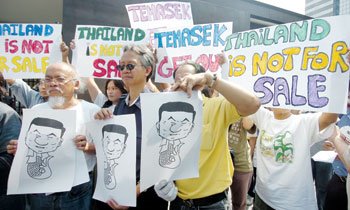
Protesters hold banners at the demonstration outside the Singaporean embassy yesterday.
The anti-Thaksin Shinawatra alliance launched its “urban guerilla warfare” campaign yesterday by demonstrating outside the Singaporean embassy and calling on the city state to annul Temasek Holdings’ purchase of Shin Corporation.
A leader of the People’s Alliance for Democracy (PAD), Somsak Kosaisuk, led a small protest outside the embassy on Sathon Road yesterday afternoon and handed over a letter addressed to Singapore Prime Minister Lee Hsien Loong stating that the deal represented a serious threat to Thailand’s national security and would damage good relations between the two countries.
Essentially, the letter stated that Shin Corp owns various national concessions in telecommunications, satellites, airlines and television and that Thaksin may have abused the law to benefit his family.
PAD demanded that Temasek Holdings, a Singapore state enterprise, disclose details of the contract and stop the deal going through, or face a large-scale boycott of Singaporean products and services in Thailand.
“The secretary of the Singaporean ambassador accepted our letter and promised to send it quickly to his government,” Somsak told ThaiDay.
“We also told him that we would come back again on Thursday en masse to receive their answer.”
The protest outside the embassy was the first in a series of planned “guerilla warfare” tactics that will continue daily, culminating in a mass march on Government House next Tuesday while the Cabinet is in session.
“We are adapting our strategies and will utilize urban guerilla warfare tactics. We will divide our forces to target the power base of the Shinawatra family,” Suriyasai Katasila, a founding member of PAD, told ThaiDay.
“These venues include the Stock Exchange of Thailand, the Revenue Department and the Shinawatra Building. We will be holding daily activities until we march on Government House.”
This morning, a female workers’ group is scheduled to march from the Royal Plaza to Government House to demand Thaksin’s resignation, according to Suriyasai.
Somsak added that at 9am on Thursday, 5,000 protesters will march from Lumphini Park to the Singaporean embassy.
“We will ask for their answer,” he said.
In justification for their actions, Suriyasai said that it was a matter of national security.
“The Shin Corp sale represents a threat to national security, particularly in the case of satellites,” he said.
“If Shin Corp decides at some point in the future to move the ThaiCom 4 control station to Singapore then it will affect the safety of our country.”
Suriyasai added that details of other planned marches had not yet been finalized, adding that they would be worked out on a daily basis.
“We decided to monitor the situation daily before making any move. But all the little moves will culminate in the march on Government House on March 14.”
Pian Yongnu, president of the Metropolitan Electric Authority Union and a leading PAD member, told ThaiDay that various state enterprise workers’ groups plan to join Tuesday’s march on Government House.
“We will meet with other groups within the State Enterprise Labor Relations Confederation this week and expect there will be up to 100,000 state enterprise workers joining the march on Government House,” Pian said.
Protesters Rally At Singapore Embassy in Thailand
Boycott! It's in fashion
---
---
BANGKOK (Dow Jones)--A group of protesters rallied Tuesday in front of the Singapore Embassy in Bangkok, demanding that Temasek Holdings Pte. Ltd. (TEMAH.YY) pull out of its takeover of Thailand's Shin Corp. PCL (SHIN.TH) or face a boycott of all Shin products and services, The Nation reported Wednesday.
About 50 activists from the People's Alliance for Democracy, which has led rallies against Prime Minister Thaksin Shinawatra in the past few weeks, also submitted a letter to a senior embassy official.
The letter, addressed to Singapore's Prime Minister Lee Hsien Loong, called on Temasek to nullify the Shin deal by Thursday, citing a threat to Thailand's national security, the report said.
Temasek's units, Cedar Holdings and Aspen Holdings, bought a 49% stake in Shin Corp. from the family of Thaksin in late January. The sale sparked anti-Thaksin sentiment as many critics said the deal lacked transparency.
Cedar and Aspen are making a public tender for the remaining shares of Shin.
Thursday is the last day of the tender offer and the deadline for Temasek to alter the terms of its public tender if it concludes there are factors that could significantly damage Shin's status and assets, according to the Nation.
Law Society Rejects Chee's Allegations Against Judiciary
SINGAPORE : The Law Society has responded to allegations by the Secretary-General of the Singapore Democratic Party, Chee Soon Juan, that Singapore's judiciary is not independent in its rulings, especially when they involve opposition politicians.
Dr Chee was charged over these accusations and had asked the Law Society to weigh in.
He made these comments during a bankruptcy hearing.
Responding on Tuesday, the society's president Philip Jeyaretnam rejected these allegations, saying its members' daily experiences in the courts assured it of the judiciary's independence.
He added the Law Society is duty-bound to uphold the rule of law.
That meant it would condemn incursions on judicial independence.
It also means it would condemn unfounded allegations against the judiciary, whether as a whole or as individuals. - CNA /ct
Joining hands to Condemn Censorship of Blogs in Pakistan

LAUNCHED BY THE ALVI-E TEAM (Awab Alvi & Omer Alvie) on March 3rd 2006, this is an online campaign to support free speech of Pakistani bloggers and internet free speech in general. Support our cause by copying the banner code (below) to your web site.
Over the past few days, Pakistani Bloggers’ Freedom of Speech has been under attack by some, if not all, Internet Service Providers (ISPs) who has chosen to block all blogs hosted on the blogspot.com domain. Political pressure groups have protested to the government to block those web sites displaying the controversial cartoon images of Prophet Muhammed (PBUH) that were hosted on the net. But instead of blocking specific sites, ISPs have simply blacklisted the entire domain, causing thousands of blogs to be inaccessible for viewing or authoring in Pakistan.
News Reports Appearing Globally Fighting for the Cause
The News - (Ethan Casey - www.ethancasey.com)
Reporters Without Borders
Global Voices Online
We as Pakstani Bloggers object to this action and would like to request you to join in our cause and display either one of the banners condemning this action and appealing for an immediate change.
7 Mar 2006
Contempt case: Chee asks Law Society to step in
Singapore Democrats Party
OPPOSITION politician Chee Soon Juan has asked the Law Society to weigh in on his contempt of court case.
The secretary-general of the Singapore Democratic Party has been charged over his accusations that the Singapore judiciary is not independent in its rulings, especially when they involve opposition politicians.
Yesterday, in an open letter to Law Society president Philip Jeyaretnam, Chee said he stood by his comments.
'My statements are not fiction but borne out from my own dealings with the judicial system in my lawsuit and, more important, substantiated by previous cases in Singapore as well as assessments of reputable organisations and individuals well versed with law and jurisprudence from around the world.'
Chee had made the offending remarks on Feb 10 during a hearing that declared him a bankrupt, after he failed to pay $500,000 in court-awarded damages to Senior Minister Goh Chok Tong and Minister Mentor Lee Kuan Yew.
The ministers had sued Chee for defamation because of allegations he made during the 2001 General Election.
In the letter, Chee also reiterated his statement in court to the effect that Mr Francis Seow, a former solicitor-general, had also criticised the judiciary for lacking independence.
'Whichever position it takes, I hope that the Law Society, given the important role the organisation plays in this country, will not assume the stance of the proverbial ostrich with its head in the sand,' he wrote.
S'pore says SE Asian nations may have to distance themselves from Myanmar
From Singapore Window
Associated Press
March 3, 2006
SINGAPORE
Associated Press
March 3, 2006
SINGAPORE
SINGAPORE'S foreign minister said the Association of Southeast Asian Nations, or ASEAN, may have to distance itself from Myanmar if the military junta does not keep the bloc in the loop over moves toward democracy.
But George Yeo ruled out expelling the military-ruled nation from the 10-member bloc during a speech to Parliament Thursday, Mar 2.
"I think we will have to distance ourselves a bit if it is not possible for them to engage us in a way which we find necessary to defend them internationally," Yeo said.
The United States and European countries have complained that ASEAN has done little to force the pace of democracy in Myanmar, where pro-democracy leader Aung San Suu Kyi is under house arrest and hundreds of dissidents are jailed.
Yeo said it was becoming increasingly difficult for ASEAN to defend Myanmar at the United Nations and other international forums because Myanmar's internal developments were sometimes a "mystery" to the group.
He noted the decision to shift the seat of government from Yangon to Pyinmana, which Yeo described as "sudden" and "bizarre."
Myanmar officials announced in November the government was moving to a new administrative capital about 400 kilometers (250 miles) north of Yangon, called Pyinmana.
Yeo said he expected some "hard decisions" to be made on ASEAN's approach toward Myanmar at a ministerial meeting in Bali, Indonesia on April 17-18.
"If Myanmar needs time out to attend to its own domestic pre-occupations, I think we should respect it, but, at the same time, the rest of ASEAN should not be held back," he said, without elaborating.
Death penalty's unlikely victim

The Standard
Globalization throws up some odd linkages. Take, for instance, the connection between these two events: a young man is executed by hanging in Changi Prison after being convicted of drug trafficking; a few hours later, an international jet lifts off from Sydney airport chock- full of passengers on a lucrative daily flight to Los Angeles.
James Rose
Monday, March 06, 2006
What's the link? Well, no one's admitting it, but a line can be traced between the execution of Australian citizen Nguyen Tuong Van - known in Australia as Van Nguyen - on December 2 last year, and the decision by the Australian government last week to thwart Singapore Airlines' attempts to get access to the Sydney-LA route.
It looks like Singapore Airlines has become another, possibly innocent, victim of the death penalty.
The major clue to this is the fairly lame reasoning offered by Australian Transport Minister Warren Truss in announcing the decision to cut SIA from access to the trans-Pacific route.
The minister explained that he wanted to give locally owned, low-cost operator Virgin Blue time to establish itself on the route.
He admitted this was some years away, but he argued Virgin's cost cutting credentials will provide better competition to Qantas and United, the only two to have access to the Pacific run.
Even a cursory glance over the issue suggests there is more to it than this.
The minister, a member of the pro- rural National Party, which is in a coalition government with the ruling Liberals, is an experienced cabinet player, having been on the front bench since 1997. He would have been well aware of the politics of his decision.
When Nguyen was put on death row in March 2004, few Australians raised an eyebrow.
However, as the hanging loomed and the Australian media ramped up its coverage, the issue captured the public's attention.
During October, November and into December, it was arguably the lead story in the Australian media.
The issue split the country down the middle. In November, 2004 a poll recorded that 47 percent of Australian agreed with the execution, while 46 percent disagreed. Australia ceased executions in 1973, with the last in 1967.
As the execution loomed, those numbers seemed to move further away from supporting the death penalty for Nguyen. Twelfth-hour entreaties by the Australian government, human rights advocates, lawyers and the man's family were met with what many Australians saw to be intransigence bordering on inhumanity by the Singaporean government. No leeway, no clemency was seen to be given.
On its own merit, therefore, the issue is red hot. But there is even more heat being applied.
The Howard government is suffering the indignity of being up to its neck in an inquiry into the AWB oil- for-food scandal.
The government was pressured to initiate the investigation following claims made in the Volcker report into kickbacks to the regime of Saddam Hussein during the oil-for-food program run by the United Nations to offset damage being done by sanctions following Iraq's invasion of Kuwait in the early 1990s.
AWB - the former government- run wheat exporting authority which was deregulated in 1999 - was named in the report as being the largest payer of off-record payments to Saddam's cronies of all the 2600 individuals and organizations named, to secure access to Iraq's massive wheat market.
So, in the context of the SIA decision, the government has to ensure it is not entering into agreements with companies and regimes which are seen, rightly or wrongly, to be representing values somehow counter to the mainstream views of the average Australian. The politics would be too pointed.
The purchase of a majority interest in major Australian telecommunications company C&W Optus by Singtel in 2001 was met with outcry by many lobby groups and advocates.
However, the same government passed the sale, despite the fact that Optus holds the license for some 70 percent of the Australian defense force's satellite communications infrastructure.
That decision seemed a lot more weighty and carried heavier implications. Now, clearly, the stakes are higher and the politics more advanced.
Assuming the link between politics and business has been made then, notwithstanding denials from the Australian government, the question is raised: is this appropriate?
One way of looking at this is to note that it happens all the time. Australia is attempting to rescue its trade relations with post-Saddam Iraq, which has refused to deal with AWB until the inquiry is complete and appropriate measures taken. It is clearly a linking of moral foundations underlying the political superstructure and the myriad exigencies of business.
But, at a deeper level, even the widespread presence of a practice does not suggest its appropriateness. One way of looking into this further is as an extension of the stakeholder concept.
This orbits a belief in the fact that all organizations have an impact on a number of often disparate social environments and individuals. The stakeholder ideal is that large organizations are open to dialogue with such groups to ensure their impact on them, and to ensure the counter impact issue groups can have on organizations is minimized.
Under this ideal, the Australian government's decision is absolutely correct as it has deduced that broadly defined Australian values may be crossed by the entry into the local market of an organization that a substantial number of Australians consider to be owned by a demonstrably immoral government.
It has therefore protected the interests of its stakeholders and upheld the moral constitution the government is obliged to maintain.
While many Australians might be duly dubious about the Australian government's balance between protecting stakeholder interests and the bald realities of politics - past actions suggest the latter motivation has held sway - many Australians would no doubt agree with the government's apparent view that Australia just can't do new deals with Singapore in the current context.
Business has tried for centuries to remain separate from considerations of morality and values. For much of this time, it has managed do to so.
But today's world is more integrated, aware, and mobilized. Like it or not, that disconnect has a limited future. If the Singapore government is not swayed by the ethical arguments surrounding the death penalty, then perhaps the potential loss of business opportunities in the future might focus the minds of legislators to rid themselves of what many see as an ugly and ill- conceived policy, out of place in an advanced society.
It would be well-advised to remember that the death penalty creates many victims, some of them unwitting.
James Rose is an Australia-based business commentator specializing in corporate responsibility issues in Asia
Singapore Plans Audacious New Twisting Bridge
Yup. Singapore is off to clinch another first.
---
SINGAPORE unveiled an audacious plan to build a helix-shaped bridge that will link a massive new tourist development, including a giant Ferris wheel and casino complex on reclaimed land.
The bridge, which will cost around S$68 million, is believed to be the world's first to resemble the structure of DNA, the genetic material.
Singapore aims to double visitor arrivals to 17 million and triple tourism receipts to S$30 billion by 2015 with new projects such as two planned casino-resorts and a 170-meter high (558 feet) Ferris wheel.
The nearby resort island of Sentosa is also being developed.
Tourism is one of the biggest service industries in the city-state of 4.4 million people, generating more than 5 percent of gross domestic product.
The government said construction of the bridge, consisting of a six-lane motorway and six-metre wide pedestrian walkway, will begin at the end of the year and is targeted for completion in 2009.
---
SINGAPORE unveiled an audacious plan to build a helix-shaped bridge that will link a massive new tourist development, including a giant Ferris wheel and casino complex on reclaimed land.
The bridge, which will cost around S$68 million, is believed to be the world's first to resemble the structure of DNA, the genetic material.
Singapore aims to double visitor arrivals to 17 million and triple tourism receipts to S$30 billion by 2015 with new projects such as two planned casino-resorts and a 170-meter high (558 feet) Ferris wheel.
The nearby resort island of Sentosa is also being developed.
Tourism is one of the biggest service industries in the city-state of 4.4 million people, generating more than 5 percent of gross domestic product.
The government said construction of the bridge, consisting of a six-lane motorway and six-metre wide pedestrian walkway, will begin at the end of the year and is targeted for completion in 2009.
A Singapore Documentary with a Sound Bite
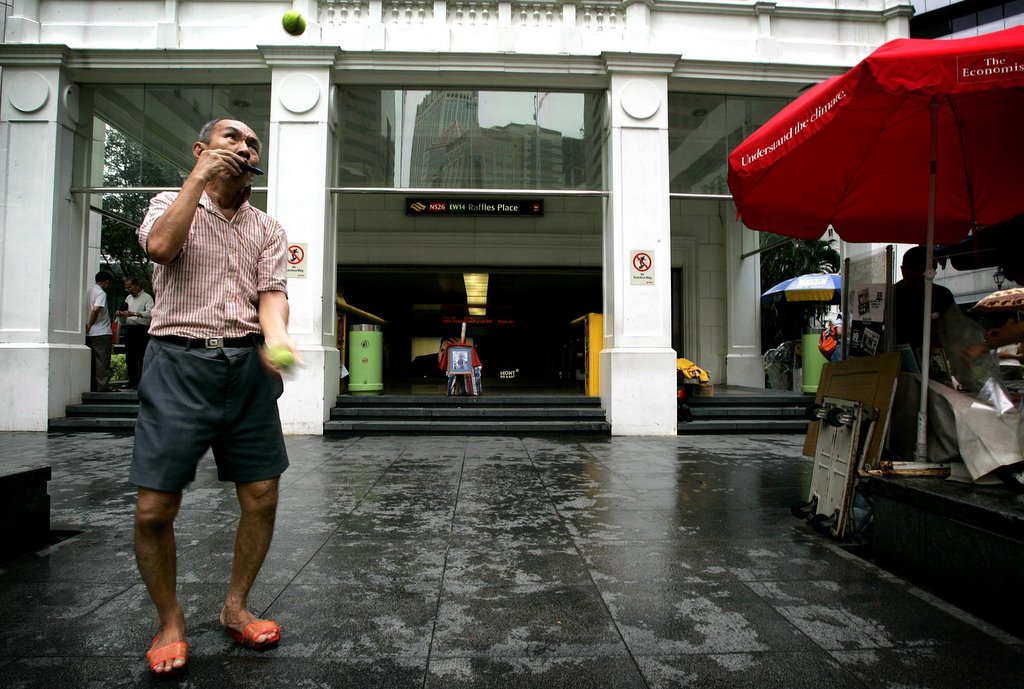
A heartfelt Singapore documentary that can either pass off as a tribute to the unsung heroes who entertain us with their sounds or music in some of the most inconspicuous places; or a thinly veiled sarcastic dig at the socio-political climate of an authoritarian contemporary society, Singapore GaGa succeeds by being a palate of sound clips that speaks to everyone.
It is the oft-unseen story of the lives of the minorities, outcasts or characters from the fringe of our society. Whether be it the madrasahs school girls in their tudungs (headscarves) belting out cheerleading tunes in Arabic or English during their sports day or Ying, the old man who does a wonderful rendition of tap dancing, juggling and playing the harmonica simultaneously at MRT stations, these Singaporeans continue their endeavours and unconsciously created their individual identity and what it means to be a Singaporean.
The documentary also poses pyscho-social dilemmas of being a citizen. In Margaret Leng Tan's performance of 4”33 at the HDB (government housing) void deck in which the audience is confronted with the clash of voices within our heads and the sounds of our environment, Pin Pin deftly juxtapose a shot of the MRT train door closing announcement with passengers staring blankly into space to contrast the idea of sounds.
In other instances, Pin Pin films the maker of sounds from an older and forgotten generation. We are witness to the dialect news report that caters to the elderly Singaporean Chinese. The famous ventriloquist, Victor Khoo, who has entertained children in his performances with Charlee lamented that they have yet to receive a national award despite all their years of bringing laughter to kids. Yew Hong Chow, a skilled harmonica player tells the story of how the musical instrument was sidelined.
In short, Tan Pin Pin's Singapore GaGa is one of those few Singapore films that is uniquely Singaporean; yet with a global appeal that will bring a smile to most audiences with a receptive listening sense.
---
Singapore GaGa will open at the Arts House, 11 March – 16 April 2006.
Showtimes: Every Wednesday, Saturday and Sunday
$8, $6 (Students with ID)
Ticket Hotline:6332 6919
Official website:singaporegaga.com
---
Subscribe to:
Posts (Atom)