3 Nov 2005

On Sentencing

Here is an excerpt from a letter in the Straits Times Forum today:

Nov 3, 2005
Laws shouldn't be too far off global standards

A MAN punched a lawyer in front of a judge and was sentenced to six years in jail. When he appealed to the High Court, another four years were added to his sentence, a decision which was later reversed.

A shoplifter was jailed for 11 years.

Drug traffickers caught with as little as 15g of heroin are sentenced to death. According to Amnesty International, since 1991, 400 people have been hanged, mostly for drug trafficking.

Singapore is known for its strong emphasis on law and order. However, one cannot help but feel that something is amiss in the way court sentences are sometimes meted
out.


Sentencing is a complex topic. The general public doesn't understand it. What often happens is that people read newspaper articles and compare those brief little reports of court cases. Then they are amazed or outraged that Mr so-&-so received such a heavy sentence for what appears to be a minor crime, while another Mr so-&-so received such a light sentence for what appears to be a serious crime.

In fact, when imposing sentences, the courts regularly take into account a wide range of factors which the press doesn't tell you about (due to lack of space, the journalist's own ignorance or simply because those factors aren't considered newsworthy). Let's take a look at the three examples. A caveat - I personally don't know anything about these cases and have not even read the previous newspaper articles about them. I speak generally on the law of sentencing, using these three examples to illustrate.

A shoplifter was jailed for 11 years. This seems to be an extraordinarily heavy sentence for shoplifting. In fact, if this person was sentenced under the ordinary provisions of the law relating to shoplifting, he could not have been sentenced to 11 years (that is well above the legal maximum sentence for shoplifting). What has happened here is that the person has been punished under a separate regime. It is either "corrective training" or "preventive detention" - a set of laws under the Criminal Procedure Code.

What is corrective training? What is preventive detention? Well, it means that you have committed crimes more than once. You are a repeat offender. You keep committing crimes again and again. So finally the law tells you, "One last chance. You've already had lots of chances. The next time you think of committing a crime again, no matter how minor, just remember that due to all your past convictions, you now legally qualify for corrective training or preventive detention. That means you can get a heavy sentence even for a minor offence." The man is released. He promptly commits a crime again. So he gets 11 years.

How about the 15 g of heroin - isn't that very, very little? Like a pinchful of powder between your forefinger and thumb. Well, not exactly. 15 g, in Singapore law, refers to the net weight of heroin, not the gross weight. Think of an orange. One average orange contains about 70 mg, or 0.07 grammes of Vitamin C. To get 15g of pure Vitamin C, you need about 214 oranges - that's plenty, plenty of oranges. Most of an orange is just water, vegetative membrane, fibre and so on.

Heroin, (in the form that is illegally sold), is similarly impure. The purity level varies, of course. To get 15g of pure heroin, you probably need a plastic packet as large as the average 3-in-1 instant Nescafe coffee packet. I'm not referring to the 3-in-1 Nescafe sachet. I'm referring to the kind of Nescafe packet which holds 40 or 50 sachets of instant coffee inside.

How about the man who punched the lawyer? I'm not quite sure about this. The brief mention in the ST Forum doesn't tell me enough. Firstly it should not be possible for the sentence to be imposed, then revised, then revised again. That's because the Singapore system allows for one appeal only. In other words, the sentence can be imposed, then revised, but typically there would be no further route for a second revision (or for that matter, a second upholding - i.e a "no change" decision). If someone can tell me more about this case, I'll comment further.

Now - what is my real point? Do I mean to say that actually, our judges are perfect and sentencing in our courts is perfectly rational? Nope. In fact, few things in the criminal legal system of any country are less "rationalisable" than sentencing. Unlike certain other aspects of the law, sentencing can never be a pure logical exercise. Right at its heart are a rash of unresolvable equations. Here are a few to think about:

How large a fine = one day's imprisonment?

How many days of imprisonment = one stroke of the cane?

How many years of imprisonment = one death sentence?

How large a fine for a rich man = how large a fine for a poor man?

How many molests = one rape?

How many shoplifting offences = one violent robbery?

As Mr Wang once put it, it is like comparing apples and oranges and rambutans. Check out his lucid exposition in the comments section of this post.

Now obviously sentencing is not really as arbitrary and impossible as I may have made it out to be, in this post. After all, sentencing has had a long time to work itself out. Over the past century, a complex set of legal principles and rules has developed to guide sentencing in the Singapore courts. The system is not perfect - it never will be, there are too many dynamic variables - but it's not as amazingly strange and incomprehensible as you might think. The point is that these legal principles and rules are quite intricate, quite complicated, and you really wouldn't understand the topic very well unless you have the opportunity to delve into it. In the meantime, the judges will have to go on judging.

If you asked me what I would change about the system if I could .... I would need to write a thesis, maybe two. There are too many things. Yet anything I propose is, after all, just one man's opinion - eminently fallible. In another life, perhaps ...

Amnesty's death row campaign draws record response

Report initially appeared on ABC news online.
Amnesty International says Australians are responding in record numbers to its campaign to save a Melbourne man sentenced to death in Singapore.

Van Nguyen, 25, has been convicted of heroin smuggling and could be executed within weeks.

Prime Minister John Howard says the Federal Government has done all it can.

But Tim Goodwin, from Amnesty International, says the fight is far from over.

"We're also getting a lot of support from the broader Australian community as well," he said.

"People are contacting us, they're logging onto our website, they're phoning us in record numbers asking us what they can do to actually voice their protest and take a stand for basic human rights in this case."

But Mr Goodwin concedes it is a major challenge to try to convince Singapore's Government to change its mind.

"They do have a very tough record, a very brutal record of carrying out executions and we're very aware of that but at the same time we're not going to give up on this case," he said.

"While ever he's still alive we're going to keep campaigning, keep raising awareness of this issue and the fundamental violation that actually is the death penalty."

2 Nov 2005

The birth of the gender vision

The original article was not particularly relevant to Singapore, save this paragraph where it quotes Singapore laws.

Adopted in 1979 by the General Assembly of the United Nations, the Convention on the Elimination of All Forms of Discrimination Against Women (CEDAW) – the most far-reaching international commitment of governments working for gender equality – was the first international human rights instrument to explicitly define all forms of discrimination against women as fundamental human rights violations. As of April 2005, 180 states have ratified CEDAW, interpreting their treaty obligations in diverse ways ranging from reluctance to active incorporation.

This, I can say, is old news.

States that ratify the treaty are obliged to implement CEDAW’s principles in their domestic context. Upon ratification, they are allowed to enter “reservations” to single provisions of the treaty, as long as these are not incompatible with the Convention’s object and purpose. A global monitoring mechanism requires states to report every four years on their progress and enter into a ‘constructive dialogue’ with the CEDAW committee – twenty-three experts of ‘high moral standing’ representing the world regions. In a nutshell, the Convention is an ambitious instrument with regard to content, while being non-coercive in its enforcement mechanisms.
As of April 2005, a remarkable 180 states had ratified CEDAW with only eleven UN member-states not being a party to it – the USA being the single exception amongst developed countries. Overall, those who signed up show a limited commitment, combined with increasing respect for the Convention. The majority of the states parties do not comply with the duty to submit periodic reports to the CEDAW committee every four years, making it difficult to establish a continuous monitoring process. However, where the committee has received regular reports it has almost always noted improvement. State institutions undergo a learning process, so that those delegations engaged in dialogue with the committee tend to be better prepared, franker and more aware of the complexity of their obligations.However, roughly 20 percent of states parties have entered reservations that are incompatible with the Convention, usually not withdrawing them even if consistently urged by the committee to do so. For example, Singapore states:

In the context of Singapore's multi-racial and multi-religious society and need to respect the freedom of minorities to practice their religious and personal laws, the Republic of Singapore reserves the right not to apply the provisions of articles 2 and 16 where compliance with these provisions would be contrary to their religious and personal laws.

This nullifies the Convention’s provision to grant equal rights and duties for men and women in matters regarding marriage and the family – one of the areas where equal rights for women are most necessary. Another group comprising less than 10 percent of states parties has overtly expressed disapproval with the fundamental reservations of other states, though this symbolic protest has had little effect.

The birth of gender vision Susanne Zwingel - openDemocracy

A particular pet peeve I harbour is how religion is used to justify discrimination, usually against women.

Where do we draw the line between observing one's cultural and religious practices, and the issue of personal freedom and equal rights? Isn't granting everyone their religious rights a form of granting equal rights in itself? So why a freedom, granted in the name of equality, being used to suppress equality for another disadvantaged section of the public? There is a glaring contradiction here, but few people seem to be able to see it.


,

Planned training center for maids draws protests

Tb. Arie Rukmantara, The Jakarta Post/Jakarta

Activists and labor exporters dismissed on Tuesday a plan by a Singaporean company to establish a training center for maids in Indonesia, saying it would largely serve the interests of employers rather than Indonesian overseas workers.

Such a center would only commercialize its training programs and would therefore impose more financial burden on Indonesian maids wanting to work overseas, said Wijaksana, an activist of Jurnal Perempuan -- a non-governmental organization that advocates the rights of women domestic workers.

"The training center would merely focus on improving skills but avoid talking about the risks of working abroad," he told The Jakarta Post.

Nor would the planned center provide adequate information on workers' protection and safety, he added.

A Singaporean company, Homemaker, had announced its plan to set up schools in Indonesia and the Philippines to prepare "custom-trained maids" before they took jobs in the city state.

"We want maids with the right attitude and aptitude," Alvin Kor, director of the firm, told The Straits Times as reported by DPA.

The company said it would open a center in Jakarta next month and in the Philippines in January 2006.

The maids will spend two months at the center learning about housekeeping and looking after infants and the elderly. They will also learn safety tips and how to handle chemicals.

According to the company, Indonesia and the Philippines are the primary sources of the 160,000 domestic helpers in Singapore. Others come from Thailand, Sri Lanka and India.

The plan came amid reports of local training centers that are ineffective in improving the skills of its maids. This has partly been blamed for the problems they encounter overseas.

Saleh Al Waini, who chairs the advisory board of the Association of Indonesian Labor Recruitment Companies, accused the Singaporean company of trying to take over the job of training from domestic firms.

"We have a large number of such centers here. Why do they (Homemaker) need to teach skills that we already train people in?" he told the Post.

Saleh suggested that Singaporean labor recruitment companies focus more on efforts to ensure clear salary mechanisms and scrap recruitment fees imposed on Indonesian domestic workers.

"They should abolish discriminative treatment in terms of salaries, as Indonesian workers are paid less than their Philippine counterparts. They have also to start forcing Singaporean employers to pay the recruitment fees as practiced in Malaysia," he said.

Wijaksana said he was worried that the training center would charge prospective maids to pay for its overhead costs.

"This kind of center should be free of charge. It should not charge any operational costs to migrant domestic workers because they already spend millions of rupiah to arrange their work documents," he said.

Indonesian domestic migrant workers pay millions of rupiah for passports, work permits, training fees and various illegal fees to be able to work abroad.

Despite the high costs imposed on them, many often return home without any earnings. Some have even lost their lives or ended up in prison.

Nguyen could be spared, argues Singaporean lawyer

Transcript
This is a transcript from The World Today. The program is broadcast around Australia at 12:10pm on ABC Local Radio.

You can also listen to the story in REAL AUDIO and WINDOWS MEDIA and MP3 formats.


The World Today
- Wednesday, 2 November , 2005 12:30:00
Reporter: Eleanor Hall
ELEANOR HALL: A Singaporean lawyer who's acted for two death row prisoners says while diplomatic channels have now closed for the Australian drug trafficker Van Nguyen, there is still hope he can be spared execution through a legal appeal.

Mr M Ravi, a human rights lawyer who made Singapore's death penalty a front-page issue when he represented a Singaporean athlete on death row, says while Van Nguyen has only about 10 days to go before he's likely to be executed, that is time enough to lodge the appeal.

And Mr Ravi says if it's successful, the case could overthrow the death penalty in Singapore altogether.

He spoke to me from Singapore earlier today.

ELEANOR HALL: Mr Ravi, do you think the Australian Government has done all it can to try to save Van Nguyen?

M RAVI: I think the Australian Government has tried its utmost at this point, but from now they have to realise that, and also the Australian public must realise that diplomatic channel has come to a dead-end, and we are looking at a prospective execution from the two cases I dealt with before – 11th of November must be the cut-off date that they must look at. There must be some timeframe they have to work, because execution takes place three weeks from the last date where announcement is made on the rejection of the clemency.

But what is important right now is to exhaust other avenues that are available. One, the legal avenues are not closed. In particular, I would like to cite that the Court of Appeal in Van's case, the court said that it is now open to an accused to show through experts and international law that a mandatory death sentence is cruel and inhuman punishment under customary international law. Therefore, there is light on this path, and this commentary was taken from one of the eminent former High Court judicial commissioner, as well as a senior counsel.

The Court of Appeal has said very clearly that if you can show through international law that mandatory death sentence is cruel and inhuman, we will have judicial discretion and stave off the execution.

ELEANOR HALL: So what do you think the Australian Government should be doing in this light then?

M RAVI: What the Australian Government should do is that… ask what they can do is that to appeal to his advanced counsel to instruct the counsel in Singapore – and I am prepared to do this matter pro-bono, that I've always done – or any other lawyers whom they think deem fit to canvas this point.

So therefore, there's a resumé and case law have already developed in this point, and this can be canvassed before the court. In fact, that could be a first case of, you know, the first case to begin and end to the death penalty in Singapore. There's a brilliant window of opportunity opened there. I don't know why the lawyers are not using this.

ELEANOR HALL: Now, you've also made your own appeal to the President of Singapore. You raise the case of a British man extradited to Singapore from Australia. Why is this case relevant?

M RAVI: This case is relevant because what we have been arguing for in Singapore is the courts should have judicial discretion, you know, in death sentences.

You know, in this instance, in particular, that executive discretion had been exercised, ie. the Singapore Government even before the case had commenced in the court, I mean McCrea's case of…

ELEANOR HALL: This is the British man?

M RAVI: British man, British national, who was resident or illegal immigrant in Australia, the Singapore Government had given an undertaking that they will grant basically clemency, even before the case had gone to the courts, and even before the clemency had been formally submitted. If they could give executive discretion could be exercised, why are they, why the same is not applied to Van? Therefore, he is prejudicially treated.

ELEANOR HALL: Now, what response have you received from the President to your appeal?

M RAVI: The President has not written to me, and the last two occasions when I've written similar petitions to the President, the President has just one-liner say that, you know, we do not accede to your request, full-stop.

ELEANOR HALL: If the President has so far not responded, what course of action will you now take?

M RAVI: What I would like the Australian community to do right now is to approach United Nations and file a complaint with the UN rapporteur for extra-judicial and summary executions, and asking the Singapore Government – the UN can ask the Singapore Government to stave off the execution, pending an inquiry into this matter, before it's too late.

ELEANOR HALL: Why would the Singaporean Government listen to Australia or any other member of the international community making that point, when its argument is that it weighs the rights of the prisoner against the rights of the Singaporean community?

M RAVI: Because there is already a movement forward towards this process, and given the fact that Caribbean lawyers from London have gone into Commonwealth countries and abolished death penalty through this kind of legal arguments and all that, why don't we look at all these avenues?

Of course, this is normal process should be exhausted. But what is very important is the other avenues, which seemingly seems to not to get addressed by the Australian media or the Australian Government. I don't understand why.

ELEANOR HALL: Now, you've acted for two death row prisoners…

M RAVI: Right.

ELEANOR HALL: … What's it like for these people waiting on death row?

M RAVI: Ah… it's um, extremely excruciating an experience, because in particular the fact that the last day of the week they will give a letter on the Monday saying that, you know, from Tuesday to Thursday, preceding the execution on Friday that you can visit, you know, from nine o'clock to five o'clock, and also the letter also has a line that says that please make the funeral arrangements, necessary funeral arrangements on Friday, failing which the state will conduct its state funeral.

So having that letter and receiving it in a very nonchalant or blasé way the prison authorities usually treat these matters, so having taken that and going and visiting the prisoners, it's very, very inhumane and very painful.

ELEANOR HALL: Now, Mr Ravi, at this stage, how do you rate the Australian prisoner Van Nguyen's chances of survival?

M RAVI: Diplomatic channels are completely closed at this moment. It's come to a dead-end. One has not, one must not delude oneself. I think if all the other avenues that I have stated, the legal avenues as well as the International Court of Justice, as well as the United Nations process, should kick off, and if this kicks off, I think he has a good chance, I would say.

ELEANOR HALL: And that's Singaporean human rights lawyer, Mr M Ravi.

Rosa Parks, 92, Founding Symbol of Civil Rights Movement, Dies

Rosa Parks, 92, Founding Symbol of Civil Rights Movement, Dies
New York Times
October 25, 2005

Rosa Parks, a black seamstress whose refusal to relinquish her seat to a white man on the city bus in Montgomery, Ala, almost 50 years ago grew into a mythic event that helped touch off the civil rights movement of the 1950's and 1960's, died yesterday at her home in Detroit. She was 92 years old.

Her death was confirmed by Dennis W. Archer, the former mayor of Detroit.

For her act of defiance, Mrs Parks was arrested, convicted of violating the segregation laws and fined $10, plus $4 in court fees. In response, blacks in Montgomery boycotted the buses for nearly 13 months while mounting a successful Supreme Court challenge to the Jim Crow law that enforced their second-class status on the public bus system.

The events that began on that bus in the winter of 1955 captivated the nation and transformed a 26-year-old preacher named Martin Luther King Jr into a major civil rights leader. It was Dr King, the new pastor of the Dexter Avenue Baptist Church, who was drafted to head the Montgomery Improvement Association, the organization formed to direct the nascent civil rights struggle.

"Mrs Parks' arrest was the precipitating factor rather than the cause of the protest." Dr King wrote in his 1958 book, "Stride Towards Freedom. "The cause lay deep in the record of similar injustices."

Her act of civil disobedience, what seems a simple gesture of defiance so many years later, was in fact a dangerous, even reckless move in the 1950's Alabama. In refusing to move, she risked legal sanction and perhaps even physical harm, but she also set into motion somthing far beyond the control of the city authorities. Mrs Parks clarified for people far beyond Montgomery the cruelty and humiliation inherent in the laws and customs of segregation.

That moment in the Cleveland Avenue bus also turned a very private woman into a reluctant symbol and torchbearer in the quest for racial equality and of a movement that became increasingly organized and sophisticated in making demands and getting results.

.................

On Montgomery buses, the first four rows were reserved for whites. The rear was for blacks, who made up more than 75 percent of the bus system's riders. Blacks could sit in the middle rows until those seats were needed by whites. Then the blacks had to move to seats in the rear, stand or, if there was no room, leave the bus. Even getting on the bus presented hurdles: If whites were already sitting in the front, blacks could board to pay the fare but then they had to disembark and re-enter through the rear door.

For years blacks had complained, and Mrs. Parks was no exception. "My resisting being mistreated on the bus did not begin with that particular arrest," she said. "I did a lot of walking in Montgomery."

After a confrontation in 1943, a driver named James Blake ejected Mrs. Parks from his bus. As fate would have it, he was driving the Cleveland Avenue bus on Dec. 1, 1955. He demanded that four blacks give up their seats in the middle section so a lone white man could sit. Three of them complied.

Recalling the incident for "Eyes on the Prize," a 1987 public television series on the civil rights movement, Mrs. Parks said: "When he saw me still sitting, he asked if I was going to stand up and I said, 'No, I'm not.' And he said, 'Well, if you don't stand up, I'm going to have to call the police and have you arrested.' I said, 'You may do that.' "

Her arrest was the answer to prayers for the Women's Political Council, which was set up in 1946 in response to the mistreatment of black bus riders, and for E. D. Nixon, a leading advocate of equality for blacks in Montgomery.

...............

While Mr. Nixon met with lawyers and preachers to plan an assault on the Jim Crow laws, the women's council distributed 35,000 copies of a handbill that urged blacks to boycott the buses on Monday, Dec. 5, the day of Mrs. Parks's trial.

"Don't ride the buses to work, to town, to school, or anywhere on Monday," the leaflet said.

...............

The boycott lasted 381 days, and in that period many blacks were harassed and arrested on flimsy excuses. Churches and houses, including those of Dr. King and Mr. Nixon, were dynamited.

Finally, on Nov. 13, 1956, in Browder v. Gayle, the Supreme Court outlawed segregation on buses. The court order arrived in Montgomery on Dec. 20; the boycott ended the next day. But the violence escalated: snipers fired into buses as well as Dr. King's home, and bombs were tossed into churches and into the homes of ministers.


I was wondering how come there wasn't any mention of Mrs Parks' death in the many blogs or political parties which clamour for civil rights. Though Mrs Parks was protesting against the cruel laws and customs of segregation, it was nonetheless a quest for civil rights for freedom, equality and dignity.

Mrs Parks was a courageous lady who refused to be treated as anything less than a full human being. She also carried out her act of civil disobedience all by herself and even persevered in the face of threat of being arrested.

As one of the very few people whose actions or conduct changed the face of a nation, Mrs Parks deserves to be remembered by us, esp those championing for civil rights.

1 Nov 2005

Sedition by the numbers

3 down, 1 more to go

Usedbrainsforsale, my fellow writer at Singabloodypore, reports the capitulation in court of the third blogger to be charged with sedition (for posting racist remarks online) in Singapore.

As xenoboysg (another fellow SBP writer) points out, we are witnessing an incredibly efficient legal process at work: the machinery of the state moves on relentlessly, crushing all miscreants in its way. This is not hyperbole, by the way.

Even the token arch-conservative member of SBP - marked by his espousal of the doctrine of police infallibility and dedication to a strong crime and punishment style towards our polis, is awed by how the state has handled the trial of the bloggers. The judge, prosecutor, and defense attorney assigned to the case are top-notch pillars of the legal community. Judge Bala used to be the most senior deputy public prosecutors persecutors around, with his hardline stance - a stance which Mr Wang neglects to inform readers, may have continued in his tenure as a judge. The prosecutor for the case is Jaswant Singh, a "top guy" in the attorney-general's office. On defence was Edmond Pereira, an ex-judge and DPP.

Mr Wang is convinced that with the best of the crop involved in this case, justice will be impeccably served. Trust these men, he seems to say. Be assured that whatever sentence is meted out will be fair, just, and legal.

Now, all these blogging trials are remarkable. They involve young men shooting off their mouths online and having their politically incorrect remarks read by people who weren't expected to read them. This crime is of such national, political and racial important that it warrants the mobilisation of the Big Guns. Or, you could look at the identities of the judge, prosecutor, defense lawyer and say that they were impeccably selected to ensure a very entertaining and informative show trial. Propaganda through the courts.

So: 3 down, 1 to go.

The Internets problem

Also, gay dating websites with members-only galleries like www.sgboy.com and www.fluffboy.com were fined and shut down respectively. Despite fluffboy being hosted overseas...

Some political bloggers in Singapore have quietly stopped updating their sites, or completely changed the focus content. This is not to say that they can feel what may be in store soon: a political website and blogger(s) being made an example of, under the Political Broadcasts act. Their fear is overstated - the point about the sedition trials is Singapore has passed the age where the state can, with impunity, charge people who are really seditious (spies, traitors, guerillas) with sedition. We are reduced to having people who are nowhere seditious to be hammered with the sedition law. By the same reasoning, the upcoming shutdown of a select few political blogs will not affect any real political blogs.

It's not about racial harmony, promotion of undesirable lifestyles, or political punditry by ordinary citizens. It's about the internets.

No really, it's about the internets

Singapore has an efficient legal system where judges, DPPs and the police will pounce on any criminal and process his case swiftly finish him off.

I want to know why no sedition act was thrown at the following people for making certain racist, antireligious, and misogynistic remarks that were much more offensive and shocking, in view of their status as national leaders and the very public avenues their remarks, which have caused popular condemnation or moral outrage in their time:

Former MP Choo Wee Khiang, in 1992, made a speech to Parliament "One evening, I drove to Little India and it was pitch dark but not because there was no light, but because there were too many Indians around."

Then-Brigadier General (Reservist) and cabinet minister Lee Hsien Loong, in February 1987, clarified in Parliament the reason behind the non-existence of Malay figher pilots: The Government saw armed conflict with Malaysia as a possibility when he defended the policy of taking limited number of Malays into the SAF (Singapore Armed Forces) and then not placing them in militarily critical roles. Minilee argued that the policy was intended to avoid dividing soldiers' loyalties between their nation and their religion. [The Pacific Review Vol. 4, No. 3] (Minilee leaves it to us to decide whether Malays cannot be trusted to defend Singapore because of their race or their religion.)

Then-Senior Minister Lee Kuan Yew, in September 1999, remarked in the "Tanjong Pagar Singapore 21" public consultative forum reiterated that Malays cannot be trusted to defend Singapore in stronger terms than Minilee: "If, for instance, you put in a Malay officer who's very religious and who has family ties in Malaysia in charge of a machine gun unit, that's a very tricky business. We've got to know his background."

As a prime minister, Lee Kuan Yew in December 1967 gave a lecture to the nation's top students at the Premier Institute for Social Engineering on the superior glands of the Chinese race (reported by Michael D. Barr, Journal of Contemporary Asia v29, n2 (1999). The lecture began with an anecdote: "Three women were brought to the Singapore General Hospital, each in the same condition and needing a blood transfusion. The first, a Southeast Asian was given the transfusion but died a few hours later. The second, a South Asian was also given a transfusion but died a few days later. The third, an East Asian, was given a transfusion and survived. That is the X factor in development."

Remarkable racism, and very public racism at that.

Note that the text in the Sedition Act do not specify race as a basis to identify groups that are clearly offended and divided from the state by a sedious remark. How about sex/gender as a group?

1990. Senior Minister Lee Kuan Yew, on a tour of Australia, expressed his regrets about extending higher education and equal rights to women. (Facts on File: Asian Political Alamanac, p387) "The government was young, ignorant, and idealistic," said Lee. In 1986, Lee Kuan Yew mentioned that it was "wrong, it was stupid" to introduce monogamy.

It is certainly my belief that the current crop of seditious bloggers being tried is a testament to the dictum that leaders aren't subject to the same laws they impose on their followers. There are lots of people online who defend the prosecution of the 4 racist bloggers as necessary, legal, and just. Where are they when our leaders shoot their mouths off?

Petition taken to Singapore commission

From seven.com.au
Date: 01/11/05

Singapore's most senior official in Australia has accepted "with both hands" a petition from parliamentarians pleading with his government to save the life of an Australian man on death row.

Government and opposition MPs on Tuesday presented Singapore High Commissioner Joseph Koh with petitions from more than 100 parliamentarians and 300 parliamentary staff calling for the life of 25-year-old Melbourne man Nguyen Tuong Van to be spared.

Nguyen was caught trafficking heroin in 2002 and faces execution in Singapore, possibly as early as November 11, after losing a clemency appeal last month.

Liberal MP Bruce Baird and Labor MP Laurie Ferguson, both members of the Amnesty International Australia parliamentary group, took the petitions to the Singapore High Commission and met Mr Koh.

"We emphasised the case of Mr Van Nguyen himself, just saying a young guy, first time overseas, who did a foolish thing that should not be punished in terms of the death penalty," Mr Baird told reporters outside the commission in Canberra.

"We asked him to think of the boy's mother and the family and the impact it would have.

"We emphasised also that the representation was bi-partisan representation - over 400 signatures and more would be coming through to them.

"He certainly indicated that he took its significance on board and he could understand why we felt that way and he said 'I take the petition with both hands'."

On Monday in parliament, both sides of politics united to support a motion put by Opposition Leader Kim Beazley asking the Singapore government to spare Nguyen's life.

Mr Koh also met Nguyen's lawyer, Lex Lasry, QC, on Monday.

Mr Baird maintains there is still hope for Nguyen.

"There's always hope," he said.

Singapore not ashamed of low rank for press freedom

A lesson in how to take criticism and completely ignore it and continue on regardless. The so called journalists working on The Straits Jacket should be embarrassed though. What does he mean - develop a non-adversarial press, it already exists. As for claiming that the RSF report is based on a subjective western liberal prism, has anyone actually looked at their methodology. I never realised Goh had a PhD in Research Methodology.

I actually think that the ruling elite of men in white do favour a subserviant and unthinking press...

Saying something then doing and condoning the opposite tends to give the game away.

Tue Nov 1, 2005 4:46 AM GMT

SINGAPORE (Reuters) - Singapore should not be embarrassed by its lowly ranking on the international press freedom index because it has achieved top ratings for economic freedom and prosperity, its senior minister said.

Defending the city-state's model of press control, former prime minister Goh Chok Tong said the country should not subscribe to the Western model of a free press that favours criticism and opposition.

Instead, Singapore should develop a non-adversarial press that reported accurately and objectively.

"I do not favour a subservient press. An unthinking press is not good for Singapore. But press freedom must be practised with a larger sense of responsibility and the ability to understand what is in, or not in, our national interests," Goh said late on Monday, at the anniversary dinner of the Today newspaper.

Goh's comments come a week after an annual index produced by Reporters Sans Frontieres, a Paris-based media monitoring group, ranked Singapore 140th out of 167 countries -- up four notches from last year but still faring worse than tightly governed states such as Russia and Yemen.

In a report accompanying the publication of the latest index, Reporters San Frontieres (RSF) said Singapore's low ranking was due to the complete absence of independent media, the application of prison sentences for press offences, media self-censorship and the opposition's lack of access to state media.

The report also cited instances where the government used heavy fines or distribution bans on international newspapers such as the Asian Wall Street Journal, the Economist and the International Herald Tribune to "silence Singaporeans or foreign journalists" who wrote articles that embarrassed the political elite.

Goh said the RSF report was a "subjective measure computed through the prism of Western liberals".

He cited other surveys such as the Transparency International Index and the US-Based Heritage Foundation's Economic Freedom Index, in which Singapore received top ratings.

"My simple point is this: it has not been proven that having more press freedom would result in a clean and efficient government or economic freedom and prosperity," Goh said.

Singapore is known for heavy-handed censorship in the media and arts, largely enforced through a system of issuing publication and performance licences.

Run by the People's Action Party for 40 years, Singapore often gets top marks for its sound economic policies but lags other Asian countries when it comes to freedom of expression.

Last month, outgoing U.S. ambassador Franklin L. Lavin slammed the city-state's curbs on freedom of speech. In the same month, Warwick University dropped plans to set up a campus in Singapore because of concerns about academic freedom.

Graffiti and Dissent

Recently while sitting in front of the goggle box I was struck by a sudden realisation. A while back during the NKF scandal, remember that?, there suddenly appeared in Singapore's clean streets some graffiti pictured here.

This along with the attention the issue was receiving online forced the authorities into action. I have no doubt that the online petition had a major part to play but lets also allow for the possibility that the images in the media had an effect.


Many people view graffiti as nothing other than a blot on the otherwise clean landscape. Others, myself included, feel that it can be an enhancement. When I see graffiti it reminds me that people actually live here. Someone else has summed it up better though.."Imagine a city where graffiti wasn't illegel, a city where everyone could draw where they liked. Where every street was awash with a million colours and little phrases. Where standing at a bus stop was never boring. A city that felt like a living breathing thing which belonged to everyone, not just the estate agents and barons of big business. Imagine a city like that and stop leaning against the wall - its wet."

Sitting in the UK the coming together of the NKF image and protest was brought into close focus by a programme focusing on the highly acclaimed work of Banksy. An example of one piece of work that will probably have the site blocked for subverting the minds of the heterosexual young men of Singapore is included here.

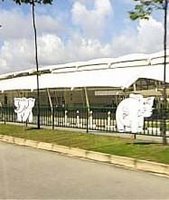
Singapore does have a few places that graffiti appears regularly, in fact I am thinking of one particular place just off Selegie Road, next to an Art and Design College, (you know who you are). The recent white elephants at an unopened MRT station is another example.
It doesn't have to be as stylised as Banksy's work, in fact look the example from American activists from FreeWay Bloggers....


It is a well researched area in my home country and a good place to start for any young sociologist would be the CAIN Web Service.
According to Neil Jarman "The intention of this paper is not to focus on the symbolic content of murals or the developments in their style and form, as this has been dealt with extensively elsewhere (Jarman 1992, 1996a, 1997; Roiston 1991, 1992, 1995a; Woods 1995). Rather I will discuss the ways in which the murals are used as symbolic objects in themselves. Objects which are used and abused, admired and transformed, replaced and defaced and which, while they ultimately physically disappear, will often survive as reproductions, and thereby transcend their context in time and place. "
'Painting Landscapes: the place of murals in the symbolic construction of urban space' by Neil Jarman


Could actually be a rather good undergraduate or postgraduate study to conduct if applied to the Singaporean context. "Political Imagery in Singapore". You have got to start with the 'Men in White' of course.

According to FreeWay Blogger -
Here's how it works:
When you put a sign on the freeway people will read it until someone takes it down.
Depending on its size, content and placement it can be seen by hundreds of thousands of people.