26 Mar 2006

Fridae’s Feeling Good party cancelled. Deja-vu anyone?

This is a duplicate article of the one posted in http://blog.sayoni.com by the same author.

March 25, 2006 (Singapore) – Feelin’ Good, a party organised by gay and lesbian media and events company Fridae, has been cancelled after the venue, Ministry of Sound, received a telephone call from local police on Friday evening demanding that they cease venue provision for the event.

According to Mr. Clement Lee, executive director of Ministry of Sound’s parent company LifeBrandz, Mr Kelvin Yeo, Compliance Management Officer from Tanglin Police called on Friday evening after office hours demanding that the club cancel the event, failing which enforcement officers would come to the club on Sunday to shut the party down. The reason given by the police to Mr. Lee over the telephone was that the party would “promote gay activities.”

Whilst Singapore laws prohibit gay sex, there are no laws against being gay. As recently as 2003, then Prime Minister Goh Chok Tong was interviewed in Time Magazine about the Singapore government’s non-discrimination policy for employment in the civil service, and was quoted saying gays are “just like you and me.”

Singapore has a thriving gay scene that includes more than dozen organisations, bars and establishments catering primarily to a gay or lesbian clientele. Feelin’ Good would have been Fridae’s first party in Singapore in more than a year and a half, featuring popular Australian DJ Kate Monroe.

In response to previous criticism by current Prime Minister Lee Hsien Loong that Fridae’s parties “should not be targeted at gays alone” (December 2004), Feelin’ Good has been actively promoted to the mainstream public through a variety of media, including Lush 99.5FM radio and local publications IS and Juice.

“The reaction from the police has been completely unexpected,” said Dr Stuart Koe, CEO of Fridae. “Feelin’ Good is simply a party, not unlike any party held at clubs all around Singapore. There is no legal justification for what the police has done. This is yet another example of institutionalised discrimination against gays and lesbians.

Fridae regrets the turn of events and will offer full refunds to ticket holders. Please refer to the website www.fridae.com/feelingood for the refund process. We would also like to thank the community and our sponsors for your continued support and understanding.

First off, I would like to say that yours truly hasn't been to a single gay party, pub or club in her entire life. So I am really wondering how the Homosexuals were able to "encourage" me to enter a gay lifestyle. I am sure it has absolutely nothing to do with all those cute girls I was fawning over from young, when I didn't even know that lesbians could get it on.

Secondly, I'd like to offer my condolences to Mr Kelvin Yeo for having been made the national (and international) laughing stock, and having to be the mouthpiece for our darling government who just LOVES to control the lives of its citizens to a tee.

Thirdly, I'd like to tell all the gay citizenry in Singapore: emigrate, darlings. As soon as you can - leave this hell-hole behind, and don't look back. Don't hope for anything from Minilee, or that he is any different from his father.

Maybe what Fridae should do is to organise mass deportation to other countries for all gay and lesbian people - let's see if Minilee steps in and says that it would promote a "gay lifestyle", or is not "in their national interests".

Thai senator expresses concern over Shin Corp sale in letter to PM Lee

Thailand's Chairman of the Senate Committee on Foreign Affairs, Senator Kraisak Choonhavan, has written a letter to Prime Minister Lee Hsien Loong and Speaker of Parliament Abdullah Tarmugi.

He has expressed concern over the potential effect on bilateral relations because of the acquisition of Shin Corp by Temasek Holdings.

The sale of Shin Corp caused massive protests in Thailand with many protesters calling for the resignation of Thai Prime Minister Thaksin Shinawatra over charges of corruption.

In Thailand, protestors have taken to the streets, claiming that the Thaksin family profited through legal loopholes to avoid paying tax.

In his letter to Mr Lee, Senator Kraisak Choonhavan stressed that the relationship between the two countries must not be jeopardised because of a single business transaction.

He said: "The relationship between our two countries must not be jeopardised as a result of a single business transaction, especially since Singapore is respected throughout the international community for her belief in the values of transparency, accountability and good governance."

In his reply on behalf of PM Lee, Singapore's Ambassador to Thailand, Peter Chan said the Republic shared the same concerns over the protests in Thailand.

And said that Singapore's stand is that Temasek and any other Singapore company that invests in Thailand must comply with Thai laws.

He added the government believed this is what Temasek is doing, and it does not expect any special exemptions.

Mr Chan said: "Temasek and any other Singapore company that invests in Thailand must comply with all Thai laws and regulations. That is what we believe Temasek is doing, and we do not expect any special exemptions or privileges for it."

In their replies, Mr Chan and Speaker Mr Abdullah both hoped that Singapore-Thailand relations will continue to strengthen. - CNA/ch

24 Mar 2006

Backlash for Temasek over ‘Singapore imperialism’

By John Burton of The Financial Times
Published: March 24 2006 00:27 Last updated: March 24 2006 00:27

When Thai protesters recently set alight pictures of Ho Ching, chief executive of Temasek Holdings, it was a further indication that the Singapore state investment company was facing growing political problems as it expands across Asia.

The burning of images of Ms Ho and her husband Lee Hsien Loong, the Singapore prime minister, was part of protests in Bangkok over Temasek’s $1.9bn (£1.1bn) purchase of Shin Corp from the family of Thaksin Shinawatra, the Thai prime minister. Demonstrators are angry that the family used legal loopholes to pay no tax on the deal.

But the protests also underscored the fact that Temasek is becoming a target of a nationalist backlash in Asia, with critics raising questions about its close links with the Singapore government and its secretive nature.

Singapore “should adhere strictly to transparency and good governance”, said the People’s Alliance for Democracy, which is leading the Thai protests. It also accused Temasek of “colluding” with Mr Thaksin.

“I’m worried about how this will affect Singapore’s standing in south-east Asia, since Thailand is probably our closest friend in the region,” said a Singapore-based political analyst.

It is not the first time that investments by Temasek and its affiliated companies have been greeted with suspicion.

When Singapore Telecommunications bought Australia’s Optus mobile phone operator in 2001, opponents warned of “Singapore imperialism”.

Indonesian lawmakers are lobbying for Temasek’s ST Telemedia to give up control of Indosat, a mobile phone operator, because they worry about Singapore’s dominance in the local telecoms sector, with SingTel a main shareholder in another mobile operator, Telkomsel.

China decided to halve Temasek’s proposed 10 per cent investment in Bank of China because of concerns about Singapore’s growing influence in the local banking sector. Temasek is the only foreign investor to have stakes in three Chinese banks, including China Construction Bank and China Minsheng Banking.

Temasek has tried to distance itself from the Singapore government in spite of being 100 per cent owned by the Finance Ministry. It describes itself as “an investment company based in Singapore” whose decisions are based solely on commercial criteria. It says associated companies act independently of Temasek in making investment decisions in spite of Temasek being represented on their boards.

But some foreign authorities do not find that explanation persuasive. South Korean regulators this week blocked Singapore’s DBS Bank from buying Korea Exchange Bank because of its links to Temasek, which is the bank’s biggest shareholder.

Temasek is classified in Korea as a non-banking group, barring it from owning more than 10 per cent of a Korean bank. The regulators suggested DBS’s ownership structure meant it was acting on behalf of Temasek, although DBS denies the bank’s management is influenced by Temasek.

India last year vetoed a bid by ST Telemedia to buy a stake in Idea Cellular, a mobile operator, because SingTel already held a interest in Bharti Televentures, the market leader.

Indian law prevents a foreign investor from having big stakes in two telecoms companies. Temasek argued unsuccessfully that SingTel and ST Telemedia were separate entities in spite of having common ownership.

Some critics have seen a political agenda in Temasek’s investments as Singapore seeks to increase its influence in the region. Temasek says there is no government involvement in making deals.

Analysts suggest Temasek could gain greater trust by becoming more open about its operations. But Ms Ho and other Temasek executives have refused to make themselves available for media interviews, which has given rise to an image of secrecy.

“It would be better for Temasek if it engaged the media more actively to allay suspicions,” said Mr Bhaskaran.

Singapore Courts Friends, Wins Enemies

From The Guardian

Singapore's business-minded leaders say they want to be friends with everybody. That makes sense for a tiny island state of 4 million people trying to make a living in a volatile region increasingly dominated by China and India.

But as protests in Thailand against the prime minister, Thaksin Shinawatra, have intensified, Singapore has found itself on the receiving end of a highly unamicable barrage of insults and threats from its large neighbour to the north.

Posters of Singapore's prime minister, Lee Hsien Loong, have been burned in public; the Singaporean embassy in Bangkok has been besieged; and a boycott of the country's products has been urged. Protesters brandish placards saying: "Thailand not for sale" and "Singapore get lost".

Sondhi Limthongkul, a leader of the Thai opposition People's Alliance for Democracy, accused Singapore of "economic imperialism", and warned of serious consequences this week. "If you don't stop, should the Thaksin government change - and he will go down soon - we will make sure that your activities in Thailand go down with him," he said.

Thai anger centres on January's tax-free $1.9bn (£1bn) sale of Shin Corp, a telecoms conglomerate founded by Mr Thaksin and owned by his family, to Temasek Holdings, the Singapore government's state investment arm.

The opposition portrays the deal as a threat to Thai sovereignty and control of key national assets such as satellites. It wants the sale rescinded and allegations of insider dealing investigated as part of its wider campaign to strengthen democracy and public accountability.

But Singaporean officials say the Shin Corp row has nothing to do with them. "Temasek operates like any other company," said Angelina Fernandez of the Monetary Authority of Singapore, the country's central bank. "Even though it is government owned, it is not government directed. The ministry of finance does not tell Temasek what to do."

Lim Hng Kiang, Singapore's minister for trade and industry, said the sale had become enmeshed in domestic Thai politics but admitted the government had been caught on the hop. "Obviously we were surprised," he said. "We didn't expect it would provoke such a reaction." Mr Lim said the opposition's boycott had "not gained traction" and predicted bilateral relations would suffer no lasting harm.

Singapore's hard-nosed brand of free-wheeling, free-market capitalism, and what critics see as a concomitant lack of concern for democratic rights and civil liberties, has caused controversy before. Campaigners say significant Singaporean investment in Burma, which is run by a military junta, undermines UN-led efforts to encourage reform.

And Singapore's enthusiastic pursuit of regional free trade agreements is not wholly shared by some fellow members of the Association of South-East Asian Nations (Asean) concerned at the social and cultural impact of too-rapid economic change. Mr Lim would like to see Asean function as a European-style common market of 500 million people. "Others don't share Singapore's sense of urgency," he said.

Majority-Chinese Singapore's be-friends-with-everybody policy is further complicated by history. The prime minister urged expanded trade with China during a recent visit to Beijing. But the former British colony remains an important western ally that affords naval facilities to the US Pacific fleet, keeps on good terms with Japan, and harbours secret sympathies for Taiwan. As Sino-American strategic competition in Asia hots up, it may eventually be forced to take sides.

Singapore's precociousness has also fuelled regional jealousies, illustrated by a bizarre row with Malaysia (from which it broke away in 1965). Malaysia wants to replace the causeway linking the countries with a bridge. Singapore has not agreed so far. It cites the high costs - but deeper concerns about its "over-bearing" neighbour are also in play.

Impatient at the delay, Malaysia has now decided to build its half of the bridge anyway, regardless of whether it actually leads anywhere. "Singapore is the most insolent neighbour in the world," one Malaysian MP said this week - showing once again that friendly bridge-building is uphill work.

23 Mar 2006

Bubble, Bubble, Toil and Trouble

You Tube Link


Does government control produce a utopian society or an oppressed people?

This fast-paced, music video style documentary explores this through the chewing gum ban in Singapore.


From Final Destiny.

Singapore film-maker says again questioned by police

Tue Mar 21, 12:25 PM ET
Yahoo News


A Singapore film-maker says he has been questioned again by police over his documentary about an opposition politician.

Martyn See told the Foreign Correspondents Association that he was questioned for about 30 minutes on Monday over his short documentary "Singapore Rebel" about Chee Soon Juan, secretary general of the Singapore Democratic Party.

See's "Singapore Rebel" has been classified by local censors as having violated the Films Act because of its political content.

The Films Act bans political advertising using films or videos, as well as movies directed towards any political end such as promoting political parties.

See has not been charged but the maximum penalty for making a political film is two years in jail or a 100,000-dollar (61,850 US) fine.

"It's arbitrary, the way they term a political film, what constitutes a political film," See said. "Until today I've not been told why 'Singapore Rebel' is a political film."

He said he has now been questioned three times by police since last May after he was asked to withdraw the film from the Singapore International Film Festival following the censor's verdict that it was political.

"I think it's a landmark case," said See, 38.

Prime Minister Lee Hsien Loong last September denied backtracking on his promise to encourage political debate in Singapore, saying the trend has been towards opening up.

"But that doesn't mean the laws don't have to be enforced," he said.

Chee, one of Singapore's few opposition politicians, was jailed Friday for an unprecedented eight-day term after questioning the integrity of the judicial system.

It is the first time a Singapore court has jailed anyone for an offense known as "scandalizing the court".

The attorney general lodged the contempt application with the High Court after a February 10 hearing at which Chee was declared bankrupt.

That declaration followed his failure to pay 500,000 Singapore dollars (307,000 US) in damages to the city-state's founding father Lee Kuan Yew -- the current prime minister's father -- and another former prime minister, Goh Chok Tong.

Lee Kuan Yew, Goh and other members of the People's Action Party, which has ruled Singapore since independence in 1965, have a history of taking legal action against their political opponents and media critics. They argue they do so to protect their reputations.

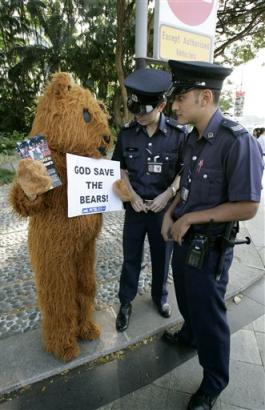
Surreal or Banal Moment for Protests in Singapore?

Originally spotted on Asiapundit and clicked through to bobafett81


Jodi Ruckley, 33, a volunteer with PETA (People for the Ethical Treatment of Animals), drressed as a bear, protesting the use of the palace's Houseguards bearskin hats, struggles with a policeman as she is placed into a police van at the gate of the Istana or Presidential Palace where Britain's Queen Elizabeth II was expected to arrive on Friday March 17, 2006 in Singapore. The queen, who arrived in Singapore late Thursday after completing a five-day visit to Australia, is making her first trip to the city-state in nearly two decades at the invitation of the city-state's President S.R. Nathan.


A policeman questions Jodi Ruckley, 33, a volunteer with PETA (People for the Ethical Treatment of Animals), dressed as a bear, protesting the use of the palace's Houseguards bearskin hats, as she stands at the gate of the Istana or Presidential Palace where Britain's Queen Elizabeth II was expected to arrive on Friday March 17, 2006 in Singapore.

Singapore police detained an Australian animal-rights demonstrator dressed in a bear suit (L) who staged an illegal protest as Queen Elizabeth II started a state visit


Related Article:
Aussie disrupts Queen's Singapore visit

It reminds me of Jeff Koons 1988 sculpture, apart from the notion that the above images are more menacing.

22 Mar 2006

Take 3 for Rebel director

Sign the Petition to END THIS HARASSMENT .

Martyn See questioned about Singapore Rebel again; new film goes to the censors this week

Wednesday • March 22, 2006


Derrick A Paulo of Today
derrick@newstoday,com.sg

IT HAS been 10 months since the police opened the case on Singapore Rebel — a documentary on opposition politician Chee Soon Juan — and its director Martyn See, and investigations are still underway.

On Monday, Mr See was called down to the Police Cantonment Complex for a 30-minute interview to "clarify what (he) had said before" to investigators, the 38-year-old told reporters yesterday, at a luncheon with the Foreign Correspondents Association.

It was the third time he had been questioned about his 26-minute movie on Dr Chee, following a report lodged last year by the Board of Film Censors. The Board believes Singapore Rebel is a party political film, and hence, an offence under the Films Act.

Last August, Mr See was asked to surrender his video camera and tapes of the documentary to the police. On Monday, he asked if he could have his equipment back, but was told he had to wait until the "completion of the case".

The police confirmed that Mr See had been interviewed on Monday, but said that it would not comment any further as the matter was still under investigation.

Mr See's latest venture is a 49-minute feature on former journalist Said Zahari, 78, who had been arrested in 1963 by the Government on suspicion of subversive activities. He was detained for 17 years.

The film, Zahari's 17 Years, may be screened at this year's Singapore International Film Festival (Siff), despite what happened to Singapore Rebel last year.

Siff is sending the film to the censorship board for approval this week. Mr See does not believe that his new film would be considered "party political" as it covers a current event, namely the launch of Mr Said's book next month.

The freelance film editor is considering more such documentaries, including one on Chia Thye Poh, who was detained under the Internal Security Act from 1966 to 1989.

"They're getting old. How many more years do they have to live? And their stories have not been documented," said Mr See.

The film-maker said that he made Singapore Rebel to get people interested in political issues.

If Mr See is charged, however, he faces a maximum penalty of two years in jail or a $100,000 fine for making a party political film.

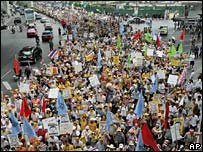
Thais march on Singapore embassy

From the BBC...
Protesters are demanding Mr Thaksin's resignation
Thousands of people have marched on the Singaporean embassy in Bangkok in the latest of a series of protests aimed at ousting the Thai prime minister.
Thaksin Shinawatra's opponents are particularly angry about a tax-free sale of his family's stake in a Thai telecoms giant to a Singapore company.

The latest protest came as Thailand's election chief reportedly said he could not postpone a controversial poll.

Mr Thaksin called the snap election for 2 April in a bid to regain legitimacy.

Election Commission chairman Vasana Puemlarp last week cast doubt on whether the poll could go ahead due to a vow by the main opposition to boycott the election, leading to concerns over whether enough MPs could be returned to fill parliament.

But on Tuesday he told a Bangkok radio station that such a ruling was not within his powers, according to Reuters news agency.

"The law doesn't allow me to set the election date," he reportedly said, adding that only the prime minister could make that decision.

Mr Thaksin is campaigning hard in rural areas

There are particular concerns about the election in two-thirds of the constituencies where the ruling Thai Rak Thai party would be unopposed if the election boycott goes ahead, as candidates need to win 20% of the available vote to be elected.

This could be a problem in the restive south, where the party's unpopularity in the face of a long-running insurgency meant the party did not win a single seat in the last election in February 2005.

On Sunday, the main opposition Democrat Party alleged that Thai Rak Thai officials were involved in a plan to hire candidates to stand for small opposition parties to get round this problem.

The Election Commission has pledged to look into the claims, and on Tuesday said it had ordered the transfer of the three officials in question pending an investigation.

Protests

Traffic came to a halt in Bangkok's commercial district on Tuesday as the marchers moved towards the embassy chanting "Thaksin get out".

"I politely ask Singapore to stop cooperating with Thaksin to loot Thailand," protest leader Sondhi Limthongkul told the crowd, calling the deal "economic imperialism".

Mr Thaksin, who denies any wrongdoing, continued his campaign in rural areas, where he is still popular.

Addressing a crowd in the northern city of Chiang Rai on Monday evening, he criticised the protest leaders.

"They want a new government, but they forget that there is big support for this government," he told a cheering crowd.


See more images of the protests.

Singapore - Least "Dear"

Singapore boasts the lowest business costs of any major industrialised country, according to a new study.

The cost of launching and running a business in Singapore is much lower than in the US, Japan or any major European nation, KPMG found.

This was mainly due to its much lower labour costs, with average wages well below other countries in the study.

France and Italy have overtaken the UK in terms of "cost-competitiveness" since 2004, the study found.

Labour costs key

The bi-annual study - which covers 128 cities in nine countries - is based on the costs of setting up and running businesses across different industries over a 10-year cycle.

The research takes into account key factors such as wages, business taxes, rent, and energy costs.

COST-COMPETITIVENESS LEAGUE
1: Singapore
2: Canada
3: France
4: Netherlands
5: Italy
6: United Kingdom
7: United States
8: Japan
9: Germany
Source: KPMG-2006

Singapore topped the "cost competitiveness" league after being included in the study for the first time.

Average wages there are considerably lower than in the other countries included in the study, despite the fact that Singapore now boasts GDP per capita equivalent to some European countries.

The study concluded that labour costs are the most important factor for businesses when deciding where to locate their operations, followed by the cost of finding and securing premises and taxes.

"What we are really seeing here is the price that the UK is paying for having a successful economy" Ian Barlow, KPMG quotes.

Canada was judged the second most competitive country in terms of business costs. The US came seventh while Germany was deemed the least competitive.

The UK lost its position as the most "cost-effective" European country, falling behind both France and Italy.

Not cheap option

KPMG said wage costs were higher in the UK than in France and Italy, a product of its low employment and its skilled workforce.

"What we are really seeing here is the price that the UK is paying for having a successful economy," KPMG partner Ian Barlow said.

"The UK no longer really markets itself as a low cost option to access the European Union market."

Employer groups have called on the British government to reduce the tax burden on companies in Wednesday's budget.

Ahead of the budget, Chancellor Gordon Brown announced he had asked 12 top business leaders to advise the Treasury on improving the UK's competitiveness.
---
In other words, Singapore is cheap!