27 Oct 2005

Letters from death row


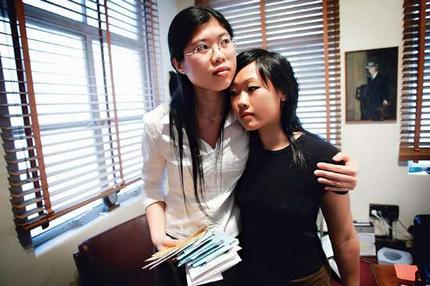
"Something inside him sparkles" ... Kelly Ng, left, and Bronwyn Lew on their friend, Nguyen Tuong Van, who has written to them almost every week from death row.
Photo: Jason South


Let us not allow the Singaporean government to continue ignoring this case. This is not some dehumanised matter of crime statistics and theoretical arguments. Send urgent appeals.

By Steve Butcher and Craig Skehan of smh.com.au
October 27, 2005

"For myself, I only pray for courage," writes Nguyen Tuong Van.

From his cell in Singapore's Changi Prison, the condemned Australian seeks the virtue many say he already possesses.

As his execution looms, Nguyen prays for God to watch over his family and friends, particularly his mother, Kim Nguyen, who collapsed yesterday while speaking to reporters.

Nguyen recently wrote to his close friend, Kelly Ng, that he did not want to die, "but I know where I'm going and I know how much God loves us all".

Intimate fragments of his thoughts in maximum security were released yesterday as an emotional Ms Ng read Nguyen's letters. "I only ask for what I need and not once have I been disappointed, ever," he wrote to her.

"But then, again, I only ask Him to watch over you all and love you all as much as He has loved me. As for myself, I only pray for courage, lest God's will be done."

Last Friday Nguyen, 25, lost his last legal hope of clemency when the President, S. R. Nathan, was advised to refuse his plea.

He was sentenced to death in March last year after being stopped in transit at Changi Airport in December 2002, carrying 396 grams of heroin as he ran to catch a Qantas flight to Melbourne.

Nguyen told police he agreed to act as a courier for a Sydney syndicate to help pay legal debts owed by his twin brother.

As frantic efforts mount to save his life, Ms Ng and another of his close friends, Bronwyn Lew, spoke how "there's just something inside him that just sparkles".

The women, who have visited Nguyen many times since his arrest, revealed how the warders regarded him as the most admired inmate in Changi.

"Everyone is in love with him over there," Ms Lew said.

In a letter written last week, Nguyen tells of the impending execution of his closest friend on death row. He warns the loss of "my dear friend" may affect later letters and how "it breaks my heart because there is only so much I can do for him".

He writes: "He's asked me a long time ago to write his last letter to his family."

Just hours before Nguyen was told last week his clemency had failed, the friend was hanged.

Nguyen had befriended and counselled many prisoners who have been executed in his 19 months on death row.

Both Ms Ng and Ms Lew said Nguyen had the ability to comfort his fellow inmates. Nguyen encouraged Ms Ng last month to "let any emotions out [because] I want you to let them out when I'm here with you."

The Opposition's foreign affairs spokesman, Kevin Rudd, yesterday called for clemency, saying it would be "abhorrent" if Nguyen were hanged.

He made the plea after meeting Singapore's high commissioner, Joseph Koh. "I spoke to him in the most direct terms about our request that the Singaporean cabinet extend an act of clemency to this young Australian man," Mr Rudd said.

"For us in Australia, in the Australian Labor Party, we find all forms of capital punishment abhorrent."

Federal Labor's president, Barry Jones, said yesterday Labor had not done enough to help Nguyen. In a speech in which he urged his party to show more courage, he said: "We seem to have gone quiet on our longstanding rejection of the death penalty, one of our oldest political commitments."

A petition for Nguyen's release has been circulated round the Federal Parliament and Amnesty International has begun a worldwide campaign to save him.

17-year-old blogger pleads guilty to two charges under Sedition Act


First spotted this on Used Brains for Sale.
By Pearl Forss, Channel NewsAsia


SINGAPORE : 17-year-old private school student Gan Huai Shi has pleaded guilty to two charges of making seditious and inflammatory remarks about Muslims on the Internet.

His lawyer hopes the remaining five similar charges can be taken into consideration so he can get a probation sentence instead of a jail term.

Gan is the third person charged under the Sedition Act recently for making racist remarks in his blog.

He made inflammatory comments about Malays and Muslims. He also called himself an "extreme racist."

The defence lawyer said the main reason why Gan had such feelings of ill will towards the Malay community is because of the death of his younger brother when he was only seven years old.

His month-old brother had breathing difficulties and needed to be taken to the hospital in a cab, but a Malay couple refused to let them go first despite his mother's pleas.

By the time the family got to the hospital, his brother was already dead. His mother was subsequently diagnosed with post-natal depression.

Gan's lawyer said as a result of the incident, he became an introvert, spending most of his time on the computer.

Gan's teachers and Malay friends wrote in their testimonials he had never shown any racist tendencies toward them.

One Malay friend, Ismail Kassim who Gan got to know during his part-time work, said he got along well with Gan and often discussed football together.

Defence lawyer Edmond A. Pereira said: "They have all described him as a very quiet person, so none of them knew about his deep sentiments.

"But in front of the computer, he's a different animal. He is extremely remorseful for what he has done and wishes to say sorry to all Singaporeans."

Gan is currently sitting for his 'O' levels which ends on November 22. His case will be heard again the day after.


- CNA /ls

MPs fight to save drug smuggler

The Advertiser
27oct05
NEARLY all Federal MPs and former Prime Minister Malcolm Fraser will plead for convicted Australian heroin smuggler Van Tuong Nguyen to be spared the gallows in Singapore.

A petition addressed to the Singaporean President and Prime Minister is being circulated in Parliament House as part of the save Nguyen campaign.

Nguyen, arrested with just less than 400g of heroin at Changi Airport in December, 2002, may be hanged within weeks.

"I am writing as a member, senator or member of staff of the Australian Parliament to express my concern over the decision not to commute the death sentence which has been imposed on Australian citizen, Mr Van Tuong Nguyen," it says.


Related Link:
Send urgent appeals

Downer: Don't execute Australian

From CNN

CANBERRA, Australia (Reuters) -- The Australian government will make a final plea to Singapore to spare the life of an Australian due to be executed for drug smuggling, Foreign Minister Alexander Downer has said.

Nguyen Tuong Van, 25, was sentenced to death in March 2004 after being convicted for smuggling almost 400 grams (0.9 lb) of heroin from Cambodia. He was arrested at Singapore's Changi Airport in December 2002, where he was in transit for Australia.

The Singapore government last week rejected Nguyen's final plea for clemency, despite intense lobbying from Australia over the past 18 months.

"I think it's worth getting in touch again with the Singapore government, expressing our enormous disappointment at the decision they've made," Downer told reporters.

He said he would ask Singapore to reconsider the death penalty because Nguyen had cooperated fully with police since his arrest, and because he was willing to give evidence against those responsible for drug trafficking.

Australia is a staunch opponent of the death penalty but Singapore, known for its tough stand against crime, mandates the death penalty for murder and drug trafficking.

Singapore has not disclosed the date of Nguyen's execution, but lawyers told Reuters that hangings are usually carried out three weeks after a clemency appeal is rejected.

Nguyen admitted he acted as a drugs courier, but only to help his twin brother pay off the equivalent of $19,000 in debts to loan sharks.

Nguyen's Melbourne-based lawyer, Lex Lasry, and human rights group Amnesty International have condemned the death penalty and called on the Singapore government to reconsider its decision.

"To now hang him in those circumstances, when he has done everything he can to make up for his conduct, is a grievous injustice. It may be tough as far as Singapore is concerned, but it is grossly unfair," Lasry told reporters in Canberra.

Capital punishment in the city-state has long been shrouded in silence, with little public debate about the issue and even less information on how the process is carried out.

"Families are left in a state of complete anxiety and lack of knowledge until very late in the day," said M.Ravi, a lawyer who has handled death penalty cases.

The executions are generally carried out at Changi prison, in the island's leafy eastern suburbs, and take place at the pre-dawn hour of 0600 (2200 GMT) on Fridays.

In a 2004 report Amnesty International said about 400 people had been hanged in Singapore since 1991, mostly for drug trafficking, giving the state of 4.2 million people the highest execution rate in the world relative to its population.

Nguyen will be the first Australian executed for drugs charges since 1993, if the sentence is carried out.

Two other Australians, Mai Cong Thanh, 46, and Nguyen Van Chinh, 45, remain on death row in Vietnam after being convicted for drug smuggling.

26 Oct 2005

Nguyen Tuong Van faces death by hanging

I decided to post this message as the Think Centre article contains a link to the Community of Community of Sant'Egidio website which allows concerned persons to send an urgent appeal to the Singapore government .

Send urgent appeals

Think Centre - 21 October 2005 by Sinapan Samydorai

Think Centre is very disappointed that Nguyen Tuong Van faces death by hanging for a non-violent drug offence. The death penalty for Nguyen Tuong Van is unfair, cruel, inhuman, degrading and disproportionate punishment. It violates the right to life.

Nguyen Tuong Van is facing the death penalty for a non-violent drug offence. Nguyen Tuong Van, an Australian, had plead for clemency from the President of Singapore, Sellapan Ramanathan.

The death peanlty for Nguyen Tuong Van is disproportionate and cruel. Is the death sentence in the case of Nguyen just? Justice has become a victim of a law that provides for the state with a "legal framework to kill a person." Its against both the right to life and the right not to be subjected to cruel, inhuman or degrading treatment.

Death for NGUYEN Tuong Van is disproportionate given the nature of his crime, his youth, lack of criminal history and his opportunity for rehabilitation.

Think Centre opposes the death penalty as a violation of the right to life and the right not to be subjected to cruel, inhuman or degrading treatment, as proclaimed in the Universal Declaration of Human Rights.

Think Centre is very disappointed that Nguyen Tuong Van faces death by hanging. Think Centre had been hoping that the President will commute Nguyen's death penalty. Since 2003, Think Centre has been calling for a moratorium on Death Penalty.

Think Centre urges the President to call for a moratorium on Death Penalty and request the Singapore government seek a more humane way to overcome the problem.

Think centre calls on all concern persons, groups and organisations to light candles and host vigils in the coming weekdays - to remember those on death row, pray for Nguyen Tuong Van, and death penalty victims like Shanmugam. Pray the government, the lawmakers, will respect and consider the call for a moratorium on death penalty. Save the lifes of those on death row.

The Singapore government seems to be unnecessarily cruel without any mercy given to those who have make honest mistake. Why not give the person a second chance? This cruel, inhumane and degrading punishment has to go. The laws that permit such cruel punished has to be amended. Think Centre calls on the government, members of parliament, to abandon the use of the death penalty and seek a more humane way to overcome the problem.

In Singapore, the death penalty by hanging is implemented on Friday morning's. There are at least 8 persons on death row.

25 Oct 2005

University plays down fears about Singapore offshoot

It is a story about playing down fears while at the same time openly admitting that those fears are real and that they exist. Yes the big monster is in the cupboard but lets forget about it and get on with the business of making money. After all that is what our business is... said the university management team.

By Kelly Burke Higher Education Reporter
October 26, 2005

The University of NSW has moved to allay fears about academic freedom and human rights at its planned $200 million-plus Singapore campus.

But university management has conceded it cannot guarantee protection of its academic staff in Singapore, given the city-state's harsh laws governing public comment and defamation.

UNSW is one of only two foreign universities granted special status by the Singaporean Government to set up fully fledged independent teaching and research institutions offering undergraduate degrees.

It expects to open the doors of its Changi campus, to be called UNSW Asia, to up to 15,000 students from early 2007.

Yesterday it said its dean of commerce and economics, Professor Greg Whittred would be the Singapore campus's first president (vice-chancellor).

However, the other overseas institution approved by Singapore, the University of Warwick in England, said last week it would not proceed with a full-scale $354 million university campus because of concerns about academic freedom and financial risk.

According to the student newspaper, the Warwick Boar, the university also had concerns about Singapore's ban on homosexuality and certain religious practices and about possible legal reprisals against academic-related comments "that might be seen as being outside the boundaries of political debate".

Under Singapore law, foreign institutions are not allowed to criticise local politics.

UNSW has already secured a State Government-endorsed bank loan of $113 million for the Singapore campus. But it will also receive about $80 million in capital works funding from the Singapore Government, a figure the university's deputy vice-chancellor (international and development), John Ingleson, has refused to confirm or deny, on the grounds that it is commercial-in-confidence.

Speaking from Singapore yesterday, Professor Ingleson said he had been assured by the Government there that students and academics would enjoy complete academic freedom on campus. [so when is the first edition of 'Gay Rights' due off the presses?]He dismissed concerns raised by the Warwick pull-out, arguing that UNSW had "a more nuanced view of how Singapore and [its] society worked". [Nuanced - Amnesty International, Reporters Without Borders, US State Department... Nuanced]

He conceded, however, that the university would be powerless to protect its academics should they fall foul of the Government over issues of public comment.

"There is no such thing as absolute freedom of speech in any country … in that sense, our staff and our students will be subject … off-campus to the laws of Singapore like anyone else," he said.

Professor Ingleson believed Warwick's decision was based on financial risk rather than concern about academic freedom. [sorry to burst your bubble but it clearly stated fears related to academic freedom]

He said UNSW was not exposed to the same risk as Warwick because the Australian university had closer ties with the region and a more firmly established brand name. [And we have a tighter grip on our academics.]

Singapore's deadly sling


October 25, 2005

The impending execution of Nguyen Tuong Van is a travesty of justice and a failure of diplomacy, writes Mark Baker.

AT DAWN on a Friday soon a young Australian will be taken from his death-row cell in the grey colonial pile of Singapore's Changi Prison, fitted with a hood and noose and dropped to oblivion through a gallows trapdoor. A few hours later his broken body will be handed back to his family.

In the island metropolis to our north, a place that admires itself through a polished veneer of modernity and sophistication, the city-state's brand of justice will be delivered with all the subtlety and compassion of the Middle Ages.

Yet few beyond his family, friends and dogged legal team are likely to mourn the passing of Nguyen Tuong Van, convicted heroin trafficker. As one of his Melbourne lawyers, Julian McMahon, observed despairingly at the weekend, Nguyen is not the kind of pretty young Anglo-Saxon damsel whose distress ignites national indignation.

But there are good reasons Australians should be alarmed and angered by the impending execution of the 25-year-old former Melbourne salesman — and why they should be demanding a much more vigorous response from the Federal Government to the final rejection of his plea for clemency than the limp resignation we are now witnessing from John Howard and Alexander Downer.

In short, Nguyen is to be hanged on a pretext that flouts the principles, if not the letter, of international law, after a flawed trial and after a comprehensive diplomatic snub that makes a mockery of the supposedly close political, defence and business friendship between Singapore and Australia.

Nguyen was arrested at Changi Airport in December 2002 after a routine security check revealed 396 grams of heroin strapped to his body and hidden in his hand luggage. Under Singapore law — the harshest in Asia — anyone found with more than 15 grams of heroin is deemed a trafficker and the mandatory sentence is death.

Canberra's increasing ambivalence about capital punishment surely undermined the credibility of its argument.But the verdict that Nguyen was trafficking into Singapore is a nonsense. He was arrested in the airport transit lounge while preparing to board a plane for the second leg of a journey from Cambodia to Australia. He had not passed through Singapore immigration and he had no intention of entering Singapore. Even neighbouring Malaysia — which has hanged three Australians for drug trafficking since the 1980s — acknowledges a legal distinction between people who formally enter a country and those who are merely in transit (those found with drugs in transit face a relatively modest jail sentence).

Nguyen's lawyers did not pursue this obvious defence because the Singapore courts — which adopt the airs and trappings of their British colonial ancestry but are in practice a deeply politicised law unto themselves — have flatly refused such arguments in the past.

The trial itself and the subsequent failed appeal were also flawed. The judges ignored evidence that might well have brought an acquittal in the Australian courts, or other properly independent jurisdictions.

The Singapore judges ignored evidence that the arresting and investigating police had themselves broken the law by denying Nguyen Australian consular support before he was interrogated, and had failed to secure the evidentiary drugs that showed significant and unexplained variations when weighed at different times. No action was taken against a senior police officer who gave contradictory testimony.

The trial judge also brushed aside a compelling defence argument that mandatory death sentences — which have helped create a world's-worst-practice of 400 people executed in Singapore since the early 1990s — are a violation of international human rights standards.

Singapore's mandatory sentencing regime also meant no consideration could be given to mitigating circumstances or the character of the defendant. And there was plenty that should have been heard.

Born in a refugee camp in Thailand and raised by a struggling single mother in Melbourne, Nguyen was not a drug addict, a drug trader or even an avaricious "mule" for a drug syndicate. Naive and desperate, he was pressured into making the trip to Cambodia to repay substantial debts owed by his twin brother to loan sharks. Nguyen and his family were threatened before he left Australia.

In the end, Singapore's uncompromising policy on mandatory sentencing made a conviction virtually inevitable, but last week's failure of the petition for a presidential pardon — Nguyen's last lifeline — has raised more disturbing issues.

While the Federal Government gave strenuous support to the application for a pardon, including a personal plea by Howard to Prime Minister Lee Hsien Loong during a visit to Singapore earlier this year, Canberra's increasing ambivalence about capital punishment surely undermined the credibility of its argument.

What is left of principle when one day Australia's Government cheers the death penalty for Bali bombers, on another its police assist in sending accused drug runners to face the death penalty abroad and the next it tries to argue against a hanging on humanitarian grounds?

The refusal of a pardon to Nguyen, dictated by the Singapore cabinet, now stands as a stinging diplomatic rebuff to Howard personally and Australia as a whole. And this from a nation that is supposed to be our best friend in South-East Asia and the neighbour with which we have the strongest strategic, commercial and personal links.

The Prime Minister and the Foreign Minister now solemnly shake their heads and lament there is nothing more that can be done. But there is plenty that can be done by Australians who believe state-sanctioned killing — however odious the crime — has no place in a civilised society.

They can boycott Singapore-owned companies such as Optus and Singapore Airlines, they can take their shopping holidays elsewhere, they can protest against the thousands of Singapore military who train on Australian soil and they can start flying to Europe via Bangkok — not a bad idea when a visit to the transit lounge at Changi Airport can finish in a cell at Changi prison.

Mark Baker is opinion editor. He was Asia editor, based in Singapore, from 2001 to 2004 and reported the arrest and trial of Nguyen Tuong Van.

24 Oct 2005

PM downplays hopes for Nguyen clemency

PUTTING THE BLOODY IN TO SINGABLOODYPORE.
I don't like the word 'bloody' being used in the word Singapore. It offends me. Hanging people well that's ok.

From ABC News
Video
The lawyer for young Melbourne man on death row in Singapore has pleaded for the Prime Minister to make a last ditch appeal for mercy, but John Howard does not want to raise false hope.

[Real Broadband] [Real Dialup] [Win Broadband] [Win Dialup]

Prime Minister John Howard says the Federal Government has already done everything it possibly can for Tuong Van Nguyen, who has been sentenced to hang in Singapore for heroin smuggling.

Twenty-five-year-old Nguyen could be hanged within weeks for trying to smuggle 400 grams of heroin in 2002.

On Friday, Singapore's President denied an appeal for clemency for the Melbourne man.

"People have to understand that when you go to another country and commit a crime against the laws of that country, you are punished according to the laws of that country," Mr Howard said.

"I am desperately sorry. If there is anything new then we will put that before the relevant authorities, but if there is nothing new, I don't want to raise false expectations.

Mr Howard has appealed to the lawyers of Nguyen to take any new information to the relevant authorities.

"I feel for the man's family, he did it to help his brother, it was wrong, it was a serious crime," he said.

"He would've known that, but he did it to help his brother. Now I feel for him, as a human being. I don't believe in capital punishment but this is another country - we don't control Singapore."

Foreign Minister Alexander Downer says he will make a final written appeal to his counterpart in Singapore, amid claims that the Australian Government is not doing enough to save the man's life.

"I think it's worth getting in touch again with the Singapore Government expressing our enormous disappointment," Mr Downer said.

However, Mr Downer says he remains very pessimistic about Nguyen's chances of a reprieve.

He says Australian authorities are re-examining police reports in the case but hold little hope.

"I don't think we should mislead the public and suggest that either the Prime Minister or I can really turn this around, I think that is nigh impossible," he said.

Nguyen's lawyer Lex Lasry says there is more the Federal Government can do to try to save his life.

Mr Lasry has praised the Federal Government's efforts to help Nguyen, but says there is still more that could be done.

"I think this is the time, in fact, for them to be doing twice as much as they previously have while he remains alive," he said.


Related Audio
Some time before Christmas, and possibly much sooner, 25-year-old Melbourne man Van Nguyen is likely to be the first Australian prisoner executed overseas since 1993. Today his lawyers asked Prime Minister John Howard to become directly involved. They say it is the only thing that might save his life.

[RealMedia 28k+] [WinMedia 28k+] [MP3]

Although the Federal Government says it has done all it can to help Van Nguyen escape the death penalty, an expert on the Singaporean constitution says there is still some hope for the 25-year-old Australian man.

[RealMedia 28k+] [WinMedia 28k+] [MP3]

Extract for a Related Article from The Age...

A deafening public silence surrounds the imminent execution of an Australian in Singapore.

[...]Many Australians know little of the cruelty surrounding the death penalty. It is almost four decades since anyone was taken to a place of execution in Australia and hanged by the neck until they were dead. This ghastly punishment was finally abolished in Australia in 1984. In 125 years, there were 185 executions in Victoria, just 21 in the 20th century. Singapore has hanged more than 420 people since 1991. These judicial killings have had no perceptible impact on the island's drug problem.

In Australia, both sides of politics profess opposition to the death penalty. Yet there have lately been murmurings tantamount to acquiescence. When the terrorists involved in the 2002 Bali bombings were convicted on capital charges, Prime Minister John Howard pointedly hailed the verdicts, but made no principled plea for clemency. It should surprise no one that such official ambiguity may have helped seal Nguyen's fate. The Government says it will make another last-ditch plea for his life. As long as Nguyen Tuong Van is alive, it must seek with vigour clemency on his behalf, reminding Singapore that the death penalty is barbaric and uncivilised.


More Age Related Links:
Fresh appeal for Singapore clemency
[5:03pm] Australia to provide more information to Singapore in a bid to save condemned Melbourne man's life. more
MPs intensify campaign to save Nguyen
Saving Nguyen Van Tuong: Your Say
Rudd's plea to Singapore
Mother's mercy plea
Death sentence: Vote now

Old formula losing impact in new world

First spotted on Singapore Window.

Star, Malaysia
October 23, 2005


Insight Down South By Seah Chiang Nee

FOR many years, Singaporeans have showed little interest in politics, preferring to leave matters to the government as long as it gives them a good life. The ruling People’s Action Party (PAP) called it “the social compact” and it worked like this: The government has a duty to provide jobs and govern well; if it succeeds, it is the citizens’ duty to vote for it. If it fails, then the people have the right to choose another.

Based on Confucianism, it was enunciated by Lee Kuan Yew and largely supported by the people in the years when Singapore’s economic growth faced few problems.

At the time, the government was superb and it delivered, year after year.

Then the world economy changed with the emergence of China and India, and Singapore began to stagnate and was overtaken by many better-endowed nations.

Globalisation has made it impossible for Prime Minister Lee Hsien Loong to rely on the same “social compact” to rule. No government can guarantee jobs. At the same time, the voters, too, have changed, and so has the PAP.

In recent years as the rich-poor gap widened and unemployment rose, murmurings of hardship by citizens (especially those above 40) have become shriller.

Now that general elections are a year or possibly months away, the political temperature has risen and the government is more willing to crack down on any “threats” to orderliness.

Last week, the political excitement rose by a few degrees when two important foreign commentators joined the debate.

The ambassador of the United States, Singapore’s strategic ally, delivered one of its occasional admonitions against the city-state’s limits on political expression.

In his departure speech, Franklin L. Lavin said governments would pay an increasing price for failing to give citizens freedom of choice and expression. It was posted on the embassy website.

At the same time, one of Britain’s top 10 universities announced it would scrap plans to set up a campus in Singapore because of concerns about academic freedom.

The decision by the University of Warwick council dealt a blow to the city-state’s ambitions to attract more foreign students.

Singapore requires international educational institutions operating in the city-state to agree not to conduct activities seen as interference in domestic affairs. Local universities are also under scrutiny.

Thio Li-ann, a Singapore law professor who drew up an advisory report for Warwick University, had warned “the government will intervene if academic reports cast a negative light on their policies”.

It is the first time that a foreign university has refused to meet government conditions.

Singapore is already home to several foreign campuses, French business school INSEAD, the University of Chicago Graduate School of Business, and the Massachusetts Institute of Technology.

It aims to double the number of international students to 150,000 by 2015 as part of a strategy to reduce its reliance on manufacturing.

Warwick and Australia’s University of New South Wales were the only two foreign universities selected by Singapore’s Economic Development Board to set up a full-scale campus, which can award undergraduate degrees.

But it was the American ambassador’s remarks that raised excitement here.

“Singapore has flourished over the past 40 years, but is a 20th century model adequate for the 21st century?” Lavin asked.

“Remaking (Singapore’s) economy is, in a sense, the easy decision. Shaping a political system to reflect the needs and aspirations of its citizens is more difficult and more sensitive,” he added.

His remarks are not surprising given America’s policies on human rights. Liberal Singaporeans cheer them but PAP supporters find them undiplomatic and interfering.

He said it was surprising to find what he called constraints on discussions given Singapore’s strong international links.

“In this era of weblogs and webcams, how much sense does it make to limit political expression?” Lavin added.

PM Lee recently ruled out adopting a Western liberal democracy with a multi-party system in the next 20 years, saying that it was unsuitable for the country.

Neither the American nor the British message will have any impact on politics here. Nevertheless, it is a blow to Singapore’s ambition to attract global talent to become a great global city.

When he became Prime Minister a little over a year ago, Lee promised a freer, inclusive society, but critics say there has not been any real movement towards it.

On the coming election, Lee said he expected to win a strong mandate although his party could perform less well compared to 2001. People who know him say that he is sincere in wanting to open up gradually.

Some observers say he leads the right place at the wrong time, having taken charge when Singapore is going through a painful transition.

For its long-term survival, the city’s declining domestic population needs desperately to be topped up by a large influx of foreigners, but this is under attack by Singaporeans who have lost jobs.

Lee is sandwiched by two groups of unhappy voters. The biggest are unhappy “heartlanders” in the housing estates who are struggling with a lower standard of living, unemployment and rising costs.

These “bread-and-butter” worriers outnumber the second group: young Singaporeans who want greater personal liberties and a freer press. Online petitions demanding more “human rights” have so far attracted relatively less interest.

The government’s strong point, however, remains its ability to convince the majority of Singaporeans that it can generally govern well and provide efficient services.

This will probably sweep them back into power again.

Singapore Media Manipulates Opinion on Subtle Level

TODAY online reported Singapore’s ranking as 140th, a miserable 7 notch climb from its last year ranking, as if to imply that the media in the country has improved since.

It even claimed that it is only one place behind Philippines, as if our media deserves a pat in the back for being just one place behind one of South East Asia’s more liberal democracy. That is however far from reality.

The media in Philippines played a significant part in bringing down its dictators during the People Power Revolution. The Singapore media is however certainly incapable of doing the same thing if they continue to toe the line. I shall explain in greater detail.

In a separate report on Asia which can be downloaded as a PDF file, the section on Singapore notes,

“Singapore (140th), which has a quite different style, still has a very low ranking because the government headed by the son of founding father Lee Kwan Yew keeps its grip on the media and uses drastic laws to crack down on the few independent journalists.”

Compare that to, “ the complete absence of independent newspapers, radio stations and TV stations, the application of prison sentences for press offences, media self-censorship and the opposition's lack of access to the state media" which was reported on TODAY and extracted from the Singapore Annual Report 2005.

It is obvious that in this case, names are not mentioned. This is something that the local media has always practiced with great nuance. They rarely mention anything negative about the Singapore government or its leaders but is quick to look the other way when it comes to activists or Opposition politicians.

Sure, they do critique the “system” at times. As a general rule however, they never identify the real perpetuators. In this case, those at the top of the hierarchy who denies those press freedom.

The deft touch of rewriting, rephrasing, or omitting out certain details makes it more difficult for the average reader to identify the real source of the problem.

This is what media censorship at its most subtle level can do. F**ing with our mind.

Note: It is not my intention to use the F word for fear of being interpreted as being too vulgar, frivolous or shocking. However, it is also my opinion that replacing it with any other word is in itself practicing a form of self-censorship. The F word is used to convey the seriousness of the manipulations by the local media; and what it can do to us.

For more reports, go to:

Reporters Without Borders - Asia Report 2005

Reporters Without Borders - Singapore Report 2005

TODAY Report on Singapore Press Ranking by Reporters Without Borders:
Singapore 140th in press freedom index
Monday • October 24, 2005

Singapore has inched up seven spots in the 2005 World Press Freedom Index, released on Thursday by international association Reporters Sans Frontieres (RSF).

The Republic is now ranked 140th out of 167 countries, one place behind the Philippines.

Last year, Dr Lee Boon Yang, Minister for Information, Communications and the Arts, slammed the rankings for favouring the press' role of criticism and opposition — a model Singapore does not follow.

RSF noted in this year's index report that Singapore "has a quite different style".

It attributes the country's low ranking to "the complete absence of independent newspapers, radio stations and TV stations, the application of prison sentences for press offences, media self-censorship and the opposition's lack of access to the state media".

The 20-year-old organisation was bleak in its assessment of press freedom in Asia, calling it the toughest continent for journalists.

Once again, North Korea was at the bottom of the rankings, with Nepal, China, Vietnam and Myanmar not much higher up the ladder.

But there are a couple of bright spots.

Indonesia is now ranked 102nd, a jump of 15 places, whilst Malaysia is 113th, up nine rungs.

The latter no longer has any journalists or cyber dissidents in prison and peace accords in Indonesia have opened up the former rebel province of Aceh to journalists, said RSF.

South Korea is the highest-ranked Asian country at the 34th spot.

The mostly Northern European countries of Denmark, Finland, Iceland, Ireland, Netherlands, Norway and Switzerland were once again tied at the top of the rankings.

The United States proved it was no bastion of press freedom through legal moves that undermined the privacy of journalistic sources.

Contributing to this was the imprisonment of New York Times reporter Judith Miller. The move saw the US slip 20 places to number 44 on the list.

One observation made by RSF is that countries that have recently won their independence or have recovered it (within the past 15 years) are "very observant of press freedom and give the lie to the insistence of many authoritarian leaders that democracy takes decades to establish".

It cited nine countries — including ninth-ranked Slovenia and Timor Leste which stands at the 58th position — as part of this group.

As a note to its index, RSF stressed that the rankings "should in no way be taken as an indication of the quality of the press in the countries concerned".

— Derrick A Paulo