The Government's Role in the NKF
In all the hand-wringing and breast-beating by the Government over the NKF issue, Singaporeans must not lose sight of one thing: Such a scandal is inevitable given the kind of secretive and non-accountable system bred by the PAP.
The Government now tries to exone-rate itself by playing the innocent and gullible party duped by greedy NKF officials.
It forgets that in April 2004, Minister Khaw Boon Wan had, in reaction to public unease about the NKF, sought to appease Singaporeans by telling them that the Ministry of Finance "would have reacted many years ago" if there was any breach of rules by the NKF.
Mr Khaw categorically endorsed the NKF's dealings and called on the charity to "continue" to remain "transparent" in its operations.
At the same time the Second Minister for Finance, Mr Lim Hng Kiang, said that the NKF had "quite a sound record" because it spends "more than 80 percent of its funds on its beneficiaries" whom we now know are not kidney patients.
Clearly, alarm bells were raised. People could see that something was wrong and they had expressed their unhappiness over the years.
And yet, the Government which had the power to do something, chose not to. Not only did it choose not to rein in NKF but it also continued to praise the charity and encouraged people to donate to it. With assurances from not one but two Ministers, the charity went on its merry way.
The question that is on everyone's lips is: If Mr TT Durai had not taken the legal suit, would the Government have bothered to look into the NKF records? NKF would in all likelihood have continued to operate with the Government's blessings.
The NKF fiasco is not about bad practices. It is not even about negligence on the Government's part.
It is about greed and power.
It is about the idea that the political elite must be paid top dollar, no matter how obscene those amounts are and regardless of who suffers as a result of it.
It is about a system engineered over the decades by the PAP that ensures that it and only it has access to public information and by fiat decides what is allowed and what is not.
It is about what a "democratic society, based on justice and equality" should not be.
Singaporeans must note that the NKF is not an aberration of the PAP system. It is, instead, a product of it.
To ensure that there is transparency and that Singaporeans are kept informed of matters directly affecting them and their future, the Government must:
One, disclose the breakdown of the cost of building HDB flats and the profits HDB makes.
Two, reveal where and how GIC uses our savings.
Three, disclose the salaries of the top executives of Temasek Holdings and other GLCs.
Four, declare the assets and incomes of its Ministers.
Five, reform the election system to ensure that it is free and fair.
It goes without saying that someone must be held accountable over the whole sordid NKF affair. However, real accountability starts much higher up.
25 Apr 2006
Where's the defamation?
Below is the article from The New Democrat which Father Lee Kuan Yew and Son Lee Hsien Loong are saying is defamatory. Read and see how ridiculous they are.


Why Sudddenly EveryBody Talking About FIrst World
Minister Mentor Lee Kuan Yew has rebutted criticism by Workers' Party chief Low Thia Khiang that the PAP is not a First World government.
Mr Lee said that if the PAP did not have the capabilities of a First World government, Singapore would not have risen up to the First World standards as measured by the World Bank, the World Economic Forum (WEF), the International Institute for Management Development (IMD) and the Transparency International.
The Minister Mentor's rebuttal was issued in a statement by his Press Secretary on Tuesday.
The opposition chief made his comment on Monday, after the Minister Mentor said over the weekend that Singapore would not have a First World parliament without First World opposition candidates.
In Tuesday's statement, Mr Lee reiterated that the PAP would respond at the level the opposition chooses to fight for votes.
When dealing with opposition like the Workers' Party when it was headed by Mr J B Jeyaretnam - whom Mr Lee said "played by the standards of the street fighters" - he stressed that the PAP must respond in kind.
The Minister Mentor added that the Workers' Party under Mr Low Thia Khiang must take this opportunity of having got rid of Mr Jeyaretnam to begin the process of getting the Workers' Party to First World standards. - CNA/ir
I am not sure whats wrong with me, but one thing i know about first world politics, is that politicians do not tell each other "You are not first world." Elections were held in UK quite recently. Guess what they talked about, among other things? Education and Healthcare.
The Worker's Party Manifesto is a concerted effort to talk about real issues.
Why are we not talking about them?
I know, I know - because even politics in Singapore is not first world!
SDP Stands Firm
Another defamation suit is underway. Why does not the PAP understand that such underhand tactics on the opposition leaders are stellar examples of how the promise of an open and inclusive society is all a sham. This time the PAP has gone a step further and indiscriminately wants to sue all the SDP leaders, even including one that jumped ship to another party some time ago. Where is the sense in that? Who is the real hooligan?
24 Apr 2006
Took Leng How (m) aged 22, Malaysian citizen
Received from AMNESTY INTERNATIONAL Canada
Urgent Action
PUBLIC
AI Index: ASA 36/004/2006
UA 94/06
Death Penalty
19 April 2006
SINGAPORE
Took Leng How (m) aged 22, Malaysian citizen
Urgent Action
PUBLIC
AI Index: ASA 36/004/2006
UA 94/06
Death Penalty
19 April 2006
SINGAPORE
Took Leng How (m) aged 22, Malaysian citizen
Malaysian citizen Took Leng How, who was sentenced to death in August 2005, has had his final appeal rejected by the Court of Appeal. The President still has the power to grant clemency. Took Leng How's lawyers are currently preparing a clemency appeal: for maximum impact they have asked that all UA Network appeals should arrive by 11 May, before they submit the appeal to the President.
Took Leng How was sentenced to death for the October 2004 murder of an eight-year-old girl, Huang Na. In Singapore a murder conviction carries a mandatory death sentence.
A panel of three Court of Appeal judges rejected his appeal by two votes to one, in late January. The judge who voted against execution, Kan Ting Chiu, wrote in his dissenting opinion that there was "reasonable doubt whether the appellant caused the deceased's death by smothering her mouth and nose, or whether she died as a result of a fit." He concluded that Took Leng How "should be convicted for an offence of voluntarily causing hurt".
Took Leng How's family have reportedly gathered more than 30,000 signatures on a petition for clemency.
BACKGROUND INFORMATION
There is usually little public debate in Singapore about the death penalty, partly as a result of tight government controls on the press and civil society organisations. However, activists in the country claim the debate on the death penalty in 2005 was possibly the most prominent in four decades, after national and international campaigning for clemency for two men facing execution for drug-related offences, Shanmugam s/o Murugesu and Van Tuong Nguyen. (See UA 104/05, ASA 36/001/2005, 29 April 2005 and UA 279/05, ASA 36/003/2005, 24 October 2005, and follow-ups).
In his report to the United Nations Commission on Human Rights on 24 March 2006, the Special Rapporteur on extrajudicial, summary or arbitrary executions, Philip Alston, observed:
"Measures taken by the Government of Singapore suggest an attempt to suppress public debate about the death penalty in the country. For example, in April 2005, the Government denied a permit to an Amnesty International official to speak at a conference on the death penalty organized by political opposition leaders and human rights activists... If public opinion really is an important consideration for a country, then it would seem that the Government should facilitate access to the relevant information so as to make this opinion as informed as possible".
The UN Special Rapporteur has previously argued that the mandatory nature of the death sentence is a violation of international legal standards.
Singapore, with a population of just over four million, is believed to have the highest per capita execution rate in the world. More than 420 people have been executed since 1991, the majority for drug trafficking. The government has consistently maintained that the death penalty is not a human rights issue.
Amnesty International opposes the death penalty in all cases as a violation of the most fundamental of human rights: the right to life. It is the ultimate cruel, inhuman and degrading punishment and there is no escaping the risk of error, which can lead to the execution of an innocent person.
RECOMMENDED ACTION: Use your own words to send appeals quickly
- urging the President to grant clemency to Took Leng How and commute his death sentence;
- urging the authorities to impose a moratorium on executions, with a view to complete abolition, in line with the April 2005 UN Commission on Human Rights (UNCHR) resolution on the question of the death penalty;
- noting that the UNCHR has urged states which still maintain the death penalty not to impose it as a mandatory sentence;
- calling on the authorities to be transparent by making full statistics on death sentences and the background of those on death row regularly available to the public.
APPEALS TO:
His Excellency S R Nathan
Office of the President
Istana, Orchard Road
Singapore 0922
Fax:011 65 6735 3135
Email: s_r_nathan@istana.gov.sg
Salutation:Your Excellency
COPIES TO:
His Excellency Mr Vanu Gopala MENON
High Commissioner for Singapore
c/o Permanent Mission to the U.N.
231 East 51st Street
New York, NY 10022, USA
Fax:(212) 826-2964
Lee Hsien Loong
Office of the Prime Minister
Istana Annexe, Orchard Road
Singapore 0923
Fax:011 65 6732 4627
Email:lee_hsien_loong@pmo.gov.sg
Professor S. Jayakumar
Ministry of Law
100 High Street
The Treasury 08-02
Singapore 179434
Fax:011 65 6332 8842
23 Apr 2006
Singapore opposition leader says will not apologise
Why should he retract a statement which is true? The PAP should be apologising to the people of Singapore.
Sun Apr 23, 2006
SINGAPORE (Reuters) - The leader of a Singapore opposition party, threatened with a defamation suit by the city-state's ruling politicians for accusations of corruption days ahead of a poll, said on Sunday he would not apologise.
Lawyers for Prime Minister Lee Hsien Loong and his father, Lee Kuan Yew, have sent letters to leaders of the Singapore Democratic Party (SDP), complaining about articles in the party's newsletter.
The action comes before the May 6 general election in a replay of a legal drama ahead of the last poll in 2001, won overwhelmingly by the People's Action Party (PAP) that has dominated parliament since independence from Malaysia in 1965.
Chee Soon Juan, secretary-general of the SDP, and members of his party's central executive committee must apologise and pay an unspecified amount in damages, a lawyer representing the Lees told the Strait Times newspaper on Saturday.
"I personally will not be apologising. You can't be apologising every time someone threatens you," Chee told Reuters.
"I was only doing what the opposition should be doing: questioning government policies and wanting more transparency and accountability. Only here in Singapore are these actions frowned upon and draw defamation lawsuits," he said.
Lawyers said should the case go to court, the SDP ran the risk of being shut down if the party or its executive committee was not able to pay the damages.
An acerbic critic of the Singapore government, Chee has had several skirmishes with the ruling PAP. He was slapped with a defamation suit in 2001 for accusations against Lee, founder of the city state, and then Prime Minister Goh Chok Tong.
Chee was declared bankrupt in February for failing to make libel payments of S$500,000. Last month, he was jailed for eight days for questioning the independence of Singapore's judiciary.
Does the Defence of Qualified Privilege Work in Singapore?
4. Qualified Privilege
In most common law democracies qualified privilege protects criticism of government political debate from libel actions. The degree of protection provided to political expression varies.
In the United States following the decisions of the U.S. Supreme Court in New York Time v. Sullivan[14] and Garrison v. Lousiana[15], a political plaintiff can only establish liability for such statements if theplaintiff can prove that the words complained of were untrue and the defendant either knew the words were false or was reckless as to their falsity.[16]
Therefore in the United States, a government official or public figure cannot succeed in a defamation suit based on a statement regarding an issue of public interest even though that statement damages the plaintiff’s reputation unless malice can be proven. Even if the defendant’s assertion is proven to be untrue and defamatory the plaintiff, to succeed, has to prove that the defendant knew the impugned statement was untrue or showed reckless disregard.[17]
In New Zealand and Australia courts have recognised a more limited defence of qualified privilege in defamation arising from political discussions. England has recognised a more general qualified privilege for discussions of matters of public concern. [18]
Australian courts have extended the defence of qualified privilege to “disseminating and receiving information, opinions and arguments concerning government and political matters that affect the people of Australia” provided that the publication is ‘reasonable’.
The New Zealand Court in Lange v. Atkinson[19], found that the public has an interest in information about the government and concluded that a defence of qualified privilege is available for words published to the public. Justice Elias of the New Zealand Supreme Court has explained that it is an essential to the democratic political process that issues can be put forward for political debate without the risk of defamation suits. Elias J. held:
“Comment on the official conduct and suitability for office of those exercising the powers of government is essential to the proper operation of a representative democracy. Political discussion in a democracy will inevitably on occasion entail the making of statements that are likely to injure the reputation of others. Qualified privilege in my view attaches to statements made to the general public about matters of government. It is necessary for the public to be informed about these matters for a representative government to function.”[20]
The New Zealand Law Commission issued a preliminary paper criticising the decision and recommending that the defence of qualified privilege for discussion of political matters published to the general public should be available to a defendant only if the publication of the defamatory material was reasonable, i.e. if the defendant had reasonable grounds for believing the defamatory words were true and gave the plaintiff a chance to respond.[21]
The Latimer House Guidelines for the Commonwealth while affirming that freedom is expression is the foundation upon which other freedoms depend, specifically rejects the American approach and recommends that defamation law “continue to strike an appropriate balance between the protection of reputation and freedom of expression.”[22] The Guidelines explicitly provide for restrictions that are required to “respect other social interest which are of pressing and substantial significance”.
Clearly the pressing and substantial need is to protect the citizen’s right to participate in political debate during elections and not the protection of reputation.
Singapore’s Constitution provides for a freedom of expression subject to restrictions, including the restriction of defamation:
Article 14
(1)Subject to clauses (2) and (3)
(a)every citizen of Singapore has the right to freedom of speech and expression;
(2)Parliament may by law impose
(a)on the rights conferred by clause (1)(a), such restrictions as it considers necessary or expedient in the interest of the security of Singapore or any part thereof, friendly relations with other countries, public order or morality and restrictions designed to protect the privileges of Parliament or to provide against contempt of court, defamation or incitement to any offence:
The Defamation Act of Singapore, Section 14 is clearly designed to severely restrict the freedom of to discuss ‘questions in issue’ in an election (by or on behalf of a candidate) by precluding qualified privilege as a defence. Singapore’s Defamation Act is designed to preclude candidates from using this defense.
* 14.A defamatory statement published by or on behalf of a candidate in any election of the President or other elected or partially elected body shall not be deemed to be published on a privileged occasion on the grounds that it is material to a question in issue in the election, whether or not the person by whom it is published qualified to vote at the election.
Given the definition of defamatory words as ones that “tend to lower the plaintiff in the estimation of right thinking members of society generally”[23] this section seeks to remove the protection of qualified privilege from the political discussion and debate upon which an election depends. Candidates or those campaigning for them engage in political expression at the risk of defamation suits against them.
There is no question that this restriction goes beyond a restriction that is appropriate in a democratic society. Section 14 of the Defamation Act is also inconsistent with the Declaration of Commonwealth Principles, 1971 (The Singapore Declaration) which affirms citizens’ “inalienable right to participate by means of free and democratic political processes in framing the society in which they live.”[24]
Lawyers Rights Watch Canada (LRWC) seems to be suggesting that Singapore's right to criticize public figures seems to be one of the most restrictive in the Commonwealth especially compared to the First world countries.
Lee Kuan Yew said that "First World country must have First World government and opposition." Perhaps a First World country should also have First World laws.
Thais To Rally in San Francisco to Stop the Thaksin Regime

Thais To Rally in San Francisco to Stop the Thaksin Regime
Next Saturday, April 22th at 12pm
Exhausted by Thaksin's shameless corruption, obstruction of justice, deception, and dishonesty?
Take control of our own destiny and be part of a sustained international movement to uproot the Thaksin Regime!
Send signals to the international community that Thaksin's puppet government must leave now!
And let Temasek, a.k.a the Singaporean government, know that their takeover of Shin Corp. is not a smart investment after all.
Meet at noon on April 22th at 595 Market Street, San Francisco, one block from the Montgomery BART exit
Feel free to be creative with your banners and placards!
This blitz rally should take approx. 10 minutes. We would gather, take photos, give interviews to reporters, and part. The purpose is to wield people's power through international media and not to disrupt San Francisco pedestrians! So, you can even hop from the rally to the soccer game!
posted by Singapore Imperialism
22 Apr 2006
Singapore opposition party faces threat of legal action
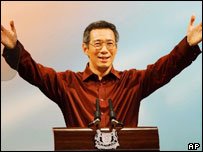
"There is no policy too sensitive to question, and no subject so taboo that you cannot even mention it."
- DPM Lee Hsien Loong, Straits Times, 17 Jan 2000
Picture and quote from Singapore Election Watch
'Corrupt' is a very strong term, maybe the opposition should simply use a different term, nepotism, authoritarianism, dictatorship, benevolent dictatorship, despotic, oppressive, totalitarian, one party state... just a few of the choices. Which one will get your vote?
Apr 22, 2006, 5:30 GMT
Singapore - Leaders of an opposition party faced the threat of legal action on Saturday for newsletter articles alleging that Prime Minister Lee Hsien Loong was perpetuating a corrupt political system set up by Minister Mentor Lee Kuan Yew, Singapore's founding father.
The alleged defamation was contained in three English and Chinese articles in the latest issue of the Singapore Democratic Party's (SDP's) newsletter, The New Democrat, according to letters of demand served on members of the party's 12-member central committee, including party leader Chee Soon Juan.
Chee, bankrupted by a defamation suit stemming from the last general election, and the others were given until Tuesday to apologize and pay unspecified damages to the Lees. The prime minister is secretary general of the ruling People's Action Party (PAP).
The apologies would have to be published in The Straits Times and the Chinese-language Liahe Zaobao on April 27, Nomination Day, ahead of the May 6 general election, the first since Lee Hsien Loong came into power in August 2004.
The opposition leaders will face legal action unless they apologize, Senior Counsel Davinder Singh, representing the prime minister and Singapore's founding father, told The Straits Times Friday night after the letters of demand were delivered.
'The party expected this,' said opposition supporter Yap Keng Ho, a 44-year-old executive. 'We are not intimidated.'
The SDP has not disclosed the number of candidates it plans to run, but political observers noted the impact could deal a blow to the goal of the opposition parties to field 47 candidates and prevent the PAP from being automatically returned to power on Nomination Day. The walkovers stretch back to 1988.
The PAP, which has ruled the city-state since independence from Malaysia in 1965, is hoping to defeat the only two opposition members in the 84-seat parliament.
Critics such as Amnesty International maintain the spate of defamation suits brought by Singapore's leaders against opposition members in the past were aimed at crippling the cash-strapped parties.
Leaders contend the suits are necessary to protect their reputations.
Heads of two other opposition parties said they were not surprised by the development and would continue with their campaigns.
Workers' Party Chief Low Thia Khiang said Singaporeans must decide if they want to give the PAP a 'blank cheque' or if they want an opposition to check and balance a PAP government.
Low, 49, who is defending his seat for the fourth time, referred to the WP slogan, 'You Have A Choice.'
The three articles suggested that the prime minister condoned corruption at the Housing Board, Central Providend Fund Board responsible for pensions and the Government of Singapore Investment Corporation.
They also alleged that the PAP leaders covered up problems at the National Kidney Foundation (NKF), Singapore's largest charity.
The scandal came to light in court testimony last July over pay and perks for its former chief and raised questions about NKF's transparency and accountability.
Saying the NKF was run in an autocratic manner with power concentrated in the hands of Durai, the article asked, 'Is not power in Singapore concentrated around one party, if not one individual?'
The lawyer's letters said the articles implied and alleged that the prime minister and his government knew about the NKF's wrongdoings but corruptly concealed and covered up the facts to avoid criticism.
The PAP was also accused of monopolizing power 'and making sure that no one has the power to challenge that hold.'
The articles and pictures were 'published maliciously and constitute a grave libel,' The Straits Times quoted Singh as saying. They were calculated to gain political mileage and undermine the character and integrity of the two leaders, he added.
The scenario was viewed as a replay of the legal drama that took place in the run-up to the 2001 polls.
Chee was slapped with a suit after falsely accusing then Prime Minister Goh Chok Tong of lending money to former Indonesian President Suharto.
Chee later apologized publicly. He was declared bankrupt after failing to pay 500,000 Singapore dollars (314,000 US) in libel damages. Bankrupt individuals are barred from running for election.
Under Singapore's carefully orchestrated system of political succession, Lee Hsien Loong, then deputy prime miniter, was named premier after Goh, now senior minister, stepped down from the top post.
Goh had inherited the premiership in 1990 from Lee Kuan Yew, father of Lee Hsien Loong.
© 2006 dpa - Deutsche Presse-Agentur
Asian Dialogues Series: General Election Singapore
Asian Dialogues Series: General Election of Singapore
Asia247
15 min 36 sec - Apr 21, 2006
WP and the SDP
Workers' Party Candidates Unveiled Officially
"The MIW is going to harp on the quality of the opposition candidates again and the academic and employment background of people from the WP etc would be scrutinised. That is a fair personal attack in a GE but academic and employment history alone do not measure how a person can be a good political leader. Once an opposition party member possesses a subjective minimum standard in terms of education and work experience, we as voters should look our for other criteria to assess whether he or she can perform well as an MP in parliament. Academic and work history is not the be all and end all. For example, what makes a good political leader is someone who can inspire, communicate, and reach out to all Singaporeans. People and oratorical skills to me is what might be lacking in the current MPs and only very few of them inspire through their speeches."
More
Another GE Defamation Lawsuit Threat
As all of us know, politics can be about timing and this demand to the SDP to apologise is questionable in terms of how the MIW can benefit from it. If anything, it is bad timing with the GE here and it reminds political observers and voters that defamation lawsuits are still in vogue with the MIW. It just shows that the MIW are just not creative enough to come up with new tricks to tackle the opposition, and by extension, maybe the MIW might not have new ideas on making Singapore "stay ahead" in the next few years.
More
"The MIW is going to harp on the quality of the opposition candidates again and the academic and employment background of people from the WP etc would be scrutinised. That is a fair personal attack in a GE but academic and employment history alone do not measure how a person can be a good political leader. Once an opposition party member possesses a subjective minimum standard in terms of education and work experience, we as voters should look our for other criteria to assess whether he or she can perform well as an MP in parliament. Academic and work history is not the be all and end all. For example, what makes a good political leader is someone who can inspire, communicate, and reach out to all Singaporeans. People and oratorical skills to me is what might be lacking in the current MPs and only very few of them inspire through their speeches."
More
Another GE Defamation Lawsuit Threat
As all of us know, politics can be about timing and this demand to the SDP to apologise is questionable in terms of how the MIW can benefit from it. If anything, it is bad timing with the GE here and it reminds political observers and voters that defamation lawsuits are still in vogue with the MIW. It just shows that the MIW are just not creative enough to come up with new tricks to tackle the opposition, and by extension, maybe the MIW might not have new ideas on making Singapore "stay ahead" in the next few years.
More
Subscribe to:
Posts (Atom)